Summary
Table of Content

Exhaust Aftertreatments System Market
Get a free sample of this report
Form submitted successfully!
Error submitting form. Please try again.
Thank you!
Your inquiry has been received. Our team will reach out to you with the required details via email. To ensure that you don't miss their response, kindly remember to check your spam folder as well!
Request Sectional Data
Thank you!
Your inquiry has been received. Our team will reach out to you with the required details via email. To ensure that you don't miss their response, kindly remember to check your spam folder as well!
Form submitted successfully!
Error submitting form. Please try again.
Exhaust Aftertreatment System Market Size
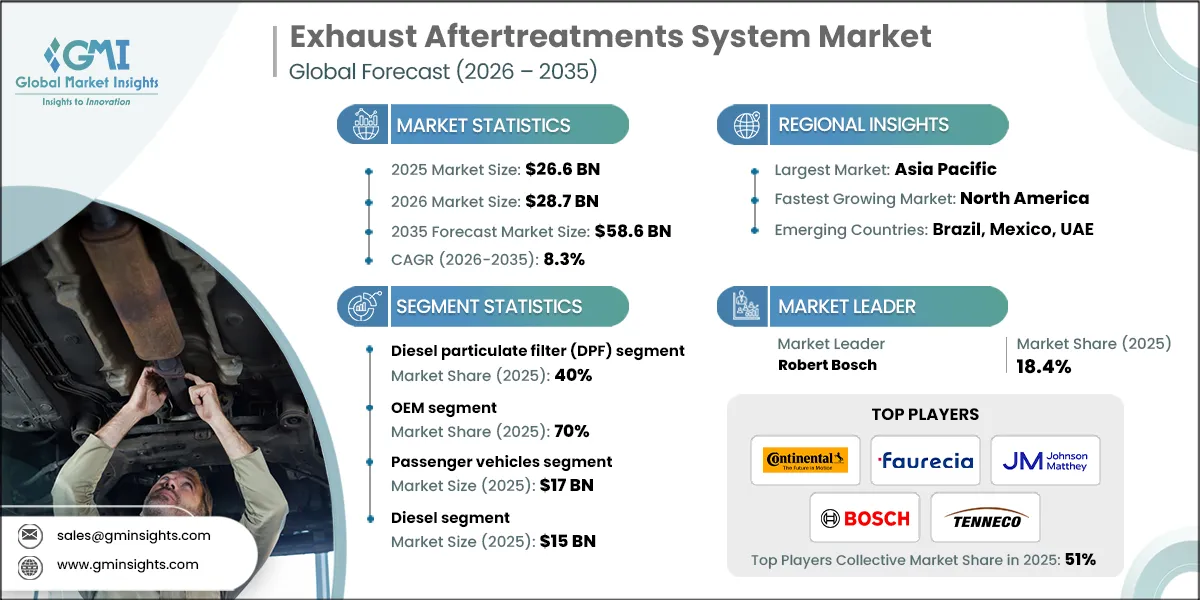
The global exhaust aftertreatment system market was valued at USD 26.6 billion in 2025. The market is expected to grow from USD 28.7 billion in 2026 to USD 58.6 billion in 2035, at a CAGR of 8.3%, according to latest report published by Global Market Insights Inc.
Exhaust Aftertreatments System Market Key Takeaways
Market Size & Growth
- 2025 Market Size: USD 26.6 Billion
- 2026 Market Size: USD 28.7 Billion
- 2035 Forecast Market Size: USD 58.6 Billion
- CAGR (2026–2035): 8.3%
Regional Dominance
- Largest Market: Asia Pacific
- Fastest Growing Region: North America
Key Market Drivers
- Stringent Global Emission Regulations.
- Rising Production of Commercial Vehicles.
- Increasing Adoption of Gasoline Direct Injection (GDI) Engines.
- Advancements in Aftertreatment Technologies.
Challenges
- High System Cost and Material Price Volatility.
- Growing Penetration of Battery Electric Vehicles (BEVs).
Opportunity
- Upcoming Euro 7 and Ultra-Low NOx Regulations.
- Expansion of Aftermarket and Retrofit Solutions.
Key Players
- Market Leader: Robert Bosch led with over 18.4% market share in 2025.
- Leading Players: Top 5 players in this market include Continental, Faurecia, Johnson Matthey, Robert Bosch, Tenneco, which collectively held a market share of 51% in 2025.
Get Market Insights & Growth Opportunities
The exhaust aftertreatment system market is projected to witness steady growth in the coming years, driven by increasingly stringent global emission regulations, rising vehicle production, and growing focus on reducing harmful exhaust pollutants such as NOx, particulate matter, CO, and unburned hydrocarbons. Regulatory frameworks including Euro 6/7, EPA Tier 3, China 6, and Bharat Stage VI are compelling automotive OEMs and fleet operators to adopt advanced aftertreatment technologies across passenger and commercial vehicles.
Growing pressure on automotive manufacturers to enhance emission performance, improve fuel efficiency, and comply with real-world driving emission (RDE) standards is driving demand for advanced systems such as Diesel Particulate Filters (DPF), Selective Catalytic Reduction (SCR), Diesel Oxidation Catalysts (DOC), Gasoline Particulate Filters (GPF), and Three-Way Catalysts (TWC). The increasing penetration of diesel engines in commercial vehicles and gasoline direct injection (GDI) engines in passenger cars is further boosting the adoption of high-efficiency, durable, and integrated aftertreatment architectures.
Technological advancements such as advanced catalyst materials, integrated aftertreatment modules, sensor-based feedback systems, real-time emission monitoring, and onboard diagnostics (OBD) are transforming conventional exhaust management systems. Innovations in urea dosing optimization, lightweight substrate materials, multi-functional catalyst coatings, and thermal management are improving conversion efficiency, durability, and regulatory compliance while reducing system size and overall vehicle weight.
In 2025, leading exhaust aftertreatment system manufacturers including Robert Bosch, Continental, DENSO, Cummins, Tenneco, Faurecia (FORVIA), and Johnson Matthey continued to expand their portfolios through investments in catalyst innovation, electrified exhaust solutions, and modular aftertreatment architectures. For instances, in February 2025, Cummins announced advancements in ultra-low NOx aftertreatment systems for heavy-duty engines, while in May 2025, FORVIA expanded its integrated exhaust module offerings targeting Euro 7–compliant passenger and light commercial vehicles. These developments reflect the industry’s focus on high-efficiency, compact, and regulation-ready aftertreatment systems.
The exhaust aftertreatment system ecosystem continues to evolve as regulatory tightening, digitalization, and electrification reshape product design and system integration. Industry participants are increasingly prioritizing modular, lightweight, and highly integrated aftertreatment solutions that enhance emission reduction efficiency, improve durability, reduce lifecycle costs, and ensure compliance with global emission standards. These developments are redefining the Exhaust Aftertreatment System Market, enabling cleaner combustion, regulatory compliance, and more sustainable mobility solutions across passenger vehicles, commercial fleets, and off-highway applications.
To get key market trends
Exhaust Aftertreatment System Market Trends
The demand for advanced exhaust aftertreatment systems is rapidly increasing, driven by growing collaboration among automotive OEMs, Tier 1 suppliers, catalyst manufacturers, sensor technology providers, and regulatory authorities. These partnerships aim to enhance emission reduction efficiency, real-world driving compliance, system durability, and integration with modern powertrain architectures. Stakeholders are working together to develop integrated, modular, and technologically advanced aftertreatment solutions incorporating SCR, DPF/GPF, DOC, advanced catalyst coatings, sensor-based control, and onboard diagnostics to comply with evolving global emission regulations.
For instance, in 2025, leading companies such as Robert Bosch, Continental, Faurecia (FORVIA), Johnson Matthey, Cummins, and Tenneco strengthened strategic collaborations with OEMs, engine manufacturers, and regulatory bodies to deploy low-temperature SCR systems, ultra-low NOx catalysts, integrated aftertreatment modules, and sensor-enabled emission control platforms. These initiatives improved cold-start emission performance, real-world compliance, system integration efficiency, and adherence to upcoming Euro 7, EPA, and China 7 emission norms across global vehicle platforms.
Regional customization of exhaust aftertreatment systems has emerged as a key trend. Leading suppliers are developing region-specific catalyst formulations, modular system architectures, and localized manufacturing capabilities across North America, Europe, Asia Pacific, Latin America, and the Middle East & Africa. These tailored solutions address OEM-specific requirements, regional emission regulations, fuel quality variations, infrastructure constraints, and cost sensitivities while supporting scalable production for global vehicle programs.
The rise of specialized catalyst developers, emission sensor providers, digital diagnostics firms, and aftertreatment technology startups is reshaping the competitive landscape. Companies focused on advanced catalyst chemistry, AI-enabled emission optimization, smart urea dosing, and predictive maintenance are enabling cost-effective deployment of high-performance aftertreatment systems. These innovations empower both established players and emerging entrants to improve emission control, operational efficiency, and regulatory compliance in passenger and commercial vehicle applications.
The development of standardized, modular, and interoperable aftertreatment platforms is transforming the market. Leading players such as Bosch, FORVIA, Continental, Johnson Matthey, and Tenneco are deploying integrated exhaust platforms that combine DPF/GPF, SCR, DOC, sensors, and electronic control units into compact, scalable architectures. These platforms support customizable vehicle integration, high-volume manufacturing, regional compliance, and durability requirements, enabling OEMs and Tier 1 suppliers to achieve efficient, compliant, and future-ready exhaust emission control across global markets.
Exhaust Aftertreatment System Market Analysis
Learn more about the key segments shaping this market
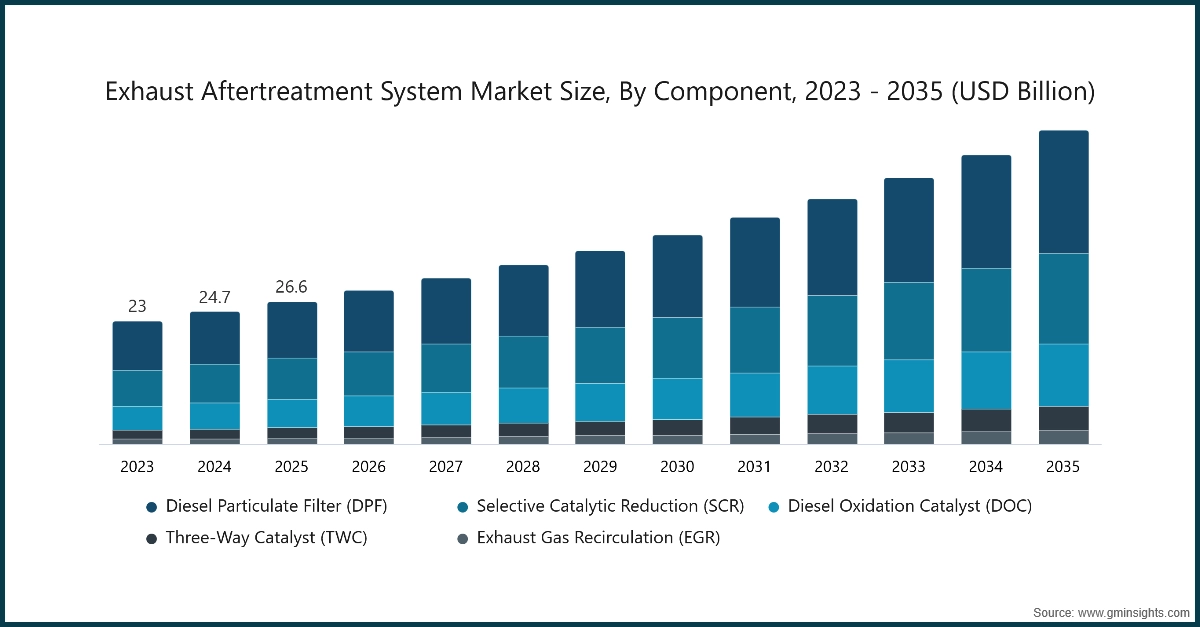
Based on component, the market is divided into diesel particulate filter (DPF), selective catalytic reduction (SCR), diesel oxidation catalyst (DOC), three-way catalyst (TWC) and exhaust gas recirculation (EGR). The diesel particulate filter (DPF) segment dominated the market, accounting for around 40% share in 2025 and is expected to grow at a CAGR of over 8.1% from 2026 to 2035.
- The diesel particulate filter (DPF) segment dominates the exhaust aftertreatment system market, primarily due to its critical role in reducing particulate matter emissions from diesel engines and meeting stringent emission regulations. DPFs are mandatory across diesel passenger cars, light commercial vehicles, and heavy-duty vehicles under standards such as Euro 6/7, EPA, China 6, and BS VI. Their ability to effectively capture soot and fine particles makes DPFs a foundational component for emission compliance, driving widespread adoption by OEMs and Tier 1 suppliers globally.
- The selective catalytic reduction (SCR) and diesel oxidation catalyst (DOC) segments play complementary but secondary roles. SCR systems are essential for NOx reduction, particularly in medium- and heavy-duty diesel vehicles, while DOCs support oxidation of carbon monoxide and hydrocarbons and enable downstream DPF regeneration. The three-way catalyst (TWC) segment serves gasoline-powered vehicles, and exhaust gas recirculation (EGR) supports in-cylinder NOx reduction. However, their market influence remains lower than DPFs due to narrower application scope or lower per-unit system value. For instance, in 2025, several European and North American OEMs continued to standardize DPF systems across new diesel platforms, reinforcing DPFs as the primary aftertreatment component.
- Continuous advancements in filter substrate materials, regeneration technologies, low-ash coatings, and integration with SCR and DOC systems further reinforce the dominance of the DPF segment. These improvements enable higher filtration efficiency, extended service life, and improved real-world emission performance, supporting widespread deployment of DPF systems across passenger cars, commercial vehicles, and off-highway applications worldwide.
Learn more about the key segments shaping this market
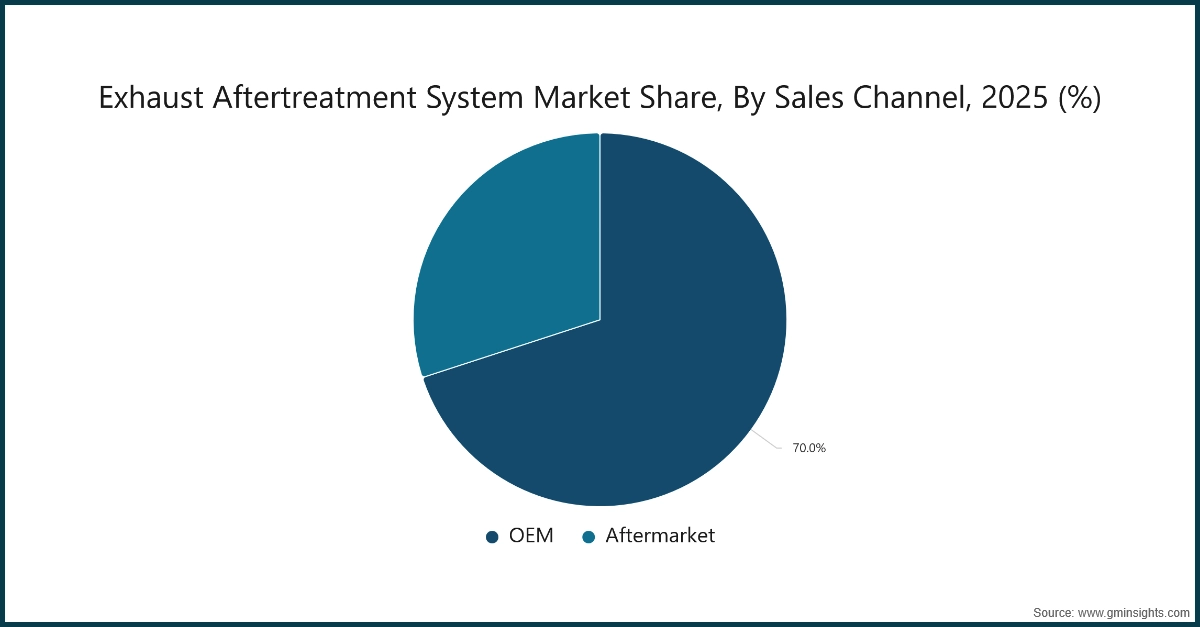
Based on sales channel, the market is divided into OEMs and aftermarket. The OEMs segment dominates the market, accounting for around 70% share in 2025, and the segment is expected to grow at a CAGR of over 8.6% from 2026 to 2035.
- The OEM segment dominates the exhaust aftertreatment system market due to strong adoption by automotive manufacturers and Tier 1 suppliers that require high-performance, regulation-compliant, and fully integrated emission control systems. OEM-supplied aftertreatment systems are installed during vehicle assembly, ensuring proper system integration, optimized calibration with engine control units, durability, and full compliance with global emission standards such as Euro 6/7, EPA, China 6, and BS VI. The critical role of OEMs in ensuring emission compliance, quality control, and system-level optimization makes this segment the preferred sales channel.
- The aftermarket segment is gaining traction for replacement, maintenance, and retrofit purposes, particularly in regions with aging vehicle fleets and extended vehicle lifecycles. Aftermarket solutions support cost-effective replacement of DPFs, SCR components, DOCs, and sensors, especially in diesel-heavy markets. However, the need for factory-level calibration, system durability, warranty assurance, and strict emission compliance continues to favor OEM-supplied aftertreatment systems, enabling the OEM segment to retain its dominant position in the global market.
Based on vehicles, the market is divided into passenger vehicles and commercial vehicles. Passenger vehicles segment dominated the market and was valued at USD 17 billion in 2025.
- The passenger vehicles segment dominates the exhaust aftertreatment system market due to its critical role in high-volume vehicle production, emission compliance, and integration of advanced powertrain and aftertreatment technologies. Passenger vehicles, including hatchbacks, sedans, and SUVs, account for most of the global automotive output, where DPF, SCR, DOC, and sensor-integrated emission systems are standard requirements to meet Euro 6/7, EPA Tier 3, China 6, and BS VI regulations. Any disruption in passenger vehicle production can significantly affect OEM operations, making this segment the primary focus for aftertreatment system suppliers.
- The commercial vehicles segment, including light, medium, and heavy-duty trucks and buses, relies on exhaust aftertreatment systems for regulatory compliance, NOx and particulate reduction, and fuel efficiency, but represents a smaller share of the overall market. While commercial vehicles require high-capacity DPFs, SCR systems, and robust DOC modules, their lower production volumes and slower adoption of advanced emission optimization technologies make them secondary to passenger vehicles in terms of market dominance.
Based on fuel, the market is divided into diesel, gasoline and alternative fuels. The diesel segment dominated the market and was valued at USD 15 billion in 2025.
- The diesel segment dominates the exhaust aftertreatment system market due to its critical role in controlling NOx, particulate matter, and other harmful emissions from diesel engines. OEMs, Tier 1 suppliers, and engine manufacturers rely heavily on DPF, SCR, DOC, and integrated aftertreatment systems to meet stringent emission standards such as Euro 6/7, EPA Tier 3, China 6, and BS VI. The regulatory compliance requirements, high system value, and widespread use of diesel in commercial vehicles and passenger cars make diesel the primary fuel segment driving aftertreatment adoption globally.
- Other fuel segments, including gasoline and alternative fuels (CNG, LPG, hybrids, and EVs), also contribute to market growth by requiring GPF, TWC, or partial aftertreatment solutions to reduce emissions. However, these fuels generally have lower particulate emissions or smaller fleet penetration, resulting in comparatively lower market dominance than diesel.
- Continuous innovations such as low-ash DPFs, low-temperature SCR catalysts, integrated emission modules, and sensor-enabled diagnostics are further reinforcing the diesel segment’s dominance. Due to its essential role in emission compliance, regulatory adherence, and vehicle performance, diesel continues to maintain a leading position in the global exhaust aftertreatment system market.
Looking for region specific data?
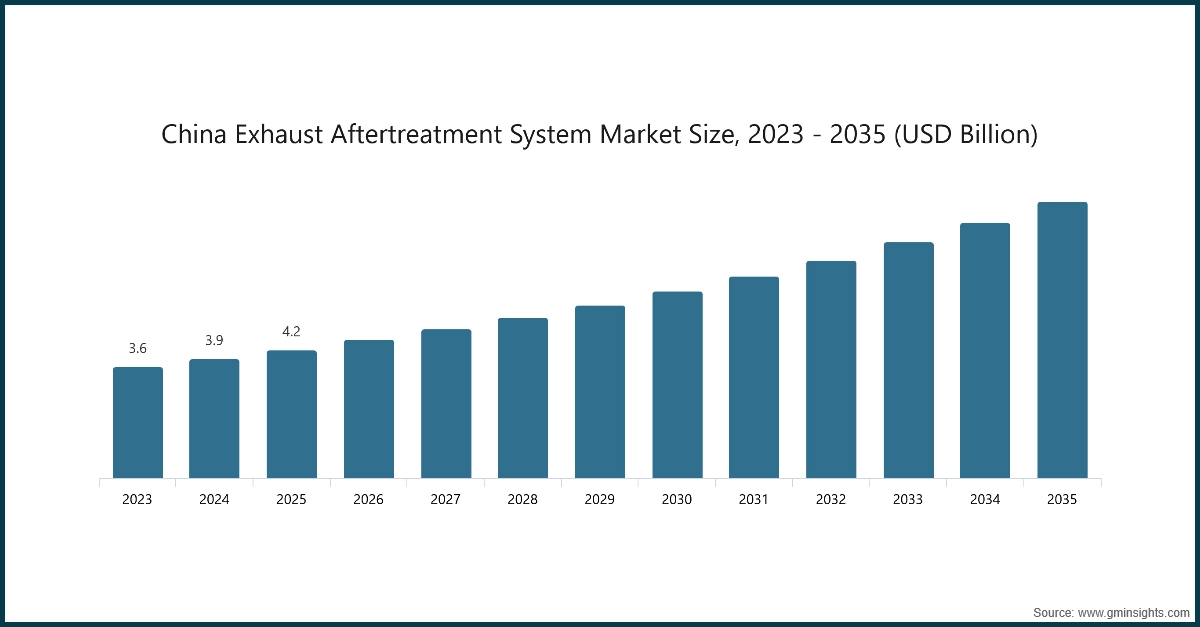
In 2025, China dominated the Asia Pacific exhaust aftertreatment system market with around 41% market share and generated approximately USD 4.2 billion in revenue.
- Asia-Pacific dominates the exhaust aftertreatment system market, supported by rapid growth in vehicle production, strong presence of OEMs and Tier 1 suppliers, and increasing adoption of advanced exhaust aftertreatment technologies such as DPF, SCR, DOC, and integrated emission control modules. The region benefits from large-scale manufacturing infrastructure, cost-efficient production, and supportive government emission regulations, driving high demand across passenger and commercial vehicles.
- China represents the largest market in Asia-Pacific, driven by high vehicle production volumes, widespread adoption of advanced diesel and gasoline aftertreatment systems, and strong collaborations between OEMs, Tier 1 suppliers, and catalyst technology providers. Major automotive hubs such as Shanghai, Beijing, Guangzhou, and Shenzhen are witnessing significant deployment of DPF, SCR, and DOC systems in compliance with China 6 emission standards. Government support, production scale, and strong OEM partnerships further accelerate the adoption of advanced aftertreatment solutions across the country.
- Other Asia-Pacific markets, including India, Japan, and South Korea, are emerging as high-growth regions, supported by increasing adoption of emission-compliant aftertreatment systems, regulatory enforcement, and advanced manufacturing techniques. India emphasizes cost-effective aftertreatment solutions for passenger and light commercial vehicles, Japan focuses on precision-engineered emission systems, and South Korea prioritizes integration of advanced SCR and DPF technologies in premium vehicles. Despite growth in these countries, China remains the dominant market in Asia-Pacific, driven by production scale, regulatory enforcement, and strong collaborations between OEMs and technology providers.
US holds share of 83% in North America exhaust aftertreatment system market in 2025 and it will grow tremendously between 2026 and 2035.
- North America accounted for a significant share of the exhaust aftertreatment system market, supported by a mature automotive ecosystem, advanced OEM operations, and widespread adoption of high-performance DPF, SCR, DOC, and integrated aftertreatment solutions. The region benefits from large-scale vehicle production, stringent emission standards such as EPA Tier 3, and advanced manufacturing infrastructure, positioning it as a leader in efficient, compliant, and technologically advanced automotive production.
- Within North America, the United States accounts for the largest share, driven by a high concentration of OEMs, advanced engine and aftertreatment system manufacturing facilities, and strict regulatory compliance standards. Widespread adoption of diesel particulate filters, SCR systems, and DOC modules across passenger and commercial vehicles fuels market growth. Major automotive hubs such as Detroit, Chicago, Los Angeles, and Austin serve as key centers for innovation, system integration, and high-quality aftertreatment production.
- Leading U.S. aftertreatment system suppliers, including Robert Bosch, Continental, Johnson Matthey, Faurecia (FORVIA), and Tenneco, continue to expand their portfolios of high-efficiency SCR, DPF, and integrated emission modules, enhance production capacity, and strengthen collaborations with OEMs and Tier 1 suppliers. Ongoing investments in low-temperature catalysts, sensor-enabled diagnostics, and modular system architectures consolidate the U.S.’s dominant position in the North American market.
Germany holds share of 21% in Europe exhaust aftertreatment system market in 2025 and it will grow tremendously between 2026 and 2035.
- Europe holds a major share of the system market, supported by a mature automotive ecosystem, leading OEMs, and growing adoption of advanced aftertreatment technologies such as DPF, SCR, DOC, and integrated emission modules. Manufacturers, Tier 1 suppliers, and regulatory authorities across the region focus on emission compliance, production efficiency, durability, and adherence to stringent EU automotive and environmental standards. Well-established manufacturing regulations, advanced R&D infrastructure, and rising demand for high-performance, regulation-ready aftertreatment systems reinforce Europe’s position as a key regional market.
- Germany dominates the European market, driven by its strong automotive industry, concentration of advanced OEMs, technological maturity, and strict regulatory enforcement. German manufacturers and aftertreatment suppliers lead in the deployment of high-efficiency DPFs, SCR systems, and DOC modules, integrating sensor-enabled controls, thermal management technologies, and compact modular architectures. Investments in advanced catalyst technologies, integrated system platforms, and automated testing facilities have strengthened emission performance, reduced maintenance challenges, and accelerated market growth, positioning Germany as the regional leader.
- Other major European countries, including the United Kingdom, France, and the Netherlands, are contributing to regional market expansion through adoption of advanced aftertreatment systems. The UK emphasizes multi-OEM deployment and fleet compliance, France focuses on regulatory alignment and premium vehicle integration, and the Netherlands prioritizes precision engineering and sensor-integrated systems. Despite growing adoption in these countries, Germany maintains its leading role in scale, technological innovation, and comprehensive deployment of high-performance exhaust aftertreatment systems across Europe.
Exhaust aftertreatment system market in Brazil will experience significant growth between 2026 and 2035.
- Latin America holds a smaller share but is steadily expanding its presence in the exhaust aftertreatment system market, driven by growing vehicle production, increasing adoption of DPF, SCR, DOC, and integrated aftertreatment systems, and rising investments in advanced manufacturing and emission compliance technologies. OEMs, Tier 1 suppliers, and catalyst manufacturers across the region are gradually deploying high-performance diesel particulate filters, selective catalytic reduction modules, and sensor-enabled emission control systems. Strengthening environmental regulations, expanding industrial capabilities, and improving production infrastructure continue to support Latin America’s growing role in the global aftertreatment market.
- Brazil dominates the Latin American market, supported by its large automotive industry, high vehicle production volumes, and growing adoption of advanced diesel and gasoline aftertreatment systems. Major automotive hubs such as São Paulo, Rio de Janeiro, and Brasília host extensive OEM and Tier 1 supplier operations, where manufacturers implement DPFs, SCR systems, DOC modules, and integrated emission control platforms to meet local emission standards. Leading aftertreatment system suppliers, including Robert Bosch, Continental, Faurecia (FORVIA), Johnson Matthey, and Tenneco, actively offer advanced emission solutions to support Brazil’s dominant position in the regional market.
- Mexico represents the second largest and rapidly growing market, driven by increasing adoption of DPF, SCR, and integrated aftertreatment modules, improved production standards, and expansion of OEM and Tier 1 supplier operations. Key industrial centers such as Mexico City, Monterrey, and Guadalajara are witnessing higher implementation of advanced emission control systems and digital diagnostics capabilities, contributing to the overall growth and modernization of Latin America’s automotive manufacturing ecosystem, while Brazil continues to maintain its leading role.
Exhaust aftertreatment system market in UAE will experience significant growth between 2026 and 2035.
- Middle East & Africa (MEA) holds a smaller share but is gradually expanding its presence in the exhaust aftertreatment system market, driven by growing vehicle production, increasing adoption of DPF, SCR, DOC, and integrated aftertreatment systems, and rising investment in advanced manufacturing and emission compliance technologies. OEMs, Tier 1 suppliers, and catalyst manufacturers across the region are gradually deploying high-performance diesel particulate filters, selective catalytic reduction modules, and sensor-enabled emission control systems. Strengthening environmental regulations, expansion of industrial capabilities, and improvements in production infrastructure continue to support MEA’s growing role in the global aftertreatment market.
- United Arab Emirates (UAE) dominates the MEA market, supported by its rapidly developing automotive manufacturing sector, advanced engine and aftertreatment system production capabilities, and growing adoption of DPF, SCR, and DOC technologies. Major industrial hubs such as Dubai, Abu Dhabi, and Sharjah host extensive OEM and Tier 1 supplier operations, where manufacturers implement high-efficiency DPFs, SCR modules, DOC units, and integrated emission control systems to comply with regional and international emission standards. Leading aftertreatment system suppliers, including Robert Bosch, Continental, Faurecia (FORVIA), Johnson Matthey, and Tenneco, actively offer advanced emission solutions, reinforcing UAE’s dominant position in the MEA market.
- Other MEA countries, including Saudi Arabia, South Africa, and Egypt, are emerging as high-growth markets, driven by increasing adoption of DPF, SCR, and integrated aftertreatment systems, industrial automation, and advanced production capabilities. Saudi Arabia emphasizes large-scale OEM and commercial vehicle applications, South Africa focuses on fleet and light commercial vehicles, and Egypt prioritizes integration of advanced emission modules and sensor-enabled diagnostics. Despite growing adoption in these countries, UAE continues to maintain its leading role in MEA due to production scale, technological innovation, and strong government and enterprise support.
Exhaust Aftertreatment System Market Share
The top 7 companies in the market are Robert Bosch, Faurecia (FORVIA), Tenneco, Continental, Johnson Matthey, Eberspächer, Cummins. These companies hold around 55% of the market share in 2025.
- Robert Bosch is a leading provider of exhaust aftertreatment systems, offering high-performance DPF, SCR, DOC, and integrated emission control solutions for passenger and commercial vehicles. Bosch leverages advanced sensor technologies, electronic control units, and modular system integration to deliver durable, efficient, and regulation-compliant aftertreatment systems. Its strong OEM partnerships, global manufacturing footprint, and technological expertise reinforce its leadership position in the market.
- Faurecia (FORVIA) delivers comprehensive aftertreatment solutions, combining SCR, DPF/GPF, and modular emission system technologies with advanced thermal and catalyst management. FORVIA’s large-scale manufacturing, global OEM collaborations, and focus on regulatory compliance enable automotive manufacturers to meet emission standards while optimizing system efficiency, securing its competitive market position.
- Tenneco provides complete exhaust aftertreatment systems, including DPF, SCR, DOC, and integrated modules for diesel and gasoline vehicles. Tenneco leverages advanced materials, acoustic integration, and robust engineering to serve global OEMs and Tier 1 suppliers, strengthening its presence across passenger and commercial vehicle segments.
- Continental specializes in integrated emission control platforms combining DPF, SCR, NOx sensors, and onboard diagnostics for compliance with Euro 6/7, EPA, and China 6 standards. Continental’s expertise in system integration, thermal optimization, and OEM collaborations enables high-performance, durable aftertreatment solutions, reinforcing its market share globally.
- Johnson Matthey focuses on advanced catalyst technologies for exhaust aftertreatment, including TWC, SCR, DOC, and particulate filter coatings. Johnson Matthey’s deep expertise in catalyst chemistry, precious metal optimization, and emission compliance ensures high conversion efficiency and long-term system durability, solidifying its market leadership.
- Eberspächer delivers tailored aftertreatment solutions for passenger and commercial vehicles, including SCR, DPF, and DOC systems. Eberspächer leverages advanced thermal management, compact system designs, and global OEM partnerships to enhance emission reduction efficiency and system integration, supporting its competitive market presence.
- Cummins provides exhaust aftertreatment solutions primarily for commercial vehicles and heavy-duty diesel engines, offering integrated DPF, SCR, and DOC systems. Cummins’ strong focus on durability, real-world emission compliance, and system-level optimization across engines strengthens its position among global aftertreatment suppliers.
Exhaust Aftertreatment System Market Companies
Major players operating in the exhaust aftertreatment system industry include:
BorgWarner
- Continental
- Cummins
- Eberspächer
- Faurecia
- HJS Emission Technology
- Johnson Matthey
- MANN+HUMMEL
- Robert Bosch
- Tenneco
- The exhaust aftertreatment system market is highly competitive, with leading solution providers such as Robert Bosch, Faurecia (FORVIA), Tenneco, Continental, Johnson Matthey, Eberspächer, Cummins, HJS Emission Technology, MANN+HUMMEL, and BorgWarner occupying key segments across DPF, SCR, DOC, TWC, and integrated emission control solutions.
- Robert Bosch, Faurecia, Tenneco, Continental, Johnson Matthey, and Eberspächer lead the market with comprehensive aftertreatment solutions, integrating DPF, SCR, DOC, NOx sensors, ECU systems, and catalyst technologies. These companies focus on enhancing emission reduction efficiency, regulatory compliance, durability, and system integration, while maintaining large-scale production capacity and strong global OEM partnerships.
- Cummins, HJS Emission Technology, MANN+HUMMEL, and BorgWarner specialize in modular, high-performance, and technology-driven aftertreatment systems, emphasizing low-ash DPFs, advanced SCR modules, catalyst coatings, and sensor-enabled diagnostics. Their products enable improved emission control, fuel efficiency, regulatory compliance, and integration with advanced powertrain systems across passenger, commercial, and heavy-duty vehicle segments worldwide.
Exhaust Aftertreatments System Market Report Attributes
| Key Takeaway | Details |
|---|---|
| Market Size & Growth | |
| Base Year | 2025 |
| Market Size in 2025 | USD 26.6 Billion |
| Market Size in 2026 | USD 28.7 Billion |
| Forecast Period 2026-2035 CAGR | 8.3% |
| Market Size in 2035 | USD 58.6 Billion |
| Key Market Trends | |
| Drivers | Impact |
| Stringent Global Emission Regulations | Tightening emission standards such as Euro 6/7 (Europe), EPA Tier 3 (U.S.), China 6, and Bharat Stage VI (India) are forcing OEMs to deploy advanced aftertreatment systems including DPF, SCR, and GPF to meet NOx and particulate limits across passenger and commercial vehicles |
| Rising Production of Commercial Vehicles | Growth in heavy-duty and light commercial vehicle fleets, particularly in Asia-Pacific and North America, is driving strong demand for SCR and DPF systems, which are mandatory for diesel-powered trucks and buses |
| Increasing Adoption of Gasoline Direct Injection (GDI) Engines | The shift toward GDI gasoline engines to improve fuel efficiency has increased particulate emissions, accelerating adoption of Gasoline Particulate Filters (GPFs) in passenger cars globally |
| Advancements in Aftertreatment Technologies | Innovation in low-temperature catalysts, integrated exhaust modules, real-time sensors, AI-based control systems, and onboard diagnostics (OBD) is improving emission performance, durability, and regulatory compliance, encouraging OEM adoption |
| Pitfalls & Challenges | Impact |
| High System Cost and Material Price Volatility | Advanced aftertreatment systems rely on precious metals such as platinum, palladium, and rhodium, leading to high system costs and exposure to raw material price fluctuations, impacting OEM margins. |
| Growing Penetration of Battery Electric Vehicles (BEVs) | The accelerated adoption of zero-emission BEVs, particularly in Europe and China, reduces long-term demand for internal combustion engine–based exhaust aftertreatment systems. |
| Opportunities: | Impact |
| Upcoming Euro 7 and Ultra-Low NOx Regulations | Stricter upcoming regulations are creating opportunities for next-generation SCR, multi-stage aftertreatment systems, and advanced catalyst technologies, especially in heavy-duty and off-highway vehicles. |
| Expansion of Aftermarket and Retrofit Solutions | Aging vehicle fleets and regulatory-driven retrofitting programs in Europe, North America, and emerging markets are increasing demand for replacement DPFs, SCR components, and emission retrofit kits. |
| Market Leaders (2025) | |
| Market Leader |
18.4% market share |
| Top Players |
Collective market share in 2025 is 51% |
| Competitive Edge |
|
| Regional Insights | |
| Largest Market | Asia Pacific |
| Fastest growing market | North America |
| Emerging countries | Brazil, Mexico, UAE |
| Future outlook |
|
What are the growth opportunities in this market?
Exhaust Aftertreatment System Market Industry News
- In March 2025, Robert Bosch launched a next-generation exhaust aftertreatment system line featuring advanced DPF, SCR, and DOC modules with sensor-enabled diagnostics and integrated NOx control. The initiative aims to improve emission reduction efficiency, production scalability, and system reliability across global OEM and Tier 1 supplier networks.
- In February 2025, Faurecia (FORVIA) expanded its aftertreatment portfolio, introducing high-performance SCR, DPF/GPF, and integrated emission control platforms with advanced thermal management and catalyst technologies. The rollout focuses on accelerating adoption of regulation-compliant emission solutions, improving durability, and supporting passenger and commercial vehicle OEMs worldwide.
- In January 2025, Tenneco unveiled upgraded production capabilities for DPF, SCR, and DOC systems, incorporating low-ash filters, advanced catalyst coatings, and sensor-enabled monitoring. The initiative targets large-scale manufacturing facilities, enabling improved emission compliance, system longevity, and regulatory alignment across global automotive OEMs.
- In December 2024, Continental expanded its aftertreatment manufacturing operations with new high-volume production lines featuring integrated SCR, DPF, and DOC modules with ECU optimization. The deployment aims to enhance product reliability, support multi-plant OEM operations, and meet rising demand for advanced emission control systems across passenger and commercial vehicles.
- In October 2024, Johnson Matthey, Eberspächer, Cummins, and BorgWarner launched integrated aftertreatment solutions combining DPF, SCR, DOC, and advanced catalyst technologies with sensor-enabled diagnostics. The initiative emphasizes high-quality production, regulatory compliance, scalable deployment, and improved emission reduction performance across passenger cars, commercial fleets, and heavy-duty vehicles globally.
The exhaust aftertreatment system market research report includes in-depth coverage of the industry with estimates & forecasts in terms of revenue ($ Bn) and volume (units) from 2022 to 2035, for the following segments:
Market, By Component
- Diesel Particulate Filter (DPF)
- Selective Catalytic Reduction (SCR)
- Diesel Oxidation Catalyst (DOC)
- Three-Way Catalyst (TWC)
- Exhaust Gas Recirculation (EGR)
Market, By Vehicle
- Passenger vehicles
- Hatchbacks
- Sedans
- SUV
- Commercial vehicles
- Light commercial vehicles (LCV)
- Medium commercial vehicles (MCV)
- Heavy commercial vehicles (HCV)
Market, By Fuel
- Diesel
- Gasoline
- Alternative Fuels
Market, By Sales Channel
- OEM
- Aftermarket
The above information is provided for the following regions and countries:
- North America
- US
- Canada
- Europe
- UK
- Germany
- France
- Italy
- Spain
- Belgium
- Netherlands
- Sweden
- Asia Pacific
- China
- India
- Japan
- Australia
- Singapore
- South Korea
- Vietnam
- Indonesia
- Latin America
- Brazil
- Mexico
- Argentina
- MEA
- South Africa
- Saudi Arabia
- UAE
Frequently Asked Question(FAQ) :
What was the market size of the exhaust aftertreatment system market in 2025?
The market size was USD 26.6 billion in 2025, driven by increasing regulatory requirements for emission reduction and advancements in aftertreatment technologies.
What is the projected value of the exhaust aftertreatment system market by 2035?
The market is expected to reach USD 58.6 billion by 2035, growing at a CAGR of 8.3%, fueled by the adoption of advanced emission control systems and integration with modern powertrain architectures.
What is the projected size of the exhaust aftertreatment system market in 2026?
The market is expected to grow to USD 28.7 billion in 2026.
What was the market share of the diesel particulate filter (DPF) segment in 2025?
The diesel particulate filter (DPF) segment held the largest share, accounting for approximately 40% of the market in 2025, and is projected to grow at a CAGR of over 8.1% from 2026 to 2035.
What was the market share of the OEMs segment in 2025?
The OEMs segment dominated the market with a 70% share in 2025 and is expected to grow at a CAGR of over 8.6% from 2026 to 2035.
Which vehicle segment dominated the market in 2025?
The passenger vehicles segment led the market in 2025, valued at USD 17 billion, reflecting the high demand for emission control systems in this category.
Which region leads the Asia Pacific exhaust aftertreatment system market?
China dominated the Asia Pacific market in 2025, holding a 41% share and generating approximately USD 4.2 billion in revenue.
Who are the key players in the exhaust aftertreatment system market?
Major players include BorgWarner, Continental, Cummins, Eberspächer, Faurecia, HJS Emission Technology, Johnson Matthey, and MANN+HUMMEL.
Exhaust Aftertreatments System Market Scope
Related Reports