Summary
Table of Content

Europe Nurse Call Systems Market
Get a free sample of this report
Form submitted successfully!
Error submitting form. Please try again.
Thank you!
Your inquiry has been received. Our team will reach out to you with the required details via email. To ensure that you don't miss their response, kindly remember to check your spam folder as well!
Request Sectional Data
Thank you!
Your inquiry has been received. Our team will reach out to you with the required details via email. To ensure that you don't miss their response, kindly remember to check your spam folder as well!
Form submitted successfully!
Error submitting form. Please try again.
Europe Nurse Call Systems Market Size
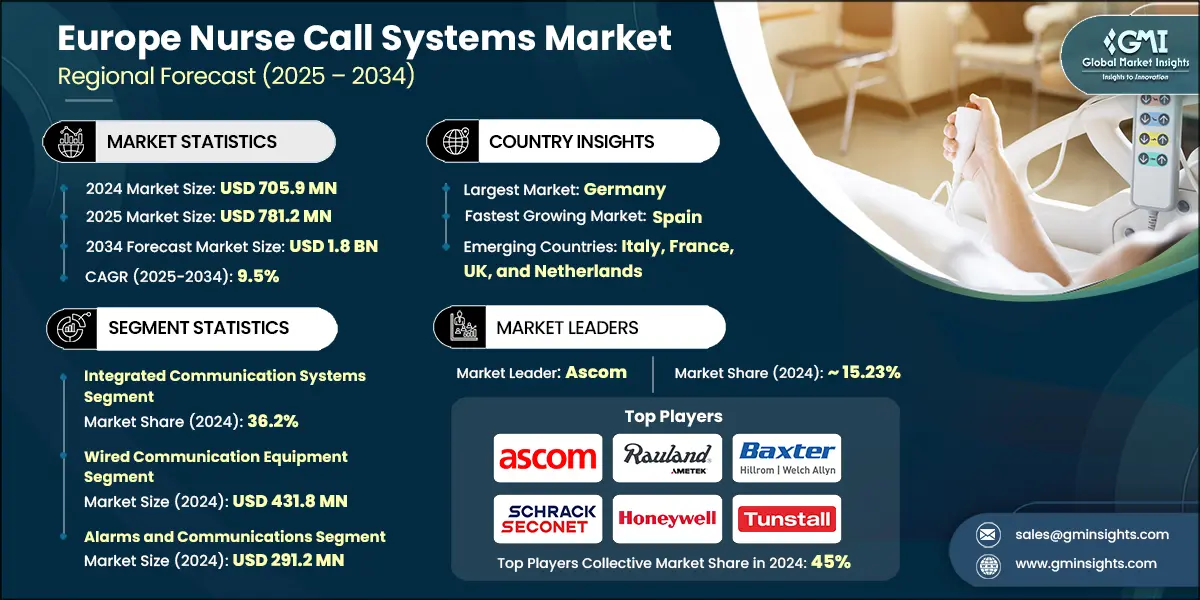
Europe nurse call systems market was valued at USD 705.9 million in 2024. The market is expected to reach from USD 781.2 million in 2025 to USD 1.8 billion in 2034, growing at a CAGR of 9.5% during the forecast period, according to the latest report published by Global Market Insights Inc. The high market growth is attributed to the growing adoption of smart hospitals and digital health, government regulations and healthcare quality standards, and rising demand in long-term and home care settings, among other contributing factors.
To get key market trends
Nurse call systems are communication systems used in healthcare facilities that allow patients to alert nurses or caregivers when they need help. Usually, the features of the system consist of bedside buttons, wall-mounted devices, or wearable transmitters that are connected to a centralized control panel. The main functions of the system are to upgrade patient safety, to shorten the time of response, and to facilitate the efficiency of workflow for the healthcare staff.
The major players in the nurse call systems market include ascom, AMETEK (Rauland), Baxter (Hillrom), SCHRACK SECONET, Honeywell, and Tunstall Group. These firms uphold their competitive position by product innovation on a regular basis, their presence in the regional market, and their noteworthy expenditure on research and development.
The market has increased from USD 518.3 million in 2021 and reached USD 640.3 million in 2023, with the historic growth rate of 10.9%. The market growth was driven by the rising adoption of digital healthcare solutions, growing demand for efficient patient communication systems in hospitals, and government initiatives supporting smart hospital infrastructure in Europe.
Europe's aging population is among the highest globally, with 21.1% of the EU population aged 65 years or older in 2022, projected to reach 23.9% by 2024 (Eurostat). This demographic shift has increased chronic diseases, with 60% of people over 65 having at least two chronic conditions as of 2023 (WHO Europe).
In addition, the European Commission allocated USD 6 billion in 2023 for healthcare digitalization, including patient monitoring systems. In Germany alone, nursing home occupancy reached 92% in 2023, driving the implementation of nurse call systems. Healthcare institutions across the EU reported a 27% increase in nurse call system installations between 2021-2023 to improve caregiver efficiency and patient safety.
Furthermore, with the growing elderly population, demand for long-term care facilities and home care is expanding across Europe. Nurse call systems are being increasingly used in residential care homes and home healthcare to ensure quick assistance and emergency response. The trend supports decentralized patient care and reduces dependency on hospital admissions.
Europe Nurse Call Systems Market Report Attributes
| Key Takeaway | Details |
|---|---|
| Market Size & Growth | |
| Base Year | 2024 |
| Market Size in 2024 | USD 705.9 Million |
| Market Size in 2025 | USD 781.2 Million |
| Forecast Period 2025-2034 CAGR | 9.5% |
| Market Size in 2034 | USD 1.8 Billion |
| Key Market Trends | |
| Drivers | Impact |
| Rising geriatric population and chronic disease prevalence | Increasing elderly demographics and higher rates of chronic conditions are boosting the need for advanced communication systems to ensure timely care and patient safety. |
| Technological advancements in nurse call systems | Integration of wireless, mobile, and IoT-enabled solutions has improved workflow efficiency and enhanced adoption across hospitals and care facilities. |
| Surging government expenditure in the healthcare sector | Investments in smart hospital infrastructure and digital health projects are accelerating the deployment of modern nurse call systems in Europe. |
| Shortage of qualified/trained nurses coupled with diverse applications of nurse call systems | Nurse call systems are mitigating workforce shortages by automating alerts, improving care coordination, and enabling multitasking in high-demand environments. |
| Expansion of long-term care and assisted living centers | Growing number of assisted living facilities is driving adoption of nurse call systems to ensure resident safety and enhance quality of life. |
| Pitfalls & Challenges | Impact |
| High costs involved in the implementation of nurse call systems | Capital-intensive installation and maintenance remain barriers for smaller hospitals and care facilities, slowing adoption in cost-sensitive regions. |
| Stringent regulatory policies related to privacy breach | Compliance with GDPR and other privacy regulations adds complexity to system deployment, creating delays and higher implementation costs. |
| Opportunities: | Impact |
| Growing demand for smart hospitals and IoT-enabled solutions | Adoption of AI- and IoT-integrated nurse call systems will accelerate, enabling predictive alerts, real-time monitoring, and improved patient safety in Europe’s next-generation hospitals. |
| Expansion in emerging markets with improving healthcare infrastructure | Strengthening healthcare infrastructure in Eastern Europe will create new growth avenues for vendors, expanding market penetration beyond Western European countries. |
| Rising demand for wireless and mobile nurse call systems | The shift toward wireless and smartphone-integrated systems will enhance mobility for healthcare staff, improve response times, and drive replacement demand for legacy wired systems. |
| Market Leaders (2024) | |
| Market Leader |
15.23% Market share |
| Top Players |
Collective market share in 2024 is 45% |
| Competitive Edge |
|
| Regional Insights | |
| Largest Country Market | Germany |
| Fastest growing market | Spain |
| Emerging countries | Italy, France, UK, and Netherlands |
| Future outlook |
|
What are the growth opportunities in this market?
Europe Nurse Call Systems Market Trends
The market is growing considerably with the shift toward wireless and IP-based solutions, integration with digital health ecosystems, rising focus on patient-centric care, and growing emphasis on data analytics and AI integration, among other factors collectively driving industry growth.
- Hospitals and care facilities in Europe are increasingly replacing wired systems with wireless and IP-based nurse call platforms. These solutions provide better scalability, mobility, and integration with smartphones or tablets. The trend also reduces infrastructure costs and improves responsiveness across larger hospital campuses and home care settings.
- Nurse call systems are integrated with electronic health records (EHRs), patient monitoring devices, and hospital information systems. The interoperability enables the caregivers to have the real-time alerts along with patient data so that they can make the clinical decisions faster. It ties up with Europe’s overall move towards digital health and connected care environments.
- Moreover, nurse call system in the region is getting equipped with the help of AI along with analytics to make staff more efficient and save a great deal of time. Hospitals are utilizing predictive alerts, response time monitoring, and workload distribution tools which are giving them a lot of efficiencies. This trend is changing the nature of the hospital alarm system from reactive to one that is proactive in care management, thereby sustaining market growth.
Europe Nurse Call Systems Market Analysis

Learn more about the key segments shaping this market
Based on the product, the Europe nurse call systems market is segmented into integrated communication systems, button systems, mobile systems, and intercom systems. The integrated communication systems segment has asserted its dominance in the market by securing a significant market share of 36.2% in 2024 owing to their ability to streamline workflows, enable real-time communication between patients and caregivers, and seamlessly integrate with other hospital information and monitoring systems. The segment is expected to exceed USD 625.8 million by 2034, growing at a CAGR of 9.3% during the forecast period.
On the other hand, the mobile systems segment is expected to grow with a CAGR of 10.3%. The growth of this segment is driven by the rising adoption of smartphones and wireless technologies in healthcare settings, increasing demand for enhanced staff mobility, and the need for faster response times to improve patient safety and care efficiency.
- The integrated communication systems segment continues to dominate the market. Hospitals in Europe are concentrating on the elimination of the communication gap between nurses, doctors, and patients. Integrated communication systems facilitate real-time coordination through voice, text, and the like on one platform. This not only improves the flow of work but also shortens response times and decreases the number of errors in critical care environments.
- The digital transformation in the healthcare sector in the region is the main factor behind the adoption of integrated communication systems. Nurse call platforms are now being connected to EHRs, patient monitoring devices, and hospital IT systems. As a result, information flow will be uninterrupted and operational efficiency will be enhanced in smart hospital projects throughout Europe.
- The button systems segment held a revenue of USD 196.9 million in 2024, with projections indicating a steady expansion at 9% CAGR from 2025 to 2034. The growth of the segment is largely influenced by its cost-effectiveness, simplicity of installation, and user-friendly design that makes them very suitable for small to medium healthcare facilities. The trust they gain from their rapid patient-to-staff communication features will continuously attract the interest of nursing homes and long-term care centers.
- The mobile systems segment held a revenue of USD 171.9 million in 2024, with projections indicating a steady expansion at 10.3% CAGR from 2025 to 2034. The growth of the segment is driven by the increasing shift toward wireless healthcare infrastructure and the rising need for real-time, on-the-go communication between patients and caregivers. Their ability to enhance staff mobility, reduce response times, and integrate with hospital IT systems is accelerating their adoption across modern healthcare facilities.
- The intercom systems segment accounted for significant revenue in 2024, with projections indicating a steady expansion at 9.7% CAGR from 2025 to 2034. The segment is driven by their ability to facilitate direct, real-time voice communication between patients and healthcare staff. Their simplicity, reliability, and cost efficiency make them a preferred choice in smaller hospitals and long-term care facilities.
Based on technology, the Europe nurse call systems market is segmented into wired communication equipment and wireless communication equipment. The wired communication equipment segment dominated the market in 2024, accounting for USD 431.8 million and is anticipated to grow at a CAGR of 9% during the forecast period.
- Wired nurse call systems are widely known and appreciated in Europe for their stable and uninterrupted performance, especially in critical care units. Unlike wireless systems, these are less susceptible to interferences or signal drops, so a consistent flow of communication can be maintained. This trust in their reliability makes them the first preference in high-dependency wards and emergency departments.
- Many European hospitals are required to follow strict EU as well as national regulations regarding their medical communication infrastructure. Wired systems offer communication channels that are secure and controlled and thus, are in line with these standards. Their record of safety in the past serves as a support for different kinds of accreditation and compliance requirements, thereby leading to the segmental growth.
- The wireless communication equipment segment accounted for significant revenue in 2024 and is anticipated to grow at a CAGR of 10.3% over the forecast period. The segment's expansion is attributable to the increasing focus on hospital infrastructure that is flexible and scalable and, thus, less dependent on wired installations. Besides, the trend of remote monitoring, along with the integration of IoT-enabled devices, has become a major factor for the efficiency of the workflow that is being enhanced.
- Hospitals are adopting wireless solutions to minimize installation disruptions and maintenance costs. Additionally, rising patient expectations for prompt response and personalized care are boosting the uptake of wireless communication systems.
Based on application, the Europe nurse call systems market is segmented into alarms & communications, workflow support, wanderer control, and fall detection & prevention. The alarms & communications segment dominated the market in 2024, accounting for USD 291.2 million and is anticipated to grow at a CAGR of 9.3% during the forecast period.
- Alarms and communication systems, alongside other security devices, make sure that nurses and other hospital staff are informed immediately through alerts about any sudden incidents like falls, cardiac events, or patient calls for help. Most hospitals in the region are focusing on the rapid response as a priority to comply with the patient safety standards, prevent the occurrence of adverse events, and raise the quality of care in general.
- Moreover, with the region’s shift toward digital health, alarms and communication systems are increasingly integrated with EHRs, mobile devices, and IoT-enabled monitoring systems. This connectivity ensures streamlined workflow, faster response times, and centralized management of patient communications.
- The workflow support segment accounted for significant revenue in 2024 and is anticipated to grow at a CAGR of 9.7% over the forecast period. The segment's growth is mainly driven by the emerging trend of staff management and the need to incorporate standard practices into the daily routine of healthcare facilities. Digital task management, real-time data tracking, and automated alerts are the main features that have become efficiencies and have been instrumental in elevating the quality of patient care.
- The wanderer control segment held a revenue of USD 150.4 million in 2024, with projections indicating a steady expansion at 10.2% CAGR from 2025 to 2034. The growth of the segment is linked mainly to the increasing emphasis on the safety of patients, especially the aged or those with cognitive impairments. The adoption of monitoring technologies in the prevention of unauthorized wandering has the effect of reducing the number of incidents and also facilitates the observance of regulations in care facilities.
- The fall detection & prevention segment accounted for significant revenue in 2024, with projections indicating a steady expansion at 7.7% CAGR from 2025 to 2034. The segment is driven by the increasing geriatric population and the high risk of injuries in healthcare and long-term care settings. Advanced sensors and real-time alerts help reduce accidents, enhance patient safety, and lower healthcare costs.
Learn more about the key segments shaping this market
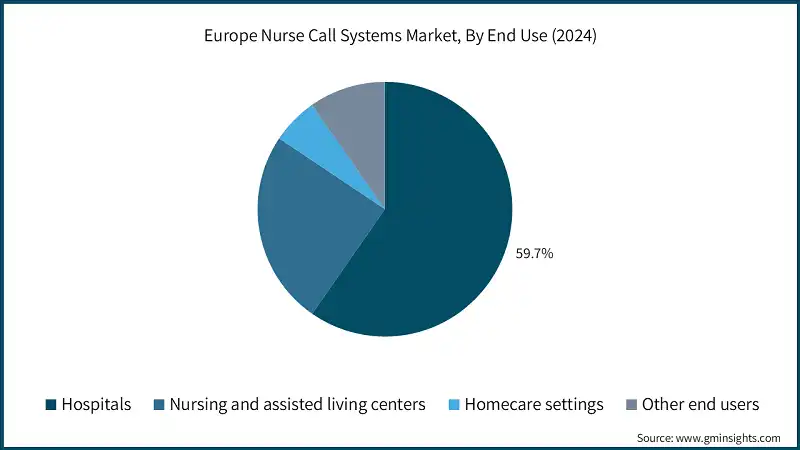
Based on end use, the Europe nurse call systems market is classified into hospitals, nursing and assisted living centers, homecare settings, and other end users. The hospitals segment dominated the market with a revenue share of 59.7% in 2024 and is expected to reach USD 1 billion within the forecast period.
- Hospitals in the region mainly focusing on lowering response times to patient calls as well as to any emergencies. Nurse call systems help to observe the patient needs in real-time, thus ensuring that interventions are made on time and that the number of medical errors is minimized. Directly, this concentration on patient safety is the main driver of system adoption.
- Further, these hospitals must adhere to strict EU and national regulations regarding patient care and safety. Nurse call systems help meet these requirements by providing documented alerts, response tracking, and integration with hospital information systems, supporting accreditation efforts.
- The nursing and assisted living centers segment held a revenue of USD 174.4 million in 2024, with projections indicating a steady expansion at 10.2% CAGR from 2025 to 2034. The growth of nursing and assisted living centers in Europe is the main factor behind the escalation of nurse call system’s demand, which is required for the proper patient monitoring and for the patient to receive the care needed in time. These facilities continue to integrate more advanced communication solutions that help them keep the residents safe and be more efficient from a managerial point of view.
- The homecare settings segment held a revenue of USD 41.5 million in 2024, with projections indicating a steady expansion at 9.8% CAGR from 2025 to 2034. Homecare settings in the region are driving demand for nurse call systems due to the rising preference for aging in place and remote patient monitoring. Portable and wireless solutions enable caregivers to provide timely assistance while supporting independent living for patients.
Looking for region specific data?
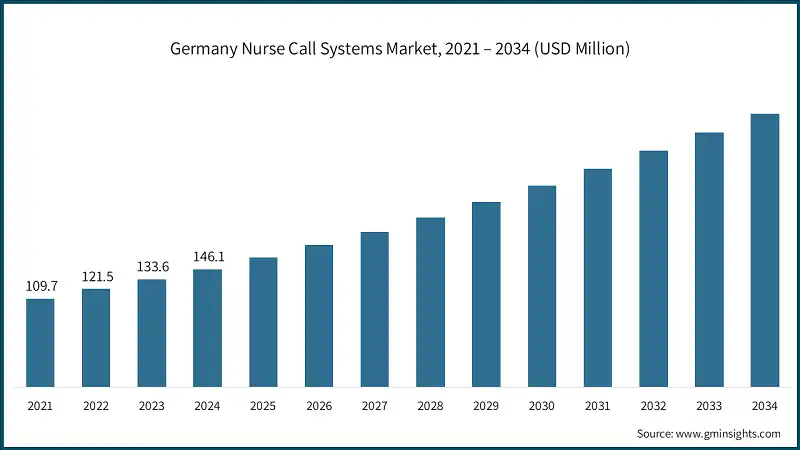
Germany Nurse Call Systems Market Germany nurse call systems market was valued at USD 109.7 million and USD 121.5 million in 2021 and 2022, respectively. The market size reached USD 146.1 million in 2024, growing from USD 133.6 million in 2023, and is anticipated to grow at a CAGR of 8.6% between 2025 to 2034. UK nurse call systems market accounted for USD 93.6 million in 2024 and is anticipated to show lucrative growth over the forecast period. France nurse call systems market is anticipated to grow at the substantial CAGR of 10.1% during the analysis timeframe. The market is highly competitive, characterized by the presence of several well-established multinational and regional players offering a wide range of solutions. Companies are focusing on technological innovation, product differentiation, and strategic partnerships to strengthen their market position. The adoption of advanced features such as IoT integration, mobile alerts, workflow management, and patient safety modules is becoming a key factor for gaining a competitive edge. Additionally, vendors are increasingly targeting hospitals, long-term care facilities, and homecare providers to expand their customer base and drive revenue growth. Key players include ascom, AMETEK (Rauland), Baxter (Hillrom), SCHRACK SECONET, Honeywell, and Tunstall Group, collectively accounting for 45% of the total market share. These companies dominate through strong regional presence, comprehensive product portfolios, and strategic collaborations with healthcare facilities. Other players compete by offering niche solutions, competitive pricing, and customizable systems tailored to specific care settings. Overall, the market is witnessing gradual consolidation, technological upgrades, and increasing focus on wireless and mobile systems to meet evolving healthcare demands. Few of the prominent players operating in the Europe nurse call systems industry include: The company is leading the nurse call systems market with a ~15.2% share in 2024. Telligence nurse call system integrates data from multiple sources, including medical devices and patient call buttons, to streamline workflows and improve response times. Its open, modular architecture allows customization and scalability to meet the needs of diverse healthcare settings. Voalte Nurse Call integrates nurse call, mobile communications, alarm management, and patient engagement into a single platform, enhancing hospital-wide care coordination. Its seamless connectivity with Hillrom smart beds allows real-time patient status updates, improving response times and overall patient safety. Systevo Call Systems offers comprehensive components such as patient handsets, corridor indicators, and central units to ensure seamless communication. The system’s mobile integration enables caregivers to receive alerts and communicate directly from devices, boosting response efficiency.UK Nurse Call Systems Market
France Nurse Call Systems Market
Europe Nurse Call Systems Market Share
Europe Nurse Call Systems Market Companies
Europe Nurse Call Systems Industry News:
Europe nurse call systems market research report includes an in-depth coverage of the industry with estimates and forecast in terms of revenue in USD Million from 2021 - 2034 for the following segments:
Market, By Product
- Integrated communication systems
- Button systems
- Mobile systems
- Intercom systems
Market, By Technology
- Wired communication equipment
- Wireless communication equipment
Market, By Application
- Alarms & communications
- Workflow support
- Wanderer control
- Fall detection & prevention
Market, By End Use
- Hospitals
- Nursing and assisted living centers
- Homecare settings
- Other end use
The above information is provided for the following countries:
- Germany
- UK
- France
- Spain
- Italy
- Netherlands
- Rest of Europe
Frequently Asked Question(FAQ) :
What are the upcoming trends in the Europe nurse call systems industry?
Key trends include adoption of wireless and IP-based platforms, AI-enabled predictive alerts, integration with EHRs and IoT devices, and rising demand from homecare and assisted living facilities.
Who are the key players in the Europe nurse call systems market?
Key players include Ascom, AMETEK (Rauland), Baxter (Hillrom), Schrack Seconet, Honeywell, and Tunstall Group.
Which country leads the Europe nurse call systems market?
Germany led the market with USD 146.1 million in 2024, driven by heavy investment in smart hospitals, stringent safety regulations, and advanced healthcare infrastructure.
What is the projected size of the Europe nurse call systems industry in 2025?
The Europe nurse call systems market is expected to reach USD 781.2 million in 2025.
What is the projected value of the Europe nurse call systems market by 2034?
The market is expected to reach USD 1.8 billion by 2034, fueled by wireless systems, IoT integration, and expansion of assisted living and homecare settings.
What is the market size of the Europe nurse call systems in 2024?
The market size was USD 705.9 million in 2024, with a CAGR of 9.5% expected through 2034 driven by smart hospital adoption, digital health initiatives, and demand from long-term care facilities.
What was the valuation of the hospitals segment?
The hospitals segment dominated with 59.7% share in 2024 and is projected to reach USD 1 billion by 2034, supported by strict EU patient safety regulations and rising hospital digitalization.
How much revenue did the integrated communication systems segment generate?
The integrated communication systems segment accounted for 36.2% share in 2024 and is projected to exceed USD 625.8 million by 2034, driven by workflow efficiency and integration with hospital IT systems.
Europe Nurse Call Systems Market Scope
Related Reports