Summary
Table of Content

Europe Heat Pump Market
Get a free sample of this report
Form submitted successfully!
Error submitting form. Please try again.
Thank you!
Your inquiry has been received. Our team will reach out to you with the required details via email. To ensure that you don't miss their response, kindly remember to check your spam folder as well!
Request Sectional Data
Thank you!
Your inquiry has been received. Our team will reach out to you with the required details via email. To ensure that you don't miss their response, kindly remember to check your spam folder as well!
Form submitted successfully!
Error submitting form. Please try again.
Europe Heat Pump Market Size
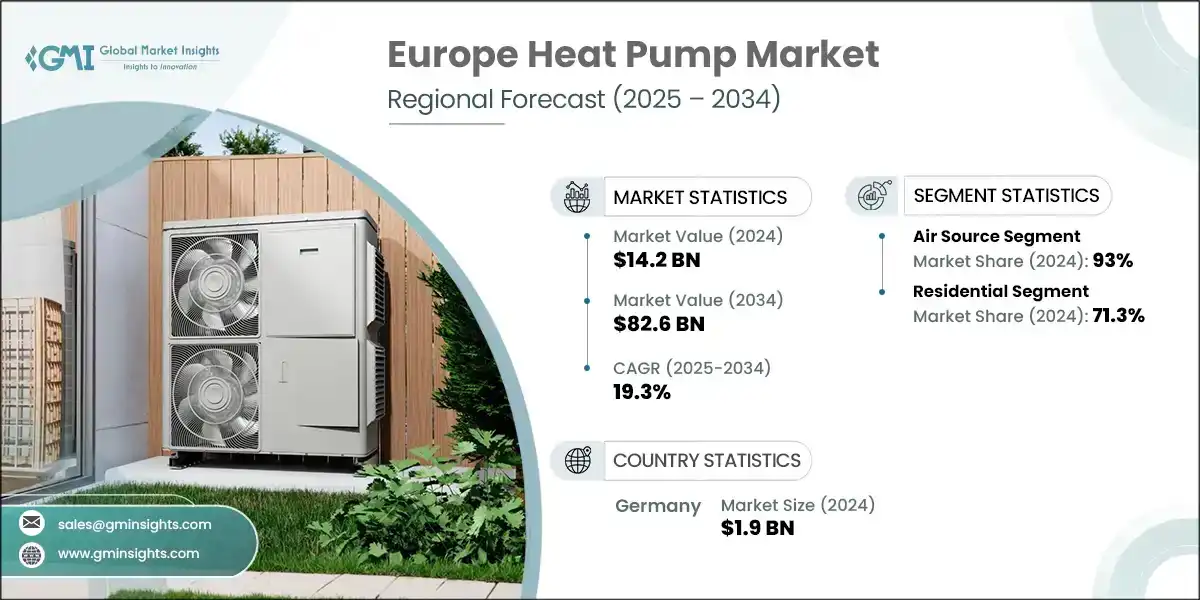
The Europe heat pump market size was estimated at USD 14.2 billion in 2024 and is expected to reach USD 16.8 billion in 2025 to USD 82.6 billion by 2034, at a CAGR of 19.3%.
To get key market trends
- Ongoing shift toward technological and environmental sustainability coupled with stricter enforcement strategies for the adoption of clean energy solutions are driving the need for heat pump solutions. Favorable policies toward heat pump adoption, stringent regulatory landscape toward emission reduction and increasing development of residential and commercial infrastructure will complement the Europe heat pump market landscape.
- For instance, to increase the heat pumps deployment rate, the Commission initiated the Heat Pump Accelerator Platform in January 2025. This is within the scope of a wider Heat Pump Support Action to supervise policy framework at the country level, gather information, supervise training initiatives, as well as assist in placing emphasis on policies regarding the sponsored research, technology, and innovation activities.
- Organizations and governments are spending generously towards green energy policies and objectives including reducing carbon emissions, driving greater demand for heat pumps. For instance, in April 2025, Milan hosted Heat Pump Technologies, the maiden international conference and exhibition dedicated to heat pumps enabling the energy transition. This exhibition was organized by RX Italy at the Allianz MiCo, to explore market trends, decarbonization strategies, and advanced technological solutions.
- European countries have put in place policies aimed at stimulating the use of heat pumps through grants and financial subsidies. These policies seek to reduce the capital expenditure required by residential and commercial users, thereby improving the cost-effectiveness of heat pump systems. Germany is particularly notable in this regard, offering generous subsidies through its Market Incentive Program (MAP) for renewables, which includes heat pumps. For example, a homeowner in Berlin can obtain as much as 35% of the installation costs subsidized, thus alleviating the financial pressure.
- The European Commission, in February of 2025, shared plans to build competitive clean industry sectors with accessible energy, taking steps to further accelerate heat pump deployment. The combination of this clean industrial deal and the decarbonization clean technology manufacturing deal satisfied the need for industrial decarbonization. The operational cost of electricity was addressed by the affordable energy action plan, which also offered flexibility within the grid.
- The growing measures to limit harmful GHG emissions have created a significant demand for low-carbon energy systems across the region. Stern objectives & policies by the EU have mandated the member states to adopt strategies to minimize the carbon footprint of various establishments.
- The continuous adoption of clean energy systems along with shifting consumer inclination toward environmental sustainability will positively influence the business dynamics. In addition, continuous research & development initiatives, the introduction of new government projects to boost the adoption of sustainable systems, and growing measures to diminish adverse environmental impacts will stimulate the product deployment.
- For instance, in February 2025, Diehl Controls joined the Heat Pump Accelerator Platform introduced by European Commission across the European Union. This initiative brings leading players together in the heat pump industry to accelerate the heat pump adoption across the region. The company would bring its expertise and make a valuable contribution in this program to achieving EU climate goals.
- Germany leads the market supported by favorable government incentives, introduction of stringent environmental regulations, and increased awareness of sustainable heating solutions. Ongoing technological advancements and rising electricity prices are encouraging consumers and businesses to adopt heat pumps, supporting the country’s target to reducing carbon emissions and achieving climate goals.
- France is one the fastest growing country driven by rising demand for energy efficient heating & cooling systems, policies to remove carbon footprint, and inclination on adoption of high efficiency heat pump systems. Favorable climate conditions and incentives for residential and commercial installations further accelerate heat pump deployment, which in turn will augment the industry dynamics.
Europe Heat Pump Market Report Attributes
| Key Takeaway | Details |
|---|---|
| Market Size & Growth | |
| Base Year | 2024 |
| Market Size in 2024 | USD 14.2 Billion |
| Forecast Period 2025 - 2034 CAGR | 19.3% |
| Market Size in 2034 | USD 82.6 Billion |
| Key Market Trends | |
| Drivers | Impact |
| Positive inclination towards clean energy alternatives | Significantly accelerates the adoption and growth of the heat pump market by promoting sustainable and eco-friendly heating solutions. |
| Increasing demand for advanced space heating technologies | Innovation in heat pump technologies encourages the adoption of energy efficient and sophisticated heating solutions. |
| Favorable outlook towards adoption of energy efficient systems | Increased investment and adoption of heat pump technologies across the region, promote energy sustainability, and support environmental goals across the region. |
| Pitfalls & Challenges | Impact |
| High initial deployment cost | Affect widespread adoption of heat pumps by making technology less accessible for consumers. |
| Opportunities: | Impact |
| Growing consumer awareness and government incentives promoting energy-efficient heating solutions | Encourages more households and businesses to invest in sustainable technologies, leading to accelerated heat pump adoption and a reduction in carbon emissions. |
| Expanding infrastructure for renewable energy sources, facilitating integrated heating solutions | Facilitates greater adoption of technologies like heat pumps and solar thermal systems, reducing reliance on fossil fuels. Accelerates the transition to a low-carbon energy landscape and enhances energy resilience. |
| Regulations and policies aimed at reducing carbon emissions | Help to achieve environmental targets while promoting energy security and economic growth. They incentivize innovation and investment in renewable technologies, leading to decreased reliance on fossil fuels. |
| Technological advancements and declining costs are enhancing the competitiveness of heat pumps | Increase adoption of heat pumps, reduced greenhouse gas emissions, and a faster transition to renewable and sustainable heating systems. |
| Market Leaders (2024) | |
| Market Leader |
|
| Top Players |
Collective market share in 2024 is 40% |
| Competitive Edge |
|
| Regional Insights | |
| Largest Market | France |
| Fastest growing market | Germany |
| Emerging states | France, Italy, Sweden, Netherlands, Poland |
| Future outlook |
|
What are the growth opportunities in this market?
Europe Heat Pump Market Trends
- The European heat pump industry is growing significantly because of Europe’s focus on cutting carbon emissions and improving energy efficiency. Different countries in Europe are adopting or creating laws, as well as subsidizing the purchase of heat pumps to replace fossil fuel heating systems.
- For instance, in April 2025, the UK introduced new regulations on Energy Smart Appliances (ESA), demands that the UK government requires heat pumps to have smart features and advanced cybersecurity. These rules will mandate heat pumps to adopt smart grids and meet cybersecurity requirements under ETSI EN 303 645. In addition, devices must possess grid stability functions including a random offset function to mitigate synchronized demand surges.
- The market is further changing with the adoption of new propane refrigerants due to compliance with environmental regulations. Technological changes such as smart controls and hybrids with solar energy also contribute to changing new markets. Moreover, the increasing electricity costs together with the need for energy security drives many users to purchase heat pumps for long term savings.
- For instance, in December 2024, The European governments, in conjunction with the European Heat Pump Association, are boosting their financial aid to industrial heat pumps in the form of subsidizations, loans, and tax exempts. It highlights the substantial funding that has been set aside to expedite decarbonization across multiple industries.
- The adoption of sustainable heating solutions is supported by government bodies which resulted in a growing market for air-to-water and ground source heat pumps. Moreover, opportunities for growth are available with issues including supply chain challenges, inadequate qualified personnel, high installation costs, and others continue to hinder the use of heat pumps.
Europe Heat Pump Market Analysis
Learn more about the key segments shaping this market
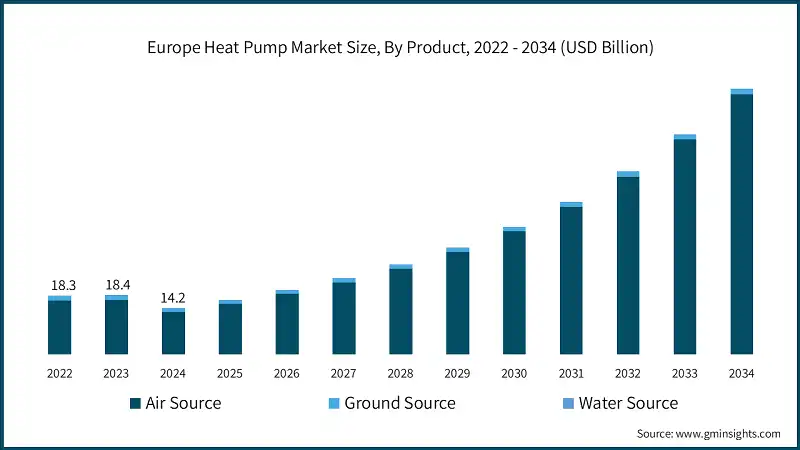
- Based on product, the industry is segmented into air source, ground source, and water source. The air source segment accounted for 93% market share in 2024 and is expected to grow at a CAGR of over 19% through 2034
- The air source heat pumps segment is expected to surpass USD 80 billion by 2034, driven by the growing awareness of the advantages of renewable heating solutions, along with rising energy costs and environmental concerns, is fueling demand for air source heat pumps. ASHPs are especially favored in residential applications due to their simple installation and dual functionality for both heating and cooling.
- For instance, in November 2024, Wondrwall, a UK company which in November 2024 launched a new residential air source heat pump, claiming it works in conjunction with the company’s AI-powered Home Energy Management Systems. This system is supposed to optimize heating efficacy and minimize costs. The company's claims are that the system lowers the cost of heating in a home by a significant margin when compared to standard heat pumps.
- Their cost-effectiveness, ease of installation, and ability to function efficiently across a myriad of weather conditions increases the popularity of these heat pumps. In addition, the anticipated implementation of new financial incentives such as subsidies, tax credits, and clean energy advertisement initiatives will further boost the air source heat pump industry landscape.
- The market for ground source heat pumps is poised to grow as a result of growing use of low carbon heating technologies and new energy efficiency standards for emissions control, contributing towards augmenting the industry landscape of the economy. Moreover, the ongoing rising growth of industrial infrastructure will further drive industry development.
- The market for water source heat pumps surpasses combustion-based solutions in longevity, offering efficient heating and cooling at a lower cost. This will likely accelerate the adoption of water source heat pumps over other popular alternatives along with the air source heat pumps, reshaping business growth.
- For instance, in June 2024, Bosch Home Comfort launched two new series of water source heat pumps designed for both retrofits and new constructions. Available in sizes ranging from ½ to 6 tons, these high-efficiency heat pumps offer a coefficient of performance (COP) of up to 4.9, ensuring optimal energy savings and sustainability.
Learn more about the key segments shaping this market
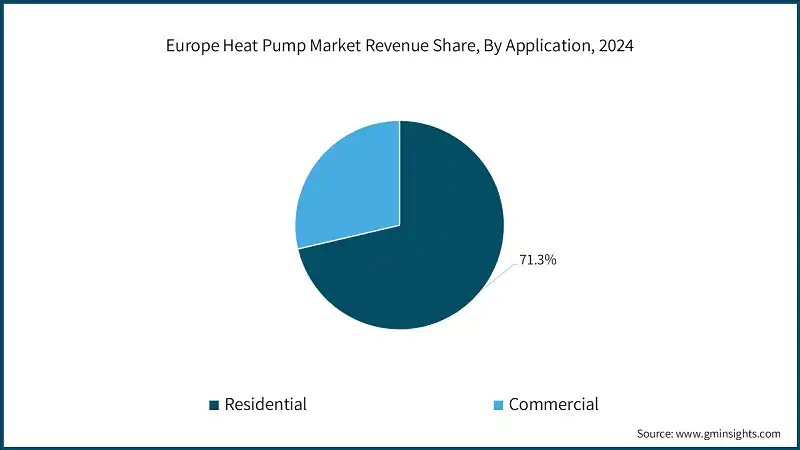
- Based on the application, the Europe heat pump industry is broadly categorized into residential and commercial. The residential segment dominates the market with 71.3% share in 2024 and is expected to grow at a CAGR of over 19% from 2025 to 2034
- The installation of residential heat pumps is expected to increase at a fast pace, fueled by the rising need for energy-efficient heating and cooling services across residential establishments including flats, apartments, houses, duplex, multi-story buildings and shifting consumer inclination toward adoption of clean energy systems and reducing energy cost.
- For instance, in October 2024, Danfoss created a prototype water to water residential heat pump operating on propane (R290) with a charge of only 130g, helping to pioneer sustainable heating solutions. The innovative unit was designed for high efficiency and low ecological impact and was launched to help support decarbonization efforts within the residential heating sector.
- The commercial segment of the heat pump market will project at a CAGR of over 18% by 2034 and will grow significantly owing to increased investments in eco-friendly heating infrastructure, government policies focused on lowering carbon emissions, and growing usage of energy-efficient technologies.
- Rising demand for sustainable heating & cooling solutions across the commercial establishments along with manufacturers aiming to introduce advance heat pump technologies with large capacities to cater to various applications will further complement the business landscape.
- For instance, in February 2024, Viessmann unveiled its latest line of air-source heat pumps, designed for commercial & residential applications called the Vitocal 200-A Pro with three model series. These units offer 32 kW to 128 kW heating capacities and cooling capacities spanning from 34 kW to 139 kW.
- Additionally, sectors including office buildings, hotels, hospitals, and educational institutions, where heating and cooling requirements are substantial with the rise of district heating networks and the integration of heat pumps with renewable energy sources are further propelling the industry growth.
- In January 2025, Carrier Solutions UK released a new line featuring the AquaSnap 30AWH-P, a high-efficiency reversible propane (R290) monobloc heat pump. These new offerings are available in 4kW to 14kW capacities for single-phase and 12kW to 14kW for three-phase commercial use. The light-commercial range is equipped with eight monoblocs for two-pipe or four-pipe systems.
- Based on installation, the industry is predominantly bifurcated into new construction and retrofit. The new construction deployment is projected to observe a significant growth on account of the encouraging & stern regulatory mandates, decarbonization goals, and heightened energy efficiency standards. Moreover, the respective national & global authorities are actively promoting the adoption of heat pumps through financial help programs including incentives, subsidies, and building codes to boost heat pump deployment across residential and commercial developments.
Looking for region specific data?
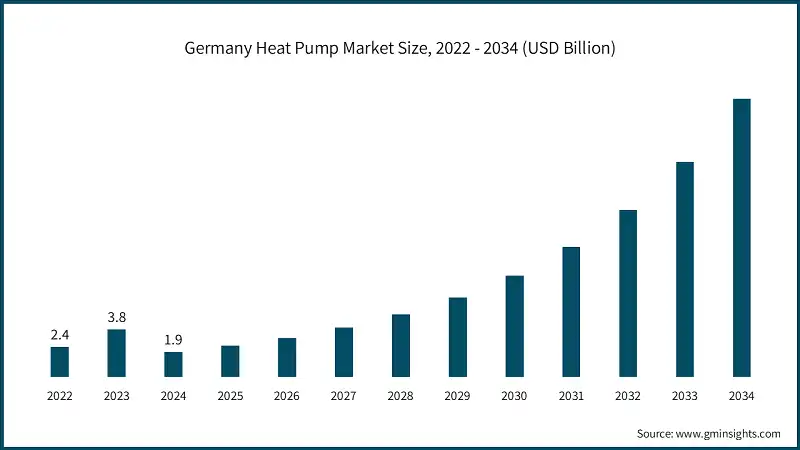
- Germany dominated the Europe heat pump market with around 14% revenue share in 2024 and generated USD 1.9 billion in revenue. Rising public awareness of environmental concerns and a stronger commitment to sustainability among consumers are fueling demand for eco-friendly heating solutions.
- The growing adoption of eco-friendly practices, including lowering one’s carbon footprint, continues to enhance the popularity and development of heat pumps. The features of heat pumps make them modern and useful because they lessen damage done to the surrounding.
- For instance, in December 2024, experts using open-source models suggest that Germany could allocate an extra 54GW to 57GW of solar PV capacity towards the deployment of ten million heat pumps by 2030.
- The UK heat pump market is projected to hit USD 2.5 billion by 2034. The development of new and better control systems that can be integrated with other systems along with rising demand for reliable heating systems influencing the business landscape. The adoption of solar energy systems integrated with heat pump systems along with phasing out of prevailing fossil fuel heating technologies will influence the industry dynamics.
- For instance, Ideal Heating, during February 2025, increased its activities to include the heat pump sector for the purposes of accelerating decarbonization of home heating in the UK. The company utilized its skill set to facilitate the transition from gas boilers to more environmentally friendly systems by engaging with the government, industry stakeholders, installers, and end-users.
- The rise of IoT and smart technologies is changing the very structure of the industry. Smart automation systems allow domestic users to remotely manage their heating systems by integrating smart heat pumps, thus improving effectiveness and optimization in energy usage.
Europe Heat Pump Market Share
- The top 5 companies across the Europe heat pump industry are Carrier, Daikin, Mitsubishi Electric, Bosch, and Panasonic collectively accounting for about 40% of the market share. The companies are developing Lower GWP refrigerants, efficient smart controls, and high efficiency devices. The increasing competition and the rising adoption of heat pumps increased energy prices, many businesses competed for a greater market share by forming joint ventures, diversifying their product portfolios, and even engaging in price competition.
- These companies address all-in-one solutions by combining heat pumps with solar panels and energy storage units to meet multifunctional and eco-friendly customer needs. The market can be oriented towards rapid growth and competition focused on price, efficiency, and sustainability driving the adoption of heat pump industry.
- Over the past couple of years, the heat pump industry across Europe has observed significant fluctuations owing to the delayed subsidies, unexpected policy shift, and regulatory uncertainty across various key countries. In addition, the major economic factors including national inflation rates, high electricity prices, and slowdown of residential & commercial establishments were some of the crucial factors downsizing the regional heat pump demand. However, positive steps taken by the respective administration agencies to support region’s energy efficiency and clean energy transition goals coupled with the expanding strategic initiatives by the key industry players will extrapolate the industry growth through 2034.
Europe Heat Pump Market Companies
- Daikin services a variety of residential, commercial, and industrial heating and cooling units with incredible energy-efficient solutions. The company is recognized for its sustainable air-to-water, air-to-air, and ground-source heat pumps that are in line with Europe’s sustainable goals as well as for advanced heat pump technology.
- Mitsubishi Electric Corporation provides a wide range of comprehensive automation and energy management business solutions for various industry verticals. Moreover, the company offers an extensive portfolio of smart connected products and services to deliver resilient & smart solutions. Its annual revenue is USD 116 billion.
- Kensa Heat Pumps is a pioneer company manufacturing ground source heat pumps (GSHP) alongside other heating appliances and is based in the UK. The company specializes in domestic, commercial, and district heating applications. It supplies GSHPs to individual houses, shared ground loop systems for apartments and housing estates, as well as for large district heating schemes.
Major industry players operating across Europe heat pump market include:
- Aira
- Bosch
- Carrier
- Daikin
- Finn Geotherm
- Fujitsu
- Glen Dimplex
- Gree
- Kensa
- LG
- Mitsubishi
- Nibe
- Panasonic
- Samsung
- Stiebel
- Swegon
- Systemair
- Toshiba
- Trane
- Vaillant
- Viessmann
- Wolf
Europe Heat Pump Industry News
- In June 2025, STIEBEL ELTRON partnered with Solarwatt to launch the UK's first fully integrated home energy system that combines a heat pump with solar energy in North Wales. This collaboration aims to deliver sustainable and efficient energy solutions by integrating STIEBEL ELTRON's heat pump technology with Solarwatt's solar panels and energy management systems into a single, cost-effective package.
- In March 2025, Vaillant's portfolio of heat pumps, presented at ISH, focuses on new construction and remodeling projects while guaranteeing efficient installation, minimal operational noise, and user-friendly design. The company provides its customers with advanced digital services for systematic planning, remote assistance, and optimization of system functions. Peripheral users are equipped with smart technologies for energy control which allow for significant savings in energy consumption and operating costs. The portfolio incorporates smart fan coil units to provide compact and efficient heating and cooling.
- In March 2025, Panasonic Heating & Cooling Solutions showcased its latest heating technologies advancements in heating technologies at the ISH held in Frankfurt. With smart controls from tado, the Aquarea M Series heat pumps from Panasonic can save up to 22% on costs by intelligent temperature scheduling, multi-room control, and dynamic tariff optimization. The Aquarea Loop system best suited for flats, heats and cools with eco-friendly water-based low-temp central circuits augmented by R290 refrigerant-compressors.
- In February 2025, Carrier launched its maiden air source reversible heat pump for high-temperature suitable for commercial applications, the AquaSnap 61AQ. It uses R-290, an almost entirely natural refrigerant with a GWP of nearly zero. Designed to achieve high efficiency and performance, even at outdoor temperatures as low as -7°C, the AquaSnap 61AQ can deliver heating up to 75°C. It can also remain operational down to -25°C.
- In November 2024, Daikin introduced the EWYE-CZ Inverter air-to-water heat pump. It promises unprecedented energy efficiency and sustainability. With the use of Daikin’s innovative Inverter Scroll compressor and the employment of the low Global Warming Potential (GWP) refrigerant R-454C, top performance was achieved with the least possible damage to the surroundings.
The Europe heat pump market research report includes in-depth coverage of the industry with estimates & forecast in terms of “’000 Units” and “USD Million” from 2021 to 2034 for the following segments:
Market, By Product
- Air source
- Residential
- Commercial
- Ground source
- Residential
- Commercial
- Water source
- Residential
- Commercial
Market, By Application
- Residential
- Commercial
Market, By Installation
- New construction
- Retrofit
The above information has been provided for the following countries:
- Austria
- Norway
- Denmark
- Finland
- France
- Germany
- Italy
- Switzerland
- Spain
- Sweden
- UK
- Netherlands
- Poland
Frequently Asked Question(FAQ) :
What is the growth outlook for the residential application segment from 2025 to 2034?
The residential segment is expected to grow at a CAGR of over 19% from 2025 to 2034, due to rising demand for energy-efficient heating and cooling solutions.
Who are the key players in the Europe heat pump market?
Key players include Carrier, Daikin, Bosch Thermotechnology, Panasonic, Mitsubishi, Nibe, LG, Samsung, Vaillant, and Viessmann, among others.
What are the upcoming trends in the Europe heat pump market?
Key trends include advancements in heat pump technologies enhancing efficiency, integration with smart energy systems, increasing adoption of renewable energy sources, and growing government incentives promoting sustainable heating solutions.
Which region leads the Europe heat pump market?
Germany led the Europe heat pump market with a 14% revenue share, generating USD 1.9 billion in 2024. The country's strong commitment to sustainability and rising public awareness of environmental concerns drive its market dominance.
What is the projected size of the UK heat pump market by 2034?
The UK heat pump market is expected to reach USD 2.5 billion by 2034, propelled by advancements in control systems and growing demand for reliable heating solutions.
What was the market share of the air source heat pump segment in 2024?
The air source heat pump segment accounted for 93% of the market share in 2024 and is projected to grow at a CAGR of over 19% through 2034.
What is the projected value of the Europe heat pump market by 2034?
The Europe heat pump industry is expected to reach USD 82.6 billion by 2034, propelled by technological advancements, government incentives, and growing consumer awareness of energy-efficient solutions.
What is the market size of the Europe heat pump in 2024?
The market size was USD 14.2 billion in 2024, with a CAGR of 19.3% expected through 2034, driven by favorable policies, stringent emission regulations, and increasing infrastructure development.
Europe Heat Pump Market Scope
Related Reports