Summary
Table of Content

Enzymatic Food Processing Solutions Market
Get a free sample of this report
Form submitted successfully!
Error submitting form. Please try again.
Thank you!
Your inquiry has been received. Our team will reach out to you with the required details via email. To ensure that you don't miss their response, kindly remember to check your spam folder as well!
Request Sectional Data
Thank you!
Your inquiry has been received. Our team will reach out to you with the required details via email. To ensure that you don't miss their response, kindly remember to check your spam folder as well!
Form submitted successfully!
Error submitting form. Please try again.
Enzymatic Food Processing Solutions Market Size
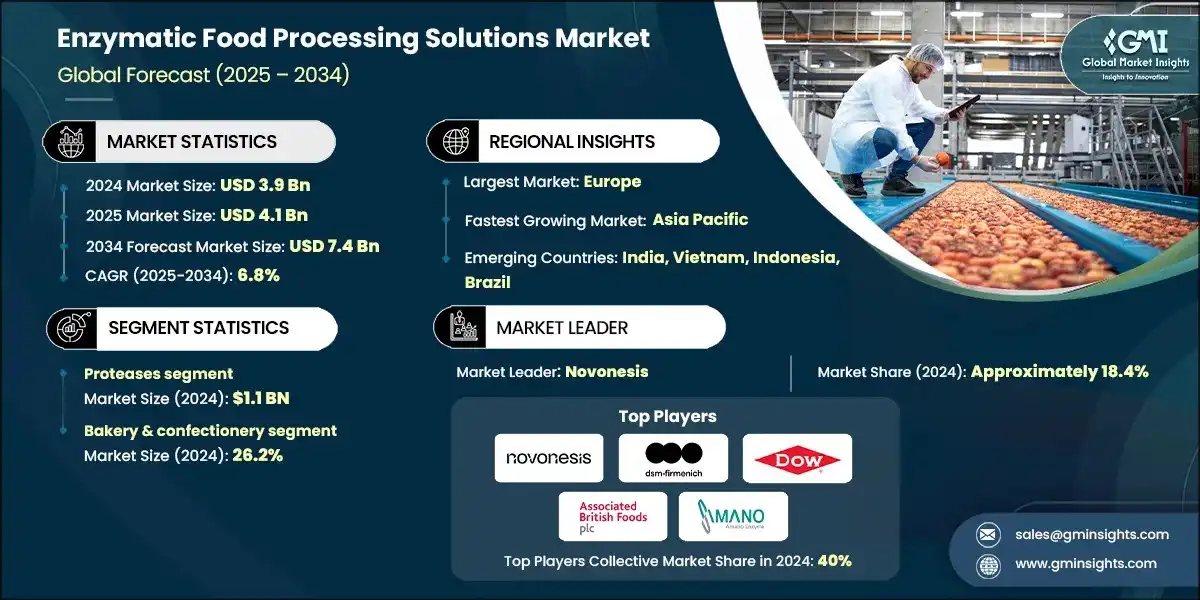
The global enzymatic food processing solutions market size was estimated at USD 3.9 billion in 2024. The market is set to expand from USD 4.1 billion in 2025 to USD 7.4 billion by 2034, reflecting a 6.8% CAGR from 2025 to 2034, according to latest report published by Global Market Insights Inc.
To get key market trends
The market’s role spans efficiency, quality, and sustainability improvements across bakery, dairy, beverages, plant based proteins, starch & sweeteners, oils & fats, and other niches.
Enzymes have moved from single function aids to platform technologies embedded in digitally controlled processes. Demand is reinforced by clean label reformulation, regulatory support for naturally derived processing aids, and precision fermentation capacity coming online.
The enzymatic food processing solutions market growth is reflecting the monetization of enzyme concentrates, formulated blends, and application services across industrial food lines worldwide. Market value captures both commodity classes used at scale (e.g., baking amylases) and premium, application specific systems (e.g., proteases for plant protein texturization), which command higher pricing based on purity, thermostability, and delivery format.
Looking at momentum, steady 2025–2034 expansion at 6.8% CAGR is consistent with a sector moving from project-by-project adoption toward platform integration in core processes, particularly in bakery freshness management, lactose reduction in dairy, juice clarification, and plant based protein functionality. Because of this, enzyme suppliers increasingly bundle technical service and pilot scale optimization with product sales, reinforcing stickiness and enlarging deal sizes over time.
On the flip side, budget cycles in emerging markets tend to elongate adoption where price sensitivity is highest, so suppliers often lead with blends that replace multiple synthetic aids while keeping input cost neutral. Enzymes benefit from regulatory and consumer tailwinds as “processing aids,” enabling clean label reformulations that would be harder using chemical stabilizers or preservatives, especially in Europe’s compliance environment.
Enzymatic Food Processing Solutions Market Report Attributes
| Key Takeaway | Details |
|---|---|
| Market Size & Growth | |
| Base Year | 2024 |
| Market Size in 2024 | USD 3.9 Billion |
| Market Size in 2025 | USD 4.1 Billion |
| Forecast Period 2025 - 2034 CAGR | 6.8% |
| Market Size in 2034 | USD 7.4 Billion |
| Key Market Trends | |
| Drivers | Impact |
| Clean-Label Demand | Clean-label reformulation is lifting enzyme penetration across bakery, dairy, and beverages |
| Plant-Based & Functional Foods Growth | Plant-based and functional foods expand use cases for proteases and carbohydrases |
| Industrial Automation | Industrial automation favors predictable, sensor-integrated dosing |
| Pitfalls & Challenges | Impact |
| High Development Costs | High development/compliance costs slow niche commercialization |
| Enzyme Stability Issues | Stability constraints require costlier immobilization/encapsulation in harsh processes |
| Opportunities: | Impact |
| Multi-Enzyme Blends | Multi-enzyme blends reduce ingredient complexity while improving performance |
| Byproduct Valorization | Valorization of byproducts via enzymatic processing supports circular-economy revenue |
| Market Leaders (2024) | |
| Market Leaders |
Approximately 18.4% market share in 2024 |
| Top Players |
Collectively 40% market share in 2024 |
| Competitive Edge |
|
| Regional Insights | |
| Largest Market | Europe |
| Fastest growing market | Asia Pacific |
| Emerging countries | India, Vietnam, Indonesia, Brazil |
| Future outlook |
|
What are the growth opportunities in this market?
Enzymatic Food Processing Solutions Market Trends
- Precision fermentation has become the backbone of new enzyme development, allowing rapid iteration of variants with refined specificity and higher thermostability for tough unit operations such as starch liquefaction and continuous baking lines. The real driver here is the ability to tailor active sites and glycosylation patterns to match substrates and process windows, which lowers over processing risks and reduces off flavor formation in sensitive foods.
- Timelines point to sustained gains over the medium to long term, as new strains and production hosts move from pilot into commercial fermenters. The numbers tell us R&D cycles are compressing as AI/ML models prescreen candidates, cutting wet lab iterations and speeding go to market for application specific enzymes. Market implication: suppliers that combine silico design with precision fermentation capacity will set the pace across high value niches in the enzymatic food processing solutions market.
- Consumers keep trading up for simpler ingredient lists, pushing formulators to replace synthetic emulsifiers, stabilizers, and preservatives with enzymatic routes that hit texture and shelf life specs without chemical additives. Because of this, bakery and dairy have become anchor segments for multi enzyme blends that strengthen dough, soften crumb, improve lactose handling, and manage moisture migration.
- Digital optimization of enzyme performance, IoT sensors and automated dosing ensure enzymes hit their sweet spot neither under nor over dosed while advanced QC provides real time feedback loops. Short term gains include tighter consistency and lower waste, while medium term, AI assists in crafting blend ratios for specific flours, milks, or fruit matrices. Lower cost to serve for suppliers and stickier customer relationships as process recipes become co developed assets embedded in production software.
- Enzymatic processes unlock bioactive peptides, prebiotic oligosaccharides, and improved protein digestibility, which are central to the next wave of functional foods. Timeline: near term adoption of premium SKUs, expanding as cost curves improve for tailored blends. Impact-wise, this dovetails with the +2.1% CAGR contribution from plant based and functional categories in our driver model, tipping more R&D toward proteases and carbohydrase’s in the market.
Enzymatic Food Processing Solutions Market Analysis
Learn more about the key segments shaping this market
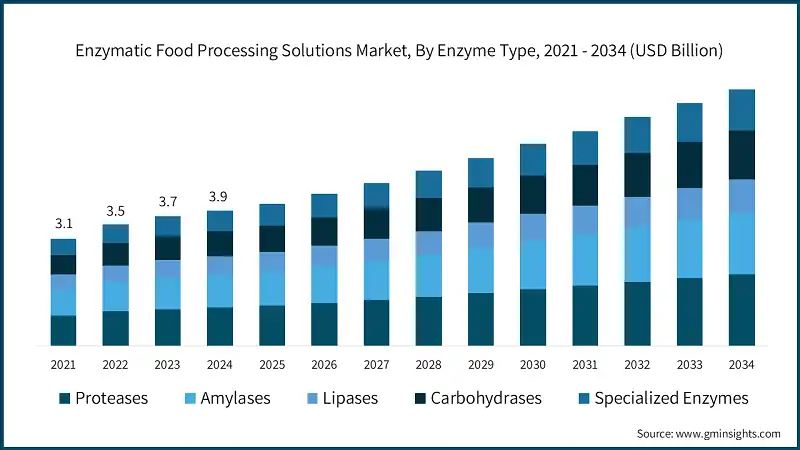
Based on enzyme type, the enzymatic food processing solutions market is divided into proteases, amylases, lipases, carbohydrases, specialized enzymes. Proteases segment generated a revenue of USD 1.1 billion in 2024, and it is expected to reach USD 2.1 billion in 2034 at a CAGR of 6.6%.
- By Enzyme Type Proteases lead with an estimated 28.4% share in 2024, underpinned by their versatility in dairy coagulation, meat tenderization, baking performance, and plant protein functionality. The real driver here is texture and digestibility improvement, which supports clean label premiumization while maintaining process efficiency in high throughput plants.
- Amylases constitute about 24.2% of the market, growing at approximately 6.7% CAGR on softening bread, handling dough, and improving shelf life, and including thermostable products for continuous lines. Carbohydrases comprise about 18.5% and show the highest growth projection near 7% as pectinases, cellulases, and hemicellulases improve extraction yields and tailor fiber functionality in beverages and plant based formats. Lipases account for nearly 13.5% with growth near 6.2%, supporting dairy flavor development, dough handling, and structured lipid production for nutrition applications.
- Specialized enzymes transglutaminases, glucose oxidases, catalases, and others collectively hold near 15.3% and post the strongest trajectory near 7.2% as niche functions command premium pricing and custom formulations in demanding processes. Because of this, suppliers increasingly co develop blends that balance activity, stability, and dose precision, reducing rework and variability in production runs.
Learn more about the key segments shaping this market
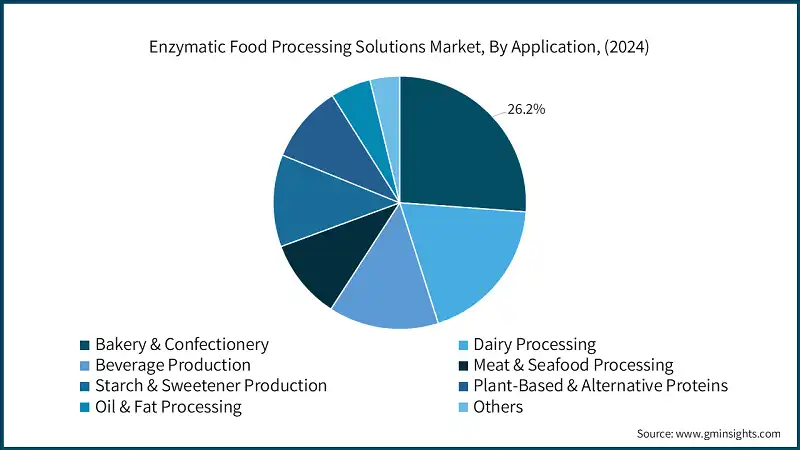
Based on application, the enzymatic food processing solutions market is divided into bakery & confectionery, dairy processing, beverage production, meat & seafood processing, starch & sweetener production, plant-based & alternative proteins, oil & fat processing, others. In 2024, bakery & confectionery segment held major market share, accounted for 26.2% share supported by enzyme enabled dough conditioning, crumb softening, acrylamide mitigation, and freshness extension, with a ~6.7% CAGR outlook.
- Dairy processing follows near 18.9% with around 6.8% CAGR as lactase for lactose reduced products and proteases for texture optimization scale with consumer demand for convenient, premium dairy formats. Beverage production holds roughly 14.1% and grows at about 6.6% on pectinase driven yield, clarity improvement, and cycle time reduction in juices, wines, and brewing. Then there’s fast rising plant based proteins where proteases and carbohydrases improve solubility, flavor, and emulsification turning challenging matrices into consumer friendly textures.
- Enzyme spend is a fraction of raw materials, yet it consistently returns measurable yield and quality gains that justify rapid adoption in high volume lines. Because of this, multi enzyme blends now replace several synthetic additives in premium SKUs to meet clean label requirements without sacrificing sensory performance.
Looking for region specific data?
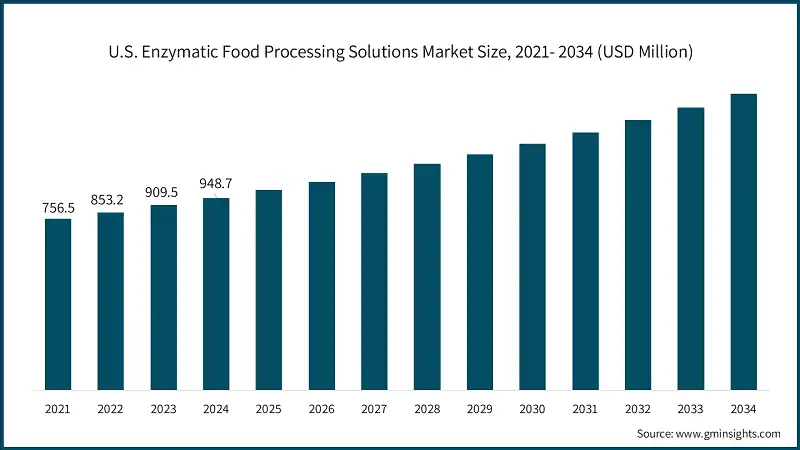
- The U.S. enzymatic food processing solutions market generated a revenue of USD 948.7 million in 2024. The U.S. market is projected to grow at a CAGR of 6.7% reaching USD 1.8 billion by 2034. North America’s market benefits from clean label momentum, deep R&D capabilities, and automation maturity across bakery, dairy, and beverages, supporting premium applications and predictable performance at scale. The U.S. enzymatic food processing solutions market sees strong adoption of multi enzyme blends in bread softness and shelf life management, with AI assisted formulation increasingly embedded in bakeries and starch processors.
- The enzymatic solutions used in food processing across Canada's dairy and beverage industries are such as what is witnessed in other geographical markets where suppliers use local plant species in their blends, as well as matrices that use local varieties of fruit. Enzyme dosing of plants through sensors, as part of a control process of some sort, continues to produce higher return on investment (ROI) per kg of enzyme in Canada, thus showing a preference for digital enabled solutions.
- Europe enzymatic food processing solutions market generated a revenue of USD 1.3 Billion in 2024. Europe market is projected to grow at a CAGR of 6.5% reaching USD 2.4 Billion by 2034. Approximately 32.1% of the market for enzymatic food processing solutions is in Europe, where regulatory constraints on food safety and strong public demand for natural processing aids in food continue to drive the market. Germany and France are leaders in the adoption of enzyme products for the processing of bread and cheese. The UK and Italy are expanding enzyme-enabled premium ranges in retail and foodservice.
- Spain’s juice processors rely on pectinases for yield and clarity, cutting filtration loads and cycle times in high volume plants. EFSA’s exposure assessment tooling and transparency drive faster, safer reformulations aligned to clean label expectations.
- Asia Pacific enzymatic food processing solutions market generated a revenue of USD 840 Million in 2024. Asia Pacific market is projected to grow at a CAGR of 6.8% as industrialization, urban retail, and processed food adoption rise across China, India, Japan, and Southeast Asia.
- China market prioritizes starch, bakery, and plant protein applications where throughput and cost discipline meet quality upgrades. India’s market sees rapid bakery and dairy adoption as modern trade expands, and consumer preferences shift toward packaged foods.
- Japan and South Korea lean into precision fermentation and premium beverages, creating demand for high stability, application specific enzyme systems in the enzymatic food processing solutions market.
- The enzymatic food processing market in Latin America is developing because of enhancements in food processing infrastructure, and an increase of interest in inexpensive natural processing aids. Brazil, Mexico, and Argentina are the leaders in enzymatic adoption, primarily in the dairy and brewing segments, where enzymes are being used for improving protein functionality and fermentation control.
- There are also favorable government attitudes towards modernization of the food industry and supporting partnerships with international enzyme companies for the purposes of technology transfer into Latin America. Moreover, the expansion of the middle class in Latin America is creating demand for wider and more sophisticated food products of a higher quality, indicative of local processors incorporating enzymatic technology into their products for improved flavor retention, even without chemical additives, enhanced flavor and improved shelf stability.
- Growth in the realization of enzyme incorporation into the baking and cereal segments is also notable with regional solutions being developed for local taste profiles and climatic conditions for storage.
- In the Middle East and Africa region, the adoption of enzymatic food processing solutions remains in its infancy but is advancing progressively, with food imports optimization, halal food demand, and the outlook for investments in the local food production capacity anticipated key growth drivers.
Enzymatic Food Processing Solutions Market Share
The top five suppliers control approximately 40% of worldwide revenue and the lead, Novonesis, accounts for nearly 18.4% of this due to scale, breadth of portfolio, and experience depth across bakery, dairy, beverages, and plant-based proteins.
Competitive intensity remains high within the commodity classes (notably baking amylases), while specialty niches (e.g. transglutaminase systems and immobilized oxidases) can command a premium price because the performance is documented and they have a strong documentation, history, and success with the regulators. Application support and pilot line collaboration have become central to share defense, as customers look for outcomes do not input in reformulation and process optimization projects.
Europe’s share leadership around 32.1% reflects dense bakery and dairy processing footprints under strict safety frameworks, while North America’s nearly 30% share tilts toward high value, automation rich operations that reward predictable enzyme systems and digital integration.
Asia Pacific faster growth fragmenting early as regional suppliers ramping up fermentation capacity and tailoring blends based on local raw materials are providing price performance options for expanding processors. Global leaders are maintaining their advantage through a combination of R&D scale and regulatory experience, while mid-tier and local players are winning with regional intimacy and niche specialization in the enzymatic food processing solutions market.
Co-development tie ups between ingredient majors and enzyme specialists are accelerating application fit and expanding distribution footprints in key categories. Meanwhile, new product lines like IFF’s TEXSTAR and DIAZYME NOLO signal continuing innovation aimed at texture management and process gaps in plant based and fermented foods. Expect steady consolidation at the margins and targeted alliances for precision fermentation, especially where capacity and strain IP are scarce.
Mid tiers gain by specializing in a few application verticals and co-marketing with distributors who carry formulation houses into second tier cities where food processors are scaling. Concentration is unlikely to spike sharply given ongoing new entry activity in high value niches and the service heavy nature of winning deals in the market.
Enzymatic Food Processing Solutions Market Companies
Major players operating in the enzymatic food processing solutions industry are:
- Novonesis
- DSM-Firmenich
- Dow
- Chr. Hansen Holding A/S
- Kerry Group PLC
- Amano Enzyme Inc.
- Advanced Enzyme Technologies Ltd
- Biocatalysts Ltd
- Deerland Probiotics & Enzymes
- Codexis Inc.
- Advanced Enzyme Technologies Ltd: An Indian manufacturer making significant strides in bakery, dairy and beverage industries, due to economical production and expanding markets.
- Amano Enzyme Inc.: A Japanese expert in proteases and custom-made food solutions, supported by high-purity fermentation and extensive application knowledge.
- Aralez Bio: A biotechnological company focusing on designed enzymes with great potential in food processing, alternative proteins, and sustainable processing.
- AB Enzymes (Associated British Foods): Specializing in bakery and brewing support through tailored solutions with a technical focus in southern Europe.
- Biocatalyst Limited: A UK company providing custom enzyme and specialized application services to solve specific processing problems.
Enzymatic Food Processing Solutions Industry News:
- In February 2025, for USD 1.5 billion, Novonesis completed the acquisition of DSM Firmenich's stake in Feed Enzyme Alliance, more than doubling their portfolio and expanding their global reach.
- In February 2025, Layn Natural Ingredients announced the expansion of their biotech facility for the large-scale production of enzyme and precision fermentation ingredients.
- In November 2024, IFF released TEXSTAR, an enzymatic texturizing product intended for plant-based and fermented foods.
- In October 2024, Biocatalysts Ltd announced a new product for their specialized enzyme aimed at sustainable processing applications.
- In September 2024, IFF released DIAZYME NOLO technology, which addresses certain processing constraints.
The enzymatic food processing solutions market research report includes in-depth coverage of the industry, with estimates & forecast in terms of revenue (USD Million) from 2021 to 2034, for the following segments:
Market, By Enzyme Type
- Proteases
- Serine proteases (subtilisin, chymotrypsin)
- Aspartic proteases (pepsin, rennet/chymosin)
- Cysteine proteases (papain, bromelain, ficin)
- Metalloproteases (neutral proteases)
- Amylases
- Α-amylases (endo-acting, liquefaction)
- Β-amylases (exo-acting, saccharification)
- Glucoamylases (glucose production)
- Pullulanases (debranching enzymes)
- Lipases
- Animal lipases
- Microbial lipases
- Phospholipases
- Carbohydrases
- Pectinases
- Cellulases & hemicellulases
- Lactases (β-galactosidase)
- Specialized enzymes
- Transglutaminases
- Glucose isomerases
- Catalases & glucose oxidases
Market, By Application
- Bakery & confectionery
- Dough conditioning applications
- Anti-staling solutions
- Gluten modification technologies
- Dairy processing
- Cheese production applications
- Lactose reduction technologies
- Protein modification solutions
- Beverage production
- Brewing applications
- Juice processing solutions
- Wine making technologies
- Meat & seafood processing
- Tenderization applications
- Protein binding solutions
- Yield enhancement technologies
- Starch & sweetener production
- Starch liquefaction processes
- Saccharification technologies
- Isomerization applications
- Plant-based & alternative proteins
- Protein functionality enhancement
- Texture modification solutions
- Digestibility improvement technologies
- Oil & fat processing
- Interesterification applications
- Degumming processes
- Flavor development solutions
- Others
The above information is provided for the following regions and countries:
- North Americ
- U.S.
- Canada
- Europe
- Germany
- UK
- France
- Spain
- Italy
- Rest of Europe
- Asia Pacific
- China
- India
- Japan
- Australia
- South Korea
- Rest of Asia Pacific
- Latin America
- Brazil
- Mexico
- Argentina
- Rest of Latin America
- Middle East and Africa
- Saudi Arabia
- South Africa
- UAE
- Rest of Middle East and Africa
Frequently Asked Question(FAQ) :
What is the growth outlook for the U.S. enzymatic food processing solutions sector?
The U.S. market generated USD 948.7 million in 2024 and is set to expand at a CAGR of 6.7%, reaching USD 1.8 billion by 2034.
What are the upcoming trends in the enzymatic food processing solutions market?
Key trends include precision fermentation, AI-driven R&D, clean-label demand, IoT-based enzyme optimization, and enzymatic production of functional bioactives.
Who are the key players in the enzymatic food processing solutions industry?
Key players include Novonesis, DSM-Firmenich, Dow, Chr. Hansen Holding A/S, Kerry Group PLC, Amano Enzyme Inc., Biocatalysts Ltd, Deerland Probiotics & Enzymes, and Codexis Inc.
What was the market share of the bakery & confectionery segment in 2024?
The bakery & confectionery segment held a major market share of 26.2% in 2024, led by enzyme-enabled dough conditioning, crumb softening, acrylamide mitigation, and freshness extension.
How much revenue did the proteases segment generate in 2024?
The proteases segment generated approximately USD 1.1 billion in 2024 and is expected to witness over 6.6% CAGR through 2034.
What is the expected size of the enzymatic food processing solutions industry in 2025?
The market size is projected to reach USD 4.1 billion in 2025.
What is the market size of the enzymatic food processing solutions in 2024?
The market size was USD 3.9 billion in 2024, with a CAGR of 6.8% expected from 2025 through 2034. The market is driven by advancements in enzyme concentrates, formulated blends, and application services across global food industries.
What is the projected value of the enzymatic food processing solutions market by 2034?
The market is poised to reach USD 7.4 billion by 2034, fueled by precision fermentation, AI-driven R&D, and increasing demand for clean-label and functional food solutions.
Enzymatic Food Processing Solutions Market Scope
Related Reports