Summary
Table of Content

End-to-End Neural Network Autonomous Driving System Market
Get a free sample of this report
Form submitted successfully!
Error submitting form. Please try again.
Thank you!
Your inquiry has been received. Our team will reach out to you with the required details via email. To ensure that you don't miss their response, kindly remember to check your spam folder as well!
Request Sectional Data
Thank you!
Your inquiry has been received. Our team will reach out to you with the required details via email. To ensure that you don't miss their response, kindly remember to check your spam folder as well!
Form submitted successfully!
Error submitting form. Please try again.
End-to-End Neural Network Autonomous Driving System Market Size
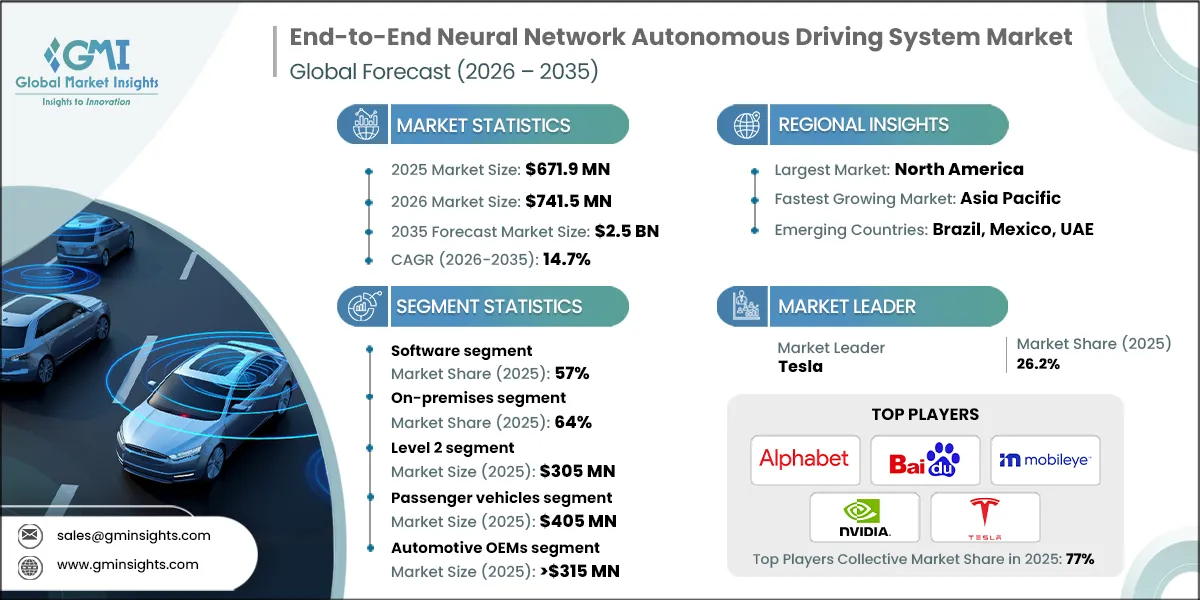
The global end-to-end neural network autonomous driving system market size was valued at USD 671.9 million in 2025. The market is expected to grow from USD 741.5 million in 2026 to USD 2.5 billion in 2035, at a CAGR of 14.7%, according to latest report published by Global Market Insights Inc.
End-to-End Neural Network Autonomous Driving System Market Key Takeaways
Market Size & Growth
- 2025 Market Size: USD 671.9 Million
- 2026 Market Size: USD 741.5 Million
- 2035 Forecast Market Size: USD 2.5 Billion
- CAGR (2026–2035): 14.7%
Regional Dominance
- Largest Market: North America
- Fastest Growing Region: Asia Pacific
Key Market Drivers
- Growing adoption of autonomous vehicles.
- Advancements in AI & deep learning.
- Increasing investment in sensor technologies & onboard computing.
- Rising demand for safer and more efficient mobility.
Challenges
- Regulatory and safety concerns.
- High development and deployment costs.
Opportunity
- Expansion of autonomous fleets & robotaxis.
- Cloud-based AI training & OTA updates.
Key Players
- Market Leader: Tesla led with over 26.2% market share in 2025.
- Leading Players: Top 5 players in this market include Alphabet, Baidu, Mobileye, NVIDIA, Tesla, which collectively held a market share of 77% in 2025.
Get Market Insights & Growth Opportunities
The end-to-end neural network autonomous driving system market is projected to witness strong growth in the coming years, driven by the increasing adoption of autonomous vehicles, growing demand for safer and more efficient mobility solutions, and rising investments in AI-powered vehicle technologies. As OEMs and mobility service providers expand deployment of autonomous system across multiple regions, they increasingly prioritize real-time decision-making, operational safety, energy efficiency, and seamless vehicle control, making advanced end-to-end neural network solutions essential for fully autonomous driving capabilities.
Technological advancements such as onboard AI processing, deep learning neural networks, sensor fusion, real-time perception-to-action pipelines, and cloud-based model training are transforming traditional autonomous driving system. These innovations enable end-to-end vehicle intelligence across perception, decision-making, and control functions, while improving accuracy, reducing latency, enhancing adaptability to complex driving environments, and lowering development costs.
In 2025, leading players including Tesla, NVIDIA, Alphabet (Waymo), Baidu Apollo, Mobileye, XPeng, and Huawei Technologies expanded their end-to-end autonomous driving capabilities through investments in next-generation neural network architectures, high-performance automotive AI chips, simulation-driven training, and large-scale fleet data learning.
These companies focused on advancing Level 2+, Level 3, and Level 4 autonomy across passenger vehicles, robotaxis, and commercial fleets while enhancing safety validation and regulatory readiness. For instance, in March 2025, Tesla broadened the rollout of its Full Self-Driving (FSD) V12 software across the United States, strengthening its end-to-end neural network approach that directly maps camera inputs to driving controls, reducing dependency on rule-based planning stacks.
The end-to-end neural network autonomous driving system ecosystem continues to evolve as AI, software-defined vehicle platforms, sensor technologies, and cloud-scale data training reshape vehicle intelligence. Industry participants are increasingly adopting integrated, AI-native autonomous driving platforms that improve driving safety, optimize vehicle energy consumption, minimize operational risks, and support scalable autonomous deployment.
In June 2025, Waymo expanded its commercial robotaxi services into additional U.S. metropolitan areas, leveraging enhanced end-to-end neural network decision system to improve real-time driving performance in dense urban environments. These developments are redefining the end-to-end neural network autonomous driving system market, enabling more intelligent, adaptive, and autonomous mobility across global automotive and transportation sectors.
To get key market trends
End-to-End Neural Network Autonomous Driving System Market Trends
The demand for advanced end-to-end neural network autonomous driving system is rapidly increasing, driven by growing collaboration among automotive OEMs, mobility service providers, AI software vendors, semiconductor companies, and regulatory authorities. These partnerships aim to enhance real-time vehicle intelligence, safety, operational efficiency, and compliance with evolving autonomous driving regulations. Stakeholders are working together to develop integrated, modular, and data-driven AI platforms incorporating deep learning perception models, reinforcement learning for decision-making, sensor fusion, cloud-based training, and OTA software update capabilities.
For instance, in 2024, leading companies such as Tesla, NVIDIA, Waymo, Baidu, Mobileye, and XPeng strengthened strategic collaborations with automakers, mobility fleets, and technology partners to deploy real-time autonomous driving solutions, AI-powered perception and planning system, cloud-trained neural networks, and high-performance compute platforms. These initiatives improved driving accuracy, response time, safety validation, and adaptability across diverse traffic and environmental conditions.
Regional customization of end-to-end neural network autonomous driving platforms has emerged as a key trend. Leading providers are developing localized perception models, region-specific mapping data, and jurisdiction-aware regulatory compliance frameworks across North America, Europe, Asia Pacific, Latin America, and the Middle East & Africa. These solutions support country-specific traffic laws, safety standards, infrastructure constraints, and data privacy regulations, tailored to the operational realities of autonomous vehicle deployments.
The rise of specialized AI software providers, mobility startups, and automotive tech companies offering simulation-based training, predictive control, cloud-to-vehicle model updates, and AI-enabled fleet optimization dashboards is reshaping the competitive landscape. Companies focused on workflow automation, neural network optimization, and scalable AI compute architectures are enabling cost-effective deployment of advanced end-to-end autonomous driving system. These innovations empower both established players and emerging entrants to improve vehicle intelligence, strengthen safety compliance frameworks, and accelerate adoption of autonomous mobility solutions globally.
The development of standardized, modular, and interoperable AI platforms is transforming the market. Leading players such as Tesla, NVIDIA, Waymo, Mobileye, and Baidu are deploying unified AI architectures that integrate seamlessly with vehicle control system, sensors, cloud computing platforms, simulation frameworks, and mobility management software. These platforms support customizable neural network pipelines, real-time decision-making, multi-vehicle scalability, and regulatory compliance, enabling OEMs and fleet operators to achieve efficient, safe, and technology-driven autonomous driving operations across global automotive and mobility networks.
End-to-End Neural Network Autonomous Driving System Market Analysis
Learn more about the key segments shaping this market
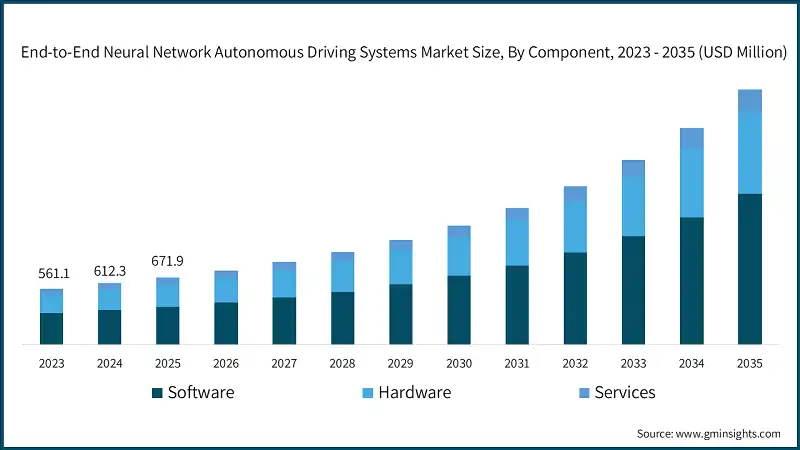
Based on components, the end-to-end neural network autonomous driving system market is divided into software, hardware and services. The software segment dominated the market, accounting for around 57% share in 2025 and is expected to grow at a CAGR of over 15.2% from 2026 to 2035.
- The software segment dominates the end-to-end neural network autonomous driving system industry, primarily due to its critical role in enabling real-time perception, decision-making, and control in autonomous vehicles. Software solutions, including deep learning neural networks, sensor fusion algorithms, planning and control modules, and AI frameworks, allow vehicles to process raw sensor data and execute driving actions accurately and safely. OEMs, mobility service providers, and autonomous fleet operators particularly rely on comprehensive software platforms that integrate seamlessly with vehicle sensors, AI chips, and cloud-based training infrastructures.
- The hardware segment includes sensors such as LiDAR, radar, and cameras, along with GPUs, AI accelerators, and onboard computing platforms that support software execution, while the services segment comprises simulation, cloud-based model training, validation, OTA software updates, and technical support. Although both segments are essential for system deployment, their influence remains secondary to software, as differentiation increasingly comes from AI models rather than physical components. For instances, in January 2025, NVIDIA began large-scale automotive deployments of its DRIVE Orin platform, providing hardware support for multiple OEMs, but positioning the AI software stack as the primary value layer.
- Continuous advancements in AI model development, neural network architectures, cloud-based training, and modular software frameworks further reinforce the dominance of the software segment, enabling OEMs and fleet operators to deploy scalable, reliable, and high-performance autonomous driving system across diverse vehicle types and operating environments.
Learn more about the key segments shaping this market
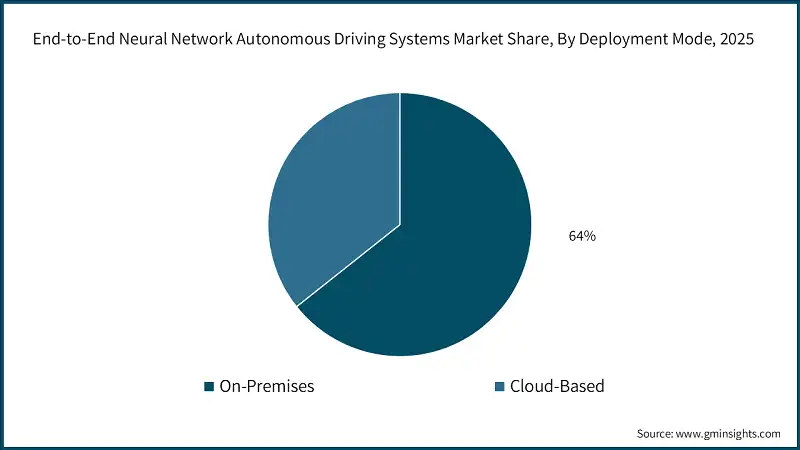
Based on deployment mode, the end-to-end neural network autonomous driving system market is divided into on-premises and cloud-based. The on-premises segment dominates the market, accounting for around 64% share in 2025, and the segment is expected to grow at a CAGR of over 13.8% from 2026 to 2035.
- The on-premises segment dominates the end-to-end neural network autonomous driving system industry due to its strong adoption among OEMs, mobility service providers, and autonomous fleet operators that require ultra-low latency, enhanced data security, and full control over vehicle AI system.
- On-premises solutions allow vehicles to process real-time sensor data, neural network inference, and driving decisions locally without relying on network connectivity, ensuring safety, reliability, and compliance with regulatory standards. The high computational requirements, safety-critical nature, and complexity of autonomous driving workflows make on-premises deployments the preferred choice for advanced end-to-end system.
- The cloud-based segment is gaining traction, particularly for model training, OTA updates, fleet learning, and simulation, due to its scalability, centralized computing power, and ease of deployment. Cloud solutions enable continuous improvement of neural network models, remote updates, and collaborative data processing. However, latency concerns, dependence on network availability, and safety-critical constraints continue to encourage OEMs and fleet operators to favor on-premises system, enabling this deployment mode to retain its dominant position in the market.
Based on level of automation, the end-to-end neural network autonomous driving system market is divided into Level 2, Level 3, Level 4 and Level 5. The Level 2 segment dominated the market and was valued at USD 305 million in 2025.
- The Level 2 segment dominates the end-to-end neural network autonomous driving system industry due to its balance of automation and human oversight, making it suitable for passenger vehicles, commercial fleets, and mobility service deployments that require reliable control over driving operations.
- Level 2 autonomy typically includes advanced driver-assistance features, lane keeping, adaptive cruise control, and partial automated decision-making, while still allowing human intervention for complex scenarios and emergency situations. This combination ensures safe, real-time vehicle operation while maintaining flexibility for diverse driving environments and regulatory compliance.
- Higher autonomy levels, including Level 3, Level 4, and Level 5, offer fully automated perception, decision-making, and vehicle control, enabling robotaxis, autonomous freight, and urban mobility services. While these levels significantly improve operational efficiency and reduce human intervention, adoption remains largely limited to controlled deployments due to regulatory, infrastructure, and safety validation constraints. For instance, in June 2025, Waymo expanded its Level 4 robotaxi operations to additional U.S. metropolitan areas, operating fully driverless vehicles under defined conditions, while Baidu Apollo continued Level 4 pilot programs in multiple Chinese cities during 2025.
- Continuous innovations such as cloud-based neural network training, AI-powered decision algorithms, and OTA model updates are gradually enabling higher autonomy levels. However, Level 2 remains the most widely implemented due to its optimal balance of automation, control, scalability, and cost-effectiveness, reinforcing its dominant position in the global end-to-end neural network autonomous driving system industry.
Based on vehicles, the end-to-end neural network autonomous driving system market is divided into passenger vehicles and commercial vehicles. The passenger vehicles segment dominated the market and was valued around at USD 405 million in 2025.
- The passenger vehicles segment dominates the end-to-end neural network autonomous driving system industry due to the high volume of passenger vehicles, widespread adoption of advanced driver-assistance system (ADAS), and rapid integration of autonomous features in consumer cars. OEMs and mobility service providers in this segment require end-to-end neural network solutions to manage real-time perception, decision-making, and control, ensuring safe and efficient vehicle operation in diverse driving environments. The scale of passenger vehicle deployment, frequent urban driving scenarios, and regulatory safety requirements make this segment the primary adopter of comprehensive autonomous driving system.
- The commercial vehicles segment, which includes trucks, buses, and delivery fleets, also contributes to market growth by adopting autonomous driving solutions for fleet management, route optimization, and operational efficiency. However, commercial vehicles generally have lower deployment volumes and slower adoption of fully integrated end-to-end neural network system compared to passenger vehicles, resulting in comparatively lower market penetration. For instance, In June 2025, Baidu Apollo introduced Level 4 autonomous delivery vans in select Chinese cities, enabling driverless freight movement with AI-based perception and route planning.
Based on end use, the end-to-end neural network autonomous driving system market is divided into automotive OEMs, fleet operators, mobility service providers and others. The automotive OEMs segment dominated the market and was valued at over USD 315 million in 2025.
- The automotive OEMs segment dominates the end-to-end neural network autonomous driving system industry due to the large scale of operations, multi-model vehicle production, and complex autonomous driving requirements associated with original equipment manufacturing and distribution. OEMs require advanced end-to-end neural network system to manage real-time perception, decision-making, control, safety compliance, and vehicle integration. The need for accurate, reliable, and scalable AI-driven driving solutions makes automotive OEMs the primary adopters of comprehensive autonomous driving platforms.
- Fleet operators, mobility service providers, and other end users also contribute to market growth by adopting end-to-end autonomous system for robotaxi fleets, delivery vehicles, and last-mile mobility services, improving operational efficiency, safety, and route optimization. However, these segments generally have smaller vehicle volumes and less complex deployment requirements compared to OEMs, resulting in comparatively lower adoption of fully integrated end-to-end neural network system.
- Continuous innovations such as cloud-based model training, OTA updates, AI-driven simulation, and real-time fleet analytics are gradually being adopted across fleet operators and mobility providers. Nevertheless, the automotive OEM segment retains its dominant position due to scale, operational complexity, and widespread adoption of advanced, technology-driven autonomous driving solutions globally.
Looking for region specific data?
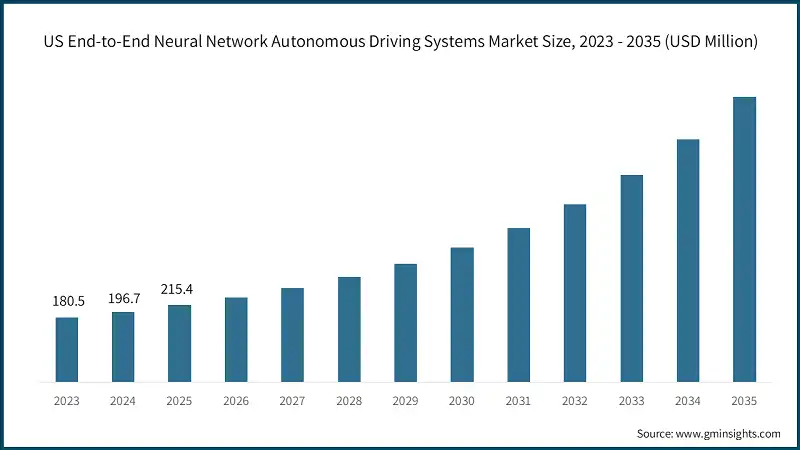
In 2025, US dominated the North America end-to-end neural network autonomous driving system market with around 83% market share and generated approximately USD 215.4 million in revenue.
- North America dominates the market, supported by a mature automotive ecosystem, advanced OEM operations, and widespread adoption of technology-driven autonomous driving solutions. The region benefits from early implementation of high-performance AI platforms, end-to-end neural network system, real-time perception-to-action pipelines, and seamless integration with vehicle hardware and cloud-based model training, positioning it as a global leader in safe, efficient, and reliable autonomous vehicle operations.
- Within North America, the United States accounts for the largest share, driven by a high concentration of OEMs, advanced mobility service providers, strong regulatory frameworks, and significant investment in AI-enabled autonomous driving technologies. Widespread adoption of onboard neural network computing, real-time sensor fusion, OTA software updates, and large-scale autonomous fleet deployment fuels market growth. Major automotive hubs such as Detroit, Silicon Valley, Los Angeles, and Austin serve as key centers for technology development, vehicle integration, and autonomous system deployment.
- Leading U.S. players, including Tesla, NVIDIA, Waymo, Mobileye, and GM Cruise, continue to expand their end-to-end neural network autonomous driving portfolios, enhance AI-driven perception and decision-making capabilities, and strengthen collaborations with OEMs, mobility operators, and technology partners. Ongoing investments in deep learning frameworks, high-performance compute platforms, simulation-based training, and vehicle-to-cloud integration consolidate the U.S.’s dominant position in the North American market.
Germany holds share of 21% in Europe end-to-end neural network autonomous driving system market in 2025 and it will grow tremendously between 2026 and 2035.
- Europe accounted for a significant share of the end-to-end neural network autonomous driving system industry, supported by a mature automotive ecosystem, leading OEMs, and growing adoption of AI-powered autonomous driving solutions. Vehicle manufacturers, fleet operators, and regulatory authorities across the region focus on operational efficiency, vehicle safety, real-time perception, and compliance with autonomous driving standards. Well-established automotive regulations, advanced IT and automotive R&D infrastructure, and rising demand for scalable, reliable, and integrated end-to-end neural network system reinforce Europe’s position as a key regional market.
- Germany dominated the Europe end-to-end neural network autonomous driving system industry, driven by its strong automotive industry, concentration of advanced OEMs, technological maturity, and robust safety and regulatory standards. German automakers and technology providers are leading in the deployment of AI-powered perception system, neural network-based decision-making, cloud-assisted model training, and full vehicle integration.
- Investments in workflow automation, modular AI software architectures, and high-performance onboard computing platforms have strengthened operational efficiency, improved vehicle autonomy, and accelerated market growth, positioning Germany as the regional leader.
- Other major European countries, including the United Kingdom, France, and the Netherlands, are contributing to regional market expansion through adoption of neural network-based autonomous driving system, cloud simulation platforms, and integrated vehicle AI solutions. The UK emphasizes fleet and multi-location OEM deployments, France focuses on safety compliance and regulatory integration, and the Netherlands prioritizes smart mobility solutions and real-time vehicle intelligence. Despite varying adoption levels, Germany maintains its leading role in scale, technological innovation, and comprehensive end-to-end autonomous driving system deployment across Europe.
China holds share of 20% in Asia Pacific end-to-end neural network autonomous driving system market in 2025 and it is expected to grow tremendously between 2026 and 2035.
- Asia-Pacific holds a major share of the end-to-end neural network autonomous driving system industry, supported by rapid adoption of AI-driven autonomous vehicle technologies, expansion of mobility services, and increasing focus on vehicle safety, real-time decision-making, and regulatory compliance. The region is witnessing steady growth as OEMs, fleet operators, and technology providers invest in deep learning neural networks, sensor fusion, cloud-based model training, and integrated end-to-end vehicle AI system. Strong IT infrastructure, large-scale vehicle production, and supportive government regulations continue to strengthen Asia-Pacific’s position in the global market.
- China represents the largest market in Asia-Pacific, driven by widespread adoption of cloud-assisted model training, neural network-based perception and control system, simulation platforms, and OTA software updates.
- Major automotive and mobility hubs such as Shanghai, Beijing, Guangzhou, and Shenzhen are experiencing high demand for autonomous passenger vehicles, robotaxis, and commercial fleets equipped with end-to-end neural network system. Government support, technological maturity, and strong collaborations between OEMs, mobility providers, and AI technology vendors further accelerate the deployment of advanced autonomous driving solutions across public and commercial operations.
- Other Asia-Pacific markets, including India, Japan, and South Korea, are emerging as high-growth regions, supported by increasing adoption of autonomous driving software, AI-powered perception system, and cloud-to-vehicle updates. India emphasizes small and mid-sized fleet deployments, Japan focuses on regulatory compliance and safety validation, and South Korea prioritizes multi-location fleet operations and high-tech mobility services. Despite growing adoption in these countries, China remains the dominant market in Asia-Pacific, driven by scale, technological innovation, and strong enterprise and regulatory support.
End-to-End neural network autonomous driving system market in Brazil will experience significant growth between 2026 and 2035.
- Latin America holds a smaller share but is steadily expanding its presence in the end-to-end neural network autonomous driving system industry, driven by growing adoption of autonomous vehicle technologies, increasing investment in AI-driven vehicle intelligence, real-time decision-making system, operational efficiency, and rising demand for scalable, end-to-end neural network platforms.
- OEMs, fleet operators, and technology vendors across the region are gradually deploying deep learning perception models, cloud-assisted model training, OTA updates, and integrated vehicle AI system. Strengthening regulations, expanding mobility services, and improving IT and automotive infrastructure continue to support Latin America’s growing role in the global autonomous driving market.
- Brazil dominates the Latin America market, supported by its large automotive industry, growing adoption of AI-powered perception and decision-making system, neural network-based vehicle control, and cloud-integrated autonomous driving platforms, and focus on multi-vehicle fleet operations.
- Major automotive hubs such as São Paulo, Rio de Janeiro, and Brasília host extensive OEM operations and autonomous vehicle deployments, where companies implement high-performance AI compute platforms, real-time sensor fusion, simulation-driven neural network training, and end-to-end vehicle intelligence solutions. Leading players, including Tesla, NVIDIA, Mobileye, Waymo, and Baidu, actively offer scalable, AI-driven, and technology-enabled autonomous driving system to support Brazil’s dominant position in the regional market.
- Mexico represents the second largest and rapidly growing market, driven by increasing adoption of autonomous vehicle technologies, fleet expansion, and deployment of real-time perception, predictive control, and cloud-enabled model updates. Key automotive centers such as Mexico City, Monterrey, and Guadalajara are witnessing higher implementation of end-to-end neural network platforms, contributing to the overall growth and modernization of Latin America’s market, while Brazil continues to maintain its leading role.
End-to-End neural network autonomous driving system market in UAE will experience significant growth between 2026 and 2035.
- Latin America holds a smaller share but is steadily expanding its presence in the market, driven by growing adoption of autonomous vehicle technologies, increasing investment in AI-driven vehicle intelligence, real-time decision-making system, and operational efficiency, and rising demand for scalable, end-to-end neural network platforms.
- OEMs, fleet operators, and technology vendors across the region are gradually deploying deep learning perception models, cloud-assisted model training, OTA updates, and integrated vehicle AI system. Strengthening regulations, expanding mobility services, and improving IT and automotive infrastructure continue to support Latin America’s growing role in the global autonomous driving market.
- Brazil dominates the Latin American market, supported by its large automotive industry, growing adoption of AI-powered perception and decision-making system, neural network-based vehicle control, and cloud-integrated autonomous driving platforms, and focus on multi-vehicle fleet operations.
- Major automotive hubs such as São Paulo, Rio de Janeiro, and Brasília host extensive OEM operations and autonomous vehicle deployments, where companies implement high-performance AI compute platforms, real-time sensor fusion, simulation-driven neural network training, and end-to-end vehicle intelligence solutions. Leading players, including Tesla, NVIDIA, Mobileye, Waymo, and Baidu, actively offer scalable, AI-driven, and technology-enabled autonomous driving system to support Brazil’s dominant position in the regional market.
- Mexico represents the second largest and rapidly growing market, driven by increasing adoption of autonomous vehicle technologies, fleet expansion, and deployment of real-time perception, predictive control, and cloud-enabled model updates. Key automotive centers such as Mexico City, Monterrey, and Guadalajara are witnessing higher implementation of end-to-end neural network platforms, contributing to the overall growth and modernization of Latin America’s autonomous driving system market, while Brazil continues to maintain its leading role.
End-to-End Neural Network Autonomous Driving System Market Share
The top 7 companies in the market are Tesla, NVIDIA Corporation, Alphabet Inc. (Waymo), Baidu (Apollo), Mobileye (Intel Corporation), XPeng Motors and Huawei Technologies. These companies hold around 80% of the market share in 2025.
- Tesla is a leading provider of end-to-end neural network autonomous driving system, offering comprehensive solutions for real-time perception, decision-making, and vehicle control. Tesla leverages camera-based neural networks, deep learning perception models, OTA updates, and full self-driving (FSD) software to enhance driving safety, operational efficiency, and autonomous capabilities. Its extensive fleet data, strong OEM integration, and scalable software platforms reinforce its market leadership in passenger and fleet vehicles globally.
- NVIDIA Corporation delivers AI-driven autonomous driving solutions through its DRIVE platform, focusing on high-performance compute, neural network training, and perception-to-control pipelines. NVIDIA leverages GPUs, deep learning frameworks, simulation tools, and cloud-assisted training to enable OEMs and mobility providers to deploy scalable, end-to-end neural network system. Its hardware-software co-design, global technology leadership, and partnerships with automakers strengthen its competitive position in the market.
- Alphabet Inc. (Waymo) offers enterprise-grade autonomous driving system emphasizing robotaxi and mobility services. Waymo leverages sensor fusion, deep learning-based decision-making, simulation-driven model training, and cloud-connected vehicle platforms to ensure safety, real-time intelligence, and operational efficiency. Its early market adoption, regulatory expertise, and fleet-scale deployment capabilities reinforce its leadership in urban autonomous mobility.
- Baidu (Apollo) provides AI-powered end-to-end autonomous driving system focused on urban and highway mobility. Baidu leverages neural network perception, LiDAR-camera fusion, cloud-based model training, and OTA software updates to optimize vehicle intelligence and decision-making. Its strong OEM collaborations, government support, and regional deployment expertise strengthen its position as a leading provider in the Chinese and Asia-Pacific markets.
- Mobileye (Intel Corporation) delivers autonomous driving solutions centered on ADAS and full autonomy, leveraging EyeQ AI chips, neural network perception, real-time decision-making, and camera-radar fusion system. Mobileye’s deep automotive expertise, global OEM partnerships, and scalable AI platforms support deployment across multiple vehicle types, enhancing safety and operational efficiency.
- XPeng Motors provides end-to-end autonomous driving solutions focused on passenger vehicles, combining neural network-based perception, planning modules, AI-powered decision-making, and OTA updates. XPeng leverages real-world vehicle data, advanced driver-assistance system (XPilot), and cloud-integrated model training to enhance safety, vehicle intelligence, and autonomous driving performance. Its regional presence in China and growing fleet deployments support its expanding market share.
- Huawei Technologies offers AI-driven autonomous driving system emphasizing vehicle intelligence, connectivity, and smart mobility solutions. Huawei leverages neural network-based perception, cloud-assisted neural model training, AI chips, and sensor integration to deliver scalable end-to-end system. Strong partnerships with OEMs and mobility providers, combined with expertise in 5G, edge computing, and cloud integration, strengthen Huawei’s competitive position in Asia-Pacific and global autonomous driving markets.
End-to-End Neural Network Autonomous Driving System Market Companies
Major players operating in the end-to-end neural network autonomous driving system industry include:
- Alphabet
- Aurora Innovation
- Baidu
- Cruise (GM)
- Huawei Technologies
- Mobileye
- NVIDIA
- Tesla
- XPeng Motors
- Zoox (Amazon)
- The End-to-End neural network autonomous driving system market is highly competitive, with leading solution providers such as Tesla, NVIDIA, Waymo, Baidu, Mobileye, XPeng Motors, Huawei Technologies, Aurora Innovation, Cruise (GM), and Zoox (Amazon) occupying key segments across perception, decision-making, control, sensor integration, and cloud-based neural network training.
- Tesla, NVIDIA, Waymo, and Baidu lead the market with comprehensive end-to-end autonomous driving system, integrating deep learning perception, neural network decision-making, real-time control, cloud-assisted training, and OTA updates. These companies focus on enhancing driving accuracy, operational efficiency, safety, and scalability across passenger vehicles, commercial fleets, and mobility services globally.
- Mobileye, XPeng Motors, Huawei, Aurora, Cruise, and Zoox specialize in flexible, scalable, and technology-driven autonomous driving platforms, emphasizing AI-powered perception, reinforcement learning, simulation-based validation, modular software architecture, and real-time vehicle-to-cloud integration. Their solutions enable efficient vehicle autonomy, improved safety, cost-effective deployment, and data-driven decision-making across small to large fleets and diverse geographies.
End-to-End Neural Network Autonomous Driving System Market Report Attributes
| Key Takeaway | Details |
|---|---|
| Market Size & Growth | |
| Base Year | 2025 |
| Market Size in 2025 | USD 671.9 Million |
| Market Size in 2026 | USD 741.5 Million |
| Forecast Period 2026 - 2035 CAGR | 14.7% |
| Market Size in 2035 | USD 2.5 Billion |
| Key Market Trends | |
| Drivers | Impact |
| Growing adoption of autonomous vehicles | OEMs and mobility service providers are increasingly deploying AI-driven vehicles. |
| Advancements in AI & deep learning | Neural networks enable real-time perception-to-action pipelines, improving driving safety and efficiency |
| Increasing investment in sensor technologies & onboard computing | High-performance GPUs, AI chips, LiDAR, and radar support end-to-end system |
| Rising demand for safer and more efficient mobility | Consumers and fleets prioritize collision avoidance, energy efficiency, and autonomous assistance |
| Pitfalls & Challenges | Impact |
| Regulatory and safety concerns | Limited government approvals for full autonomy slow large-scale adoption. |
| High development and deployment costs | End-to-end neural network system requires massive datasets, high computing power, and expensive sensors. |
| Opportunities: | Impact |
| Expansion of autonomous fleets & robotaxis | End-to-end system can capture growing mobility service and commercial vehicle markets. |
| Cloud-based AI training & OTA updates | Continuous model improvements and fleet learning create new business models and service revenue streams |
| Market Leaders (2025) | |
| Market Leaders |
26.2% market share |
| Top Players |
|
| Competitive Edge |
|
| Regional Insights | |
| Largest Market | North America |
| Fastest growing market | Asia Pacific |
| Emerging countries | Brazil, Mexico, UAE |
| Future outlook |
|
What are the growth opportunities in this market?
End-to-End Neural Network Autonomous Driving System Industry News
- In March 2025, Tesla, Inc. launched an upgraded end-to-end neural network autonomous driving system featuring enhanced neural network perception, AI-driven decision-making, real-time vehicle control, and OTA software updates. The initiative aims to improve autonomous driving accuracy, operational safety, fleet scalability, and real-time data-driven decision-making across passenger vehicles and fleet deployments globally.
- In February 2025, NVIDIA Corporation introduced new enhancements to its DRIVE AI platform, integrating high-performance GPUs, simulation-based model training, cloud-assisted neural network updates, and automated perception pipelines. The rollout focuses on accelerating autonomous vehicle deployment, enhancing real-time decision-making, and supporting OEMs and mobility service providers worldwide.
- In January 2025, Waymo (Alphabet Inc.) unveiled a next-generation autonomous driving solution incorporating reinforcement learning, AI-powered fleet management, predictive routing, and fully integrated perception-to-control modules. The initiative targets robotaxi fleets and urban mobility services, enabling safer, more efficient, and scalable autonomous operations.
- In December 2024, Baidu (Apollo) expanded its end-to-end neural network autonomous driving platform with cloud-assisted training, LiDAR-camera fusion, real-time decision-making, and OTA updates. The deployment aims to support large-scale fleet operations, improve driving safety, and enhance autonomous capabilities in China and APAC markets.
- In October 2024, Mobileye (Intel), XPeng Motors, and Huawei Technologies launched integrated end-to-end autonomous driving system featuring AI-powered perception, predictive planning, sensor fusion, real-time control, and cloud-based neural network updates. The initiative emphasizes scalable deployment, operational efficiency, and advanced autonomous driving performance across passenger vehicles, commercial fleets, and mobility services globally.
The end-to-end neural network autonomous driving system market research report includes in-depth coverage of the industry with estimates & forecasts in terms of revenue ($ Mn) from 2022 to 2035, for the following segments:
Market, By Component
- Software
- Perception
- Decision
- Control
- Hardware
- Sensors
- GPU
- AI Chips
- Services
Market, By Level of Automation
- Level 2
- Level 3
- Level 4
- Level 5
Market, By Deployment Model
- On-Premises
- Cloud-Based
Market, By Vehicle
- Passenger vehicles
- Hatchbacks
- Sedans
- SUV
- Commercial vehicles
- Light commercial vehicles (LCV)
- Medium commercial vehicles (MCV)
- Heavy commercial vehicles (HCV)
Market, By End Use
- Automotive OEMs
- Fleet Operators
- Mobility Service Providers
- Others
The above information is provided for the following regions and countries:
- North America
- US
- Canada
- Europe
- UK
- Germany
- France
- Italy
- Spain
- Belgium
- Netherlands
- Sweden
- Asia Pacific
- China
- India
- Japan
- Australia
- Singapore
- South Korea
- Vietnam
- Indonesia
- Latin America
- Brazil
- Mexico
- Argentina
- MEA
- South Africa
- Saudi Arabia
- UAE
Frequently Asked Question(FAQ) :
What is the market size of the end-to-end neural network autonomous driving system in 2025?
The market was valued at USD 671.9 million in 2025, growing at a CAGR of 14.7% from 2026 to 2035, driven by increasing investment in sensor technologies and onboard computing.
What is the projected value of the end-to-end neural network autonomous driving system market by 2035?
The market is expected to reach USD 2.5 billion by 2035, led by rising adoption of autonomous vehicles and AI-powered mobility solutions.
What is the expected size of the end-to-end neural network autonomous driving system industry in 2026?
The market size is projected to reach USD 741.5 million in 2026.
How much revenue did the software segment generate in 2025?
The software segment dominates, accounting for around 57% share in 2025 and is expected to grow at a CAGR of over 15.2% till 2035.
What was the valuation of the On-premises solutions segment in 2025?
On-premises solutions hold the largest share at 64% in 2025 and is set to expand at a CAGR of over 13.8% up to 2035.
What is the growth outlook for the Level 2 segment from 2026 to 2035?
Level 2 autonomy dominates, valued at USD 305 million in 2025, offering a balance of automation and human oversight suitable for passenger vehicles and fleets.
Which region leads the end-to-end neural network autonomous driving system sector?
North America leads the market, with the U.S. holding about 83% share and generating USD 215.4 million in 2025.
What are the upcoming trends in the end-to-end neural network autonomous driving system market?
Major trends include OEM–AI collaborations, cloud-trained end-to-end neural networks, OTA updates, and region-specific autonomous driving platforms.
Who are the key players in the end-to-end neural network autonomous driving system industry?
Key players include Tesla, NVIDIA Corporation, Alphabet Inc. (Waymo), Baidu (Apollo), Mobileye (Intel Corporation), XPeng Motors and Huawei Technologies.
End-to-End Neural Network Autonomous Driving System Market Scope
Related Reports