Summary
Table of Content

Elevator Ropes Market
Get a free sample of this report
Form submitted successfully!
Error submitting form. Please try again.
Thank you!
Your inquiry has been received. Our team will reach out to you with the required details via email. To ensure that you don't miss their response, kindly remember to check your spam folder as well!
Request Sectional Data
Thank you!
Your inquiry has been received. Our team will reach out to you with the required details via email. To ensure that you don't miss their response, kindly remember to check your spam folder as well!
Form submitted successfully!
Error submitting form. Please try again.
Elevator Ropes Market Size
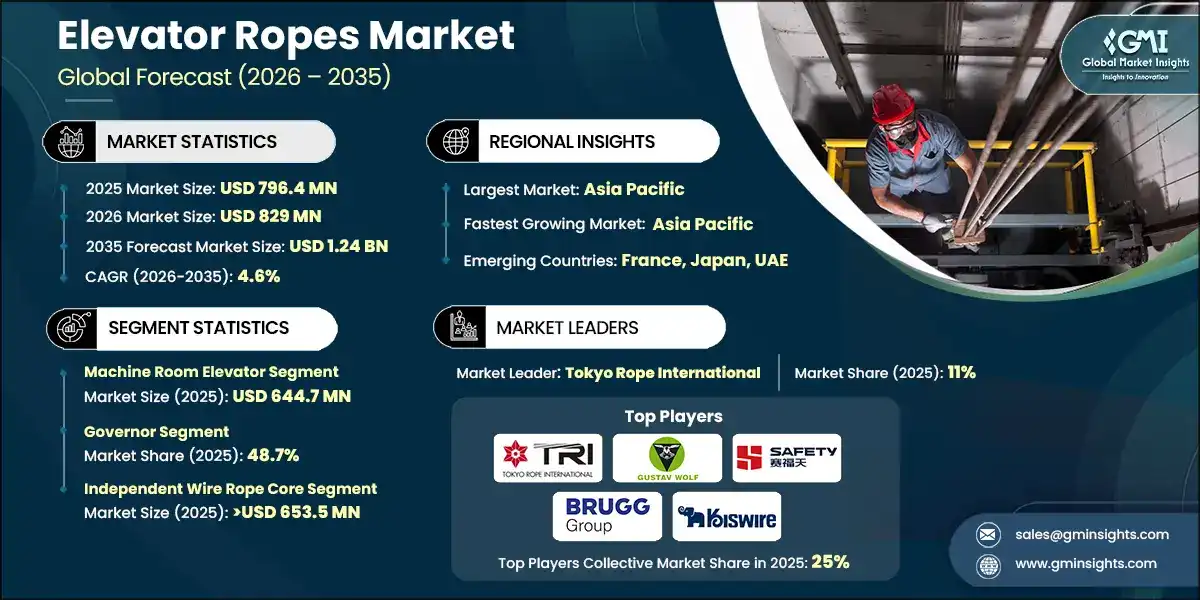
The elevator ropes market was estimated at USD 796.4 million in 2025. The market is expected to grow from USD 829 million in 2026 to USD 1.24 billion in 2035, at a CAGR of 4.6% according to latest report published by Global Market Insights Inc.
Elevator Ropes Market Key Takeaways
Market Size & Growth
- 2025 Market Size: USD 796.4 Million
- 2026 Market Size: USD 829 Million
- 2035 Forecast Market Size: USD 1.24 Billion
- CAGR (2026–2035): 4.6%
Regional Dominance
- Largest Market: Asia Pacific
- Fastest Growing Region: Asia Pacific
Key Market Drivers
- Surging urbanization & high?rise construction.
- Modernization of aging infrastructure.
- Expansion of commercial spaces.
Challenges
- Emergence of rope-less elevator systems.
- Maintenance complexity.
Opportunity
- Smart ropes with IoT monitoring.
- Advanced materials adoption.
Key Players
- Market Leader: Tokyo Rope International led with over 11% market share in 2025.
- Leading Players: Top 5 players in this market include Tokyo Rope International, Gustav Wolf, Jiangsu Safety Steel Wire Rope, Brugg Group, KISWIRE, which collectively held a market share of 25% in 2025.
Get Market Insights & Growth Opportunities
Rapid urbanization drives many of the world's markets to build increasingly tall buildings and skyscrapers. As cities grow upward to house increasing numbers of residents on a limited amount of land, the demand for elevator systems, and by extension, their associated ropes, has also risen sharply. Most high-rise buildings and structures require rope systems that can withstand the increased loads and travelled distances, and therefore, it is important for these ropes to have high-strength qualities, be extremely durable, and meet all applicable safety standards. In addition, current infrastructure projects being conducted by local governments as well as smart city initiatives help drive the continued need for advanced, efficient elevator systems, which are part of the initiative's efforts to develop modern, highly efficient, vertical transportation systems.
The result of urbanization is an increasing number of developers who have begun focusing their development efforts on producing premium quality residential and commercial spaces that will include elevators that are both fast and dependable. Therefore, there is an opportunity for elevator rope manufacturers to advance their development and production efforts using lightweight, highly performing material in conjunction with technology, such as smart monitoring, which will increase both safety and decrease maintenance costs associated with elevator’s use. As urban populations continue to grow, elevator ropes will continue to be a vital component of providing the smoothest, safest and most efficient method of vertical transportation in these buildings and structures.
The existing stock of elevators in developed areas such as North America and Europe represent a major source of replacement business. Many of these elevators are reaching their end-of-life (approximately ten years) and need to be modernized or retrofitted. Assets that are nearing the end of their useful life create a higher potential for safety hazards and operational inefficiency; therefore, the building owners and facilities will radically modify or upgrade the elevator systems to ensure that they alee to the regulatory requirements as well as meet the end-users/as per industry standards.
In addition to improving the safety of elevators, modernization projects have increasingly focused on the improvement of energy efficiency, ride comfort and connectivity via technology. Therefore, rope producers have an opportunity to produce innovative products that assist in these areas, particularly ropes that are smart connected and/or environmentally friendly with sustainability in mind. Digitalization will continue to play a large role in building modernization planning, thus creating a stable and lucrative market segment for rope suppliers on a global basis.
To get key market trends
Elevator Ropes Market Trends
There are several factors contributing to the increased growth of the elevator rope market including rapid urbanization of the world, technological advances in the design and manufacturing processes of elevation systems, increased recognition of the need for high-rise buildings around the world, and increasing innovations being developed by manufacturers such as lightweight, high-strength ropes, and eco-friendly materials, intended to improve safety, extend the life of the product, and conserve energy. Also, regulations require the use of safety equipment to protect workers and people who use elevators.
- Urbanization worldwide is steadily increasing, with Asia-Pacific and the Middle East experiencing the fastest growth, especially in the areas of megacities that continually grow. The rise of high-rise and super tall buildings has resulted in higher densities of these buildings in major cities, which means that more efficient land use must be provided. These taller buildings will require a high level of advanced technology in their elevators, such as being able to take very heavy loads and travel long distances; therefore, it creates a high level of demand for ropes with extremely high tensile strength, high fatigue resistance and low elongation. Most of these developments also support the growing trend in our cities of mixed-use skyscrapers where the combination of living, working and hospitality spaces creates a significant increase in elevator ride per day.
- Conventional steel cables have gradually been supplanted or supplemented by more advanced materials that include aramid fiber and hybrid composites. Superior strength-to-weight ratios, resistance to corrosion, and lower vibration have helped improve ride comfort and energy efficiency. Additionally, manufacturers are integrating smart technology into cables, such as sensors that track the amount of tension, wear, and elongation in the cables to allow predictive maintenance and to minimize the amount of time that a cable is out of service. Both of these trends support the growing use of connected elevators that have incorporated IoT technology and are being installed in upscale commercial and residential buildings.
- In mature markets such as North America and Europe, many of the existing elevator systems are old and require modernization to bring them into compliance with current safety and performance standards. This trend to upgrade elevator systems is also leading to the introduction of advanced design rope systems that incorporate new traction systems and provide additional sustainability benefits. Additionally, many projects that involve replacing existing rope systems with new rope designs require that the new systems include digital control ("DCS") capabilities as well as regenerative drive systems, creating an attractive aftermarket business opportunity for rope manufacturers.
- With the increase in global safety regulatory requirements like EN 81 (Europe) and ASME A17.1 (North America), there has been an increase in pressure on manufacturers to develop and implement comprehensive quality control and testing protocols. Manufacturers who comply with these regulations ensure that they produce ropes that can handle extreme stress levels without experiencing catastrophic breakage, and that they can maintain a constant level of performance throughout their extended life cycles. Additionally, new sustainability-based regulations are encouraging that recyclable material will be used in the manufacture of ropes, as well as the development of environmentally friendly coatings, which have in turn influenced all facets of the industry as they relate to product development.
Elevator Ropes Market Analysis
Learn more about the key segments shaping this market
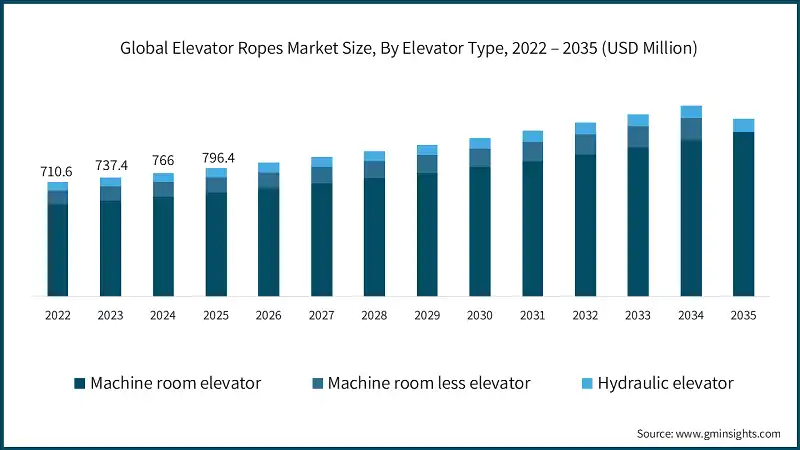
Based on elevator type, the market is divided into machine room elevator, machine room less elevator and hydraulic elevator. The machine room elevator generated a revenue of USD 644.7 million in 2025.
- The MR elevators represent a typical type of traction elevator system with dedicated machine rooms located either at the top or side of the hoist and contain all items required to operate a traction machine including major components of the traction machine; motor; control panel and drive systems. The existence of a separate machine room facilitates maintenance/ repair operations, a significant advantage to tenants and owners of the building. As such, mid-high-rise buildings generally utilize MR elevators as they allow for larger size motors and up-to-date control systems, making them ideal for heavy loads, fast travel and as an overall efficient elevator.
- Many of the design benefits of MR elevators over compact models derive from the combination of sufficient space for all major components within the machine room, as opposed to having an insufficient amount of space for some components which would restrict the maximum speed and load that compact alternatives are capable of delivering. Commercial towers, hotels and apartment buildings with long vertical travel distances require a high load capacity coupled with increased speeds. MR elevators typically employ a steel wire rope drive system with independent wire rope core (IWRC) for strength and are coupled to a counterweight system to make the elevator operate smoothly, improve energy efficiency, and have enhanced safety and leveling which are extremely important qualities to provide for increase traffic volume.
- MR (machine-room) elevators have higher construction expenses and a lesser degree of design flexibility than other types of elevators due to their requirements for greater amounts of space within the building and on the structure, machine-room elevators are still used frequently for commercial settings that demand maximum durability, reliability, and ease of upkeep. Many times, MR elevators are selected to be installed in high-rise and/or heavy-duty applications because they are regarded as the most dependable type of elevator in terms of delivering performance and safety. However, the additional footprint of a machine room limits the potential for space savings when designing any type of facility where maximizing building space is important.
Learn more about the key segments shaping this market
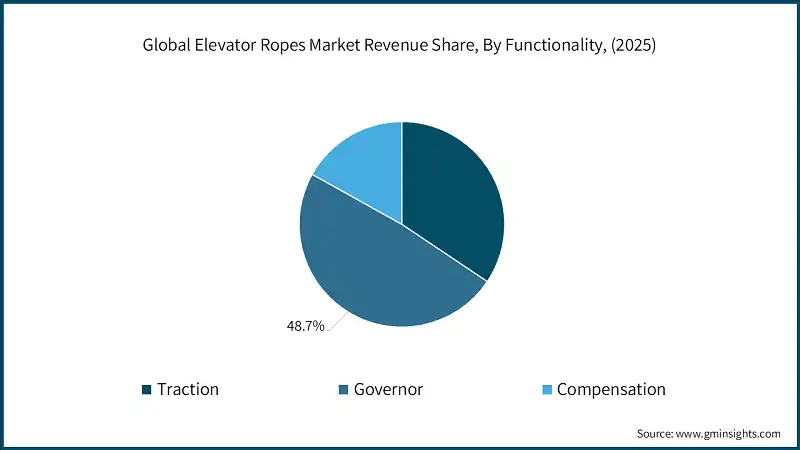
Based on functionality, the elevator ropes market is segmented into traction, governor and compensation. The governor segment held about 48.7% of the market share in 2025.
- A governor is the most important element in the elevator system from a safety standpoint and is responsible for keeping track of how fast the elevator car is travelling and for slowing down or stopping the car when it goes above the maximum allowable speed. When the elevator travels too fast, the governor will engage the elevator's safety mechanisms and bring the elevator to a stop, thereby preventing an uncontrolled fall. It is because of this danger that governor and safety mechanisms are mandated for all elevators and establish them as an integral part of the global elevator ropes market.
- Traction and governor ropes serve two different purposes. Traction ropes support the weight of the elevator as well as provide a way to deliver power and movement to the elevator system. Governor ropes relay information about the speed of the elevator car to the governor device. The diameter of governor ropes is generally smaller than traction ropes, and governor ropes are not designed to support large weights. They are designed for extreme flexibility and to be made from material that allows for precise operation, not large loads. The materials used to make governor ropes are typically steel wire, either with a core of fibers or wire, ensuring that the governor rope is durable and operates smoothly in all conditions. The ability to maintain a governor rope's performance directly affects the ability to maintain the performance of the safety system.
- As the demand for governor ropes is driven primarily by the modernization of elevators, there has been a large increase in consumers wanting to conform to regulations and comply with safety requirements. As a result, new and retrofit elevator installations are being completed with higher-quality governor rope, which is less sensitive to price fluctuations than traction rope due to the critical nature of governor ropes to safety and therefore require premium certification and quality. Due to the focus on safety and reliability as well as regulations governing these products, governor ropes represent a niche specialty within the elevator rope industry rather than being impacted by the price optimization strategy of other types of elevator rope.
Based on core type, the elevator ropes market is segmented into fiber core and independent wire rope core. The independent wire rope core segment exceeded USD 653.5 million in 2025.
- Independent Wire Rope Core (IWRC), in the elevator industry, refers to how roofs are constructed with a wire-rope core that is independent of any fiber-based cores. IWRC construction provides a significant strength and load-bearing advantage as well as anti-compression properties compared to fibers. IWRC roofs consist of numerous wire strands helical wrapped around a steel core, so they exhibit greater endurance and stability when under intense tension. IWRC roofs are especially well suited to very heavy-duty elevators (i.e., high-rise elevator applications) because the characteristic of both strength and durability enhances the reliable performance of these types of elevators.
- An IWRC rope's principal advantage is its ability to maintain shape and tensile strength even when subjected to extreme stress. As a result, IWRC ropes experience considerably less elongation and wear fiber-woven ropes over time. Therefore, IWRC ropes are uniquely suited to new or modernizing elevator projects where either a substantial weight or speed amount is present. Although IWRC ropes are considerably pricier than fiber-based ropes, the longer lifespan and supplementary safety of IWRC ropes warrants any excess expense. IWRC ropes also inherently resist the effects of environmental factors like humidity and heat, making them a preferred choice of ropes in most modern-day elevator installations.
Looking for region specific data?
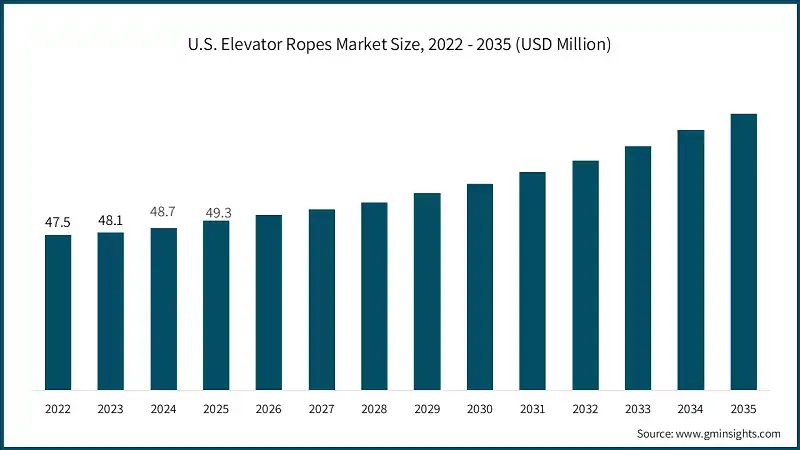
The U.S dominated around 77.9% share of the North America elevator ropes market with around USD 49.3 million revenue in 2025.
- As industries move quickly toward more energy efficient and sustainable methods of operation, the U.S. high-speed blower market is similarly evolving in response. The wastewater treatment industry is currently the primary source of use for Elevator Ropes, due to the increased demand associated with more stringent environmental regulations in addition to the requirement for more efficient methods of providing aeration. However, high speed blower systems have now begun to be utilized by many different industries including chemical processing, oil and gas and power generation. These industries are beginning to employ advanced blower technologies to reduce operating and maintenance costs while increasing system reliability.
- The North American Marketplace, which includes the United States, Canada, represents a convergence of modernization and new building trends, as well as urban redevelopment & high-rise residential development in Canada and economic development-driven increased commercial development. In North America, enhanced energy-efficiency and compliance with safety regulations have become the primary drivers of advanced-performing ropes & environmentally sound ropes being accepted by users throughout the region.
- As such, the aftermarket segment for the assessment, analysis and replacement of rope replacement services and predictive maintenance has also seen tremendous growth due to the introduction of IoT sensors and smart monitoring systems. All the above-listed variables collectively represent North America as a leading center in the creation of new technology and premium elevator rope solutions.
Europe elevator ropes market, UK leads the market 21% share in 2025 and is expected to grow at 2.9% CAGR during the forecast period.
- In Europe, there are many influences affecting the development of the elevator rope market. These influences include strict government safety regulations, modernization of aging infrastructure, and increased adoption of energy efficient elevator systems. countries such as Germany, France and the United Kingdom are leading retrofitting projects within existing buildings to meet EN 81 Safety Standards as well as becoming more sustainable in their buildings. As high-rise development continues to increase in major city areas, there is a demand for more advanced traction ropes with higher performance characteristics. The focus on eco-friendly materials as well as the ability to recycle elevator ropes has an impact on product development and has marked Europe as the leading region for sustainable elevator rope solutions.
- Modernization is still the main catalyst for growth in Europe as there are still a high percentage of elevator installations within both residential buildings and commercial buildings that were installed several decades ago. The trend towards machine-room-less (MRL) elevators, in addition to integrated IoT enabled systems, has opened new avenues for manufacturers of rope products and the development of compact designs and predictive maintenance systems. Countries in Southern Europe, specifically Spain and Italy, will see additional construction volume for hospitality and mixed-use developments, while countries in Eastern Europe will emerge as strong growth areas because of the rapid growth in urban populations and the ongoing improvements in their infrastructure systems. Therefore, Europe will remain focused on the importance of safety, sustainability, and technology, thus allowing it to retain its position as an established, yet innovative market for the manufacture of elevator ropes globally.
The Asia Pacific leads the elevator ropes market; China leads with market share of around 22.9% in 2025 and is anticipated to grow with a CAGR of around 6.4% from 2026 to 2035.
- The elevator rope market is growing rapidly, as Asia-Pacific is becoming the biggest and fastest-growing market for this product due to increasing population density and the need for higher-density structures in countries such as China, India, Japan, and Southeast Asia. Demand for high-rise, commercial, residential, industrial, and mixed-use buildings, coupled with the need for smart cities and mega-city developments, will continue to drive the development of advanced traction cables designed to handle heavy loads and longer lengths. There is also a growing trend toward MRL and IoT-based elevators, which are helping industry professionals identify the best materials to provide maximum tensile strength, lightweight composition, and integrated sensor systems for predictive maintenance.
- The support of government-sponsored housing and commercial growth initiatives, along with an increase in investment in high-end commercial real estate and mixed-use high-rises, continues to contribute to the development of this region. In addition, APAC is characterized by a competitive marketplace consisting of both global and regional companies that concentrate on low-cost/high-quality products. Emerging trends toward sustainability are also evident in higher interest in recycling and energy-efficient elevators; thus, APAC has become the fastest-growing and most technologically advanced market worldwide.
Latin America elevator ropes markets are growing at a CAGR of 4.8% during the forecast period.
- Urbanization and modernization projects in Brazil, Mexico, Argentina, and other countries throughout Latin America are continuing to drive the steady growth of the elevator rope market in that region. The trend of increased construction activity within commercial buildings, hotels, and residential high-rise towers is continuing to create demand for traction ropes and compensation ropes. The modernization of older elevator systems located within urban centers and compliance with national and international elevator safety codes are creating opportunities for the sale of premium quality elevator ropes.
- Positive economic growth and increased infrastructure development within LATAM will continue to support the adoption of newer, improved elevator technology, specifically machine room-less elevators, which will have an impact on future design and material development for elevator rope systems. In addition, the growth of aftermarket products, such as replacement ropes and predictive maintenance systems, is helping to create a culture of increased safety and efficiency among building owners. In addition, the gradual alignment of regulations in LATAM with international standards will contribute to the continued growth of the elevator rope market in Latin America.
Elevator Ropes Market Share
Gustav Wolf is leading with 11% market share. Gustav Wolf, Tokyo Rope International, Jiangsu Safety Steel Wire Rope, Brugg Group, KISWIRE collectively hold around 25%, indicating moderately fragmented market concentration. These prominent players are proactively involved in strategic endeavors, such as mergers & acquisitions, facility expansions & collaborations, to expand their product portfolios, extend their reach to a broad customer base, and strengthen their market position.
Bekaert provides a wide array of advanced steel wire transformation and coating products to customers in many different markets, including the elevator ropes segment, where Bekaert provides Steel Wire Ropes that are designed to withstand the rigors of repeated use and the element of corrosion while remaining performance based. With years of experience in metallurgical processes and surface treatments, Bekaert’s steel wire rope products meet and exceed the most stringent safety and performance requirements imposed upon the modern elevator industry, including high rise and heavy-duty elevator applications.
Gustav Wolf is one of the world’s leading manufacturers of steel wire rope products, focusing on manufacturing products specifically for elevator applications. The range of products manufactured by Gustav Wolf includes traction ropes, governor ropes and compensating ropes that are designed specifically for use in the growing number of MRL (room-less machines) and high-rise elevator installations. Because of its strong emphasis on precision engineering and compliance with international quality standards, Gustav Wolf GmbH has positioned itself as a world-class supplier of products that provide long-term service life, high-strength and fatigue-resistant products. As a manufacturer to elevator OEM’s and as a key supplier to elevator modernization contractors, Gustav Wolf GmbH has earned a reputation among elevator professionals as the supplier of choice for leading-edge elevator systems.
Elevator Ropes Market Companies
Major players operating in the elevator ropes industry are:
- Bekaert
- Brugg Group
- DSR Wire
- Fasten Group
- Gustav Wolf
- Jiangsu Safety Steel Wire Rope
- Jiangsu Shenwang Group Wire Rope
- KISWIRE
- PFEIFER DRAKO Drahtseilwerk
- Redaelli Tecna
- Teufelberger Wire Rope
- Tianjin Goldsun Wire Rope
- Tokyo Rope International
- Usha Martin
- WireCo World Group
Usha Martin, which has a broad presence as one of the largest wire rope manufacturers in the world, is a key player in the manufacture of elevator ropes. Usha Martin produces traction, governor, and compensation elevator ropes that are manufactured under strict international standards for safety and quality. Usha Martin's emphasis on using advanced steel grades; the organization tests its ropes using rigorous fatigue testing; and the manufacturer's dimensional stability of the ropes provide assurance that they will withstand the rigorous of use in high-speed and tall building elevators.
Jiangsu Safety Steel Wire Rope commonly referred to as Safety Group, is a major manufacturer of elevator ropes in Asia. The company manufactures traction, governor and compensation elevator ropes for major global brands. In addition, Safety Group emphasizes high-strength, corrosive-resistance and compliance with ISO and other international standards. Safety Group utilizes advanced manufacturing processes and quality control systems to produce elevator ropes suited for use in high-rise, intelligent and smart elevator systems. The company is well established in the Asia Pacific region and is associated with many established OEMs, so it occupies a leading position in the rapidly growing elevator market in Asia.
Elevator Ropes Market Report Attributes
| Key Takeaway | Details |
|---|---|
| Market Size & Growth | |
| Base Year | 2025 |
| Market Size in 2025 | USD 796.4 Million |
| Market Size in 2026 | USD 829 Million |
| Forecast Period 2026 - 2035 CAGR | 4.6% |
| Market Size in 2035 | USD 1.24 Billion |
| Key Market Trends | |
| Drivers | Impact |
| Surging urbanization & high?rise construction | High-rise buildings and urban development have led to increased needs for stronger and longer-lasting elevator ropes for use in urban areas, where elevators are now required to move people up and down. |
| Modernization of aging infrastructure | The demand for improved elevator ropes to replace obsolete elevator systems presents significant aftermarket opportunities for manufacturers of advanced elevator ropes that conform to existing technology requirements as well as established safety and energy management practices. |
| Expansion of commercial spaces | Developing new office space with towers, shopping centers, and mixed-use developments will lead to an increased number of elevator installations and an expanded demand for elevator ropes. |
| Pitfalls & Challenges | Impact |
| Emergence of rope-less elevator systems | The emergence of rope-free elevators is likely to be a long-term threat to rope-based manufacturers due to cars that dont use ropes in future tall buildings due to decreased demand. |
| Maintenance complexity | Ropes are continuously checked for repairs and replaced regularly, making them cumbersome and costly for building owners; therefore, manufacturers are motivated to innovate the development of long-lasting and low-maintenance products. |
| Opportunities: | Impact |
| Smart ropes with IoT monitoring | IoT sensors integrated into elevator ropes will allow real-time monitoring of the ropes wear and tension, resulting in improved safety and decreased downtime due to predictive maintenance. |
| Advanced materials adoption | Switching to more lightweight and environmentally sustainable materials that resist corrosion has led to innovations in the design of elevator ropes that result in improved performance while continuing to support sustainable construction practices. |
| Market Leaders (2025) | |
| Market Leaders |
11% market share |
| Top Players |
|
| Competitive Edge |
|
| Regional Insights | |
| Largest market | Asia Pacific |
| Fastest growing market | Asia Pacific |
| Emerging countries | France, Japan, UAE |
| Future outlook |
|
What are the growth opportunities in this market?
Elevator Ropes Industry News
- In November 2025, Gustav Wolf demonstrated new offerings at Interlift 2025, including elevator traction media for new builds, modernization and service applications. This exhibit included a number of new elevator rope technologies specifically tailored to provide better performance, safety and environmental sustainability. New compact and durable designs are suitable for the needs of high-rise and intelligent building projects. Thus, these advances demonstrate Gustav Wolf's commitment to technological development in the area of energy efficient products that are necessary for tomorrow's elevator systems.
- In August 2023, Jiangsu Safety Steel Wire Rope exhibited a new 8×19S-CGSFG Fiber-Core Elevator Rope during WEE 2023. This product was specifically developed to be used in mid-rise elevators that move at a maximum speed of 6 m/s. The product is engineered to offer enhanced flexibility and durability, and it complies with relevant international safety requirements. The launch of this product demonstrates Jiangsu Safety Steel Wire Rope's commitment to continued innovation that will meet the needs of modern elevator systems as they continue to evolve.
- In July 2023, At the World Elevator & Escalator Expo (WEE 2023), Bekaert presented its Flexisteel coated traction elevator ropes. These ropes consist of a polymer coated fine steel cord and have a smaller diameter of 6.5 mm than that of conventional ropes which have a diameter of 11.9 mm. The Flexisteel ropes weigh up to 30% less than their comparable conventional counterparts, are more fatigue resistant, and are ideal for modern day elevator systems which are often constrained by limited space. In addition to their primary functions, Flexisteel elevating systems are intended to provide efficient energy use during operation and less maintenance over the life of the product, and therefore, provide for a smoother form of operation in a high-rise application.
The elevator ropes market research report includes in-depth coverage of the industry with estimates & forecasts in terms of revenue (USD Million) and volume (Thousand Units) from 2022 to 2035, for the following segments:
Market, By Elevator Type
- Machine room (MR) elevator
- Machine room less (MRL) elevator
- Hydraulic elevator
Market, By Functionality
- Traction/Hoist
- Governor
- Compensation
Market, By Core Type
- Fiber core (FC)
- Independent wire rope core (IWRC)
Market, By Price
- Low
- Medium
- High
Market, By End Use
- Residential
- Commercial
- Industrial
Market, By Distribution Channel
- Direct sales
- Indirect sales
The above information is provided for the following regions and countries:
- North America
- U.S.
- Canada
- Europe
- Germany
- UK
- France
- Italy
- Spain
- Asia Pacific
- China
- India
- Japan
- Australia
- South Korea
- Latin America
- Brazil
- Mexico
- Argentina
- Middle East and Africa
- South Africa
- Saudi Arabia
- UAE
Frequently Asked Question(FAQ) :
What was the market size of the elevator ropes market in 2025?
The market size was USD 796.4 million in 2025, with a CAGR of 4.6% expected through 2034 driven by rapid urbanization and the rise of tall buildings globally.
What is the projected value of the elevator ropes market by 2035?
The elevator ropes market is expected to reach USD 1.24 billion by 2035, supported by infrastructure projects and smart city initiatives.
What is the expected market size of the elevator ropes market in 2026?
The market size is projected to reach USD 829 million in 2026.
How much revenue did the machine room elevator segment generate in 2025?
The machine room elevator segment generated USD 644.7 million in 2025, dominating the elevator type category.
What was the valuation of the governor segment in 2025?
The governor segment held 48.7% market share in 2025, highlighting its critical role in elevator safety systems.
What is the growth outlook for the Latin America elevator ropes market during the forecast period?
The Latin America elevator ropes market is projected to grow at a CAGR of 4.8% from 2026 to 2035, supported by urbanization and modernization projects.
Which region dominated the North America elevator ropes market in 2025?
The U.S. dominated the North America elevator ropes market with a 77.9% share, generating USD 49.3 million in revenue in 2025.
What are the upcoming trends in the elevator ropes market?
Key trends include the demand for high-strength, durable ropes, modernization of older elevator systems, and compliance with safety standards.
Who are the key players in the elevator ropes market?
Key players include Bekaert, Brugg Group, DSR Wire, Fasten Group, Gustav Wolf, Jiangsu Safety Steel Wire Rope, Jiangsu Shenwang Group Wire Rope, KISWIRE, PFEIFER DRAKO Drahtseilwerk, Redaelli Tecna, Teufelberger Wire Rope, Tianjin Goldsun Wire Rope, Tokyo Rope International, Usha Martin, and WireCo World Group.
Elevator Ropes Market Scope
Related Reports