Summary
Table of Content

Electric Household Appliances Market
Get a free sample of this report
Form submitted successfully!
Error submitting form. Please try again.
Thank you!
Your inquiry has been received. Our team will reach out to you with the required details via email. To ensure that you don't miss their response, kindly remember to check your spam folder as well!
Request Sectional Data
Thank you!
Your inquiry has been received. Our team will reach out to you with the required details via email. To ensure that you don't miss their response, kindly remember to check your spam folder as well!
Form submitted successfully!
Error submitting form. Please try again.
Electric Household Appliances Market Size
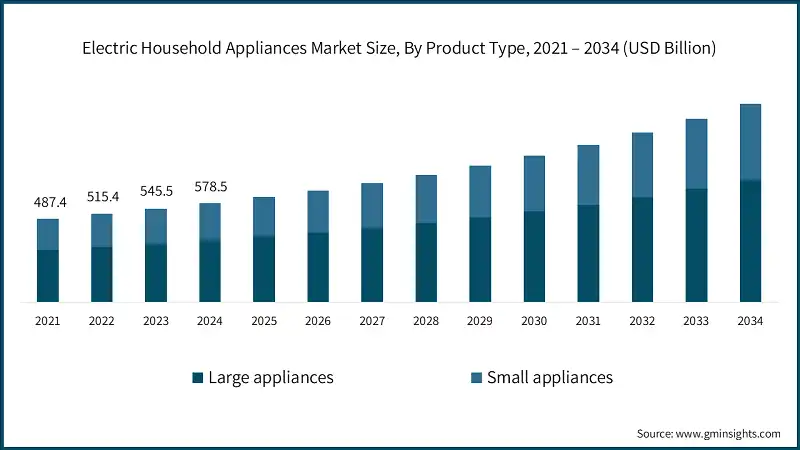
The electric household appliances market was estimated at USD 578.5 billion in 2024. The market is expected to grow from USD 613.7 billion in 2025 to USD 1.15 trillion in 2034, at a CAGR of 7.3%, according to latest report published by Global Market Insights Inc.
Electric Household Appliances Market Key Takeaways
Market Size & Growth
- 2024 Market Size: USD 578.5 Billion
- 2025 Market Size: USD 613.7 Billion
- 2034 Forecast Market Size: USD 1.15 Trillion
- CAGR (2025–2034): 7.3%
Regional Dominance
- Largest Market: Asia Pacific
- Fastest Growing Region: Asia Pacific
Key Market Drivers
- Technological advancements.
- Urbanization & changing lifestyles.
- Rising disposable income.
Challenges
- High initial costs.
- Regulatory complexity.
Opportunity
- Smart & connected appliances.
- Energy-efficient & sustainable solutions.
Key Players
- Market Leader: Haier Group led with over 5.6% market share in 2024.
- Leading Players: Top 5 players in this market include Haier Group, LG Electronics, Electrolux AB, Samsung Electronics, Whirlpool, which collectively held a market share of 15% in 2024.
Get Market Insights & Growth Opportunities
The electric household appliance industry is changing rapidly with technological innovations. Smart features with IoT connectivity, AI-driven automation, and voice control are redefining the convenience and efficiency of the user experience. The innovations integrate equipment with smart home ecosystems to facilitate remote monitoring, predictive maintenance, and personalized settings. Manufacturers are ensuring energy-efficient technologies are a top priority for sustainability objectives and compliance with environmental regulations as a valuable consumer selling point.
Manufacturers are leveraging advanced sensor capabilities and machine-learning algorithms to improve performance and durability. For instance, refrigerators are able to adjust cooling temperatures based upon usage, so as to provide optimal cooling, and washing machines introduced a learning capability to recommend water and detergent levels for specified loads. These new functionalities make the user experience more convenient and provide differentiation in a competitive appliance industry. As consumer habits continue to be driven by convenience, sustainability, and connectivity to technology, it can be expected that technological advancement will continue driving consumer demand in the electric household appliance category.
Urbanization is growing significantly around the world. As the number of dwellings becomes smaller, appliances are being designed smaller, have more than one use, and/or are multi-functional. In urban markets, your typical consumer is looking for space-saver products with multi-functionality like washer-dryer combinations and smart kitchen appliances. The growth of dual-income households, combined with busy domestic lives, has further fueled demand for time-saving solutions, and therefore increased the consumption of automated and smart appliances that require lower levels of manual input and improved time efficiency.
A growing consumer preference for modern design, aesthetics, and more premium features is also shaping product design and innovation. Urban consumers will purchase appliances that suit the aesthetics of their modern home, while still providing advanced appliance performance. This trend is increasingly pronounced in emerging economies, where increasing disposable income and aspirational lifestyles are contributing to premium and luxury appliance demand. All of these factors indicate that urbanization and evolving lifestyles represent very real growth opportunities for appliance manufacturers in developing new products to meet the new needs of consumers in this space.

To get key market trends
Electric Household Appliances Market Trends
The electric household appliances industry is undergoing a transformative shift, responding to advances in technology, sustainable practices, and changing lifestyles. The increasing emphasis by manufacturers on smart technology, energy efficiency, and compactness, aims to meet the challenges of urbanization and sustainability. Digital retailing is adjusting consumer purchasing behavior in conjunction with post-pandemic priorities, generating new interest in premium and multifunctional kitchen products.
- IoT and artificial intelligence fully blended into household appliances is a game changer to enhance interactivity and efficiency. Smart appliances will connect to the home network, and users will have the ability to remotely control them via smartphone apps and voice digital assistants (e.g., Alexa or Google Home). Appliances now include regular predictive maintenance alerts, energy usage reports, and user-directed features based on user behavior. As more smart homes become widely adopted and consumers are increasingly inclined towards technology for their experience and convenience, smart appliances are rising.
- Environmental issues and escalating energy prices are motivating manufacturers to develop appliances that require less energy and are made from sustainable materials. Governments around the world are establishing incentives and regulations to encourage the adoption of sustainably efficient products, for example, star ratings and green certifications. Sustainability already is, and will increasingly be, important to consumers, and energy-efficient appliances will not only become a mandatory requirement, but a source of differentiation for brands.
- Urbanization has generated smaller homes and businesses, creating a need for compact but multifunctional appliances. Washer dryer combos, kitchen modulars, stacked appliances, and foldable appliances are also on the rise. These appliance designs are meant to consider small space without reducing functionality for urbanite living and young working professionals who desire functional and aesthetically pleasing appliances.
- The growth of online shopping has changed how customers buy appliances. By utilizing virtual showrooms, augmented reality previews, and product videos, customers can do most of their shopping online without ever entering a store. Suppliers are increasingly investing in omnichannel options to provide ease in online shopping paired with in-store service and support.
Electric Household Appliances Market Analysis
Learn more about the key segments shaping this market
Based on product type, the electric household appliances market is divided into large appliances and small appliances. In 2024, large appliances held the major market share, generating a revenue of USD 361.7 billion.
- The large appliance segment, which includes refrigerators, washing machines, air conditioners, and ovens, represents the largest share of total revenue in the electric household appliances market. The necessary nature of an appliance means they are a priority class of purchase, even in an unfavorable economy. The segment experience replacement cycles and upgrades as customers move toward more energy-efficient and smart appliances to decrease utility costs and for better convenience.
- The large appliance category is swiftly embracing cutting-edge technologies like Internet of Things connectivity, artificial intelligence controls, and energy optimization features. Smart refrigerators with touch screens, washing machines that operate based on an app, and air conditioners equipped with climate sensors are becoming commonplace. Premiumization is also apparent, as consumers are leaning toward appliances with aesthetically pleasing designs, multi-functional features, and sustainability benefits, which is driving margins up for manufacturers.
- Increasing disposable income and urbanization in the developing markets are creating a favorable environment for large appliances. Growing housing developments and government initiatives to electrify are also contributing to increased demand from more households. To appeal to the growing middle-class, manufacturers are targeting food and beverages with products designed locally, marketed competitively, and made available for retail financing.
Learn more about the key segments shaping this market
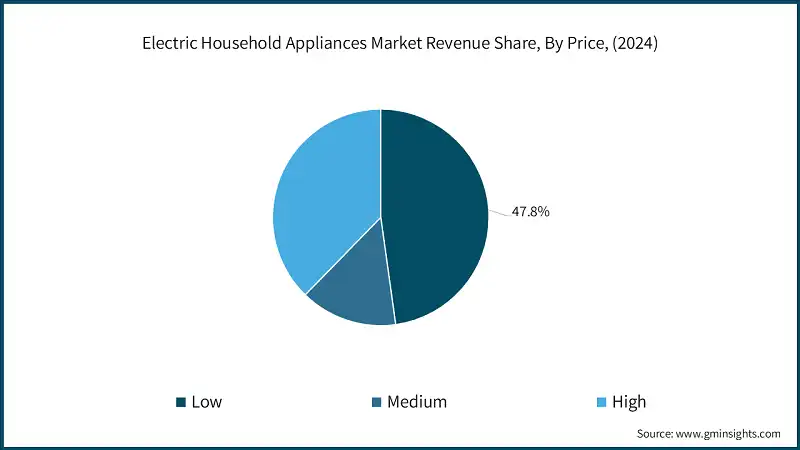
Based on price, the electric household appliances market is segmented into low, medium and high. The low-price segment held the largest share, accounting for 47.8% of the market in 2024.
- The low-price segment finds its market primarily from highly price sensitive consumers, particularly in emerging markets and rural areas, which will prioritize price above advanced features. In this case basic functionality and durability make for the bestselling points. This segment will typically drive high volumes of sales given that entry level boxes such as basic fans, irons, and simple kitchen appliances are perceived to be essential in the household.
- The low-cost appliance industry's commoditized characteristics create significant competition amongst local and regional vendors. For manufacturers, there is pressure to minimize costs while still maintaining acceptable quality standards, resulting in increasingly thin margins and continual price competition which make operational efficiencies and supply chain management requirements crucial to success in this segment.
- Low margins mean that there is a significant growth opportunity in the segment due to economies of scale and local product strategies. The brands that localize the designs of the products to regional preferences provide affordable finance options and utilize distribution networks in rural environments can truly capture market share. Continuing government support to electrify developing areas also creates an easier means to expand the low-cost appliance customer base.
Based on distribution channel, the electric household appliances market is segmented into online and offline. In 2024, offline distribution channel held a major market share, generating a revenue of USD 396.1 billion.
- Offline retail continues to be the primary channel, due to the ability to experience a product before purchasing, along with the ability to speak to other people for support. Consumers are more inclined to visit brick-and-mortar stores for large or high-priced appliances, when the factor of assessing product quality, product comparison, and informative advice from knowledgeable associates weighs into the mind of the consumer. Experience is valuable and builds trust within consumers, especially first-time purchasers or when a consumer is making a sizable purchase for a premium product.
- Physical stores also provide consumers with immediate access to the purchased product, as well as the traditional after-sale service of installation and warranty repair, which many consumers insist on. Many like the convenience of seeing the appliance demonstrated in store with the companionship of a representative for an instant resolution if any are experienced. Many retailers also market financing aspects and extended warranties to a sale that provides further appeal to offline channels for high-priced appliances.
Looking for region specific data?
North America Electric Household Appliances Market
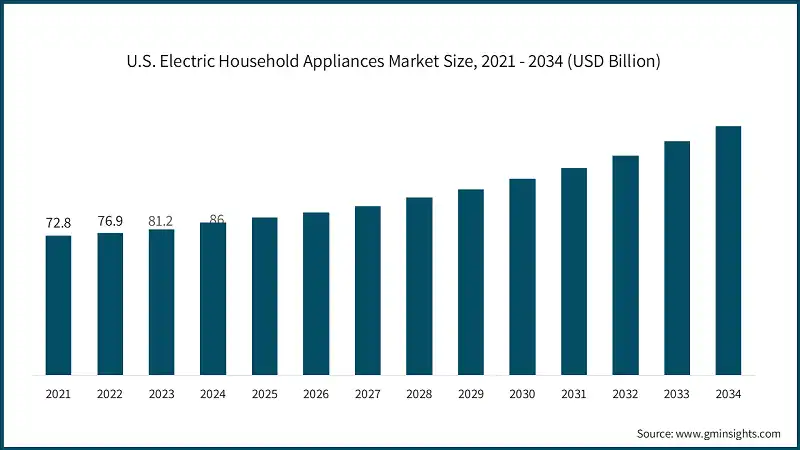
In 2024, the U.S dominated the North America market, accounting for around 66.8% and generating around USD 86 Billion revenue in the same year.
- The market for electric household appliances in the United States is witnessing a rapid surge in popularity, continued consumer preference for smart, eco-friendly devices is creating demand, fueled by improvements in technology, as IoT-capable appliances, and newly developed AI-based controls change household management of daily tasks. In addition, sustainability, renewable products, and government-supported energy standards have also spurred existing consumer demand for environmentally friendly models. Along with consumer lifestyle changes, like increased home renovations/remodeling and spending more time at home, are all contributing to the surrounding demand for premium appliance offerings. The introduction of omnichannel retail and e-commerce models are making it easier for consumers to shop, and accordingly the U.S. is the leading marketplace for high-tech appliance adoption.
- The North American market is rapidly expanding, bolstered by high levels of consumer spending power and general consumer comfort with connected technology. An increase in environmental awareness and increasing energy regulations lead manufacturers to innovate with sustainable designs. New digital retail channels and shopping experiences, including virtual showrooms, are changing buying behavior. North America will continue to be a key region for the premium appliance segment and technology adoption, with the US at the forefront, followed closely by Canada and Mexico.
Europe Electric Household Appliances Market
Europe market, Germany leads the market with 26.8% share in 2024 and is expected to grow at 7.6% during the forecast period.
- The European electric household appliances market is consistently growing, owing to a very supportive demand from consumers for energy efficient and sustainable products, as well as environmental policies and regulations that are forcing manufacturers to innovate with low-energy and recyclable materials, such as its eco-design directives. Consumers in Europe are very aware of sustainability issues, and certified green or energy rated products are generally a key factor in purchasing decisions. The European continent is also notable for having typically mature infrastructures with high penetration of broadband internet and this has driven the adoption of connected devices, or smart appliances, particularly in Western Europe.
- Premiumization is another key trend, as consumers are usually willing to spend on advanced features, design, and connectivity. Retail shopping is changing, driven by online shopping and omnichannel approaches which make shopping more convenient and price focused. In addition, the uptick in home renovations and government incentives towards appliances that are energy-efficient are providing manufacturers with the opportunities to expand their presence in this regulated but attractive segment.
Asia Pacific Electric Household Appliances Market
The Asia Pacific leads the market; China leads with market share of around 35.9% in 2024 and is anticipated to grow with a CAGR of around 8% from 2025 to 2034.
- Asia-Pacific is the largest and fastest-growing region in the market, driven by rapid urbanization, rising disposable incomes, and a burgeoning middle class. The demand for both large and small appliances is increasing in China, India, and Southeast Asian countries as standard of living increases. The strong manufacturing base and cost advantages of the region have established the APAC region as a center of appliance manufacturing, allowing manufacturers to sell at low prices and deliver to wide areas of availability. Increased electrification in rural areas and government-sponsored programs for energy-efficient appliances are further supporting market growth.
- In the APAC region, consumer preference has changed toward smart and multifunctional appliances driven by high penetration of smartphones and increased interest in connected home solutions. For example, compact design appliances are becoming more popular in big cities, where space is limited. There is an increasing role of e-commerce to access appliances with reduced price and delivery barriers. There is rising awareness of sustainability, with manufacturers also offering eco-friendly models, responding to these requests. These factors, along with positive economic growth and ongoing infrastructure improvement will all see the APAC region as poised to lead when it comes to innovation and continued market expansion.
Middle East and Africa Electric Household Appliances Market
Middle East and Africa markets are growing at a CAGR of 6.2% during the forecast period.
- The market for electric household appliances in the Middle East and Africa is evolving gradually, with increasing urbanization, rising living standards, and further electrification in rural states. Countries in the Gulf are taking steps to diversify their economies while efforts to build infrastructure in Africa are creating a considerable demand for modern appliances. Consumers in the region are beginning to recognize basic appliances as fundamental, and premium products are emerging as popular purchases within wealthier urban areas. A mix of competitive global and regional brands are offering various pricing options to meet consumer demand.
- The rise of internet and smartphone use is benefiting the market by facilitating adoption of e-commerce and wider availability of appliances. Government initiatives geared towards energy efficiency and electrification are pushing the use of modern appliances in emerging economies within Africa. Compact and robust design is in demand partly from the size of living space and challenging climate in parts of Africa. Demand for premium appliances is supported by the hospitality and real estate sectors in the Middle East, creating a region of opportunities for growth whether through the mass market or luxury segment.
Electric Household Appliances Market Share
Haier Group is leading with 5.6% market share. Haier Group, LG Electronics, Electrolux AB, Samsung Electronics, Whirlpool collectively hold around 15%, indicating moderately fragmented market concentration. These prominent players are proactively involved in strategic endeavors, such as mergers & acquisitions, facility expansions & collaborations, to expand their product portfolios, extend their reach to a broad customer base, and strengthen their market position.
Haier is a specialized brand in household and consumer electronics. Haier is famous throughout the world and has a notable presence globally, providing a variety of products such as refrigerators, washing machines, air conditioning units, and kitchen appliances, marketed under the Haier, Casarte, GE Appliances, and Fisher & Paykel brands. It has often ranked first in volume as the world's leading major appliance brand, as well as being recognized as a leader in the development of innovative IoT-based smart home solutions. Haier’s strategy involves adopting a user-centric design approach, sustainability and developing a more open ecosystem of connected living.
LG Electronics is a leading global company in consumer electronics and home appliances. LG’s extensive product offerings include refrigerators, washing machines, air conditioners, and smart kitchen products, configured, for many, with state-of-the-art technologies such as AI and IoT, through its LG ThinQ platform. The company fast-tracked innovation in its household appliance division with products such as InstaView refrigerators and AI laundry systems. With a solid global presence and dedicated smart living products, LG is an essential player in the electric household appliance industry.
Electric Household Appliances Market Companies
Major players operating in the electric household appliances industry are:
- BSH Hausgeräte
- Electrolux
- Gree Electric Appliances
- Haier Group
- Hitachi
- LG Electronics
- Midea Group
- Miele
- Panasonic
- Robert Bosch
- Samsung Electronics
- Sharp
- Siemens
- Walton Group
- Whirlpool
Panasonic is a diversified electronics conglomerate that has a strong focus on home appliances and life solutions. Its Living Appliances and Solutions division includes products like refrigerators, washing machines, kitchen appliances, and beauty care devices, to improve convenience and sustainability. For decades, Panasonic has applied its technological expertise to create reliable and energy-efficient appliances that align with its vision for better living spaces and a sustainable society. It incorporates smart features and eco designs in its products to meet the changing needs of consumers across the world.
Samsung Electronics is a specialized company that operates in consumer electronics including home appliances. The company’s portfolio boasts refrigerators, washing machines, ovens, and vacuum cleaners all with smart connectivity enabled through the SmartThings system. Samsung aims to innovate by using AI-enabled features, efficiency in energy and performance, and even customization that is evident in the Bespoke line, adapting to the needs of consumers based on lifestyle. In addition, Samsung concentrates on sustainability like energy certifications and incorporates elements of ease of use in its products as it shapes the premium appliance space and develops its platform to service smart home connectivity around the world.
Electric Household Appliances Market Report Attributes
| Key Takeaway | Details |
|---|---|
| Market Size & Growth | |
| Base Year | 2024 |
| Market Size in 2024 | USD 578.5 Billion |
| Market Size in 2025 | USD 613.7 Billion |
| Forecast Period 2025 - 2034 CAGR | 7.3% |
| Market Size in 2034 | USD 1.15 Trillion |
| Key Market Trends | |
| Drivers | Impact |
| Technological advancements | Innovations such as the Internet of Things (IoT), artificial intelligence (AI), and smart connectivity are being used for appliances to create products with “smart” capabilities and being seen as a new product category with convenience and efficiency. |
| Urbanization & changing lifestyles | Smaller living spaces and fast-paced lifestyles create increased value for appliances that are compact, multifunctional, and have many applications. Urban style consumers prioritize convenience and aesthetics in the appliances they buy, which leads brands to innovate in basic design and appliance functionality. |
| Rising disposable income | Greater disposable consumer income allows the opportunity to shop for and buy those products at premium pricing that have higher levels of features and functionality. This trend remains strong in emerging economies, leading to growth for the mid-to-high appliance segment. |
| Pitfalls & Challenges | Impact |
| High initial costs | Excessive initial pricing for advanced appliances often limits penetration among price-sensitive buyers. Thus, there is little opportunity for smart, energy efficient products especially in emerging markets. |
| Regulatory complexity | Regulatory compliance with energy-efficiency and environmental standards also adds incrementally to the cost of products and reduces speed to market. Manufacturers must continuously modify designs to adhere to monopoly standards which adds complexity to the operations. |
| Opportunities: | Impact |
| Smart & connected appliances | The increased adoption of smart home technology creates new revenue opportunities through connectivity to IoT and personalized services. Brand managers can use connectivity to encourage premium pricing, increase loyalty and relationship length with customers. |
| Energy-efficient & sustainable solutions | Environmental consciousness continues to rise while incentives for eco-friendly appliances add additional appeal. Even though work is required to gain certifications for appliances, the ability to market a more sustainable appliance adds to competitive advantage and drives long term growth. |
| Market Leaders (2024) | |
| Market Leaders |
5.6% Market Share |
| Top Players |
Collective market share in 2024 is 15% |
| Competitive Edge |
|
| Regional Insights | |
| Largest market | Asia Pacific |
| Fastest growing market | Asia Pacific |
| Emerging countries | Germany, India, Brazil, UAE |
| Future outlook |
|
What are the growth opportunities in this market?
Electric Household Appliances Industry News
- In September 2025, Robert Bosch announced the spotless robot vacuum & mop during IFA 2025, featuring advanced suction power and precision laser navigation capabilities. Designed for modern smart homes, the appliance combines vacuums and mops in one device, allowing for versatility in cleaning surfaces. This launch presented a combination of approaches that coincide with Bosch's efforts to converge smart technology with a convenient, everyday consumer experience, or what Bosch describes as an enhanced solution to cleaning the home.
- In September 2025, Haier Group demonstrated its vision for smart living at IFA 2025 by launching the Compact Coffee Machine Series 5 and the Dual-Basket Air Fryer with the theme "Naturally Connected." The products can be easily integrated into connected home ecosystems to deliver convenience and efficiency to contemporary living. The coffee machine promotes compact and intuitive design, while also making the Dual-Basket Air Fryer innovative for versatile cooking.
- In August 2025, the Electrolux brand Frigidaire launched a revolutionary new product, the Frigidaire Gallery Range with Stone-Baked Pizza Mode. This is the first home oven to reach 750°F to make authentic stone-baked pizza in the home. The Gallery Range was created in response to the surge in gourmet cooking in homes, which combines high-performance heating technologies with user-friendly controls to give consumers professional cooking without leaving their kitchen. This launch solidifies Electrolux’ ongoing commitment to combine culinary excellence with superior appliance engineering.
- In June 2025, LG Electronics added to its premium appliance lineup with the QuadWash Steam Dishwasher that features four rotating arms, with TrueSteam feature which enables deep sanitation and lessened water spots during drying, the company said, in a release. The appliance addresses consumers' wants for sanitation rather than just convenience. In other words, this product carries with it the notion of elevated hygiene levels, the company said.
- In March 2025, to commemorate its anniversary Panasonic released the FlashXpress Air Fry Toaster Oven that combines eco-conscious design and versatility to suit the societal consumption behavior and growing consumer interest for healthy and faster meal preparation. In a compact footprint, with convenient and energy-efficient functionality, the design demonstrates the value that Panasonic is giving to sustainable products while delivering convenience and performance for today's modern kitchens.
The electric household appliances market research report includes in-depth coverage of the industry with estimates & forecasts in terms of revenue (USD Billion) and volume (Million units) from 2021 to 2034, for the following segments:
Market, By Product Type
- Large appliances
- Refrigerators
- Cooking appliances
- Laundry appliances
- Cleaning appliances
- Climate control appliances
- Small appliances
- Toasters
- Coffee makers
- Blenders & mixers
- Irons
- Hair dryers
- Water filters
- Others (electric kettles, steamers, etc.)
Market, By Price
- Low
- Medium
- High
Market, By End Use
- Residential
- Commercial
Market, By Distribution Channel
- Online
- E-commerce
- Company website
- Offline
- Mega retail stores
- Supermarket/hypermarket stores
- Others
The above information is provided for the following regions and countries:
- North America
- U.S.
- Canada
- Europe
- Germany
- UK
- France
- Italy
- Spain
- Asia Pacific
- China
- India
- Japan
- Australia
- South Korea
- Latin America
- Brazil
- Mexico
- Argentina
- Middle East and Africa
- South Africa
- Saudi Arabia
- UAE
Frequently Asked Question(FAQ) :
What is the market size of the electric household appliances market in 2024?
The market size was USD 578.5 billion in 2024, with a CAGR of 7.3% expected through 2034, driven by advancements in smart technology, energy efficiency, and urbanization challenges.
What is the projected value of the electric household appliances market by 2034?
The market is expected to reach USD 1.15 trillion by 2034, fueled by the adoption of smart appliances, digital retailing, and increasing demand for premium multifunctional products.
What is the projected size of the electric household appliances market in 2025?
The market is expected to grow to USD 613.7 billion in 2025.
How much revenue did the large appliances segment generate?
Large appliances generated USD 361.7 billion in 2024, holding the major market share.
What was the valuation of the low-price segment?
The low-price segment accounted for 47.8% of the market share, generating significant revenue in 2024.
Which distribution channel led the electric household appliances market?
The offline distribution channel dominated in 2024, generating USD 396.1 billion in revenue.
Which region leads the electric household appliances market?
The U.S. led the North American market in 2024, accounting for 66.8% of the regional share and generating approximately USD 86 billion in revenue.
What are the upcoming trends in the electric household appliances industry?
Key trends include the integration of IoT and AI into appliances, the rise of smart homes, energy-efficient designs, and the growing popularity of digital retailing for premium and multifunctional products.
Who are the key players in the electric household appliances market?
Key players include BSH Hausgeräte, Electrolux, Gree Electric Appliances, Haier Group, Hitachi, LG Electronics, Midea Group, Miele, Panasonic, Robert Bosch, and Samsung Electronics.
Electric Household Appliances Market Scope
Related Reports