Summary
Table of Content

Egg Protein Hydrolysates Market
Get a free sample of this report
Form submitted successfully!
Error submitting form. Please try again.
Thank you!
Your inquiry has been received. Our team will reach out to you with the required details via email. To ensure that you don't miss their response, kindly remember to check your spam folder as well!
Request Sectional Data
Thank you!
Your inquiry has been received. Our team will reach out to you with the required details via email. To ensure that you don't miss their response, kindly remember to check your spam folder as well!
Form submitted successfully!
Error submitting form. Please try again.
Egg Protein Hydrolysates Market Size
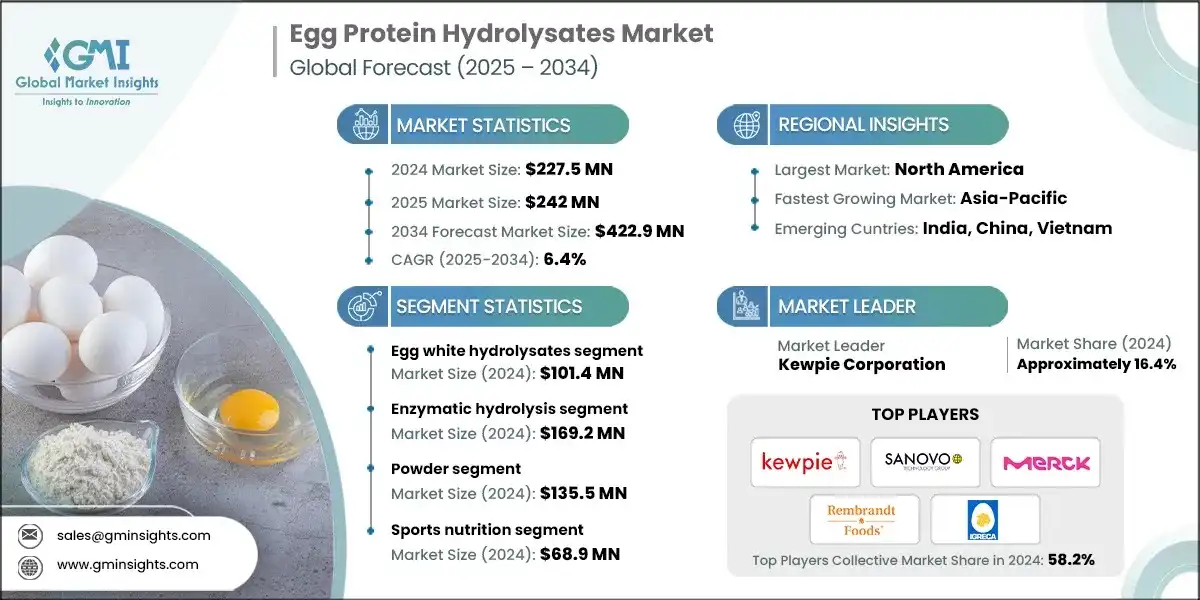
The global egg protein hydrolysates market size was valued at USD 227.5 million in 2024. The market is expected to grow from USD 242 million in 2025 to USD 422.9 million in 2034, at a CAGR of 6.4% according to latest report published by Global Market Insights Inc.
Egg Protein Hydrolysates Market Key Takeaways
Market Size & Growth
- 2024 Market Size: USD 227.5 Million
- 2025 Market Size: USD 242 Million
- 2034 Forecast Market Size: USD 422.9 Million
- CAGR (2025–2034): 6.4%
Key Market Drivers
- Rising demand for functional food products.
- Increasing protein consumption globally.
- Growth in sports and clinical nutrition.
Challenges
- Limited consumer awareness in developing regions.
- High processing and R&D costs.
- Allergic concerns and regulatory oversight.
Opportunity
- Expansion into infants and elderly nutrition.
- Upcycling egg waste for sustainability.
- Rising e-commerce nutraceutical channels.
Key Players
- Market Leader: Kewpie Corporation led with over 16.4% market share in 2024.
- Leading Players: Top 5 players in this market include Kewpie Corporation, Sanovo Technology Group, Merck KGaA, Rembrandt Foods, IGRECA, which collectively held a market share of 58.2% in 2024.
Get Market Insights & Growth Opportunities
- The demand for bioactive proteins globally is increasing. Egg-derived hydrolysates integrate all the sought after trends: clean-label, allergen-free, and elaborate on the complete-amino-acid profiles. Data from FAOSTAT reported an increase for eggs from 82.2 million tons in 2019, to 89 million tons in 2023, an increase of 8.2%. This data increase allows for an increased access to more proteinaceous feedstock for value-added bioactive protein hydrolysates.
- Moreover, between the years 2019 to 2023, the U.S. NIH PubChem database recorded more than 200 new studies focused on egg-protein peptides that possess antioxidant or antihypertensive properties. This illustrates an increased attention in these proteins and bioactive hydrolysates that are now shifting towards sports drinks, nutraceutical gummies, and medical foods.
- Enzymatic hydrolysis is the most used form of hydrolysis in industry as it is considerably cost effective, it preserves the biological activity of the hydrolysate, and it avoids the acid neutralization cost. Eurostat data between 2020 and 2023 showed enzyme imports to the EU for food purposes increasing by 6 % CAGR and thus confirming the increase in demand for hydrolysates.
- There are more studies being published on hydrolysis and hydrolysates, an increase in confidence around the hydrolysates industry, and more specifically reported by Wageningen University, the 2023 published studies report an 85% in 2023, compared to their 70 % report in 2019, which correlates to a 33 % decrease in cost to produce a kg of peptides. This increase in efficiency closes the gap and thus the need for acid routes is diminishing.
- Geographically, demand is diversifying fast. USDA export data reveal U.S. shipments of dried egg products to Asia jumping from 25 kt (2020) to 38 kt (2023), driven by Chinese sports-nutrition formulators that now account for 27 % of global consumption. India’s Food Safety Authority cleared egg hydrolysates for infant formulas in 2022, sparking double-digit domestic growth. Meanwhile, Brazil’s ANVISA recorded a 41 % increase in protein-fortified RTD beverages (2021-23), providing an anchor for Latin American uptake. Europe remains innovation-centric, with Germany and the U.K. together filing 46 peptide-related patents since 2020 (EPO database).
- Looking ahead, circular-economy and animal-welfare pressures will shape the market’s arc. Carbon Trust data indicate that enzymatically produced egg peptides emit ~1.6 kg CO2-eq /kg—already 30 % below whey isolate. Producers are trailing cage-free supply contracts and membrane-filtration water reuse, aiming for 20% footprint cuts by 2027. Regulatory harmonization is also progressing Codex Alimentarius is drafting a peptide-ingredient annex, which could unlock cross-border standardization. With robust raw-material growth, maturing tech and a widening health halo, egg protein hydrolysates look poised for resilient, innovation-led expansion over the next decade.
To get key market trends
Egg Protein Hydrolysates Market Trends
- Consumer Preference for Clean Label and Natural Proteins: Growing concern for natural and minimally processed sources of proteins is increasing the demand for egg protein hydrolysates that meet clean-label standards. Kewpie and IGRECA have targeted fitness and wellness consumers by marketing hydrolysates with no artificial ingredients or allergens. This is indicative of a global trend centered on ingredient transparency and simplicity, with egg hydrolysates a suitable candidate for the burgeoning “food-as-medicine” trend.
- Technological Advances in Enzymatic Hydrolysis: There is greater ability to precisely manipulate and tailor enzymatic hydrolysis and peptide purification processes and methodologies. Sanovo Technology Group has introduced processes to enzymatically improve digestibility and bioactive yield. Such developments serve specific nutritional markets in clinical Nutrition and sports supplementation, which demand high precision in absorption rates and bioavailability for optimized performance and recovery.
- Sustainability in Production and Egg Waste Management: The circular economy model is becoming the new standard in ingredient innovation. Upcycling egg waste and shells to produce hydrolysates has become common practice. For example, European producers have reported a 20% improvement in yield efficiencies through waste valorization as suggested in the USDA sustainability reports of 2023. Such innovations don’t just improve the bottom line; they also help meet the increasing global corporate sustainability targets.
- Integration into Functional Foods and Nutraceuticals: Egg protein hydrolysates are more and more being added to snacks such as protein bars, as well as meal replacements, capsules, and energy drinks. Merck KGaA and Rembrandt Foods allied with nutraceutical companies to provide clinically formulated hydrolysate blends. The rapid growth of functional formulations, particularly in Japan and South Korea, is driven by the increasing demand for convenient, high protein foods. In these countries, fortified foods are consumed on a daily basis.
Egg Protein Hydrolysates Market Analysis

Learn more about the key segments shaping this market
Based on source type, the egg protein hydrolysates market is segmented into egg white hydrolysates, egg yolk hydrolysates, whole egg hydrolysates. Egg white hydrolysates segment was valued at USD 101.4 million in 2024, and it is anticipated to expand with 6.1% CAGR during 2025 to 2034.
- Growth within the egg protein hydrolysates space is due to both source types and types of formulation functions. Egg white hydrolysates are popular due to their protein quality, protein purity, and digestibility, and are a main component of sports and clinical nutrition products. Moreover, allergen-reduced egg white hydrolysates are increasingly popular among health-oriented consumers due to their safe, easy-to-digest protein, and are positioned as highly desirable protein options for everyday supplementation.
- There are unique advantages to using egg yolk and whole egg hydrolysates container as they are functional ingredients. Egg yolk hydrolysates contain yolk-derived phospholipid-rich peptides and lipoprotein hybrids which are used for cardiovascular and cognitive health products, while whole-egg hydrolysates are becoming popular due to their well-balanced amino acid profile, and are used as general-purpose nutritional bases for nutrition- fortified beverages, powders and foods to meet growing nutraceutical requirements.
Based on process, the egg protein hydrolysates market is segmented into enzymatic hydrolysis, acid hydrolysis, and other methods. Enzymatic hydrolysis was valued at USD 169.2 million in 2024, and it is projected to expand to 6.4% of CAGR during 2025 to 2034.
- Enzymatic hydrolysis is the main process used for the production of egg protein hydrolysates. This is due to his precision, the ability to keep bioactive peptides, and the ability to gently process enzymatic hydrolysis. Leading companies, such as Sanovo Technology Group, are developing refinements to enzymatic techniques to improve cost and yield efficiencies.
- In contrast to methods like acid hydrolysis, which has membrane filtration-assisted hydrolysis, is slowly gaining selective uses where cost-sensitive production is large scale. Although acid hydrolysis is simple and fast, it has the drawback of potentially denaturing the amino acids. Hence, it is still being used in the industrial and feed-grade sectors for bulk production consistency but is declining in high value food applications.
Based on form, the egg protein hydrolysates market is segmented into powder, liquid, capsules/tablets. Powder segment was largest and valued at USD 135.5 million in 2024, and it is expected to expand to 6.9% of CAGR during 2025 to 2034, constituting 59.1% in overall market share.
- Due to their long shelf life and ease of blending, powdered egg protein hydrolysates can easily integrate into sports nutrition powders and functional beverages, which is why they tend to dominate the market. The ability of product developers to adjust solubility and taste makes powdered egg protein hydrolysates versatile for large scale commercial use. Brands tend to favor powders because of ease and scale of integration into food formulations and dietary supplements.
- Diversity of the market to consumer ready solutions is expanding in liquid and capsule or tablet form. Liquids are for fast absorption and are formatted for functional beverages and medical nutrition, while capsules and tablets serve the nutraceutical market for dosage control and ease of transport. The greater variety in available formats reflects the consumer demand for convenience and tailored systems for nutrient delivery.
Learn more about the key segments shaping this market
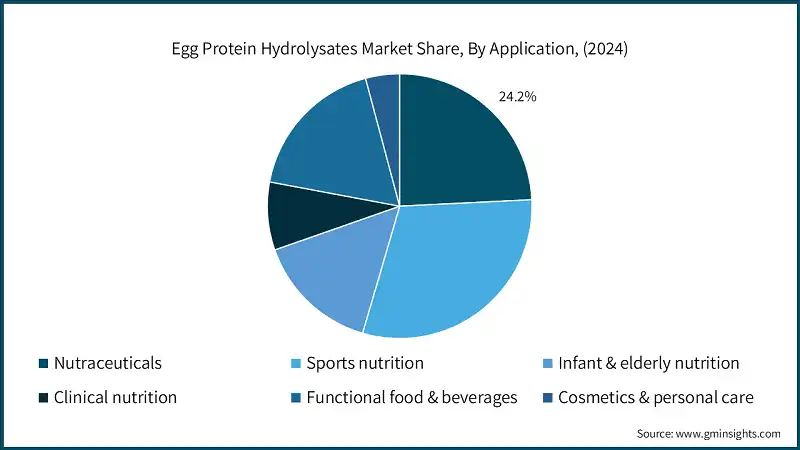
In application segment, the egg protein hydrolysates market from sports nutrition was valued at USD 68.9 million in 2024, and it is anticipated to expand to 7.1% of CAGR during 2025-2034, constituting 24.2% in overall market share.
- Egg protein hydrolysates have become increasingly popular in sports nutrition, nutraceuticals, clinical nutrition, and functional foods due to their adjustable values and bioactive properties. Within the realm of nutraceuticals, the focus is placed on their usefulness for digestive functionality, immune modulation, and anti-inflammatory action, particularly in the athletic population and the general health-conscious consumers. In sports nutrition, designed products from pre-workout to post-recovery blends all psychosocial features the muscle-recovery peptides and rapidly absorbable amino acids, which enhance the clinically important outcomes of performance.
- At the same time, the clinical and nutrition for infants and the elderly contain hypoallergenic, easily digestible hydrolysates, clinically for tube-feeding and recovery diet hydrolysates, and aged care. Functional foods particularly, bakery mixes and dairy alternatives, fortified with protein hydrolysates. In the centered emerging areas of personal care, anti-aging skincare and moisture-retention products, egg peptides for nutrition and functional added to finished products demonstrate the versatility of egg hydrolysates.
Looking for region specific data?
North America will continue to have the largest egg protein hydrolysates market in terms of value, growing from USD 68 million in 2024 to USD 124.7 million in 2034, mainly due to the booming nutraceutical market and the market’s increased focus on clean sources of protein.
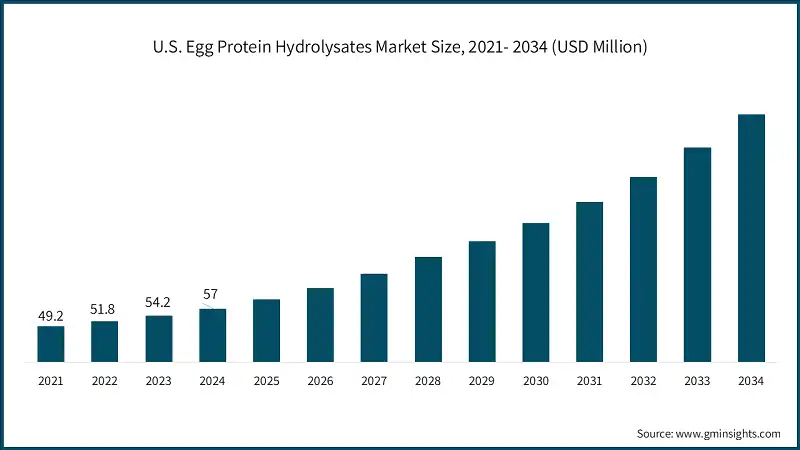
- The U.S. will continue to have the largest market, worth USD 57 million in 2024, and growing 6.2% CAGR from 2025 to 2034, mainly due to innovative functional beverage development and high protein consumption motivated by the fitness trend in the United States.
- Canada, as a stable secondary contributor to overall North American growth, will continue to grow due to local wellness product formulations as domestic egg processors increase the hydrolysis capacity for export and local wellness product formulations.
Europe egg protein hydrolysates market is expected to grow from USD 60.7 million in 2024 to USD 108.7 million in 2034 due to sustainable sourcing and the growing interest in bioactive ingredients.
- Europe’s largest market of Germany, worth USD 10.8 million in 2024, is expected to grow by 5.8% CAGR due to innovative enzymatic hydrolysis and increasing funding for peptide-based dietary supplements research.
- The U.K. continues to lead in the early adoption of hypoallergenic egg-based formulations due to high health consciousness and a strong nutraceutical manufacturing sector in major metropolitan areas, including London and Manchester.
Asia-Pacific egg protein hydrolysates market is predicted to expand from USD 65.1 million in 2024 to USD 129.4 million in 2034. This is primarily due to increasing investment in functional foods, rising middle-class populations, and evolution of markets pertaining to diet and nutrition.
- At USD 29.2 million in 2024, China holds 7% CAGR potential as the market grows, primarily due to the Agri food industry sectioning, and scale up of egg polypeptides to enrich value-added foods, and sports drinks.
- In India, the market is currently valued at USD 7.7 million, yet the growth is fastest in the region at 6.8% CAGR, primarily due to the growing awareness of the nutraceutical industry, and the urban market demand for bio accessible protein supplementation.
In Latin America, the egg protein hydrolysates market is predicted to expand from USD 20.3 million in 2024 to USD 36.4 million in 2034. This is due to fitness oriented diet trends and government support for domestic ingredient production.
- In the region, Brazil is projected to grow the most; from USD 6.3 million in 2024 to an unreported number in 2034 at 5.9 % CAGR. This is due to the growing demand for functional supplements and investment in egg processing at the local level. Brazil’s market is primarily driven by consumer demand for localized egg processing and functional supplements.
- By forming partnerships with local manufacturers, multinational nutraceutical companies are focusing on the affordability and availability of sports and lifestyle nutrition products tailored to the specific needs of the market. This is evident in Mexico.
The Middle East and Africa (MEA) egg protein hydrolysates market is expected to increase from USD 13.4 million in 2024 to USD 23.7 million in 2034. Such increase is supported by rising health consciousness and diversification in ingredient sourcing.
- The 2024 valuation of the Saudi Arabian market is USD 4.4 million, and by 2034 it is expected to be USD 7.7 million, with a CAGR of 5.7%. This shows expansion of premium nutrition products and clinical formulations within the market.
- The increase in demand for high-protein beverages and fortified baked goods in the United Arab Emirates is contributing to the country’s positioning as a growing consumer hub in developed wellness ecosystems of the region.
Egg Protein Hydrolysates Market Share
- Kewpie Corporation, Sanovo Technology Group, Merck KGaA, Rembrandt Foods, IGRECA. accounted for market share of 58.2% of the egg protein hydrolysates industry in 2024.
- Kewpie Corporation dominates the global market for egg protein hydrolysates with a market share of 16.4%. This is attributed to Kewpie's bioactive peptide expertise in clean-label product innovations. Kewpie's vertically integrated supply chains along with its strong network in Asia give the company strategic advantages, especially in Japan and Southeast Asia, where the adoption of food functionalization is growing in consumer wellness and clinical nutrition.
- Sanovo Technology Group owns 13.6% of the market share due to its expertise in enzymatic hydrolysis and high egg processing technologies. Sanovo is considered a key enabler for ingredient producers and drives innovation with turnkey process solutions that enhance yield and system sustainability. Collaborative integrated processing in Europe with global nutraceuticals has expand Sanovo's market presence.
- Merck KGaA, Rembrandt Foods, and IGRECA collectively account for just over a quarter of the total market share with 10.9%, 9.1%, and 8.2% respectively. Merck is dedicated to pharmaceutical-grade hydrolysates offered for precision health, while Rembrandt cheesemaking with its extensive egg supply is focused on cost-efficient production. IGRECA’s distinction is in its European enzymatic expertise combined with eco-efficient operations for premium food and health applications. This enhances Europe’s place in the world for these applications and contributes to the premium food and health applications.
Egg Protein Hydrolysates Market Companies
The major players operating in egg protein hydrolysates industry include:
- Kewpie Corporation
- Sanovo Technology Group
- Merck KGaA
- Rembrandt Foods
- IGRECA
- Kewpie Corporation: Kewpie Corporation's cutting-edge R&D in functional nutrition and advanced egg-derived peptide innovations have placed it in the 1st position with a 16.4% market share. The company specializes in clean-label hydrolysates and caters to the health-conscious consumer. It has begun to market clinically backed nutraceutical ingredients especially in the bioactive peptide range focusing on claims for blood pressure. This signifies increased investment in clinically backed nutraceutical ingredients in Asia and beyond.
- Sanovo Technology Group: Sanovo Technology Group enjoys a 13.6% share and is the owner of a range of proprietary enzymatic hydrolysis technologies helping global ingredient processors. They make and sell sustainable protein processing equipment and systems which enhance environmental sustainability and industry efficiency. Sanovo enjoys collaboration with European food tech partners working on the sustainable use of egg waste and the circular economy of production.
- Merck KGaA: Merck KGaA has 10.9% market share and is known for production of premium and pharmaceutical-grade hydrolysates. It uses egg protein hydrolysates in the biomedical and nutraceutical formulations of its Life Science division. It is advancing known bioprocessing applications in peptide therapy and personalized nutrition which is an important intersection in clinical research and food innovation.
- Rembrandt Foods: With a 9.1% market share, Rembrandt Foods uses its extensive network of egg production to make inexpensive hydrolysate ingredients. The company’s expansion into custom-formulated solutions of egg proteins revolves around the needs of the sports and medical nutrition industry. Sustainable sourcing practices and energy-efficient hydrolysis technologies which the company recently implemented improve the environmental footprint for Rembrandt’s production facilities in the United States.
- IGRECA: With 8.2% of the market, IGRECA develops high-quality enzymatic hydrolysis and functional ingredients. It is one of the few European precision processors in the industry, focusing on the creation of allergen-reduced and bioavailable protein fractions. Recent work at IGRECA includes innovative partnerships with international nutraceuticals to improve lean peptide purification for use in therapeutic food.
Egg Protein Hydrolysates Market Report Attributes
| Key Takeaway | Details |
|---|---|
| Market Size & Growth | |
| Base Year | 2024 |
| Market Size in 2024 | USD 227.5 Million |
| Market Size in 2025 | USD 242 Million |
| Forecast Period 2025 - 2034 CAGR | 6.4% |
| Market Size in 2034 | USD 422.9 Million |
| Key Market Trends | |
| Drivers | Impact |
| Rising demand for functional food products | Boosting product innovation and usage |
| Increasing protein consumption globally | Expanding target consumer base |
| Growth in sports and clinical nutrition | Accelerating niche product adoption |
| Pitfalls & Challenges | Impact |
| Limited consumer awareness in developing regions | Slows down market penetration |
| High processing and R&D costs | Barrier for new entrants |
| Allergic concerns and regulatory oversight | Delayed product approvals |
| Opportunities: | Impact |
| Expansion into infants and elderly nutrition | Unlocking new high-value segments |
| Upcycling egg waste for sustainability | Adds value through circular economy |
| Rising e-commerce nutraceutical channels | Broadens reach to end-users |
| Market Leaders (2024) | |
| Market Leaders |
Approximately 16.4% Market share |
| Top Players |
Collective market share in 2024 is 58.2% |
| Competitive Edge |
|
| Regional Insights | |
| Largest Market | North America |
| Fastest Growing Market | Asia-Pacific |
| Emerging Country | India, China, Vietnam |
| Future Outlook |
|
What are the growth opportunities in this market?
Egg Protein Hydrolysates Industry News
- In March 2024, Kewpie Corporation announced the launch of a new line of bioactive egg peptide ingredients aimed at blood pressure and muscle recovery applications, strengthening Japan’s leadership in functional food-based clinical nutrition across Asia-Pacific.
- In August 2023, Sanovo Technology Group partnered with a European biotech consortium to develop next-generation enzymatic hydrolysis systems enhancing peptide yield and reducing processing waste, positioning egg-derived proteins as a sustainable source for high-performance nutraceuticals.
- In November 2022, Merck KGaA expanded its Life Science division to include egg protein hydrolysates for pharmaceutical-grade applications, integrating bioactive proteins into research solutions supporting regenerative health and therapeutic peptide formulation studies globally.
- In May 2021, IGRECA introduced a clean-label egg hydrolysate range formulated for allergen-sensitive consumers, targeting European and North American markets seeking improved digestibility and high bioavailability for sports, clinical, and infant nutrition products.
The egg protein hydrolysates market research report includes in-depth coverage of the industry with estimates & forecast in terms of revenue (USD Million) & volume (Kilo Tons) from 2021 to 2034, for the following segments:
Market, By Source Type
- Egg white hydrolysates
- High-purity protein formulations
- Allergen-reduced variants
- Egg yolk hydrolysates
- Phospholipid-rich peptides
- Lipoprotein-functional blends
- Whole egg hydrolysates
- Balanced amino acid profile
- General-purpose formulations
Market, By Process
- Enzymatic hydrolysis
- Acid hydrolysis
- Other methods
Market, By Form
- Powder
- Liquid
- Capsules/Tablets
Market, By Application
- Nutraceuticals
- Digestive health
- Immune support
- Anti-inflammatory functionality
- Sports nutrition
- Pre-workout formulations
- Post-workout recovery formulations
- Muscle recovery peptides
- Infant & elderly nutrition
- Hypoallergenic protein blends
- Easily digestible amino profiles
- Clinical nutrition
- Tube-feeding solutions
- Recovery diets
- Functional food & beverages
- Bakery mixes
- Dairy and non-dairy beverages
- Cosmetics & personal care
- Anti-aging skincare
- Moisturizing applications
- Barrier-repair formulations
The above information is provided for the following regions and countries:
- North America
- U.S.
- Canada
- Europe
- UK
- Germany
- France
- Italy
- Spain
- Rest of Europe
- Asia Pacific
- China
- India
- Japan
- South Korea
- Australia
- Rest of Asia Pacific
- Latin America
- Brazil
- Mexico
- Argentina
- Rest of Latin America
- MEA
- UAE
- Saudi Arabia
- South Africa
- Rest of Middle East and Africa
Frequently Asked Question(FAQ) :
What is the market size of the egg protein hydrolysates in 2024?
The market size was valued at USD 227.5 million in 2024, with a CAGR of 6.4% expected through 2034. The increasing demand for bioactive proteins and clean-label products is driving market growth.
What is the projected value of the egg protein hydrolysates market by 2034?
The market is poised to reach USD 422.9 million by 2034, driven by advancements in enzymatic hydrolysis, sustainability initiatives, and the integration of hydrolysates into functional foods and nutraceuticals.
What is the expected size of the egg protein hydrolysates industry in 2025?
The market size is projected to reach USD 242 million in 2025.
How much revenue did the egg white hydrolysates segment generate in 2024?
The egg white hydrolysates segment was valued at USD 101.4 million in 2024 and is anticipated to expand at a CAGR of 6.1% from 2025 to 2034.
What was the valuation of the enzymatic hydrolysis segment in 2024?
The enzymatic hydrolysis segment was valued at USD 169.2 million in 2024 and is set to observe around 6.4% CAGR till 2034.
What is the growth outlook for the powder segment from 2025 to 2034?
The powder segment, valued at USD 135.5 million in 2024, is expected to witness over 6.9% CAGR up to 2034.
Which region leads the egg protein hydrolysates sector?
The United States leads the market, valued at USD 57 million in 2024, with a CAGR of 6.2% projected through 2034. Growth is driven by innovative functional beverage development and high protein consumption trends.
What are the upcoming trends in the egg protein hydrolysates market?
Key trends include rising demand for clean-label natural proteins, improved enzymatic hydrolysis techniques, sustainability via waste valorization, and growing use of hydrolysates in functional foods and nutraceuticals.
Who are the key players in the egg protein hydrolysates industry?
Key players include Kewpie Corporation, Sanovo Technology Group, Merck KGaA, Rembrandt Foods, and IGRECA.
Egg Protein Hydrolysates Market Scope
Related Reports