Summary
Table of Content

E-Beam Wafer Inspection System Market
Get a free sample of this report
Form submitted successfully!
Error submitting form. Please try again.
Thank you!
Your inquiry has been received. Our team will reach out to you with the required details via email. To ensure that you don't miss their response, kindly remember to check your spam folder as well!
Request Sectional Data
Thank you!
Your inquiry has been received. Our team will reach out to you with the required details via email. To ensure that you don't miss their response, kindly remember to check your spam folder as well!
Form submitted successfully!
Error submitting form. Please try again.
E-Beam Wafer Inspection System Market Size
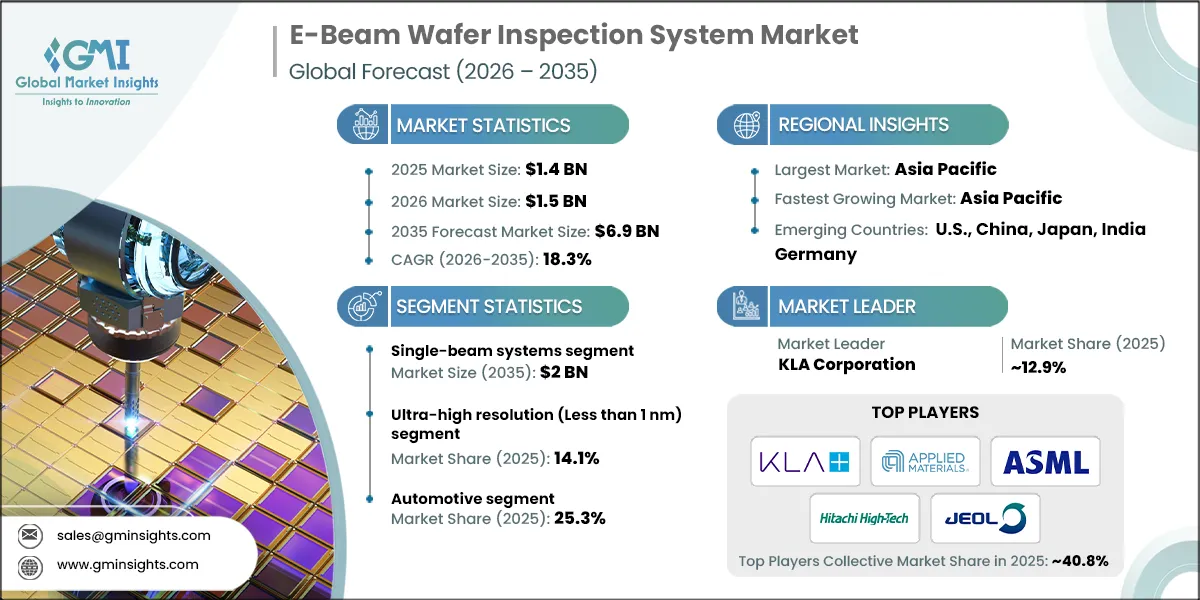
The global e-beam wafer inspection system market was valued at USD 1.4 billion in 2025. The market is expected to grow from USD 1.5 billion in 2026 to USD 6.9 billion in 2035, at a CAGR of 18.3% during the forecast period according to the latest report published by Global Market Insights Inc.
E-Beam Wafer Inspection System Market Key Takeaways
Market Size & Growth
- 2025 Market Size: USD 1.4 Billion
- 2026 Market Size: USD 1.5 Billion
- 2035 Forecast Market Size: USD 6.9 Billion
- CAGR (2026–2035): 18.3%
Regional Dominance
- Largest Market: Asia Pacific
- Fastest Growing Region: Asia Pacific
Key Market Drivers
- Escalating defect sensitivity requirements in advanced nodes.
- Expansion of semiconductor foundry capacity.
- Growing complexity of 3D device architectures.
- Rapid adoption of EUV lithography.
- Technological advancements in multi-beam e-beam systems.
Challenges
- Relatively low throughput compared to optical tools.
- Complexity of system integration into fab workflows.
Opportunity
- Growth of subscription-based & mapping-as-a-service models.
- Expansion opportunities in underpenetrated markets.
Key Players
- Market Leader: KLA Corporation led with over 12.9% market share in 2025.
- Leading Players: Top 5 players in this market include KLA Corporation, Applied Materials, Inc., ASML Holding N.V., Hitachi High‑Technologies Corp., JEOL Ltd., which collectively held a market share of 40.8% in 2025.
Get Market Insights & Growth Opportunities
The market for e-beam wafer inspection systems is witnessing steady growth, due to rising investments in semiconductor manufacturing capacity. The market is seeing substantial technological advancement with integration of artificial intelligence (AI) and machine learning (ML) algorithms into inspection systems. Furthermore, the increased need for semiconductor wafers among emerging technologies like 5G, artificial intelligence, the Internet of Things (IoT), and automotive electronics has further increased the demand for wafer inspection across various industries such as consumer electronics and telecommunication.
The increasing adoption of advanced 3D device architectures, including finest, gate-all-around (GAA) transistors, and 3D NAND, is significantly intensifying defect characterization challenges. Complex vertical structures, multilayer stacking, and advanced packaging processes exceed the resolution capabilities of optical inspection tools, driving greater reliance on e-beam wafer inspection systems. As a result, e-beam adoption is rising across both logic and memory fabrication facilities worldwide to ensure process integrity and yield optimization. The capability of e-beam inspection system to deliver high-resolution images and precise detection of structural flaws in 3D NAND and FinFET designs makes them essential in guaranteeing quality and reliability in semiconductor manufacturing.
To get key market trends
E-Beam Wafer Inspection System Market Trends
- The e-beam wafer inspection market is increasingly being influenced by innovative technological trends such as the developments in the integration of AI and deep learning algorithms to enhance defect detection throughput and accuracy.
- Leading semiconductor manufacturers are significantly leveraging on AI-driven analytics to reduce false positives, improve root-cause identification, and to accelerate process optimization. It is particularly evident in 3 nm and 2 nm nodes where even minor defects can cause significant yield losses.
- Another notable trend is the deployment of hybrid inspection systems that combine e-beam and optical technologies. The hybrid solutions allow high-speed pre-screening with optical tools while reserving high-resolution e-beam inspection for critical defect analysis. This approach when used particularly in advanced logic and memory production lines, has streamlined yield learning, shortened time-to-market, and enables fabs to balance throughput and precision.
- Technological advancements in multi-beam e-beam systems are further accelerating market growth. Multi-beam architecture dramatically improves inspection throughput while maintaining sub-nanometer resolution, addressing one of the traditional limitations of single-beam systems. The integration with AI-driven defect classification and predictive analytics enables fabs to scale high-resolution inspection for high-volume manufacturing, enhancing operational efficiency and supporting next-generation nodes and packaging technologies.
- The increasing adoption of e-beam inspection in automotive and safety-critical semiconductor applications is contributing to rising demand. Electrification, autonomous driving, and advanced driver-assistance systems (ADAS) require near-zero defect tolerance, rendering high-resolution e-beam inspection essential for ensuring reliability and regulatory compliance. Manufacturers across Europe, North America, and Asia-Pacific are deploying advanced e-beam tools to achieve defect-free wafers in mission-critical devices, thereby reinforcing the strategic importance of these systems in high-reliability market segments.
- Device miniaturization continues to reinforce this growth trajectory. As Moore’s Law pushes feature sizes smaller, defect detection complexity rises, necessitating more capable e-beam systems. Applications such as EUV lithography further emphasize stochastic defect detection, driving investments in next-generation inspection solutions capable of supporting both current and emerging semiconductor architectures.
E-Beam Wafer Inspection System Market Analysis
Learn more about the key segments shaping this market
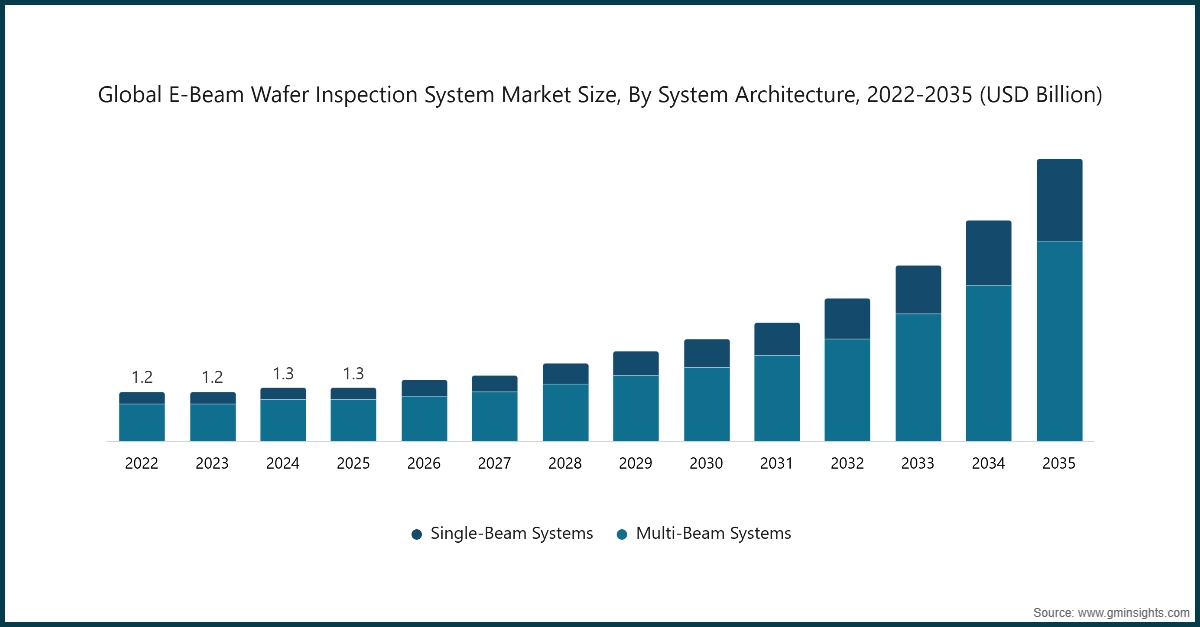
On the basis of system architecture, the e-beam wafer inspection system market is segmented into single-beam systems, and multi-beam systems.
- The single-beam systems segment is anticipated to reach USD 2 billion by 2035. The segment is driven by its continued relevance in research, development, and low- to mid-volume fabrication environments. Single-beam tools offer high-resolution imaging with simplified deployment and lower capital costs, making them attractive for small- to medium-scale fab and university research centers. Additionally, their precision in defect analysis for advanced nodes supports yield learning, enabling manufacturers to optimize processes and reduce scrap, particularly in sub-10 nm logic and memory devices.
- The segment’s growth is also supported by incremental upgrades to imaging and automation features, allowing single-beam platforms to meet evolving defect detection requirements. Integration with AI-assisted defect classification and process control software enhances throughput efficiency while maintaining sub-nanometer resolution. Emerging markets, particularly in the Asia-Pacific, are increasingly investing in single-beam inspection for pilot lines and niche fabrication, contributing to the segment’s steady revenue expansion through 2035.
- The multi-beam systems segment was valued at USD 1 billion in 2025 and is anticipated to grow at a CAGR of 17.6% over the forecast years. The growth is driven by the need for high-throughput inspection at leading-edge nodes. Multi-beam architectures significantly improve scanning speed without compromising resolution, enabling high-volume manufacturing adoption. The integration of AI-driven analytics and predictive defect classification further enhances operational efficiency. Increasing deployment in advanced logic, memory, and automotive semiconductor fab globally is expected to sustain robust revenue growth.
On the basis of resolution capability, the e-beam wafer inspection system market is divided into ultra-high resolution (Less than 1 nm), high resolution (1 nm to 10 nm), and standard resolution (More than 10 nm).
- The ultra-high resolution (Less than 1 nm) segment held a market share of 14.1% in 2025 due to is driven by the increasing demand for precise defect detection at advanced semiconductor nodes. Sub-nanometer resolution enables fabs to identify critical patterning, stochastic, and material defects that optical and lower-resolution systems cannot detect. This capability is particularly vital for EUV lithography and next-generation logic and memory devices, where even atomic-scale imperfections can significantly impact yield and device performance, reinforcing adoption of ultra-high-resolution e-beam systems.
- The segment’s growth is further supported by integration with AI-based defect classification and predictive analytics tools, allowing for faster root-cause analysis and process optimization. North America, Europe, and Asia-Pacific lead adoption due to extensive advanced-node fabs, while increasing investments in automotive, AI, and HPC chips are expanding the demand. Continuous technological innovation, including improved electron optics and enhanced beam stability, is also sustaining the segment’s share in the e-beam inspection market.
- The high resolution (1 nm to 10 nm) segment is anticipated to grow at a CAGR of 19.9% during the forecast period, driven by its suitability for high-volume manufacturing at leading-edge nodes. Systems in this range balance throughput and precision, enabling efficient detection of critical defects in logic, memory, and advanced packaging applications. Increasing adoption of multi-beam architectures, hybrid inspection workflows, and AI-assisted defect analytics is further enhancing the segment’s operational efficiency, making it the preferred choice for fab scaling production across Asia-Pacific, North America, and Europe.
Learn more about the key segments shaping this market
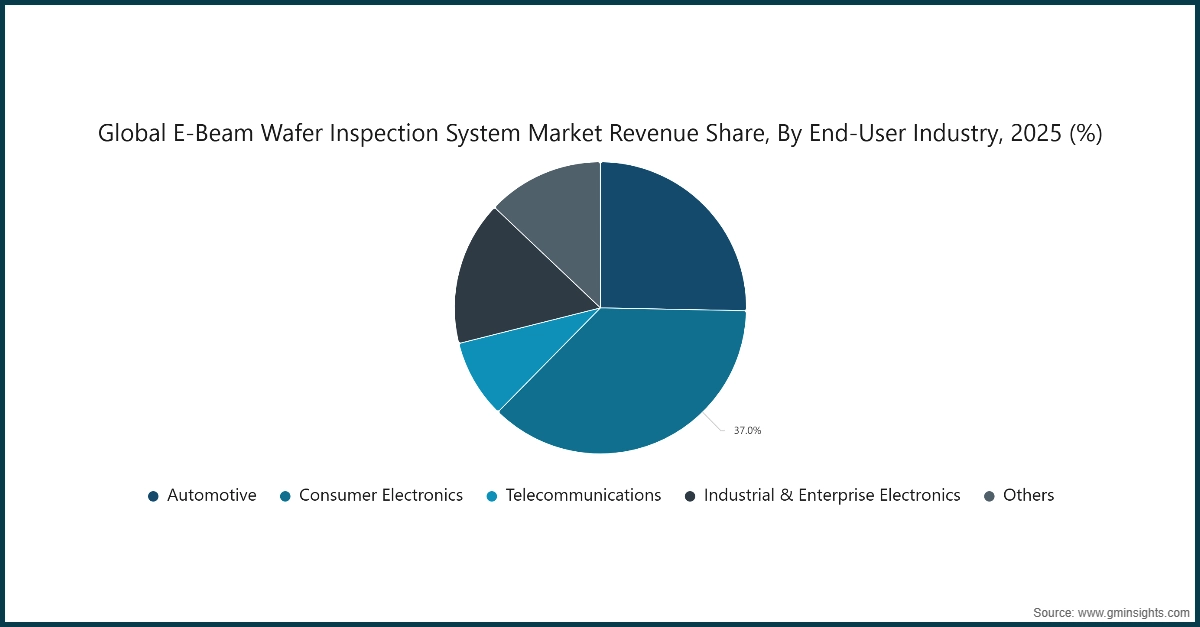
On the basis of end-user industry, the e-beam wafer inspection system market is segmented into automotive, consumer electronics, telecommunications, industrial & enterprise electronics, and others.
- The automotive segment held a market share of 25.3% in 2025, driven by the rising complexity and reliability requirements of electric vehicles (EVs), advanced driver-assistance systems (ADAS), and autonomous driving technologies. Semiconductor components in safety-critical automotive applications demand near-zero defect tolerance, prompting fabs to deploy high-resolution e-beam wafer inspection systems. Leading automotive chip manufacturers in North America, Europe, and Asia-Pacific increasingly rely on these tools to ensure process integrity and compliance with functional safety standards such as ISO 26262.
- Growth in this segment is further fueled by increasing electrification and vehicle connectivity trends. Chips for power electronics, sensors, and microcontrollers require rigorous quality control at advanced logic nodes. The need to reduce field failures and warranty costs reinforces investments in e-beam inspection for both production and qualification wafers, making automotive a consistently high-value segment for inspection system vendors globally.
- The consumer electronics segment is anticipated to grow at a CAGR of 19.2% during the forecast period 2026 – 2035, driven by the rapid adoption of smartphones, wearables, and smart home devices that use increasingly complex and miniaturized chips. High-density logic and memory devices for these applications require precise defect detection at sub-10 nm nodes. Manufacturers in Asia-Pacific, particularly China, Taiwan, and South Korea, are expanding capacity and integrating e-beam inspection systems to maintain yield, ensure device reliability, and meet growing consumer demand.
North America E-Beam Wafer Inspection System Market
Looking for region specific data?
The North America e-beam wafer inspection system market holds a significant share of the market with a market share of 33.2% in 2025.
- North America’s growth is driven by the presence of leading semiconductor manufacturers and advanced-node fabs across the United States. High adoption of sub-7 nm logic and memory processes, coupled with early deployment of EUV lithography, necessitates precision defect detection and yield optimization, making e-beam inspection systems critical. Strong investments in R&D and advanced process control further reinforce the region’s market dominance.
- The region’s growth is also supported by robust collaborations between semiconductor equipment vendors and fab operators, enabling integration of AI-driven defect analytics and multi-beam technologies. Additionally, government incentives for semiconductor manufacturing, including the CHIPS Act, are expanding domestic fab capacity, creating increased demand for high-resolution inspection tools. These factors collectively position North America as a key market hub for e-beam wafer inspection systems.
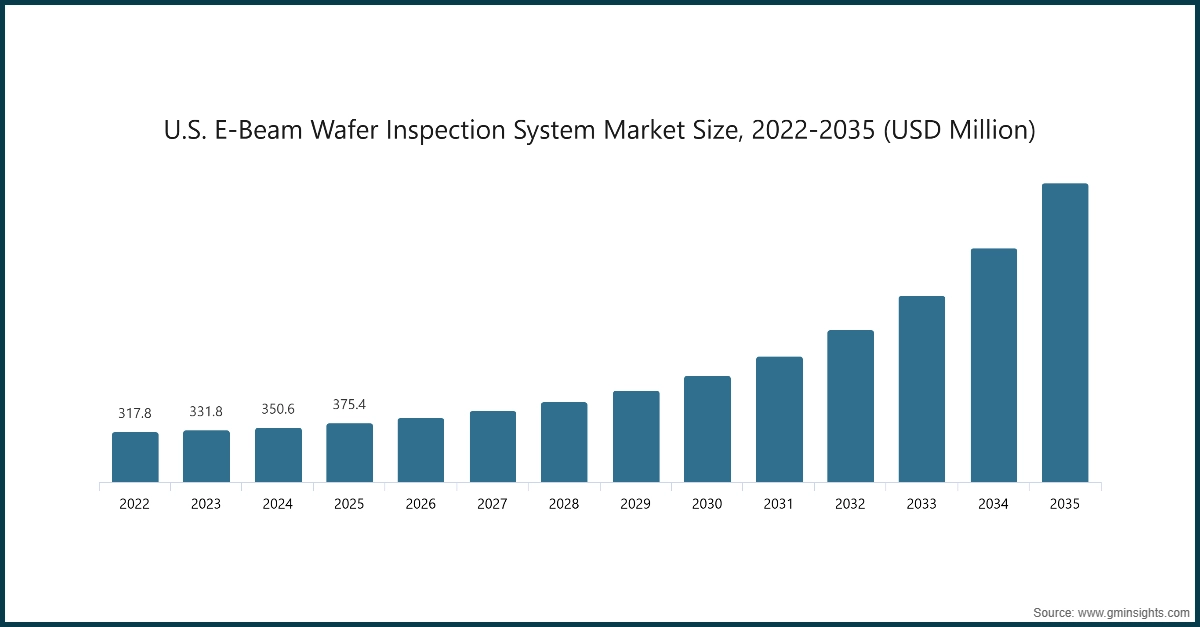
The U.S. e-beam wafer inspection system market was valued at USD 317.8 million and USD 331.8 million in 2022 and 2023, respectively. The market size reached USD 375.4 million in 2025, growing from USD 350.6 million in 2024.
- The U.S. e-beam wafer inspection system industry is expanding due to strong investments in advanced semiconductor manufacturing and the growing adoption of sub-7 nm logic and memory nodes. Increasing deployment of EUV lithography, 3D device architectures, and high-density packaging drives demand for high-resolution defect detection and yield optimization. Integration of AI-based defect analytics, multi-beam systems, and predictive process control further enhances throughput and efficiency, making e-beam inspection systems indispensable for leading-edge fabs and reinforcing North America’s market leadership.
Europe E-Beam Wafer Inspection System Market
Europe e-beam wafer inspection system industry accounted for USD 229.9 million in 2025 and is anticipated to show lucrative growth over the forecast period.
- Europe’s e-beam wafer inspection system industry growth is propelled by increasing investments in advanced semiconductor manufacturing, particularly in Germany, France, and the Netherlands. The region’s focus on leading-edge logic, memory, and automotive semiconductor production requires high-resolution defect detection to maintain yield and quality. Adoption of EUV lithography, 3D packaging, and FinFET/GAA architectures is driving demand for precise inspection tools, making e-beam systems critical for both pilot lines and high-volume manufacturing across European fabs.
- The market is further supported by strong R&D initiatives and collaborations between equipment vendors and semiconductor manufacturers. European fabs are increasingly integrating AI-driven defect analytics, multi-beam e-beam systems, and predictive process control to optimize throughput and yield. Additionally, government incentives promoting domestic semiconductor production and technological innovation are boosting adoption, positioning Europe as a key growth region for high-resolution wafer inspection solutions.
- Germany dominates the Europe e-beam wafer inspection system market, due to its well-established semiconductor manufacturing ecosystem, advanced R&D infrastructure, and strong presence of automotive and industrial chip fabs. Leading semiconductor companies and research institutions invest heavily in sub-7 nm logic, memory, and power devices, driving demand for high-resolution e-beam inspection tools. Additionally, government incentives supporting innovation, precision manufacturing, and Industry 4.0 adoption further reinforce Germany’s position as the primary hub for advanced wafer inspection solutions in Europe.
Asia Pacific E-Beam Wafer Inspection System Market
The Asia Pacific e-beam wafer inspection system industry is anticipated to hold significant share of 43.8% in 2025 and is expected to grow at the highest CAGR of 19.1 % during the forecast period.
- The Asia-Pacific e-beam wafer inspection system industry is experiencing rapid growth, driven by large-scale investments in semiconductor fabrication across China, Taiwan, South Korea, and Japan. Expansion of foundries and advanced logic and memory production lines is increasing demand for high-resolution defect detection and yield optimization. Adoption of EUV lithography, 3D NAND, and advanced packaging technologies require precise inspection capabilities, making e-beam systems essential for maintaining product quality and throughput in the region’s high-volume fabs.
- Growth is further supported by rising demand from automotive, AI, and consumer electronics applications, which require defect-free, high-performance chips. Multi-beam e-beam systems and AI-assisted defect analytics are increasingly deployed to enhance throughput and reduce analysis time. Government initiatives supporting domestic semiconductor manufacturing, coupled with private sector investment in process innovation, are reinforcing Asia-Pacific as the fastest-growing regional market for e-beam wafer inspection systems.
- China e-beam wafer inspection system market is estimated to grow with a CAGR of 20.3%, in the Asia Pacific e-beam wafer inspection system industry. The country remains a key growth engine within Asia-Pacific, driven by rapid expansion of domestic semiconductor fabrication and aggressive investments in advanced logic, memory, and 3D NAND production. Government initiatives promoting self-reliance in semiconductor technology, coupled with rising demand from automotive, AI, and consumer electronics sectors, are increasing adoption of high-resolution e-beam inspection systems. Multi-beam and AI-assisted platforms are also being deployed to enhance throughput and yield in high-volume fabs.
Latin American E-Beam Wafer Inspection System Market
- The Latin America particulate matter monitoring market, valued at USD 54.4 million in 2025, driven by increasing government regulations and environmental monitoring initiatives targeting air pollution control. Rapid urbanization, industrial growth, and rising vehicle emissions are prompting authorities in Brazil, Mexico, and Argentina to deploy advanced monitoring systems. Adoption of IoT-enabled sensors and real-time data analytics for air quality assessment is enhancing pollution tracking and regulatory compliance, supporting market expansion across the region’s environmental and public health sectors.
Middle East and Africa E-Beam Wafer Inspection System Market
UAE e-beam wafer inspection system industry to experience substantial growth in the market in 2025.
- The UAE e-beam wafer inspection system industry is expected to experience substantial growth in 2025, driven by increasing investments in semiconductor manufacturing, research, and advanced electronics within the Middle East and Africa region. Government initiatives supporting technological innovation, smart city projects, and electronics manufacturing are boosting demand for high-resolution defect inspection tools. Rising adoption of AI-enabled analytics and multi-beam e-beam systems in pilot fabs and R&D facilities further reinforces the UAE as a key growth hub for wafer inspection solutions in the region.
E-Beam Wafer Inspection System Market Share
The global e-beam wafer inspection system industry is moderately consolidated, led by key technology providers such as KLA Corporation, Applied Materials, Inc., ASML Holding N.V., Hitachi High‑Technologies Corp., and JEOL Ltd., which together account for a share of approximately 40% the market. These companies leverage deep expertise in semiconductor process control, advanced metrology, and defect inspection, combined with longstanding relationships with leading foundries and integrated device manufacturers, to deliver high-resolution inspection solutions for logic, memory, and advanced packaging applications.
Despite the dominance of these leading vendors, the market remains partially fragmented, with regional and specialized suppliers addressing niche requirements such as automotive, AI/HPC chips, and pilot-line fabrication. Smaller players compete through customized solutions, cost-efficient tools, AI-assisted defect classification, and rapid deployment services. This competitive landscape encourages continuous innovation in multi-beam architectures, sub-nanometer resolution, throughput optimization, and integration with fab-wide process control systems, supporting sustained growth in the global e-beam wafer inspection system industry.
E-Beam Wafer Inspection System Market Companies
Prominent players operating in the e-beam wafer inspection system industry are as mentioned below:
- KLA Corporation
- Applied Materials, Inc.
- ASML Holding N.V.
- Hitachi High‑Technologies Corp.
- JEOL Ltd.
- Onto Innovation.
- Carl Zeiss SMT
- Aerotech, Inc.
- MKS Inc.
- PDF Solutions
- Wuhan Jingce Electronic Group
- Thermo Fisher Scientific Inc.
- Camtek
- Advantest Corporation
- SCREEN SPE Tech Co., Ltd.
- KLA Corporation
KLA Corporation is a leading global supplier of semiconductor process control and yield management solutions, commanding a strong position in e‑beam wafer inspection tools that serve advanced logic and memory fabs. The company’s extensive portfolio includes high‑resolution and multi‑beam inspection platforms tailored for sub‑5 nm nodes, integrated with fab‑wide yield analytics and defect classification software. KLA’s deep R&D investments and longstanding partnerships with major foundries reinforce its leadership across defect detection and process control workflows.
Applied Materials, Inc. offers a broad suite of metrology and inspection solutions that encompass advanced e‑beam wafer inspection capabilities designed to meet high‑resolution imaging and defect review needs. Its PROVision e‑beam systems deliver nanometer‑scale resolution and through‑layer imaging to support advanced logic, DRAM, and 3D NAND production, while integration with AI‑driven analytics enhances defect classification and throughput. Applied’s focus on process control integration and yield optimization underpins its competitive position across global semiconductor manufacturing lines.
ASML Holding N.V. expands its semiconductor equipment leadership into e‑beam wafer inspection through its HMI‑branded metrology and inspection platforms, which locate and analyze individual chip defects amid millions of printed patterns. ASML leverages multibeam e‑beam technology and deep integration with lithography and computational control systems to support high‑resolution inspection and inline defect monitoring for advanced nodes. These capabilities complement the company’s core lithography offerings, enabling tighter process control and yield improvement in leading‑edge fabs.
E-Beam Wafer Inspection System Market Report Attributes
| Key Takeaway | Details |
|---|---|
| Market Size & Growth | |
| Base Year | 2025 |
| Market Size in 2025 | USD 1.4 Billion |
| Market Size in 2026 | USD 1.5 Billion |
| Forecast Period 2026-2035 CAGR | 18.3% |
| Market Size in 2035 | USD 6.9 Billion |
| Key Market Trends | |
| Drivers | Impact |
| Escalating defect sensitivity requirements in advanced nodes | As semiconductor manufacturing shifts to sub-5 nm and 3 nm nodes, defect sizes of concern are shrinking to atomic-scale dimensions. Leading foundries now require inspection sensitivity well below optical resolution limits, driving increased adoption of e-beam wafer inspection systems. This shift is most pronounced in North America and East Asia, where advanced-node production dominates capital equipment spending. |
| Expansion of semiconductor foundry capacity | Global fab expansion programs are accelerating, with significant capacity additions underway in the U.S., Taiwan, South Korea, and Japan. As new fabs come online, demand for advanced process control tools rises in parallel. E-beam wafer inspection systems are increasingly specified during fab buildouts to support yield learning and high-volume manufacturing at advanced logic and memory nodes. |
| Growing complexity of 3D device architectures | The transition to FinFETs, gate-all-around transistors, and 3D NAND structures has introduced complex vertical features that are difficult to characterize using conventional inspection methods. E-beam inspection systems enable high-resolution defect detection across layered and non-planar surfaces, driving adoption particularly in memory manufacturing hubs in Asia-Pacific, where 3D NAND production is expanding rapidly. |
| Rapid adoption of EUV lithography | EUV lithography is being deployed at scale for advanced logic production, especially at 5 nm and below. However, EUV processes introduce stochastic defects that are challenging to detect optically. This has increased reliance on e-beam wafer inspection systems for defect monitoring and root-cause analysis, reinforcing their role as critical yield-enablement tools in leading-edge fabs. |
| Technological advancements in multi-beam e-beam systems | Recent advancements in multi-beam e-beam architectures have significantly improved inspection throughput, addressing a longstanding limitation of single-beam systems. These performance gains are accelerating broader deployment in high-volume manufacturing environments, particularly in large foundries across Asia and North America, where balancing inspection accuracy with productivity is a key purchasing criterion. |
| Pitfalls & Challenges | Impact |
| Relatively low throughput compared to optical tools | Despite resolution advantages, e-beam wafer inspection systems operate at significantly lower throughput than optical inspection tools, limiting suitability for high-volume manufacturing. Even with multi-beam advances, inspection times remain 2–4× longer in dense pattern layers. This throughput gap constrains inline deployment in leading fabs, moderating overall market growth, particularly in cost-sensitive memory manufacturing regions. |
| Complexity of system integration into fab workflows | Integrating e-beam inspection systems into existing fab workflows requires extensive process tuning, data alignment, and tool-to-tool calibration. Engineering integration cycles can extend ramp-up timelines by several months, increasing operational costs. Advanced fabs in North America and Asia face skilled integration resource constraints, slowing system adoption and marginally dampening market expansion rates. |
| Opportunities: | Impact |
| Growth of subscription-based & mapping-as-a-service models | The integration of AI and machine learning into e-beam defect analytics is improving defect classification accuracy and reducing false positives by up to ~30–40%. These capabilities lower analysis time and operational costs, making e-beam inspection more scalable for high-volume manufacturing. As adoption expands across advanced fabs, AI-enabled systems are expected to accelerate tool penetration and revenue growth. |
| Expansion opportunities in underpenetrated markets | Automotive and safety-critical semiconductor applications require near-zero defect tolerance and long-term reliability validation. As vehicle electrification and ADAS adoption increase, manufacturers are expanding the use of e-beam inspection for process qualification and failure analysis. This trend is strengthening demand for high-resolution inspection systems, particularly in Europe and Asia, creating sustained market growth opportunities. |
| Market Leaders (2025) | |
| Market Leader |
~12.9% Market Share |
| Top Players |
Collective Market Share is ~40.8% |
| Competitive Edge |
|
| Regional Insights | |
| Largest Market | Asia Pacific |
| Fastest growing market | Asia Pacific |
| Emerging countries | U.S., China, Japan, India, Germany |
| Future outlook |
|
What are the growth opportunities in this market?
E-Beam Wafer Inspection System Industry News
- In February 2025, Applied Materials, Inc. introduced its SEMVision H20 defect review system, designed to support semiconductor manufacturers in advanced-node scaling and process optimization. The platform combines highly sensitive e-beam imaging with AI-driven image recognition to enable rapid and accurate analysis of buried nanoscale defects. With ultra-high-resolution capabilities, SEMVision H20 addresses limitations of traditional optical inspection by distinguishing true defects from false positives, a critical requirement as chip feature sizes approaches the angstrom scale in next-generation logic and memory devices.
- In October 2024, Onto Innovation Inc., a global provider of semiconductor process control and packaging lithography solutions, has expanded its inspection portfolio through the acquisition of Lumina Instruments, Inc., a Milpitas-based provider of laser scattering technology. The integration enhances Onto Innovation’s defect detection capabilities, extending sensitivity from 750 nm to below 100 nm while maintaining high throughput. The acquisition broadens the company’s addressable market by over USD 250 million, covering wafer and panel manufacturing as well as power semiconductor applications, and complements its existing Firefly® inspection platform for advanced packaging.
- In April 2022, ASML deployed its first HMI eScan 1100 system, the company’s inaugural multi-beam e-beam wafer inspection platform for in-line yield enhancement applications. Equipped with a 25-beam (5×5) configuration, the eScan 1100 provides up to 15× higher throughput compared to conventional single-beam systems, while maintaining sub-nanometer sensitivity. The platform supports a wide range of defect types, enabling both R&D process development and high-volume manufacturing excursion monitoring, reinforcing ASML’s leadership in advanced-node wafer inspection solutions.
The e-beam wafer inspection system market research report includes in-depth coverage of the industry with estimates and forecast in terms of revenue in USD Million from 2022 – 2035 for the following segments:
Market, By System Architecture
- Single-Beam Systems
- Multi-Beam Systems Fixed wing drones
Market, By Resolution Capability
- Ultra-High Resolution (Less than 1 nm)
- High Resolution (1 nm to 10 nm)
- Standard Resolution (More than 10 nm)
Market, By Process Stage
- Front-End Wafer Inspection
- Back-End Wafer Inspection
Market, By End-User Industry
- Automotive
- Consumer Electronics
- Telecommunications
- Industrial & Enterprise Electronics
- Others
- Healthcare / Medical Electronics
- Defense / Aerospace Electronics
The above information is provided for the following regions and countries:
- North America
- U.S.
- Canada
- Europe
- Germany
- UK
- France
- Spain
- Italy
- Netherlands
- Asia Pacific
- China
- India
- Japan
- Australia
- South Korea
- Latin America
- Brazil
- Mexico
- Argentina
- Middle East and Africa
- South Africa
- Saudi Arabia
- UAE
Frequently Asked Question(FAQ) :
What was the market size of the e-beam wafer inspection system in 2025?
The market size was valued at USD 1.4 billion in 2025, growing at a CAGR of 18.3% during the forecast period. The market is driven by increasing investments in semiconductor manufacturing and advancements in inspection technologies.
What is the projected value of the e-beam wafer inspection system market by 2035?
The market is poised to reach USD 6.9 billion by 2035, fueled by AI integration, multi-beam systems, and demand from advanced semiconductor nodes.
What is the expected size of the e-beam wafer inspection system industry in 2026?
The market size is expected to reach USD 1.5 billion in 2026.
How much revenue is the single-beam systems segment expected to generate by 2035?
The single-beam systems segment is anticipated to generate USD 2 billion by 2035, supported by its relevance in research, development, and low- to mid-volume fabrication environments.
What was the market share of the ultra-high resolution segment in 2025?
The ultra-high resolution (less than 1 nm) segment held a 14.1% market share in 2025, led by the need for precise defect detection at advanced semiconductor nodes.
What was the market share of the automotive segment in 2025?
The automotive segment accounted for 25.3% of the market in 2025, propelled by the rising complexity and reliability requirements of EVs, ADAS, and autonomous driving technologies.
Which region led the e-beam wafer inspection system sector in 2025?
North America led the market with a 33.2% share in 2025, driven by the presence of leading semiconductor manufacturers, advanced-node fabs, and strong R&D investments in the United States.
What are the upcoming trends in the e-beam wafer inspection system market?
Key trends include AI and deep learning for defect detection, adoption of hybrid inspection systems, advances in multi-beam e-beam technology, and growing use in automotive and safety-critical semiconductor applications.
Who are the key players in the e-beam wafer inspection system industry?
Key players include KLA Corporation, Applied Materials, Inc., ASML Holding N.V., Hitachi High-Technologies Corp., JEOL Ltd., Onto Innovation, Carl Zeiss SMT, Aerotech, Inc., MKS Inc., PDF Solutions, and Wuhan Jingce Electronic Group.
E-Beam Wafer Inspection System Market Scope
Related Reports