Summary
Table of Content

Drought-Resistant Seed Varieties Market
Get a free sample of this report
Form submitted successfully!
Error submitting form. Please try again.
Thank you!
Your inquiry has been received. Our team will reach out to you with the required details via email. To ensure that you don't miss their response, kindly remember to check your spam folder as well!
Request Sectional Data
Thank you!
Your inquiry has been received. Our team will reach out to you with the required details via email. To ensure that you don't miss their response, kindly remember to check your spam folder as well!
Form submitted successfully!
Error submitting form. Please try again.
Drought-Resistant Seed Varieties Market Size
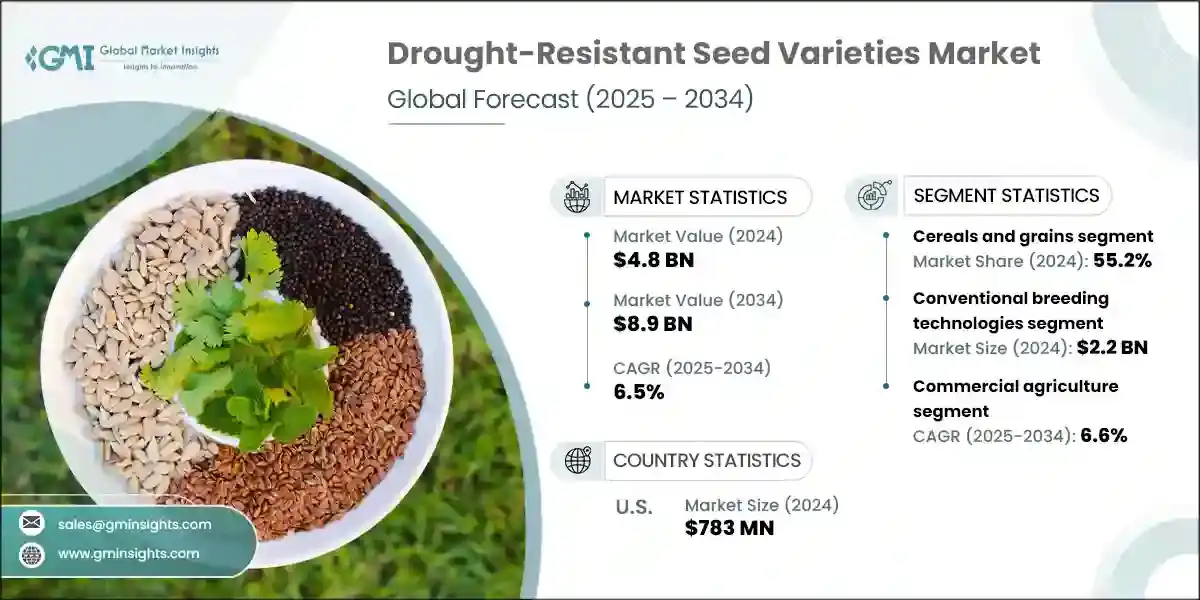
The global drought-resistant seed varieties market was estimated at USD 4.8 billion in 2024. The market is expected to grow from USD 5.1 billion in 2025 to USD 8.9 billion in 2034, at a CAGR of 6.5%.
Drought-Resistant Seed Varieties Market Key Takeaways
Market Size & Growth
- 2024 Market Size: USD 4.8 Billion
- 2034 Forecast Market Size: USD 8.9 Billion
- CAGR (2025–2034): 6.5%
Regional Dominance
- Largest Market: North America
- Fastest Growing Region: Asia Pacific
Key Market Drivers
- Increasing climate variability.
- Rising food security concerns.
- Growing adoption of sustainable agriculture practices.
Challenges
- High cost of drought-resistant seeds.
- Regulatory and certification challenges.
Opportunity
- Expanding into developing regions.
- Partnerships with governments and NGOs.
- Development of non-GMO cost-effective seed varieties.
Key Players
- Market Leader: Syngenta AG led with over 10.3% market share in 2024.
- Leading Players: Top 5 players in this market include Bayer AG, Corteva, Inc, Syngenta AG, BASF SE (Agricultural Solutions), KWS SAAT SE & Co. KGaA, which collectively held a market share of 47.8% in 2024.
Get Market Insights & Growth Opportunities
- The continuous growth of the drought-resistant seed varieties market is a solution to combat water scarcity and its adverse effects on crop production. Seeds that can withstand drought conditions are forecasted to be in demand such that stable yields can be achieved in the continuous changing weather patterns. This really fits into the global narrative on sustainable agriculture and food security, where farmers are being encouraged to grow more resilient crop varieties.
- Increasing awareness of the economic benefits of drought-resistant seeds such as less reliance on irrigation and reduced crop losses during droughts is having an impact on the market. Consequently, the growing adoption of these seed varieties by commercial farmers and smallholders alike has been a contributing factor to market expansion. In addition, any government incentives to support sustainable farming will reinforce this engine for market growth.
- Their application converges on a wide range of staple crops, including maize, wheat, and rice, as well as legumes and vegetables. Such varieties are used in both commercial agriculture and small farms, supporting food security, saving water, and enhancing sustainable farming practices. Altogether, it is expected that the market will continue to grow as agriculture seeks more resilient crop options in response to climate events.
- Asia Pacific takes a strong position in this market, holding a significant share of the market due to the growing agriculture sector in the region.
- For instance, India has made continuous progress in raising more unit yield of different food grains through the high yielding climate resilient varieties along with the rate of seed and varietal replacement which has gone up by a factor of 4.57 in food grain productivity at 2386 kg/ha during the year 2020-21. Ever since 2014, the yields of most crops have risen and thereby increased the food grain production to 6.4 times from 50.8 million tonnes in 1950-51 to reaching 323.6 million tonnes during 2022-23.
- North America has the largest share among all region due to the growing demand in the nation like U.S. and Canada. This region is facing immense technological innovation and growing opportunities for market players for business expansion.
To get key market trends
Drought-Resistant Seed Varieties Market Trends
- The market for drought-resistant varieties of seeds has enormous scope to grow as there are several underlying technological developments, more regulations, and increased consumer demand towards sustainable agriculture. The advances in genetic engineering, diseases' usage of gene editing (CRISPR), and precision breeding technologies all help improve the development of water-scarce-resilient seed varieties, which strengthens crop yields under adverse conditions. These technological advances provide competitive advantages to industry players by speeding up the development cycle and narrowing down the target traits.
- For instance, in an estimate given in 2023, drought disasters across the world accounted for an economic damage of USD 45 billion. More than 770 million people have also been affected by droughts in the past decade. That is why it is more important now to focus more on growing innovative seed through advance technologies.
- In the regions, the regulatory framework favorably supports the biotech crops in a manner that smoothens approval pathways and promotes farmer adoption of proven solutions to climate challenges. Governments are also promoting sustainable farming practices using subsidies and incentives in this market.
- Market demand rises due to dwindling water supplies and efforts to meet the world's food security. Globally drought tolerance is demanded from seeds because productivity still needs to be preserved despite reduced irrigation, especially in arid and semi-arid regions.
- The development of drought-resistant seed varieties grow phenomenally because of rapid technological advancement and supportive regulatory environments and with increasing consumer and farmer awareness regarding sustainable, resilient solutions to agriculture. Industry players thus continually innovate and collaborate to achieve that goal, building towards a resilient, sustainable future for global agriculture.
Drought-Resistant Seed Varieties Market Analysis
Learn more about the key segments shaping this market
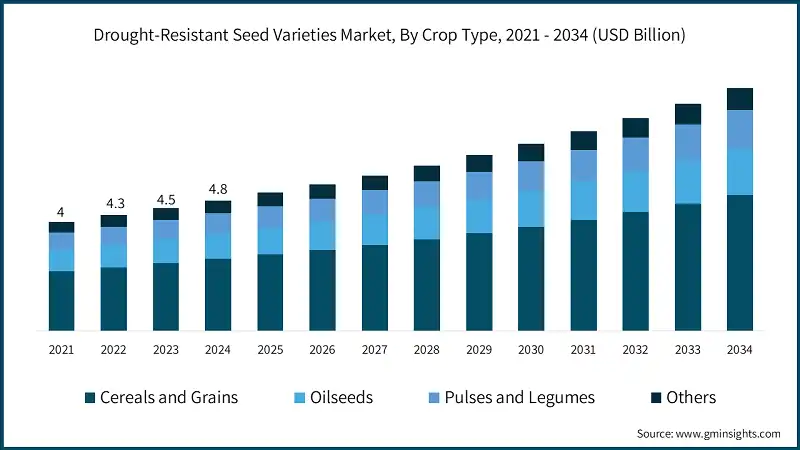
Based on crop type the market is segmented into cereals and grains, oilseeds, pulses and legumes, others. The cereals and grains accounted for 55.2% of the market share in 2024 and is expected to grow with the CAGR of 6.6% in 2034.
- Drought resistance seeds for cereals and grains are rapidly heading to become the largest segment of the market because they are the backbone of global food security and main staple item among agriculture worldwide. Developmental strides in biotechnology and genetic modification have enabled the production of resilient varieties for drought-tolerance, making cereals and grains by far the largest segments of all drought-resistant seeds.
- For instance, Corteva is set to introduce its drought-resistant hybrid Hard Red Winter wheat in 2027. The product will answer the increasing appeal for more sustainable solutions in farming. The hybrid wheat will also ensure yield increase and drought tolerance.
- The use of oilseeds is gradually rising due to their versatile usage and economic importance. The breeding activity supporting the development of drought-tolerant varieties of oilseeds is increasing as innovations in seed technology gain pace. Though oilseeds are growing only at a modest level, they do not have as large a market share as cereals and grains primarily due to the specificities of application and the area of cultivation.
- Pulses and legumes are increasingly being developed with drought-resistant characteristics for improved resilience in cultivation across arid to semi-arid environments. The area is gaining acceptance as a source of sustainable food; however, its overall market share would still be classified as relatively small. Pulses and legumes are well known for their nutritional value and improving soil health though the greatest segment in drought-resistant seed use remains cereals and grains due to more widespread cultivation and consumption worldwide.
Learn more about the key segments shaping this market
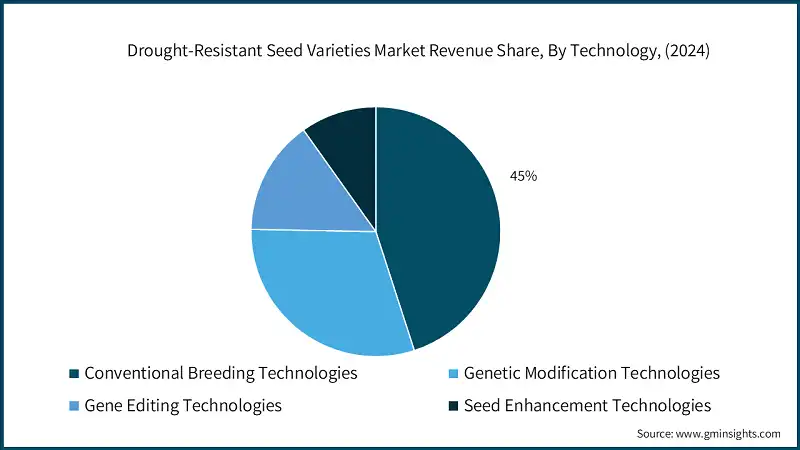
Based on technology the drought-resistant seed varieties market is segmented into conventional breeding technologies, genetic modification technologies, gene editing technologies, seed enhancement technologies. Conventional breeding technologies holds the market size of USD 2.2 billion in 2024 and expected to grow at a faster rate of 6.5% CAGR in 2034.
- The conventional breeding technologies methods are still very much the ruling technologies for the drought-resistant seed market, owing to their time-tested efficiency and acceptance within the regulatory framework. This category of breeding usually involves conventional crossbreeding and selection, forms of breeding that are particularly popular in developing parts of the world with limited access to advanced biotechnologies.
- Next, the technologies for genetic modification have started to find increasing acceptance in today's market environment for the presumed advantages of massively enhancing crop resilience and yield stability in areas deprived of adequate water.
- Gene editing technologies, especially CRISPR, have emerged as powerful agents for developing drought-resistant varieties with extreme precision and high efficiency. It still is at the embryonic stage with respect to commercial acceptance; however, gene editing holds renewed hope for sped-up breeding programs toward crops customized to withstand drought, placing it on the map as a significant trend for the foreseeable future.
Based on end use the drought-resistant seed varieties market is segmented into commercial agriculture, smallholder agriculture, research and development institutions. Commercial agriculture holds the market size of USD 3.1 billion in 2024 and expected to grow at a faster rate of 6.6% CAGR in 2034.
- Drought-resistant seed varieties are fast becoming the order of the day for commercial agriculture, ensuring enhanced crop yield maximization and economic stability. It is a sector with large infrastructures and investments making it the lead in the market for the adoption of the new seed technologies.
- Smallholders are slowly bringing drought-tolerant seeds into their cropping systems to enhance their resilience to water scarcity. The research and development institutions also play a very important role in developing new products through advanced-breeding and biotechnological research and development for drought resistance. Their work is vital for delivering new, credible solutions to help forge the way for the future of drought resilience.
Looking for region specific data?
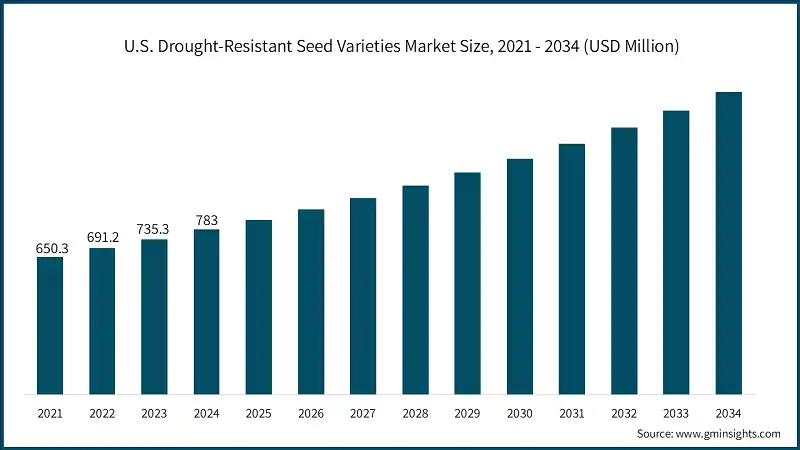
In the drought-resistant seed varieties market, U.S. accounts the major share in North America by accounting USD 783 million in 2024 and is expected to grow at a CAGR of 5.4% in 2034.
- In North America, steady growth is occurring in the market for drought-tolerant seed varieties due to increasing climatic variabilities and concerns regarding water scarcity.
- The U.S. commands this market owing to its extensive agriculture sector, adoption of state-of-the-art technology, and most important the very high investment levels in biotechnology research. Farmers are opted for drought-tolerant seeds to support maintaining the moisture content in their crops and reducing the dependence on irrigation sources, agitated in areas that are more drought prone, like the Southwest.
- Canada contributes to market expansion as the country focuses on sustainable farming practices along with adopting new seed varieties that can withstand fluctuating weather patterns.
The drought-resistant seed varieties market in the Germany is expected to experience significant and promising growth from 2025 to 2034.
- The European market for drought-resistant seed varieties is seeing additional impetus from climate change-induced water scarcity challenges. The region is expected to witness CAGR of 6.1% in 2034. The innovation and environmental sustainability thrust is driving the market forward, aided by government initiatives and collaborations with biotech companies.
- The UK also relies heavily on drought-tolerant seeds, all because of some super innovative approaches as well as backing for regulation issues concerning biotechnology risk. The climate is becoming more extreme, and so is the agricultural landscape, such that the production of food under adverse weather conditions is increasingly reliant on crops that can withstand changing climates.
- France, possessing a well-developed agricultural domain, has poured considerable resources into developing drought-resistant seed varieties to counter climate variability. The government program incentives and collaboration with the private sector promote the acceptance of these seed varieties, adding to the general development of the European market.
The drought-resistant seed varieties market in China is expected to experience significant and promising growth from 2025 to 2034.
- Asia Pacific has a significant share in the global level with the CAGR of 6.7%, due to growing nation like China, India, Japan and others agriculture countries.
- Heavy investments are being made into agricultural biotechnology to develop drought-tolerant crops able to withstand extreme weather by the major force in the field, China. Food security and sustainable farming practices are thus major factors not just for innovation but for already implementing a great deal of resilient seed varieties.
- India is witnessing considerable growth in this sector as farmer's awareness of the actual benefits of drought-resistant seeds increases. Adoption of technology raises productivity above present levels and reduces dependency on monsoon, also witness benefits with encouragement from government-sponsored programs and subsidies.
- Japan promotes advanced seed technology and research for drought-tolerant crops capable of appropriate establishment in its specific climate conditions while striving for high-tech agricultural solutions.
- South Korea promotes productivity and sustainability in agriculture. The focus on innovation & healthy agricultural practices further supports and fosters this market's development in that region.
The drought-resistant seed varieties market in Brazil is expected to experience significant and promising growth from 2025 to 2034.
- Brazil is the productive country in the region where farmers acquire effective drought protection seeds. With sustainable practices, nothing short of government support programs directs farmers in obtaining or investing in drought-resistant crop varieties, thereby ensuring stability in production and productivity.
- Mexico has also begun to awaken to this market, with farmers increasingly realizing the benefits of drought-resistant seeds. Government programs and partnerships with biotechnology companies have been enabling the entry of these advanced seeds to improve food security and agricultural resilience to changing climates.
- In Argentina, much investment in drought-tolerant seed technology is aimed at protecting the crucial agricultural exports of the nation from erratic rainfall patterns. In the agricultural sector, resilient seed varieties have increasingly considered a strategic pathway toward productivity and economic stability.
The drought-resistant seed varieties market in UAE is expected to experience significant and promising growth from 2025 to 2034.
- Drought-resistant seed varieties, because of factors including aridity and water deficit, are quite tremendously in demand in the Middle East and Africa with the CAGR of 6.3% in 2034. Advances in desert agriculture technology push forward the development of a resilient variety of seeds, which can be adopted and used in extreme environments.
- Focusing on food security and sustainable urban agriculture programs, the UAE invests in drought-resistant seeds.
- On the other hand, the increasing interest of many African countries in drought-tolerant seeds should be interpreted as a commensurate response mechanism to long drought and climate variability. It would be used by government and local farmers in further securing food production, diversifying agricultural income sources, and enabling adaptation to changing environmental conditions, particularly in water-scarce regions.
Drought-Resistant Seed Varieties Market Share
Top 7 companies include Bayer AG , Corteva, Inc., Syngenta AG, BASF SE (Agricultural Solutions), KWS SAAT SE & Co. KGaA, Limagrain Group, DLF Seeds A/S. These are prominent companies within the global market operating in their respective regions covers 48.05% of the market share. These companies hold strong positions globally because of their extensive experience in drought-resistant seed varieties market. Their diverse product portfolios backed by robust production capabilities and distribution networks, enable them to meet the rising demand for drought-resistant seed varieties across various regions.
- Bayer AG: Bayer AG is a world leader in both biotechnology and seed production in agriculture. The company lays particular emphasis on the development of drought-resistant seed varieties. Such extraordinary research and development facilities are within its scope of capability and its broad portfolio of genetically modified seeds, enabling rapid innovation in this segment.
- Corteva, Inc.: Corteva focus on innovation and developing solutions for sustainable agriculture. Through increased investment in R&D, Corteva develops drought-tolerant seeds specific to regions in North America, Latin America, and emerging markets.
- Syngenta AG: Syngenta is the voice of innovation when it comes to seed technology and crop protection. The integrated seed & crop protection solutions provide strength to enhance Syngenta position in the market.
- KWS SAAT SE & Co. KGaA: KWS is a strong seed company focusing on high-yield and resilient crop varieties from which drought-resistant varieties are one. With plant breeding technology investments in place, KWS can be singled out as a contender, especially in Europe, North America, and emerging markets.
- Limagrain Group: Limagrain is a cooperative group that centers its business on the field and vegetable seeds and cereal products. Its collaborative approach with local farmers and research institutions enhances its ability to innovate in drought resilience.
- DLF Seeds A/S: Among the major players in the forage and cereal seed markets is DLF Seeds, also currently investing much in developing drought-hardy varieties.
Drought-Resistant Seed Varieties Market Companies
Major players operating in the drought-resistant seed varieties industry are:
- Bayer AG
- Corteva, Inc.
- Syngenta AG
- BASF SE (Agricultural Solutions)
- KWS SAAT SE & Co. KGaA
- Limagrain Group
- DLF Seeds A/S
- Sakata Seed Corporation
- Takii & Co., Ltd.
- Rijk Zwaan Zaadteelt en Zaadhandel B.V.
- Enza Zaden Beheer B.V.
Drought-Resistant Seed Varieties Market Report Attributes
| Key Takeaway | Details |
|---|---|
| Market Size & Growth | |
| Base Year | 2024 |
| Market Size in 2024 | USD 4.8 Billion |
| Forecast Period 2025 – 2034 CAGR | 6.5% |
| Market Size in 2034 | USD 8.9 Billion |
| Key Market Trends | |
| Drivers | Impact |
| Increasing climate variability | As climate change leads to more frequent and severe droughts, farmers are compelled to adopt drought-resistant seeds to maintain crop yields. This drives market growth by creating a sustained demand for resilient seed varieties. |
| Rising food security concerns | Governments and organizations prioritize food security, encouraging farmers to use drought-tolerant seeds to minimize crop failures. This societal focus boosts adoption rates and expands the market. |
| Growing adoption of sustainable agriculture practices | The shift towards sustainable farming reduces water usage and promotes resilient crop varieties. This increases market demand for drought-resistant seeds that align with eco-friendly practices, fostering industry expansion. |
| Pitfalls & Challenges | Impact |
| High cost of drought-resistant seeds | Elevated seed prices can deter smallholder and resource-constrained farmers from adoption, limiting market penetration and slowing overall growth. |
| Regulatory and certification challenges | Lengthy approval processes and stringent regulations can delay product launches and restrict market access, hindering industry expansion. |
| Opportunities: | Impact |
| Expanding into developing regions | Growing agricultural regions with frequent droughts present vast opportunities for market expansion, especially with tailored solutions for local crops and conditions. |
| Partnerships with governments and NGOs | Collaborations can facilitate subsidies, awareness campaigns, and distribution networks, accelerating adoption and market growth. |
| Development of non-GMO cost-effective seed varieties | Creating affordable, non-GMO drought-resistant seeds can broaden access, especially among smallholders, opening new market segments and driving overall growth. |
| Market Leaders (2024) | |
| Market Leaders |
10.3% Market Share |
| Top Players |
Collective share of 47.8% in 2024 |
| Competitive Edge |
|
| Regional Insights | |
| Largest Market | North America |
| Fastest Growing Market | Asia Pacific |
| Emerging Countries | India, China, Brazil, Mexico, Canada |
| Future outlook |
|
What are the growth opportunities in this market?
Drought-Resistant Seed Varieties Industry News
- In October 2024, drought affected farmers in Moldova with their active partnership with FAO, started drought relief program. The program was set up to support farmers who are heavily affected by crop loss exceeding 70% due to the drought.
- In May 2024, the ICAR, has developed and launched a new drought-tolerant tapioca variety named Sree Kaveri which is expected to address mid-season drought challenges. The variety carries impressive agricultural attributes, as it is known to give high yields of 51 tons per hectare and has 28% in starch content. This development is the product of long and extensive research that involves screening and evaluation of about 30 cassava clones: indigenous, released, and South American varieties.
- In April 2024, Zambia launched pilot projects for drought-tolerant seed varieties at the Zambia Agriculture Research Institute (ZARI) to enhance food security from severe weather events.
The drought-resistant seed varieties market research report includes an in-depth coverage of the industry with estimates and forecast in terms of revenue in (USD Billion) and volume (Tons) from 2021 to 2034 for the following segments:
Market, By Crop Type
- Cereals and grains
- Maize/corn drought-resistant varieties
- Wheat drought-tolerant varieties
- Rice drought-resistant varieties
- Sorghum and millet varieties
- Oilseeds
- Soybean drought-tolerant varieties
- Sunflower and canola
- Pulses and legumes
- Cowpea and pigeon pea varieties
- Bean and lentil segments
- Other crops
Market, By Technology
- Conventional breeding technologies
- Genetic modification technologies
- Gene editing technologies
- Seed enhancement technologies
Market, By End Use
- Commercial agriculture
- Large-scale farming operations
- Medium-scale commercial farmers
- Smallholder agriculture
- Subsistence farming segment
- Semi-commercial smallholders
- Research and development institutions
- Public research organizations
- Universities and academic institutions
- International agricultural research centers
The above information is provided for the following regions and countries:
- Key trends
- North America
- U.S.
- Canada
- Europe
- Germany
- UK
- France
- Italy
- Spain
- Asia Pacific
- China
- India
- Japan
- Australia
- South Korea
- Latin America
- Brazil
- Mexico
- Argentina
- Middle East & Africa
- Saudi Arabia
- South Africa
- UAE
Frequently Asked Question(FAQ) :
What is the market size of drought-resistant seed varieties in 2024?
The market size was USD 4.8 billion in 2024, with a CAGR of 6.5% expected through 2034 driven by rising climate variability and adoption of sustainable agriculture practices.
What is the projected value of the drought-resistant seed varieties market by 2034?
The market is projected to reach USD 8.9 billion by 2034, fueled by increasing food security concerns, biotechnology advancements, and expanding use in developing regions.
How much revenue did the cereals & grains segment generate in 2024?
Cereals and grains accounted for 55.2% market share in 2024.
What was the valuation of conventional breeding technologies in 2024?
Conventional breeding technologies generated USD 2.2 billion in 2024 and are expected to grow steadily due to broad regulatory acceptance and use in developing nations.
Which region leads the drought-resistant seed varieties market?
North America led with USD 783 million from the U.S. in 2024. Growth was driven by biotech investment and advanced farming practices.
What are the key trends in the drought-resistant seed varieties industry?
Key trends include increasing use of CRISPR and genetic technologies, growing government subsidies for sustainable farming, and rising demand for non-GMO drought-resistant seeds.
Who are the key players in the drought-resistant seed varieties market?
Key players include Bayer AG, Corteva, Inc., Syngenta AG, BASF SE, KWS SAAT SE & Co. KGaA, Limagrain Group, DLF Seeds A/S, Sakata Seed Corporation, Takii & Co., Ltd., Rijk Zwaan, and Enza Zaden.
Drought-Resistant Seed Varieties Market Scope
Related Reports