Summary
Table of Content

Digital Twin for Consumer Product Design Market
Get a free sample of this report
Form submitted successfully!
Error submitting form. Please try again.
Thank you!
Your inquiry has been received. Our team will reach out to you with the required details via email. To ensure that you don't miss their response, kindly remember to check your spam folder as well!
Request Sectional Data
Thank you!
Your inquiry has been received. Our team will reach out to you with the required details via email. To ensure that you don't miss their response, kindly remember to check your spam folder as well!
Form submitted successfully!
Error submitting form. Please try again.
Digital Twin for Consumer Product Design Market Size
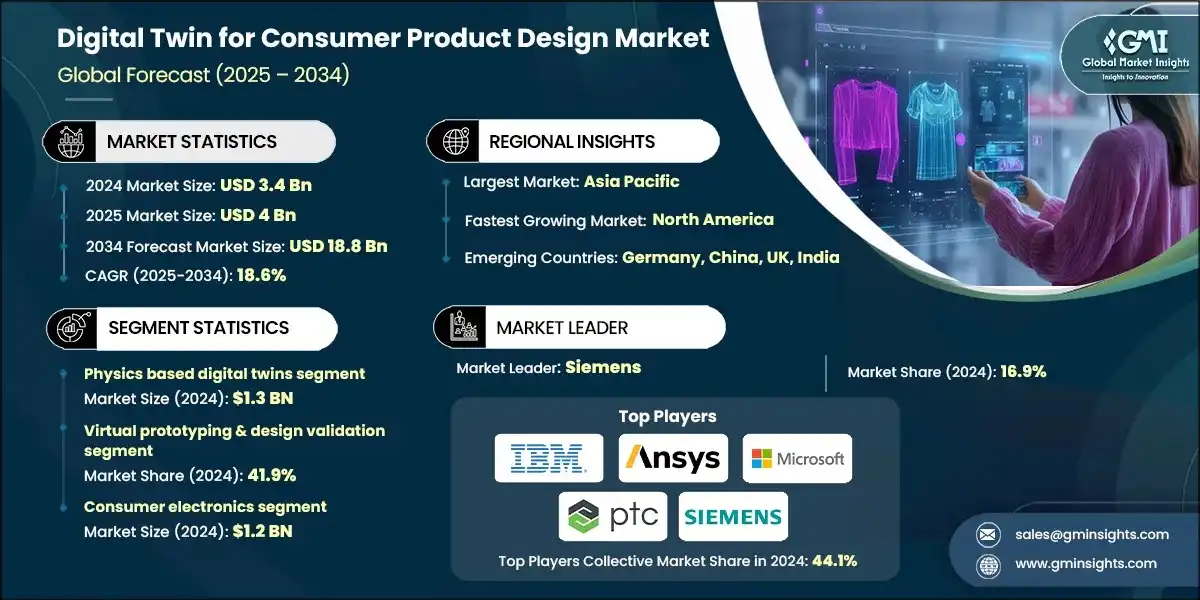
The global digital twin for consumer product design market was estimated at USD 3.4 billion in 2024. The market is expected to grow from USD 4 billion in 2025 to USD 18.8 billion in 2034, at a CAGR of 18.6%, according to latest report published by Global Market Insights Inc.
Digital Twin for Consumer Product Design Market Key Takeaways
Market Size & Growth
- 2024 Market Size: USD 3.4 Billion
- 2025 Market Size: USD 4 Billion
- 2034 Forecast Market Size: USD 18.8 Billion
- CAGR (2025–2034): 18.6%
Key Market Drivers
- Accelerated time-to-market demands.
- Consumer personalization requirements.
- Regulatory compliance and safety.
Challenges
- Data integration.
- High implementation costs.
Opportunity
- Personalized product development at scale.
- Data-driven design optimization.
Key Players
- Market Leader: Siemens led with over 16.9% market share in 2024.
- Leading Players: Top 5 players in this market include IBM, Ansys, Microsoft, PTC, Siemens, which collectively held a market share of 44.1% in 2024.
Get Market Insights & Growth Opportunities
The market for digital twins in consumer product design is growing rapidly due to the rising demand for personalized, efficient, and sustainable product development. Digital twins, which are virtual copies of physical products, let designers and manufacturers simulate, test, and refine products in a virtual setting before starting the actual physical production. This method speeds up time-to-market and lowers prototyping costs and material waste. A report by the International Data Corporation (IDC) predicts that global spending on digital twin technology will surpass USD 26 billion by 2025, with a compound annual growth rate (CAGR) of over 35% during this period. As consumer demand for customization and quick innovation increase, digital twins are becoming essential tools for brands that want to stay competitive.
The use of digital twin technology is particularly strong in industries like consumer electronics, apparel, and home appliances, where frequent design changes and improved user experiences are key to success. In the consumer electronics sector, companies use digital twins to model user interactions, predict product performance, and collect real-time feedback through IoT (internet of things) integration. This feature allows for ongoing product improvement even after launch. In the apparel industry, designers are using digital twins to create virtual prototypes of garments. This lets them visualize and change designs without needing physical samples, which helps cut down on fabric waste. Likewise, in the home appliances industry, manufacturers are using digital twins to model energy production and durability, ensuring they meet strict regulatory standards from the U.S. Department of Energy (DOE).
The combination of technologies like artificial intelligence (AI) and machine learning (ML) with digital twins is increasing their capabilities. AI and ML algorithms analyze the large amounts of data produced by digital twins to give predictive insights, making design decisions smarter and quicker. For example, AI-driven digital twins can predict possible product failures and recommend design changes to reduce risks, which enhances product reliability and customer satisfaction. Also, the usage of cloud-based platforms is becoming digital twin technology easier for businesses of all sizes to access. Cloud solutions let companies grow their digital twin operations without major upfront costs for infrastructure, which is especially helpful for small and medium-sized enterprises (SMEs).
To get key market trends
Digital Twin for Consumer Product Design Market Trends
The integration of digital twins with product lifecycle management (PLM) systems is revolutionizing the way manufacturers manage product lifecycles.
- This integration facilitates a seamless flow of data across all stages, from concept design and prototyping to manufacturing, distribution, and end-of-life management. According to ScienceDirect's research on digital twin and digital thread within PLM, this approach provides manufacturers with a centralized and reliable source of product information, ensuring consistency and accuracy throughout the lifecycle.
- The measurable benefits of this integration are significant. Studies have shown that manufacturers can achieve up to a 25% reduction in time-to-market and a 30% improvement in operational efficiency. For instance, Siemens, a leader in PLM solutions, has reported that integrating digital twins into their PLM systems has enabled their clients to reduce design errors by 15% and improve production planning accuracy by 20%. This integration is particularly critical in industries such as automotive and aerospace, where precision and efficiency are paramount.
- Modern digital twin platforms are increasingly incorporating real-time consumer feedback mechanisms, enabling manufacturers to enhance product design validation and improve customer satisfaction. By collecting data on product usage, performance metrics, and consumer preferences directly from deployed products, manufacturers can establish a closed-loop feedback system. This system allows for iterative design improvements based on real-world insights. For example, in the consumer electronics sector, companies like Samsung have utilized digital twins to analyze real-time feedback from smart devices, leading to a 12% reduction in product returns and a 15% increase in customer satisfaction scores. Additionally, the integration of Internet of Things (IoT) sensors with digital twins has enabled manufacturers to monitor product performance remotely, reducing maintenance costs by up to 20% as per a report by the International Data Corporation (IDC).
- The integration of artificial intelligence (AI) and machine learning (ML) technologies with digital twin platforms is transforming the design optimization process. AI-powered digital twins can autonomously evaluate thousands of design variations within seconds, significantly accelerating the design cycle. McKinsey's research on digital twins in product development reveals that this capability has reduced design timelines by up to 50% in certain industries.
- In renewable energy applications, for instance, ML-enhanced digital twins have been used to evaluate over one million design configurations in seconds, a task that traditionally required hours using conventional computational fluid dynamics (CFD) analysis. This has halved the end-to-end design cycle time, enabling faster deployment of renewable energy solutions.
- Furthermore, General Electric (GE) has reported that the use of AI-powered digital twins in their wind turbine design process has increased energy output efficiency by 15% while reducing material costs by 10%. These advancements underscore the potential of AI-driven digital twins to revolutionize product development across various sectors, including automotive, aerospace, and energy.
Digital Twin for Consumer Product Design Market Analysis

Learn more about the key segments shaping this market
Based on technology type, the market is segmented into physics-based digital twins, data-driven digital twins, hybrid digital twins and reduced order models. The physics based digital twins segment held the major market share, generating a revenue of USD 1.3 billion in 2024.
- Physics-based digital twins provide deterministic modeling capabilities that enable precise prediction of product behavior under various operating conditions, making them essential for safety-critical applications and regulatory compliance validation. Technology’s strength lies in its ability to model complex physical phenomena without requiring extensive historical data, making it suitable for innovative product designs where limited operational data exists. Major applications include virtual crash testing for automotive components, thermal management optimization for consumer electronics, and structural integrity validation for home appliances.
- Data-driven digital twins, leveraging machine learning algorithms, statistical analysis, and pattern recognition to create behavioral models based on historical and real-time operational data. This approach excels in applications where complex system interactions are difficult to model using first principles, such as consumer behavior prediction, usage pattern analysis, and predictive maintenance optimization. Data-driven twins become more accurate over time as they accumulate operational data, making them particularly valuable for products with extensive deployment and usage history.
- The data-driven approach is particularly effective for consumer products with embedded sensors and connectivity capabilities, enabling continuous learning from real-world usage patterns. Applications include smartphone battery optimization, smart home device behavior prediction, and personalized product recommendation systems. Technology’s ability to identify unexpected correlations and usage patterns provides valuable insights into product improvement and feature development.
- Hybrid digital twins, representing the convergence of deterministic and statistical modeling techniques. Hybrid approaches leverage the predictive accuracy of physics-based models for well-understood phenomena while utilizing machine learning for complex interactions and emergent behaviors that are difficult to model analytically. This combination provides comprehensive modeling capabilities that address the limitations of purely physics-based or data-driven approaches.
Learn more about the key segments shaping this market
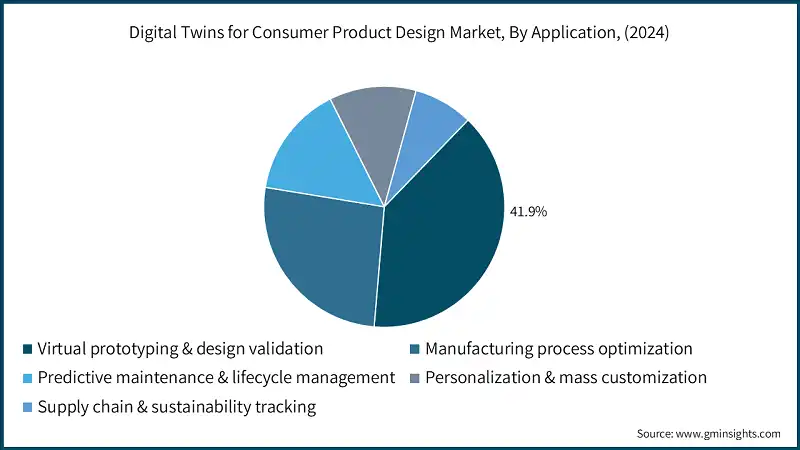
Based on the application, the digital twin for consumer product design market is segmented into virtual prototyping & design validation, manufacturing process optimization, predictive maintenance & lifecycle management, personalization & mass customization and supply chain & sustainability tracking. The virtual prototyping & design validation segment held the largest share, accounting for 41.9% of the global market in 2024.
- Virtual prototyping and design validation dominates the application segment reflecting the fundamental value proposition of digital twin technology in reducing physical prototyping costs and accelerating product development cycles. This application enables manufacturers to test multiple design variations, evaluate performance under various conditions, and identify potential issues before committing to physical prototypes.
- Virtual prototyping applications span the entire product development lifecycle, from conceptual design validation to detailed engineering analysis and manufacturing process optimization. Consumer electronics manufacturers utilize virtual prototyping to evaluate thermal management, electromagnetic compatibility, and mechanical durability before producing physical prototypes. Automotive component suppliers leverage virtual prototyping for crash simulation, vibration analysis, and assembly validation, reducing development time by up to 50% while improving product quality.
- The application's growth is driven by increasing pressure to reduce time-to-market, minimize development costs, and improve product quality through comprehensive testing and validation. Advanced simulation capabilities enable testing of extreme conditions, failure modes, and edge cases that would be expensive or dangerous to replicate with physical prototypes. Virtual prototyping also enables parallel development activities, allowing multiple design teams to work simultaneously on different aspects of product development.
- Manufacturing process optimization, on the other hand, focuses on improving production efficiency, quality control, and resource utilization through digital twin-enabled process simulation and optimization. This application leverages real-time manufacturing data, process models, and optimization algorithms to identify bottlenecks, reduce waste, and improve overall equipment effectiveness. Digital twins enable manufacturers to simulate process changes, evaluate new production methods, and optimize resource allocation without disrupting ongoing operations.
Based on the end use, the digital twin for consumer product design market is segmented into consumer electronics, automotive, fashion & apparel, home appliances, and others (semiconductor & hardware etc.). In 2024, consumer electronics held a major market share, generating a revenue of USD 1.2 billion.
- The consumer electronics sector has emerged as a dominant force in the digital twin landscape for product design, driven by its rapid innovation cycles, high consumer demand, and the need for precision in design and performance. Digital twins virtual replicas of physical products enable manufacturers to simulate, test, and optimize devices like smartphones, wearables, and smart home appliances before they reach the market.
- This capability is especially critical in consumer electronics, where product lifecycles are short and competition are fierce. By leveraging digital twins, companies can reduce development costs, accelerate time-to-market, and ensure higher product quality, all while responding swiftly to user feedback and market trends.
Looking for region specific data?
North America Digital Twin for Consumer Product Design Market
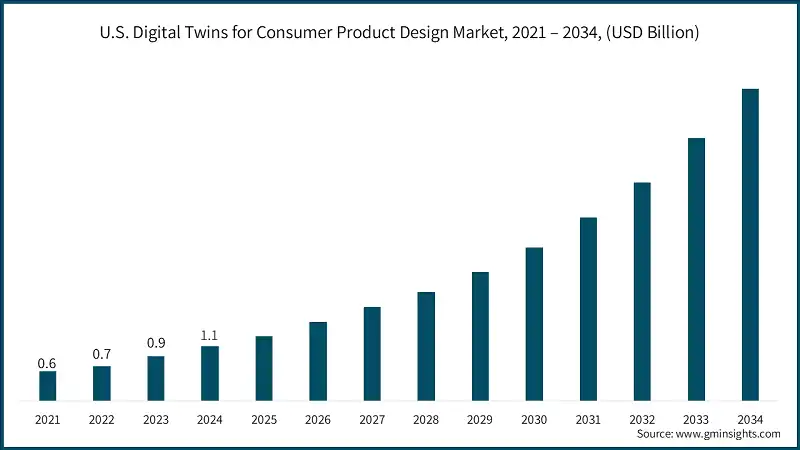
In 2024, the U.S. contributed significantly to the market growth in North America, accounting for 76% share in the region.
- North America maintains market leadership with, driven by advanced digital infrastructure, high concentration of technology vendors, and early adoption of digital twin technologies across consumer product industries. The region benefits from substantial investment in research and development, with major technology companies including Microsoft, IBM, Amazon Web Services, and Google providing cloud-based digital twin platforms that reduce implementation barriers for manufacturers. The presence of leading automotive, electronics, and aerospace industries creates strong demand for advanced product design and validation technologies.
- The U.S. represents the largest market within North America, supported by significant government investment in advanced manufacturing initiatives, strong intellectual property protection, and access to venture capital funding for digital twin technology development. Major consumer product companies including Apple, General Electric, Ford, and Procter & Gamble are implementing digital twin technologies to optimize product development cycles, improve quality control, and enhance consumer experiences. The region's skilled workforce and advanced educational institutions provide essential human capital for digital twin implementation and operation.
Asia Pacific Digital Twin for Consumer Product Design Market
Asia Pacific market is expected to grow at 19.2% during the forecast period.
- Asia Pacific reflecting rapid industrialization, increasing manufacturing sophistication, and growing consumer electronics production. The region benefits from large-scale manufacturing operations, government support for digital transformation, and increasing focus on product quality and innovation to compete in global markets.
- China represents the largest market within Asia Pacific, driven by massive manufacturing scale, government investment in smart manufacturing technologies, and growing domestic consumer market demanding higher product quality and innovation. Chinese manufacturers are implementing digital twin technologies to improve product design, optimize manufacturing processes, and enhance quality control across diverse consumer product categories including electronics, automotive components, and home appliances.
Europe Digital Twin for Consumer Product Design Market
Europe digital twin for consumer product design industry is expected to grow at 18.3% during the forecast period.
- Europe, supported by strong automotive and industrial manufacturing sectors, comprehensive regulatory frameworks promoting digitalization, and significant investment in Industry 4.0 initiatives. The European Union's Digital Single Market strategy and Green Deal initiatives create favorable conditions for digital twin adoption, particularly for applications supporting sustainability reporting and circular economy principles.
- Germany leads European adoption through its advanced automotive industry, strong manufacturing sector, and government support for digitalization initiatives. Companies including Siemens, SAP, and Bosch are major digital twin technology providers, while automotive manufacturers such as BMW, Mercedes-Benz, and Volkswagen are implementing comprehensive digital twin strategies for product development and manufacturing optimization. The country's Industrie 4.0 initiative provides framework and funding for digital twin implementation across manufacturing sectors.
Middle East and Africa Digital Twin for Consumer Product Design Market
Middle East and Africa digital twin for consumer product design markets are growing at a CAGR of 18.2% during the forecast period.
- The consumer electronics sector has solidified its position as a key driver in the digital twin market, fueled by rapid innovation cycles, escalating consumer demand, and the critical need for precision in design and performance. Digital twins, which are virtual replicas of physical products, enable manufacturers to simulate, test, and optimize devices such as smartphones, wearables, and smart home appliances before they are introduced to the market.
- This capability is particularly vital in the consumer electronics sector, where product lifecycles are increasingly short, and competition is exceptionally fierce. According to the Consumer Technology Association (CTA), the global consumer electronics market is projected to reach USD 1.1 trillion by 2026, underscoring the immense scale and potential of this sector. By leveraging digital twin technology, companies can significantly reduce development costs, accelerate time-to-market, and enhance product quality, all while responding swiftly to evolving user feedback and dynamic market trends.
- Moreover, the integration of Internet of Things (IoT) and Artificial Intelligence (AI) technologies into consumer electronics has further amplified the importance of digital twins. IoT enables real-time data collection from physical devices, which can then be fed into their digital counterparts. This real-time data exchange facilitates predictive maintenance, performance optimization, and the creation of personalized user experiences.
- For instance, leading manufacturers like Samsung and Apple have incorporated digital twin technology to streamline their product design processes, ensuring that their devices meet the highest standards of functionality and user satisfaction. According to a report by the International Data Corporation (IDC), the global IoT market is expected to grow at a compound annual growth rate (CAGR) of 26.7% from 2023 to 2030, further driving the adoption of digital twins in consumer electronics.
Digital Twin for Consumer Product Design Market Shares
The top companies in the digital twin for consumer product design industry include Ansys, IBM, Microsoft, PTC, and Siemens, and collectively hold a share of 44.1% in the market. These prominent players are proactively involved in strategic endeavors, such as facility expansions & collaborations, to expand their product portfolios, extend their reach to a broad customer base, and strengthen their market position.
- Ansys stands out with its physics-based simulation expertise and the Ansys Twin Builder platform. It enables the creation of high-fidelity digital twins using Reduced-Order Models (ROMs), which allow real-time simulation of complex systems with high accuracy. This capability empowers engineers to optimize product performance, reduce prototyping costs, and enhance lifecycle management. Ansys also supports open standards like FMI, making it highly integrative across tools and platforms.
- IBM leverages its AI-first platforms, hybrid cloud infrastructure, and deep consulting expertise to co-create tailored digital twin solutions. Its strength lies in integrating product engineering, design, and management with AI and cloud-native technologies. IBM’s Garage methodology accelerates product development through agile, iterative design, helping clients reduce time-to-market and improve customer-centric innovation.
- Microsoft’s edge lies in its Azure Digital Twins platform, which integrates seamlessly with IoT, AI, and cloud services. It enables real-time, scalable, and cost-effective digital twin solutions for personalized product content creation and consumer experience optimization. Collaborations with companies like Nestlé showcase its ability to deliver hyper-realistic 3D product models and AI-driven content workflows, reducing time and cost by up to 70%.
Digital Twin for Consumer Product Design Market Companies
Major players operating in the digital twin for consumer product design industry are:
- Akselos
- Altair
- Amazon Web Services
- Ansys
- AVEVA
- Bentley
- Bosch
- Cosmo Tech
- Dassault
- Hexagon
- IBM
- Microsoft
- PTC
- SAP
- Siemens
PTC offers a comprehensive digital twin framework that spans the entire product lifecycle—from design and manufacturing to service. Its solutions integrate CAD, PLM, IoT, and AR, enabling real-time data visualization, predictive maintenance, and enhanced customer service. PTC’s digital twins are designed to improve product quality, operational efficiency, and customer satisfaction, while also supporting new business models like product-as-a-service.
Siemens leads with its CAD-integrated digital twin ecosystem through platforms like NX and Solid Edge. These tools combine real-time IoT data, simulation, and AI to create dynamic, evolving digital twins that support predictive maintenance, virtual testing, and lifecycle optimization. Siemens’ solutions are scalable for both SMBs and large enterprises, enabling faster design iterations, reduced prototyping, and sustainable product development.
Digital Twin for Consumer Product Design Market Report Attributes
| Key Takeaway | Details |
|---|---|
| Market Size & Growth | |
| Base Year | 2024 |
| Market Size in 2024 | USD 3.4 Billion |
| Market Size in 2025 | USD 4 Billion |
| Forecast Period 2025 - 2034 CAGR | 18.6% |
| Market Size in 2034 | USD 18.8 Billion |
| Key Market Trends | |
| Drivers | Impact |
| Accelerated time-to-market demands | The increasing pressure to reduce product development cycles is driving widespread adoption of digital twin technology in consumer product design. Digital twins enable virtual prototyping and design validation. |
| Consumer personalization requirements | Growing consumer demand for personalized products is fueling investment in digital twin technologies that enable mass customization. Digital twins allow manufacturers to simulate individual usage patterns and preferences. |
| Regulatory compliance and safety | Increasing regulatory requirements, particularly in automotive and electronics sectors, are driving adoption of digital twins for compliance validation. Digital twins enable comprehensive safety testing and scenario simulation, reducing the risk of non-compliance and product recalls. |
| Pitfalls & Challenges | Impact |
| Data integration | The complexity of integrating data from multiple sources including PLM systems, IoT sensors, manufacturing execution systems, and external datasets presents significant implementation challenges. Organizations face difficulties with data standardization, quality management, and real-time processing requirements as per Chemcopilot analysis on digital twins and PLM lifecycle optimization. |
| High implementation costs | The substantial upfront investment required for digital twin implementation, including sensors, software platforms, cloud infrastructure, and skilled personnel, creates barriers to adoption, particularly for small and medium enterprises. |
| Opportunities: | Impact |
| Personalized product development at scale | Digital twins allow manufacturers to simulate and tailor product designs based on individual customer requirements. This opens opportunities for mass customization, where companies can efficiently deliver personalized solutions without compromising on cost or production speed. |
| Data-driven design optimization | By integrating real-time usage data from existing products, digital twins enable continuous improvement in design. This feedback loop helps companies innovate faster, reduce design flaws, and create more user-centric products, enhancing competitiveness and customer loyalty. |
| Market Leaders (2024) | |
| Market Leaders |
16.9% market share |
| Top Players |
The collective market share in 2024 is 44.1% |
| Competitive Edge |
|
| Regional Insights | |
| Largest Market | Asia Pacific |
| Fastest Growing Market | North America |
| Emerging Country | Germany, China, UK, India |
| Future Outlook |
|
What are the growth opportunities in this market?
Digital Twin for Consumer Product Design Industry News
- In January 2025, Siemens announced significant enhancements to its Simcenter portfolio, integrating advanced artificial intelligence capabilities to accelerate simulation workflows and improve predictive accuracy for consumer product design applications. The new AI-enhanced simulation tools can automatically optimize mesh generation, reduce simulation time by up to 70%, and provide intelligent recommendations for design improvements based on simulation results as per Siemens official announcement.
- In December 2024, Microsoft launched industry-specific templates for Azure Digital Twins platform, targeting consumer electronics, automotive components, and home appliances manufacturers. The pre-configured templates include common IoT device models, analytics dashboards, and integration connectors that reduce implementation time from months to weeks for typical consumer product applications according to Microsoft official release.
- In November 2024, Dassault Systèmes completed the acquisition of a specialized cloud-based simulation company focused on consumer product testing and validation. The acquisition enhances Dassault's 3DEXPERIENCE platform with advanced virtual testing capabilities specifically designed for consumer product durability, safety, and performance validation as per Dassault Systèmes press release.
- In October 2024, PTC announced a strategic partnership with a leading consumer electronics manufacturer to implement comprehensive digital twin solutions across their product portfolio. The collaboration demonstrates PTC's ThingWorx platform capabilities for connected product lifecycle management and real-time performance optimization according to PTC announcement.
The digital twin for consumer product design market research report includes in-depth coverage of the industry with estimates & forecast in terms of revenue (USD Billion) (Units) from 2021 to 2034, for the following segments:
Market, By Technology Type
- Physics-based digital twins
- Data-driven digital twins
- Hybrid digital twins
- Reduced order models
Market, By Deployment Model
- Cloud-based digital twins
- Edge computing digital twins
- Hybrid cloud-edge
- Others
Market, By Application
- Virtual prototyping & design validation
- Manufacturing process optimization
- Predictive maintenance & lifecycle management
- Personalization & mass customization
- Supply chain & sustainability tracking
Market, By End Use Industry
- Consumer electronics
- Smartphone & wearable device
- IoT device integration
- Performance testing & reliability
- User experience simulation
- Automotive
- Electric vehicle component
- Autonomous vehicle system integration
- Battery management system
- Fashion & apparel
- Virtual garment design
- Material behavior simulation
- Home appliances
- Others
The above information is provided for the following regions and countries:
- North America
- U.S.
- Canada
- Europe
- Germany
- UK
- France
- Spain
- Italy
- Asia Pacific
- China
- Japan
- India
- Australia
- South Korea
- Latin America
- Brazil
- Mexico
- Argentina
- MEA
- South Africa
- Saudi Arabia
- UAE
Frequently Asked Question(FAQ) :
What is the market size of the digital twin for consumer product design industry in 2024?
The market size was USD 3.4 billion in 2024, with a CAGR of 18.6% expected through 2034, driven by the demand for virtual prototyping, mass customization, and regulatory compliance.
What is the current digital twin for consumer product design market size in 2025?
The market size is projected to reach USD 4 billion in 2025.
What is the projected value of the digital twin for consumer product design market by 2034?
The market is expected to reach USD 18.8 billion by 2034, fueled by advancements in AI, IoT integration, and the growing need for real-time design optimization.
How much revenue did the physics-based digital twins segment generate in 2024?
The physics-based digital twins segment generated USD 1.3 billion in 2024, holding the largest share among technology types.
What was the valuation of the virtual prototyping & design validation segment in 2024?
The virtual prototyping & design validation segment accounted for 41.9% of the global market, generating significant revenue in 2024.
Which region leads the digital twin for consumer product design market?
In 2024, the U.S. contributed 76% of the North American market, showcasing its dominance in the region. This growth is driven by strong technological infrastructure and the adoption of advanced manufacturing solutions.
What are the upcoming trends in the digital twin for consumer product design industry?
Key trends include the integration of AI and IoT with digital twins, the rise of cloud-based platforms for collaborative design, and the use of real-time data for predictive analytics and continuous product improvement.
Who are the key players in the digital twin for consumer product design market?
Key players include Siemens, IBM, Ansys, Microsoft, PTC, Akselos, Altair, Amazon Web Services, AVEVA, Bentley, Bosch, Cosmo Tech, Dassault, and Hexagon.
Digital Twin for Consumer Product Design Market Scope
Related Reports