Summary
Table of Content

Digital Substation Market
Get a free sample of this report
Form submitted successfully!
Error submitting form. Please try again.
Thank you!
Your inquiry has been received. Our team will reach out to you with the required details via email. To ensure that you don't miss their response, kindly remember to check your spam folder as well!
Request Sectional Data
Thank you!
Your inquiry has been received. Our team will reach out to you with the required details via email. To ensure that you don't miss their response, kindly remember to check your spam folder as well!
Form submitted successfully!
Error submitting form. Please try again.
Digital Substation Market Size
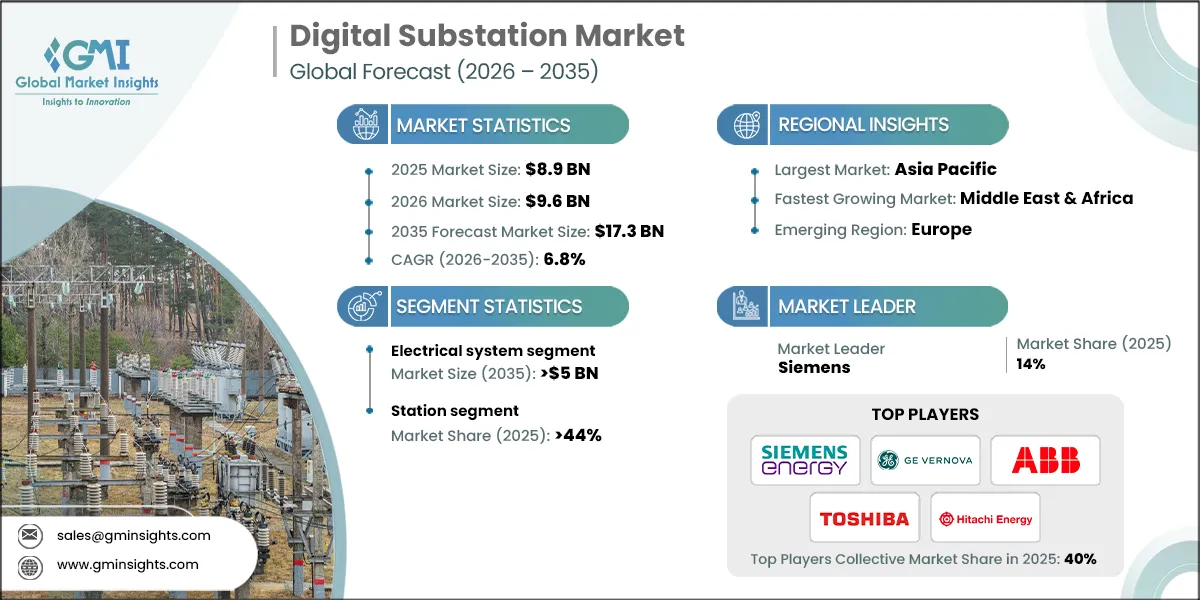
The global digital substation market was estimated at USD 8.9 billion in 2025. The market is expected to grow from USD 9.6 billion in 2026 to USD 17.3 billion in 2035, at a CAGR of 6.8%.
Digital Substation Market Key Takeaways
Market Size & Growth
- 2025 Market Size: USD 8.9 Billion
- 2026 Market Size: USD 9.6 Billion
- 2035 Forecast Market Size: USD 17.3 Billion
- CAGR (2026–2035): 6.8%
Regional Dominance
- Largest Market: Asia Pacific
- Fastest Growing Region: Middle East & Africa
Key Market Drivers
- Rising Demand for Electricity.
- Growing Renewable Energy Integration.
Challenges
- High Dependency on Imports.
Opportunity
- Advancement in Technology.
Key Players
- Market Leader: Siemens led with over 14% market share in 2025.
- Leading Players: Top 5 players in this market include Siemens Energy, GE Vernova, ABB, Toshiba, Hitachi Energy, which collectively held a market share of 40% in 2025.
Get Market Insights & Growth Opportunities
- The digital substation market is witnessing rapid growth globally, driven by the need for modern, efficient, and resilient power infrastructure. Traditional substations are being replaced or upgraded with digital technologies that enable real-time monitoring, automation, and predictive maintenance. This transformation is essential for meeting rising electricity demand and integrating renewable energy sources into power grids.
- Digital substations leverage IEC 61850 communication standards, fiber-optic process buses, and IoT-enabled devices to reduce wiring costs and improve interoperability. For instance, replacing copper wiring with fiber optics can cut installation costs by up to 70%. Advanced analytics, digital twins, and cybersecurity solutions further enhance operational efficiency, making digital substations attractive for utilities and industrial users.
- The global push for smart grids is a major catalyst for digital substations. Smart grids require advanced communication and automation to manage distributed energy resources (DERs) and bidirectional power flows. For example, India’s Smart Grid Mission has allocated billions of rupees for upgrading substations with digital technologies to support renewable integration and reduce outages. These initiatives create a strong foundation for digital substation deployment.
- Rapid urbanization in emerging economies is driving large-scale electrification projects. Countries like China and India are investing heavily in high-voltage transmission networks to meet growing energy demand. China’s State Grid Corporation announced plans to invest over USD 70 billion in grid upgrades, including digital substations, to ensure reliable power supply for industrial and residential sectors. Such projects highlight how infrastructure development fuels market growth.
- As power grids become more digital, cybersecurity has become a critical concern. Governments are mandating compliance with standards like IEC 61850 and NERC CIP to protect critical infrastructure. Utilities are adopting digital substations equipped with secure communication protocols and encryption to meet these requirements. For instance, European utilities have implemented cybersecurity frameworks in digital substations to comply with EU Network Code regulations, ensuring resilience against cyber threats.
To get key market trends
Digital Substation Market Trends
- Widespread adoption of IEC 61850, including GOOSE and sampled values, is transforming substations. By replacing traditional copper wiring with fiber-optic process bus systems, utilities cut wiring by up to 70%, speeding commissioning and reducing physical footprint. This shift paves the way for interoperable, future-proof digital infrastructure.
- There's growing uptake of edge devices in subnetworks to enable instant, autonomous decision-making. For instance, intelligent edge PCs certified for harsh environments can run analytics locally, isolating faults during storms in milliseconds rather than waiting on central SCADA. This decentralization improves grid reliability and resilience.
- Digital substations offer significant cost savings over their lifecycle. By replacing copper wiring with fiber optics and enabling remote monitoring, utilities reduce installation and maintenance costs. Predictive maintenance powered by IoT sensors minimizes downtime and extends asset life. For example, ABB reported that utilities using digital substations achieved up to 30% reduction in maintenance costs compared to conventional systems. These economic benefits make digital substations a compelling choice for utilities worldwide.
- AI integration is now central to substation management. AI-driven analytics at the edge are enabling real-time diagnostics such as transformer insulation breakdown predictions and switchgear health monitoring shifting preventative maintenance from scheduled to condition-based. OEMs like GE Grid Solutions and Analog Devices are embedding AI in solutions to enhance automation and reliability.
- The rising preference for solar energy is driving the overall demand for digital substations all over the world. For instance, in 2024, the U.S. solar energy sector experienced a record-breaking year, adding more new capacity than any other energy technology in the past two decades. Utility-scale solar generation reached 218.5 terawatt-hours, with total solar generation, including small-scale, estimated at 303.2 TWh.
- Similarly, wind energy is also growing tremendously, driving the market of digital substation. In 2024, Europe installed 16.4 GW of new wind power capacity, with 13.8 GW coming from onshore and 2.6 GW from offshore wind. The EU-27 accounted for 12.9 GW of this new capacity. Despite this growth, Europe's wind power expansion is not on track to meet its 2030 renewable energy targets.
- The evolution of smart grids incorporates advanced communication, automation, and control systems. Digital substations are becoming integral to these intelligent networks, offering real-time voltage regulation, frequency control, and enhanced grid resilience, which are essential for modern, digitized power infrastructure. Advancements in digital technologies, including IoT, AI, and machine learning, are transforming digital substation operations.
Digital Substation Market Analysis
Learn more about the key segments shaping this market
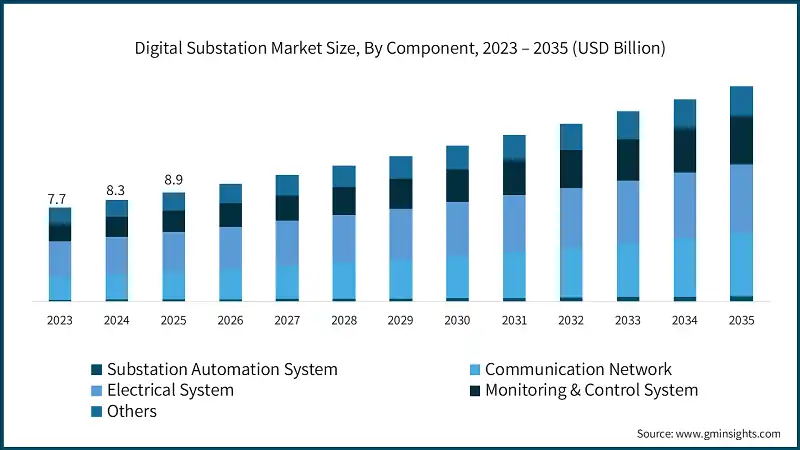
- Based on components, the electrical system segment is anticipated to exceed USD 5 billion by 2035 since it is the core physical infrastructure of a substation, comprising transformers, circuit breakers, busbars, and other high-voltage equipment. In a digital substation, these components are augmented with sensors and merging units that digitize analog signals for processing by IEDs. This digital interface eliminates bulky copper wiring and improves accuracy in measurement and protection.
- The electrical system ensures safe power flow, voltage regulation, and fault isolation, while digital enhancements enable real-time monitoring and condition-based maintenance. Integration with automation and communication layers transforms the electrical system into a smart, data-driven network, optimizing performance and extending asset life.
- This automation enables real-time data acquisition, remote control, and predictive maintenance, reducing downtime and operational costs. Key benefits include improved grid reliability, faster fault detection, and enhanced flexibility for integrating renewable energy sources. SAS also supports advanced analytics and cybersecurity measures, making substations smarter and more resilient against modern challenges.
- Communication network segment is also an important segment in the digital substation market, holding around 25% market share. A robust communication network is essential for seamless data exchange within a digital substation. It connects IEDs, sensors, controllers, and central systems using high-speed, secure protocols. Fiber-optic cables are commonly used for their immunity to electromagnetic interference and ability to handle large data volumes.
- The rapid evolution of power infrastructure over the past two decades reflects a clear shift toward digitalization and smart grid technologies. From 2003 to 2023, utility capital investment in transmission systems nearly tripled, rising to USD 27.7 billion, with substantial funding for smart meters, sensors, and substation automation. This surge in investment highlights the growing emphasis on digitalization and grid modernization to enhance reliability and efficiency.
- The surge in global electricity consumption has been a major driver for substation automation. According to the International Energy Agency (IEA), global electricity demand grew by nearly 25% between 2003 and 2023, fueled by urbanization, industrialization, and the rise of electric vehicles and data centers. This escalating demand places immense pressure on transmission and distribution networks, requiring faster fault detection, real-time monitoring, and predictive maintenance capabilities that traditional substations cannot provide.
- Digital substations, equipped with automation systems and intelligent electronic devices (IEDs), enable utilities to handle higher loads efficiently while maintaining grid stability. For instance, India’s power consumption crossed 1,500 billion units in FY23, prompting utilities like PGCIL and Tata Power to invest heavily in IEC 61850-based automation to ensure reliability and reduce outages. Such large-scale investments in automation technologies are expected to accelerate the growth of digital substation solutions, as utilities strive to meet rising electricity demand with smarter, more reliable infrastructure.
Learn more about the key segments shaping this market
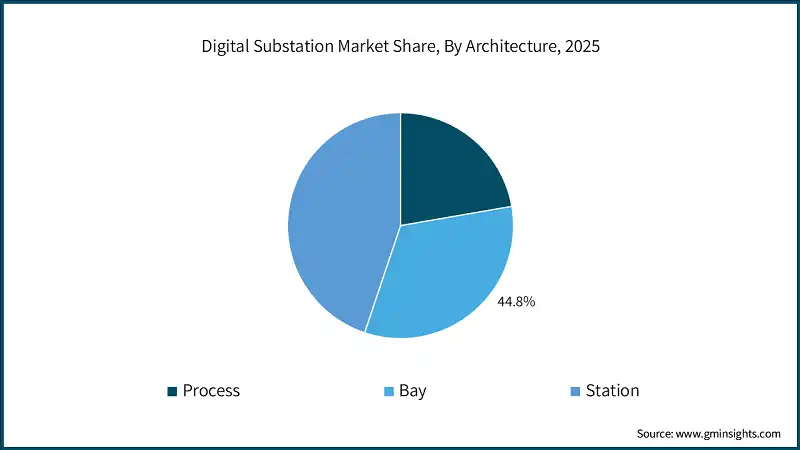
- Based on architecture, the digital substation market is segmented into process, bay and station. The station segment holds a market share of over 44.8% in 2025 and is expected to grow at a CAGR of over 6% by 2035.
- The process level is the foundation of the substation architecture, where primary equipment such as circuit breakers, current transformers (CTs), and voltage transformers (VTs) interact with intelligent electronic devices (IEDs). This level is crucial because it digitizes analog signals from the primary equipment using merging units and sensors, enabling real-time data acquisition and monitoring.
- By replacing traditional copper wiring with fiber-optic communication, the process level reduces installation costs, minimizes electromagnetic interference, and enhances safety. Its importance lies in enabling accurate measurements and fast protection schemes, which are vital for grid stability and fault isolation.
- The bay level acts as the intermediary between the process and station levels. It hosts protection and control IEDs that manage individual bays, such as feeders or transformers. This segment is essential for localized decision-making, ensuring that faults are detected and cleared promptly within a specific section of the substation.
- Bay-level automation improves operational flexibility, supports remote configuration, and facilitates predictive maintenance by analyzing data from the process level. Its role is pivotal in reducing downtime and enhancing system resilience, making it a cornerstone of modern substation automation.
- The bay level contains IEDs dedicated to monitoring and controlling specific bays such as feeders or transformers. Acting as a critical link between the process and station levels, it facilitates localized decision-making and rapid fault clearance.
- Enhanced bay-level automation enables remote configuration, real-time data analytics, and condition-based maintenance. This focus on targeted control reduces outages and optimizes system resilience, critical in substations that serve as essential nodes within the over 600,000 miles of high-voltage transmission line network overseen by the DOE.
- The station level serves as the supervisory layer, integrating data from multiple bays and providing a centralized interface for operators. It includes Human-Machine Interfaces (HMIs), SCADA systems, and gateways for communication with control centers. This level is critical for overall coordination, enabling advanced functionalities such as load management, fault analysis, and cybersecurity.
- By consolidating information from the entire substation, the station level ensures efficient decision-making and compliance with grid codes. Its importance extends to enabling interoperability and supporting future grid requirements like renewable integration and distributed energy resources.
Looking for region specific data?
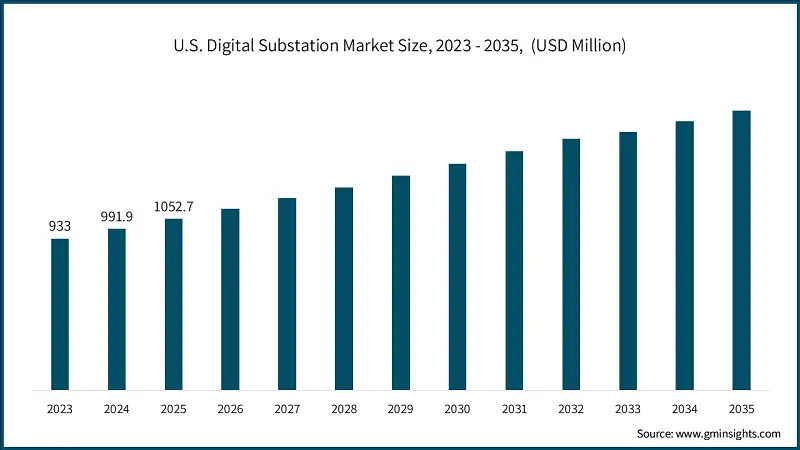
- The U.S. digital substation market is anticipated to exceed USD 1.5 billion by 2035. The United States plays a pivotal role in shaping the global digital substation landscape due to its aggressive modernization policies, large-scale investments, and growing electricity demand.
- Aging infrastructure is a major challenge nearly 70% of U.S. transmission and distribution lines were built before the 1970s, making upgrades critical for reliability and resilience. To address this, the Department of Energy (DOE) has launched initiatives like the Grid Resilience and Innovation Partnerships (GRIP), allocating USD 3 billion in smart grid grants, with USD 2 billion awarded in 2024 alone to enhance automation, renewable integration, and cybersecurity.
- Under the DOE’s Grid Resilience and Innovation Partnerships (GRIP) initiative, up to USD 3 billion in smart grid grants (approximately USD 600 million annually through FY2022–2026) have been allocated. In October 2024 alone, nearly USD 2 billion was awarded across 38 projects to enhance transmission capacity, integrate renewables, and bolster automation.
- Europe holds a strategic position in the global digital substation market, driven by ambitious climate goals, aging grid infrastructure, and strong policy support. The European Grids Action Plan (2023) estimates that Euro 584 billion will be required for grid investments by 2030, as electricity consumption is projected to rise by nearly 60% due to electrification of transport, heating, and industry.
- With almost 40% of Europe’s distribution grids over 40 years old, modernization is critical and digital substations are at the heart of this transformation. Programs like Horizon Europe and Next Generation Distribution Substation initiatives are channeling millions of euros into AI-based automation and virtualization technologies. Under Horizon Europe, projects like ESTELAR received Euro 2.5 million to develop virtualization and digital twin technologies for substations between 2025–2027.
- Asia-Pacific and the Middle East are emerging as critical regions for digital substation growth due to rapid urbanization, industrial expansion, and ambitious renewable energy targets. Asia-Pacific accounts for the largest share of global electricity consumption, with countries like China and India driving demand through electrification of transport and manufacturing. China’s State Grid Corporation is deploying thousands of digital substations to support its renewable integration goals.
- In the Middle East, nations such as Saudi Arabia and the UAE are investing billions under programs like Vision 2030 to modernize grids and integrate solar and wind energy. These regions face rising peak loads and harsh environmental conditions, making digital substations essential for reliability, remote monitoring, and cybersecurity. Together, Asia-Pacific and the Middle East represent the fastest-growing markets for smart grid infrastructure worldwide.
Digital Substation Market Share
- The top 5 companies in the digital substation industry are Siemens Energy, GE Vernova, ABB, Toshiba, and Hitachi Energy. They are contributing around 40% of the market in 2025.
- These leading companies play a pivotal role in the global digital substation market due to their technological expertise, extensive product portfolios, and innovative solutions. These corporations also contribute significantly through their global presence and extensive service networks, enabling them to undertake large-scale projects across diverse regions such as the Middle East, Asia Pacific, and Europe. Their ability to customize solutions to meet specific grid requirements makes them preferred partners for utilities and independent power producers.
- In addition to manufacturing, these companies provide comprehensive after-sales support, maintenance, and training services, which are essential for the long-term performance and sustainability of digital substations. Their leadership and technological advancements have solidified their positions as industry frontrunners, driving growth and innovation in the evolving energy landscape.
Digital Substation Market Companies
- In May 2025, Siemens Energy reported USD 17 billion in orders, marking a 52.3% year-over-year increase on a comparable basis, driven by significant growth in grid technologies and record-high quarterly order in energy services.
- GE Vernova (GEV) reported USD 37.67 billion in trailing twelve-month revenue as of Q3 2025, marking a 9.4% YoY increase. Q3, 2025 alone saw USD 10 billion in revenue (+12% YoY), USD 500 million in net income, and USD 700 million in free cash flow.
- Eaton delivered record 2025 results with Q1 revenue of USD 6.38 billion, adjusted EPS USD 2.72, Q2 revenue USD 7.0 billion, EPS USD 2.95, and raised full-year guidance to USD 11.80–12.20 EPS with expected organic growth of 8–9%.
Major players operating in the digital substation market are:
- ABB
- Belden Inc
- Bharat Heavy Electricals Limited
- Cisco Systems
- Eaton Corporation
- GE Vernova
- NovaTech.
- OMICRON
- Ponovo Power
- Redeia
- Schneider Electric
- Siemens Energy
- Toshiba Energy Systems & Solutions
- WEG
Digital Substation Market Report Attributes
| Key Takeaway | Details |
|---|---|
| Market Size & Growth | |
| Base Year | 2025 |
| Market Size in 2025 | USD 8.9 Billion |
| Market Size in 2026 | USD 9.6 Billion |
| Forecast Period 2026 - 2035 CAGR | 6.8% |
| Market Size in 2035 | USD 17.3 Billion |
| Key Market Trends | |
| Drivers | Impact |
| Rising Demand for Electricity | Rising demand for electricity drives the digital substation market by necessitating advanced monitoring, automation, and efficient management systems to handle increased load, ensure reliability, and optimize grid performance amidst growing consumption. |
| Growing Renewable Energy Integration | Growing renewable energy integration accelerates the digital substation market by requiring sophisticated control and communication systems to manage variable power sources like solar and wind. |
| Pitfalls & Challenges | Impact |
| High Dependency on Imports | Relying heavily on imported components exposes the digital substation market to global supply chain disruptions, such as geopolitical tensions, trade restrictions, and logistical delays, leading to project delays, increased costs, and reduced reliability of critical infrastructure. |
| Opportunities: | Impact |
| Advancement in Technology | Smart sensors enable real-time data collection and remote monitoring, enhancing substation efficiency and reliability. IoT integration facilitates predictive maintenance, reduces downtime, and improves operational decision-making, creating significant growth opportunities in the digital substation market. |
| Market Leaders (2025) | |
| Market Leaders |
14% market share |
| Top Players |
|
| Competitive Edge |
|
| Regional Insights | |
| Largest Market | Asia Pacific |
| Fastest Growing Market | Middle East & Africa |
| Emerging Region | Europe |
| Future outlook |
|
What are the growth opportunities in this market?
Digital Substation Industry News
- In December 2025, Hitachi Energy joined SP Energy Networks’ FITNESS project in Scotland to advance digital substation technology. The initiative aims to modernize transmission networks by replacing traditional copper wiring with fiber-optic communication, enhancing safety, flexibility, and reliability while reducing costs and environmental impact.
- In March 2025, Siemens announced plans to showcase its latest grid modernization innovations at DISTRIBUTECH 2025. Through Siemens Xcelerator, the company aims to simplify energy system transformation, offering utilities interoperable, scalable, and AI-driven solutions to manage increasing complexity.
- In March 2025, Schneider Electric introduced the One Digital Grid Platform, designed to serve as a technical foundation for independent software solutions. This platform empowers utilities to accelerate grid modernization efforts and deliver cleaner, more affordable energy.
The digital substation market research report includes in-depth coverage of the industry with estimates & forecast in terms of revenue (USD Million) & (Units) from 2022 to 2035, for the following segments:
Market, By Component
- Digital substation automation system
- Communication network
- Electrical system
- Transformer
- Busbar
- Protection devices
- Circuit breaker
- Protective relay
- Switchgear
- Monitoring & control system
- Human machine interface
- Programmable logic controller
- Others
- Others
Market, By Architecture
- Process
- Bay
- Station
Market, By Application
- Transmission
- Distribution
Market, By Connectivity
- ≤ 33 kV
- > 33 kV to ≤ 110 kV
- > 110 kV to ≤ 220 kV
- > 220 kV to ≤ 550 kV
- > 550 kV
Market, By Voltage Level
- Low
- Medium
- High
Market, By End Use
- Utility
- Industrial
Market, By Installation
- New
- Refurbished
The above information has been provided for the following regions and countries:
- North America
- U.S.
- Canada
- Mexico
- Europe
- UK
- France
- Germany
- Italy
- Russia
- Spain
- Asia Pacific
- China
- Australia
- India
- Japan
- South Korea
- Middle East & Africa
- Saudi Arabia
- UAE
- Turkey
- South Africa
- Egypt
- Latin America
- Brazil
- Argentina
Frequently Asked Question(FAQ) :
What is the market size of the digital substation in 2025?
The market size was USD 8.9 billion in 2025, with a CAGR of 6.8% expected through 2035 driven by the need for modern, efficient, and resilient power infrastructure.
What is the projected value of the digital substation market by 2035?
The digital substation market is expected to reach USD 17.3 billion by 2035, propelled by smart grid adoption, renewable energy integration, and advancements in automation and IoT technologies.
What is the current digital substation market size in 2026?
The market size is projected to reach USD 9.6 billion in 2026.
How much revenue is the electrical system segment expected to generate by 2035?
The electrical system segment is anticipated to exceed USD 5 billion by 2035, as it forms the core physical infrastructure comprising transformers, circuit breakers, and busbars with digital enhancements.
What was the market share of the station architecture segment in 2025?
The station segment held 44.8% market share in 2025 and is expected to grow at a CAGR of over 6% by 2035.
What is the growth outlook for the communication network segment?
The communication network segment holds around 25% market share and is essential for seamless data exchange using fiber-optic cables and secure protocols, supporting the market's overall 6.8% CAGR through 2035.
Which region leads the digital substation market?
The U.S. digital substation market is projected to hit USD 1.5 billion by 2035, supported by aggressive grid modernization initiatives, strong investments, and rising electricity demand.
What are the upcoming trends in the digital substation market?
Key trends include widespread adoption of IEC 61850 standards, AI-driven edge analytics for predictive maintenance, fiber-optic process bus systems replacing copper wiring, and integration of IoT sensors for real-time monitoring and condition-based maintenance.
Who are the key players in the digital substation market?
Key players include Siemens Energy, GE Vernova, ABB, Toshiba, Hitachi Energy, Belden Inc, Bharat Heavy Electricals Limited, Cisco Systems, Eaton Corporation, NovaTech, OMICRON, Ponovo Power, Redeia, Schneider Electric, and WEG.
Digital Substation Market Scope
Related Reports