Summary
Table of Content

Dietary Fibers Market
Get a free sample of this report
Form submitted successfully!
Error submitting form. Please try again.
Thank you!
Your inquiry has been received. Our team will reach out to you with the required details via email. To ensure that you don't miss their response, kindly remember to check your spam folder as well!
Request Sectional Data
Thank you!
Your inquiry has been received. Our team will reach out to you with the required details via email. To ensure that you don't miss their response, kindly remember to check your spam folder as well!
Form submitted successfully!
Error submitting form. Please try again.
Dietary Fibers Market Size
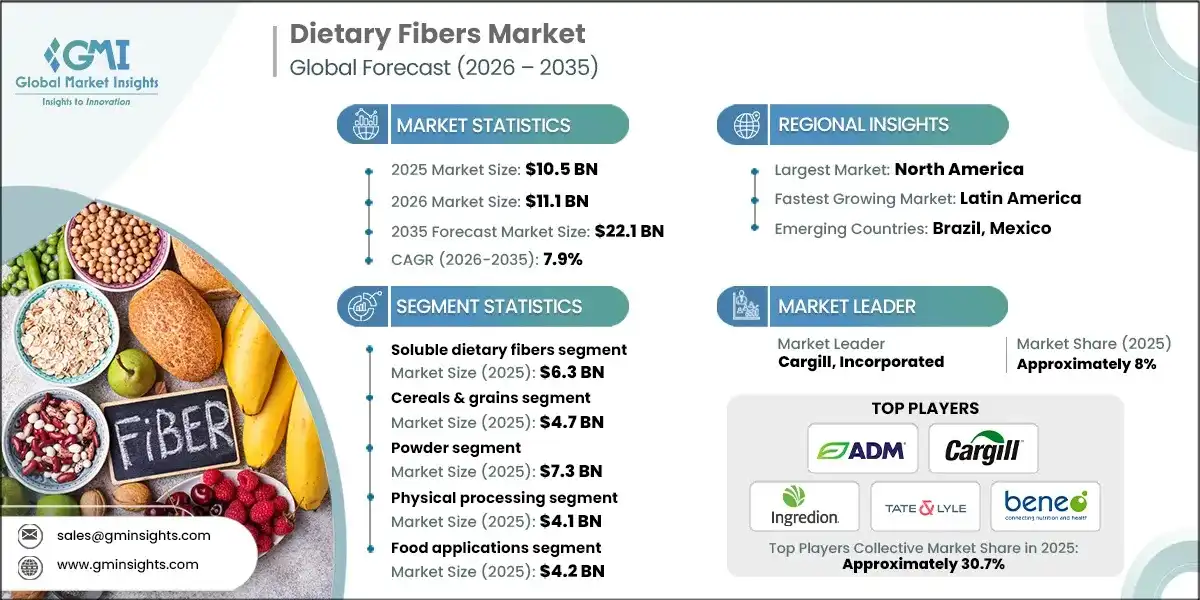
The global dietary fibers market size was valued at USD 10.5 billion in 2025. The market is projected to grow from USD 11.1 billion in 2026 to USD 22.1 billion by 2035, representing 7.9% CAGR from 2026 to 2035, according to latest report published by Global Market Insights Inc.
Dietary Fibers Market Key Takeaways
Market Size & Growth
- 2025 Market Size: USD 10.5 Billion
- 2026 Market Size: USD 11.1 Billion
- 2035 Forecast Market Size: USD 22.1 Billion
- CAGR (2026–2035): 7.9%
Regional Dominance
- Largest Market: North America
- Fastest Growing Region: Latin America
Key Market Drivers
- Rising health awareness among consumers about benefits of dietary fiber..
- Increasing prevalence of lifestyle and chronic diseases (e.g., obesity, diabetes, cardiovascular disorders) prompt preventive nutrition..
- Growing demand for functional foods and beverages enriched with fiber..
- Rising popularity of plant based diets and veganism, boosting natural fiber demand..
Challenges
- Negative impact on taste, texture, and mouthfeel when fiber is added, reducing consumer acceptance..
- High cost of extraction, processing, and quality-controlled fiber ingredients, raising final product price..
- Supply-chain and raw-material volatility affecting availability and price stability..
Opportunity
- Development of high-fiber functional foods and beverages targeting specific health benefits..
- Innovation in fiber-enriched snacks, cereals, bakery, and dairy products..
- Expansion into emerging markets with growing health awareness and disposable income..
- Collaboration with nutraceutical and pharmaceutical companies for gut health and digestive supplements..
Key Players
- Market Leader: Cargill, Incorporated led with over 8% market share in 2025.
- Leading Players: Top 5 players in this market include Archer Daniels Midland Company (ADM), Cargill, Incorporated, Ingredion Incorporated, Tate & Lyle PLC, BENEO GmbH, which collectively held a market share of 30.7% in 2025.
Get Market Insights & Growth Opportunities
- The dietary fibers business is also on a great growth path due to the growing awareness of consumers on health and wellness. People are more actively engaged in the process of finding the means to keep their gut healthy, to better its functionality, and to ensure well-being, which increased the pressure on the consumption of fiber-enriched foods. This increased awareness of the advantages of dietary fiber is compelling food and beverage producers to be more innovative and produce products that address the needs of health conscious buyers.
- The market has also been growing at a high rate due to lifestyle-related and chronic diseases, including obesity, diabetes and cardiovascular disorders. Consumers are driving towards preventive approaches in nutrition with inclusion of fiber rich diets as a way of controlling weight, balancing blood sugar as well as minimizing the chances of developing chronic diseases. This trend in health consumption is pushing companies to increase their products in the fiber-enriched functional food and supplements.
- The nutrition market in functional foods and beverages has become one of the most important growth areas of dietary fibers. Fortified fibers are becoming popular among products due to nutritional value but also due to the convenience and versatility in daily diet. In the same way manufacturers of cereals and snacks are now incorporating fibers into their products to suit the new trends of the health conscious market creating steady growth in the market.
- Plant-based diets and veganism are also gaining popularity, which is increasing the demand of natural sources of dietary fiber. Due to the consumption of plant-based nutrition, consumer interest in fiber sources of fruits, vegetables, legumes, and whole grains grows. This is one of the motivating factors of product innovation and diversification enabling manufacturers to create a host of fiber-based products that meet the trends of sustainable and plant-based consumption.
To get key market trends
Dietary Fibers Market Trends
- Dietary fibers industry is seeing a significant trend in high transition to functional and fortified food and beverages. Fiber is also being added to snacks, bakery, beverages, and dairy alternatives, and it is becoming much easier to consume these foods and appealing to a broader consumer group. Such incorporation facilitates daily eating patterns and expands the market penetration.
- There is also an increased demand for clean-label, plant-based and natural ingredients. The consumers are now seeking non-GMO, plant-based fibers in fruits, vegetables, cereals, and legumes as people increasingly seek sustainability and transparency in the ingredient list, as well as simpler ingredients. The trend is compelling for manufacturers to be more inventive and find more diversified sources of fiber.
- Another trend is the interest in the wellness of the gut, prebiotics, and wellness. The soluble and prebiotic fibers are being discovered to play a role in digestion, microbiome level, metabolism, and prevention of chronic diseases. The trend is toward products that are specifically focused on digestive wellness and preventive nutrition products.
- The market is being developed by product format diversification and convenience. Ready-to-eat foods, fortified beverages, plant-based dairy alternatives, and snack forms have now been made available in fibers, and consumers can now add fiber to their diets without having to change their daily food intakes. This expands adaptation to the traditional health-centric segments.
Dietary Fibers Market Analysis
Learn more about the key segments shaping this market
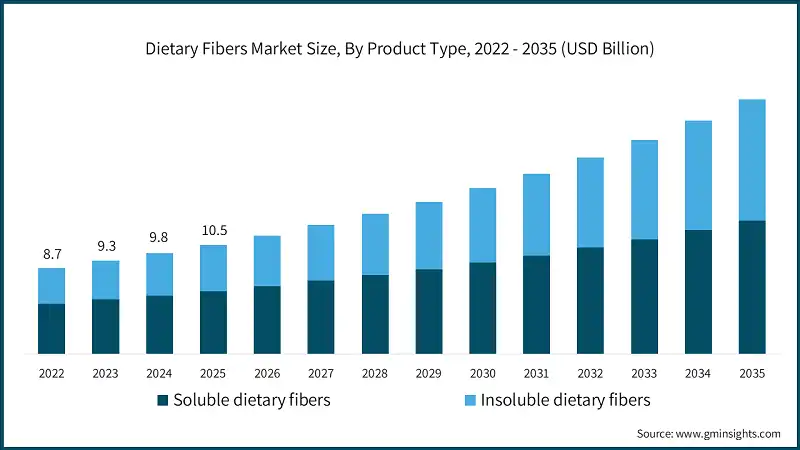
Dietary fibers market based on product type is segmented into soluble dietary fibers and insoluble dietary fibers. The soluble dietary fibers segment was valued at USD 6.3 billion in 2025, and it is anticipated to expand to 8.2% of CAGR during 2026 to 2035.
- The soluble dietary fibers market is in an expanding phase since the fibers are now being appreciated in digestive health, cholesterol and glycemic control. Products containing soluble fibers are also being introduced in functional food, beverages and dietary supplements as consumers show interest in preventive nutrition.
- Indigestible dietary fibers are being sought after because of their capability to maintain bowel movement and general gut health. Consumers can use their addition to bakery products, cereals and snacks to help them include fiber into daily meals and do not change their eating habits significantly, which will encourage them to adopt the change over the long term.
Dietary fibers market based on source is segmented into cereals & grains, legumes, nuts & seeds, and other sources. The cereals & grains segment was valued at USD 4.7 billion in 2025, and it is anticipated to expand to 8.1% of CAGR during 2026 to 2035.
- Cereal and grain fibers are also popular in bakery, snack, and beverage applications and as a response to the need to utilize staples as a source of functional nutrition. Their flexibility in food processing enables manufacturers to develop numerous types of foods fortified with fiber, which will enable them to grow in various segments.
- The natural sources of legumes, nuts and seeds, and so forth contribute to market growth as a result of the increased consumer interest in plant-based, clean-label ingredients. These products are being consumed in both convenience and powders, which come with the bonus of being convenient and consistent with the healthy eating trends and sustainable products.
Dietary fibers market based on form is segmented into powder, liquid/gel, solid dosage forms, and convenience formats. The powder segment was valued at USD 7.3 billion in 2025, and it is anticipated to expand to 7.8% of CAGR during 2026 to 2035.
- Fibers in powder form are still popular among food producers as well as supplement manufacturers because they are easy to formulate and to control their dose. They are applied most often in bakery, beverage and supplement activities which allow easy incorporation of fiber into daily foods.
- The liquid, gel, solid dosage and convenience dosage forms are growing as pharmacists are targeting ready-to-use and on the go forms of consumption. These formats help to satisfy consumer demand in terms of convenience and retain nutritional benefits, which would help to be widely adopted by age groups.
Dietary fibers market based on processing method is segmented into physical processing, chemical processing, enzymatic processing, biological/fermentation processing, hybrid/combined methods, and others. The physical processing segment was valued at USD 4.1 billion in 2025, and it is anticipated to expand to 7.5% of CAGR during 2026 to 2035.
- Physical processing is being applied extensively to preserve the natural characteristics of fibers and at the same time improving solubility and performance. This enables manufacturers to produce products that have not lost their nutritional value but are natural as expected by the consumers.
- The innovation is being pushed through chemical, enzymatic, biological/fermentation, and hybrid processing approaches that are enhancing the functionality of fibers and increasing their versatility of applications. These solutions allow extended solubility, prebiotic functionality and specific health advantages to broaden the application of fiber inclusion in both foods, drinks and nutritional supplements.
Learn more about the key segments shaping this market
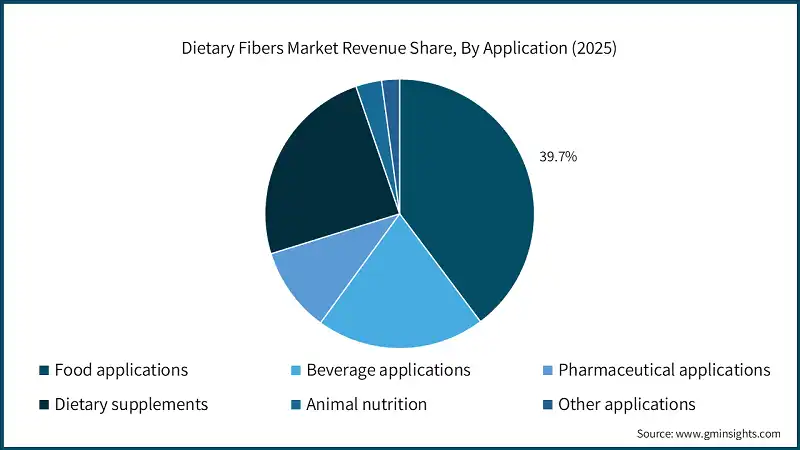
Dietary fibers market based on application is segmented into food applications, beverage applications, pharmaceutical applications, dietary supplements, animal nutrition, and other applications. The food applications segment was valued at USD 4.2 billion with a market share of 39.7% in 2025, and it is anticipated to expand to 7.7% of CAGR during 2026 to 2035.
- Food applications are a significant source where fibers have been used in bakery goods, snacks, cereals and in functional meals. This enables consumers to easily boost fiber intake without compromising on taste and texture likings.
- Fibers are being utilized to increase the digestive, metabolic, and general wellness of beverages, pharmaceuticals, dietary supplements, and animal nutrition segments. These applications are being pioneered in innovation, which is developing new niches of functional products and varied consumption.
Looking for region specific data?
The North America dietary fibers market accounted for USD 3.1 billion in 2025 and is anticipated to show lucrative growth over the forecast period.
The North America market is growing steadily as the population is getting more concerned about gut health, weight control, and prevention-related nutrition. The use of functional foods, drinks and supplements containing fiber is not very controversial, and this is supported by an extensive retail network and an increase in consumer awareness regarding the value of health.
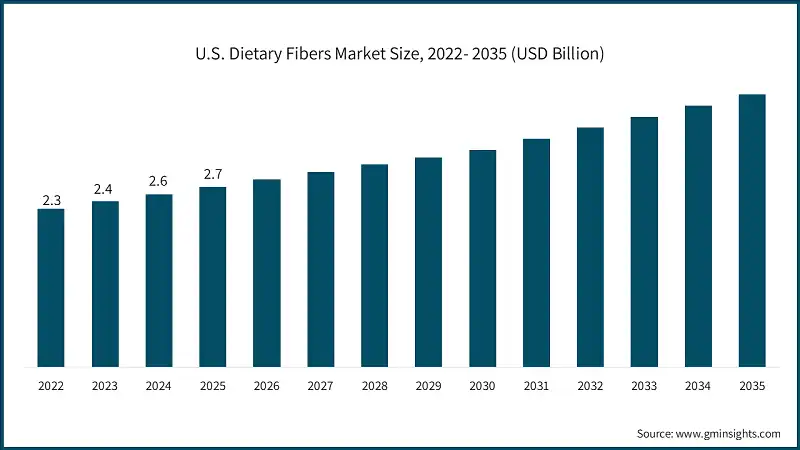
U.S. dominates the North America dietary fibers market, showcasing strong growth potential.
U.S. is experiencing a faster growth in the region as there is increased demand of convenience food, plant products and prebiotic fibers. Fiber fortified snacks, drinks, and nutritional supplements are being innovative, and these products are getting adopted amongst the health conscious customers who are requiring nutrition solutions in their daily lives.
The Europe dietary fibers market accounted for USD 2.7 billion in 2025 and is anticipated to show lucrative growth over the forecast period.
The dietary fibers market of Europe is expanding because regulatory support, nutritional labelling, and the promotion of digestive health are persuading people to eat foods and drink fiber-enriched products. Customers are also getting more inclined to use products that are in line with clean-label and natural ingredients trends.
Germany dominates the Europe dietary fibers market, showcasing strong growth potential.
Germany has seen a tremendous growth due to the demand of whole grain, functional and fortified food especially bakery goods, cereals and beverages. The emphasis on preventive health, as well as digestive wellness, is favoring the creation of new fiber-based solutions.
Asia Pacific dietary fibers market is anticipated to grow at a CAGR of 8.2% during the analysis timeframe.
The Asia Pacific market is experiencing healthy growth in the market because of the growing disposable income, increased urbanization, and the focus on preventive diets. The popularity of functional foods, beverages, and dietary supplements is on the rise owing to the growing popularity of healthier lifestyles among the consumers.
China dietary fibers market is estimated to grow with a significant CAGR, in the Asia Pacific market.
China market is evolving at a tremendous rate due to the necessity to consume fiber enriched convenience food, beverages, and supplements. The increase in the awareness of consumers in urban areas regarding their digestive health and metabolic wellness is driving the innovation and uptake of various food categories.
The Latin America dietary fibers market is anticipated to grow at a CAGR of 8.4% during the analysis timeframe.
The Latin American market of dietary fibers is evolving and growing as more consumers start focusing on health and wellness products. Access to bakery products, cereals as well as beverages by way of increasing retail and modern trade is becoming more available with fiber enrichment.
Brazil leads the Latin America dietary fibers market, exhibiting remarkable growth during the analysis period.
The adoption has been accelerated in Brazil because of the increased awareness on how to control weight, digestive health and preventative nutrition. There is an increased trend towards functional foods and beverages enriched with fiber by the urban population who are pursuing healthy lifestyle choices.
Middle East & Africa dietary fibers market is expected to grow at a CAGR of 7.9% during the analysis timeframe.
The Middle East & Africa region has been slowly growing with health-conscious consumers looking into the field of functional foods and beverages. Market growth is being facilitated by the increasing urbanization, modernization of retail and increased awareness of the benefits of fiber.
Saudi Arabia dietary fibers market to experience substantial growth in the Middle East and Africa market in 2025.
Saudi Arabia is experiencing the most rapid expansion in MEA due to the demand in dietary and fortified food and convenient forms. The increasing health consciousness and government planning on wellness is stimulating consumption of fiber products.
Dietary Fibers Market Share
- Archer Daniels Midland Company (ADM), Cargill, Incorporated, Ingredion Incorporated, Tate & Lyle PLC, and BENEO GmbH are a significant part of the global dietary fibers market and with further standing of being fragmented with the top five players steadily holding 30.7% market share in the year 2025.
- Firms are very keen on product innovation where new fibers are constantly being developed in new forms and fortified versions to serve the changing needs of consumers to achieve digestive health, weight control and metabolic wellness.
- Portfolios in food, beverages, supplements, and animal nutrition are diversified such that the company can easily access markets and provide a variety of products that meet the needs of diverse buyers.
- They put resources in area of research and development and technological innovation to enhance fiber extraction, solubility and prebiotic functionality in order to provide higher quality and efficient products.
- Strategic partnerships and alliances with food and beverage manufacturers, nutraceutical brands, and ingredient suppliers are used to increase reach and introduction of fibers within a range of products of wide consumption.
- Firms capitalize on health benefits, clean-label and natural sourcing through branding and marketing to inform consumers and build trust, which enhances consumer loyalty and repurchases.
- The distribution networks are globalized so that the product can be made available in various regions, retail shops and electronic shops and hence, the fiber products are made available in both the urban and emerging markets.
- They are also concerned with sustainability and responsible sourcing, with plant-based, non-GMO and environmentally friendly sources of fiber, which conforms to the current trends of consumers and regulatory requirements.
- There is strict maintenance of regulatory compliance and health claims to guarantee credibility in the labeling, functional claims, and fortification to boost market acceptance and facilitate growth.
- Firms are forever tracking the market dynamics and changing tactics to meet the new consumer demands, such as convenient form, functionality blends, and plant-based components, so that they remain relevant and influential in the market.
Dietary Fibers Market Companies
The major players operating in dietary fibers industry include:
- Archer Daniels Midland Company (ADM)
- Cargill, Incorporated
- Ingredion Incorporated
- Tate & Lyle PLC
- BENEO GmbH
- Others
- Archer Daniels Midland Company (ADM) specializes in the supply of numerous dietary fibers that are obtained through cereals, grains and plant-based materials. It maintains its market position by sustained product innovation, excellent global distribution and collaboration with food and beverage manufacturers to incorporate fibers in various applications.
- Cargill, Incorporated focuses on food, beverage and supplement applications that have high-quality soluble and insoluble fibers. The company sustains itself through its investment in R/D, creation of functional fiber, prebiotic fiber, and through strategic partnerships to increase its market base in major markets within the global setting.
- Ingredion Incorporated provides fiber solutions to digestive health, weight management and clean-label trends. It guarantees market relevancy through the innovation of fiber based ingredients, customized solutions to manufacturers and convenience format to respond to changing consumer demands.
- Tate & Lyle PLC focuses on soluble fibers, prebiotics, and animal and human nutritional functional ingredients. The company maintains the status with technological breakthroughs in the extraction of the fibers, efficiency in its global supply chain and intense interaction with food and beverage customers.
- BENEO GmbH is a provider of fibers of chicory, wheat and other plants and serves the markets in functional foods and beverages. It is retaining its market position through sustainable sourcing, prebiotic innovation and creation of applications that are responsive to the trends of digestive wellness and metabolic health.
Dietary Fibers Market Report Attributes
| Key Takeaway | Details |
|---|---|
| Market Size & Growth | |
| Base Year | 2025 |
| Market Size in 2025 | USD 10.5 Billion |
| Market Size in 2026 | USD 11.1 Billion |
| Forecast Period 2026 - 2035 CAGR | 7.9% |
| Market Size in 2035 | USD 22.1 Billion |
| Key Market Trends | |
| Drivers | Impact |
| Rising health awareness among consumers about benefits of dietary fiber. | Boosts demand for fiber-rich foods as preventive nutrition |
| Increasing prevalence of lifestyle and chronic diseases (e.g., obesity, diabetes, cardiovascular disorders) prompt preventive nutrition. | Accelerates adoption of fiber for weight and disease management |
| Growing demand for functional foods and beverages enriched with fiber. | Expands market for fiber-enriched products across categories |
| Rising popularity of plant based diets and veganism, boosting natural fiber demand. | Drives preference for natural fiber sources in food formulations |
| Pitfalls & Challenges | Impact |
| Negative impact on taste, texture, and mouthfeel when fiber is added, reducing consumer acceptance. | Limits consumer acceptance of fiber-fortified products |
| High cost of extraction, processing, and quality-controlled fiber ingredients, raising final product price. | Raises product prices, restricting affordability and mass adoption |
| Supply-chain and raw-material volatility affecting availability and price stability. | Creates uncertainty in raw material availability and pricing |
| Opportunities: | Impact |
| Development of high-fiber functional foods and beverages targeting specific health benefits. | Opens niche segments targeting gut health and immunity |
| Innovation in fiber-enriched snacks, cereals, bakery, and dairy products. | Enables product diversification and premium positioning |
| Expansion into emerging markets with growing health awareness and disposable income. | Unlocks growth through rising health awareness and income |
| Collaboration with nutraceutical and pharmaceutical companies for gut health and digestive supplements. | Strengthens fiber’s role in supplements and digestive health |
| Market Leaders (2025) | |
| Market Leaders |
Market Share 8% |
| Top Players |
|
| Competitive Edge |
|
| Regional Insights | |
| Largest Market | North America |
| Fastest growing market | Latin America |
| Emerging countries | Brazil, Mexico |
| Future outlook |
|
What are the growth opportunities in this market?
Dietary Fibers Industry News
- In July 2025, Tate & Lyle augmented ingredient lines such as fiber fortification and mouthfeel solutions at the IFT FIRST conference, revealing prototype items which incorporated fiber fortification with clean-label and texture targeted innovation. This showed the ability of fiber-based foods to compete to the indulgence and taste with clean-label and functional requirements, driving broader mainstream food and beverage categories.
- In April 2025, the curve-processing facility in Germany, operated by BENEO GmbH, which is a company of the Südzucker Group, became operational, giving the company an additions enhancement to its pulse-processing capacity of fibers, protein, and other functional ingredients. This growth endorses the growth of high-fiber and plant-based food, bucking the trend toward plant-based sources of fiber and clean-label formulations in both food and feed markets.
- In 2025, Roquette unveiled a new strategic initiative a foresight platform called HORIZONS, aimed at helping food industry clients anticipate future trends, regulatory shifts, and innovation opportunities. This suggests Roquette is strengthening its role as a partner for long-term food ingredient strategy potentially shaping future fiber based innovations and new application development.
The dietary fibers market research report includes in-depth coverage of the industry with estimates & forecast in terms of revenue (USD Billion) & (Kilo Tons) from 2022 to 2035, for the following segments:
Market, By Product Type
- Soluble Dietary Fibers
- Beta-Glucan
- Oat Beta-Glucan
- Barley Beta-Glucan
- Yeast Beta-Glucan
- Mushroom Beta-Glucan
- Psyllium Husk
- Inulin & Inulin-Type Fructans
- Chicory Root Inulin
- Jerusalem Artichoke Inulin
- Agave Inulin
- Pectin
- High-Methoxyl Pectin
- Low-Methoxyl Pectin
- Polydextrose
- Fructooligosaccharides (FOS)
- Galactooligosaccharides (GOS)
- Resistant Maltodextrin/Dextrin
- Soluble Corn Fiber
- Guar Gum
- Locust Bean Gum
- Acacia (Gum Arabic)
- Alginate
- Arabinoxylan
- Glucomannan
- Beta-Glucan
- Insoluble Dietary Fibers
- Cellulose
- Microcrystalline Cellulose (MCC)
- Powdered Cellulose
- Hemicellulose
- Lignin
- Resistant Starch
- RS1 (Physically Inaccessible)
- RS2 (Granular Starch)
- RS3 (Retrograded Starch)
- RS4 (Chemically Modified)
- RS5 (Amylose-Lipid Complex)
- Chitin & Chitosan
- Wheat Bran/Cereal Bran
- Corn Bran
- Hydroxypropylmethylcellulose (HPMC)
- Mixed Plant Cell Wall Fibers
- Sugar Cane Fiber
- Apple Fiber
- Citrus Fiber
- Cellulose
Market, By Source
- Cereals & Grains
- Wheat
- Oats
- Barley
- Corn
- Rice
- Rye
- Fruits & Vegetables
- Citrus
- Apple
- Banana
- Root Vegetables (Chicory, Potato)
- Other Fruits (Berries, Guava)
- Legumes
- Beans
- Peas
- Lentils
- Soybeans
- Nuts & Seeds
- Chia Seeds
- Flaxseed
- Psyllium
- Almonds
- Other Sources
- Seaweed/Algae
- Fungi/Mushrooms
- Yeast
- Microbial/Fermentation-Derived
Market, By Form
- Powder
- Fine/Ultrafine Powder
- Coarse Powder
- Flavored Powder
- Unflavored Powder
- Liquid/Gel
- Liquid Concentrate
- Syrup
- Solid Dosage Forms
- Capsules
- Caplets/Tablets
- Gummies
- Wafers
- Convenience Formats
- Single-Serve Packets
- On-the-Go Formats
Market, By Processing Method
- Physical Processing
- Mechanical Milling/Grinding
- Steam Explosion
- Extrusion
- Single-Screw Extrusion
- Twin-Screw Extrusion
- Blasting Extrusion
- High Hydrostatic Pressure (HHP)
- Microwave-Assisted Extraction
- Ultrafine/Superfine Grinding
- High-Pressure Homogenization (HPH)
- Chemical Processing
- Acid Extraction
- Alkaline Extraction
- Oxidation
- Chemical Modification
- Enzymatic Processing
- Cellulase Treatment
- Hemicellulase/Xylanase Treatment
- Pectinase Treatment
- Amylase/Protease Treatment
- Biological/Fermentation Processing
- Lactic Acid Bacteria Fermentation
- Fungal Fermentation
- Yeast Fermentation
- Solid-State Fermentation (SSF)
- Hybrid/Combined Methods
- Fermentation + Microfluidization
- Enzymatic + Ultrasound
- Extrusion + Alkaline Treatment
- Others
Market, By Application
- Food Applications
- Bakery
- Bread & Rolls
- Biscuits & Cookies
- Cakes & Muffins
- Pastries
- Breakfast Cereals & Snacks
- Ready-to-Eat Cereals
- Hot Cereals
- Cereal Bars
- Nutrition Bars
- Snack Crackers
- Confectionery
- Chocolate
- Candies & Gummies
- Sugar-Free Confectionery
- Dairy & Dairy Alternatives
- Yogurt
- Ice Cream & Frozen Desserts
- Cheese & Cheese Alternatives
- Fluid Milk & Milk Alternatives
- Plant-Based Dairy Alternatives
- Meat & Meat Alternatives
- Sausages
- Processed Meat Products
- Plant-Based Meat Alternatives
- Infant & Toddler Nutrition
- Infant Formula
- Baby Food
- Toddler Nutrition Products
- Other Food Applications
- Pasta & Noodles
- Soups & Sauces
- Dressings & Condiments
- Ready Meals
- Bakery
- Beverage Applications
- Functional Beverages
- Nutrition Shakes
- Smoothies
- Carbonated Beverages
- Juice & Juice Drinks
- Powdered Beverage Mixes
- Pharmaceutical Applications
- Laxatives
- Cholesterol Management
- Diabetes Management
- Medical Nutrition (Enteral/Parenteral)
- Dietary Supplements
- Digestive Health Supplements
- Weight Management Supplements
- Prebiotic Supplements
- Sports Nutrition
- Animal Nutrition
- Companion Animal (Pet Food)
- Livestock Feed
- Aquaculture
- Other Applications
- Personal Care & Cosmetics
- Biodegradable Packaging Materials
The above information is provided for the following regions and countries:
- North America
- U.S.
- Canada
- Europe
- UK
- Germany
- France
- Italy
- Spain
- Rest of Europe
- Asia Pacific
- China
- India
- Japan
- South Korea
- Australia
- Rest of Asia Pacific
- Latin America
- Brazil
- Mexico
- Argentina
- Rest of Latin America
- MEA
- UAE
- Saudi Arabia
- South Africa
- Rest of Middle East and Africa
Frequently Asked Question(FAQ) :
What was the market size of the dietary fibers in 2025?
The market size was USD 10.5 billion in 2025, with a CAGR of 7.9% expected from 2026 to 2035. Growing consumer awareness about health and wellness is driving market growth.
What is the projected value of the dietary fibers market by 2035?
The market is projected to reach USD 22.1 billion by 2035, driven by increasing demand for functional foods, clean-label products, and gut health-focused innovations.
What is the expected size of the dietary fibers industry in 2026?
The market size is projected to reach USD 11.1 billion in 2026.
How much revenue did the soluble dietary fibers segment generate in 2025?
The soluble dietary fibers segment generated USD 6.3 billion in 2025 and is anticipated to grow at a CAGR of 8.2% from 2026 to 2035.
What was the valuation of the cereals & grains segment in 2025?
The cereals & grains segment was valued at USD 4.7 billion in 2025 and is set to expand at a CAGR of 8.1% till 2035.
What is the growth outlook for the food applications segment from 2026 to 2035?
The food applications segment, valued at USD 4.2 billion in 2025 with a 39.7% market share, is projected to observe around 7.7% CAGR up to 2035.
Which region leads the dietary fibers sector?
North America leads the market, accounting for USD 3.1 billion in 2025. Growth is led by increasing consumer focus on gut health, weight management, and preventive nutrition, supported by a strong retail network and rising awareness.
What are the upcoming trends in the dietary fibers market?
Key trends include growing use of dietary fibers in functional foods, rising clean-label and plant-based demand, increased focus on gut-health prebiotics, and expansion into ready-to-eat and fortified beverage formats.
Who are the key players in the dietary fibers industry?
Key players include Archer Daniels Midland Company (ADM), Cargill, Incorporated, Ingredion Incorporated, Tate & Lyle PLC, and BENEO GmbH.
Dietary Fibers Market Scope
Related Reports