Summary
Table of Content

Data Center-as-a-Service Market
Get a free sample of this report
Form submitted successfully!
Error submitting form. Please try again.
Thank you!
Your inquiry has been received. Our team will reach out to you with the required details via email. To ensure that you don't miss their response, kindly remember to check your spam folder as well!
Request Sectional Data
Thank you!
Your inquiry has been received. Our team will reach out to you with the required details via email. To ensure that you don't miss their response, kindly remember to check your spam folder as well!
Form submitted successfully!
Error submitting form. Please try again.
Data Center-as-a-Service Market Size
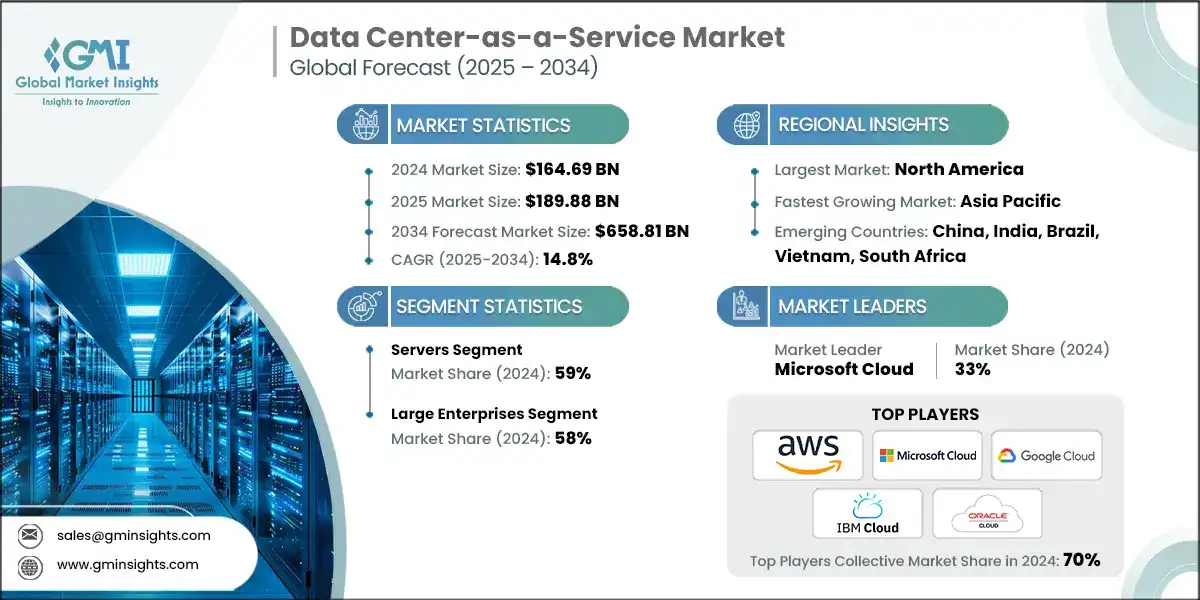
The global data center-as-a-service market was estimated at USD 164.69 billion in 2024. The market is expected to grow from USD 189.88 billion in 2025 to USD 658.81 billion in 2034, at a CAGR of 14.8%, according to latest report published by Global Market Insights Inc.
Data Center-as-a-Service Market Key Takeaways
Market Size & Growth
- 2024 Market Size: USD 164.69 Billion
- 2025 Market Size: USD 189.88 Billion
- 2034 Forecast Market Size: USD 658.81 Billion
- CAGR (2025–2034): 14.8%
Regional Dominance
- Largest Market: North America
- Fastest Growing Region: Asia Pacific
Key Market Drivers
- Increased Demand for Cloud Services.
- Cost Efficiency and Scalability.
- Adoption of Hybrid and Multi-cloud Strategies.
- Growing Need for Data Storage and Processing.
- Enhanced Focus on Security and Compliance.
- Rise in Edge Computing.
Challenges
- High Initial Investment for Data Center Infrastructure.
- Latency Issues in Remote Locations.
Opportunity
- Expansion of 5G Networks.
- AI and Machine Learning Integration.
- Mergers and Acquisitions to Expand International Footprint.
- Rising Demand for Edge Computing Solutions.
Key Players
- Market Leader: Microsoft Cloud led with over 33% market share in 2024.
- Leading Players: Top 5 players in this market include Amazon Web Services (AWS), Microsoft Cloud, Google Cloud Platform, IBM Cloud, Oracle Cloud, which collectively held a market share of 70% in 2024.
Get Market Insights & Growth Opportunities
- Data center-as-a-service (DCaaS) is a new model in which organizations receive subscription-based or pay-per-use access to a data center's resources (compute, network, storage and cooling). The DCaaS acquisition model has eliminated the need for up-front capital investment in premises-based infrastructure and came with flexibility, scalability and operational efficiencies. This is now becoming increasingly relevant in a digitized world where organizations cannot avoid complex workloads such as artificial intelligence (AI), machine learning, big data analytics and the Internet of Things (IoT).
- In 2024, the market was estimated at USD 164.69 billion, and it is anticipated to grow considerably by 2030, reaching USD 382.12 billion. The growing dependency and adaptations to cloud-native applications, hybrid IT strategies, and the demand for Edge computing are the main initiatives driving organizations to consume IT through DCaaS capabilities. Many organizations, government, or enterprises, are promoting a transition to this model to reduce expense and deliver services more effectively.
- The rapid expansion of new generative AI and unprecedentedly high-compute workloads is prompting organizations to look for an infrastructure that can be scaled without any upfront capital. Second, growing concerns about data privacy and compliance, especially under the General Data Protection Regulation (GDPR) in Europe or data localization requirements in places like India, are pushing organizations to consume region-specific managed data center (DC) services. Lastly, sustainability is top of mind as they are searching for ways to eliminate carbon production as governments and organizations across the globe look to reduce their carbon footprint.
- Recent developments across several countries show the expansion and evolution of the DCaaS landscape. In the UAE, in 2024 Hewlett Packard Enterprise rolled out a managed DCaaS solution that uses direct liquid cooling, the first of its kind in the UAE the intent to accommodate highly intensive AI workloads hosted locally as part of regional ambitions to create a digital and AI information infrastructure.
- There are also many ways that governments can substantially impact the traction of DCaaS platforms through initiatives. India demonstrated it by launching the "MeghRaj", which is a government-managed cloud delivering Infrastructure, Platform, and Software as a Service (IaaS, PaaS, and SaaS) simultaneously (Massachusetts eHealth Institute, 2022). Canada has taken several hundred federally owned data centers and integrated them into a few newly established and more efficient enterprise data center operations that have been set up using more viable, sustainable, and cost-effective options.
- However, there are significant challenges that the DCaaS platform continues to grapple with as it develops. Standardization will be a concern for the cloud DCaaS contribution for a while. Consider that China has vastly broadened traditional domestic chip reach, but due to generally different and outdated architectures, they can leverage resources stored in DCaaS when and if they ever standardize their platforms. The regulatory environment can impose limitations on sustainability considerations, which in the case of DCaaS networks have climate-sensitive areas such as energy consumption preventing expansion.
To get key market trends
Data Center-as-a-Service Market Trends
- The data center-as-a-service industry is increasingly shifting due to more than just technology adoption, it is also shifting because of regulatory mandates and compliance, environmental sustainability and evolving business models. Along with the increasing demand for high-performance computing comes the increasing strain on energy infrastructure, spurring new planning and policy implications.
- One notable trend is the added strain on national electricity grids in the United States. Utilities are now overpowered with interconnection applications from proposed data centers, many of which will never be built. These speculative or "phantom data centers" will not only make the grid planning process more complicated, but they will also create inefficiencies in the response of the utility and lead to over-investing in electric infrastructure. Energy regulators are beginning to get involved and have suggested better demand forecasting and modifying permitting to reflect the evolving responsibilities in managing interconnection requests.
- The second and even more recent focus is on environmental justice and community strategy. Recently, a site for a new AI data center that was planned received public outcry because of the significantly elevated levels of nitrogen dioxide in the air, largely in Black communities. The push back and ability for the community to enact legal recourse prompted several groups to develop guiding principles, including environmental disclosure, consultation that includes input from the community, and an equitable share of the benefits of digital infrastructure.
- Additionally, some countries, including China, are tightening restrictions on data center buildouts. China recognizes that many data centers are under-utilized within their "Eastern Data, Western Computing" policy. As such, national agencies are building a cloud-network that redistributes surplus computing capacity across regions and has a stricter approval process for approvals.
- Industries are also changing to respond to burgeoning demand. Equinix, for example, is increasing its data-center power capacity by 2× while also pursuing policy changes for government treatment of data centers as critical infrastructure. This resulted in policy changes in the UK, where new AI growth zones are designated to expedite the timeline for deployments.
- In India, the fast-tracked growth of generative AI and 5G networks has prompted telecom operators to invest significantly in data center infrastructure. What was once regarded as an ancillary service to their operations is now that primary revenue generating element telecom providers depend on, showing the role DCaaS is now playing in relation to national digital strategy and economic development.
Data Center-as-a-Service Market Analysis
Learn more about the key segments shaping this market
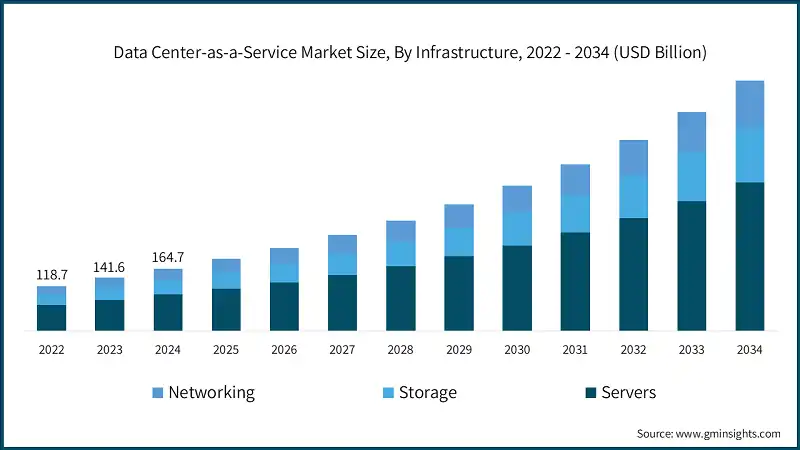
Based on infrastructure, the data center-as-a-service industry is divided into servers, storage, and networking. The servers segment dominated the market, accounting for around 59% in 2024 and is expected to grow at a CAGR of over 15% through 2025 to 2034.
- From an infrastructure perspective in the data center-as-a-service space, servers are clearly the most important and highly sought component. Servers represent the largest segment of the market and are driven primarily by virtualization technologies, which allow multiple applications and workloads to run concurrently on shared physical hardware. As computing resources are consolidated, providers can lower costs, increase efficiencies, and scale operations quickly, which is all critical in a world where agility and performance are paramount.
- The server segment will also benefit from the burgeoning demand related to AI, hyper-performance computing, and real-time data analytics. Organizations and large enterprises are rapidly adopting new-generation servers that enable higher compute densities and advanced cooling techniques, including liquid cooling, to keep pace with the tremendous processing requirements of machine learning and generative AI applications. Recent trends indicate we are in a major refresh cycle, as data center operators have begun upgrading the existing systems to support modern workloads more efficiently.
- In practical terms, large cloud providers (AWS, Microsoft) are expected to invest tens of billions of dollars in server infrastructure over the next few years, with these investments aimed at both adding capacity and improving the overall intelligence and energy efficiency of server farms and, in specific countries, (e.g. USA) these unique investments may be offset to some extent with public incentives, (i.e. the DRIVES Act), and regulatory support for localized, high efficiency server deployments, (for example).
- While servers dominate the DCaaS markets, the storage sector is growing rapidly. Recent demand is largely being driven by an immense amount of unstructured data being generated by a wide array of IoT devices, surveillance systems, and content-based platforms moving forward. Further, organizations are increasingly mindful of regulatory and compliance requirements, which also supports the demand to ensure that organizations have "data" in service of reliable and distributed storage services.
Learn more about the key segments shaping this market
Based on organization size, global data center-as-a-service market is bifurcated among small/medium enterprises, and large enterprises. Large enterprises dominate the market with 58% share in 2024, and the segment is expected to grow at a CAGR of over 14.7% from 2025 to 2034.
- The data center as a service market contains Large Enterprises, which may be the most complex IT, operational worldwide reach, and compliance burden. Large Enterprises often require infrastructure that is scalable, secure, located near their operational activities, and capable of managing their expansive volumes of data and applications based in multiple locations. For large enterprises, DCaaS provides an ideal blend of having management of the infrastructure externally, but they can keep performance, security, and regulatory compliance within their organizational control.
- The essence of a Large Enterprise, which could be a bank, manufacturer, or tech giant, is their constant need for continuity for all their mission-critical workloads by utilizing a 24/7 uptime strategy and their capacity to respond rapidly to changing incoming and outgoing volumes. For example, firms like IBM and Oracle compete in delivering DCaaS to large enterprises, often bundling hybrid cloud platforms, data compliance tools, and edge computing nodes. A great example in real-world terms is Accenture's successful deployment of cloud-backed Services for their international operations, which reduced infrastructure expense, and allowed them to react quickly to service demands across departments.
- Small and medium enterprises (SMEs) face considerable challenges when contemplating the adoption of data center-as-a-service (DCaaS) solutions. These challenges could include budget limitations, available resources of technology staff, and notifications of the complexity around cloud service agreements. Many SMEs simply do not have internal resources available to accurately assess or manage large-scale infrastructure services, which can lead SMEs to assume that their only choices are limited in cost options, but that they aren't implementable. Concerns around the security of the data, reliability of the vendor, and the ongoing support capability established in the agreement also contribute to uncertainty. Academic literature has consistently identified these issues relating to DCaaS services to the capabilities of SMEs and the cloud services.
- Nevertheless, SMEs are not absent from the DCaaS ecosystem. In growing economies, such as parts of Africa and Southeast Asia, local start-ups and mid-sized businesses are leveraging DCaaS for seasonal or event-driven traffic use. For example, small retailers during a national sale event or e-commerce festival would access regional data center suppliers for on-demand provisioning and scaling only to what is required to meet customer demand.
Based on deployment model, the data center-as-a-service market is segmented into public cloud, private cloud, and hybrid cloud. The public cloud segment dominates the market.
- Within the data center-as-a-service (DCaaS) marketplace, public cloud is the top deployment model. Public cloud has experienced a great deal of popularity due to its overall cost-effective plan, accessibility, and the speed at which one can quickly scale up infrastructure, with little or no upfront capital. Public cloud suppliers (e.g., Amazon Web Services (AWS), Microsoft Azure, and Google Cloud) offer pay-as-you-go or consume-as-you-go pricing models for computing and storage solutions. It can be a hard value to trade for both a public sector or private sector operation that is attempting to reduce operational burden or create digital infrastructure.
- Government agencies worldwide have been transitioning to public cloud models to modernize legacy IT systems and improve service delivery. For instance, in the UK, the government has implemented a "cloud first" policy in which all public service regulator entities are mandated to consider feasible public cloud options as a form of delivery instead of traditional commodity-based or information technology procurement processes. With the G-Cloud framework, public sector entities get basic access to a public digital marketplace. From this access, they can select from a list of suppliers that can fulfil an open cloud service aggregator with simplification of public cloud adoption and acceleration of public service procurement goals. Public cloud adoption by major entities, including NASA, defense departments, reinforces the public cloud value proposition and reflects the international scope and public sector reach of public cloud.
- On the other hand, private cloud deployment is generally pursued by organizations that require tighter control over the data, a higher security posture, or compliance with mandated regulations. Generally, the private cloud infrastructure is owned and consumed by either the organization in-house or by a hosting service that services only that organization. This flexibility offers significant customization and isolation but is reliant on significant investment in financial and technological resources. For most organizations, particularly those that do not operate on a scale, these investments are often not possible.
- Hybrid cloud delivers a combination of two traditional IT models, public and private clouds, together in an offering. Organizations can keep sensitive workloads in a private environment, but just as easily access and consume public cloud resources to run less critical ES applications or to handle peaks in traffic. While hybrid clouds retain the best properties of both worlds, the use of a hybrid cloud introduces challenges in orchestration, interoperability, and governance, which require scale and advanced IT organizational skills and planning.
Based on end use industry, the data center-as-a-service market is segmented into BFSI, IT and telecom, healthcare and life sciences, government and public sector, manufacturing and industrial, retail and e-commerce, and others. The retail and e-commerce sector dominates the market.
- The retail and e-commerce region represents the biggest proportion of the worldwide data center-as-a-service (DCaaS) marketplace due to the phenomenal boom in online shopping, virtual bills, and omnichannel retail techniques. As customer behavior continues to shift online, retailers want a scalable and bendy infrastructure that supports peaks in visitors at excessive sales instances, such as Black Friday, Diwali, and so on. Cloud-based information centers can store the ability, velocity, and revolutionary operational complexity (assume personalized recommendation engines, real-time inventory, customer analytics, and so forth.) to maintain pace with demand.
- For instance, in 2024 India’s ONDC (Open Network for Digital Commerce), will place millions of digital transactions per month streamlined under a unified backend cloud, and cloud-based data infrastructure. Therefore, while there will be much growth in dependency on data-driven models amongst retailers, it will continue to position retail as the world’s largest industry using representing demand for DCaaS.
- In the BFSI (Banking, Financial Services, and Insurance) industry, the rapid proliferation of digital banking, online insurance services, and fintech applications has created an urgent demand for secure and compliant storage of data. Regulations such as the General Data Protection Regulation (GDPR) and India’s Digital Personal Data Protection Act (DPDP) which requires both data localization and protections for Personal Data, along with the increased use of third-party data center services, place a significant amount of responsibility upon financial institutions - which is why DCaaS offers an attractive alternative of maintaining business continuity, cutting costs associated with infrastructure and meeting the new fast-paced demands of dynamic and constantly evolving markets. As mobile banking, along with real-time payment systems like UPI, continue to expand globally, financial institutions are making every effort to leverage DCaaS - in a variety of ways - to effectively store data individually and in an aggregated manner.
- The IT and telecommunications sectors are another strong growth area for the developing DCaaS market. The large-scale rollout of 5G, exponential growth of equitably distributed IoT devices, and the increased demand for edge computing are all major areas of interest for telecom developers to explore low-latency, distributed data centers. Data center-as-a-service models allow these organizations to accelerate their path to scalability without the requirement of significant capital expenditure. Major telecommunications operators have made considerable leaps into modular edge data centers for deploying extremely high-speed services to facilitate newer cloud-based services such as cloud gaming and real-time streaming services.
- Data centers are integral to the healthcare and life sciences sector to process high volumes of sensitive data—from electronic health records to telemedicine capabilities to AI-driven diagnostics. The digital transformation of the healthcare sector has accelerated during the pandemic, with hospitals and research laboratories increasingly depending on DCaaS to provide scalability for computing power, secure storage for data without huge capital outlays, and compliance with numerous health data regulations. Artificial intelligence and machine learning capabilities for diagnostics, drug discovery, and remote patient monitoring capabilities, which derive additional demand for data infrastructure that is both powerful and flexible, are being embraced by healthcare and life sciences operations.
- DCaaS enables governments and the public sector to swiftly modernize their civilian services and secure data security and meet their digital inclusion goals. Many governments have established a centralized platform for public services, for instance, India's Aadhaar, coin and, UPI systems, are built on strong data center infrastructure to support operations. These platforms need high availability, rapid scalability, and surplus data. By outsourcing specialized suppliers, governments can reduce running costs while securing national data authority.
Looking for region specific data?
North America dominated the global data center-as-a-service market with around 38% market share and generated around USD 62.22 billion revenue in 2024.
- As a result of the technological advantage and infrastructure maturity of both the United States and Canada, North America currently establishes itself as the largest share market for data center-as-a-service (DCaaS) across the world. The region's early adoption of cloud computing services, artificial intelligence, and data-based services has provided strong demand signals for flexible, scalable, secure, and demand for data center capacity. As a result, businesses in a wide range of industries, from finance to healthcare sectors, are moving their workloads to service-based infrastructure to limit capital expense and meet rapidly changing computing requirements.
- The United States is the driver for the entire region and has the most significant share of data center capacity. The United States has several major data center hubs, including Northern Virginia, Silicon Valley, Dallas, and Phoenix, which have become hyperscale ecosystems built around dense fiber networks, redundant, reliable power grids which enabling businesses to develop data centers with fewer regulatory constraints when complying with energy standards. The United States currently has thousands of data centers, many are operated by major cloud providers such as Amazon Web Services, Microsoft Azure, and Google Cloud, as one mechanism for DCaaS delivery for flexible service provisioning across North America and the world.
- Federal and state-level initiatives in the U.S. have also fueled growth in DCaaS. Government programming promoting cloud-first policies and digital modernization has motivated public agencies and enterprises alike to utilize service-based infrastructure. Many states even offer tax incentives and renewable energy credits to encourage investment in data center locations, contributing to an ongoing wave of new construction or modernization of data center facilities.
- Canada is also important to the region's DCaaS preeminence. Canada is favorable for data centers because it has a stable regulatory environment, strong privacy laws that will benefit DCaaS, and, on average, have cooler conditions, which will reduce cooling costs naturally. The provinces such as Quebec and British Columbia are favored for data center construction for hydropower access, however, even Ontario is a growing option. Moreover, the leading cloud providers have recently made commitments to the Canadian market based on the demand and changing national data residency requirements.
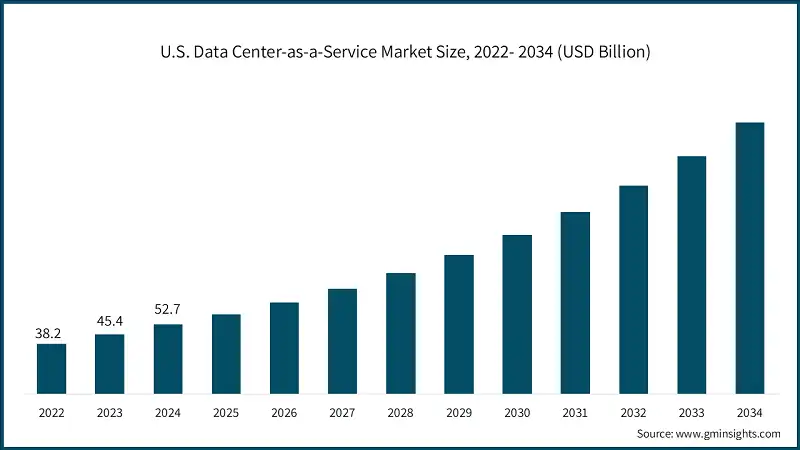
U.S. dominated the North America data center-as-a-service market with around 85% market share and generated around USD 52.7 billion revenue in 2024.
- In 2024, the U.S. was responsible for almost 85% of North America’s data center-as-a-service (DCaaS) market (USD52.7 billion in revenue). This significant share is driven primarily by the U.S.'s existing digital infrastructure, the significant presence of major cloud providers, and historical investment trajectory from both public and private sectors into scalable, service-enabled computing models.
- The U.S. DCaaS market is still anchored to the major hubs of hyperscale data centers, namely, Northern Virginia, Silicon Valley, Dallas-Fort Worth, and Phoenix. The campus-style deployments accommodating massive data centers are operated by the likes of Amazon Web Services, Microsoft Azure, Google Cloud, and Equinix. These providers continue to grow capacity and improve service profiles, enabled by the rapidly growing demand from applications related to AI, e-commerce, gaming and enterprise cloud. By late 2024, many of the largest DCaaS providers report record levels of demand for high-performing compute related primarily to generative AI, real-time analytics, and hybrid approaches to work.
- Sustainability is another aspect of market growth. Many of the U.S. based providers are making big investments in renewable energy and energy-efficient infrastructure. A company like Amazon committed itself to spend their entire operation (including data centers) on renewable energy and around cloud services where carbon footprints are becoming a big part of many clients' purchasing decisions, the focus on environmental responsibility is an additional benefit to U.S.-hosted DCaaS selling to 'green-minded' customers.
- The regulatory environment in the U.S. also promotes DCaaS through cloud-first policies, federal digital modernization initiatives, and tax incentives for data center development at the state level. The combination of these factors is reinforcing the U.S. position as the leading player in North America’s DCaaS market and an important player globally, enabling next generation cloud infrastructure.
Europe data center-as-a-service accounted for USD 36.90 billion in 2024 and is anticipated to show lucrative growth over the forecast period.
- The European data center-as-a-service market size was around USD 36.90 billion, with expectations of strong growth over the next few years. Much of this growth is being fueled by the general acceptance of Cloud Computing, the surge in significance of edge computing, along with strict data privacy and compliance regulations present in the region. As businesses in many industries work to convert their existing infrastructure to a cloud-based infrastructure, DCaaS solutions are becoming a necessity for organizations looking for scalable, flexible, and cost-effective computing resources to assist with their digital transformation initiatives.
- The EU’s firm regulatory landscape is one of the primary contributors to the growth of the DCaaS market in Europe. As a result of the General Data Protection Regulation (GDPR), businesses are under pressure to ensure data privacy and data protection. Organizations must utilize local and regional DCaaS Providers as they will be compliant with the GDPR’s data sovereignty requirements which are outlined in the GDPR provisions, businesses don’t have the same level of assurance with non-European data centers. By using European-based data centers for their DCaaS solutions, companies can feel confident that their required data protection and data processing are in compliance with local laws, but they may also decrease the risks of data transfers between countries.
- Another major factor in the growth of the market is sustainability. Many of the data center operators in Europe make decisions based on their level of environmental impact, using energy efficiency and their reliance on renewable energy. Many data center operators in Europe have set high sustainability goals, including Google, which has committed to running all its European DC's using 100% renewable energy by 2025. Equinix has bold sustainability metrics, including net-zero emissions for its facilities in Europe by 2030 and demonstrates the value of sustainability for data-center infrastructure in Europe.
- Moreover, the market is also expanding due to strong demand for edge computing, especially from the automotive, manufacturing, and telecommunications industries. The demand is increasing due to a growing number of IoT devices, applications needing low latency needs, etc. As companies are beginning to utilize local edge data centers for faster processing with less network congestion, countries that are leading this trend (Germany, UK, France, etc.) along with the continued capital investment in edge computing, will help capture capacity from additional companies.
The data center-as-a-service market in the Germany is expected to experience significant and promising growth from 2025 to 2034 at a CAGR of 15.2%.
- The data center-as-a-service (DCaaS) market in Germany is projected to further develop from 2025 to 2034, expanding at a compound annual growth rate (CAGR) of 15.2%. Growth in the DCaaS space is the result of increased demand for cloud services, changing data privacy regulations and Germany's centrality in the digital infrastructure of Europe. As the largest economy in Europe, Germany is experienced with digital trends, as both private and public organizations advance on digital transformation in a way that prioritizes local data storage solutions.
- One of the drivers helping push growth in this market area is the quick spread of cloud computing and AI and related technologies. Sectors like manufacturing, automotive, and financial services all rely on cloud-based architectures for data storage, computing power, and AI-based analytics. Germany's economic base and industrial advantage is driving vastly more data from the IoT, smart factories, and autonomous systems, leaving them with increasing opportunities to find scalable, secure and flexible DCaaS solutions to deal with the processing of rather large data volumes.
- Germany's strict data protection regulations and more so the General Data Protection Regulation (GDPR), are also causing strong growth of the DCaaS market. Companies throughout Germany are under more pressure to comply with these regulations, so many have chosen to store and process data internally in Germany, and/or wider EU. More Germany data centers (and thus compliant and secure services), increase demand in the market. And, Germany's position as a leader in data privacy means that both international and domestic customers will continue to view Germany's data centers as attractive.
- In addition, the sustainability and energy efficiency initiatives are a further large driver of growth. Germany has set much more stringent climate targets than other countries, including lowering carbon emissions and reliance on renewables. Data center operators are investing very heavily into more green technologies. Many data center operators like Equinix are utilizing 100% renewable energy in their Germany-based data centers, and for many companies, this is important as they want sustainable solutions.
- The rise of edge calculation also plays an important role in expanding the German DCaaS market. With the need for rapid growth in IoT units and real-time, low-latency processes, edge data centers are required. These location centers help to address the growing demand for applications in areas such as the automotive industry, robotics and health care. Cities such as Frankfurt, with their strategic location and strong fiber-optic infrastructure, appear as a hub for fast edge calculation, leading to DCaaS demand ahead.
Asia Pacific data center-as-a-service accounted for USD 43.68 billion in 2024 and is anticipated to show the fastest growth over the forecast period.
- The Asia Pacific (APAC) region observes rapid growth in the data center-as-a-service market (DCaaS) with an expected evaluation of USD 43.68 billion in 2024. This increase is largely inspired by increasing the demand for cloud-based services and increasing the demand for digital transit. important.
- One of the main drivers of DCaaS growth in the APAC region is the ongoing infrastructure development in the region. Countries like China, India, Japan, and South Korea have made major investments in their digital infrastructure and are now trying to become main players in the cloud computing and data management ecosystem. China, for example, has quickly expanded their data center networks and is now helped by major tech companies like Alibaba Cloud and Tencent offering state-of-the-art data services throughout the region. India for example, is also seeing the number of data center facilities increase emerging out of demand from their IT sector and strong government backing driving forward its digital growth.
- Another important driver for DCaaS adoption in the APAC region is a focus on regulatory compliance and data sovereignty. Like other parts of the world, governments in the APAC region have continued to tighten data protection legislation over time. Singapore introduced the Personal Data Protection Act (PDPA), and India is preparing data privacy regulations that have made organizations look for localized data centers where they can expect that they will be compliant with national laws. Compliance has made a necessary pre-condition of the security of the organization, which in turn has led to an expansive adoption of DCaaS solutions, an adopted abbreviation that refers to the service of obtaining DC resources as-a-service, and in which organizations can be guaranteed support to maintain regulatory conditions.
- Edge computing is a major contributor to the rising demand for DCaaS in the APAC region. With the explosion of IoT devices, there is growing interest in real-time data analysis and processing on the edge of networks. Localized data centers can deliver this analysis far more quickly than centralized systems in major cities can today. The shift toward edge computing has been noted as trend in several countries, but is by far more significant in countries like Japan and South Korea, where transformative technologies in multiple fields (e.g. autonomous vehicles, industrial automation etc.) create great excitement and need for low-latency, real-time data processing.
The data center-as-a-service market in the China is expected to experience significant and promising growth from 2025 to 2034 at a CAGR of 15.6%.
- The data center-as-a-service (DCaaS) market in China is expected to experience tremendous development from 2025 to 2034 at a compound annual growth rate (CAGR) of 15.6%. The primary catalyst for such growth takes place in a uniquely developed infrastructure and overall landscape for technology, in addition to strong government support related to innovation-based policy and digital infrastructure. Digital transformation is not only taking hold in China, but businesses are expanding data center services, including DCaaS offerings as they aim to add digital agility and scale.
- China's DCaaS market is positioned as one of the leading entities and is well supported by digital infrastructures driven by the "Made in China 2025" agenda, emphasizing advancements in high-tech industries, specifically those focused on cloud, AI, and Big Data. The government is actively shifting investment into digital infrastructures and innovation policy opportunities that empower the growth of infrastructure-based networks as a reduction in costs, which is broader than just national data centers, but also smaller tech-focused hubs in tier-2 and tier-3 cities across the country to alleviate demands for digital services.
- Aside from government assistance, major Chinese tech companies like Alibaba Cloud, Tencent Cloud, and Huawei also are leading the way for the growth of the DCaaS market. Collectively, these technology companies have expanded their cloud-enabled data center business as consumer demand for DCaaS skyrockets. For example, Alibaba Cloud is pouring massive investments into deploying next-generation data centers around various parts of China, using AI and machine learning technologies, data center costs may be reduced while also improving the efficiency of new cloud enterprise systems. As more companies adopt these technologies, the demand for DCaaS with localized content will also increase, allowing for data sovereignty with an increased use of DCaaS across the Chinese digital landscape.
- In addition to the above-listed companies, China's regulatory landscape is encouraging DCaaS market growth. The Cybersecurity Law and data sovereignty laws mandate that data generated in China must be stored within China. Therefore, the need for sufficient and compliant data centers has led to demand for DCaaS. Local corporations, including finance professionals, e-commerce companies, and government organizations will begin to require solutions for compliance with national or local laws.
Latin America data center-as-a-service accounted for USD 10.31 billion in 2024 and is anticipated to show lucrative growth over the forecast period.
- Data center-as-a-service market in Latin America is expected to see a significant increase in 2024 with an estimated price of USD 10.31 billion. Increasing cloud computing of digital changes in this sector increases the demand for data storage and is being inspired by the need for more flexible and cost-trained IT infrastructure. When businesses across Latin America go to digital first models, the demand for scalable, safe and energy-efficient data centers has intensified, which inspires the development of the DCaaS market.
- One of the main factors that drives this growth is an increasing investment in digital infrastructure by both local authorities and private companies. Governments across Latin America focus on promoting economic growth through digitalization, causing favorable conditions for the development of data centers.
- For instance, Brazil's "Digital Brazil" scheme is designed to speed up digital changes in businesses and public services, which in turn improves the demand for strong data center services. Similarly, Mexico looks at a rejection in using digital technologies, which are supported by the national initiative with a view to increasing cloud computing infrastructure.
- The increasing presence of cloud suppliers in Latin America has further increased the demand from DCaaS. Companies such as Amazon Web Services (AWS), Microsoft and Google have expanded their data center operations in the field and acknowledge the need to meet the growing demand for cloud services. These large giants have either created new data centers or formed a partnership with local suppliers to serve regional customers more efficiently.
- For instance, AWS opened a new data center area in Sau Paulo, Brazil in 2023, which would support both local and global companies to operate applications and prepare data in Latin America. Large companies emphasize attractive development opportunities in such investment sectors.
The data center-as-a-service market in the Brazil is expected to experience significant and promising growth from 2025 to 2034 at a CAGR of 14.3%.
- According to estimates, Data center-as-a-service (DCaaS) market in Brazil will grow significantly with a mixed annual growth rate (CAGR) of 14.3% between 2025 and 2034. A large driver for the expansion of the Brazil in the DCaaS market pushes the country's government to digitize and technological innovation. The Brazilian government has taken an active approach to support initiatives such as "Digital Brazil", which wants to promote many industries that use digital technologies. With state support from DCaaS and other types of cloud infrastructure, because companies are utilizing new technologies, while also improving operational efficiency, there has been an increase in demand for data center services. Apparently, with such important government support, it is relatively easy to see that the demand for DCaaS solutions in Brazil is well established.
- The status of Brazil as a regional center for technology and innovation has also attracted key service providers of cloud services such as Amazon Web Services (AWS), Microsoft and Google. In 2023, AWS expanded its infrastructure with a new data center area in Sao Paulo to meet the growing demand for cloud services. This extension emphasizes the increasing importance of Brazil in the wider Latin American cloud. Since the international supplier continues to invest in the operation of Brazil's data center, local businesses take on using DCaaS solutions to increase IT opportunities and access the state art technologies.
- Another significant driver for the growth of DCaaS are the increasingly stringent privacy and security rules recently enacted in Brazil. The General Data Protection Act (LGPD) was passed by Brazilian lawmakers in 2020 and is now a legal framework providing personal data protection and providing a legal basis to protect them. The regulatory landscape is pushing companies to adopt data storage solutions that meet their regulatory obligations and do so securely. The regulations in DCaaS ensure comparable services to its analog predecessors, offer service level agreements on price and availability, and comply with local privacy regulations.
Middle East and Africa data center-as-a-service market accounted for USD 11.57 billion in 2024 and is anticipated to show lucrative growth over the forecast period.
- There is significant digital change in MEA region, requiring advanced, flexible and scalable data infrastructure. When MEA businesses adopt cloud -based services, the demand for safe, economically skilled data center services will expand at rapid speed.
- As the MEA region is seeing pressure for digitalization from the public and private sectors, this is a direct factor for the demand for DCaaS. Countries like the UAE, Saudi Arabia, and South Africa have governments heavily investing in digital infrastructure as a commitment to their national development. To this point, the Dubai "Smart City" program aims to position the city as an international leader in smart technologies, necessitating data centers to manage the increasing amount of data resulting from Digital Services. Similarly, Saudi Arabia's Vision 2030 will diversify and create an economy based on digitalization, creating a great need for advanced procedures and further storage for the data.
- In addition to the government -leading initiatives, the increasing presence of crucial technical giants in the region is accelerating the development of the DCaaS market. Companies such as Microsoft, Amazon Web Services (AWS), and Google have expanded operations in MEA sharply by creating new data centers. For example, Microsoft’s Azure Cloud Platform launched new data center regions in Abu Dhabi and Dubai in recent years in order to better accommodate local customers and meet regional data residency standards. This expansion points to the heightened demand for localized data infrastructure across the region, which causes DCaaS solutions to be utilized.
- Regulatory compliance is another important factor affecting the DCaaS market in the MEA region. Governments implement strict data on privacy and encourage the location of data centers. For example, the UAE introduced "federal law" to regulate data privacy and protect personal data. Such rules motivate businesses to search for data centers that can ensure compliance with local laws. As a result, the DCaaS provider in the region provides an analog solution to meet the specific requirements for businesses in terms of data security, privacy and compliance.
The data center-as-a-service market in the Saudi Arabia is expected to experience strong growth from 2025 to 2034 at a CAGR of 13.6%.
- Data center-as-a-service industry in Saudi Arabia will increase at a mixed annual growth rate (CAGR) of 13.6% between 2025 and 2034. This growth will mainly be performed by Saudi Arabia's Vision 2030 initiative to bring diversity to the economy. Important government investments to upgrade IT capacity in Saudi Arabia will intensify the demand for scalable, safe and flexible DCaaS and will also strengthen the presence of Saudi Arabia in the regional DCaaS market.
- Vision 2030 prioritizes reducing the effect of oil revenues while entering the knowledge-based economy. The Saudi Arabia government has adopted digitalization as a top priority as a top priority of the Saudi Arabia government. The focus on the digital economy coincides with the growing demand for DCAAs to ensure agility, performance and cost competition for new digital services, it will meet the immediate needs of the state.
- Also boosting the growth opportunities is that international companies in the tech ecosystem, including Microsoft, Amazon Web Services (AWS), and Google, are helping to propel the growth of the DCaaS sector in Saudi Arabia. Take an example of AWS, which built several data centers in the country in order to serve local businesses that wanted a non-international data option, and had to comply with the data sovereignty needed in Saudi Arabia. Microsoft's Azure cloud platform now also has data centers in the kingdom, making it a strong player in the market. These international contributions to local data supply, and to greater storage and processing capability, can help meet a growing momentum for demand for local data supply, further assisting with the adoption of DCaaS.
Data Center-as-a-Service Market Share
- As of April 2024, the largest 8 companies in the data center-as-a-service industry are Amazon Web Services (AWS), Microsoft Azure, Google Cloud Platform, IBM Cloud, Alibaba Cloud, Oracle Cloud, Salesforce, Tencent Cloud contributed around 80% of sales in 2024.
- In September 2024, AWS provided a major upgrade to its Graviton3 processors which are built to optimize performance, cloud workloads while cutting costs. The Graviton processors, will be a key feature of AWS's DCaaS offering, enhancing compute power particularly for enterprise workloads (databases, web servers, machine learning) at an affordable cost.
- In September 2024, Microsoft has announced a move to bolster its cloud and artificial intelligence (AI) capabilities in Latin America with an investment of 14.7 billion Brazilian Reais (about USD 2.85 billion) over the next three years. The investment continues a focus on the expanding focus on existing infrastructure, and developing AI technologies, while acknowledging there will also be an increased demand for up skilling of Brazil's workforce.
- In February 2024, Google Anthos enables customers to manage applications across hybrid cloud environments, giving customers an integrated experience whether their applications are running in GCP, on-prem, or other clouds. With an update to Anthos, GCP made the platform more multi-cloud capable, providing additional flexibility for to enterprises.
- In October 2024, Oracle's flagship cloud service is evolving, and now taking away more of the work in database management. The Autonomous Database offers features like automatic scaling, backups, and patching, thanks to Oracle's superior data center technology.
Data Center-as-a-Service Market Companies
Major players operating in the global data center-as-a-service industry are:
- Amazon Web Services (AWS)
- Microsoft Azure
- Google Cloud Platform
- IBM Cloud
- Alibaba Cloud
- Oracle Cloud
- Salesforce
- Tencent Cloud
- CyrusOne
- CoreSite Realty
- AWS, with its data center and cloud services, Amazon Web Services (AWS) is a pioneering force in the market, as well as a leader in advanced data center service provision. AWS has a vast worldwide network of data centers to ensure on-demand order compute, storage, and network services can be provided to its customers. AWS is regarded as one of the top international providers of cloud services as of 2024.
- Microsoft Azure has emerged as a significant player within the cloud computing and data center services market. Azure is providing hybrid cloud and enterprise solutions that have made a preference for large enterprises, government agencies, and other industries that have regulatory obligations.
- Google Cloud Platform (GCP) is a leading cloud provider in terms of infrastructure and data services, and it is recognized especially for its areas of focus of big data, AI, and machine learning. In its role as a DCaaS provider, Google Cloud is positioned well with respect to its strengths in providing highly scalable and secure cloud storage and compute solutions.
- IBM Cloud is another cloud provider that provides public cloud, private cloud, and hybrid solutions by taking advantage of IBM's strengths in enterprise computing, AI, and blockchain. IBM has a long history of being a provider of cloud services aimed at enterprise customers, and in 2024, IBM Cloud continues to be a strong player in the DCaaS space, especially for selling primarily to regulated industries.
- Alibaba Cloud is a leading cloud service provider in China and the Asia-Pacific region and is actively experiencing worldwide expansion. Alibaba Cloud is known for its strong infrastructure and services in e-commerce, artificial intelligence, and big data is a formidable competitor in the DCaaS market, especially in Asia.
- Oracle Cloud is a leading provider of enterprise cloud solutions including autonomous databases and software as a service (SaaS) applications. Oracle´s cloud infrastructure has a strong focus on delivering high-performance data services for enterprise customers with critical workloads.
Data Center-as-a-Service Market Report Attributes
| Key Takeaway | Details |
|---|---|
| Market Size & Growth | |
| Base Year | 2024 |
| Market Size in 2024 | USD 164.69 Billion |
| Market Size in 2025 | USD 189.88 Billion |
| Forecast Period 2025 - 2034 CAGR | 14.8% |
| Market Size in 2034 | USD 658.81 Billion |
| Key Market Trends | |
| Drivers | Impact |
| Increased Demand for Cloud Services | Cloud migration increases demand for scalable, flexible data centers, boosting DCaaS adoption worldwide. |
| Cost Efficiency and Scalability | DCaaS eliminates capital expenses, offering on-demand services that scale with business growth requirements. |
| Adoption of Hybrid and Multi-cloud Strategies | Hybrid and multi-cloud models drive demand for DCaaS providers that offer seamless infrastructure integration. |
| Growing Need for Data Storage and Processing | Growing data needs push organizations to seek cost-effective, scalable DCaaS for efficient storage and processing. |
| Enhanced Focus on Security and Compliance | DCaaS providers robust security measures make them ideal for enterprises needing secure, compliant data management. |
| Rise in Edge Computing | DCaaS solutions integrating edge computing allow businesses to manage latency-sensitive applications effectively. |
| Pitfalls & Challenges | Impact |
| High Initial Investment for Data Center Infrastructure | High setup costs make DCaaS less accessible for small businesses or startups with limited budgets. |
| Latency Issues in Remote Locations | Latency issues can affect the reliability and performance of DCaaS solutions, hindering broader adoption. |
| Opportunities: | Impact |
| Expansion of 5G Networks | The rollout of 5G creates demand for local, low-latency DCaaS solutions supporting real-time processing and IoT. |
| AI and Machine Learning Integration | AI-driven DCaaS offerings provide greater efficiency, automation, and predictive insights for workload management and maintenance. |
| Mergers and Acquisitions to Expand International Footprint | M&A activities create stronger international players and more accessible, comprehensive services across diverse regions. |
| Rising Demand for Edge Computing Solutions | Edge computing solutions meet demand for faster data processing in industries like IoT, autonomous vehicles, and smart cities. |
| Market Leaders (2024) | |
| Market Leaders |
33% market share |
| Top Players |
Collective market share in 2024 is 70% |
| Competitive Edge |
|
| Regional Insights | |
| Largest Market | North America |
| Fastest growing market | Asia Pacific |
| Emerging countries | China, India, Brazil, Vietnam, South Africa |
| Future outlook |
|
What are the growth opportunities in this market?
Data Center-as-a-Service Industry News
- In April 2024, Equinix, one of the world's leading data center colocation service providers, announced it would be acquiring Switch, a leading U.S. data center provider with a robust collection of Tier III and hyperscale data centers, for USD 3.8 billion, expanding Equinix's total data center footprint by adding more than 10 facilities in North America.
- In March 2024, Google Cloud announced it would be acquiring Mandiant, a threat intelligence and incident response cybersecurity company, for USD 5.4 billion.
- In January 2024, DigitalBridge (a digital infrastructure investment company) acquired Vantage Data Centers, one of the world's leading hyperscale data center providers, for USD 4.5 billion as part of DigitalBridge's broader DCaaS market growth strategy.
- In October 2023, Microsoft announced a major investment of USD 10 billion over the next three years to develop its data center infrastructure and improve its Azure cloud capabilities in emerging markets, particularly Brazil, India, and Africa.
The data center-as-a-service market research report includes in-depth coverage of the industry with estimates & forecasts in terms of revenue (USD Bn) from 2021 to 2034, for the following segments:
Market, by Infrastructure
- Servers
- Storage
- Networking
Market, by Organization Size
- Small/medium enterprises
- Large enterprises
Market, by Deployment Model
- Public cloud
- Private cloud
- Hybrid cloud
Market, by End use Industry
- BFSI
- IT and telecom
- Healthcare and life sciences
- Government and public sector
- Manufacturing and industrial
- Retail and e-commerce
- Others
The above information is provided for the following regions and countries:
- North America
- U.S.
- Canada
- Europe
- Germany
- UK
- France
- Italy
- Spain
- Nordics
- Russia
- Asia Pacific
- China
- India
- Japan
- Australia
- Indonesia
- Philippines
- Thailand
- South Korea
- Singapore
- Latin America
- Brazil
- Mexico
- Argentina
- Middle East and Africa
- Saudi Arabia
- South Africa
- UAE
Frequently Asked Question(FAQ) :
What is the market size of the data center-as-a-service market in 2024?
The market size was USD 164.69 billion in 2024, with a CAGR of 14.8% expected through 2034 driven by increased demand for cloud services.
What is the current data center-as-a-service market size in 2025?
The market size is projected to reach USD 189.88 billion in 2025.
What is the projected value of the data center-as-a-service market by 2034?
The DCaaS industry is expected to reach USD 658.81 billion by 2034, supported by hybrid cloud adoption, edge computing, and demand for scalable IT infrastructure.
How much share did the servers segment generate in 2024?
The servers segment dominated the market with around 59% share in 2024.
What was the share of large enterprises segment in 2024?
Large enterprises accounted for 58% share in 2024.
What is the growth outlook for the hybrid cloud deployment model from 2025 to 2034?
The hybrid cloud segment is expected to grow significantly, driven by demand for flexibility and integration of private and public cloud environments.
Which region leads the data center-as-a-service market?
The U.S. dominated the market with USD 52.7 billion revenue in 2024, holding nearly 85% of North America’s share. Strong hyperscale data center hubs and cloud-first policies fuel its dominance.
What are the upcoming trends in the data center-as-a-service market?
Key trends include AI-driven workload optimization, sustainability and green data centers, edge computing integration, and expansion of 5G-enabled low-latency DCaaS solutions.
Who are the key players in the data center-as-a-service market?
Major players include Amazon Web Services (AWS), Microsoft Azure, Google Cloud Platform, IBM Cloud, Oracle Cloud, Alibaba Cloud, Salesforce, and Tencent Cloud.
Data Center-as-a-Service Market Scope
Related Reports