Summary
Table of Content

Conveyor System Market
Get a free sample of this report
Form submitted successfully!
Error submitting form. Please try again.
Thank you!
Your inquiry has been received. Our team will reach out to you with the required details via email. To ensure that you don't miss their response, kindly remember to check your spam folder as well!
Request Sectional Data
Thank you!
Your inquiry has been received. Our team will reach out to you with the required details via email. To ensure that you don't miss their response, kindly remember to check your spam folder as well!
Form submitted successfully!
Error submitting form. Please try again.
Conveyor System Market Size
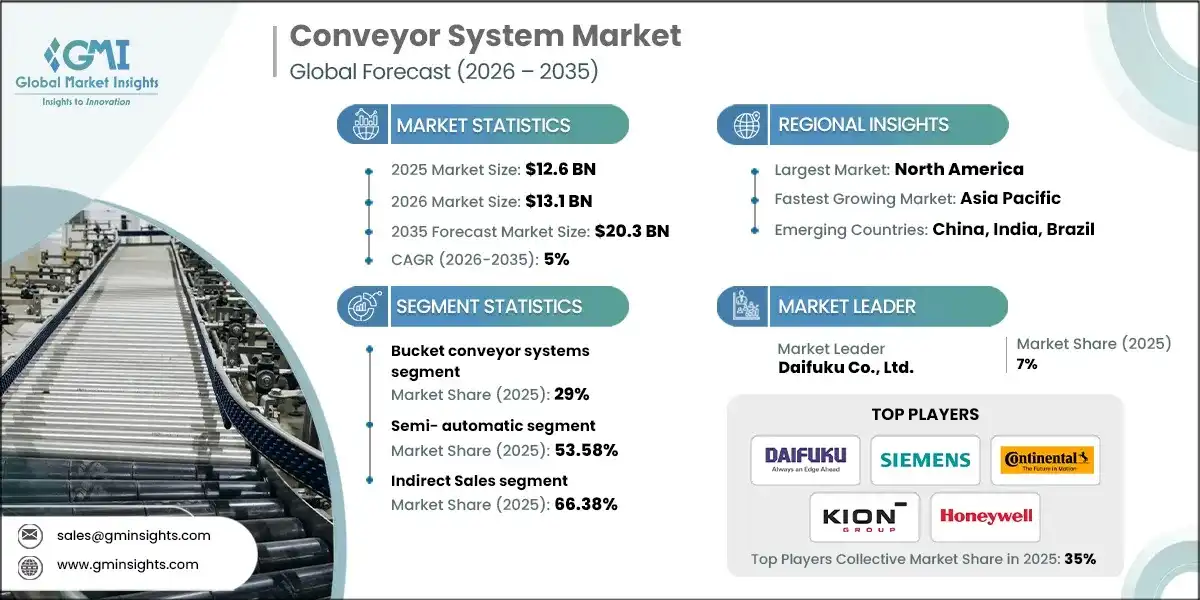
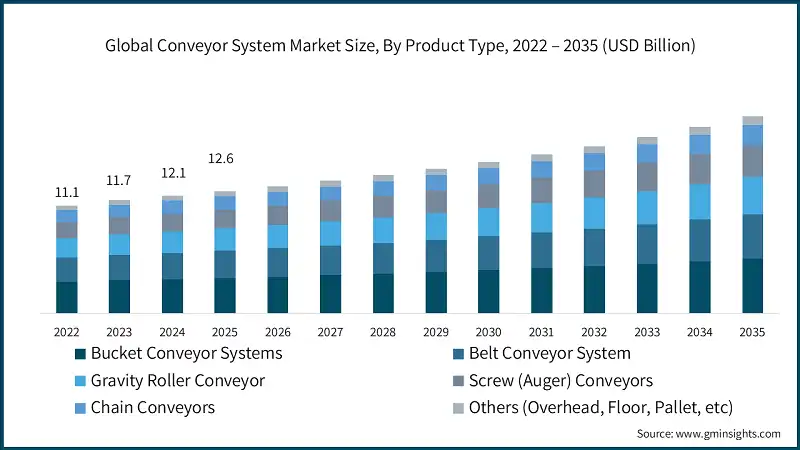
The conveyor system market was estimated at USD 12.6 billion in 2025. The market is expected to grow from USD 13.1 billion in 2026 to USD 20.3 billion in 2035, at a CAGR of 5% according to latest report published by Global Market Insights Inc.
To get key market trends
The increasing operational efficiency and supply chain sustainability awareness that is heavily emphasized is the rise in demand for conveyor systems due to the surge in mergers and acquisitions among industry leaders. The joining of forces of the key players in the business led to increased innovation, expanded product portfolios, and enhanced market presence. In contrast, traditional methods of manual material handling, such as forklift, based transport or manual sorting, are less environmentally friendly and economically viable. The modern conveyor systems represent a more sustainable option, as they are designed with energy, efficient motor technology and regenerative braking, thus limiting environmental impact. This environmentally friendly method is in line with the increasing adoption of sustainable practices in logistics and manufacturing and is a contributing factor to the market's growth.
The demand for automated warehousing and logistics hubs is rapidly increasing in North America. Besides, there is a rise in the industrial and e-commerce infrastructure expenditure in Europe and parts of the Asia and Pacific region, which is creating the base for the commercial viability of this equipment. Both consumers and professionals are turning to efficient, mechanized solutions for high throughput distribution, thus abandoning the use of old, time consuming methods such as manual palletizing or basic gravity fed systems. Automated sortation, which converts the fulfillment process into a continuous, ultra fast operation, is generally considered to be a cleaner, faster, and more environmentally friendly alternative.
With most e-retailers and third party logistics (3PL) providers demanding faster, less disruptive methods for order fulfillment, conveyor systems are becoming a major choice due to their already, known benefits, such as the optimization of floor space and reduction of the risk of workplace injuries caused by heavy lifting. Indeed, this market is fundamentally driven by an increasing awareness of the long, term benefits of a fully integrated material flow, resulting in a wider acceptance of these powerful devices. Besides that, the ongoing improvements in machine design will definitely help to further enhance the safety and ease of operation of the users. The combination of infrastructure support, an industry wide focus on smart warehouse management, and a demand for high efficiency convenience acting as a synergy is thus behind the market's strong financial performance.
One major factor behind the market's continuous expansion is the progressive technological innovation in equipment, which is gradually converting the traditional simple mechanical tracks into highly intelligent, application, specific machinery. The industry is seeing a very clear shift towards the use of smart drive rollers and sophisticated control systems that, on one hand, enhance efficiency and, on the other hand, increase the life of the belt when different load weights and packaging types are handled. The manufacturers thus are very much preoccupied with the improvement of the operator experience by providing such features as IoT enabled remote monitoring for the sake of safety, modular conveyor designs for excellent maneuverability on irregular facility layouts, and integrated AI and telematics for fleet management.
The conveyor system market would primarily be a day to-day moving machinery market, driven by a big pandemic sized jump in e-commerce fulfillment and global trade, which in turn has led to a professional and industrial demand for error free and high speed distribution spaces. The main operational difference between traditional transport methods and automated conveyors is that the latter electrically and automatically direct the goods with absolute accuracy and effectiveness, thus doing away with handling bottlenecks while at the same time an additional felicitous consequence (data insights for warehouse optimization) is also generated and the time spent on sorting and dispatch is hitting the floor.
Such effectiveness has found favor with very large scale distribution centers which are looking for even greater throughput and with manufacturing/packaging firms that have a need for a steady and timely supply of the production line. The market composition shows the direct consequence of this demand, as the Belt and Roller conveyor segments have been consistently capturing the largest revenue share, thus accounting for most of the total conveyor system market revenue in recent years. The dominance of this segment is a direct result of the performance strength, durability, and high mobility of these machines, which are a perfect fit for the modern professional's need for versatility and rapid deployment.
Moreover, technology is progressively becoming a very important factor and features such as programmable logic controllers (PLCs) provide a more customized and accurate material handling experience. All these interconnected trends talk about the market's liveliness and its capacity to meet the needs of a wide range of industrial and commercial sectors.
As a result of more and more individuals and professional services demanding quicker and less disruptive methods of maintaining indoor air quality and water safety, HEPA and RO filtration systems are becoming very popular due to their recognized benefits, such as reducing health hazards and lessening the risk of pathogen transmission from contaminated environments. The market for these products is mainly driven by an increasing awareness of the long term benefits of high, efficient particle removal, which is resulting in a wider acceptance of these powerful devices.
In addition, by the end of several ongoing works on improvements in filter media and housing design, user safety and operating ease will be enhanced further. The interaction between better infrastructure, a concerted industry effort towards sustainable resource management, and a demand for high, efficiency convenience is reinforcing the market's bullish financial trend. The advancement of filter media technology is one of the main factors that contributed to the market growth transition from simple screening tools to highly durable, application specific machinery. The industry is noticing a significant switch towards nanofiber membranes and high, porosity activated carbon that enhances efficiency and media longevity for dealing with a wider range of contaminant densities and chemical compositions. Manufacturers are putting a lot of effort into improving the operator's experience and they are introducing features such as IoT, enabled performance monitoring for safety enhancement, and automated self, cleaning systems for great mobility in high, load environments
All demonstrated in the market signs of growing further as technology develops and the respective demand continues.
Conveyor System Market Report Attributes
| Key Takeaway | Details |
|---|---|
| Market Size & Growth | |
| Base Year | 2025 |
| Market Size in 2025 | USD 12.6 Billion |
| Market Size in 2026 | USD 13.1 Billion |
| Forecast Period 2026-2035 CAGR | 5% |
| Market Size in 2035 | USD 20.3 Billion |
| Key Market Trends | |
| Drivers | Impact |
| Rapid E-commerce & Fulfillment Growth | The explosion of online shopping requires high-speed, automated sorting and parcel handling. This drives massive demand for automated belt and roller systems in distribution centers. |
| Industry 4.0 & Smart Manufacturing | Transitioning to "Dark Warehouses" and smart factories necessitates conveyors that can communicate with robots and AMRs, boosting sales of intelligent, software-driven systems. |
| Sustainability & Energy Efficiency | Global regulations (like the EU Green Deal) push companies toward regenerative drive systems and VFD-controlled conveyors that reduce power consumption by up to 30-40%. |
| Pitfalls & Challenges | Impact |
| High Initial CAPEX & Long ROI | The significant upfront cost for fully automated, high-precision systems acts as a barrier for SMEs, often delaying facility upgrades or resulting in phased implementations. |
| Complexity of Retrofitting Legacy Sites | Integrating modern smart conveyors into existing older infrastructure often leads to high integration costs, production downtime, and software compatibility issues. |
| Opportunities: | Impact |
| IoT & Predictive Maintenance Integration | Utilizing AI-driven sensors to monitor belt health and motor temperature reduces unplanned downtime by ~30% and opens new revenue streams for "Service-as-a-Product" (SaaS). |
| Modular & Flexible Conveyor Design | The rise of "Micro-fulfillment" centers in urban areas creates a need for modular, easy-to-reconfigure conveyors that can fit into non-traditional, smaller footprints. |
| Market Leaders (2025) | |
| Market Leaders |
7% market share |
| Top Players |
|
| Competitive Edge |
|
| Regional Insights | |
| Largest market | North America |
| Fastest growing market | Asia Pacific |
| Emerging countries | Asia Pacific |
| Future outlook |
|
What are the growth opportunities in this market?
Conveyor System Market Trends
The conveyor system industry is advancing quickly due to innovative products and technological developments by key companies. These companies are introducing automated and modular systems with features like smart sensors, AI, integrated sorting, and energy-efficient high-torque motors. These advancements are designed to meet the growing demand for efficient and user-friendly solutions in logistics and manufacturing. By focusing on continuous innovation, the industry provides tools that improve performance, reduce setup times, and make material handling processes more efficient. This commitment to innovation highlights the industry's dedication to addressing user needs and enhancing productivity across operations.
- Technology advancement and product innovation: The machines are becoming more advanced and efficient, which is reflected in the decision to integrate IoT, enabled remote monitoring and wireless control systems for better safety and performance. Companies are investing in the development of more powerful and energy efficient electric rollers as well as the production of a durable high, tensile belt that will increase system uptime and load capacity.
- The growth of the retail and third-party logistics (3PL) industries has significantly contributed to market expansion. Together, e-commerce and logistics companies make up approximately 37% of the market. The increasing focus on faster order processing and optimizing last-mile delivery has driven the demand for advanced sortation and distribution systems. This rising demand is not only supporting the global expansion of supply chains but is also promoting the development of urban micro-fulfilment centers. To address these needs, retailers are making substantial investments in automated distribution infrastructure, aiming to enhance efficiency and meet customer expectations. These advancements in automation and fulfilment services are playing a crucial role in shaping the future of the market.
- Sustainable Land and Facility Management: Efficient material transport is crucial to reducing energy waste and avoiding delays caused by manual handling. This approach supports healthier operations and makes it easier to adopt green logistics and improve warehouse efficiency. These efforts align with ESG (Environmental, Social, and Governance) goals and carbon neutrality programs worldwide.
- Global Supply Chain Disruptions: Fluctuations in global trade are putting pressure on supply chains, leading businesses to focus on making local logistics more flexible and resilient. This has significantly increased the use of modular conveyor systems. Warehouses are frequently reconfigured and scaled to meet changing needs, driving higher demand for conveyor systems in distribution centers, manufacturing facilities, and logistics companies.
- Focus on Industry 4.0 and Smart Warehousing: Facility managers and planners are prioritizing the safety and reliability of automated systems by performing regular maintenance. They use predictive diagnostics to monitor conveyor systems and prevent costly downtime. The constant need for smooth material flow ensures a steady demand for smart, commercial-grade conveyor systems throughout the year.
Conveyor System Market Analysis
Learn more about the key segments shaping this market
Based on the product type, the market is divided into bucket conveyor systems, belt conveyor systems, gravity roller conveyors, screw (auger) conveyors, chain conveyors, and others. The bucket conveyor systems segment accounted for over 29% of the market share in 2025.
- Industries such as mining and agriculture are increasingly using vertical material handling systems to improve efficiency and productivity. This growing adoption is driving the expansion of this segment, as these systems are essential for moving heavy materials in a streamlined manner.
- Bucket conveyors hold a significant share of the market due to their ability to handle large volumes of bulk materials effectively, even in space-constrained environments. Their high capacity and reliability make them a preferred choice for industries requiring efficient vertical material transport.
- Belt and gravity roller conveyors are witnessing consistent growth, supported by the rising demand from e-commerce and logistics sectors. These sectors rely on these conveyors for high-speed sorting and unit handling, which are critical for meeting the increasing consumer demand for faster deliveries and streamlined operations.
- Screw and chain conveyors are particularly suited for specialized industrial applications, such as chemical processing and heavy-duty automotive assembly. These systems are highly valued for their durability and ability to handle challenging materials, including abrasive or high-temperature substances. Facility managers prefer these conveyors for their robust performance in demanding environments, ensuring smooth operations and reduced downtime. As industries continue to evolve, the demand for these specialized systems is expected to remain strong, driven by their proven efficiency and reliability in handling complex material handling tasks.
Learn more about the key segments shaping this market
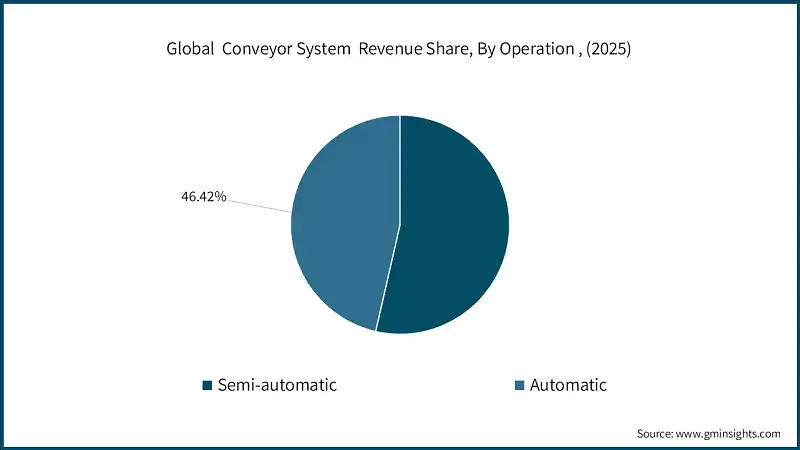
Based on the mode of operation, the conveyor system market is segmented into semi-automatic and automatic. In 2025, Semi- automatic segment held a major market share of 53.58%, generating a revenue of USD 6.7 billion.
- Automated conveyor systems offer enhanced productivity, reduced labor costs, and improved safety. The integration of technologies like sensors, robotics, and artificial intelligence further bolsters their efficiency and reliability.
- Industries such as e-commerce, automotive, and food & beverage increasingly rely on automated conveyor systems to meet the growing demand for faster and more accurate material handling operations, driving market growth.
- The automatic segment represents the largest portion of the market, reflecting the industry's shift towards Industry 4.0 and smart technology that maximizes throughput and minimizes human error.
- Automatic modes, often involving features like IoT sensors and AI-driven predictive maintenance, highlight the demand for intelligent systems that can self-diagnose and integrate with warehouse execution software.
- The semi-automatic segment maintains a solid growth rate of 5.6%, likely representing cost-effective solutions for smaller distribution centers or specialized manufacturing cells where some operator interaction remains necessary.
- The trend toward full automation is driven by rising labor costs and the need for "dark warehouses" that operate with minimal intervention to meet same-day delivery demands
Based on the mode of distribution, the conveyor Systems market is segmented into direct sales and indirect sales. The indirect sales held the major market share of 66.38% in 2025, reflecting the industry’s reliance on third-party integrators and specialized distributors.
- Indirect sales represent the largest portion of the market and show high projected growth through 2035, driven by the critical role of system integrators who provide customized turnkey solutions.
- This dominance is fueled by the need for localized technical support and aftermarket services. End-users in manufacturing and retail prefer indirect channels for rapid part replacement and on-site maintenance contracts.
- Direct sales typically involve transactions for large-scale infrastructure projects, such as major airport baggage handling systems or global e-commerce fulfillment hubs, where the OEM manages the installation and long-term service directly.
Looking for region specific data?
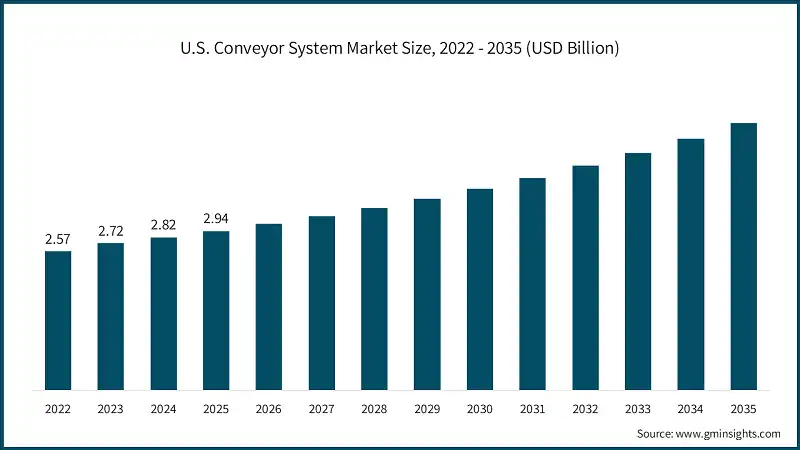
North America conveyor system market estimated value of USD 3.7 billion in 2025 and is projected to attain 5.1% CAGR through 2035.
- The U.S. leads the region, showing a strong growth rate of 5.4%. This growth is driven by a mature market with massive investments in warehouse automation and the rapid expansion of e-commerce networks.
- Conveyor systems are essential tools for major retail hubs and distribution centers, where the transition to automated parcel sorting is at an all-time high.
- The North American market meets this need by offering advanced overhead and belt solutions that support large-scale industrial manufacturing and high-volume automotive production.
- The demand is further fueled by a focus on workplace safety and ergonomic handling, as companies look to reduce manual lifting and improve operational efficiency across the continent.
Europe conveyor system market estimated at USD 3.2 billion in 2025 with a projected growth rate of 4.7%. Germany leads the region with a high growth rate of 5.6% and a market value of USD 600 million in 2025 due to its advanced automotive and machinery sectors
- The European market benefits from sustainability initiatives and the EU Green Deal, encouraging the adoption of energy-efficient drives and eco-friendly belt materials.
- These efforts make Europe a competitive landscape for innovation, particularly in "green" conveyor technologies that reduce power consumption by up to 30% through regenerative braking.
- Countries like France and Italy experience steady growth driven by the modernization of food and beverage processing lines, requiring high hygiene and safety standards.
- The focus on Industry 4.0 in Europe promotes the integration of robotics with conveyors to streamline production time and minimize environmental impact.
Asia Pacific conveyor system market estimated USD 4 billion in 2025 with a projected growth rate of 5.5% from 2026 to 2035.
- India has the highest sub-regional growth rate at 6.1%, followed by China at 5.7%. China also holds the largest market share in the region, valued at USD 1.3 billion in 2025.
- The rapid growth results from massive urbanization and significant infrastructure projects, particularly in logistics hubs and "smart cities" that require modern material handling.
- Rising demand for high-quality production and better operational efficiency influences the market, as manufacturers in the region shift from manual labor to automated conveyor platforms.
- Countries like Japan and Australia are also important players, utilizing sophisticated conveyor systems for high-tech electronics assembly and heavy-duty mining operations.
Latin America conveyor system market expected to reach USD 900 million by 2025, growing at a rate of 3.9% from 2026 to 2035.
- Overall growth is steady as increasing urbanization, and a growing retail sector boost the demand for professional logistics and warehousing services.
- Market players are focusing on durable, cost-effective equipment to cater to the agricultural and mining sectors, which remain the backbone of the region's industrial demand.
- While economic variability exists, the long-term trend points toward increased mechanization in public works and manufacturing to improve regional competitiveness.
Conveyor System Market Share
Daifuku Co., Ltd. is leading with a 7% market share. Daifuku Co., Ltd., Honeywell Intelligrated, Continental AG, Siemens Logistics and KION Group collectively hold around 35%, indicating a moderately fragmented market concentration with a strong tier of dominant global players. These prominent players are proactively involved in strategic endeavors, such as mergers & acquisitions, facility expansions, and collaborations, to expand their product portfolios, extend their reach to a broad customer base, and strengthen their market position.
- In May 2025, Vanderlande completed the acquisition of Siemens Logistics' airport baggage handling and cargo business for approximately USD 325 million. This strategic move significantly expanded Vanderlande’s footprint in the global airport logistics sector. The acquisition allowed Vanderlande to integrate Siemens' innovative baggage handling technologies, reinforcing its commitment to performance, durability, and high-speed sortation. Andrew Manship, CEO of Vanderlande, emphasized that the deal provides a broader range of future-oriented solutions to help customers tackle evolving supply chain challenges.
- In December 2024, Continental AG unveiled an array of new digital monitoring attachments for its heavy-duty conveyor belts, catering to the mining, construction, and bulk logistics applications. The additions included the Conti Load Sense system, a 2D radar-based monitoring tool capable of measuring material flow in real-time. This technology features smart sensors for improved visibility into belt health and robust durability for harsh environments. Frank Gangi, a senior product manager, highlighted the company's commitment to enhancing material handling performance by providing operators with a comprehensive set of digital tools for predictive maintenance
Conveyor System Market Companies
Major players operating in the conveyor system industry are:
- Beumer Group
- Continental AG
- Daifuku Co., Ltd.
- FlexLink AB (Coesia Group)
- Fives Group
- KION Group
- Honeywell Intelligrated
- Interroll Holding AG
- Hytrol Conveyor Company, Inc.
- Siemens Logistics
- Intralox, L.L.C. (part of Laitram, L.L.C.)
- Rexnord Corporation
- Shuttleworth, LLC (ProMach)
- Viastore Systems GmbH
- Swisslog Holding AG (KUKA AG)
- WAMGROUP S.p.A.
Interroll expanded its range of modular conveyor platforms with the introduction of the Specialized Light Goods Conveyor, a system compatible with high-speed automated warehouses. Engineered for optimal productivity and precise control, this rigid-mount system offered faster operation compared to older articulating roller designs. Unveiled at ProMat 2025, its modular hitch and forward-reaching design improved control for diverse parcel sizes. The design's advantage lies in providing better flow control and eliminating the need for constant manual adjustments during peak fulfillment hours
Conveyor System Industry News
- In November 2025, Bandit Materials Handling (Specialized Industrial) introduced two new high-production conveyors: the HC-75W (a 74 HP gearbox-driven unit for bulk material) and the HC-40H (featuring a redesigned hydraulic drive system for simplified maintenance). The HC-75W is designed for high-capacity industrial work, utilizing a gearbox drive to eliminate belt slippage, while the HC-40H introduces a side-mounted hydraulic motor system to simplify maintenance on its medium-load platform.
- In July 2025, Vermeer Industrial launched the BC402 Bulk Conveyor, a self-propelled unit equipped with a high-efficiency motor and the proprietary SmartFlow control system. This system automatically adjusts the belt speed based on load weight, maximizing energy efficiency; the BC402 also boasts a narrow frame for easy integration into tight brownfield facility access points.
- In 2025, Hansa Systems will continue to offer their specialized, high-performance modular attachments for assembly lines. This focuses on high mobility and lower overhead for smaller manufacturing firms that require rapid reconfiguration of their production floors.
- In September 2024, Daifuku introduced the redesigned AS-35 Sliding Shoe Sorter, tailored for tree-care and retail logistics specialists. This new iteration boasted robust performance in package sortation and production. Powered by a high-efficiency electric drive, it featured a Series III duplex belt, aggressive infeed for diverse packaging, and various durability enhancements. Operating at a quiet 65 decibels, the AS-35 addressed the needs of professionals aiming to broaden their fulfillment capacity in the e-commerce industry. Christoph Schenk, President of Daifuku Intralogistics America, emphasized its versatility and performance attributes in modern "dark warehouses."
- In 2024, Rayco Logistics continued to emphasize its powerful heavy-duty models, such as the TR165, which uses a high-performance drive engine and incorporates their Command Flow automatic speed control to enhance performance on large-scale bulk loads. This focuses on meeting emissions standards without the need for complex fluid additives.
The conveyor system market research report includes in-depth coverage of the industry with estimates & forecasts in terms of revenue (USD Billion) and volume (Thousand Units) from 2021 to 2034, for the following segments:
Market, By Product Type
- Bucket Conveyor Systems
- Belt Conveyor System
- Gravity Roller Conveyor
- Screw (Auger) Conveyors
- Chain Conveyors
- Others (Overhead, Floor, Pallet, etc.)
Market, By Operation
- Semi-automatic
- Automatic
Market, By End Use Vertical
- Airport
- Retail
- Automotive
- Food & Beverages
- Others
Market, By Distribution Channel
- Direct
- Indirect
The above information is provided for the following regions and countries:
- North America
- U.S.
- Canada
- Europe
- Germany
- UK
- France
- Italy
- Spain
- Asia Pacific
- China
- India
- Japan
- Australia
- South Korea
- Latin America
- Brazil
- Mexico
- Argentina
- Middle East and Africa
- South Africa
- Saudi Arabia
- UAE
Frequently Asked Question(FAQ) :
What was the valuation of the semi-automatic operation segment in 2025?
The semi-automatic segment held a major market share of 53.58% in 2025, generating a revenue of USD 6.7 billion.
What are the upcoming trends in the conveyor system market?
predictive maintenance integration, modular and flexible conveyor designs for micro-fulfillment centers, and energy-efficient drives with regenerative braking technology.
Which region leads the conveyor system market?
North America leads with USD 3.7 billion in 2025 and a projected CAGR of 5.1% through 2035. Mature market infrastructure, massive warehouse automation investments, and rapid e-commerce expansion fuel the region's dominance.
What is the growth outlook for the Asia Pacific conveyor system market from 2026 to 2035?
Asia Pacific is projected to grow at a CAGR of 5.5% through 2035, driven by massive urbanization, significant infrastructure projects, and the shift from manual labor to automated conveyor platforms.
Who are the key players in the conveyor system market?
Key players include Daifuku Co., Ltd., Siemens Logistics, Continental AG, KION Group, Honeywell Intelligrated, Beumer Group, FlexLink AB (Coesia Group), Fives Group, Interroll Holding AG, Hytrol Conveyor Company Inc., Intralox L.L.C., Rexnord Corporation, Shuttleworth LLC (ProMach), Viastore Systems GmbH, Swisslog Holding AG (KUKA AG), and WAMGROUP S.p.A.
How much revenue did the bucket conveyor systems segment generate in 2025?
Bucket conveyor systems accounted for over 29% of the market share in 2025, driven by their ability to handle large volumes of bulk materials effectively in space-constrained environments.
What is the current conveyor system market size in 2026?
The market size is projected to reach USD 13.1 billion in 2026.
What is the market size of the conveyor system in 2025?
The market size was USD 12.6 billion in 2025, with a CAGR of 5% expected through 2035 driven by rising demand for operational efficiency, supply chain sustainability, and increased mergers and acquisitions among industry leaders.
What is the projected value of the conveyor system market by 2035?
The belt segment in the conveyor system market will record USD 10.80 billion and exhibit 5.8% CAGR through 2032, owing to its extensive application across various industries, such as manufacturing, food processing, and mining.
Conveyor System Market Scope
Related Reports