
Authors:
Preeti Wadhwani, Manish Verma
Download free PDF
Construction Accounting Software Market Size & Share 2026-2035
Report ID: GMI5837
|
Published Date: August 2026
|
Report Format: PDF/Excel/Dashboard/Platform
Download Free PDF
Explore Our Licensing Options:
Download Free PDF

Construction Accounting Software Market
Get a free sample of this report
What are you hoping to find?
Your PDF is on its way. Tell us little about your research goal, and we'll help you find the most relevant market insights.
Construction Accounting Software Market Size
The construction accounting software market was valued at USD 2.6 billion in 2025 and is projected to reach USD 4.8 billion by 2035, expanding from USD 2.8 billion in 2026 at a 6.3% CAGR over 2026–2035. According to the latest report published by Global Market Insights Inc., the forecast captures financial-management software and related professional and managed services purpose-built for project-based contractors.
Construction Accounting Software Market Key Takeaways
Market Leader: Procore Technologies led with over 11% market share in 2025.
Leading Players: Top 5 players in this market include Procore Technologies, Sage, Trimble/Viewpoint, Oracle, Acumatica, which collectively held a market share of 35.4% in 2025.
Coverage includes standalone construction accounting software, integrated ERP modules, implementation and managed services; cloud-based SaaS and on-premise deployments; job costing, billing, AP/AR, payroll and HR, audit reporting and analytics, and equipment tracking. It also covers residential, commercial, civil and infrastructure, industrial, and specialty-trade construction buyers across SMEs and large enterprises in North America, Europe, Asia Pacific, Latin America, and MEA.
The addressable base extends beyond current software spending because many contractors, particularly SMEs in emerging markets, still rely on spreadsheets, QuickBooks, or fragmented point tools. North American revenue reached USD 1 billion in 2025 against US construction put-in-place above a USD 2.1 trillion annualized rate, indicating that financial-system penetration remains low relative to construction activity.[1]U.S. Census Bureau, "Value of Construction Put in Place," census.gov
GMI Analyst View
Construction accounting is moving from a back-office recordkeeping purchase to a project-control decision. Compliance-intensive public work, subcontractor payment administration, and real-time cost visibility now converge in the same procurement cycle. Cloud deployments will take a larger share through 2035 because multi-site visibility, automatic updates, and connected payment workflows solve operational issues that isolated on-premise installations cannot address. The second-order effect is a change in vendor selection: field-management platforms increasingly shape finance-platform choices because contractors seek to eliminate manual handoffs between field, payroll, project controls, and accounting. The durable constraint is not feature availability but migration risk, particularly where multi-year projects carry deeply customized job-cost histories.
Key Drivers
Rising construction project complexity and regulatory compliance burden
Rising project complexity is the largest modeled growth contributor. Commercial and civil projects often span joint ventures, multiple tax jurisdictions, layered subcontractor tiers, retainage schedules, lien releases, change-order trails, and certified-payroll records. US construction put-in-place exceeded a USD 2.1 trillion annualized rate in 2025, increasing the volume of transactions that must be linked to project controls and compliance records. Sage 300 Construction and Real Estate and CMiC Financial address this need through construction-specific compliance and transaction modules.
Government-mandated infrastructure investment programs
Public infrastructure funding turns compliance functionality into a procurement baseline. The Infrastructure Investment and Jobs Act authorized and appropriated more than USD 551 billion in transportation funding for fiscal years 2022–2025, while the Department of Transportation had obligated more than USD 260 billion by April 2025. [2]U.S. Department of Transportation, "Infrastructure Investment and Jobs Act Funding and Obligations," transportation.gov Davis–Bacon requirements create weekly payroll, classification, fringe-benefit, and subcontractor-chain documentation work. In Europe, Regulation (EU) 2024/3110 entered force in January 2025, increasing demand for digital product and compliance documentation. [3]European Union, "Regulation (EU) 2024/3110 on Construction Products," eur-lex.europa.eu
Rapid cloud adoption accelerating ERP migration
Cloud adoption supplies the near-term operational mechanism. Cloud-based deployment represented approximately 58% of market revenue in 2025, and its 9.1% 2022–2026 CAGR exceeded total-market growth. Subscription delivery reduces server capital expenditure and maintenance work while making updates and cross-site access easier to administer. Procore Financial Management, Autodesk Construction Cloud, Acumatica Construction Edition, Sage Intacct Construction, and Trimble Construction One illustrate the market’s migration toward connected suites.
Labor-cost volatility and skilled-labor shortages
Workforce pressure reinforces demand for payroll and HR automation. The Bureau of Labor Statistics projects 649,300 average annual openings in construction and extraction occupations during 2024–2034, and the occupational mean annual wage reached USD 65,360 in May 2025. [4]U.S. Bureau of Labor Statistics, "Occupational Employment and Wage Statistics: Construction and Extraction Occupations," bls.gov Associated Builders and Contractors estimated that the sector needed approximately 501,000 additional workers in 2024 beyond normal hiring pace. [5]Associated Builders and Contractors, "Construction Workforce Shortage," abc.org Automated payroll, benefits tracking, labor-cost forecasting, and certified-payroll tools therefore support both compliance and scarce-finance-team productivity.
Urbanization and infrastructure buildout in Asia Pacific
Asia Pacific adds the longest-duration regional tailwind. The region accounts for more than 55% of the global urban population, while India’s National Infrastructure Pipeline commits INR 111 trillion through 2030. India, Indonesia, and Vietnam are building infrastructure programs that increase the future pool of contractors requiring formal project-cost and tax-compliance processes.
Key Restraints
High switching costs and implementation complexity in legacy ERP migration
Legacy migration remains the principal restraint because the problem includes historical project data, custom cost codes, proprietary integrations, established workflows, data conversion, retraining, and parallel-run controls. Oracle and SAP implementations at Tier 1 contractors can require 12–24 months and consulting and integration fees equivalent to 5–10% of annual software spend. This favors hybrid approaches from CMiC and vendors that can preserve existing records while adding cloud-connected capabilities.
Inconsistent jobsite internet connectivity
Connectivity constrains real-time cloud use on highway, bridge, pipeline, utility, and remote civil sites. Offline-sync workflows address part of the issue, and Trimble and Viewpoint have invested in offline-capable mobile applications. Yet intermittent broadband still delays field-to-finance data transmission, reducing the immediate value of cloud systems for specific project types.
GMI Analyst View
The balance of forces favors steady expansion rather than a rapid replacement cycle. Public-work compliance and labor scarcity support recurring demand, but legacy-platform transitions will continue to slow enterprise conversion. Cloud vendors will gain most where they combine financial depth with implementation support and offline or hybrid operating options. By 2030, the sharper competitive distinction will be the ability to orchestrate project, payment, and compliance data across connected applications, not the presence of a general ledger alone.
Construction Accounting Software Market Segment Analysis
By Offering
Software generated USD 2 billion in 2025, or approximately 74% of market revenue, and expanded at a 6.9% CAGR between 2022 and 2026. The segment includes cloud suites such as Procore Financial Management and Acumatica Construction Edition as well as CMiC Financial and Viewpoint Vista deployments. Cloud-native products attract most new implementations, while perpetual-license revenue is under structural pressure. Sage’s Sage 300 CRE and Sage Intacct Construction combination shows how incumbents retain installed bases while moving customers toward cloud delivery. CMiC’s analytics modules and Trimble Financials add AI-based differentiation, while Foundation Software and Buildertrend extend purpose-built accounting to smaller contractors.
Services generated USD 0.7 billion in 2025, representing approximately 23–27% of revenue, and expanded at a 3.1% CAGR between 2022 and 2025. The category includes configuration, migration, training, support, and managed services. Vendor accelerators reduce some time-and-materials implementation work, but governance of historical job-cost data remains difficult. Expert-panel interviews with 12 senior construction ERP implementation consultants in Q4 2025 identified historical job-cost migration as the most time-consuming implementation task. Managed services and customer-success engagements will retain value through 2035 because a migration does not end at go-live.
By Deployment Mode
Cloud-based SaaS generated USD 1.5 billion in 2025, representing 57.7% share, and expanded at a 9.2% CAGR between 2022 and 2026. Procore, Acumatica, and Autodesk Construction Cloud operate on cloud infrastructure; Sage has shifted construction products toward Sage Intacct Construction; and Trimble positions Trimble Construction One as a cloud successor to legacy Viewpoint products. Multi-site data centralization and subcontractor portal access are the two construction-specific advantages. Cloud share will exceed the total-market trajectory through 2035 as SMEs leave spreadsheet systems and enterprises consolidate project platforms.
On-premise systems generated USD 1.1 billion in 2025, or 42.3% share, with near-flat 2022–2025 growth. Large contractors with deeply customized finance processes, government buyers with data-residency requirements, and industrial contractors integrated with SCADA environments remain the core constituency. CMiC, Penta Software, and Computer Guidance Corporation’s eCMS platform hold meaningful incumbent positions. On-premise revenue share is expected to decline toward 20–25% by 2035, although the remaining deployments will be among the most complex and regulated.
By Functionality
Job costing was the largest functionality category at USD 0.72 billion in 2025, or approximately 27% of revenue, and grew at approximately 5.4% between 2022 and 2026. Procore connects field time, material confirmations, and subcontractor invoices to the job-cost ledger. CMiC applies cost-to-complete analytics, while Trimble Financials brings project budgeting, cost tracking, invoicing, cash-flow reporting, and AI-assisted queries to smaller contractors. The functionality’s strategic role is shifting from retrospective budget comparison to earlier deviation detection.
Digital payment operations are becoming a connected workflow. Procore Pay, Oracle Textura, GCPay, and Trimble Materials connect pay applications, invoices, retainage, lien waivers, procurement, and AP data. Commercial contractors managing 50 or more active subcontractors on one project face administration volumes that make manual payment controls difficult to sustain. Payment functionality will increasingly be purchased for its compliance trail as well as its transaction efficiency.
Payroll and HR modules are central to certified-payroll, worker-classification, benefit, and labor-cost control. Foundation Software is positioned around payroll-first requirements for SMEs, while Viewpoint Vista and Penta support heavy-civil contractors that must create Department of Labor and LCP Tracker submission formats. Skilled-labor shortages raise the cost of manual rework, making payroll automation a practical response to workforce volatility.
Audit reporting and financial analytics generated USD 0.39 billion in 2025 and recorded the fastest historical functionality growth at 7.9% between 2022 and 2026. IIJA programs, state and local prevailing-wage rules, and government-funded-project scrutiny sustain demand for auditable labor and payment records. LCP Tracker integration with Procore and Oracle Textura’s March 2025 AI enhancements address this workflow. AI-driven anomaly detection will add value where it identifies cost deviations before they become unrecoverable.
Equipment and asset tracking matters most in industrial, civil, and energy-related construction where equipment costs must be connected to job codes and labor data. Penta Software, IFS, and Trimble’s broader construction portfolio support these asset-intensive environments. The segment’s value lies in integrating equipment allocation into project-cost reporting rather than treating equipment records as isolated operational data.
By Organization Size
SMEs generated USD 1.6 billion in 2025 and accounted for approximately 59% of revenue. Their adoption path usually begins with displacement of QuickBooks and Microsoft Excel rather than replacement of another construction ERP. A H2 2025 survey of 190 procurement decision-makers at SME general contractors with USD 5–50 million annual revenue found that 58% had switched or were evaluating a switch to construction-specific accounting within 24 months; 73% of completed migrants cited certified-payroll compliance as the evaluation trigger. Foundation Software, Jonas Construction Software, Buildertrend, and Premier Construction Software target this transition.
Large enterprises generated USD 1 billion in 2025, or approximately 41% share, and expanded at a 5.4% CAGR between 2022 and 2026. They assess functional depth, hundreds-of-project scalability, surety-reporting integration, and vendor track record rather than per-seat pricing. CMiC serves major North American contractors, Oracle supports global infrastructure and program-management requirements, and IFS addresses EPC and energy-utility users. Typical implementation cycles run 12–18 months, and first-year total cost of ownership can reach three to five times the subscription cost.
By End User
Residential construction tied commercial construction as the largest end-user category at approximately 27% share in 2025. Buildertrend, Foundation Software, and cloud-delivered platforms address homebuilders and remodelers that need job-level cost, payroll, invoicing, and subcontractor controls without enterprise implementation overhead. SME purchasing will continue to favor packaged workflows and shorter deployment cycles.
Commercial construction generated USD 0.7 billion in 2025, approximately 27% of revenue. US nonresidential construction spending reached approximately USD 1.24 trillion at a seasonally adjusted annualized rate in late 2025. Projects commonly involve 30–80 subcontractors, multiple monthly pay applications, lien waivers, insurance verification, and retainage tracking over 12–36 months. Procore Pay, GCPay, and CMiC subcontractor management address this transaction density.
Civil and infrastructure construction generated USD 0.4 billion in 2025, or approximately 17% share, and advanced at a 7.7% CAGR between 2022 and 2026. IIJA obligations create recurring certified-payroll, prevailing-wage, and Buy America documentation requirements. Viewpoint Vista and Penta generate government-reporting formats from payroll data, while InEight and B2W Software serve specialized heavy-civil project-control needs. Connectivity remains a material deployment limitation for remote sites.
GMI Analyst View
Segment growth will not be uniform. Cloud delivery, audit analytics, and payment-compliance workflows carry the strongest momentum because they connect data that contractors previously handled in separate systems. The more consequential cross-segment effect is that payroll and AP/AR automation improves job-cost data quality, which then strengthens AI-based cost forecasting. SMEs will drive volume adoption, while large enterprises will keep a disproportionate share of services revenue because implementation and integration complexity remain high. Through 2035, vendors that pair modular SaaS products with credible migration and governance services will capture demand across both buyer groups.
Construction Accounting Software Market Regional Analysis
Asia Pacific
Asia Pacific was the fastest-growing region, expanding at approximately 8.3% share of construction accounting software market between 2022 and 2026. China generated USD 0.2 billion in 2025 and also recorded 7.6% historical growth. Domestic vendors Yonyou, Kingdee International Software, and GLODON lead the Chinese market, where Golden Tax invoice authentication links construction accounting with state VAT systems. China’s shift from residential construction toward infrastructure, energy, and advanced manufacturing favors higher-value project-cost and compliance tools.
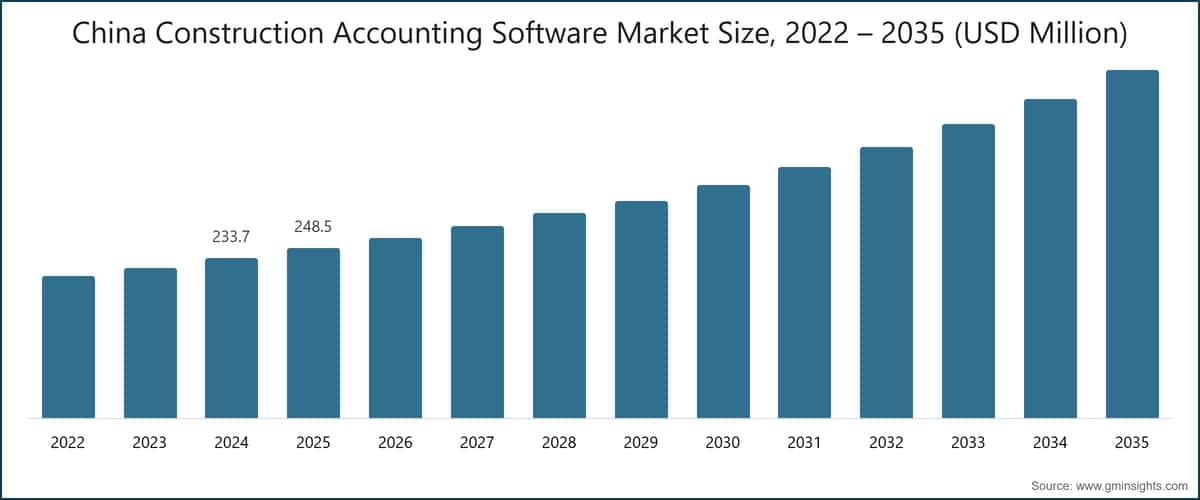
India’s National Infrastructure Pipeline commits INR 111 trillion through 2030, supporting a long-run contractor formalization and infrastructure demand pool. India GST e-invoicing requirements, Australia GST recordkeeping, Australia Single Touch Payroll and security-of-payment requirements, Singapore InvoiceNow and the Personal Data Protection Act, and China’s Accounting Law and Enterprise Accounting Standards create distinct compliance configurations. Japan, South Korea, Singapore, Thailand, Indonesia, Vietnam, and Australia are within regional coverage; no individual market values were provided for these countries. Xpedeon has a South Asian and Gulf focus, while cloud platforms target connected multinational and domestic contractors.
North America
North America is the largest region, accounting for approximately 38% of global revenue in 2025. The US generated USD 0.9 billion, or approximately 35% of global revenue, in 2025. Federal infrastructure funding and Davis–Bacon compliance make payroll, prevailing-wage, audit reporting, and subcontractor-payment controls core requirements. The Department of Transportation had obligated more than USD 260 billion of IIJA funding by April 2025, while GAO identified approximately USD 178 billion of available formula and discretionary grant funding that remained unlocked. California High-Speed Rail, New York MTA, and Texas DOT programs add state-level demand.
Canada adds GST/HST reporting and recordkeeping requirements alongside Personal Information Protection and Electronic Documents Act obligations. Cloud adoption benefits multi-province contractors, although data governance and integration with established ERP systems remain constraints. Sage, Procore, Trimble/Viewpoint, CMiC, Oracle, Foundation Software, Jonas, Deltek ComputerEase, Computer Guidance, Premier, and Penta have relevant North American positions.
Europe
Germany was the largest European national market at USD 0.2 billion in 2025. VOB public-procurement rules, EU Public Procurement Directive BIM requirements, and federal BIM Level 2 requirements for federally funded projects since 2021 create a structured digitalization environment. Regulation (EU) 2024/3110 requires Digital Product Passports for construction products, adding traceability demands. RIB Software, Access Coins Evo, Xpedeon, Procore, Autodesk, and Sage Intacct compete for contractors seeking connected finance and project-management workflows.
Across Europe, the General Data Protection Regulation, Electronic Invoicing Directive 2014/55/EU, EN 16931, VAT Directive 2006/112/EC, Corporate Sustainability Reporting Directive, UK Making Tax Digital requirements, and UK Construction Industry Scheme shape data, tax, invoicing, and payroll-compliance needs. Country-specific demand is concentrated in Germany, the UK, France, Italy, Spain, Russia, Norway, the Netherlands, and Sweden, although the package does not provide individual software-revenue estimates beyond Germany. This is a regional data limitation, not a basis for invented country values.
Latin America
Brazil is the dominant Latin American construction accounting software market. Its tax and labor-compliance environment includes ISS, COFINS, PIS, INSS, SPED electronic bookkeeping, NF-e electronic invoices, and eSocial. Brazil’s General Personal Data Protection Law adds data-governance requirements. TOTVS provides a construction-industry module, and eSocial’s extension to small employers supports formalization-driven user adoption. Mexico CFDI electronic invoicing and Chile’s Electronic Tax Document System create adjacent compliance demand. Brazil, Mexico, and Argentina remain covered geographies; evidence does not supply individual market values.
MEA
The UAE is the most commercially advanced MEA market in the supplied evidence. It introduced 5% VAT in January 2018 and maintains e-invoicing frameworks connected to Federal Tax Authority digital submission infrastructure. Oracle Construction & Engineering and SAP S/4HANA are deployed by international Tier 1 contractors on UAE work. The Abu Dhabi National Development Plan through 2035 and utility-scale energy-transition projects support demand.
Saudi Arabia’s Vision 2030 giga-project pipeline, including NEOM, Red Sea Development, and Diriyah Gate, exceeds USD 1 trillion. Saudi FATOORA, VAT implementing regulations, UAE corporate-tax recordkeeping, and South Africa’s Protection of Personal Information Act define regional compliance conditions. South Africa, Saudi Arabia, UAE, and Turkey are in scope, but individual market sizes were not supplied. The operational constraint across MEA is uneven connectivity and buyer readiness outside major commercial centers.
GMI Analyst View
Regional demand follows regulatory intensity and construction-program structure rather than construction volume alone. North America monetizes certified payroll and public-work documentation; Europe prioritizes interoperable digital records and product traceability; Asia Pacific combines infrastructure expansion with heterogeneous national compliance systems. Latin America and MEA offer greenfield potential where e-invoicing and tax formalization force process digitization. Through 2035, the fastest regional growth will favor platforms that localize compliance workflows without fragmenting their core project and finance data model.
Construction Accounting Software Market Share & Competitive Landscape
The market is moderately fragmented. Procore Technologies led with 11% revenue share in 2025, followed by Sage Group at 8.4%, Trimble/Viewpoint at 7.4%, Oracle at 4.4%, and Acumatica at 4.2%. These five players collectively held 35.4% share. CMiC held 2.7%, Foundation Software held 0.5%, and the remaining 64.6% was distributed across regional and specialist providers.
Procore’s position reflects its cloud-native project-management installed base, financial modules, Procore Pay, job-costing capabilities, and API-first marketplace with more than 500 connected applications. Sage combines the established Sage 300 CRE base with Sage Intacct Construction for cloud-transitioning mid-market users. Trimble/Viewpoint combines Vista and Spectrum heritage with Trimble Construction One, Trimble Materials, and Trimble Financials. Oracle Construction & Engineering pairs Primavera Cloud and Fusion Cloud ERP with Oracle Textura capabilities for complex global programs. Acumatica differentiates through consumption-based pricing that accommodates changing project-cycle user counts.
CMiC focuses on large North American contractors requiring multi-company accounting, union payroll, and high-volume subcontractor management. RIB Software, now a Schneider Electric subsidiary, addresses international EPC and infrastructure firms. Access Coins Evo serves UK and European contractors; IFS serves EPC and asset-intensive construction; Epicor serves industrial and manufacturing-related construction; InEight specializes in capital-project controls; Autodesk Construction Cloud connects design-to-build workflows with finance integration; Buildertrend targets homebuilders and remodelers; Xpedeon serves South Asian and Gulf markets.
Regional and specialist providers include Foundation Software for payroll-focused SME residential and specialty contractors; Jonas Construction Software for commercial, industrial, and institutional firms; Deltek ComputerEase for electrical, mechanical, and specialty trades; Computer Guidance Corporation eCMS for large heavy-civil and commercial contractors in the US Midwest and Southeast; Premier Construction Software for fast cloud deployment; and Penta Software for industrial, civil, and energy construction with complex labor and equipment structures.
GMI Analyst View
The market will remain fragmented through the forecast period because construction workflows vary by project type, geography, labor rules, and buyer scale. Procore, Sage, Trimble/Viewpoint, Oracle, and Acumatica hold advantages in platform breadth or installed-base access, but specialist providers retain defensible niches where payroll, heavy civil, equipment, or local compliance requirements are decisive. Consolidation demand will intensify vendor competition for integrations and implementation partners rather than automatically producing rapid share concentration. By 2030, the vendors most likely to improve their position will be those that reduce data-migration risk while preserving specialized construction workflows.
Recent Industry Developments
May 2026: Autodesk moved the GCPay and Forma Build integration into general availability, enabling synchronized cost management, ERP, subcontractor payment, and compliance information. The release reduces manual transfer between project and finance workflows.
Nov 2025: Trimble launched Trimble Financials, an AI-enhanced job-costing and financial-management platform for small contractors. Its budgeting, cost tracking, invoicing, cash-flow reporting, AP/AR aging, financial statements, and AI-assisted query functions extend advanced finance capabilities into smaller-contractor deployments.
May 2025: Trimble launched Trimble Materials within Trimble Construction One, integrating procurement, inventory, and accounts payable with Viewpoint Vista and Spectrum. The move strengthens Trimble’s position in transaction workflows adjacent to accounting.
Need a specific section of this report?
Purchase regional analysis, country-level analysis, company profiles, or any other segment-level insights separately
based on your research needs.
Frequently Asked Question(FAQ) :
Research methodology, data sources & validation process
This report draws on a structured research process built around direct industry conversations, proprietary modelling, and rigorous cross-validation and not just desk research.
Our 6-step research process
1. Research design & analyst oversight
At GMI, our research methodology is built on a foundation of human expertise, rigorous validation, and complete transparency. Every insight, trend analysis, and forecast in our reports is developed by experienced analysts who understand the nuances of your market.
Our approach integrates extensive primary research through direct engagement with industry participants and experts, complemented by comprehensive secondary research from verified global sources. We apply quantified impact analysis to deliver dependable forecasts, while maintaining complete traceability from original data sources to final insights.
2. Primary research
Primary research forms the backbone of our methodology, contributing nearly 80% to overall insights. It involves direct engagement with industry participants to ensure accuracy and depth in analysis. Our structured interview program covers regional and global markets, with inputs from C-suite executives, directors, and subject matter experts. These interactions provide strategic, operational, and technical perspectives, enabling well-rounded insights and reliable market forecasts.
3. Data mining & market analysis
Data mining is a key part of our research process, contributing nearly 20% to the overall methodology. It involves analysing market structure, identifying industry trends, and assessing macroeconomic factors through revenue share analysis of major players. Relevant data is collected from both paid and unpaid sources to build a reliable database. This information is then integrated to support primary research and market sizing, with validation from key stakeholders such as distributors, manufacturers, and associations.
4. Market sizing
Our market sizing is built on a bottom-up approach, starting with company revenue data gathered directly through primary interviews, alongside production volume figures from manufacturers and installation or deployment statistics. These inputs are then pieced together across regional markets to arrive at a global estimate that stays grounded in actual industry activity.
5. Forecast model & key assumptions
Every forecast includes explicit documentation of:
✓ Key growth drivers and their assumed impact
✓ Restraining factors and mitigation scenarios
✓ Regulatory assumptions and policy change risk
✓ Technology adoption curve parameter
✓ Macroeconomic assumptions (GDP growth, inflation, currency)
✓ Competitive dynamics and market entry/exit expectations
6. Validation & quality assurance
The final stages involve human validation, where domain experts manually review filtered data to identify nuances and contextual errors that automated systems might miss. This expert review adds a critical layer of quality assurance, ensuring data aligns with research objectives and domain-specific standards.
Our triple-layer validation process ensures maximum data reliability:
✓ Statistical Validation
✓ Expert Validation
✓ Market Reality Check
Trust & credibility
Verified data sources
Trade publications
Industry journals, trade publications, and specialized media.
Industry databases
Proprietary and third-party market databases
Regulatory filings
Government procurement records and policy documents
Academic research
University studies and specialist institution reports
Company reports
Annual reports, investor presentations, and filings
Expert interviews
C-suite, procurement leads, and technical specialists
GMI archive
13,000+ published studies across 20+ industry verticals
Trade data
Import/export volumes, HS codes, and customs records
Parameters studied & evaluated
Every data point in this report is validated through primary interviews, true bottom-up modelling, and rigorous cross-checks. Read about our research process →