Summary
Table of Content

Cochlear Implants Market
Get a free sample of this report
Form submitted successfully!
Error submitting form. Please try again.
Thank you!
Your inquiry has been received. Our team will reach out to you with the required details via email. To ensure that you don't miss their response, kindly remember to check your spam folder as well!
Request Sectional Data
Thank you!
Your inquiry has been received. Our team will reach out to you with the required details via email. To ensure that you don't miss their response, kindly remember to check your spam folder as well!
Form submitted successfully!
Error submitting form. Please try again.
Cochlear Implants Market Size
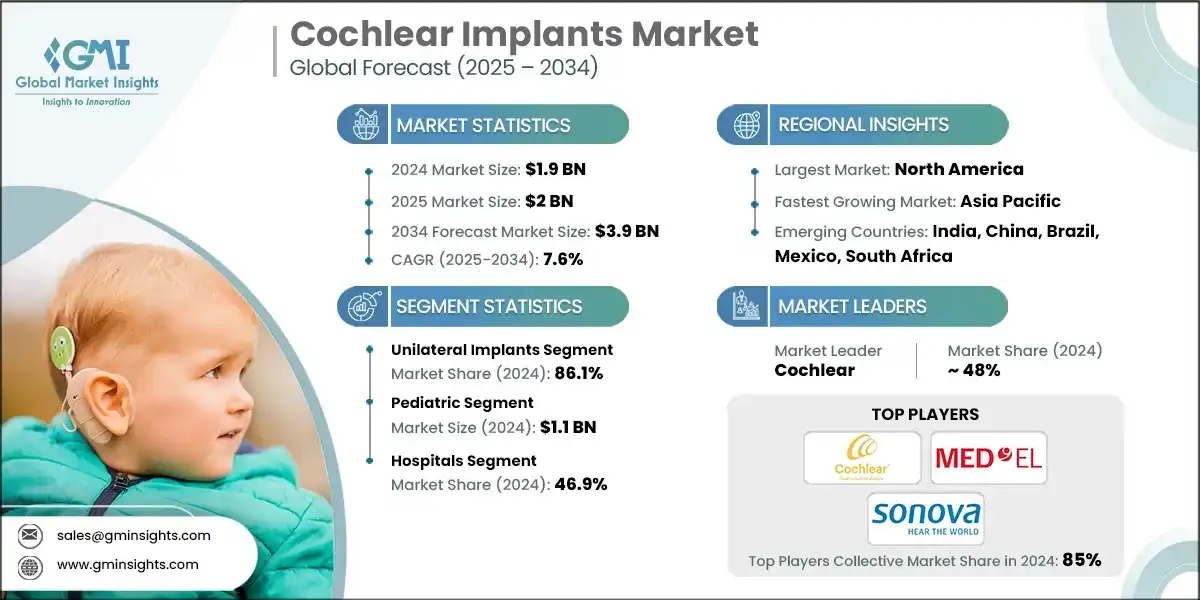
The global cochlear implants market was valued at USD 1.9 billion in 2024. The market is expected to reach from USD 2 billion in 2025 to USD 3.9 billion in 2034, growing at a CAGR of 7.6% during the forecast period, according to the latest report published by Global Market Insights Inc. The high market growth is attributed to the rising prevalence of hearing loss, technological advancements in implant design, expanding pediatric and geriatric adoption, and growing awareness and hearing screening programs, among other contributing factors.
Cochlear Implants Market Key Takeaways
Market Size & Growth
- 2024 Market Size: USD 1.9 Billion
- 2025 Market Size: USD 2 Billion
- 2034 Forecast Market Size: USD 3.9 Billion
- CAGR (2025–2034): 7.6%
Key Market Drivers
- Increase in prevalence of hearing loss.
- Technological advancements.
- Rising awareness and early diagnosis.
- Facilitative government support and improving reimbursement scenario.
Challenges
- High cost of cochlear implants.
- Lack of knowledge regarding hearing loss.
Opportunity
- AI-driven sound processing & machine learning.
Key Players
- Market Leader: Cochlear led with over 48% market share in 2024.
- Leading Players: Top 3 players in this market include MED-EL, Sonova, Cochlear, which collectively held a market share of 85% in 2024.
Get Market Insights & Growth Opportunities
Cochlear implants refer to electronic medical devices that eliminate the interference caused by the damaged hair cells of the inner ear and thus, directly stimulate the auditory nerve allowing the user to perceive sound. They are made up of external and internal parts which collect, process, and send the sound signals. Compared to hearing aids that make sounds louder, cochlear implants are designed to partially recover the hearing of a person by transforming the sound into electric pulses.
Major contributors to the cochlear implants market are Cochlear, MED-EL, and Sonova. These companies keep their competitive advantage by continuous product innovation, presence in the global market, and large investments in research and development.
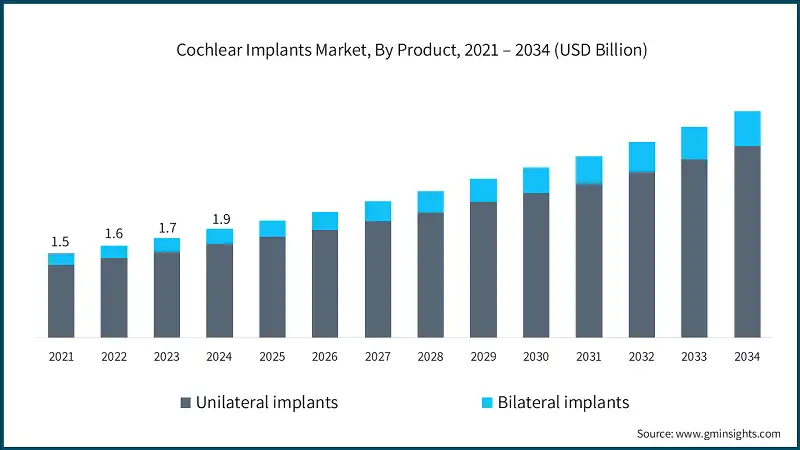
The market has increased from USD 1.5 billion in 2021 and reached USD 1.7 billion in 2023, with the historic growth rate of 8.3%. The market growth was driven by rising prevalence of sensorineural hearing loss, increasing adoption of advanced implant technologies, supportive government initiatives for hearing rehabilitation, and expanding access to cochlear implant programs in emerging economies.
Moreover, the increasing prevalence of sensorineural hearing loss globally, particularly among elderly individuals and newborns, drives the demand for cochlear implants. For instance, according to the World Health Organization (WHO) 2023 data, over 430 million people require medical rehabilitation services for hearing loss, with this number projected to reach 700 million by 2024. The U.S. National Institute on Deafness reports that approximately 2-3 out of every 1,000 children were born with detectable hearing loss in 2022. The rise in exposure to high-decibel noise and ototoxic medications contributes to hearing impairment cases.
The Centers for Disease Control and Prevention (CDC) data from 2021 indicates that about 12.5% of children aged 6-19 years have suffered permanent damage to their hearing from excessive noise exposure. Healthcare systems emphasize early detection and treatment of hearing loss, which supports market expansion, as evidenced by the implementation of universal newborn hearing screening programs in 130 countries by 2023.
Furthermore, increased awareness campaigns about hearing impairment and improved screening programs in schools and hospitals are identifying candidates earlier. Partnerships between audiology associations, healthcare providers, and implant manufacturers have strengthened education and outreach. This proactive approach has led to higher acceptance and procedural rates.
To get key market trends
Cochlear Implants Market Trends
The market is growing considerably with the miniaturization and advanced sound processing, expansion of pediatric implantation, growing adoption of AI and machine learning, and market expansion in emerging economies, among other factors collectively driving industry growth.
- Cochlear implants are becoming smaller, more discreet, and aesthetically appealing, with advanced sound processors that improve speech recognition in noisy environments. Sound processing driven by AI and adaptive algorithms are giving users a better real-time auditory experience. This trend leads to a higher level of patient comfort and, thus, a wider appeal of the devices to both pediatric and adult users.
- In modern implants, technological features such as Bluetooth and wireless connectivity are gradually becoming the part of the implant and users will be able to stream calls, music, and other audio directly from smartphones and devices. In addition, companion apps can allow setting personalization as well as remote monitoring. In other words, this integration makes it more user-friendly and is compatible with the growing need for connected healthcare solutions.
- Moreover, early implantation in children is becoming a significant trend, supported by newborn hearing screening programs and parental awareness. Earlier intervention is linked to better language and cognitive development outcomes. This has led to a surge in pediatric cochlear implant procedures worldwide.
Cochlear Implants Market Analysis
Learn more about the key segments shaping this market
Based on the product, the cochlear implants market is segmented into unilateral implants and bilateral implants. The unilateral implants segment has asserted its dominance in the market by securing a significant market share of 86.1% in 2024 owing to lower cost, simpler surgical procedure, faster recovery, and widespread clinical preference over bilateral implantation. The segment is expected to exceed USD 3.3 billion by 2034, growing at a CAGR of 7.4% during the forecast period.
On the other hand, the bilateral implants segment is expected to grow with a CAGR of 8.8%. The growth of this segment is driven by increasing awareness of the benefits of binaural hearing, rising adoption in pediatric and adult patients, and advancements in implant technology that enhance sound localization and speech recognition.
- The unilateral implants segment continues to dominate the market. Unilateral implants cost significantly less than a bilateral procedure, and that is the main reason why these implants are more accessible for patients and healthcare providers. The lower cost of devices and surgery lowers the financial barriers, which is especially true for developing markets. This cost advantage makes the adoption of the technology encouraging among the patients that want to improve their hearing but do not want to bear the high expense of dual implantation.
- Additionally, many healthcare insurance programs and government schemes provide coverage specifically for unilateral implants, particularly in adults and pediatric patients. Favorable reimbursement policies lower out-of-pocket expenses, making it a practical choice for a larger demographic. This financial support accelerates market growth.
- The bilateral implants segment held a revenue of USD 263.8 million in 2024, with projections indicating a steady expansion at 8.8% CAGR from 2025 to 2034. The growth of the segment is driven by the clinical advantages of improved sound localization, better speech perception in noisy environments, and enhanced overall hearing outcomes compared to unilateral implants.
- Patients and caregivers are becoming more aware of these benefits, and as a result, the demand is raised, particularly in pediatric and adult populations. Additionally, the progress and innovations in implants together with the supportive healthcare policies are the main reasons for the easier and faster going of bilateral procedures in the whole world.
Based on patient type, the cochlear implants market is segmented into adult and pediatric. The pediatric segment dominated the market in 2024, accounting for USD 1.1 billion and is anticipated to grow at a CAGR of 7.3% during the forecast period.
- Newborn hearing screening programs and early diagnostic initiatives are detecting children with hearing impairments at an extremely early age. Early detection enables timely cochlear implantation, which is critical for language development and cognitive growth. Such programs have tremendously raised the number of pediatric implants globally.
- The cochlear implantation in children has been proven to improve significantly the speech perception, language acquisition, and social communication skills. The benefits acknowledged by parents and clinicians intensify the trend, leading to greater acceptance rates. Educational and social outcomes that can be improved create demand for this market segment.
- The adult segment accounted for significant revenue in 2024 and is anticipated to grow at a CAGR of 7.9% over the forecast period. The growth of the segment is driven by the rising prevalence of age-related hearing loss and sensorineural impairments among the elderly population.
- Increased awareness of cochlear implants as a viable solution for improving quality of life and social engagement is boosting adoption. Moreover, better insurance coverage and reimbursement policies are making implants more accessible for adult patients.
Learn more about the key segments shaping this market
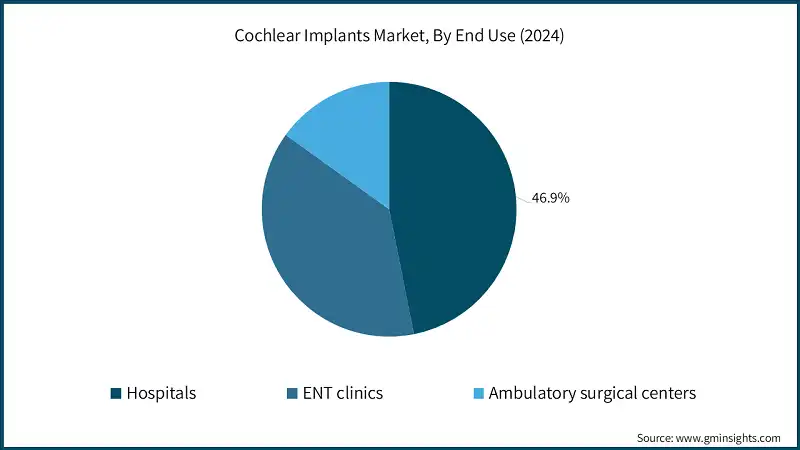
Based on end use, the cochlear implants market is classified into hospitals, ENT clinics, and ambulatory surgical centers. The hospitals segment dominated the market with a revenue share of 46.9% in 2024 and is expected to reach USD 1.7 billion within the forecast period.
- There is a rise in the number of patients diagnosed with sensorineural hearing loss who are visiting hospitals. These cases are mainly due to ageing populations, exposure to loud noise, and some rare congenital disorders. The increasing patient base is leading to a higher demand for cochlear implant surgeries. Hospitals can profit from integrating hearing restoration services with ENT and audiology departments in their offerings.
- Additionally, hospitals provide coordinated care involving ENT surgeons, audiologists, speech therapists, and rehabilitation specialists. This multidisciplinary approach ensures optimal surgical outcomes and patient support. Comprehensive care makes hospitals a preferred choice for cochlear implant procedures, increasing market penetration.
- The ENT clinics segment held a revenue of USD 720.9 million in 2024, with projections indicating a steady expansion at 8.3% CAGR from 2025 to 2034. ENT clinics drive the cochlear implants market by providing specialized diagnostic services, personalized patient counselling, and streamlined referral pathways, which facilitate early intervention and increased adoption.
- The ambulatory surgical centers segment held a revenue of USD 285.9 million in 2024, with projections indicating a steady expansion at 7.5% CAGR from 2025 to 2034. Ambulatory surgical centers boost the cochlear implants market by offering cost-effective, convenient, and minimally invasive surgical options, attracting patients seeking shorter recovery times and streamlined procedures.
Looking for region specific data?
North America Cochlear Implants Market
North America dominated the market with the highest market share of 41.2% in 2024.
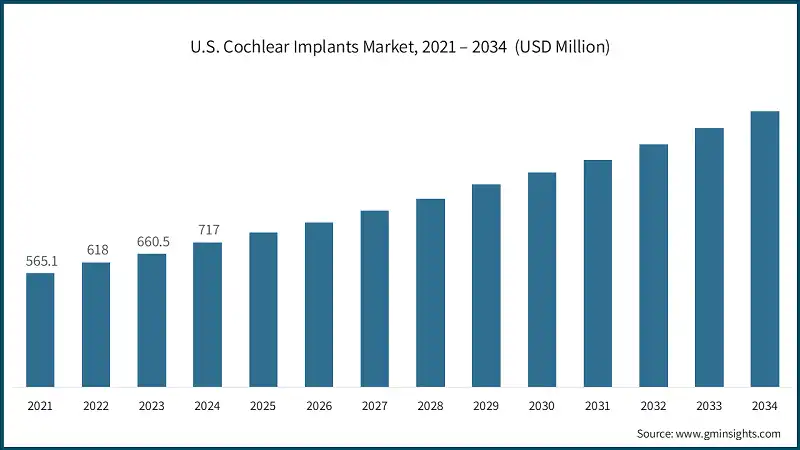
- The U.S. cochlear implants market was valued at USD 565.1 million and USD 618 million in 2021 and 2022, respectively. The market size reached USD 717 million in 2024, growing from USD 660.5 million in 2023, and is anticipated to grow at a CAGR of 6.6% between 2025 to 2034.
- The population of North America is significantly affected by sensorineural hearing loss, among which are several cases of hearing loss due to old age, and congenital diseases. As a result, early diagnosis and intervention programs have been extensively implemented, thereby considerably increasing the demand for cochlear implants. This, in turn, leads to the steady growth of the market in the region due to the large number of patients.
- In addition, the region has well-equipped hospitals, ENT clinics, and audiological centers with highly qualified staff. An excellent surgical facility, a good rehabilitation plan, and trained professionals increase the safety of cochlear implant operations and their effectiveness. This advanced technology facilitates the deep penetration of cochlear implants in the market.
- North American companies are at the forefront of developing next-generation implants, including AI-enabled sound processors, MRI-compatible devices, and wireless connectivity features. Continuous technological innovation enhances patient outcomes and attracts new users, boosting market growth.
Europe Cochlear Implants Market
Europe market accounted for USD 622.2 million in 2024 and is anticipated to show lucrative growth over the forecast period.
- Many European countries, including Germany, France, and the U.K., provide universal healthcare coverage for cochlear implants. Public funding reduces patient out-of-pocket costs and encourages early adoption. Government-backed programs also support post-operative rehabilitation, boosting market demand.
- Europe has well-established newborn and school-age hearing screening programs. Early identification of hearing loss in children ensures timely cochlear implantation, leading to improved language and cognitive development. This structured approach drives growth in the pediatric segment.
Asia Pacific Cochlear Implants Market
The Asia Pacific market is anticipated to grow at the highest CAGR of 9.7% during the analysis timeframe.
- Awareness about hearing impairment and cochlear implants is increasing across urban and semi-urban populations in Asia-Pacific. NGOs, healthcare campaigns, and media initiatives are educating patients and families about treatment options. This rising awareness is expanding the addressable patient base in the region.
- Further, countries like India, China, and Southeast Asian nations are investing in ENT clinics, audiology centers, and surgical facilities. The expansion of infrastructure enables more patients to access cochlear implant procedures. Improved facilities are making surgeries safer and more efficient, driving market growth.
Latin America Cochlear Implants Market
The Latin America market is experiencing robust growth over the analysis timeframe.
- The Latin America market is driven by increasing government initiatives to improve hearing healthcare and expand access to advanced auditory technologies. Rising awareness about hearing loss and early intervention programs is encouraging more patients to seek implants.
- Growing investments in healthcare infrastructure and specialized ENT centers are enhancing the availability of implant services. Expanding private insurance coverage and reimbursement policies are making implants more affordable for middle-income populations. Additionally, collaborations between global implant manufacturers and local distributors are facilitating technology penetration across the region.
Middle East & Africa Cochlear Implants Market
The Middle East & Africa (MEA) market is experiencing robust growth over the analysis timeframe.
- The regional growth is driven by increasing prevalence of hearing loss due to genetic factors and noise exposure. Governments are implementing supportive policies and awareness campaigns to promote early diagnosis and treatment. Investments in modern healthcare infrastructure and specialized ENT centers are improving accessibility to implant procedures.
- Rising medical tourism in the region is attracting patients seeking advanced auditory solutions at competitive costs. Furthermore, collaborations between international cochlear implant manufacturers and local distributors are enhancing product availability and adoption across key markets.
Cochlear Implants Market Share
The market is highly consolidated, dominated by a few key players that lead in technological innovation, brand recognition, and global reach. Market leaders continuously invest in research and development to introduce advanced implants with features like AI-driven sound processing, MRI compatibility, and improved battery life, enhancing patient outcomes and driving adoption. Strategic collaborations with hospitals, ENT clinics, and distributors further strengthen their market presence, while emerging players focus on niche innovations and regional expansion to capture incremental market share.
Key players include Cochlear, MED-EL, and Sonova, collectively accounting for 85% of the total market share. Smaller competitors, such as Nurotron and Envoy Medical, target specific regions or innovative solutions to differentiate themselves, creating a moderately fragmented competitive landscape. Market growth is fueled by technological advancements, rising awareness, and expanding healthcare infrastructure, making continuous innovation and strategic partnerships critical for sustaining a competitive edge.
Cochlear Implants Market Companies
A few of the prominent players operating in the cochlear implants industry include:
- Cochlear
- Envoy Medical
- MED-EL
- Nurotron
- Sonova
- Cochlear
Cochlear, leading the cochlear implants market with a ~48% share in 2024, and it offers a wide range of implant solutions with advanced sound processing and AI-driven features, backed by extensive global clinical support and strong brand recognition, ensuring reliable patient outcomes.
Known for pioneering innovative technologies such as electric-acoustic stimulation and flexible electrode arrays, providing tailored solutions for diverse hearing loss profiles across pediatric and adult patients.
Focuses on high-performance implants with superior speech recognition in noisy environments, combined with integrated wireless connectivity and a robust audiology support network.
Cochlear Implants Market Report Attributes
| Key Takeaway | Details |
|---|---|
| Market Size & Growth | |
| Base Year | 2024 |
| Market Size in 2024 | USD 1.9 Billion |
| Market Size in 2025 | USD 2 Billion |
| Forecast Period 2025 - 2034 CAGR | 7.6% |
| Market Size in 2034 | USD 3.9 Billion |
| Key Market Trends | |
| Drivers | Impact |
| Increase in prevalence of hearing loss | The growing number of individuals with moderate to severe hearing impairment continues to elevate the demand for cochlear implants, especially among aging populations. |
| Technological advancements | Innovations such as wireless connectivity, sound processing improvements, and MRI-compatible implants are enhancing user experience and adoption rates. |
| Rising awareness and early diagnosis | Public health campaigns and improved screening programs are leading to earlier identification of hearing loss, boosting implant procedures globally. |
| Facilitative government support and improving reimbursement scenario | Supportive healthcare policies and expanded insurance coverage are making cochlear implants more accessible to a broader patient base. |
| Pitfalls & Challenges | Impact |
| High cost of cochlear implants | The substantial expense of devices and surgical procedures limits affordability, particularly in low- and middle-income regions. |
| Lack of knowledge regarding hearing loss | Limited awareness about treatment options and misconceptions about cochlear implants continue to hinder timely medical intervention. |
| Opportunities: | Impact |
| AI-driven sound processing & machine learning | Integration of AI and machine learning will enhance personalized hearing experiences, improving speech recognition in noisy environments and driving higher adoption rates globally. |
| Market Leaders (2024) | |
| Market Leaders |
Market Share~ 48% |
| Top Players |
Collective market share in 2024 is 85% |
| Competitive Edge |
|
| Regional Insights | |
| Largest Market | North America |
| Fastest Growing Market | Asia Pacific |
| Emerging Country | India, China, Brazil, Mexico, South Africa |
| Future Outlook |
|
What are the growth opportunities in this market?
Cochlear Implants Industry News:
- In July 2025, Cochlear Limited announced that the U.S. Food and Drug Administration (FDA) had approved the Cochlear Nucleus Nexa System, a smart cochlear implant system. The device featured upgradeable firmware, providing users with continuous access to new innovations and enhanced hearing performance. This approval is expected to strengthen Cochlear’s market position by highlighting its commitment to technological advancement and improving patient outcomes, thereby driving adoption in the market.
- In November 2024, MED-EL Corporation announced that the U.S. Food and Drug Administration (FDA) had approved new indications for its cochlear implants, including the recognition of hearing preservation outcomes. The expanded indication allowed adults with bilateral moderate-to-profound sensorineural hearing loss and lower aided word recognition scores to qualify for MED-EL implants. This approval broadened patient eligibility, strengthened MED-EL’s competitive edge, and is expected to drive increased adoption in the cochlear implants market.
- In November 2024, Cochlear Limited announced the launch of the Nucleus 8 Sound Processor. The Nucleus 8 features advanced connectivity options, including direct streaming from compatible Apple and Android devices, and improved hearing performance in noisy environments. This innovation aims to enhance the quality of life for individuals with hearing loss by providing clearer sound and greater convenience.
The cochlear implants market research report includes an in-depth coverage of the industry with estimates and forecast in terms of revenue in USD Million from 2021 - 2034 for the following segments:
Market, By Product
- Unilateral implants
- Bilateral implants
Market, By Patient Type
- Adult
- Pediatric
Market, By End Use
- Hospitals
- ENT clinics
- Ambulatory surgical centers
The above information is provided for the following regions and countries:
- North America
- U.S.
- Canada
- Europe
- Germany
- UK
- France
- Spain
- Italy
- Netherlands
- Asia Pacific
- China
- Japan
- India
- Australia
- South Korea
- Latin America
- Brazil
- Mexico
- Argentina
- Middle East and Africa
- South Africa
- Saudi Arabia
- UAE
Frequently Asked Question(FAQ) :
What was the market size of the cochlear implants market in 2024?
The market size was valued at USD 1.9 billion in 2024, with a CAGR of 7.6% expected through 2034, driven by the rising prevalence of hearing loss, technological advancements, and increasing adoption among pediatric and geriatric populations.
What is the projected value of the cochlear implants market by 2034?
The market is expected to reach USD 3.9 billion by 2034, supported by factors such as AI-driven sound processing, wireless connectivity, and expanding adoption in emerging economies.
What is the projected size of the cochlear implants market in 2025?
The cochlear implants market is expected to reach USD 2 billion in 2025.
What was the market share of the unilateral implants segment in 2024?
The unilateral implants segment held a dominant market share of 86.1% in 2024, generating significant revenue due to lower costs, simpler surgical procedures, and faster recovery times.
What was the valuation of the pediatric segment in 2024?
The pediatric segment accounted for USD 1.1 billion in 2024 and is anticipated to grow at a CAGR of 7.3% during the forecast period.
Which end-use segment led the cochlear implants market in 2024?
The hospitals segment led the market with a revenue share of 46.9% in 2024 and is projected to reach USD 1.7 billion by 2034.
Which region dominated the cochlear implants market in 2024?
North America dominated the market with the highest share of 41.2% in 2024, driven by advanced healthcare infrastructure and increasing awareness of hearing loss solutions.
What are the upcoming trends in the cochlear implants market?
Key trends include miniaturization of implants, AI-driven sound processing, wireless connectivity, integration with companion apps, and market expansion in emerging economies.
Who are the key players in the cochlear implants market?
Key players include Cochlear, Envoy Medical, MED-EL, Nurotron, and Sonova.
Cochlear Implants Market Scope
Related Reports