Summary
Table of Content

Child Safety Seat Market
Get a free sample of this report
Form submitted successfully!
Error submitting form. Please try again.
Thank you!
Your inquiry has been received. Our team will reach out to you with the required details via email. To ensure that you don't miss their response, kindly remember to check your spam folder as well!
Request Sectional Data
Thank you!
Your inquiry has been received. Our team will reach out to you with the required details via email. To ensure that you don't miss their response, kindly remember to check your spam folder as well!
Form submitted successfully!
Error submitting form. Please try again.
Child Safety Seat Market Size
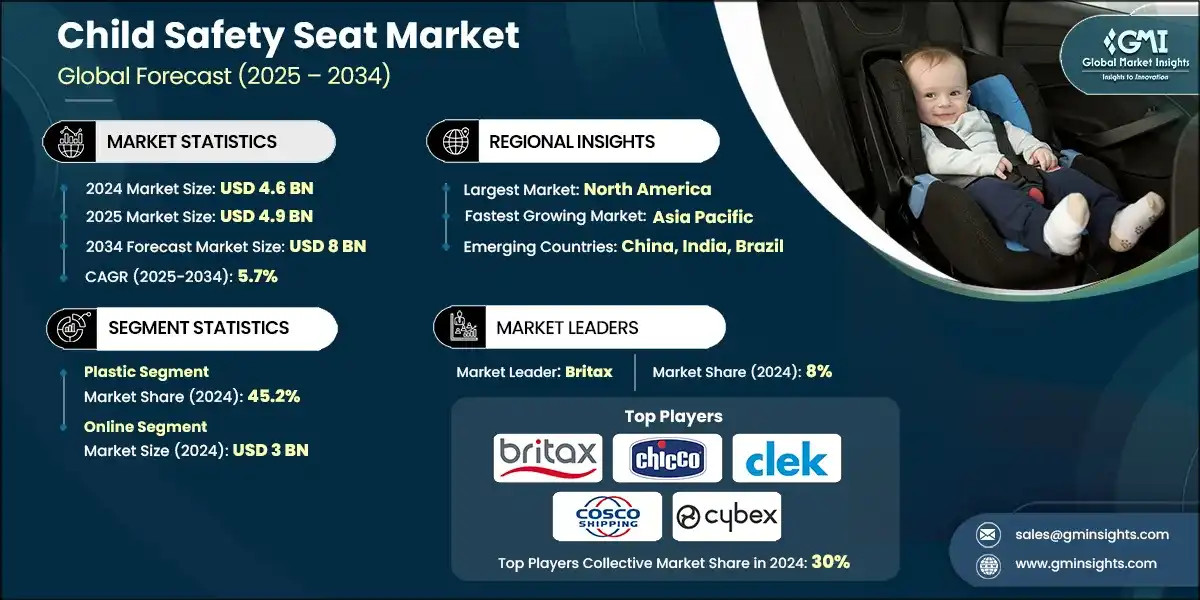
The global child safety seat market size was estimated at USD 4.6 billion in 2024. The market is expected to grow from USD 4.9 billion in 2025 to USD 8 billion in 2034, at a CAGR of 5.7% according to latest report published by Global Market Insights Inc.
Child Safety Seat Market Key Takeaways
Market Size & Growth
- 2024 Market Size: USD 4.6 Billion
- 2025 Market Size: USD 4.9 Billion
- 2034 Forecast Market Size: USD 8 Billion
- CAGR (2025–2034): 5.7%
Regional Dominance
- Largest Market: North America
- Fastest Growing Region: Asia Pacific
Key Market Drivers
- Enforcement of Stringent Child Safety Regulation.
- Increased Parental Awareness and Focus on Child Safety.
- Technological Integration of Smart Seats.
Challenges
- High Initial Cost and Certified Seat Systems.
- Consumer Confusion and Installation Gaps.
Opportunity
- Growth in Emerging Economies..
- Development of Lightweight and E-commerce Optimized Seats.
Key Players
- Market Leader: Britax led with over 8% market share in 2024.
- Leading Players: Top 5 players in this market include Britax, Chicco, Clek, Cosco, Cybex, which collectively held a market share of 30% in 2024.
Get Market Insights & Growth Opportunities
Supportive government rules and legal requirements significantly influence the growth of the child safety seats market. As people become more aware of child passenger safety, many countries have established strict laws that mandate the use of child safety seats in vehicles for certain age groups and weight categories. These laws aim to decrease child deaths and injuries in road accidents by ensuring children are securely placed in suitable seats during travel. With rigorous enforcement and penalties for non-compliance, these laws have led to increased adoption rates of child safety seats, especially in developed areas.
Additionally, as more countries create or update their child safety regulations, the demand for compliant products keeps rising. This makes government rules a major factor in market growth. The market for child safety seats maintains an upward direction as operations search for compact. The sector is being driven by factors such as stringent government regulations and a surge in parental awareness regarding the importance of proper child restraints to reduce accident-related fatalities.
For instance, In June 2022, the National Highway Traffic Safety Administration (NHTSA) issued a final rule that changed the Federal Motor Vehicle Safety Standard (FMVSS) No. 213 to require side impact protection for child restraint systems. This new FMVSS No. 213a mandates that child safety seats designed for children weighing up to 40 pounds meet specific side impact performance standards. The rule aims to improve the safety of children during side impacts by ensuring seats provide proper restraint and prevent dangerous contact with intruding structures. For companies, this rule is an opportunity to innovate and improve their products to meet the new safety standards, thus gaining consumer trust and addressing increasing regulatory demands. It relates to government rules and legal requirements in the child safety seats market, driving the need for better, compliant products and creating opportunities for market growth.
In 2024, Chicco USA released a new spinning convertible car seat for the American market. The device was made to enable 360-degree rotation, making in-car installation and daily use easier, according to the company's statement. The seat uses energy-absorbing materials for impact protection and conforms with both forward-facing and rear-facing setups for a variety of age groups. "Chicco's design addresses caregiver convenience while maintaining adherence to federal safety benchmarks," the release states. The need for certified, modular, and long-life child safety seats is anticipated to rise consistently through 2035 as nations impose stronger crash-test regulations and public awareness campaigns continue to instruct caregivers on how to utilize restraints.
The market for convertible seats increased in 2025 as North American and European regulations promoted prolonged rear-facing usage up to two years of age. Due to its flexibility to accommodate children of all weights and heights, these seats have become a popular option for families with developing children. Manufacturers improved safety features such multi-position reclining mechanisms, energy-absorbing foam, and side-impact protection.
To comply with changing safety regulations like FMVSS 213 and ECE R44/129, product development concentrated on latch system enhancements, simpler installation indicators, and vehicle compatibility. Entities such as growing middle-class families, the automotive industry, and e-commerce platforms are contributing to the market's expansion. The seats capabilities to provide superior protection in the event of a collision have made them standard equipment for child transportation.
The market for child safety seats in the U.S. is expanding due to government initiatives, growing car ownership, and parents' growing concern for their children's safety. The National Highway Traffic Safety Administration (NHTSA) has strict guidelines on the usage of car seats for children, namely those that are suitable for the child's age and weight. All demonstrated in the market signs of growing further as technology develops and the respective demand continues.
To get key market trends
Child Safety Seat Market Trends
The market constantly evolves, driven mainly by new technologies and changing user needs. Suppliers and customers prefer smaller, advanced seats that are more energy-efficient, operate quietly, and move easily in tight spaces. As smart features like pre-programmed safety systems become common, new controls allow operators to perform tasks safely and efficiently. This shift in demand shows a growing acceptance of cleaner, more adaptable equipment, catering to the pace and size of today's users.
- Automation and robotics: the child safety seat industry is increasingly incorporating automation, especially in manufacturing and quality assurance. Automated systems, such as robotic arms and AI-driven assembly lines, ensure precision in production, minimize human error, and improve safety standards. These technologies streamline repetitive tasks, such as stitching, molding, and sensor installation, boosting productivity and reducing labor costs while staying compliant with safety regulations.
- Telematics and data analytics: using telematics and data analytics enhances the capabilities of child safety seat fleets. It allows for easy access to real-time data on performance and maintenance from anywhere. This enables predictive maintenance and helps brands provide proactive customer support. Fleet operators and retailers can use analytics to optimize inventory, forecast demand, and cut down on inefficiencies.
- Customization and specialized attachments: customization options for child safety seats are increasing, and modular technology is being adopted for new applications. Quick-change technology enhances adaptability and versatility while reducing idling time by optimizing activities through shared attachments
Child Safety Seat Market Analysis
Learn more about the key segments shaping this market
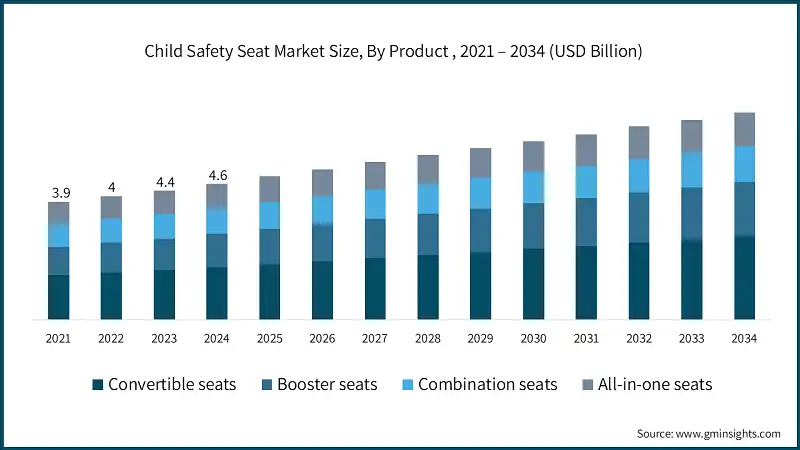
Based on product, the market is divided into convertible seats, booster seats, combination seats and all-in-one seats. convertible seats hold the largest market. these seats can transition from rear-facing to forward-facing, making them suitable for multiple age groups. their popularity is driven by parents seeking long-term value and safety compliance. The segment is expected to grow steadily as manufacturers introduce advanced features like side-impact protection and easy installation systems.
- Booster seats represent a growing segment, supported by regulations mandating their use for older children. Their lightweight design and affordability make them attractive for families. Innovations such as adjustable headrests and integrated seatbelt guides are enhancing safety and comfort.
- Combination seats combine the benefits of forward-facing harness seats and boosters, appealing to parents who want extended usability. Growth in this segment is linked to increasing awareness of child safety standards and the convenience of multi-stage seats.
- All-in-one seats are gaining traction as they offer a complete solution from infancy to toddlerhood and beyond. Though priced higher, their long-term utility and premium features such as recline adjustments and smart sensors are driving adoption among urban consumers.
Learn more about the key segments shaping this market
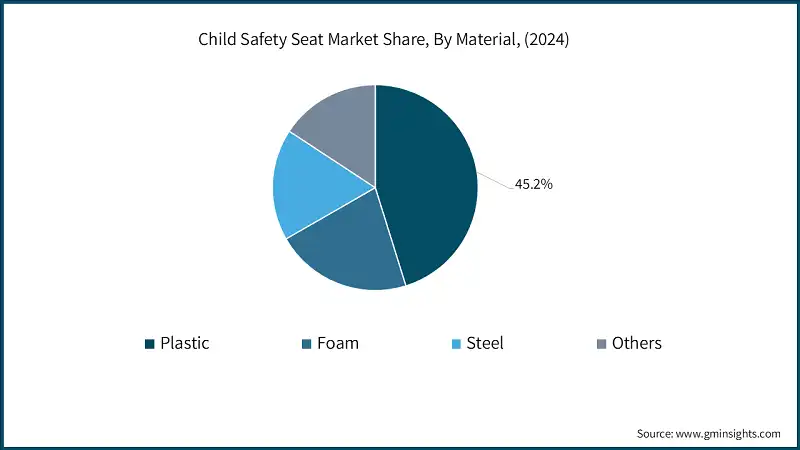
Based on material, the child safety seat market is divided into plastic, foam, steel, and others. The plastic segment held the largest share, accounting for 45.2% of the global market in 2024.
- Plastic components dominate due to their lightweight, durability, and cost-effectiveness. Advanced polymers are being used to enhance impact resistance and reduce weight without compromising safety.
- Foam materials are critical for comfort and shock absorption. Growth in this segment is driven by ergonomic designs and premium models offering memory foam padding.
- Steel Reinforcements remain essential for structural integrity in high-end models, especially those designed for extended use and higher weight limits.
- Other Materials (like polypropylene blends) are being adopted for eco-friendly and recyclable seat designs, aligning with sustainability trends.
Based on the distribution channel, the child safety seat market is segmented as online and offline. In 2024, online held a major market share, generating a revenue of USD 3 billion.
- Child safety seat sales traditionally favor online sales, which represents most of the market. Much of the preference for direct channels is due to the unique applications involved with child safety seats as well as the importance for the manufacturer, or supplier, to be a part of customer support related to product selection, configurations, and ongoing servicing of child safety seats.
- Online sales allow the manufacturer to control the relationship with the customer, thereby customizing solutions for customers while also providing a complete service package. Online sales are growing at a significant rate because of increased customer demand for an integrated package including equipment, finances, service, and telematics platforms.
- Online sales allow manufacturers to use their relationships to gain market intelligence and stay connected to the customer regarding product services and inspections and maximize customer lifetime value based on service contracts and parts related to forklift operations.
- Offline sales are comprised of dealers and distributors (sometimes referred to as the VAR channel), primarily used in market segments where a local presence and immediate availability is required. Indirect channels primarily serve small and medium enterprises that are primarily purchasing standard configurations.
- Dealers play an important role in providing customer services such as trade in programs and rental options. The impact of distribution channels on sales has increased pressure on dealers and other parts of the distribution channels from manufacturers that are now involved in most of the purchasing process.
Looking for region specific data?
North America Child Safety Seat Market
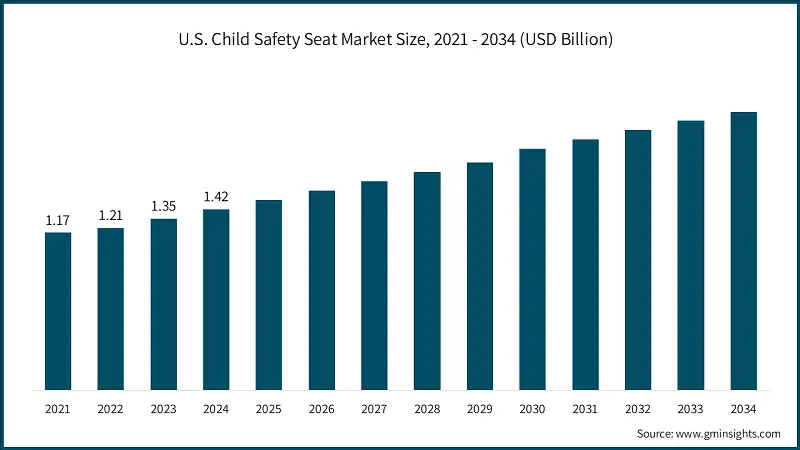
In 2024, the U.S. dominated the North America market, accounting for around 84.5% and generating around USD 1.4 billion revenue in the same year.
- North America represents a large portion of the global market share and has fared well for consistent growth on the premise of its established logistics network and widespread acceptance of technology.
- The region remains at the forefront of consumers of Child safety sales comprising a large portion of total seat belt exports. Additionally, government mandates, especially in states like California will continue to facilitate the transition of smart and integrated child seat belt.
- in June 2022, A final regulation modifying the Federal Motor Vehicle Safety Standard (FMVSS) No. 213 to incorporate side impact protection for child restraint systems was released by the National Highway Traffic Safety Administration (NHTSA). This regulation established a new FMVSS No. 213a, which mandates that child safety seats made for kids up to 40 pounds must adhere to stringent side impact performance standards. By guaranteeing that child seats offer enough restraint and avoid dangerous contact with intruding structures, the regulation sought to enhance children's protection during side impacts.
Europe Child Safety Seat Market
Europe market, Germany leads the market 27.3% share in 2024 and is expected to grow at 5.4% during the forecast period.
- Germany leads regional demand, supported by its strong automotive and manufacturing sectors, which result in significant adoption of advanced technologies. The country's broad industrial strength positions it as a leader in the sustainable and automated transformation of Europe.
- The larger European market benefits from sustainability initiatives and Industry 4.0 initiatives to drive operational efficiency, minimize environmental impact, and promote innovation. These initiatives position Europe as a competitive market for advanced technologies and sustainable industrial practices.
Asia Pacific Child Safety Seat Market
The Asia Pacific leads the market. China holds a market share of around 32% in 2024 and is anticipated to grow with a CAGR of around 5.5% from 2025 to 2034.
- China, representing the largest market in the region, is benefitting from a national plan called "Made in China 2030." The focal points of automation in combination with intelligent manufacturing systems will improve their competitive position and produce significant market growth.
- Rising awareness and costs to produce, surging demand for high-quality products, and the desire for improved operational efficiency are key factors contributing to growth in the Asia Pacific manufacturing market, driving innovation and competitiveness across the region.
- The evolution of the manufacturing sector in Asia Pacific is changing with the uptake of smart manufacturing practices and Industry 4.0 technologies, allowing various manufacturing companies to enhance operations through improved productivity while responding to the needs of a changing market due to the impact of coronavirus or COVID manufacturing.
Latin America Child Safety Seat Market
Latin America represents over 7.7% of global child safety seat revenue, with an estimated market size of USD 400 million by 2025. The region is expected to grow at around 3.2% from 2025 to 2033, driven by regulatory enforcement and growing consumer awareness of child passenger safety.
- Brazil and Argentina lead the Latin American market, thanks to stricter child restraint laws. Brazil requires car seats for children under seven, while Argentina mandates approved restraint systems for children under ten.
- The market is evolving with increased urbanization and rising disposable incomes, creating demand for premium and multifunctional seats. Parents are prioritizing safety and convenience, boosting the adoption of advanced models.
- Technological innovations like ISOFIX compatibility, side-impact protection, and smart seats with IoT sensors are appealing to tech-savvy consumers, aligning with global trends in connected mobility.
Child Safety Seat Market Share
Britax is leading with 8% market share. Chicco, Clek, Cosco, Cybex, and Baby Jogger collectively hold around 30%, indicating moderately fragmented market concentration. These prominent players are proactively involved in strategic endeavors, such as mergers & acquisitions, facility expansions & collaborations, to expand their product portfolios, extend their reach to a broad customer base, and strengthen their market position.
- Britax is a market leader with a broad portfolio, including seat belt for different ages and autonomous technologies. Britax has a strong focus on the Asia Pacific, combined with a strong emphasis on investing in childcare, will ensure continued development as well as a competitive manufacturing advantage.
- Chicco has three brands to serve different customer segments, including feeding, bath & skin, hygiene & safety, strollers & car seats, activity & entertainment, fashion and moms & maternity. Chicco has significant investments in automation and digitalization and in strollers & car seats, combined with AI partnerships in some of its products, results in Chicco becoming a market leader in material handling equipment, supported by a broad and resilient global manufacturing network.
Child Safety Seat Market Companies
Major players operating in the child safety seat industry are:
- Britax
- Chicco
- Clek
- Cosco
- Cybex
- Baby Jogger
- Diono
- Evenflo
- Graco
- Joie
- Kidsembrace
- Maxi-Cosi
- Nuna
- Peg Perego
- Recaro
- Safety 1st
Baby Jogger has launched the City Turn Convertible Car Seat in Canada, providing an innovative solution to make getting a child in and out of the car easier. This new car seat boasts a secure rotating mechanism that facilitates a one-hand 180-degree rotation in rear-facing mode, bringing the child 25.4 cm (10 inches) closer to the parent. A standout feature of the City Turn Convertible Car Seat is its unique technology, which allows parents and caregivers, including those with mobility challenges like new mothers or older grandparents, to smoothly maneuver the child in and out of the vehicle.
Cybex launches cutting-edge German engineering, innovated smart technology, and award-winning design. Their premium positioning is built on features that push the boundaries of safety and convenience, such as the integrated full-body airbag in their Anoris T i-Size seat, and SensorSafe technology that connects to a parent's smartphone to alert them about temperature changes or an unbuckled clip
Child Safety Seat Market Report Attributes
| Key Takeaway | Details |
|---|---|
| Market Size & Growth | |
| Base Year | 2024 |
| Market Size in 2024 | USD 4.6 Billion |
| Market Size in 2025 | USD 4.9 Billion |
| Forecast Period 2025 - 2034 CAGR | 5.7% |
| Market Size in 2034 | USD 8 Billion |
| Key Market Trends | |
| Drivers | Impact |
| Enforcement of Stringent Child Safety Regulation | The mandatory shift to new standards requiring enhanced testing, extended rear-facing use, and ISOFIX compatibility is driving consumers to purchase newer, high-spec seats, boosting market value and replacement rates. |
| Increased Parental Awareness and Focus on Child Safety | A growing global emphasis on reducing child passenger fatalities is leading parents to adopt premium seats, seats with advanced features, and convertible models, prioritizing safety ratings over cost. |
| Technological Integration of Smart Seats | The incorporation of features like SensorSafe, integrated airbags, app connectivity, and real-time monitoring alerts is increasing demand for high-value products that enhance child protection and accident. |
| Pitfalls & Challenges | Impact |
| High Initial Cost and Certified Seat Systems | The price premium associated with new regulatory-compliant, technologically advanced, or convertible seats may be prohibitive for lower-income families, especially in emerging markets, leading to slower adoption rates. |
| Consumer Confusion and Installation Gaps | The complexity of new standards, different seat types and improper installation is a major safety concern, leading to educational and liability challenges for manufacturers and retailers. |
| Opportunities: | Impact |
| Growth in Emerging Economies. | Rapid urbanization and increasing disposable income in nations like China, India, and Brazil are leading to first-time vehicle ownership and a strong demand for mandated, high-quality safety products. |
| Development of Lightweight and E-commerce Optimized Seats | Innovative materials and modular designs are presenting a compelling opportunity for manufacturers to cater to urban consumers needing portable solutions and to meet global sustainability goals. |
| Market Leaders (2024) | |
| Market Leaders |
8% market share |
| Top Players |
Collective market share in 2024 is 30% |
| Competitive Edge |
|
| Regional Insights | |
| Largest market | North America |
| Fastest growing market | Asia Pacific |
| Emerging countries | China, India, Brazil |
| Future outlook |
|
What are the growth opportunities in this market?
Child Safety Seat Industry News
- In June 2025, Chicco recalls over 30,000 MyFit Zip Air Harness and Booster child seats over safety violation. The National Highway Traffic Safety Administration (NHTSA) issued a recall Thursday for 31,000 Chicco MyFit Zip Air Harness + Booster car seats that did not exceed federal safety requirements.
- In August 2023, Chicco partnered with NASCAR to develop and implement a nationwide educational campaign focused on promoting the safety of child passengers. The campaign aims to encourage the proper use and responsibility regarding any car seats commonly used by women and children, which helps protect children.
- In June 2023, Graco unveiled their latest product, the 4Ever DLX Grad 5-in-1 Car Seat, which offers five modes of use and includes a unique removable seat belt trainer. This seat is suitable for children from infancy to 12 years old, providing versatility and longevity for growing families.
- In January 2023, Babyark, a company located in Coral Gables, Florida, recently introduced its newest innovation, the babyark convertible car seat, during the 2023 Consumer Electronics Show (CES). This car seat signifies a major advancement in child passenger safety, presenting a comprehensive approach that combines advanced materials and technology. It features composites such as high-strength steel, carbon fiber, and D3O—a state-of-the-art impact-absorbing polymer frequently utilized in extreme military settings.
The child safety seat market research report includes in-depth coverage of the industry with estimates & forecasts in terms of revenue (USD Billion) and volume (Thousand Units) from 2021 to 2034, for the following segments:
Market, By Product
- Convertible seats
- Booster seats
- Combination seats
- All-in-one seats
Market, By Type
- Rearward facing seats
- Forward facing seats
Market, By Material
- Plastic
- Foam
- Steel
- Others (propylene, etc.)
Market, By Age Group
- Below 6 months
- 6-12 months
- 12-24 months
- Above 24 months
Market, By Price
- Low
- Medium
- High
Market, By End Use
- Transport & travel
- Home
- Playgroup institutes
- Healthcare
- Amusement parks
- HoReCa
- Others (camping, shopping carts, etc.)
Market, By Distribution Channel
- Online
- Offline
The above information is provided for the following regions and countries:
- North America
- U.S.
- Canada
- Europe
- Germany
- UK
- France
- Italy
- Spain
- Asia Pacific
- China
- India
- Japan
- Australia
- South Korea
- Latin America
- Brazil
- Mexico
- Argentina
- Middle East and Africa
- South Africa
- Saudi Arabia
- UAE
Frequently Asked Question(FAQ) :
What is the market size of the child safety seat market in 2024?
The market size was USD 4.6 billion in 2024, driven by stringent safety regulations and growing parental awareness regarding child passenger protection.
What is the projected value of the child safety seat market by 2034?
The market is expected to reach USD 8 billion by 2034, growing at a 5.7% CAGR due to rising regulatory compliance and adoption of advanced, long-life safety seats.
How much revenue did the online distribution channel generate in 2024?
Online sales generated USD 3 billion in 2024, dominating the market due to direct manufacturer-consumer engagement and demand for customized support packages.
What was the market share of the plastic material segment in 2024?
Plastic accounted for 45.2% of the global market in 2024, driven by its lightweight, impact-resistant, and cost-efficient properties.
Which region leads the child safety seat industry?
Asia Pacific leads the global market, with China holding 32% share in 2024 and projected to grow at 5.5% CAGR through 2034.
Who are the key players in the child safety seat market?
Key players include Britax, Chicco, Clek, Cosco, Cybex, Baby Jogger, Diono, Evenflo, Graco, Joie, Nuna, Peg Perego, Maxi-Cosi, Recaro, and Safety 1st, with Britax leading at 8% market share.
What is the projected market size of the child safety seat market in 2025?
The market is projected to reach USD 4.9 billion in 2025, supported by regulatory enforcement, higher car ownership, and rising adoption of convertible and smart seats.
Child Safety Seat Market Scope
Related Reports