Summary
Table of Content

Cargo Scanning Equipment Market
Get a free sample of this report
Form submitted successfully!
Error submitting form. Please try again.
Thank you!
Your inquiry has been received. Our team will reach out to you with the required details via email. To ensure that you don't miss their response, kindly remember to check your spam folder as well!
Request Sectional Data
Thank you!
Your inquiry has been received. Our team will reach out to you with the required details via email. To ensure that you don't miss their response, kindly remember to check your spam folder as well!
Form submitted successfully!
Error submitting form. Please try again.
Cargo Scanning Equipment Market Size
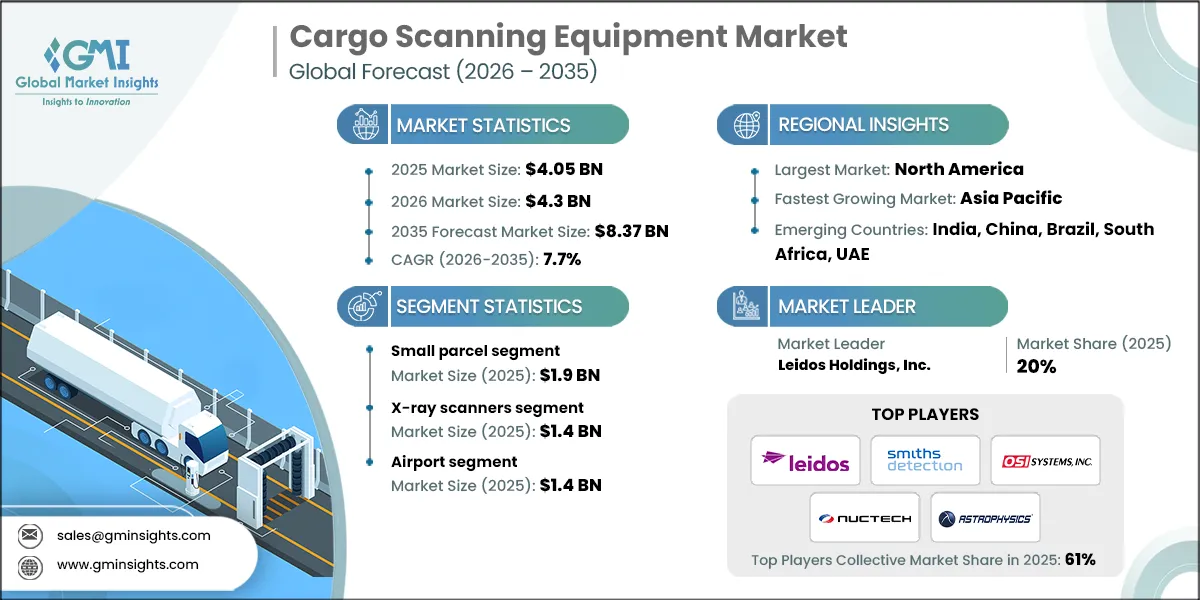
The global cargo scanning equipment market was valued at USD 4.05 billion in 2025. The market is expected to grow from USD 4.3 billion in 2026 to USD 6.23 billion in 2031 and USD 8.37 billion in 2035, at a value CAGR of 7.7% during the forecast period, according to the latest report published by Global Market Insights Inc.
Cargo Scanning Equipment Market Key Takeaways
Market Size & Growth
- 2025 Market Size: USD 4.05 Billion
- 2026 Market Size: USD 4.3 Billion
- 2035 Forecast Market Size: USD 8.37 Billion
- CAGR (2026–2035): 7.7%
Regional Dominance
- Largest Market: North America
- Fastest Growing Region: Asia Pacific
Key Market Drivers
- Rising Global Trade and Containerized Cargo Volumes.
- Increasing Security Threats and Smuggling Activities.
- Stricter Customs, Border Control, and Port Security Regulations.
- Adoption of Advanced Imaging Technologies (CT, 3D X-ray).
- Integration of AI and Automation in Cargo Inspection.
Challenges
- High Capital and Maintenance Costs of Scanning Systems.
- Operational Complexity and Skilled Workforce Requirements.
Opportunity
- Adoption of AI-enabled, software-driven cargo scanning platforms.
- Growth of portable and modular cargo scanning solutions.
Key Players
- Market Leader: Leidos Holdings, Inc. led with over 20% market share in 2025.
- Leading Players: Top 5 players in this market include Leidos Holdings Inc., Smiths Detection Group Ltd. (SMITHS GROUP PLC ), OSI Systems, Nuctech Company Limited, Astrophysics Inc., which collectively held a market share of 61% in 2025.
Get Market Insights & Growth Opportunities
The cargo scanning equipment market is expanding, owing to rising global trade and containerized cargo volumes, increasing security threats and smuggling activities, stricter customs, border control, and port security regulations, adoption of advanced imaging technologies (CT, 3D x-ray), and integration of AI and automation in cargo inspection. The growth in security threats to the world has seen governments in various countries invest more in new screening technologies that can detect the new threats to the security of the airline, border and critical infrastructure.
Government agencies, on a regular basis, have announced threat evaluations, and this points out the concept of moving threat vectors that comprise advanced concealment methods by malicious offenders and dynamic security surroundings are requiring more and more, technology-dependent screening capabilities to improve the safety of citizens and their properties. As a result, there is a massive investment in the next generation scanning equipment by the stakeholders of the public sector that increase the accuracy of the threat detection, reduce vulnerability, and proactive risk management. This working focus of regulation of the transport systems and the public space underlines the continued pressure on the enhanced security scanners of the controlled environments. For instance, In June 2025, the Science and Technology Directorate of the U.S. Department of Homeland Security, as an example, implemented programs to advance airspace screening technologies as part of the confined aviation security requirements.
The government regulation systems continue to play a major role in implementation of security scanning systems by institutionalizing the performance standards, implementation timelines, and implementation conditions of the government infrastructure. The security authorities of the different jurisdictions have mandated the upgrade of their systems to more efficient imaging systems which compels the airports and the transport hubs to spend in ensuring that the statutory requirements are met by procuring the scanning equipment that meets the requirement. These necessities will ensure that the operators adhere to the set limits of threat detection and integrate improved systems that comply with emerging policy provisions. That is why the processes of procurement are directly associated with the timelines of the regulatory compliance, and the prompt introduction of modernized scanners in large facilities is encouraged. For instance, in April 2024, the UK Department of Transport had granted extensions to airports to install the next-generation security scanners as a formal rule to improve the efficiency of detecting banned items and safeguarding the security of the passengers.
Cargo scanning equipment refers to advanced technological systems used to inspect and monitor goods transported via sea, air, rail, and road, ensuring safety, security, and regulatory compliance. These systems detect contraband, explosives, narcotics, weapons, and other prohibited items without physically opening shipments. Utilizing technologies such as X‑ray imaging, computed tomography, gamma-ray scanning, radiation detection, and AI-powered analytics, cargo scanning equipment enables faster, accurate, and non-intrusive inspections. It is essential for border security, customs enforcement, and supply chain risk management globally.
To get key market trends
Cargo Scanning Equipment Market Trends
- Image interpretation and anomaly detection cargo scanning is increasingly embracing artificial intelligence and machine learning to improve image interpretation and detection. Border agencies and customs authorities are using AI-driven scanning solutions to enhance accuracy and false positives to enable operators to prioritize more potentially risky shipments and optimize throughput. In one case, U.S. Customs and Border Protection implements AI use cases to support cargo screening and commodity threat indicator validation in multifaceted X-ray images with the aim of enhancing the efficiency and safety of its operations.
- Remote monitoring and automation are reshaping the way cargo scanning is done as the technology allows consistent and high-volume scanning with limited human-processing. Extremely advanced systems combine automated scanning lanes and remote diagnostics, enabling the customs agencies to handle and process scanning information at centralized points. This trend has helped to increase throughput and regular application of security measures to achieve trade facilitation and national security goals as the agencies upgrade inspection systems.
- Governments and customs organizations are considering multi-energy X-ray and hybrid scanning systems, which incorporate the different detection modalities to provide a more detailed analysis of the cargo. These technologies differentiate materials according to the atomic composition and enhance threat identification among various types of freights. These systems can be used to increase the detection capability of contraband, dangerous goods, and shielding efforts, which is in line with the need of non-invasive inspection at large ports and border checkpoints.
- Cargo scanners are also being combined with Internet of Things (IoT) sensors and cloud-based data solutions, allowing real-time exchange of data between the stakeholders of customs, logistics, and security. The connectivity increases visibility of the operations, predictive maintenance, and collaboration between agencies, which leads to risk-based inspection strategies. IoT scanning is not only more effective in detecting threats, but also in facilitating throughput planning and resource allocation, enhancing the process of cargo security management over global supply chains.
Cargo Scanning Equipment Market Analysis
Learn more about the key segments shaping this market
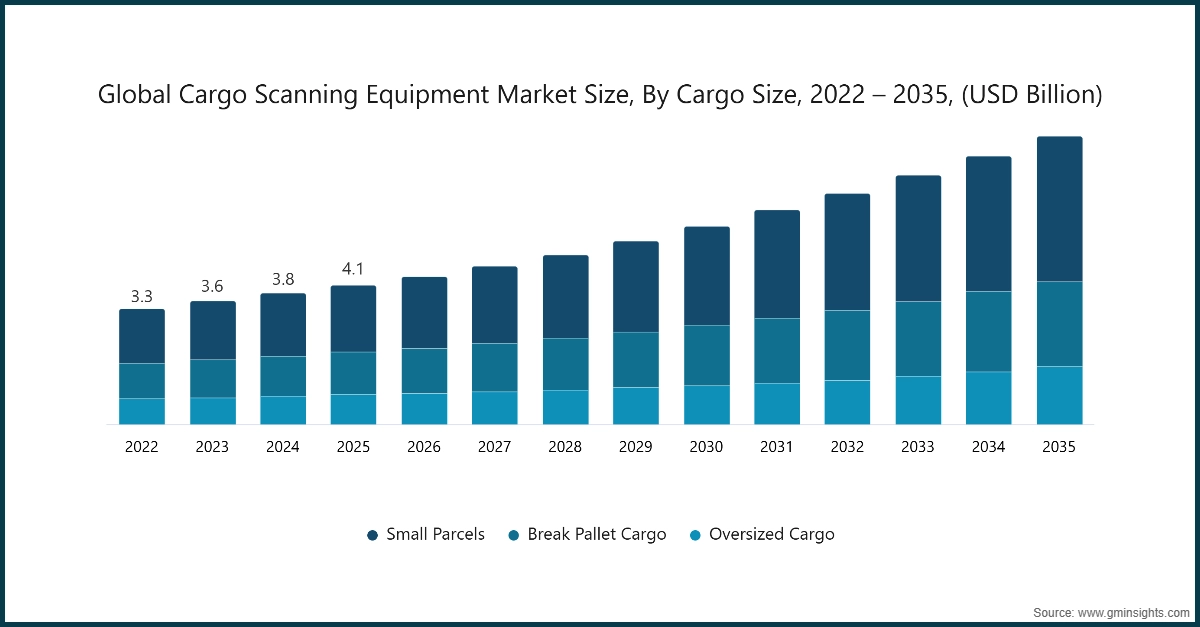
Based on cargo size, the cargo scanning equipment market is divided into small parcels, break pallet cargo, and oversized cargo.
- The small parcel segment accounted for the largest market and was valued at USD 1.9 billion in 2025. Rising e-commerce volumes drive the need for rapid, non-intrusive screening of small parcels, ensuring timely delivery while maintaining security and regulatory compliance at logistics hubs and last-mile distribution points.
- Increasing threats from contraband and illegal substances in small shipments necessitate automated, high throughput scanning systems to protect consumers and supply chain integrity.
- Manufacturers must develop compact, high-speed scanning systems optimized for high-volume parcel sorting centers, ensuring reliable detection without slowing operational throughput.
- The break pallet cargo segment was the fastest growing market during the forecast period, growing at a CAGR of 7.3% during the forecast period. Growing industrial and commercial shipments in pallets require advanced scanning systems to efficiently inspect mixed cargo types, improving customs compliance and reducing inspection bottlenecks.
- Government initiatives to prevent narcotics and smuggling in bulk cargo encourage deployment of scalable, multi-sensor scanning systems. For instance, in May 2025, U.S. Customs and Border Protection expanded its Non-Intrusive Inspection (NII) program for bulk cargo shipments, enhancing detection of high-risk pallets.
- Manufacturers should offer modular, high-capacity scanning solutions capable of inspecting palletized cargo efficiently while meeting strict customs risk management requirements.
Learn more about the key segments shaping this market
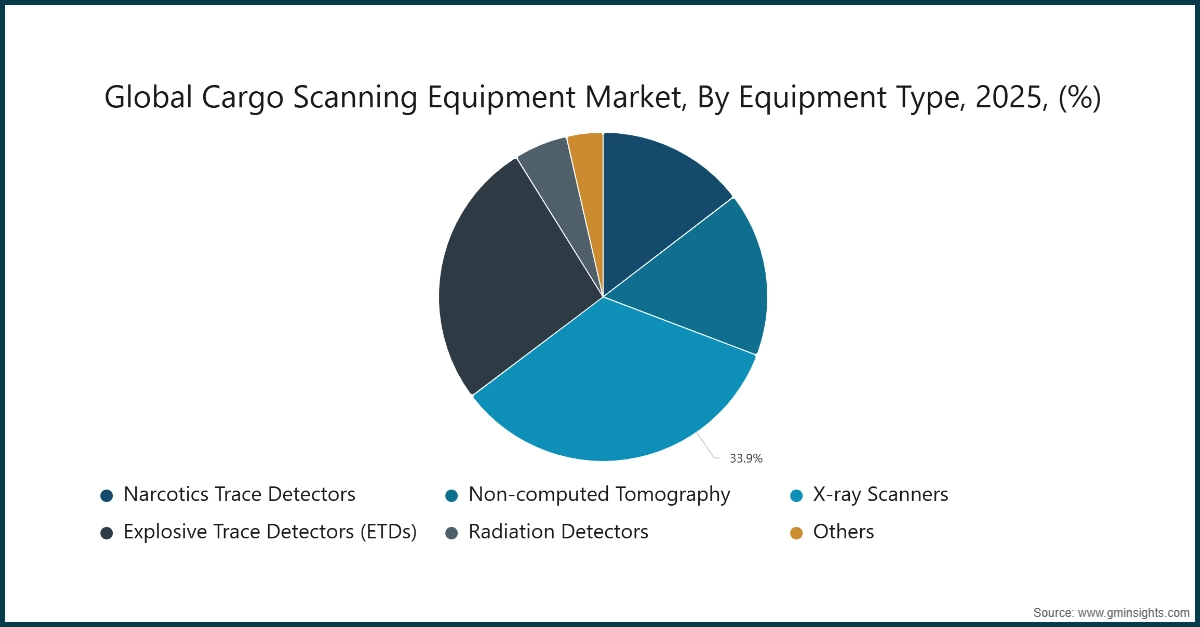
Based on equipment type, the cargo scanning equipment market is divided into narcotics trace detectors, non-computed tomography, X-ray scanners, explosive trace detectors (ETDs), radiation detectors, and others.
- The x-ray scanners segment accounted for the largest market and was valued at USD 1.4 billion in 2025. High-volume cargo throughput and regulatory requirements push airports, ports, and customs to adopt advanced X-ray scanners for rapid, non-intrusive inspection of diverse shipments.
- Technological advancements in multi-view and 3D X-ray imaging improve threat detection accuracy and speed, enhancing operator efficiency and reducing false positives.
- Manufacturers must invest in multi-view and high-resolution X-ray systems with automated threat detection features for diverse cargo types.
- The others segment was the fastest growing market during the forecast period, growing at a CAGR of 10.7% during the forecast period. Rising security threats and hazardous material regulations drive the deployment of specialized detectors for radiation, explosives, and narcotics in cargo scanning operations.
- Increased government mandates for integrating multi-sensor detection technologies in cargo inspection enhance adoption of modular “other” scanning equipment.
- Manufacturers need to focus on integrated, multi-sensor detection platforms that combine radiation, narcotics, and explosive detection for diverse regulatory environments.
Based on end-use, the cargo scanning equipment market is divided into airports, railway station, border control, logistics and transportation, industrial and manufacturing facilities, and others.
- The airport segment accounted for the largest market and was valued at USD 1.4 billion in 2025. Global air cargo growth and stricter aviation security regulations necessitate adoption of advanced scanning systems for passenger and cargo shipments.
- AI-enabled, automated scanners allow airports to process higher cargo volumes efficiently while meeting mandatory aviation safety standards.
- The others segment was the fastest growing market during the forecast period, growing at a CAGR of 10.4% during the forecast period. Expanding freight networks and border security initiatives drive adoption of scanning solutions in railways, industrial sites, and logistics hubs.
- Modular and mobile cargo scanning systems enable flexible deployment across temporary checkpoints, urban logistics corridors, and remote industrial facilities.
- Manufacturers must provide portable, scalable scanning solutions capable of deployment in varied environments, including industrial and logistical hubs, enhancing operational flexibility and compliance.
Looking for region specific data?
North America Cargo Scanning Equipment Market
North America market held a market share of 33.9% in 2025 of the global market.
- North America remains the most established cargo scanning market globally due to high trade volumes, stringent security regulations, and advanced port and border infrastructures.
- Customs and homeland security agencies enforce comprehensive screening protocols across maritime ports, airports, and land border crossings, driving consistent demand for upgraded and automated scanning systems that combine high‑throughput capability with enhanced threat detection.
- The region is also adopting AI‑assisted imaging and integrated data analytics to improve risk‑based screening and expedite cargo clearance without compromising security. These developments strengthen North America’s leadership position in deploying innovative cargo scanning technologies.
- Manufacturers should prioritize modular, high‑throughput X‑ray and AI‑integrated systems that align with strict North American regulatory and operational performance standards.
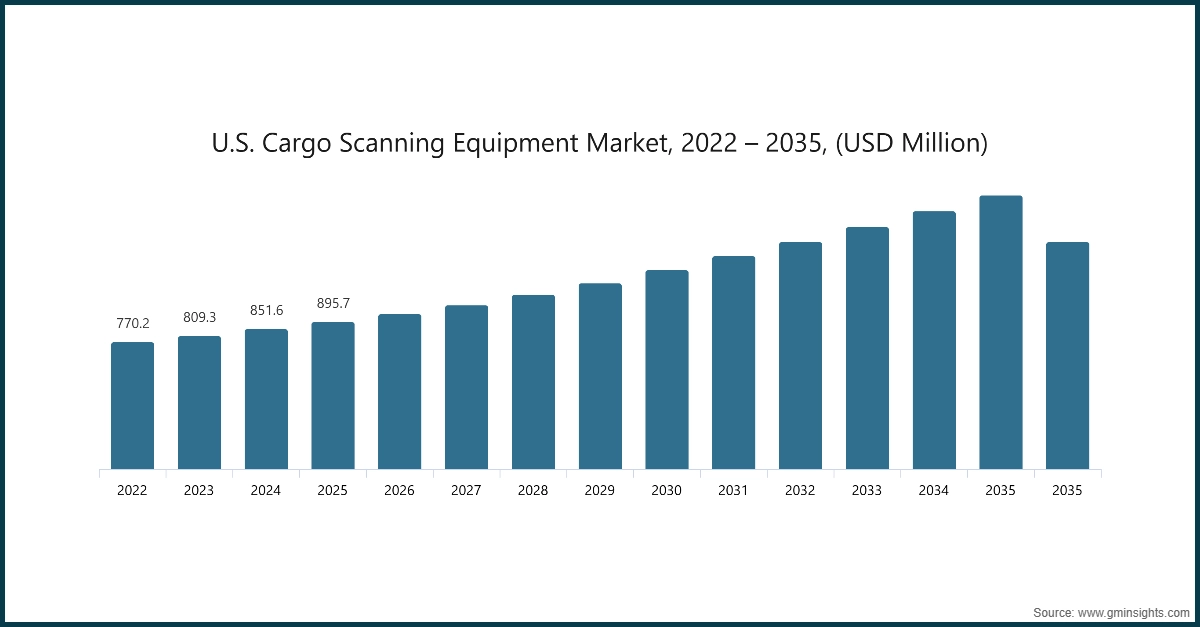
The U.S. cargo scanning equipment market was valued at USD 770.2 million and USD 809.3 million in 2022 and 2023, respectively. The market size reached USD 895.7 million in 2025, growing from USD 851.6 million in 2024.
- In the United States, cargo scanning trends are shaped by evolving federal screening requirements and regulatory enhancements that expand data capture and risk assessment ahead of cargo arrival.
- For instances, in November 2025, U.S. Customs and Border Protection published an interim final rule enhancing the Air Cargo Advance Screening (ACAS) program, which mandates extended advance cargo data to improve targeted risk analysis of incoming shipments and bolster aviation and trade security.
- This underscores the government’s shift toward data‑driven, pre‑arrival screening processes that rely on automated and advanced scanning technologies to identify high‑risk cargo.
- Manufacturers must focus on interoperable cargo scanning platforms that support expanded data integration and risk profiling ahead of arrival to meet evolving CBP requirements.
Europe Cargo Scanning Equipment Market
Europe cargo scanning equipment market accounted for USD 1.1 billion in 2025 and is anticipated to show lucrative growth over the forecast period.
- The European cargo scanning market is anchored by harmonized customs frameworks and a coordinated push toward digitalization and interoperability across member states.
- EU directives and programs emphasize risk‑based cargo inspection protocols and automated screening systems deployed at major seaports, airports, and land crossings. Investments in AI‑enabled imaging and fixed lane scanning are accelerating to meet compliance objectives while handling substantial import–export container flows.
- Integration with EU customs risk engines and cross‑border data platforms enhances threat detection consistency throughout the region, supporting trade facilitation alongside security imperatives.
- Manufacturers should develop scanning solutions compatible with EU customs data systems and risk engines to support harmonized cross‑border inspection requirements.
Germany dominated the Europe cargo scanning equipment market, showcasing strong growth potential.
- In Germany, cargo scanning trends reflect both national enforcement measures and alignment with broader European customs modernization. Enhanced digitalization of cargo release processes and secure data exchange systems are increasingly shaping screening operations.
- For instance, in September 2025, Germany began implementing the European Entry/Exit System (EES), which expands biometric and travel data integration for border management, signaling stronger digital customs and security processes that influence cargo control and associated scanning workflows.
- These measures highlight a shift toward highly digitized, connected environments where advanced cargo scanning technologies must integrate with broader border security and data platforms
- Manufacturers should offer adaptable scanning solutions that integrate with digital border and customs ecosystems, supporting biometric and cargo data exchange.
Asia Pacific Cargo Scanning Equipment Market
The Asia Pacific market is the largest and fastest growing market and is anticipated to grow at the CAGR of 9.1% during the analysis timeframe.
- The Asia Pacific region is experiencing the fastest growth in cargo scanning demand as trade volumes swell and port infrastructure expands rapidly.
- Major economies like China, India, and Southeast Asian nations are investing heavily in port modernization and integrated cargo security architectures that incorporate multi‑sensor scanning technologies and automated threat detection.
- Governments are emphasizing balanced growth between trade facilitation and security, resulting in broader adoption of non‑intrusive inspection tools that can handle high container throughput. Technological upgrades also include incorporating cloud‑based analytics and IoT connectivity to streamline cross‑agency collaboration.
- Manufacturers should target scalable, IoT‑ready scanning systems that can handle high throughput and integrate with regional trade facilitation platforms.
China cargo scanning equipment market is estimated to grow with a CAGR of 9.5% during the forecast period, in the Asia Pacific market.
- China’s cargo scanning landscape is driven by vast port throughput and government initiatives to strengthen supply chain security alongside the Belt and Road Initiative.
- Large seaports such as Shanghai and Ningbo–Zhoushan are deploying automated and AI‑enabled inspection systems to manage millions of TEUs annually.
- National transport authorities prioritize non‑intrusive inspection capacity to maintain security while facilitating rapid cargo movement, resulting in sustained demand for high‑resolution imaging and real‑time analytics systems.
- Manufacturers should align product development with large‑scale port automation and AI detection capabilities tailored to China’s high‑volume scanning requirements.
Latin American Cargo Scanning Equipment Market
Brazil leads the Latin American market, exhibiting remarkable growth during the analysis period.
- Brazil’s cargo scanning market is influenced by the need to secure extensive export logistics networks, especially in agriculture and manufactured goods.
- National customs and port authorities are gradually adopting more advanced scanning technologies at major seaports to streamline export certification and enhance risk‑based inspection protocols.
- While infrastructure upgrades progress at a measured pace, there is growing interest in mobile scanning solutions to complement fixed systems in busy cargo corridors. Investments focus on bridging capacity gaps and improving operational consistency across dispersed terminal facilities.
- Manufacturers should supply adaptable scanning systems, including mobile units, that address variable cargo flows and expand scanning reach across Brazil’s major trade gateways.
Middle East and Africa Cargo Scanning Equipment Market
South Africa market to experience substantial growth in the Middle East and Africa market in 2025.
- South Africa’s cargo scanning landscape is shaped by its strategic location along key maritime trade routes between Asia, Europe, and the Americas.
- Government authorities are prioritizing enhancements in non‑intrusive inspection technologies at major ports like Durban and Cape Town to counter smuggling and bolster trade security.
- Investments focus on upgrading existing systems and incorporating advanced imaging and radiation detection tools that align with international security standards.
- Growth in e‑commerce and regional freight activity further underlines the need for greater automation and data integration in cargo scanning operations.
- Manufacturers should provide robust, standards‑aligned scanning solutions that support multi‑modal cargo screening and regional security interoperability.
Cargo Scanning Equipment Market Share
The global market exhibits a moderately consolidated structure, characterized by the presence of major multinational security technology providers alongside specialized regional manufacturers. As of 2025, key players such as Leidos Holdings, Inc., Smiths Detection Group Ltd., OSI Systems, Nuctech Company Limited, and Astrophysics, Inc., collectively account for 61% of the total market share.
Emerging companies, including Nuctech, are rapidly expanding their presence in the Asia Pacific and African markets by offering cost-effective, technologically advanced solutions. Regionally, North America dominated the global market, driven by advanced scanning infrastructure and continual modernization initiatives across ports, airports, and border checkpoints.
Cargo Scanning Equipment Market Companies
Prominent players operating in the cargo scanning equipment industry are as mentioned below:
- Astrophysics, Inc.
- Autoclear LLC
- Braun & Co. Limited
- CEIA
- Gilardoni S.p.A.
- Leidos Holdings, Inc.
- LINEV Systems
- Nuctech Company Limited
- OSI Systems
- Smiths Detection Group Ltd.
- TODD Research
- Westminster Group Plc
- Leidos dominates the cargo scanning equipment market with a 20% share, driven by its comprehensive portfolio of high-performance, scalable scanning solutions for airports, seaports, and border checkpoints. The company emphasizes AI-enabled detection, high-throughput X-ray, and multi-sensor platforms. Leidos collaborates closely with government agencies, port authorities, and logistics operators to expand deployments across critical infrastructure and trade hubs, ensuring compliance with security mandates while maintaining operational efficiency.
- Smiths Detection holds 13% of the market, offering advanced, automated scanning systems with multi-energy X-ray, trace detection, and CT imaging capabilities. Its solutions focus on high accuracy, regulatory compliance, and operational speed. Smiths partners with customs authorities, airports, and industrial facilities to deploy AI-enhanced scanning platforms that enhance threat detection, reduce false positives, and optimize cargo throughput.
- OSI Systems controls 10% of the market through its robust portfolio of cargo scanning solutions, including high-resolution X-ray scanners, radiation detection systems, and ETDs. The company leverages strong collaborations with transportation operators, defense agencies, and border authorities to implement scalable and reliable inspection systems that meet stringent safety and regulatory standards.
- Nuctech holds an 8% share, focusing on cost-effective and high-performance cargo scanning solutions for ports, airports, and logistics centers. The company emphasizes integration with customs IT systems and offers multi-sensor and automated scanning technologies suitable for high-volume throughput and rapid deployment in emerging markets.
- Astrophysics accounts for 10% of the market, providing specialized X-ray and CT scanning systems for air cargo, postal, and high-security applications. Its solutions prioritize speed, accuracy, and regulatory compliance. Astrophysics works with governmental agencies, airport authorities, and logistics providers to deploy reliable, high throughput scanning solutions for sensitive and high-risk cargo.
Cargo Scanning Equipment Market Report Attributes
| Key Takeaway | Details |
|---|---|
| Market Size & Growth | |
| Base Year | 2025 |
| Market Size in 2025 | USD 4.05 Billion |
| Market Size in 2026 | USD 4.3 Billion |
| Forecast Period 2026-2035 CAGR | 7.7% |
| Market Size in 2035 | USD 8.37 Billion |
| Key Market Trends | |
| Drivers | Impact |
| Rising Global Trade and Containerized Cargo Volumes | Strengthens market demand as customs authorities, ports, and logistics operators face higher shipment volumes, necessitating rapid, accurate, and high-throughput scanning systems to ensure secure trade flow. |
| Increasing Security Threats and Smuggling Activities | Drives adoption of advanced cargo scanning equipment as governments respond to terrorism, narcotics, and contraband risks, deploying automated, high-resolution systems across ports, airports, and border checkpoints. |
| Stricter Customs, Border Control, and Port Security Regulations | Sustains procurement of compliant cargo scanning systems, as regulatory authorities enforce risk-based inspections, mandatory non-intrusive scanning, and periodic technology upgrades to safeguard trade integrity. |
| Adoption of Advanced Imaging Technologies (CT, 3D X-ray) | Enhances market growth by enabling higher detection accuracy, faster processing, and integration of multi-energy, CT, and AI-powered imaging for efficient cargo inspection. |
| Integration of AI and Automation in Cargo Inspection | Expands deployment opportunities as new terminals and logistics hubs incorporate advanced cargo scanning as a core infrastructure component. |
| Pitfalls & Challenges | Impact |
| High Capital and Maintenance Costs of Scanning Systems | Limits adoption in cost-sensitive regions or smaller facilities, as advanced cargo scanning systems involve significant capital expenditure, installation, and ongoing service requirements. |
| Operational Complexity and Skilled Workforce Requirements | Increase deployment complexity, as cargo scanning systems must integrate with existing customs IT platforms, port management software, and command-and-control networks, requiring additional customization. |
| Opportunities: | Impact |
| Adoption of AI-enabled, software-driven cargo scanning platforms | Reduces operational costs, improves scalability, enables automated threat detection, remote monitoring, and continuous software upgrades, supporting faster and more reliable inspections. |
| Growth of portable and modular cargo scanning solutions | Creates demand for temporary or flexible deployments in logistics hubs, urban ports, and rapid infrastructure expansion projects, allowing operators to scale scanning capacity efficiently based on demand. |
| Market Leaders (2025) | |
| Market Leader |
20% Market Share |
| Top Players |
Collective market share in 2025 is 61% |
| Competitive Edge |
|
| Regional Insights | |
| Largest Market | North America |
| Fastest growing market | Asia Pacific |
| Emerging countries | India, China, Brazil, South Africa, UAE |
| Future outlook |
|
What are the growth opportunities in this market?
Cargo Scanning Equipment Market News
- In January 2026, BigBear.ai completed the acquisition of CargoSeer, integrating an AI-powered inspection platform designed to automate cargo image analysis for customs authorities and logistics hubs.
- In January 2026, Smiths Detection successfully implemented a remote cargo screening system between South Korea and the U.S. utilizing the HI-SCAN 10080 XCT, enabling centralized international oversight of high-speed scans.
- In December 2025, Smiths Detection unveiled its SDX 100100 DV HC X-ray scanner and it was officially added to the TSA Air Cargo Screening Technology List (ACSTL) for high-density package inspection.
The cargo scanning equipment market research report includes in-depth coverage of the industry with estimates & forecasts in terms of revenue (USD Million) from 2022 to 2035, for the following segments:
Market, By Equipment Type
- Narcotics Trace Detectors
- Non-computed Tomography
- X-ray Scanners
- Explosive Trace Detectors (ETDs)
- Radiation Detectors
- Others
Market, By Cargo Size
- Small Parcels
- Break Pallet Cargo
- Oversized Cargo
Market, By End-use
- Airports
- Railway Station
- Border Control
- Logistics and Transportation
- Industrial and Manufacturing facilities
- Others
The above information is provided for the following regions and countries:
- North America
- U.S.
- Canada
- Europe
- Germany
- UK
- France
- Spain
- Italy
- Netherlands
- Asia Pacific
- China
- India
- Japan
- Australia
- South Korea
- Latin America
- Brazil
- Mexico
- Argentina
- Middle East and Africa
- Saudi Arabia
- South Africa
- UAE
Frequently Asked Question(FAQ) :
What was the market size of the cargo scanning equipment market in 2025?
The market size was USD 4.05 billion in 2025, driven by the increasing adoption of advanced scanning systems due to global air cargo growth and stricter aviation security regulations.
What is the projected value of the cargo scanning equipment market by 2035?
The market is expected to reach USD 8.37 billion by 2035, growing at a CAGR of 7.7% during the forecast period, fueled by advancements in non-intrusive inspection technologies and regulatory compliance requirements.
What is the projected size of the cargo scanning equipment market in 2026?
The market is expected to grow to USD 4.3 billion in 2026.
What was the market share of the airport segment in 2025?
The airport segment held the largest share, valued at USD 1.4 billion in 2025, driven by the need for advanced scanning systems to handle passenger and cargo shipments efficiently.
What was the market share of the x-ray scanners segment in 2025?
The x-ray scanners segment accounted for the largest market share, valued at USD 1.4 billion in 2025, due to high cargo throughput and regulatory requirements for non-intrusive inspections.
Which segment dominated the market in 2025?
The small parcel segment led the market with a valuation of USD 1.9 billion in 2025, driven by the rising e-commerce volumes and the need for rapid, non-intrusive screening at logistics hubs and distribution points.
Which region leads the cargo scanning equipment market?
North America was the largest market in 2025, holding a 33.9% share of the global market. The region's growth is supported by strong industrial infrastructure and the adoption of advanced scanning technologies.
What are the upcoming trends in the cargo scanning equipment industry?
Key trends include the integration of artificial intelligence and machine learning for image interpretation and anomaly detection, adoption of remote monitoring and automation for high-volume scanning, and the development of centralized processing systems to enhance throughput and security measures.
Who are the key players in the cargo scanning equipment market?
Major players include Astrophysics, Inc., Autoclear LLC, Braun & Co. Limited, CEIA, Gilardoni S.p.A., Leidos Holdings, Inc., LINEV Systems, Nuctech Company Limited, OSI Systems, Smiths Detection Group Ltd., and TODD Research.
Cargo Scanning Equipment Market Scope
Related Reports