Summary
Table of Content

Biobased Chemical Market
Get a free sample of this report
Form submitted successfully!
Error submitting form. Please try again.
Thank you!
Your inquiry has been received. Our team will reach out to you with the required details via email. To ensure that you don't miss their response, kindly remember to check your spam folder as well!
Request Sectional Data
Thank you!
Your inquiry has been received. Our team will reach out to you with the required details via email. To ensure that you don't miss their response, kindly remember to check your spam folder as well!
Form submitted successfully!
Error submitting form. Please try again.
Biobased Chemical Market Size
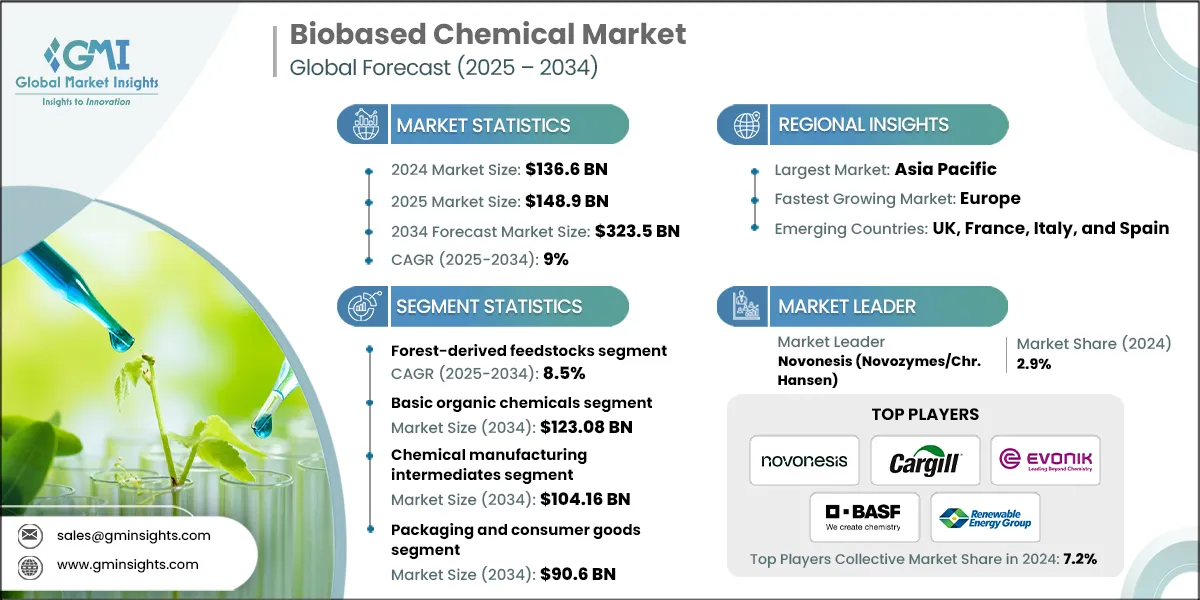
The global biobased chemical market was estimated at USD 136.6 billion in 2024. The market is expected to grow from USD 148.9 billion in 2025 to USD 323.5 billion in 2034, at a CAGR of 9% according to latest report published by Global Market Insights Inc.
Biobased Chemical Market Key Takeaways
Market Size & Growth
- 2024 Market Size: USD 136.6 Billion
- 2025 Market Size: USD 148.9 Billion
- 2034 Forecast Market Size: USD 323.5 Billion
- CAGR (2025–2034): 9%
Regional Dominance
- Largest Market: Asia Pacific
- Fastest Growing Region: Europe
Key Market Drivers
- Regulatory support, rising bio-packaging demand, and technological advances in biorefineries.
- Consumer preference for eco-friendly products and sustainability-focused initiatives.
- Innovation in biorefinery processes improving efficiency and product portfolios.
Challenges
- High production costs and competition with conventional petrochemicals.
- Feedstock supply variability and logistical constraints.
Opportunity
- Rapid adoption in emerging economies and industrial sectors.
- Circular economy integration and waste valorization.
- Development of innovative bio-composites and specialty chemicals.
Key Players
- Market Leader: Novonesis (Novozymes/Chr. Hansen) led with over 2.9% market share in 2024.
- Leading Players: Top 5 players in this market include Novonesis (Novozymes/Chr. Hansen), Cargill, Incorporated, Evonik Industries AG, BASF SE, Renewable Energy Group, Inc., which collectively held a market share of 7.2% in 2024.
Get Market Insights & Growth Opportunities
- The market is being propelled by the accelerating global transition to sustainable industrial processes, regulatory incentives for carbon-neutral products, and advances in biotechnology and green chemistry.
- Biobased chemicals, which are derived from renewable feedstocks such as agriculture, forestry sources, and algae, are progressively replacing fossil-based raw materials in applications including packaging, automotive, construction, textiles, and agriculture.
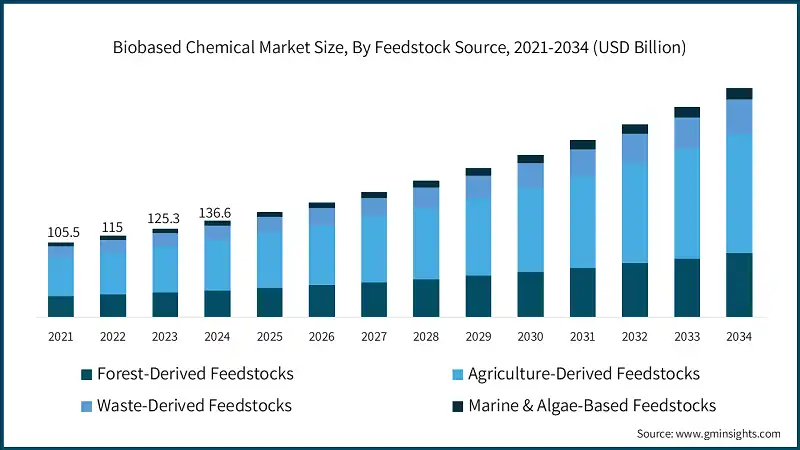
- Feedstocks from agriculture account for almost 52% of the segment, followed by feedstocks from forests, waste biomasses, and marine/algae. Growth of the feedstocks segment is driven by the increasing development of the valorization of biomass; sustainable agricultural residues; and algae-based bioprocessing technologies, all of which help to reduce dependence on fossil-feedstocks.
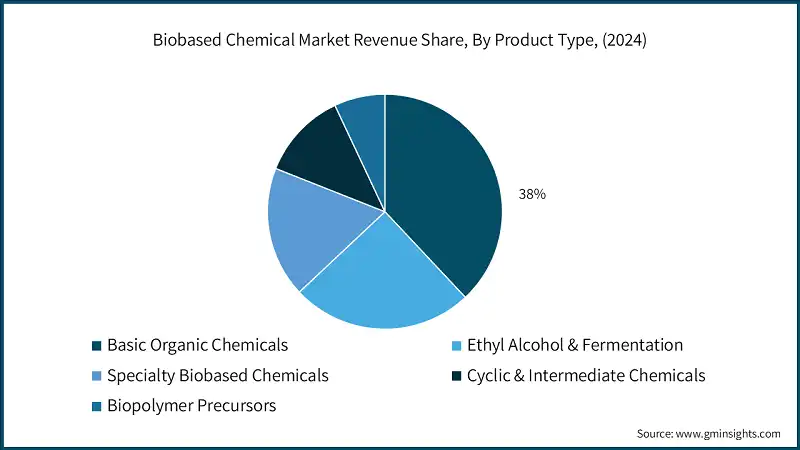
- By product type segment, Basic organic chemicals comprise the 38% of market share, while specialty biobased chemicals account for 18%. The growth of biopolymer precursors and the provision of renewable intermediates for new products, including polylactic acid (PLA), polyhydroxyalkanoate (PHA), and bio-aromatics, will further demand for bioproducts.
- Biodegradable plastics and green surfactants are gaining traction, as stricter environmental standards have necessitated the use of bio-based chemicals, as per customers' preference for environmentally safe products. Renewable binders and bio-solvents in the paints, coatings, and adhesives industries have grown, and biopesticides and fertilizers in agriculture and soil-enhancing products to support regenerative practices and to lessen their ecological impact.
- On a regional basis, the biobased chemical market is facilitated by strong bioeconomy policies and industry innovation. Europe make up about 30% of the market, driven by EU goals toward carbon neutrality and increased manufacturing activity. North America follows with 28%, primarily from the expansion of biotechnology and biorefinery segments.
To get key market trends
Biobased Chemical Market Trends
- Governments continue to impose strict regulations on carbon emissions that are having a very strong impact on the chemical industry. Most notable is the European Commission's Chemicals Industry Action Plan announced in 2025 that speaks to using bio-based chemicals as a lever of decarbonization, industrial competitiveness and resilience. This policy shift will propel faster movement from fossil-based frameworks to rational, reliable and renewable bio-based feedstocks across multiple industrial sectors while enhancing innovation and adoption of those approaches.
- The bio-based platform chemicals market is undergoing disruptive growth in areas of technology and policy. The introduction and development of technologies that underpin alkali-metal-catalyzed PLA upcycling and FDCA-based polymers emphasize improvements in efficiency and reductions in carbon footprint. These advances lay a pathway for bio-based chemistry in applications beyond current petroleum-based chemical systems, including food packaging, automotive plastics, and textiles, without compromising quality as the world shifts toward sustainable and circular business principles.
Biobased Chemical Market Analysis
Learn more about the key segments shaping this market
Based on feedstock source, the market is segmented into forest derived, agriculture derived, waste derived, & marine & algae-based feedstock.
- Forest-derived feedstocks, these products can be used in a wide range of biobased chemical applications, especially specialty chemicals and intermediates, and will grow at an 8.5% CAGR between 2024 and 2034.
- Agriculture-derived feedstocks, including conventional crops, such as corn, sugarcane, soybean and crop residues, and dedicated energy crops remain the largest segment, having abundant biomass, cost-efficient, and compatible to bioprocesses industrially, with a segment market share at 52%, indicating their strength and dominance throughout biobased chemical production, both established and emerging.
- Waste-derived feedstocks including municipal solid waste, animal agriculture residues and wastewater organics are increasingly being utilized to facilitate principles of circular economy, develop sustainable outcomes, and reduce dependence on virgin feedstock.
- Marine and algae-based feedstocks, including seaweed, microalgae, and marine waste, are gaining traction as non-food competing biomass sources, and offer new routes to specialty chemicals and biofuels, with a CAGR of 9.0% and a relatively small market share of approximately 5%, with potential for future-oriented, environmentally based biobased chemical production.
Learn more about the key segments shaping this market
Based on product type, the market is segmented into basic organic chemicals, ethyl alcohol & fermentation products, cyclic & intermediate chemicals, specialty biobased chemicals, and biopolymer precursors.
- Basic organic chemicals are set to accelerate a market share from USD 51.95 billion in 2024 to USD 123.08 billion by 2034 with a CAGR of 8.5% due to increased industrial use of biobased feedstocks and increased regulatory support for sustainable feedstocks.
- Ethyl alcohol and fermented products related to alcohol such as industrial bioethanol, amino acids, nutraceuticals are establishing a rapid growth trajectory from demand associated with biofuels, food, and healthcare, representing a share of the market at 25%. Specialty biobased chemicals related to specialty products such as industrial enzymes, biocatalysts, biosurfactants, bio-solvents are increasing in popularity due to demand related to green chemistry or through the use of sustainable products in specialty applications or production.
- Cyclic & intermediate chemicals related to bio-based monomers, renewable aromatics, and specialty intermediates are being adopted in high-performance applications with an annual growth rate of 7.5%.
- Biopolymer precursor products including biopolymer-limited polylactide (PLA), polyhydroxyalkanoate (PHA), or bio-based polyamide precursors (biodegradable plastics or eco-friendly polymer products are considered an enabling technology reflecting high growth and increased market share in packaging or textile applications.
Based on applications, the market is segmented into chemical manufacturing intermediates, plastic material & resin production, agricultural chemical applications, paint, coating & adhesive applications, and personal care & cleaning products.
- Chemical manufacturing intermediates, including polymer precursors, pharmaceutical intermediates, and fine chemicals, remain the largest application segment, projected to grow from USD 43.74 billion in 2024 to USD 104.16 billion by 2034, reflecting a CAGR of 8.9%, driven by increasing demand for sustainable and bio-based building blocks.
- Plastic material and resin production, including biodegradable plastics, bio-based engineering plastics, and composite materials, is expanding rapidly, with rising adoption in packaging, automotive, and construction industries, holding a market share of nearly 17% in 2024.
- Personal care and cleaning products, comprising bio-based surfactants, natural preservatives, and cosmetic ingredients, are gaining traction due to consumer preference for eco-friendly and non-toxic formulations, growing from USD 24.61 billion in 2024 to USD 58.25 billion by 2034.
- Paint, coating, and adhesive applications, including bio-based paints, natural adhesives, and wood treatment chemicals, are growing steadily, driven by regulatory pressure for low-VOC and renewable formulations.
- Agricultural chemical applications, such as bio-fertilizers, biopesticides, and soil conditioners, are witnessing rising adoption to improve sustainability and crop yield while reducing chemical dependency.
Based on end use, the market is segmented into packaging & consumer goods, automotive & transportation, construction & building materials, textiles & apparel, and agriculture & food processing.
- The packaging and consumer goods sector is the dominant end user market; applications include both food packaging and consumer products baked into day-to-day laundry and household product development, including e-commerce packaging. This market segment is forecasted to increase from USD 38.2 billion in 2024 to USD 90.6 billion by 2034, based on uptake of sustainable, bio-based packaging solutions.
- Agriculture and food processing applications, even the additive market, including use of crop enhancement products and food processing aids, even animal feed additives is also growing rapidly. The growth is driven by increased demand for sustainable fertilizers, biopesticides, and sustainable animal nutrition.
- Automotive and transportation applications such as lubricants, interior components, and composite products has a slow, but steady increase, reflecting the slow rate of the uptake of renewable and low emission materials used in manufacturing automotive components and a CAGR of 7.9%. Construction and building materials such as bio-adhesives, insulation, and structural composites are increasing with regulatory pressure and a sustainability push.
- Textiles and apparel applications using bio-based fibers, natural dyes, and textile processing chemicals will continue to rise, due to consumer preference for eco-friendly fabrics and sustainable production processes, into the natural textile marketplace.
Looking for region specific data?
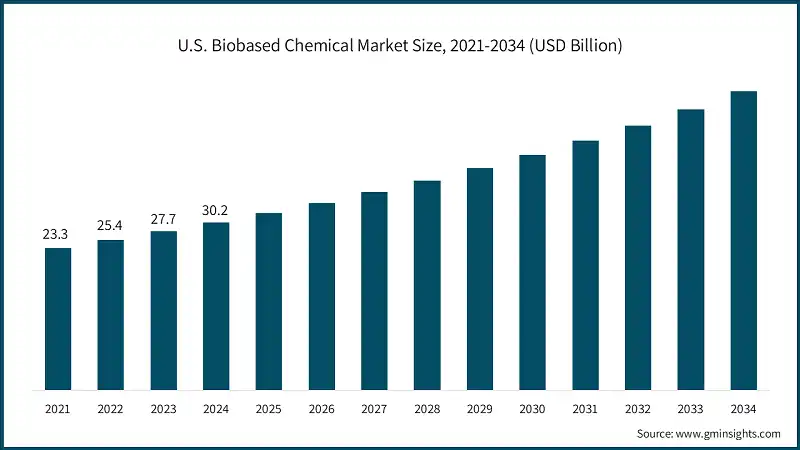
In 2024, North America has a market value of USD 38.2 billion, and a CAGR of 9%.
- In North America, particularly in the U.S. and Canada, bio-based chemicals are widely accepted in various applications, including packaging, agriculture, and automotive. This recognition is driven by several forces, including regulatory mandates towards sustainability, corporate mandates to produce green products, and advancements in technologies pertaining to renewable feedstocks.
- The growth of bio-based chemicals also continues to be robust in many parts of North America, including the U.S. and Canada, because there continues to be a strong demand for high-performing bioplastics, bio-lubricants, and industrial solutions that are eco-friendly.
Europe held market value of USD 41 billion in 2024, led specifically by the trend toward sustainability, government funding, and consumer environmental beliefs.
- Europe has a very stable market for bio-based chemicals, which is being supported by the regulatory and compliance framework around environmental performance, sustainability initiatives, and increased consumer awareness. Some of the larger countries, including Germany, the UK, France, Italy, and Spain, have a solid footprint in biobased chemicals, especially with bio-based packaging, adhesives, and other specialty chemicals. These nations continue to invest adequate funding in growing the development of bio-based chemicals through using sustainable technologies and renewable feedstock, and as a result, growth continues to be stable across several industrial platforms.
In 2025, Asia Pacific is projected to reach USD 44.7 billion and is estimated to hold 30% of the market share in 2034.
- In Asia Pacific, the market is growing rapidly but unevenly spread across the region. China, India, Japan, South Korea, and Australia are the country’s leading to the growth of bio-based chemicals in the region. Growth in this market is supported by rising industrialization, government initiatives to encourage sustainable production, and increasing demand across packaging, agricultural sectors and automotive industries.
- Furthermore, growth in demand in the rest of the Asia Pacific is driven by increasing use and preference towards utilizing bio-based materials for chemical products and advancing alternatives for eco-friendly chemicals as consumers are increasingly looking for the sustainable option of products.
Latin America is incrementally increasing and is anticipated to achieve an approximate value of USD 16.4 billion by 2024.
- Latin America, an emerging market, is seeing some adoption led by Brazil, Mexico, and Argentina. The agricultural and packaging sectors are shaping the demand, aided by a growing commitment to sustainability and a host of governmental initiatives. Investment in bio-based chemicals for fertilizers, crop protection, and biodegradable plastics is reported to be increasing steadily throughout the region.
MEA is increasing its footprint and was expected to account for 6% of market share in 2025.
- MEA has seen slow adoption led by Saudi Arabia, the UAE, and South Africa. Demand drivers include sustainable agriculture, bio-lubricants, and agricultural applications. Increased environmental awareness of sustainability, projects related to renewable energy, and government policies are all driving adoption of bio-based chemicals in the construction, packaging, and manufacturing sectors.
Biobased Chemical Market Share
The top 5 companies in the natural food color sector are Novonesis (Novozymes/Chr. Hansen), Cargill Incorporated, Evonik Industries AG, BASF SE & Renewable Energy Group, Inc. These are significant players in their respective areas and represent 7.2% of the total market share. The market currently is driven by the rising demand for sustainable and bio-based solutions from almost all the industries. Key players in this system put more resources into increasing their product portfolios through innovation and strategic acquisitions for meeting the growing market needs.
- Novonesis is a globally recognized leader in biosolutions that was formed by bringing the companies Novozymes and Chr. Hansen together. Novonesis operates across more than 30 industries with a mission of developing and delivering sustainable biosolutions to help reduce the use of chemicals and to help achieve climate neutrality. Novonesis is backed by around 10,000 employees who all aim to innovate how production and consumption occur through biological technologies.
- Cargill is an American multi-national known for their work in agribusiness, food, and other industrial sectors. Cargill manufactures biobased chemicals including, bio-based ethyl acrylate, that have a product carbon footprint that is 30% less than the fossil-based alternatives. Cargill offers renewable feedstocks and sustainable options available for a variety of industries.
- Evonik is a German producer of specialty chemicals and which built a bio-surfactant manufacturing plant in Slovakia that is the first of its kind at an industrial scale in the world. The biosurfactants are produced through fermentation from European corn sugar. Evonik's biosurfactants are biodegradable and have sustainable applications across cleaning, personal care, and industrial applications. Evonik creates programs with biobased chemicals with a tie to sustainability.
- BASF, a chemical manufacturer based in Germany, is making its shift to the biobased Ethyl Acrylate that will contain 40% certified ^14C-traceable content, slated for Q4 2024. The change is expected to reduce the carbon footprint of the product by 30% compared to fossil-based products. BASF is a part of the change for sustainability in its products into the marketplace.
- Renewable Energy Group (REG), based in the U.S., focuses on renewable fuels and biobased chemicals. REG produces biodiesel and renewable diesel from a variety of feedstocks toward reducing greenhouse gas emissions. REG is supportive of chemicals continuing the transition to more renewable energy solutions.
Biobased Chemical Market Companies
Major players operating in the biobased chemical industry include:
- Amyris
- BASF
- BioAmber
- Bolt Threads
- Braskem
- Cargill
- Corbion
- DSM-firmenich
- Ecovative
- Evonik
- Genomatica
- Gevo
- Green Biologics
- LanzaTech
- Modern Meadow
- Novamont
- Novozymes
- Renewable Energy Group
- Solugen
- Zymergen
Biobased Chemical Market Report Attributes
| Key Takeaway | Details |
|---|---|
| Market Size & Growth | |
| Base Year | 2024 |
| Market Size in 2024 | USD 136.6 Billion |
| Market Size in 2025 | USD 148.9 Billion |
| Forecast Period 2025 - 2034 CAGR | 9% |
| Market Size in 2034 | USD 323.5 Billion |
| Key Market Trends | |
| Drivers | Impact |
| Regulatory support, rising bio-packaging demand, and technological advances in biorefineries | Policies promoting low-carbon production accelerate adoption globally. Consumer preference for sustainable packaging and advanced biorefinery processes enhance efficiency, reduce environmental footprint, and strengthen market penetration. |
| Consumer preference for eco-friendly products and sustainability-focused initiatives | Growing environmental awareness drives investment, encourages adoption across industries, and accelerates the transition from petrochemicals to bio-based alternatives worldwide. |
| Innovation in biorefinery processes improving efficiency and product portfolios | Technological advancements reduce production costs, expand applications, and enable faster market entry across packaging, chemicals, automotive, and construction sectors. |
| Pitfalls & Challenges | Impact |
| High production costs and competition with conventional petrochemicals | Elevated manufacturing costs limit scalability and profitability, while cheaper petrochemical alternatives hinder adoption in price-sensitive regions. |
| Feedstock supply variability and logistical constraints | Inconsistent biomass availability disrupts supply chains, affecting production stability and long-term market growth in global bio-chemical markets. |
| Opportunities: | Impact |
| Rapid adoption in emerging economies and industrial sectors | Growing industrialization and sustainability awareness in developing regions provide untapped potential, boosting market expansion and investment opportunities. |
| Circular economy integration and waste valorization | Policies promoting recycling and waste-to-chemical initiatives create new revenue streams and support sustainable, long-term growth. |
| Development of innovative bio-composites and specialty chemicals | High-performance bio-based materials enable entry into premium applications, driving demand and diversifying market portfolios. |
| Market Leaders (2024) | |
| Market Leaders |
2.9% Market Share |
| Top Players |
Collective Market Share 7.2% in 2024 |
| Competitive Edge |
|
| Regional Insights | |
| Largest Market | Asia Pacific |
| Fastest growing market | Europe |
| Emerging countries | UK, France, Italy, and Spain |
| Future outlook |
|
What are the growth opportunities in this market?
Biobased Chemical Industry News
- In October 2025, BASF and IFF announced a strategic partnership to accelerate the development of next-generation enzymes and biobased polymers for various applications, including fabric, dish, personal care, and industrial cleaning applications. The partnership aims to leverage BASF’s chemical know-how with IFF’s bioscience innovation to provide sustainable solutions at scale while performance is maintained.
- In January 2022, Genomatica and Covestro announced the successful trial production of a plant-based version of hexamethylenediamine (HMDA), a key raw material for nylon, coatings, and adhesives. The bio-HMDA, produced from renewable feedstocks, exhibits some of the highest purity and quality available and decreases reliance on fossil fuels. The two companies plan to commercialize production to support more sustainable manufacturing and distribution within the automotive, construction, and textile industries while also advancing the transition to a more circular, low-carbon chemical industry.
This biobased chemical market research report includes in-depth coverage of the industry, with estimates & forecasts in terms of revenue (USD Billion) and volume (Tons) from 2025 to 2034, for the following segments:
Market, By Feedstock Source
- Forest-derived feedstocks
- Agriculture-derived feedstocks
- Waste-derived feedstocks
- Marine & algae-based feedstocks
Market, By Product Type
- Basic organic chemicals
- Bio-based ethylene & derivatives
- Bio-based propylene & derivatives
- Bio-based aromatics (BTX)
- Organic acids (lactic, succinic)
- Ethyl alcohol & fermentation
- Industrial bioethanol
- Amino acids & proteins
- Vitamins & nutraceuticals
- Specialty biobased chemicals
- Industrial enzymes
- Biocatalysts & biosurfactants
- Bio-based solvents
- Cyclic & intermediate chemicals
- Bio-based monomers
- Renewable aromatics
- Specialty intermediates
- Biopolymer precursors
- PLA precursors
- PHA precursors
- Bio-based polyamide precursors
Market, By Application
- Chemical manufacturing intermediates
- Polymer production
- Pharmaceutical intermediates
- Fine chemical synthesis
- Plastic material & resin production
- Biodegradable plastics
- Bio-based engineering plastics
- Composite materials
- Personal care & cleaning products
- Bio-based surfactants
- Natural preservatives
- Cosmetic ingredients
- Paint, coating & adhesive applications
- Bio-based paints & coatings
- Natural adhesives
- Wood treatment chemicals
- Agricultural chemical applications
- Bio-based fertilizers
- Biopesticides & crop protection
- Soil conditioners
Market, By End use
- Packaging & consumer goods
- Agriculture & food processing
- Automotive & transportation
- Construction & building materials
- Textiles & apparel
The above information is provided for the following regions and countries:
- North America
- U.S.
- Canada
- Europe
- Germany
- UK
- France
- Spain
- Italy
- Rest of Europe
- Asia Pacific
- China
- India
- Japan
- Australia
- South Korea
- Rest of Asia Pacific
- Latin America
- Brazil
- Mexico
- Argentina
- Rest of Latin America
- Middle East and Africa
- Saudi Arabia
- South Africa
- UAE
- Rest of Middle East and Africa
Frequently Asked Question(FAQ) :
What is the market size of the biobased chemicals in 2024?
The market size for biobased chemicals was USD 136.6 billion in 2024, with a CAGR of 9% expected through 2034 driven by innovation in biorefinery processes and regulatory incentives for carbon-neutral products.
What is the current biobased chemicals industry size in 2025?
The biobased chemicals market size is projected to reach USD 148.9 billion in 2025.
What is the projected value of the biobased chemicals market by 2034?
The market size for biobased chemicals is expected to reach USD 323.5 billion by 2034, driven by advances in biotechnology, green chemistry, and global transition to sustainable industrial processes.
How much revenue did the agriculture-derived feedstocks segment generate in 2024?
Agriculture-derived feedstocks held 52% market share in 2024, dominating the biobased chemical industry with abundant biomass and cost-efficient bioprocesses.
What was the valuation of basic organic chemicals segment in 2024?
Basic organic chemicals generated USD 51.95 billion in 2024, leading the market with 38% share.
What is the market size of the biobased chemicals industry in North America in 2024?
North America held USD 38.2 billion in 2024. Regulatory mandates for sustainability, corporate green product initiatives, and advancements in biotechnology drive the 9% CAGR in the biobased chemicals market.
What are the upcoming trends in the biobased chemicals industry?
Key trends include alkali-metal-catalyzed PLA upcycling, FDCA-based polymers, and valorization of biomass for circular economy principles in the biobased chemical industry.
Who are the key players in the biobased chemicals market?
Key players include Novonesis, Cargill Incorporated, Evonik Industries AG, BASF SE, Renewable Energy Group, Inc., Amyris, Braskem, Corbion, Genomatica, and LanzaTech.
Biobased Chemical Market Scope
Related Reports