Summary
Table of Content

Baby Car Seat Market
Get a free sample of this report
Form submitted successfully!
Error submitting form. Please try again.
Thank you!
Your inquiry has been received. Our team will reach out to you with the required details via email. To ensure that you don't miss their response, kindly remember to check your spam folder as well!
Request Sectional Data
Thank you!
Your inquiry has been received. Our team will reach out to you with the required details via email. To ensure that you don't miss their response, kindly remember to check your spam folder as well!
Form submitted successfully!
Error submitting form. Please try again.
Baby Car Seat Market Size
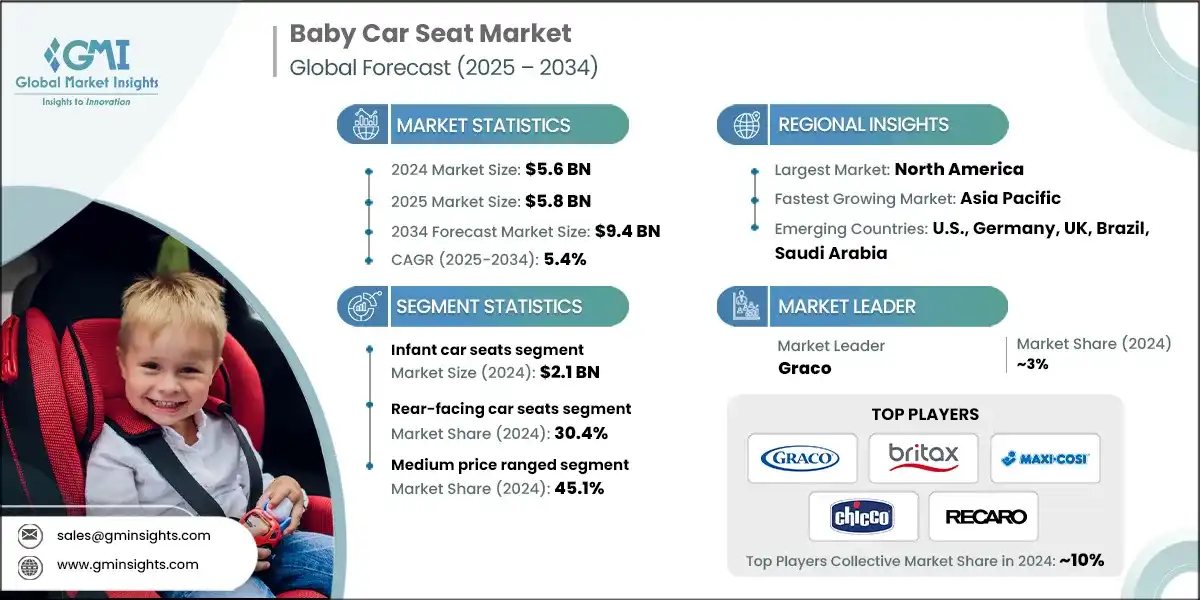
The global baby car seat market size was estimated at USD 5.6 billion in 2024. The market is expected to grow from USD 5.8 billion in 2025 to USD 9.4 billion in 2034, at a CAGR of 5.4% according to latest report published by Global Market Insights Inc.
Baby Car Seat Market Key Takeaways
Market Size & Growth
- 2024 Market Size: USD 5.6 Billion
- 2025 Market Size: USD 5.8 Billion
- 2034 Forecast Market Size: USD 9.4 Billion
- CAGR (2025–2034): 5.4%
Regional Dominance
- Largest Market: North America
- Fastest Growing Region: Asia Pacific
Key Market Drivers
- Heightened awareness of child passenger safety.
- Stringent government regulations.
- Technological advancements in safety features.
- Growing demand for premium and multi-functional seats.
Challenges
- Regulatory complexity and compliance costs.
- Price sensitivity in emerging markets.
Opportunity
- Rising birth rates in emerging economies.
- Innovation in smart and connected car seats.
Key Players
- Market Leader: Graco led with over 3% market share in 2024.
- Leading Players: Top 5 players in this market include Graco, Britax, Maxi-Cosi, Chicco, Recaro, which collectively held a market share of 10% in 2024.
Get Market Insights & Growth Opportunities
The market for baby car seats is witnessing significant growth, due to increasing child passenger safety awareness and changing consumer behavior. Parents are increasingly educated and vigilant in safeguarding children while traveling, owing to saturation of education campaigns, hospital programs, and media reporting. The National Highway Traffic Safety Administration (NHTSA) states that car seats decrease the chance of fatal injury by 71% for infants and 54% for toddlers riding in passenger vehicles. This increased awareness has created a cultural transformation in which driving with a car seat is not only the law but also an accepted parenting practice. Families are placing greater emphasis on safety and are more inclined to spend money on safe, certified car seats, even in markets with less stringent regulations. This behavior is especially common in cities and among first-time mothers and fathers, who are more open to safety innovations and high-end products.
Government policies take center stage in influencing the market. Regulations in many countries require the use of age-appropriate car seats, with non-compliance resulting in fines or legal consequences. For example, the European Union's R44/04 and R129 (i-Size) regulations prescribe stringent crash testing and material safety approval. In the United States, the Federal Motor Vehicle Safety Standard (FMVSS) 213 also prescribes stringent child restraint system requirements. These rules have led to a consistent level of demand for compliant products, prompting manufacturers to be innovative and respond to changing standards. Regulatory authorities are also revising guidelines to incorporate new studies on child safety, ensuring that the market is dynamic and adaptive to scientific knowledge.
Technological innovation is a key driver of growth, especially in the high-end segment. Contemporary baby car seats feature advanced safety technology including side-impact protection, energy-absorbing foam, and ISOFIX systems for safe mounting. There is also increasing demand for multi-purpose seats that adjust to various age groups, change between rear-facing and forward-facing configurations, and provide ergonomic designs for long-distance driving. Features such as anti-rebound bars, load legs, and temperature-control fabrics are also catching up. Sales of high-end car seats with innovative features have increased by more than 15% each year for the past three years, a report by Juvenile Products Manufacturers Association (JPMA) has established. In addition to making the ride safer, these innovations make life more convenient and comfortable, hence appealing to quality-conscious and tech-savvy buyers. Consequently, the market is moving towards premium, feature-loaded products that serve the changing needs of current parents.
To get key market trends
Baby Car Seat Market Trends
The baby car seat industry is experiencing a robust trend towards convertible & multi-purpose designs, advanced safety features and environmentally friendly and health-friendly products.
- Parents are finding more preference in car seats that can last with the child from infancy through toddler years, providing long-term value and convenience. The seats tend to blend rear-facing, forward-facing, and booster capabilities, cutting down on the need for repeated purchases. This trend is more prevalent among city dwellers and those who want space-efficient solutions. Moreover, companies are also countering with the introduction of modular systems that fit together perfectly with strollers and travel systems, with improved mobility and convenience.
- Another key trend is the advanced safety features. Today's baby car seats are equipped with features like ISOFIX systems for easy mounting, side-impact protection, energy-absorbing technology, and adjustable restraints. Some high-end models even have built-in smart sensors to notify caregivers if the child is not properly secured or abandoned. All this is prompted by regulatory compliance as well as customer requirements for added safety and comfort. With greater accessibility to technology, even mid-range models are being equipped with features previously the sole domain of high-end models, further democratizing safety across price bands.
- The market is also experiencing an increasing demand for environmentally friendly and health-friendly products. Parents are increasingly conscious of baby gear material, and demand for car seats that are made of non-toxic, organic, and recyclable material is going up. This is a trend that resonates with larger sustainability drives and chemical exposure concerns in children's products. They are reacting by introducing seats with low VOC emission certifications, flame-retardant-free materials, and ethically produced components. This transition is not only affecting product design but also marketing, as companies are emphasizing their green credentials to attract sustainable consumers.
Baby Car Seat Market Analysis

Learn more about the key segments shaping this market
Based on product type, the market can be segmented into infant car seats, convertible car seats, booster car seats, combination car seats and others. The infant car seats segment accounted for revenue of around USD 2.1 billion in the year 2024 and is estimated to grow at a CAGR of 5.4% from 2025 to 2034.
- The growth of the infant car seat segment is primarily driven by the increasing emphasis on newborn safety and the rising number of births globally. Parents are becoming more aware of the importance of using specialized car seats designed specifically for infants, especially during the first year of life when babies are most vulnerable. Hospitals, pediatricians, and government safety campaigns often recommend or even require the use of infant car seats for newborn discharge, reinforcing early adoption.
- Additionally, these seats are designed to provide optimal support for a baby’s head, neck, and spine, which makes them a preferred choice for first-time parents. The convenience of portability of many infant car seats can be easily detached and used as carriers or integrated with strollers also adds to their appeal. As a result, the segment continues to see strong demand, particularly in developed markets and urban centers where safety standards and parental awareness are high.
Learn more about the key segments shaping this market
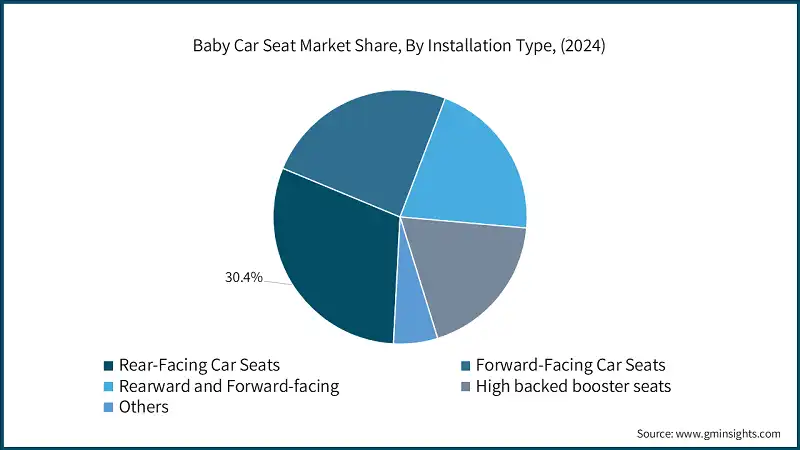
Based on installation type, the baby car seat market is segmented as rear-facing car seats, forward-facing car seats, rearwards and forward-facing seats, high backed booster seats and others. The rear-facing car seats held around 30.4% of the total market share in 2024 and is anticipated to grow at a CAGR of 5.6% during the forecast period.
- The rear-facing car segment is experiencing notable growth due to its superior safety benefits for infants and young toddlers. Rear-facing seats are widely recommended by pediatricians and safety organizations because they provide better support for a child’s head, neck, and spine in the event of a collision. As awareness of these safety advantages increases, more parents are choosing to keep their children in rear-facing seats for longer durations, often beyond the minimum legal requirements.
- Additionally, updated safety regulations in several countries now mandate extended rear-facing usage, further driving demand. Manufacturers are also responding by designing rear-facing seats that accommodate larger weight and height limits, making them suitable for older toddlers. This combination of regulatory support, medical endorsement, and evolving product design is fueling the segment’s continued expansion.
Based on price, the baby car seat market is segmented as low, medium & high. The medium price ranged car seats held around 45.1% of the total market share in 2024 and is anticipated to grow at a CAGR of 5.4% during the forecast period.
- The growth of the medium-priced car seats is driven by its ideal balance between affordability and advanced safety features, making it the most appealing choice for middle-income families. These car seats often include essential safety technologies like side-impact protection and easy installation systems, without the premium cost of high-end models.
- Additionally, they offer better durability and comfort than low-priced options, making them a value-for-money solution for parents who want reliable protection without overspending. This segment also benefits from strong availability across both retail and e-commerce channels, further supporting its widespread adoption.
Looking for region specific data?
North America Baby Car Seat Market
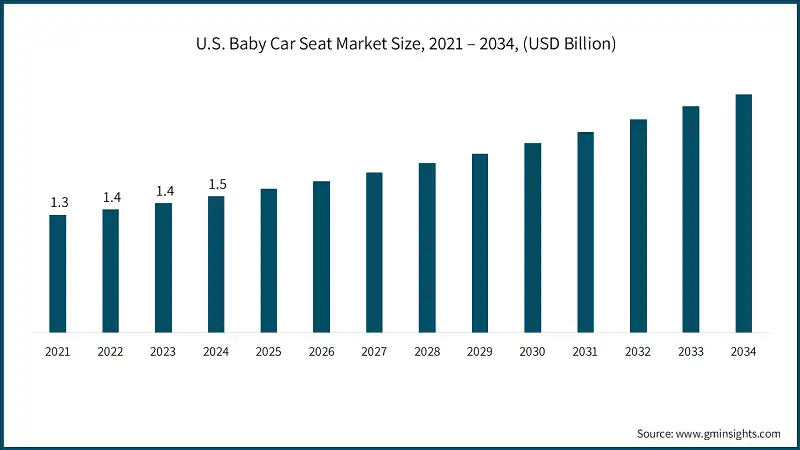
The U.S. dominates an overall North America market and valued at USD 1.5 billion in 2024 and is expected to grow at a CAGR of 5.8% during the forecast period from 2025 to 2034.
- The country has well-established child passenger safety laws that mandate the use of car seats for infants and young children, which has created a consistent and mature demand base. Additionally, American parents are highly informed about child safety standards and tend to prioritize premium, feature-rich car seats that offer advanced protection and comfort. The widespread availability of products through both offline and online retail channels, along with frequent product innovations by leading brands, further supports market growth.
- Moreover, the U.S. benefits from a high rate of vehicle ownership and a culture of frequent travel, both of which contribute to the sustained need for reliable child restraint systems. These factors collectively position the U.S. as the leading market within the North American region.
Europe Baby Car Seat Market
The market in Europe, Germany is expected to experience significant and promising growth from 2025 to 2034.
- Germany, being a leader in automotive innovation and safety, has well-established child passenger safety laws that mandate the use of certified car seats for infants and young children. This regulatory environment, coupled with a high level of parental education and awareness, ensures consistent demand for high-quality, safety-compliant products.
- Moreover, German consumers tend to prioritize durability, engineering precision, and eco-conscious materials, which aligns well with the growing trend toward premium, multifunctional, and sustainable baby car seats. The presence of leading global and domestic brands, along with a robust distribution network both online and offline further supports market expansion.
Asia Pacific Baby Car Seat Market
The Asia Pacific market, China held 32.9% market share in 2024 and is expected to grow at a CAGR of 5.8% during the forecast period from 2025 to 2034.
- One of the primary drivers is the increasing enforcement of child safety regulations, particularly in urban centers where traffic safety is a growing concern. The Chinese government has been actively promoting child passenger safety through awareness campaigns and legislation, which is gradually making car seat usage more common among families.
- Additionally, rising disposable incomes and the expansion of the middle-class population are enabling more parents to invest in quality baby car seats, especially in tier-1 and tier-2 cities. The market is also benefiting from the growth of e-commerce platforms, which have made a wide range of domestic and international brands more accessible to consumers across the country.
Middle East and Africa Baby Car Seat Market
In the Middle East and Africa market, Saudi Arabia held 35.7% market share in 2024 and is expected to grow at a CAGR of 4.1% during the forecast period from 2025 to 2034.
- The Saudi government has been actively promoting road safety, and recent regulations mandating the use of child restraint systems in vehicles have significantly boosted demand for baby car seats. Additionally, as more women are driving and participating in the workforce, there is a growing need for safe and convenient child transportation solutions.
- The country’s increasing birth rate, coupled with a young population and rising disposable incomes, is also contributing to market expansion. Urbanization and the growing influence of Western parenting practices are encouraging families to prioritize child safety and invest in quality baby gear.
Baby Car Seat Market Share
- In 2024, the prominent manufacturers in market are Graco, Britax, Maxi-Cosi, Chicco, and Recaro together these companies hold the market share of ~6-10%. These companies maintain their competitive edge through a combination of product innovation, strategic partnerships, and sustainability-driven initiatives.
- Britax exemplifies engineering excellence and an unwavering commitment to safety. The brand is renowned for its ClickTight installation system, which simplifies seatbelt setup, and its SafeCell technology, designed to absorb crash energy effectively. Britax further enhances safety with multi-layer side-impact protection, V-shaped tethers, and steel-reinforced frames that ensure superior structural integrity. Through extensive crash testing and the use of chemical-free fabrics, Britax attracts health-conscious and safety-focused consumers. Its reputation for durability, cutting-edge innovation, and premium safety features solidifies Britax’s leadership in the high-end market segment.
- Chicco capitalizes on its Italian heritage to create products that seamlessly blend style, safety, and practicality. The brand’s KeyFit series is widely acclaimed for its ease of installation and compatibility with Chicco strollers. Chicco prioritizes user comfort and convenience by offering features such as adjustable headrests, machine-washable covers, and breathable fabrics. With a strong focus on eco-conscious manufacturing, Chicco incorporates sustainable materials and environmentally friendly packaging. By delivering car seats that are stylish, functional, and affordable, Chicco establishes itself as a formidable competitor in both developed and emerging markets.
Baby Car Seat Market Companies
Major players operating in the baby car seat industry include:
- Ailebebe
- Aprica
- BeSafe
- Britax
- Chicco
- Combi Corporation
- Concord
- Goodbaby
- Graco
- Jane Group
- Joyson Safety Systems
- Kiddy
- Maxi-Cosi
- Recaro
- Stokke
Dorel Juvenile, the parent company of prominent brands like Safety 1st, Cosco, and Maxi-Cosi, fortifies its market position through strategic diversification, competitive pricing, and robust domestic manufacturing capabilities. Operating one of the largest car seat manufacturing facilities in the U.S., Dorel achieves cost efficiency, streamlined supply chain management, and strict regulatory compliance. Its expansive product portfolio spans various price points, ensuring safety is accessible to a broad consumer demographic. Furthermore, Dorel leads in sustainable product innovation by utilizing recyclable materials and modular designs that integrate seamlessly with strollers and travel systems. This adaptability, combined with its operational scale, positions Dorel as a resilient leader in a highly competitive market.
Graco maintains its competitive advantage through continuous product innovation and a strong emphasis on user-centric design. The brand has introduced several groundbreaking products, including the EasyTurn 360° Convertible Car Seat, designed for effortless child access, and the 4Ever DLX Grad 5-in-1 Car Seat, which adapts to a child’s growth from infancy to pre-teen years. Graco’s ProtectPlus Engineered safety system underscores its commitment to rigorous crash testing and superior performance standards. Features like the SnugLock and InRight LATCH systems simplify installation, enhancing user convenience. By combining advanced safety features, extended product longevity, and exceptional ease of use, Graco appeals to modern families seeking reliable, value-driven solutions.
Baby Car Seat Market Report Attributes
| Key Takeaway | Details |
|---|---|
| Market Size & Growth | |
| Base Year | 2024 |
| Market Size in 2024 | USD 5.6 Billion |
| Market Size in 2025 | USD 5.8 Billion |
| Forecast Period 2025 - 2034 CAGR | 5.4% |
| Market Size in 2034 | USD 9.4 Billion |
| Key Market Trends | |
| Drivers | Impact |
| Heightened awareness of child passenger safety | Drives consistent demand as parents prioritize safety from infancy, boosting early adoption rates. |
| Stringent government regulations | Ensures mandatory usage, expanding market size and encouraging innovation to meet compliance. |
| Technological advancements in safety features | Enhances product appeal and differentiation, especially in premium segments. |
| Growing demand for premium and multi-functional seats | Increases average selling price and encourages long-term use across age groups. |
| Pitfalls & Challenges | Impact |
| Regulatory complexity and compliance costs | Raises barriers for entry and increases operational costs for global manufacturers. |
| Price sensitivity in emerging markets | Limits adoption of high-end products and forces brands to compromise on margins or features. |
| Opportunities: | Impact |
| Rising birth rates in emerging economies | Expands the customer base and opens new markets for affordable and entry-level products. |
| Innovation in smart and connected car seats | Creates differentiation and attracts tech-savvy parents, especially in developed markets. |
| Market Leaders (2024) | |
| Market Leaders |
Market share of ~3% |
| Top Players |
Collective market share in 2024 ~10% |
| Competitive Edge |
|
| Regional Insights | |
| Largest Market | North America |
| Fastest growing market | Asia Pacific |
| Emerging countries | U.S., Germany, UK, Brazil, Saudi Arabia |
| Future outlook |
|
What are the growth opportunities in this market?
Baby Car Seat Industry News
- In January 2025, Evenflo, a leading innovator in infant and children's products, introduced the SensorySoothe at CES Las Vegas. This groundbreaking product is designed to calm crying babies and alleviate parental stress during travel, setting a new standard in childcare solutions.
- In April 2024, Maxi-Cosi, a globally renowned brand for child safety and comfort, expanded its presence across key Middle Eastern markets, including the UAE, Kuwait, Oman, Qatar, and Saudi Arabia. The Maxi-Cosi 360 Pro Family, equipped with the advanced Slide Tech technology, earned the prestigious “Product of the Year” award in the UAE, highlighting the company's cutting-edge contributions to global child mobility solutions.
- In 2024, Diono launched the Connect3 series, a revolutionary 3-in-1 booster seat that fits three across in most mid-sized sedans. Measuring just 17” wide, this convertible seat features patented nestling cup holders and a contoured EasyReach buckle, offering seamless accessibility for children seated side by side.
- In September 2024, Dorel Industries, a globally recognized leader in juvenile products under Dorel Juvenile USA, announced a long-term collaboration between Safety 1st and Tinyhood, an online parenting education platform. This partnership focuses on creating a comprehensive digital content series to empower young families with the knowledge and confidence to navigate key parenting milestones safely.
The baby car seat market research report includes in-depth coverage of the industry, with estimates & forecasts in terms of revenue (USD Billion) and volume (Thousand Units) from 2021 to 2034, for the following segments:
Market, By Product type
- Infant car seats
- Convertible car seats
- Combination car seats
- Booster car seats
- High back booster seats
- Backless booster seats
Market, By Installation Type
- Rear-facing car seats
- Forward-facing car seats
- Combination car seats
- Belt-positioning booster seats
Market, By Weight
- Below 50 LB
- 50 LB- 100 LB
- Above 100 LB
Market, By Price
- Low
- Medium
- High
Market, By Age Group
- Newborn (0-6 months)
- Infants (6 month- 2 years)
- Toddlers (2-5 years)
- Others (above 5 years)
Market, By End-User
- Individual consumers
- Hospitals & clinics
- Childcare facilities
- Car rental companies
Market, By Distribution Channel
- Online
- E-commerce websites
- Company-owned websites
- Offline
- Supermarket/hypermarket
- Departmental stores
- Others
The above information is provided for the following regions and countries:
- North America
- U.S.
- Canada
- Europe
- Germany
- UK
- France
- Italy
- Spain
- Asia Pacific
- China
- Japan
- India
- South Korea
- Australia
- Indonesia
- Malaysia
- Latin America
- Brazil
- Mexico
- Argentina
- MEA
- Saudi Arabia
- UAE
- South Africa
Frequently Asked Question(FAQ) :
What is the market size of the baby car seat market in 2024?
The market size was USD 5.6 billion in 2024, driven by heightened child passenger safety awareness, strict government regulations, and increasing consumer preference for certified car seats.
What is the projected market value of the baby car seat market by 2034?
The market is expected to reach USD 9.4 billion by 2034, expanding at a CAGR of 5.4% due to rising demand for multifunctional, smart, and eco-friendly seats.
What is the estimated market size of the baby car seat industry in 2025?
The market is projected to reach USD 5.8 billion in 2025, supported by regulatory mandates, technological innovations, and increasing birth rates in emerging economies.
Which product type segment led the baby car seat industry in 2024?
The infant car seats segment led the market with USD 2.1 billion revenue in 2024, accounting for the largest share due to the growing emphasis on newborn safety and early adoption among parents.
What was the share of the rear-facing car seat segment in 2024?
The rear-facing car seat segment held 30.4% market share in 2024 and is projected to grow at a CAGR of 5.6%, owing to superior protection for infants and regulatory support for extended rear-facing usage.
Which price segment dominated the market in 2024?
The medium price segment accounted for 45.1% of total market share in 2024, driven by strong consumer preference for safety and affordability balance.
Which region leads the market?
North America dominated the market in 2024 with USD 1.5 billion revenue, backed by strict child safety regulations, high vehicle ownership, and advanced product availability.
Which region is expected to be the fastest growing in the baby car seat market?
The Asia-Pacific region is projected to grow at a CAGR of 5.8% through 2034, fueled by rising disposable incomes, enforcement of safety regulations, and growth in e-commerce retail channels.
Who are the key players in the baby car seat market?
Key players include Graco, Britax, Maxi-Cosi, Chicco, Recaro, Dorel Juvenile, Evenflo, Combi Corporation, Goodbaby, and Joyson Safety Systems.
Baby Car Seat Market Scope
Related Reports