Summary
Table of Content

Automotive Regenerative Braking Market
Get a free sample of this report
Form submitted successfully!
Error submitting form. Please try again.
Thank you!
Your inquiry has been received. Our team will reach out to you with the required details via email. To ensure that you don't miss their response, kindly remember to check your spam folder as well!
Request Sectional Data
Thank you!
Your inquiry has been received. Our team will reach out to you with the required details via email. To ensure that you don't miss their response, kindly remember to check your spam folder as well!
Form submitted successfully!
Error submitting form. Please try again.
Automotive Regenerative Braking Market Size
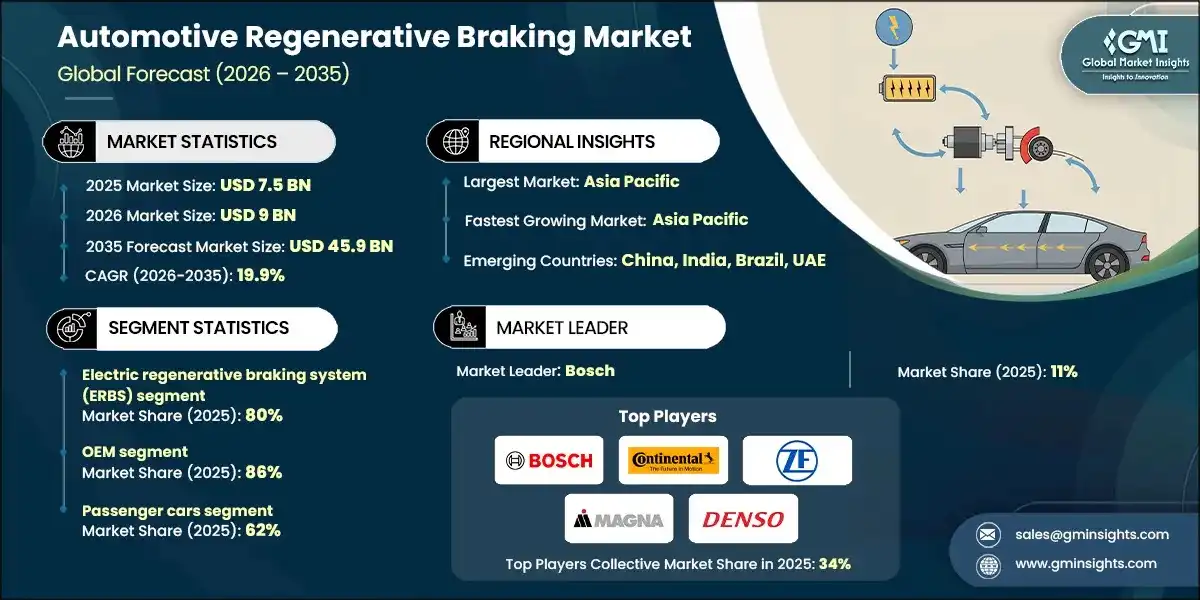
The global automotive regenerative braking market was estimated at USD 7.5 billion in 2025. The market is expected to grow from USD 9 billion in 2026 to USD 45.9 billion in 2035, at a CAGR of 19.9% according to latest report published by Global Market Insights Inc.
Automotive Regenerative Braking Market Key Takeaways
Market Size & Growth
- 2025 Market Size: USD 7.5 Billion
- 2026 Market Size: USD 9 Billion
- 2035 Forecast Market Size: USD 45.9 Billion
- CAGR (2026–2035): 19.9%
Key Market Drivers
- Rapid adoption of EVs, HEVs, and PHEVs.
- Stricter emission regulations and environmental awareness.
- Rising demand for fuel-efficient vehicles.
- Technological advancements in braking systems.
- Shift toward smart and connected vehicles.
Challenges
- High cost of regenerative braking systems.
- Complex integration with existing vehicle systems.
Opportunity
- Rising electric and hybrid vehicle adoption.
- Expansion of EV charging infrastructure.
- Growing demand for fuel-efficient and eco-friendly vehicles.
- Integration with smart and connected vehicle technologies.
Key Players
- Market Leader: Bosch led with over 11% market share in 2025.
- Leading Players: Top 5 players in this market include Bosch, Continental, ZF, Magna International, Denso, which collectively held a market share of 34% in 2025.
Get Market Insights & Growth Opportunities
Automotive regenerative braking systems convert kinetic energy from deceleration into reusable electrical energy, playing a vital role in the shift toward electrification and sustainability. The market includes electric, hydraulic, kinetic, and pneumatic systems used in passenger vehicles, commercial vehicles, two-wheelers, and specialized applications.
The market size is projected to grow significantly through 2035, with strong year-over-year growth in the near term driven by rapid adoption in key applications. Electrification and efficiency demands are expected to propel substantial expansion over the medium term. The most pronounced growth is anticipated in the latter years of the forecast period, driven by widespread deployment across vehicle platforms and regions.
Global electric vehicle sales are projected to reach 45 million units annually by 2035, up from approximately 14 million units in 2024. Regenerative braking system penetration in the EV segment is expected to rise from 78% in 2024 to nearly 95% by 2035, as it becomes standard across all price segments.
The global market value is concentrated in key economic regions. Asia Pacific leads with 41%, driven by China's dominance in automotive manufacturing and EV production. Europe follows with 31%, supported by emission regulations and government incentives, while North America accounts for 20%, primarily led by the U.S. market.
Regenerative braking systems play a crucial role in ADAS and autonomous vehicles by providing precise braking and recovering energy. Equipped with advanced sensors, real-time data processing, and machine learning, they optimize energy recovery across diverse driving conditions.
Governments globally are enforcing stricter vehicular emission standards to address climate change and urban air pollution. The EU's Euro 7 standards, set for 2025, will impose the toughest emission limits worldwide, while the U.S. CAFE standards drive continuous improvements in fleet-wide fuel efficiency.
Advancements in battery technology, supercapacitors, and power electronics have significantly improved regenerative braking systems. Lithium-ion batteries now exceed 250 Wh/kg in energy density, while silicon carbide (SiC) power semiconductors reduce energy conversion losses by 40-50%, boosting system efficiency from 70% to over 90%.
To get key market trends
Automotive Regenerative Braking Market Trends
The automotive regenerative braking market is experiencing several transformative trends that are reshaping technology development, market dynamics, and competitive positioning. These trends reflect broader shifts in the automotive industry toward electrification, digitalization, and sustainability.
Brake-by-wire (BBW) architectures are replacing traditional hydraulic brake systems by eliminating mechanical linkages. This transition enables advanced integration of regenerative and friction braking, improving energy recovery while ensuring precise control and driver experience.
This technology offers key advantages over traditional brake systems, including a 12-18% improvement in energy recovery efficiency through precise control of regenerative-to-friction braking transitions.
By eliminating hydraulic components, system weight decreases by 15-20%, enhancing vehicle efficiency and range. Additionally, the brake-by-wire architecture supports advanced safety features like automated emergency braking, adaptive cruise control, and autonomous driving with millisecond-level brake actuation precision.
Lithium-ion batteries dominate energy storage in regenerative braking systems, but supercapacitors are gaining traction for high power density and rapid charge-discharge needs. With energy transfer rates 10-20 times faster than conventional batteries, supercapacitors excel in capturing energy during intense braking events.
Hybrid energy storage systems combining supercapacitors with batteries are increasingly used in commercial and performance vehicles, as well as stop-start applications. Supercapacitors absorb high intensity braking energy, reducing battery stress and extending lifespan by 25-35%, as per Department of Energy testing.
Electric buses with regenerative braking systems recover 30-40% of energy in urban operations, saving USD 15,000-25,000 annually per vehicle. Economic and environmental benefits are driving the adoption of regenerative braking in commercial vehicles and public transportation.
Automotive Regenerative Braking Market Analysis
Learn more about the key segments shaping this market
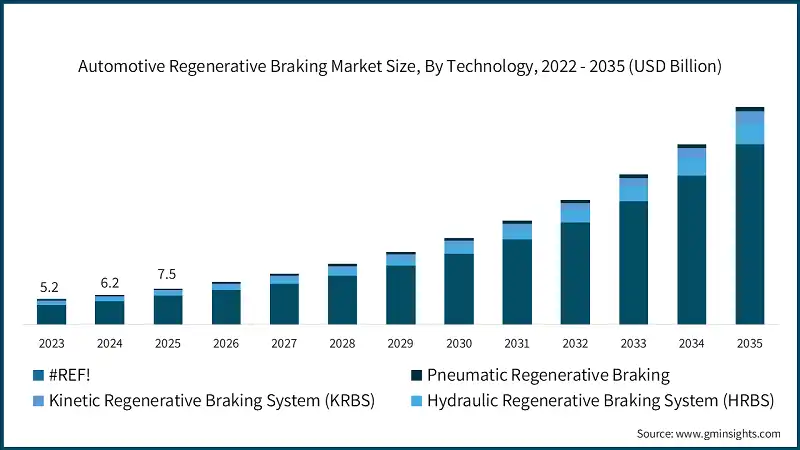
Based on technology, automotive regenerative braking market is segmented into electric regenerative braking system (ERBS), hydraulic regenerative braking system (HRBS), kinetic regenerative braking system (KRBS), and pneumatic regenerative braking. The electric regenerative braking system (ERBS) segment dominates the market with 80% share in 2025, and the segment is expected to grow at a CAGR of 20.3% from 2026 to 2035.
- Electric regenerative braking leverages the traction motor's generator mode to convert kinetic energy into electrical energy during deceleration, storing recovered energy in the vehicle's battery system.
- ERBS technology offers several advantages including high energy conversion efficiency (typically 70-85%), seamless integration with electric and hybrid powertrains, and compatibility with advanced vehicle control systems
- The technology is standard equipment on virtually all battery electric vehicles and plug-in hybrids, with adoption also expanding in mild hybrid vehicles equipped with 48-volt electrical systems.
- Recent technological advances including silicon carbide power electronics and improved motor designs have increased ERBS efficiency by 8-12% compared to systems deployed in 2020.
- Hydraulic regenerative braking systems (HRBS) constitute 10% of the automotive regenerative braking market value. The segment is forecasted to reach USD 4.5 billion by 2035, growing at a CAGR of 19.6%.
- HRBS captures braking energy by pumping hydraulic fluid into an accumulator, storing energy as compressed fluid that can subsequently drive hydraulic motors to assist vehicle propulsion.
- The technology is particularly suited to heavy commercial vehicles and applications requiring high braking forces.
- HRBS systems deliver power density advantages over electric systems, with the ability to capture and release energy at very high rates during aggressive braking events.
- This characteristic makes hydraulic regenerative braking attractive for applications including refuse collection trucks, buses operating in hilly terrain, and delivery vehicles with frequent stop-start cycles.
- Kinetic energy recovery systems (KERS) use flywheel technology to mechanically store kinetic energy. These high-speed flywheels capture braking energy and release them during acceleration, enhancing efficiency.
- Originally developed for Formula 1 racing applications, KERS technology is being adapted for commercial applications including hybrid buses and performance vehicles.
- Pneumatic regenerative braking, the smallest technology segment, is projected to reach USD 866.9 billion by 2035. It is expected to grow at a 10.7% CAGR, the slowest rate among all technology segments.
- Pneumatic systems capture braking energy by compressing air, which is subsequently used to assist vehicle acceleration or power auxiliary systems.
- The technology finds limited application in specialized heavy vehicles and rail applications where compressed air systems are already present for primary brake actuation.
Learn more about the key segments shaping this market
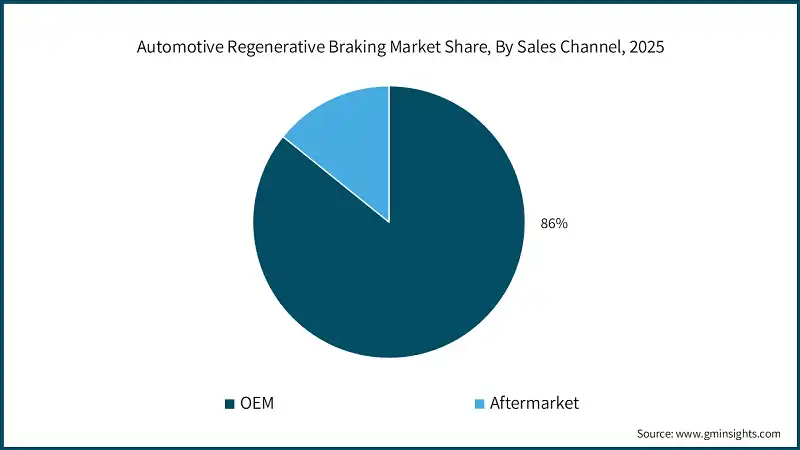
Based on sales channel, automotive regenerative braking market is divided into OEM and aftermarket. The OEM segment dominates with 86% market share in 2025 and is growing at the fastest rate of 20.2% CAGR till 2035.
- OEM channels encompass regenerative braking systems integrated during vehicle manufacturing, covering both factory-installed systems and those provided to automakers for assembly.
- Regenerative braking's close ties to vehicle powertrains and control systems underscore the OEM segment's lead, necessitating its installation during manufacturing instead of as an aftermarket retrofit.
- Major automotive suppliers, including Bosch, Continental, ZF, and Denso supply regenerative braking systems to automakers through long-term supply agreements.
- These relationships typically span multiple vehicle programs and model years, providing supply chain stability and enabling collaborative technology development.
- OEMs are tailoring regenerative braking system specifications to suit specific vehicle platforms, calibrating them for factors like vehicle weight, powertrain traits, and intended applications.
- Aftermarket sales account for 14% of the automotive regenerative braking market's total value. This segment is set to reach USD 5.6 billion by 2035, growing at an 18.1% CAGR, though it trails behind OEM growth rates.
- The aftermarket segment focuses on replacement and upgrading applications, with limited retrofitting opportunities for regenerative braking due to high integration complexity and costs.
- The demand for aftermarket regenerative braking primarily stems from component replacements in vehicles no longer under warranty. Aging electric and hybrid vehicles drive this need as they require system repairs or upgrades.
- Performance-oriented aftermarket regenerative braking systems are available for enthusiast applications, offering enhanced energy recovery or customized braking feel.
- Commercial fleet operators are retrofitting regenerative braking systems to extend vehicle service life or improve operating economics. This, however, accounts for a small share of overall aftermarket activity.
Based on vehicle, the automotive regenerative braking market is segmented into passenger cars, commercial vehicles, two-wheelers and others. The passenger cars segment dominates with 62% market share in 2025 with 19.8% CAGR during 2026 to 2035.
- The passenger vehicle segment encompasses sedans, SUVs, crossovers, and hatchbacks across all price segments, with regenerative braking penetration increasing as electric and hybrid variants proliferate.
- Premium and luxury passenger vehicles led initial regenerative braking adoption, but technology is rapidly expanding into mass-market vehicle segments as costs decline and consumer expectations evolve.
- Battery electric vehicle (BEV) sales are projected to reach 32 million units globally by 2030. Regenerative braking, with 78% penetration in 2024, is expected to rise to 95% by 2030 as entry-level EV models adopt the technology.
- The system's ability to extend electric range by 15-25% in urban driving addresses range anxiety concerns while reducing total cost of ownership through decreased brake maintenance requirements.
- Commercial Vehicles, the second-largest segment, are set to grow to USD 13.2 billion by 2035, boasting a robust 20.4% CAGR, outpacing the growth rates of passenger vehicles.
- The commercial vehicle category includes light commercial vehicles (LCVs), medium-duty trucks, heavy-duty trucks, and specialty vehicles.
- Commercial fleet operators are increasingly adopting electric vehicles with regenerative braking to reduce fuel costs, fulfill sustainability goals, and comply with zero-emission regulations in major cities worldwide.
- Electric delivery vans and light trucks are experiencing the most rapid growth within the commercial segment, driven by e-commerce expansion and last-mile delivery electrification.
- Leading manufacturers like Ford, Mercedes-Benz, and Rivian have launched electric commercial vehicles equipped with advanced regenerative braking systems, recovering 25-30% of braking energy in urban delivery cycles.
- Two-Wheelers are the fastest-growing vehicle segment, with a 21.8% CAGR. This growth highlights the rapid expansion of the electric two-wheeler market, particularly in Asia Pacific, where motorcycles and scooters are key modes of personal transportation.
- India and China together account for over 85% of global electric two-wheeler sales, with combined annual sales exceeding 20 million units in 2024.
- Regenerative braking adoption in two-wheelers faces unique technical challenges including weight sensitivity, packaging constraints, and cost pressures in price-competitive markets.
- In 2024, innovative hub-motor designs with regenerative braking functionality accounted for 32% of electric two-wheeler production, driving significant adoption.
- Other categories include specialty vehicles such as golf carts, airport vehicles, industrial equipment, and recreational vehicles.
Looking for region specific data?
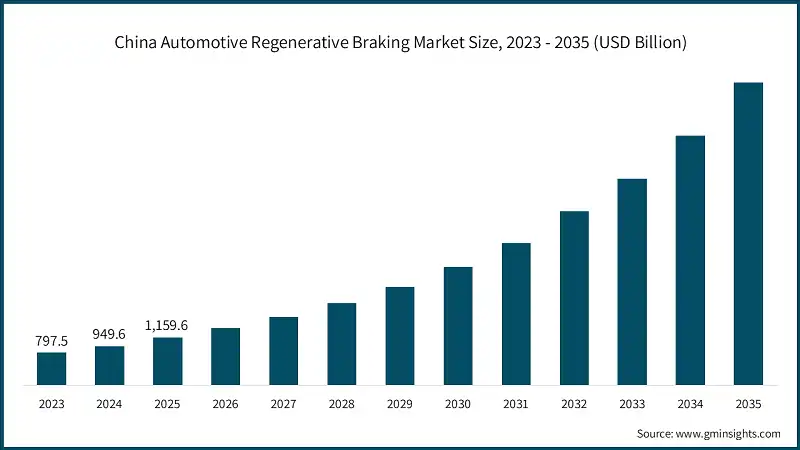
The China automotive regenerative braking market is expected to experience significant and promising growth with a CAGR of 20.3% from 2026 to 2035.
- China dominates the global automotive industry with 26 million vehicles sold annually, driven by government policies promoting EV adoption through subsidies, licensing benefits, and ICE vehicle restrictions.
- Its robust domestic EV supply chain spans batteries, motors, power electronics, and vehicle manufacturing.
- Chinese automakers including BYD, SAIC, Geely, and NIO have emerged as global EV leaders, collectively producing over 8 million electric vehicles in 2024.
- These manufacturers have made regenerative braking a standard feature across their model ranges, driving rapid technology adoption.
- China's charging infrastructure, with over 1.2 million public charging points, ensures high EV utilization rates and enhances the benefits of regenerative braking's range extension.
- China's regenerative braking market is supported by key domestic suppliers, including CATL for battery systems and BYD for integrated power electronics, strengthening its ecosystem.
- Chinese suppliers leverage a localized supply chain to achieve rapid innovation and cost efficiency, offering regenerative braking systems at 20-30% lower costs than European or North American suppliers.
Asia Pacific dominated the automotive regenerative braking market with a market share of 41%, which is anticipated to grow at a CAGR of 20.8% during the analysis timeframe.
- Asia Pacific dominates the market, driven by China's leadership in global EV manufacturing and sales, along with rapid growth in EV markets across India, Japan, South Korea, and Southeast Asia.
- China is expected to dominate the Asia Pacific market, contributing USD 1.2 billion (38% of regional value) in 2025. The market is projected to grow at a CAGR of 20.3%, reaching USD 7.3 billion by 2035.
- India is the region's second-largest market in 2024, driven by electric two-wheeler sales exceeding 3 million units annually.
- The faster adoption and manufacturing of electric vehicles (FAME) program, a government initiative, provides financial incentives to accelerate electric vehicle adoption across multiple categories.
- Despite lagging China in EV adoption rates, Japan boasts a robust market presence, leveraging its expertise in hybrid vehicles to spearhead advancements in regenerative braking technology.
- Leading the charge, Japanese automotive suppliers such as Denso, Aisin, and Hitachi Astemo have established themselves as global frontrunners in regenerative braking systems, catering to both domestic and international automakers.
- South Korea, supported by strong government initiatives, is rapidly advancing EV production through Hyundai, Kia, and emerging manufacturers, focusing on battery and electric powertrain technology.
- Southeast Asian markets, including Indonesia, Thailand, Vietnam, and the Philippines, present significant growth potential for electric two-wheelers and commercial vehicles.
- Global automakers and suppliers are heavily investing in these markets by establishing EV-focused production facilities to meet rising domestic demand and export needs.
US dominated the North America automotive regenerative braking market with a CAGR of 18.7% during the analysis timeframe.
- In 2025, the US is expected to dominate 81% of the North American market's value. The market is projected to reach USD 6.7 billion by 2035, growing at a CAGR of 18.7%.
- The United States, selling approximately 15 million vehicles annually, is the world's second-largest automotive market and a key area for regenerative braking adoption.
- In 2024, Tesla leads the U.S. market, accounting for over 50% of domestic BEV sales.
- In 2024, Tesla accounted for over 50% of domestic BEV sales in the U.S. Its innovative use of regenerative braking with one-pedal driving has set consumer expectations for EV braking performance.
- General Motors and Ford, leading U.S. automakers, plan to invest over USD 100 billion in electric vehicle and battery technology development by 2030.
- Federal policies including EPA emission standards, Corporate Average Fuel Economy (CAFE) requirements, and Inflation Reduction Act incentives are accelerating U.S. EV adoption.
- California and other states implementing Advanced Clean Cars regulations mandate 100% zero-emission light-duty vehicle sales by 2035. These policies aim to accelerate the adoption of zero-emission vehicles.
North America automotive regenerative braking market accounted for USD 1.5 billion in 2025 and is anticipated to show growth of 18.9% CAGR over the forecast period.
- By 2025, North America is expected to be the third-largest regional market, valued at USD 1.5 billion with a 20% global market share.
- It is projected to reach USD 8.5 billion by 2035, growing at an 18.9% CAGR, slightly below the global average due to the United States' mature market conditions.
- The United States leads the North American market, holding the largest share in the base year, and is expected to maintain its dominance during the forecast period. This growth is driven by technological advancements, strong adoption trends, and expanding automotive applications.
- The U.S. regenerative braking market faces challenges due to consumer preferences for larger vehicles like SUVs and trucks, longer daily driving distances that reduce regenerative braking benefits on highways, and historically low fuel prices diminishing the appeal of efficiency technologies.
- Canada's EV market benefits from strong federal and provincial incentives, though cold climates challenge regenerative braking systems. Urban areas like Toronto, Vancouver, and Montreal exhibit high environmental awareness.
- Canadian automotive manufacturing is closely integrated with U.S. operations, with major assembly plants producing both conventional and electric vehicles for North American markets.
- Quebec, British Columbia, and Ontario have introduced ambitious EV adoption targets and significant investments in charging infrastructure, driving the growth of the regenerative braking market.
Germany dominates the Europe automotive regenerative braking market, showcasing strong growth potential, with a CAGR of 20% from 2026 to 2035.
- Germany, the largest automotive manufacturer in Europe and a global leader in automotive technology, is home to Volkswagen Group, BMW, and Mercedes-Benz, all heavily investing in electric vehicle portfolios.
- Volkswagen Group alone plans to offer over 75 battery electric models by 2030, with regenerative braking standard across the lineup.
- German automotive suppliers Bosch, Continental, and ZF are global leaders in regenerative braking technology, collectively investing over EUR 2 billion annually in electric powertrain development.
- Germany's sophisticated manufacturing infrastructure and engineering expertise enable rapid scaling of regenerative braking production to meet growing global demand.
- The country's Energiewende energy transition policy and ambitious climate targets are driving both domestic EV adoption and export-oriented electric vehicle manufacturing.
- Germany's regenerative braking market thrives due to strong collaboration among automotive manufacturers, suppliers, and research institutions, including the Fraunhofer Society.
- This collaborative environment fosters rapid advancements in brake-by-wire systems, advanced energy storage, and autonomous driving platform integration.
Europe automotive regenerative braking market accounted for USD 2.3 billion in 2025 and is anticipated to show growth of 19.7% CAGR over the forecast period.
- Europe's substantial market size reflects stringent emission regulations, extensive government incentives for EV adoption, and strong consumer environmental consciousness driving electric vehicle demand.
- Germany leads the European market in 2025, holding a significant share of the regional value. It is expected to grow further by 2035, driven by a strong compound annual growth rate.
- The Rest of Europe automotive market includes key countries such as France, the United Kingdom, Italy, Spain, the Netherlands, Sweden, and Norway, each with unique characteristics and regulatory frameworks.
- In 2025, Norway led Europe in per-capita EV adoption, with electric vehicles comprising over 80% of new vehicle sales, driven by tax incentives, extensive charging infrastructure, and strong environmental awareness.
- The Netherlands holds a 45% EV market share, while Sweden follows with 40%, driven by supportive government policies and advanced charging infrastructure.
- France is Europe's second-largest automotive market after Germany, driven by domestic leaders Stellantis and Renault Group, both advancing in electric vehicle transitions.
- The United Kingdom's market is growing rapidly despite Brexit-related uncertainties, driven by government policies such as the 2030 ICE vehicle sales phase-out, which is boosting EV adoption.
- Southern European markets, including Italy and Spain, are witnessing significant growth in EV adoption due to government incentives and expanding charging infrastructure, which are addressing previous adoption barriers.
- Economic growth and EU membership are driving the modernization and electrification of the automotive sector in Eastern Europe, creating emerging opportunities in these markets.
Brazil leads the Latin American automotive regenerative braking market, exhibiting remarkable growth of 18.8% during the forecast period of 2026 to 2035.
- In 2025, Brazil leads the Latin American market, holding a significant share of the regional value. By 2035, it is expected to achieve substantial growth, driven by a strong compound annual growth rate.
- Brazil, Latin America's largest economy and automotive market, is driving regenerative braking adoption due to rising environmental awareness, urban air quality concerns in cities like Sao Paulo and Rio de Janeiro, and government efforts promoting sustainable transportation.
- Brazil generates over 80% of its electricity from hydroelectric and other renewable sources, creating a strong renewable energy infrastructure that supports EV adoption by aligning vehicle charging with the nation's clean energy profile.
- Volkswagen, General Motors, and Stellantis are incorporating electric models with regenerative braking into local manufacturing to cater to domestic and regional markets.
UAE to experience substantial growth in the Middle East and Africa automotive regenerative braking market in 2025.
- The United Arab Emirates is expected to lead the MEA market in 2025 with a 29% share of regional value. By 2035, its market value is projected to reach USD 294.7 billion, growing at a CAGR of 18.7%.
- Dubai and Abu Dhabi are driving sustainable transportation in the UAE, with plans to convert 30% of government fleets to electric by 2030 and significant investments in EV charging infrastructure.
- The UAE's economic diversification efforts, coupled with its wealth and advanced infrastructure, are driving favorable conditions for regenerative braking adoption.
- Dubai's autonomous vehicle projects and Abu Dhabi's sustainable city developments integrate electric vehicles with advanced regenerative braking systems as key components.
Automotive Regenerative Braking Market Share
- The top 7 companies in the automotive regenerative braking industry are Bosch, Continental, ZF, Magna International, Denso, BorgWarner and Valeo contributed around 35% of the market in 2025.
- Bosch leverages its expertise in automotive systems integration, strong R&D capabilities, and global manufacturing presence across 60+ countries to maintain market leadership. Its regenerative braking portfolio includes electric, hydraulic, and kinetic systems for various vehicle applications.
- Continental integrates regenerative braking solutions into its electronic brake systems portfolio. As a pioneer in brake-by-wire technology, it leads in optimizing regenerative and friction brake blending.
- ZF Friedrichshafen became the second-largest supplier by acquiring TRW Automotive in 2015. This acquisition enhanced its regenerative braking capabilities and integrated TRW's brake systems expertise with ZF's powertrain and chassis technologies.
- Magna International delivers regenerative braking components and systems through its Power and Vision business unit. The company offers modular, customizable solutions, including integrated electric drive units that combine motor, gearbox, and regenerative braking functionalities in compact designs.
- Denso, a leading Japanese automotive supplier and Toyota member, leverages decades of hybrid vehicle technology development to refine its regenerative braking systems. These systems emphasize reliability, efficiency, and compact designs for diverse vehicle applications.
- BorgWarner holds a modest position despite its strong presence in electric vehicle powertrains. Its regenerative braking solutions focus on integrated electric drive systems with regenerative capabilities rather than standalone brake systems.
- Valeo integrates regenerative braking with its thermal management and power electronics technologies, enhancing system-level efficiency. This capability represents a smaller segment of its extensive automotive systems portfolio.
Automotive Regenerative Braking Market Companies
Major players operating in the automotive regenerative braking industry are:
- Aisin Seiki
- BorgWarner
- Brembo
- Continental
- Denso
- Hitachi Astemo
- Magna
- Robert Bosch
- Valeo
- ZF Friedrichshafen
- Bosch, Continental, ZF Friedrichshafen, Denso, BorgWarner, Valeo, Hitachi Astemo, Aisin Seiki, Brembo, and Magna lead the automotive regenerative braking market with expertise in brake-by-wire systems and energy recovery technologies. Their solutions integrate seamlessly with hybrid and electric powertrains, ensuring precision, efficiency, and compatibility with vehicle stability and driver assistance systems.
- These companies are advancing regenerative braking through innovations like torque vectoring, modular designs, and machine learning-based energy recovery. By integrating it with friction braking and power electronics, they enhance efficiency, safety, and performance while leveraging strong OEM partnerships and global manufacturing capabilities.
- The market is growing due to the rising adoption of electric and hybrid vehicles, stricter emissions regulations, and demand for energy-efficient braking systems. Key players are driving the adoption of regenerative braking technologies across OEM and aftermarket channels, supporting the shift to electrified mobility.
Automotive Regenerative Braking Market Report Attributes
| Key Takeaway | Details |
|---|---|
| Market Size & Growth | |
| Base Year | 2025 |
| Market Size in 2025 | USD 7.5 Billion |
| Market Size in 2026 | USD 9 Billion |
| Forecast Period 2026-2035 CAGR | 19.9% |
| Market Size in 2035 | USD 45.9 Billion |
| Key Market Trends | |
| Drivers | Impact |
| Rapid adoption of EVs, HEVs, and PHEVs | Increases demand for regenerative braking systems as energy recovery becomes essential for extending driving range and improving overall vehicle efficiency. |
| Stricter emission regulations and environmental awareness | Drives OEMs to adopt regenerative braking to reduce emissions and comply with increasingly stringent environmental norms. |
| Rising demand for fuel-efficient vehicles | Encourages integration of regenerative braking to reduce energy losses and improve overall vehicle efficiency. |
| Technological advancements in braking systems | Enhances braking precision and energy recovery efficiency, supporting wider adoption across vehicle platforms. |
| Shift toward smart and connected vehicles | Enables intelligent brake-by-wire systems and optimized energy management, improving regenerative braking performance. |
| Pitfalls & Challenges | Impact |
| High cost of regenerative braking systems | Raises vehicle production costs and end prices, limiting adoption in cost-sensitive segments and slowing market penetration. |
| Complex integration with existing vehicle systems | Increases engineering complexity and development time, leading to higher implementation costs and delayed system deployment. |
| Opportunities: | Impact |
| Rising electric and hybrid vehicle adoption | Expands demand for regenerative braking systems as energy recovery becomes essential for improving range and vehicle efficiency. |
| Expansion of EV charging infrastructure | Supports wider EV adoption, indirectly increasing installation of regenerative braking to optimize energy utilization between charging cycles. |
| Growing demand for fuel-efficient and eco-friendly vehicles | Drives OEMs to integrate regenerative braking to reduce energy losses and enhance sustainability performance. |
| Integration with smart and connected vehicle technologies | Enables intelligent braking control and optimized energy recovery, improving system performance and user experience. |
| Market Leaders (2025) | |
| Market Leaders |
11% Market Share |
| Top Players |
|
| Competitive Edge |
|
| Regional Insights | |
| Largest Market | Asia Pacific |
| Fastest Growing Market | Asia Pacific |
| Emerging Country | China, India, Brazil, UAE |
| Future Outlook |
|
What are the growth opportunities in this market?
Automotive Regenerative Braking Industry News
- In January 2026, Bosch introduced its next-generation integrated brake control (IBC) system, combining regenerative and friction braking with AI-optimized algorithms. Utilizing real-time sensor data, the system predicts braking events and improves energy recovery efficiency by 15% compared to current systems.
- In December 2025, Tesla introduced an over-the-air software update for Model 3, Model Y, and Cybertruck, enhancing regenerative braking at higher speeds while ensuring smooth deceleration through improved motor control algorithms.
- In November 2025, Continental partnered with CATL, a leading Chinese battery manufacturer, to develop integrated regenerative braking and battery management systems. The collaboration focuses on reducing battery degradation and improving energy recovery during regenerative braking.
- In October 2025, ZF launched the Regenerative Rear Axle Drive (ReRA) for electric commercial vehicles. This system integrates an electric motor, transmission, and regenerative braking into a compact axle assembly, reducing installation costs and simplifying vehicle integration.
- In June 2025, Magna International secured a USD 450 million multi-year contract to supply integrated electric drive units with regenerative braking to an unnamed European luxury automaker. The agreement, starting in 2027, covers 500,000 units annually, making it Magna's largest regenerative braking program to date.
The automotive regenerative braking market research report includes in-depth coverage of the industry with estimates & forecasts in terms of revenue (USD Bn) and shipment (Units) from 2022 to 2035, for the following segments:
Market, By Technology
- Electric regenerative braking system (ERBS)
- Hydraulic regenerative braking system (HRBS)
- Kinetic regenerative braking system (KRBS)
- Pneumatic regenerative braking
Market, By Vehicles
- Passenger cars
- Hatchback
- SUV
- Sedan
- Commercial vehicles
- Light commercial vehicles (LCVs)
- Medium commercial vehicles (MCVs)
- Heavy commercial vehicles (HCVs)
- Two-Wheelers
- Electric scooters
- Electric motorcycles
- Others
- Buses
- Specialty vehicles
Market, By Sales Channel
- OEM
- Aftermarket
Market, By Propulsion
- Internal combustion engine (ICE) vehicles
- Hybrid electric vehicles (HEV)
- Plug-in hybrid electric vehicles (PHEV)
- Battery electric vehicles (BEV)
The above information is provided for the following regions and countries:
- North America
- US
- Canada
- Europe
- Germany
- UK
- France
- Italy
- Spain
- Russia
- Nordics
- Benelux
- Asia Pacific
- China
- India
- Japan
- Australia
- South Korea
- Singapore
- Thailand
- Indonesia
- Vietnam
- Latin America
- Brazil
- Mexico
- Argentina
- Colombia
- MEA
- South Africa
- Saudi Arabia
- UAE
Frequently Asked Question(FAQ) :
What was the market size of the automotive regenerative braking in 2025?
The market size was USD 7.5 billion in 2025, with a CAGR of 19.9% expected through 2035. The growth is driven by the increasing adoption of electrification and sustainability in the automotive industry.
What is the projected value of the automotive regenerative braking market by 2035?
The market is poised to reach USD 45.9 billion by 2035, fueled by advancements in regenerative braking technologies and the rising demand for electric and hybrid vehicles.
What is the expected size of the automotive regenerative braking industry in 2026?
The market size is projected to reach USD 9 billion in 2026.
What was the market share of the electric regenerative braking system (ERBS) segment in 2025?
The ERBS segment dominated the market with an 80% share in 2025 and is expected to grow at a CAGR of 20.3% till 2035.
What was the market share of the OEM segment in 2025?
The OEM segment held an 86% market share in 2025 and is set to expand at a CAGR of 20.2% through 2035.
What was the market share of the passenger cars segment in 2025?
The passenger cars segment accounted for 62% of the market share in 2025, with a projected CAGR of 19.8% up to 2035.
What is the growth outlook for the automotive regenerative braking sector in China?
The Chinese market is anticipated to observe around 20.3% CAGR during 2026 to 2035. The market is led by government policies promoting electric vehicle adoption, including subsidies, licensing benefits.
What are the upcoming trends in the automotive regenerative braking market?
Brake-by-wire systems, supercapacitors for fast high-power delivery, hybrid energy storage, and wider regenerative braking in electric buses and commercial vehicles for efficiency and cost savings.
Who are the key players in the automotive regenerative braking industry?
Major players include Aisin Seiki, BorgWarner, Brembo, Continental, Denso, Hitachi Astemo, Magna, Robert Bosch, Valeo, and ZF Friedrichshafen.
Automotive Regenerative Braking Market Scope
Related Reports