Summary
Table of Content

Automotive Predictive Analytics Market
Get a free sample of this report
Form submitted successfully!
Error submitting form. Please try again.
Thank you!
Your inquiry has been received. Our team will reach out to you with the required details via email. To ensure that you don't miss their response, kindly remember to check your spam folder as well!
Request Sectional Data
Thank you!
Your inquiry has been received. Our team will reach out to you with the required details via email. To ensure that you don't miss their response, kindly remember to check your spam folder as well!
Form submitted successfully!
Error submitting form. Please try again.
Automotive Predictive Analytics Market Size
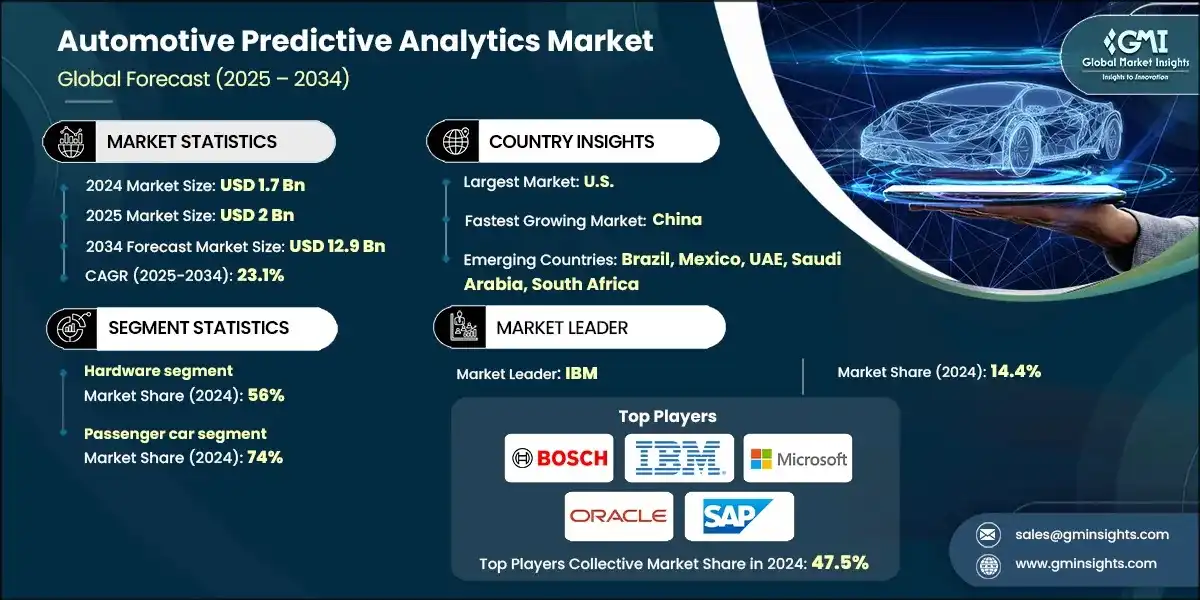
The global automotive predictive analytics market size was valued at USD 1.7 billion in 2024. The market is expected to grow from USD 2 billion in 2025 to USD 12.9 billion in 2034 at a CAGR of 23.1%, according to latest report published by Global Market Insights Inc.
To get key market trends
- Market is growing due to the inclusion of predictive analytics in sophisticated driver-assistance systems (ADAS). The advanced driver assistance system (ADAS) market was valued at USD 42.9 billion in 2024 and is estimated to register a CAGR of 17.8% between 2025 and 2034. Through data collected by sensors, telematics, and driver behavior, predictive models can be used to improve accident prevention, adaptive cruise control, and collision avoidance. The growing regulatory requirements related to vehicle safety and consumer demands to be provided with safer mobility are another reason suggesting that OEMs and suppliers are becoming convinced to embrace predictive analytics.
- As the adoption of connected cars grows at a faster rate, predictive analytics utilizes real-time sensor, GPS and infotainment systems data generated by IoT. This data is used by automakers to forecast component breakdowns, streamline performance, and provide custom services. V2X communication and the use of 5G-based telematics solutions continue to expand substantially, increasing predictive opportunities, making it more widely adopted by OEMs, fleet operators, and aftermarket service providers.
- Major market players operating in the market are engaged in various inorganic growth strategies such as partnerships, mergers and acquisitions and new product launches to stay competitive in the market. For instance, in October 2024, Allianz Partners India, collaborated with CI Metrics, the pioneer of predictive analytics and risk management to provide its comprehensive proactive roadside assistance breakdown solutions. With the combination of CI Metrics, advanced models of weather prediction and the insights provided by AI, company expects to predict and react to automotive weather-related issues, improving customer experience, and operational efficiency.
- Predictive analytics can be used to eliminate unexpected vehicle breakdowns through the prediction of mechanical breakdowns before they arise. These solutions are being embraced by fleet operators, logistics companies and mobility-as-a-service providers to reduce their costs in operations, increase their asset life cycle and efficiency. The surging popularity of predictive maintenance software in passenger and commercial cars is the main driver behind the growth of the market across the world.
- Predictive analytics are actively sought after by automotive OEMs and mobility platforms to learn how to use their vehicles, how to optimize ride-hailing routes, and predict demand. The above insights reinforce car-sharing schemes, vehicle fleet management, and on-demand mobility services. With the growth in urbanization and the case of smart cities, predictive analytics will be incorporated into improving user experience, fleet optimization, and performance in mobility ecosystems.
- The integration of predictive analytics with AI, machine learning, and big data analytics can substantially increase the accuracy of vehicle performance, driver conduct as well as market pattern forecasting. Automakers use these technologies to improve R&D, decrease warranty expenses and provide customized features. The ongoing advances in computer power and cloud computing are opening the way to scalable and cost-effective solutions.
- Consumers are demanding more personalized driving experience. Predictive analytics makes automakers and services providers suggest individualized schedules, infotainment choices and insurance deals based on an individual driving behavior. Companies will enhance customer satisfaction and loyalty by examining both historical and real-time data. The increasing global demand of personalization both in high-end and mass vehicles is a strong driver to adoption.
- North America dominates the market because it is the first region to adopt connected car technology, has high safety standards, and active ADAS penetration. Large OEMs and technology companies are in partnership to combine predictive analytics in safety, predictive maintenance, and insurance risk modeling. The dominant market position of the region has been maintained by high consumer demand for customized, data-driven vehicle services.
- The rapid development of Asia Pacific is supported by the growth of vehicle production, the spread of connected cars, and the growth of smart mobility services in such markets as China, India, and Japan. Governments encourage telematics, electric vehicles, and smart city projects, which enhance a faster deployment of predictive analytics. Expanding online ecosystems, price-sensitive fleets, and increasing urbanization support strong regional adoption patterns.
Automotive Predictive Analytics Market Report Attributes
| Key Takeaway | Details |
|---|---|
| Market Size & Growth | |
| Base Year | 2024 |
| Market Size in 2024 | USD 1.7 Billion |
| Market Size in 2025 | USD 2 Billion |
| Forecast Period 2025 - 2034 CAGR | 23.1% |
| Market Size in 2034 | USD 12.9 Billion |
| Key Market Trends | |
| Drivers | Impact |
| Urbanization and infrastructure development | Driving demand for earthmoving and material handling equipment |
| Rising government investments in smart cities & public works | Fuels sustained demand for construction machinery across roads, housing, and energy projects |
| Technological advancements | Enhances productivity, predictive maintenance, and operator efficiency |
| Shift toward electric and hybrid automotive predictive analytics | Supports sustainability goals and reduces fuel dependency |
| Rental and leasing boom | Expands access for SMEs and contractors, reducing upfront cost burden |
| Pitfalls & Challenges | Impact |
| High capital and maintenance costs | Restricts equipment ownership among small contractors |
| Volatility in raw material prices | Raises equipment cost and pressures margins |
| Shortage of skilled operators | Limits effective equipment utilization and project efficiency |
| Regulatory and emission compliance requirements | Increases R&D and operational costs for OEMs |
| Opportunities: | Impact |
| Electrification and battery-powered machinery | Expands green construction initiatives and compliance readiness |
| Strategic partnerships between OEMs and rental firms | Boosts market penetration and flexible usage models |
| Integration of AI, automation & robotics | Unlocks autonomous equipment opportunities and safety gains |
| Growth in emerging APAC & African markets | Provides large untapped customer base for infrastructure development |
| Digital platforms for equipment rental & fleet management | Improves efficiency, transparency, and contractor adoption |
| Market Leaders (2024) | |
| Market Leaders |
14.4% market share |
| Top Players |
Collective market share in 2024 is Collective Market Share is 47.5% |
| Competitive Edge |
|
| Regional Insights | |
| Largest Market | US |
| Fastest Growing Market | China |
| Emerging Country | Brazil, Mexico, UAE, Saudi Arabia, South Africa |
| Future Outlook |
|
What are the growth opportunities in this market?
Automotive Predictive Analytics Market Trends
- Connected vehicles are becoming new reality at a very high rate, producing enormous amounts of telematics, infotainment, and sensor data. Predictive analytics help automakers and technology providers to transform this data into actionable insights to ensure safety, maintainability, and personalization. With increasing global 5G implementation, data transfer without interruption further improves predictive functions, which drive both passenger and business car integration.
- Practitioners in the fleet operator and OEM sector are also increasingly incorporating predictive analytics within their toolkit to predict how a component is going to fail and use it to prevent unexpected down-time. The method reduces maintenance, extends life of the vehicle and enhances efficiency in its operation. As the uptime becomes a key growth driver with logistics, ride-hailing, and shared mobility platforms, predictive maintenance becomes a leading growth driver in both developed and emerging automotive markets.
- Predictive analytics enhances the performance of ADAS operation by examining real time sensor data and driver action to predict accidents or dangers. Predictive modeling is useful in features like collision avoidance, lane-keeping and adaptive cruise control. The push in vehicle safety by the regulatory environment, and increasing consumer demand of technologies that prevent accidents, further stimulates the increased integration of analytics into future automotive safety systems.
- Predictive analytics are now being used to forecast demand, optimize routes, and manage fleets in ride-hailing, car-sharing and subscription-based mobility models. The operators can increase the use of the fleet and the quality of services by forecasting customer behavior and trends in tourist travel. The ongoing increase of urbanization and smart mobility programs around the world increases the pressure on predictive solutions to enhance the efficiency and profitability of MaaS.
- Predictive analytics are becoming more precise and doable due to the development of AI and ML algorithms and scalable cloud infrastructure. Automakers use such tools to customize in-car services, streamline design and enhance supply chain. The automotive big data is converging with cloud computing and edge analytics, which is a strong driver toward the adoption of predictive analytics across the globe.
- There is an increasing demand among consumers to receive customized services like behavior-based insurance, individual infotainment, and adaptive maintenance notification. Predictive analytics can assist automakers and insurers to provide them based on historical and realistically driven data. This increased focus on the development of user experience and customer retention is an important growth engine that defines the automotive predictive analytics environment.
Automotive Predictive Analytics Market Analysis
Learn more about the key segments shaping this market
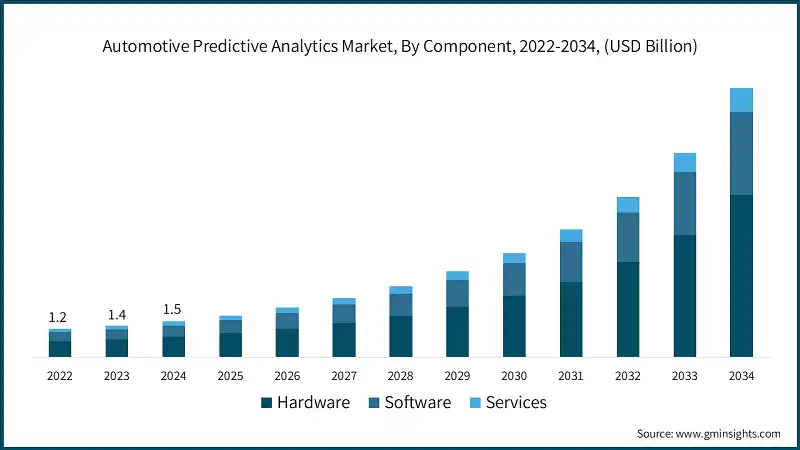
Based on component, the automotive predictive analytics market is divided into hardware, software, and services. The hardware segment dominated the automotive predictive analytics market accounting for around 56% in 2024 and is expected to grow at a CAGR of over 23.5% from 2025 to 2034.
- The increase usage of sensors such as LiDAR, radar, cameras and telematics units become the cornerstone of predictive analytics. Such sensors produce real time information regarding vehicle performance, environment and driver behavior, which allows predictive systems to perform their tasks. The demand in hardware is high because of increasing safety requirements and the adoption of ADAS.
- The current automobiles are equipped with potent Electronic Control Unit (ECU) and edge computing unit that can perform real-time data processing. This hardware development makes latency low, improves the accuracy of the decision-making process, and helps with complex predictive models. A significant accelerant to the adoption of hardware is the increased application of AI-optimized chips in automotive applications.
- The hardware that is necessary to collect and transfer data includes telematics control units (TCUs), gateways and V2X communication modules. The influx of connected cars, with the assistance of 5G deployments, is compelling OEMs to equip their vehicles with more powerful connection capabilities, which directly enable predictive analytics capabilities in passenger and commercial fleet operations.
- Fleet operators and OEMs are increasingly integrating diagnostic equipment and IoT-related devices to check engine efficiency, tire pressure and wear. Supported by these kits are real time fault detection and predictive maintenance. Increasing use of aftermarket OBD-II dongles and IoT devices enhances even more the growth of the hardware segment.
- The software layer is driven by the emergence of artificial intelligence and machine learning algorithms that convert raw car data into useful predictions. OEMs and fleets can be updated regularly, run simulations online, and scale up with the use of cloud-native platforms. The subscription-driven predictive analytics software models also contribute to growth by lowering the entry barriers of an investment.
Learn more about the key segments shaping this market
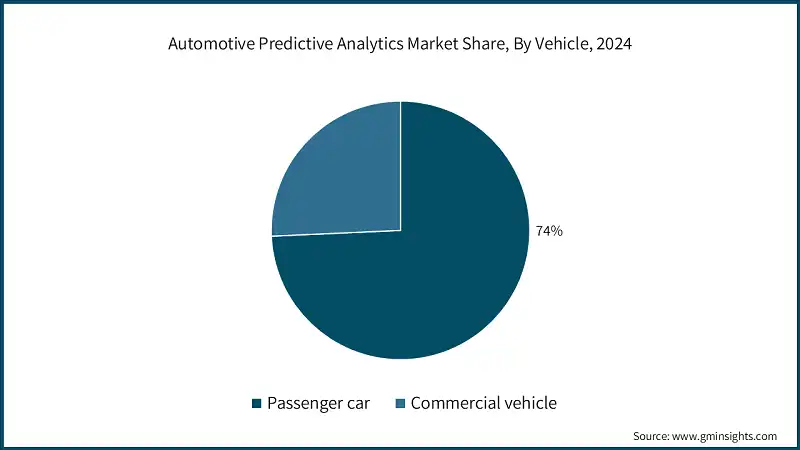
Based on vehicle, the automotive predictive analytics market is segmented into passenger car and commercial vehicle. The passenger car dominates the market with 74% share in 2024, and the segment is expected to grow at a CAGR of over 23% from 2025 to 2034.
- Passenger vehicles consumers are now looking at more personalized features, including infotainment suggestions, to predict maintenance notifications. Predictive analytics allows OEMs to understand the driving behavior, weather conditions, and previous usage trends to provide custom services. This increases user satisfaction, brand loyalty and promotes the emerging consumer behavior of ownership of cars that is data-driven, experience-oriented.
- The integration of predictive analytics with passenger car ADAS has become a more common practice, and it allows preventing accidents proactively, as the driver inputs and road conditions, and sensor data are observed in real-time. Such functions as predictive braking, adaptive cruise control and fatigue detection are directly beneficial. Passenger cars are quickly embracing analytics-based safety solutions as regulators enforce higher levels of safety in them.
- Passenger vehicles are fast becoming connected platforms, which produce data in the form of telematics, infotainment, and V2X systems. Predictive analytics uses this information to predict part failures, streamline navigation, and provide personalization in the car. With the development of 5G and cloud-based services, predictive functions are quicker, and individual drivers and families are safer and more comfortable.
- EV boom is driving the development of predictive analytics in passenger vehicles because battery health, charging patterns, and energy efficiency must be monitored constantly. Predictive algorithm assists the driver to plan on charging points, maximize battery life and avoid degradation in performance. As the global EV adoption boom approaches, predictive analytics emerges as a very important driver of effective and trustworthy passenger EV adoption.
- In the case of commercial fleets, down time directly affects profitability. Predictive analytics makes it possible to identify mechanical problems in time, optimize maintenance patterns and minimize unforeseen failures. Predictive solutions are essential in the processes of logistics and transport, by enabling the fleet operators to monitor the health of the engines, tire wear, and fuel consumption in real-time, which extends the lifecycle of assets, reduces the costs of repairs, and guarantees the increased reliability of delivery.
Based on application, the automotive predictive analytics market is segmented into predictive maintenance, vehicle telematics, driver & behavior analytics, fleet management, warranty analytics, and others. Predictive maintenance minimizes unplanned breakdowns by forecasting component failures before they occur. For OEMs, this reduces warranty claims and repair costs. For fleet operators, it cuts downtime and keeps vehicles on the road longer. The ability to save on expensive repairs and improve operational efficiency is a major driver of adoption.
- Predictive maintenance is becoming an essential requirement of large fleet operators in the logistics, ride-hailing, and delivery services industry to enhance the availability of vehicles and minimize idle time. Predicting failures in real time allows operators to optimize the repair schedules, maximize their uses and increase the lifespan of the assets. Productivity directly increases profitability, and it is rapidly adopted in global industries in which fleets are prevalent.
- Connected health and performance data is produced by IoT-enabled sensors installed in engines, tires and transmissions. This information is processed of predictive analytics platforms in order to identify anomalies and send notifications before significant harm is done. With the growing affordability and additional accessibility of connected sensor hardware, predictive maintenance adoption in the passenger and commercial vehicle sectors is quickly expanding.
- The ability to predictively maintain an electric vehicle is critical because battery decay and charging inefficiencies have a direct negative effect on performance and ownership cost. Predictive models track charging behaviors, power production and thermal regulation in order to inhibit unscheduled failures. As the adoption of EVs increases in the world, predictive maintenance using batteries is becoming a key growth engine in the analytics ecosystem.
- The vehicle telematics systems result in immense real-time information about driver performance, location and behaviour. Predictive analytics uses this information to predict fuel efficiency, optimal routing, and high-risk driving behavior. Connected mobility and its use of telematics-driven predictive insights are becoming more important to mobility service providers, insurers, and OEMs to offer safety, decrease costs, and increase customer experience.
Based on end use, the automotive predictive analytics market is segmented into OEMs, fleet operators, insurance providers, and others.
- Predictive analytics help OEMs predict component failures and enhance the products by making them more durable. Predictive vehicles allow OEMs to be unique in the competitive market by improving brand perception and customer retention. Predictive analytics is also a fundamental enabler of next-generation vehicle reliability by proactively minimizing warranty claims to enhance profitability.
- Strict safety and emission standards are being enforced by governments. To achieve these dynamic regulations, OEMs include predictive analytics in ADAS and powertrain systems. The predictive models contribute to the identification of compliance risks at their early stages and prevent fines and the reduction of certification procedures. This regulatory imperative is very potent in motivating OEM investments in predictive technologies of safety and sustainability.
- OEMs are manufacturing EVs at large scale, and predictive analytics have made sure that the batteries are managed efficiently, the charging is optimized, and the range is forecasted. Others predictive tools also facilitate over the air updates to EV systems, which increases customer satisfaction. As EV adoption is growing rapidly across the globe, OEMs believe that predictive analytics are a necessity when offering long-term reliability and competitive edge in the electrified vehicle market.
- In OEMs, predictive analytics can be used to provide personalized vehicle experiences, be it infotainment or maintenance alerts. The OEMs enhance customer interactions and retention by conducting driver habit and usage analytics. These forecasted characteristics open up fresh sources of revenue via subscription plans and related products which strengthens the transformation of OEMs as pure manufacturers to software-based mobility providers.
- Predictive analytics relies on the fleet operators to keep track of the wellness of the vehicles, their fuel efficiency, and their drivers. They reduce downtimes and increase the life of the assets by estimating the maintenance requirements and route optimization. This directly lowers overall cost of ownership (TCO) and is better operational efficiency, which is why predictive analytics is a strategic requirement in cost-sensitive logistics and mobility sectors.
Looking for region specific data?
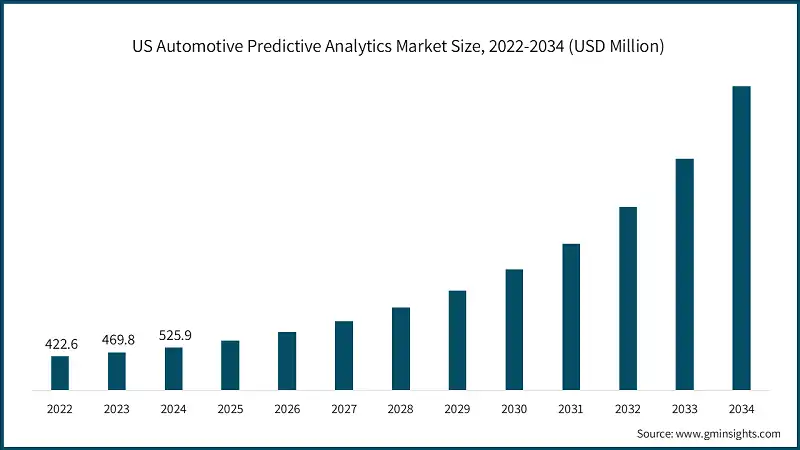
US dominated the automotive predictive analytics market in North America with around 89% share in 2024 and generated USD 525.9 million in revenue.
- US leads autonomous vehicle R&D globally with Silicon Valley, Detroit, and significant OEM-tech alliances leading to innovation. Predictive analytics lies at the heart of making accident prevention, traffic prediction, and real-time decision-making in AVs possible. Predictive analytics usage is hastened by heavy investment in Tesla, GM, Ford, and technology players on next-generation mobility platforms.
- US insurers are quickly embracing the usage-based insurance (UBI) and pay-how-you-drive models. With predictive analytics, driver risk can be accurately assessed, premiums can be personalized, and fraud can be minimized. The presence of extensive insurance infrastructure and deep penetration by telematics in the country provides ample opportunity to predictive models and systems, with automotive insurance being one of the key sources of analytics uptake in the U.S. market.
- The NHTSA and DOT are federal agencies that impose serious vehicle safety requirements such as the ADAS and crash avoidance systems. Predictive analytics helps achieve compliance as they improve collision prediction, driver monitoring, and real-time diagnostics. Such regulatory mandates hasten the uptake of predictive technologies by OEMs in the U.S. market to achieve safety standards and earn consumer confidence.
- As the US EV penetration grows, predictive analytics is key to battery lifecycle, charging optimization, and thermal stability. Demand is being speeded up by federal incentives, state-level EV mandates, and Tesla leading the market. Reliable predictive tools that save maintenance expenses to EV owners are becoming part of the U.S. auto scene.
- US hosts large technological giants, such as Google, IBM, Microsoft, and Oracle, as well as a dynamic startup community in the field of AI, IoT, and mobility analytics. Their interaction with car manufacturers speeds up the innovation of predictive analytics software. Such close interweaving between cloud, AI, and edge computing environments puts the U.S. in a distinct growth position.
The North America automotive predictive analytics market dominated market share of 34% in 2024.
- Connected and autonomous vehicles are mainly tested in North America, with the help of OEMs and technology giants. Predictive analytics is important in facilitating real-time decision-making, safety and predictive maintenance. The region has a strong lead in the early adoption of predictive solutions with the government promoting independent trials and consumer interest in connected mobility.
- The National Highway Traffic Safety Administration (NHTSA) of U.S. and Environmental Protection Agency (EPA) have strict standards of safety and emission regulations. Fleets and OEMs are using predictive analytics to make sure that they comply with risk minimization. Such regulatory forces are promoting the use of innovative safety systems, predictive maintenance configurations, and real-time tracking on both passenger and commercial cars.
- North American auto insurance market is well developed with a promising demand of usage based and behavior based policies. The predictive analytics are used to analyze the risk of drivers, tailor insurance payments and lower fraudulent claims of the insurers. The coordination among insurers, telematics and automakers leads to massive usage of predictive models, which result in the region becoming a leader in automotive risk analytics.
- US and Canada are highly developed digital ecosystems that have early 5G launch and have an extensive IoT presence. This facilitates the smooth flow of vehicle data to enable real time predictive modeling. The high investment in cloud computing and edge analytics develops capabilities, which grow predictive solutions in OEMs, fleets, and technology partners in North America.
- EVs and smart mobility models such as ride-hailing and car-sharing are on the increase in North America. These services are supported with the help of predictive analytics to monitor battery health, optimize charging, and use the fleet. Predictive analytics deployment is growing at a high rate due to consumer preference towards sustainable and technology-powered mobility solutions, as well as the federal incentives on EV adoption.
Europe automotive predictive analytics accounted for USD 513 million in 2024 and is anticipated to show lucrative growth over the forecast period.
- Strict regulations, including Euro NCAP safety regulations and Euro 7 emission regulations, are maintained by the European Union. OEMs also add predictive analytics to comply, optimize powertrains and improve crash prevention technologies. Such regulations compel car manufacturers to implement data-driven solutions, and predictive analytics are important in achieving environmental and safety standards in Europe.
- Europe has become a worldwide leader in EV adoption with powerful government incentives, carbon-neutrality objectives and expanding charging infrastructure. Predictive analytics make it possible to manage battery lifecycle, optimize charging and predict range. With the high EV adoption rates in such markets as Norway, Germany, and the Netherlands, predictive analytics will be necessary to ensure the long-term reliability and efficiency.
- The cities in Europe are leading to the use of shared mobility, ride-hailing and car-sharing systems. In these models, predictive analytics are used to optimize the utilization of a fleet, demand forecasting and driver safety. Together with EU efforts on smart cities, this pressure is increasing in both Western and Eastern Europe, to improve mobility services and sustainability.
- Early users of predictive analytics include European luxury car manufacturers like BMW, Mercedes-Benz, Volkswagen and Volvo. They prioritize the adoption of greater control over the car and its features by incorporating sophisticated driver-assistance, predictive maintenance, as well as customization into connected cars, a factor that boosts the maturity of the market. High consumer expectations in regard to innovation coupled with premium segment positioning leading to OEM front runners investing in predictive analytics platforms in Europe.
- The system of AI labs, IoT applications, and cloud implementations is active in Europe. This technological maturity gives predictive analytics solutions the ability to process the data in real-time and make improved decisions in vehicles. Alliances between OEMs, telecom operators and analytics providers are strategic initiatives that help Europe to implement massive predictive implementation up the automotive value chain.
The automotive predictive analytics market of Germany is steadily growing. The German economy is majorly driven by the country’s engineering and automobile industry.
- Germany is home to global OEMs like Volkswagen, BMW, Mercedes-Benz, and Audi, all investing heavily in connected and software-defined vehicles. Predictive analytics enables these companies to improve product reliability, enhance safety, and offer personalized services. The concentration of leading automakers ensures rapid adoption and continuous innovation in predictive solutions across the German automotive ecosystem.
- The push towards EV adoption in Germany is increasing at a faster pace due to the effect of subsidies and rigid carbon-neutrality goals, which initiates the demand of predictive analytics. Predictive technologies provide health monitoring of EV batteries, optimize the charging process, and increase the service life of vehicles. With the release of new models of EVs by German OEMs, the analytics platforms are important in staying competitive in the rapidly developing electric mobility segment.
- The predictive analytics have a good soil in Germany because of its robust R&D and powerful Industry 4.0 programs. Car manufacturing companies use predictive solutions to manage the production process more efficiently and minimize downtimes and improve supply chain efficiency. In Germany, AI, IoT, and cloud technologies are integrated into the high-tech industrial base of the country, which promotes the use of predictive analytics (manufacturing-side and in-vehicle).
- German regulators are extremely strict on vehicle safety and compliance on emissions, in line with the EU-wide directives. OEMs can use predictive analytics to predict system malfunctions, confirm that their systems meet the established emission requirements, and provide proactive safety response. These strict regulatory frameworks are forcing car manufacturers and suppliers to go to predictive technologies, making Germany a pioneer in the use of compliance-focused analytics.
- Megacities such as Berlin, Munich and Hamburg in Germany are rolling out smart mobility initiatives, such as car-sharing, ride-hailing, and electric-powered public transport. Predictive analytics can assist operators in demand forecasting, fleet availability optimization, and driving better safety. This agreement on the government-urban mobility projects with the private sector development gives a good momentum to the use of predictive analytics in Germany.
The Asia Pacific automotive predictive analytics market is anticipated to grow at the highest CAGR of over 24% during the analysis timeframe.
- China, India, Japan, and South Korea are at the forefront of the automotive platform in Asia Pacific, the largest in the world. The production of vehicles and the growing base of passengers in the region generate huge volumes of data. The predictive analytics enable OEMs and suppliers to enhance efficiency in manufacturing, decrease recalls, and augment aftersales services, which drive the quick penetration of the APAC market.
- China controls the EV market globally, with Japan and south Korea driving solid-state batteries and hybrid technologies. Predictive analytics provides the best performance of EVs by monitoring battery health, charging optimization, and lifecycle prediction. Predictive analytics is essential in facilitating the reliable adoption of EVs on large scales through robust government support, subsidies and emission control in APAC.
- The trend toward urbanization and the adoption of digital in APAC urban centers is increasing the demand of connected mobility, ride-hailing, and shared transportation. Predictive analytics optimize fleet operations, enhance driver safety and predict maintenance. Other markets such as India and Southeast Asian markets are incorporating predictive intelligence into mobility services to satisfy the increasing consumer demands of affordability, convenience and reliability.
- Asia Pacific is on the frontline on 5G deployments, with China, South Korea, and Japan in the lead. Increased connectivity will support real-time data collection and processing of vehicles that are essential to predictive analytics. This robust digital framework supports the development of autonomous driving, telematics, and predictive maintenance and helps to speed up the mass implementation of all methods within the car infrastructure of the region.
- Lean economies of APAC such as India and the ASEAN countries are cost-conscious. Predictive analytics assist fleet operators and OEMs with decreasing downtime, warranties, and supply chains optimization. Predictive analytics is a strategic facilitator in the affordability versus innovation balance of the diverse APAC market by reducing operational expenses and enhancing the reliability of vehicles.
The automotive predictive analytics market in China is projected to witness strong and sustained growth throughout the forecast period from 2025 to 2034.
- The vast number of vehicles in China offers unmatched predictive analytics data. This data is used by OEMs and tech providers to optimize vehicle performance, refine algorithms, and provide predictive maintenance solutions, with millions of passenger and commercial vehicles sold per year. The size of adoption is enough to make China the most influential predictive analytics in the automotive market.
- The regulatory environment in China is highly favorable towards intelligent connected vehicles (ICVs) and autonomous driving. Policies promoting V2X communication, intelligent highways, and connected mobility platforms set the fertile ground of predictive analytics. Adherence to such initiatives is pushing OEMs to integrate high-tech predictive safety, navigation, and efficiency, making China a force in the automotive technological front.
- China is the biggest EV adoption and manufacturing country in the world, with powerful state subsidies and dominance in battery supply chains. Predictive analytics has an important role in battery health monitoring, charging optimization, and lifecycle prediction of EVs. With EV penetration increasing more rapidly, predictive analytics guarantees efficiency and reliability, which further enhances the competitive advantage of China in next-generation automotive technologies.
- China has a growing AI and big data ecosystem that is being fueled by companies such as Baidu, Alibaba, and Tencent and it is smoothly connected to automotive predictive analytics. Through these relationships, OEMs are able to improve real-time vehicle insights, predictive diagnostics, and driver personalization. The collaboration between Chinese digital giants and automotive companies speeds up the innovation of data-driven mobility solutions.
- The rapid urbanization and massive smart cities developments in China require smart management of mobility. Predictive analytics helps with traffic forecasting, fleet optimization, and accident prevention, especially in congested cities. Connection to urban transport networks guarantees safer and more efficient mobility solutions, thereby making predictive analytics one of the pillars of the move to sustainable and tech-oriented urban transportation systems in China.
Latin America automotive predictive analytics accounted for over USD 350 million in 2034 and is anticipated to show lucrative growth over the forecast period.
- Connected cars are on the rise in Brazil, Mexico, and Argentina, as car manufacturers start to build telematics and infotainment functions in their cars. Predictive analytics uses this connection to help provide predictive maintenance, driver safety insights, and insurance telematics. Connected vehicles are a key enabler to predictive analytics adoption in Latin America due to the increasing consumer demand of smart mobility experiences.
- Latin America boasts of major manufacturing stations of international OEMs especially in Brazil and Mexico. Predictive analytics allows to streamline production, decrease the rate of defects and maximize the efficiency of the supply chain. As automakers continue to get more digitalized in order to be competitive, the use of predictive analytics is becoming more popular as a means of enhancing quality control and operational robustness of regional automotive centers.
- The logistics and ride-hailing sector of the region is rapidly growing due to the spread of e-commerce and the need to cover the transportation in the cities. Predictive analytics are used by fleet operators to reduce downtime, improve maintenance, and improve driver efficiency in Latin America. This tendency increases adoption in commercial vehicles, in particular, in Mexico and Brazil, where the logistics costs influence the competitiveness directly.
- The lack of road safety and increased environmental issues have forced Latin American governments to introduce more severe road safety and emissions regulations. Predictive analytics helps in compliance as it can facilitate proactive maintenance and emission monitoring tools and predictive accident prevention systems. This new regulatory environment is one that OEMs and fleet operators are responding to in pursuing analytics-enabled solutions to enhance safety and sustainability results.
- The initial signs of the shared mobility, leasing, and subscription-based models are being propelled by the young population of Latin America and the low-cost consumers. Predictive analytics will make sure that such vehicles are reliable and cost-effective through the reduction of failures and maintenance cost. With the growing adoption of mobility-as-a-service in megacities, predictive analytics will be an essential enabling factor of affordability, reliability, and fleet life cycle in the market.
The automotive predictive analytics market in Brazil is projected to witness a notable increase in market share from 2025 to 2034.
- Brazil is the largest vehicle manufacturing hub in Latin America that has large OEMs such as Volkswagen, GM, and Fiat. The adoption of predictive analytics is gaining momentum in factories and enhancing efficiency, minimizing downtime, and streamlining quality management. As domestic demand grows and exports stand at a high potential, predictive solutions are now crucial in the Brazilian automotive manufacturing scenario that is very competitive.
- The Brazilian consumers are increasingly asking connected vehicles that have advanced infotainment and telematics. Predictive analytics are used by OEMs and insurers to provide safer driver experiences, maximize maintenance, and customize mobility services. The high demand of digital-first solutions by the tech-savvy middle-income in Brazil is compelling automakers to add more predictive features to their cars.
- The expanding logistics fleet and the increase of ride-hailing services such as Uber and 99 are driven by the growth in the booming e-commerce industry in Brazil and urban congestion. Predictive analytics will guarantee vehicle uptime, lower the expenses of upkeep, and optimize fleet execution. As logistics effectiveness becomes one of the leading business priorities, predictive analytics are gaining momentum among business operators of commercial vehicles in Brazil.
- Brazil has also introduced more stringent rules on emissions and road safety and they are consistent with international quality. Predictive analytics can be used to aid in compliance with proactive diagnostics, monitoring of emissions, and preventive accidents. With the height in regulatory enforcement, auto manufacturers and fleet operators are increasingly adopting predictive solutions as a means to achieve sustainability goals coupled with enhancing vehicle reliability and consumer trust.
- The automotive and transport markets in Brazil are very cost sensitive. Measured cost benefits of predictive analytics include decreased unplanned breakdowns, greater fuel efficiency and longer vehicle life. It is specially applicable to small fleet operators and shared mobility platforms, where cost control is paramount to remain competitive. The price pressure is leading to widespread use of predictive analytics.
MEA automotive predictive analytics accounted for over USD 30 million in 2024 and is anticipated to show lucrative growth over the forecast period
- MEA is undergoing rapid urbanization, and the populations of countries such as UAE, Saudi Arabia, South Africa and Nigeria are witnessing increased middle-income populations. Currently, increased vehicle ownership leads to a greater need to utilize predictive analytics because consumers and OEMs are focused on safety, fuel efficiency, and proactive services to control vehicles within increasingly congested and limited resource cities.
- The Gulf countries are putting much money in smart mobility as part of what they are doing in their vision 2030. Predictive analytics assists in achieving road safety goals by facilitating accident prevention, driver control and active maintenance. The focus on digital mobility ecosystems by governments turns predictive analytics into a strategic technology in long-term infrastructure modernization efforts of MEA transportation.
- The growth of logistics fleets is triggered by the expansion of e-commerce and cross-border trade in MEA. Predictive analytics allow operators to reduce downtimes, optimize fuel consumption and enhance delivery. A growing trend in markets such as UAE, Kenya, and South Africa is the fleet operators using predictive tools to minimize the operating expenses and enhance competitiveness in industries which have high logistical requirements.
- In MEA markets, connected and electric vehicles are being adopted more rapidly; in particular, in the UAE and Saudi Arabia, sustainability goals are driving EV adoption. Predictive analytics guarantees sound EV performance through battery health monitoring and aiding predictive charging. Predictive solutions are becoming more popular in both consumer and fleet applications as connected infrastructure becomes widespread.
- The high temperatures, sand and bad road conditions in MEA pose a great challenge to vehicle performance and reliability. Predictive analytics serves to track wear and tear, maintenance, and avoid unforeseen breakdowns. Such solutions are becoming vital, both to passenger and commercial vehicles that have to work in severe conditions, leading to the spread of predictive technology in the region.
The automotive predictive analytics market in Saudi Arabia is anticipated to capture a growing share of the regional market between 2025 and 2034.
- The Vision 2030 plan of Saudi Arabia focuses on the digital transformation and the progressive mobility infrastructure. Predictive analytics are driven by investments in smart transportation, autonomous vehicle systems, and information-based mobility systems. Predictive tools are used by automakers and fleet operators to match the vision of the kingdom of becoming an innovative hub in the automotive and transport technologies.
- Advanced in-vehicle technologies are being embraced by high disposable incomes and increasing consumer preference to luxury and premium cars. Predictive analytics assists with such features as predictive maintenance, monitoring of driver behavior, and safety improvements. As premium brands continue to increase their presence in Saudi Arabia, predictive analytics is a fundamental point of difference that can help to improve customer experience and loyalty.
- The strategic geographic position of Saudi Arabia as a logistic and trade center, the investments in the ports and infrastructure create the pressure on effective fleet management. Predictive analytics helps cut downtime, lower costs, and achieve a high level of efficiency in deliveries by logistics companies. Predictive insights are utilized by the fleet operators to stay competitive as the cross-border and domestic logistics market is growing at a high pace.
- The Saudi government is proactively encouraging electric vehicles by policies, investments, as well as partnerships, such as local EV production intentions. Predictive analytics is important to maintain EV battery health, range prediction, and charging optimization. With the kingdom moving toward green mobility, predictive solutions are the key to the reliability of EV and trust in the consumer.
- The desert climate, excessive heat, and dust in Saudi Arabia cause a lot of wear to the car. Predictive analytics assists in tracking the condition of components, predicting their failures and booking the maintenance in advance. This technology is highly applicable in passenger vehicles as well as heavy commercial fleets with heavy workloads that require the use of the technology in predictive modes, which are more popular in the market.
Automotive Predictive Analytics Market Share
- The top 7 companies in the automotive predictive analytics industry are IBM, SAP, Microsoft, Bosch, Oracle, ZF, and NXP, contributing around 52% of the market in 2024.
- IBM
IBM uses its Watson AI and IoT solutions to provide predictive maintenance and driver behavior analytics and connected cars. OEMs and tier-1 supplier strategic alliances improve integration of predictive insights into manufacturing, and management of fleets. IBM is dedicated to cloud scalability, data security and AI-based analytics to remain a global leader in automotive predictive solutions.
SAP is offering predictive analytics in combination to its ERP and supply chain systems to allow the automakers to connect vehicle information and production with logistic and aftersales services. SAP enhances relationships between OEMs by providing real-time predictive insights, warranty optimization, and maintenance scheduling. The ongoing innovation of AI-based analytics, IoT connectivity, and the subscription-based services would help SAP remain competitive in automotive analytics environment.
Microsoft promotes competitive positioning in the market with its Azure clouds and AI ecosystem, which offers scalable predictive analytics platforms to OEMs, fleets and mobility providers. Its solutions unite real-time vehicle information, incorporation of telematics and machine learning to maximize maintenance, safety, and fleet operations. Connection to automotive OEMs and startups also improve innovation and market penetration of predictive automotive technologies.
Automotive Predictive Analytics Market Companies
Major players operating in the automotive predictive analytics industry are:
- Bosch
- Continental
- IBM
- Microsoft
- NXP
- Oracle
- PTC
- SAP
- SAS
- ZF
- The automotive predictive analytics market is very competitive, as it is powered by the partnership between the established car manufacturers, the technology companies, and the specialized analytics solution providers. SAP, IBM, Microsoft, Bosch and Oracle are other companies that exploit AI, machine learning, and IoT integration to provide predictive maintenance, driver behaviour analysis, and fleet optimization solutions.
- Companies like ZF, NXP and Continental are specialized in sensor-based insights and embedded systems, which allows real-time vehicle diagnostics. Such an approach that is based on collaboration makes sure that it remains innovative and competitive.
- Major vendors set themselves apart with cloud technology, scalable neural networks, and native integration with OEM systems and connected car networks. Such companies as Microsoft Azure, SAP and PTC facilitate foreseeable understanding in production, aftersales and fleet management, and other companies such as Bosch, ZF, and NXP reinforce hardware-software interrelation to real-time analytics. The areas of investment in R&D, strategic alliances, and innovative telematics solutions enable such companies to stay technologically ahead and increase their presence in the world market.
Automotive Predictive Analytics Industry News
- In September 2025, Volkswagen Group announced a five-year expansion of its strategic collaboration with Amazon Web Services (AWS), cementing the Digital Production Platform (DPP), commonly known as the factory cloud, as the key digital backbone of its manufacturing transformation. Over 1,200 AI-based applications are now available on the platform, including real-time image-based quality inspections and energy optimization, and machine learning is performed through AWS services, like Amazon SageMaker.
- In August 2025, Force Motors introduced iPulse, which is a connected vehicle platform powered by AI-driven fleet intelligence and predictive analytics, as being standard in its commercial vehicles. It provides real time vehicle information developed with Intangles, which improves efficiency and saves expenses. The platform has remote monitoring and 24/7 support command center, which enhances the maintenance process and decision-making process.
- In October 2024, automotiveMastermind announced significant changes to its Behavior Prediction Score (BPS) system, making it more powerful in its predictive capabilities through state-of-the-art machine learning technology. Alongside these enhancements, the company also introduced an updated Customer Deal Sheet interface that simplified access to crucial customer data that supports effective sales outreach by car dealers.
- In September 2024, COMPREDICT partnered with Renault Group to roll out predictive maintenance technology with virtual sensors. These virtual sensors of COMPREDICT will be incorporated in the present generation of vehicles as well as the new Software-Defined Vehicles (SDVs). By collaborating with this, not only does Renault Group embrace the latest, data-centric solutions, but also establishes a position as a leader in the innovation of vehicles maintenance.
The automotive predictive analytics market research report includes in-depth coverage of the industry with estimates & forecasts in terms of revenue ($ Mn/Bn) from 2021 to 2034, for the following segments:
Market, By Component
- Hardware
- Onboard computing units
- Telematics devices
- Diagnostics tools
- Software
- Predictive maintenance platforms
- Fleet management software
- Connected vehicle & adas software
- Ai/ml analytics engines
- Services
- Professional
- Managed
Market, By Propulsion
- Gasoline
- Diesel
- All-electric
- HEV
- PHEV
- FCEV
Market, By Application
- Predictive maintenance
- Vehicle telematics
- Driver & behavior analytics
- Fleet management
- Warranty analytics
- Others
Market, By Vehicle
- Passenger car
- Hatchback
- Sedan
- SUV
- Commercial Vehicle
- Light duty
- Medium duty
- Heavy-duty
Market, By End Use
- OEM
- Fleet operators
- Insurance providers
- Others
The above information is provided for the following regions and countries:
- North America
- US
- Canada
- Europe
- UK
- Germany
- France
- Italy
- Spain
- Russia
- Nordics
- Asia Pacific
- China
- India
- Japan
- South Korea
- ANZ
- Southeast Asia
- Latin America
- Brazil
- Mexico
- Argentina
- MEA
- South Africa
- Saudi Arabia
- UAE
Frequently Asked Question(FAQ) :
What are the upcoming trends in the automotive predictive analytics market?
Key trends include predictive maintenance, real-time ADAS, demand forecasting in mobility, big data with cloud-edge analytics, and personalized services.
Who are the key players in the automotive predictive analytics industry?
Key players include Bosch, Continental, IBM, Microsoft, NXP, Oracle, PTC, SAP, SAS, and ZF.
Which region leads the automotive predictive analytics sector?
The United States leads the market in North America, accounting for 89% of the regional share and generating USD 525.9 million in revenue in 2024.
What was the market share of the passenger car segment in 2024?
The passenger car segment dominated the market with a 74% share in 2024 and is set to expand at a CAGR of over 23% up to 2034.
What is the expected size of the automotive predictive analytics market in 2025?
The market size is projected to reach USD 2 billion in 2025.
How much revenue did the hardware segment generate in 2024?
The hardware segment generated approximately 56% of the market share in 2024 and is expected to witness over 23.5% CAGR till 2034.
What is the projected value of the automotive predictive analytics market by 2034?
The market is poised to reach USD 12.9 billion by 2034, fueled by advancements in AI, ML, and scalable cloud infrastructure, along with increasing adoption in connected vehicles and fleet management.
What is the market size of the automotive predictive analytics in 2024?
The market size was valued at USD 1.7 billion in 2024, with a CAGR of 23.1% expected through 2034. The growth is driven by the integration of predictive analytics in advanced driver-assistance systems (ADAS).
Automotive Predictive Analytics Market Scope
Related Reports