Summary
Table of Content

Automotive Injection Molding Automation Market
Get a free sample of this report
Form submitted successfully!
Error submitting form. Please try again.
Thank you!
Your inquiry has been received. Our team will reach out to you with the required details via email. To ensure that you don't miss their response, kindly remember to check your spam folder as well!
Request Sectional Data
Thank you!
Your inquiry has been received. Our team will reach out to you with the required details via email. To ensure that you don't miss their response, kindly remember to check your spam folder as well!
Form submitted successfully!
Error submitting form. Please try again.
Automotive Injection Molding Automation Market Size
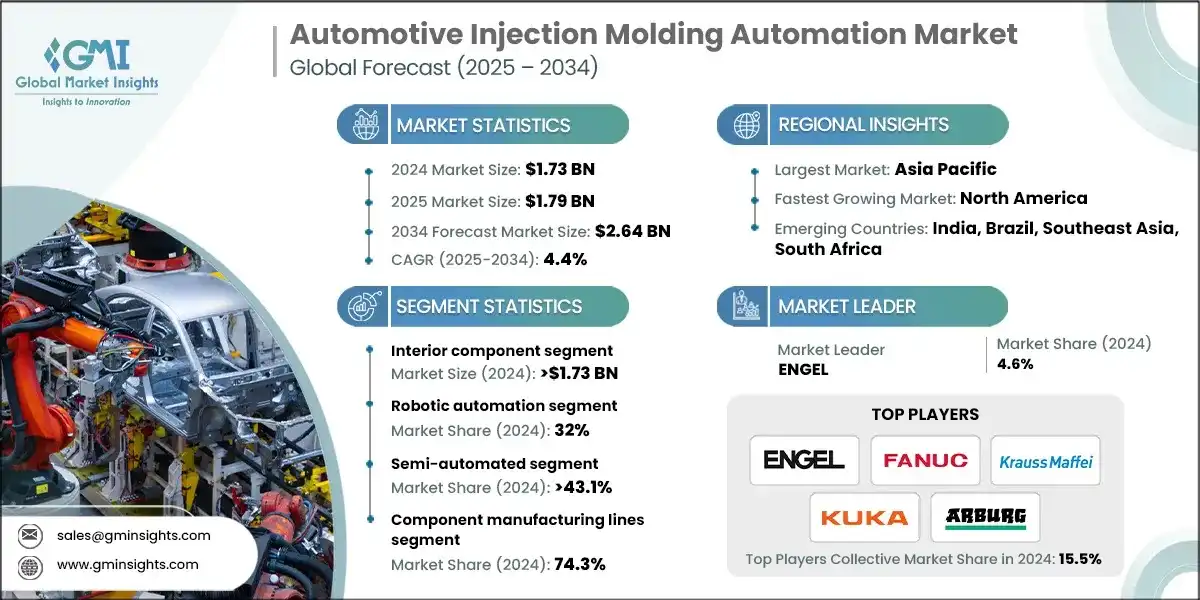
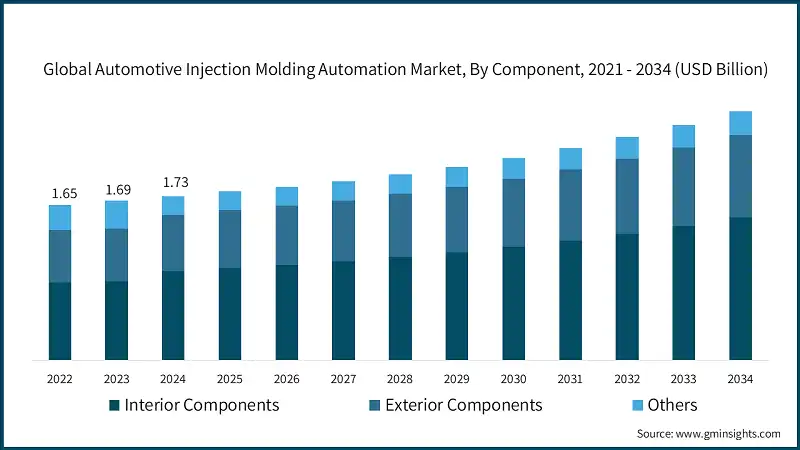
The global automotive injection molding automation market was estimated at USD 1.73 billion in 2024. The market is expected to grow from USD 1.79 billion in 2025 to USD 2.64 billion in 2034, at a CAGR of 4.4% according to the latest report published by Global Market Insights Inc.
Automotive Injection Molding Automation Market Key Takeaways
Market Size & Growth
- 2024 Market Size: USD 1.73 Billion
- 2025 Market Size: USD 1.79 Billion
- 2034 Forecast Market Size: USD 2.64 Billion
- CAGR (2025–2034): 4.4%
Regional Dominance
- Largest Market: Asia Pacific
- Fastest Growing Region: North America
Key Market Drivers
- Electrification and Lightweighting of Vehicles.
- Rising Adoption of Industry 4.0 Technologies.
- Demand for High-Volume Precision Manufacturing.
- Labor Shortages and Cost Optimization.
- Sustainability and Waste Reduction Goals.
Challenges
- High Initial Capital Investment.
- Integration and Technical Complexity.
Opportunity
- Retrofitting Existing Molding Lines.
- Expansion in Emerging Automotive Markets.
- AI and Advanced Robotics Development.
- Demand for Sustainable and Smart Factories.
Key Players
- Market Leader: ENGEL led with over 4.6% market share in 2024.
- Leading Players: Top 5 players in this market include ENGEL, FANUC, KraussMaffei, KUKA, ARBURG, which collectively held a market share of 15.5% in 2024.
Get Market Insights & Growth Opportunities
Manufacturers are more frequently adopting automation for increased productivity, quality consistency and less dependence on the labor force. Robotic handling, automated quality inspections, and integrated molding systems help to reduce defects, cycle times, and improve efficiency with the production process. This trend toward automation has become more common with Tier-1 suppliers and OEM assembly plants on a global level.
The growing market for electric vehicles (EVs) has also produced a demand for lightweight, precise, and heat-resistant plastic components. The automation of injection molding can produce complex parts (battery casings, connector housing, etc.) with consistency similar to manufactured parts. OEMs are continually looking to meet demands to reduce weight, improve efficiency and automate manufacturing processes that can be accurate, repeatable, and scalable, which has had a marked impact on the application and adoption rates of automation in EV manufacturing lines.
The combination of AI, IoT, and machine learning in injection molding enables real-time monitoring, predictive maintenance, and process enhancement. Smart factories implement connected automation cells, which support data-driven decision-making and help minimize downtime and material waste. This process of digitization will significantly strengthen the demand for automation across the value chain of automotive injection molding.
Automotive suppliers must deliver millions of exact and defect-free parts while maintaining tightly controlled tolerances. Automated injection molding lines allow for precise component replication, operate with minimal human error, and can run 24 hours a day, 7 days a week. Demand for passenger vehicles is recovering globally and OEM quality metrics are tightening, but automation will scale and put the necessary reliability into modern automotive mass production.
In September 2025, ENGEL announced the acquisition of Trexel Inc., a provider of MuCell microcellular foaming technology to augment its lightweight capabilities for automotive molding. The company also previewed its inject AI system a fully autonomous and AI-driven injection molding cell designed to optimize quality and energy consumption.
To get key market trends
Automotive Injection Molding Automation Market Trends
The growth of electric vehicles is driving demand for lighter, more complex plastic components such as battery housings and electronic enclosures. Automating injection molding permits close tolerances, repeatability and scalable volumes, addressing the OEM need for quality and consistency of parts for global manufacture of EV components.
The infusion of AI, IoT and predictive analytics into existing manufacturing processes provide capabilities for real-time monitoring, process improvement and predictive maintenance. The emergence of smart factories and facilities reduces downtime, scrap material and development error leading to higher efficiency. This trend is propelling the adoption of fully automated, connected injection molding solutions throughout the growing global automotive business.
As automakers pursue more sustainable production practices, enhanced automation systems reduce material costs along with energy incurred in manufacturing activities and the operational carbon footprint that result in better compliance with regulatory demands. This trend focuses the investment in automated molding systems that develop recyclable energy-efficient automotive components while maintaining the required accuracy and throughput.
Automakers in North America are bringing automotive production back to North America and investing in advanced automation to enhance efficiency, minimize labor reliance and address quality requirements. The implementation of robotic cells and smart injection molding systems facilitate high-volume, precision manufacturing of EV and ICE components.
China, India, and Southeast Asia are quickly growing automotive production. Domestic high-volume manufacturing, increased EV requirements, and automated injection molding systems support consistent quality and cycle times while being cost effective for domestic and export markets.
In March 2023, ARBURG announced the launch of a new freeformer additive manufacturing system, aimed at automotive prototyping and low-volume production applications. The application connects seamlessly to the existing injection molding automation ecosystem to enable flexible manufacturing capabilities.
Automotive Injection Molding Automation Market Analysis
Learn more about the key segments shaping this market
Based on component, the market is segmented as interior components, exterior components, others. The interior component segment exceeded USD 1.73 billion in 2024 and is estimated to grow at a CAGR of 5% from 2025 to 2034.
- There is a growing demand for lightweight and durable plastic automotive interior components. The increasing adoption of electric vehicles (EVs) and new infotainment technologies is increasing the demand for precision molding of automotive components. Automated production lines can manufacture dashboard, panel and console components at high throughput with low scrap, and high consistency, increasing passenger comfort while lowering production costs.
- The exterior parts of the vehicle, such as bumpers, fenders and body panels, are being manufactured with high-strength and impact-resistant polymers, similar to interior components and supported by automation. These polymer materials allow for complex geometries of exterior components along with high consistency in terms of surface finish and color. The integration of automation in robotic systems that inspect and post-process the component can maintain manufacturing cycles that OEMs satisfy/direct. The process also improves the surface aesthetic appeal and durability of the vehicle's exterior components.
Learn more about the key segments shaping this market
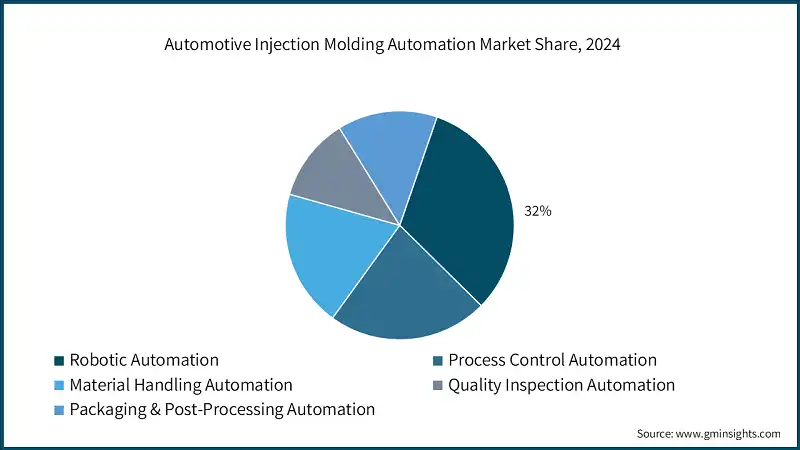
Based on automation, the automotive injection molding automation market is fragmented into robotic automation, process control automation, material handling automation, quality inspection automation, packaging & post-processing automation. The robotic automation segment held about 32% market share in 2024.
- Robotic integration with pick-and-place, insert loading, and stacking operations in molding environments improves process efficiency. Automation decreases the number of human touches, increases repeatable quality, decreases cycle time, and provides flexibility in producing high-production quantities. The automotive industry is rapidly accelerating with robotic adoption, both in developed and emerging markets, due to labor cost pressure.
- New advanced process control systems can monitor key parameters, such as temperature, pressure, and injection speed in real time. These automated control systems are intended to make precise adjustments during production to improve product defects and minimize material usage. By introducing systems that integrate AI and predictive analytics, these control systems improve autonomous control to reduce downtime, while ensuring the best consistency of part quality for more complex automotive parts.
- Automated systems for feeding, drying, and conveying resins can minimize risk of contamination, improve efficiencies of systems, and provide a continuous process operation for molding lines. Integrating mechanical processing systems of material handling minimizes labor dependency in the injection molding plant while optimizing time efficiency to minimize labor. Continuous material handling systems are a great design for production methods where the part involves intricate mold designs with different material processing for the end product.
Based on level of automation, the automotive injection molding automation market is classified into semi-automated systems, fully automated systems, smart/industry 4.0-enabled systems. The semi-automated accounted for over 43.1% market share in 2024.
- Semi-automated systems integrate human input with automated processes which may be suitable for production volumes of small to medium sizes. They help OEMs meet the cost versus quality balance, offer flexibility in making many types of automotive components, while slowly increasing robotic and control elements within a process.
- Fully automated systems provide for completely operational injection molding lines, to include dispensing, handling, inspection, and post-processing of the part. Fully automated systems, improve volume throughput, limit human error, and facilitate high volume production of automotive parts requiring precision, as part of labour optimization and consistent quality part-making.
- Connected molding cells with IoT, AI, and predictive maintenance allow for real-time monitoring of the process, with near autonomous optimization. Smart systems improve efficiency, minimize downtime, and minimize wasted material, supporting the modern OEM specific agenda for digitalized, sustainable and high-automated manufacturing facilities.
Based on end use, the automotive injection molding automation market is segmented into component manufacturing lines, precision tooling & mold engineering, secondary production & finishing. The component manufacturing lines segment held a market share of 74.3% in 2024 and is anticipated to grow at a CAGR of 4% from 2025 to 2034.
- AI-enhanced automation and smart robotics are revolutionizing automotive component manufacturing lines. Real-time process intelligence, adaptive controls, and collaborative robots increase molding accuracy, reduce cycle times, and lower waste. This technology not only improves overall factory efficiency but also provides mass-customization opportunities in automotive mass production environments.
- Precision tooling is being revolutionized utilizing digital twin simulations and state-of-the-art mold materials. Digital twins provide instantaneous verification of designs while enabling faster prototyping, while nano-coated high-strength alloys improve longevity and thermal management. Both innovations increase tooling precision while reducing downtime associated with more complicated automotive component processes.
- Post-molding automation efforts rely on AI-enabled vision inspection systems, robotic assembly, and environmentally friendly finishing processes. Automated assessment of defects and water-based coatings are examples of quality improvement and sustainability initiatives. Together, these technologies are advancing automotive component secondary operations to minimize rework and support global environmental and efficiency goals.
Looking for region specific data?
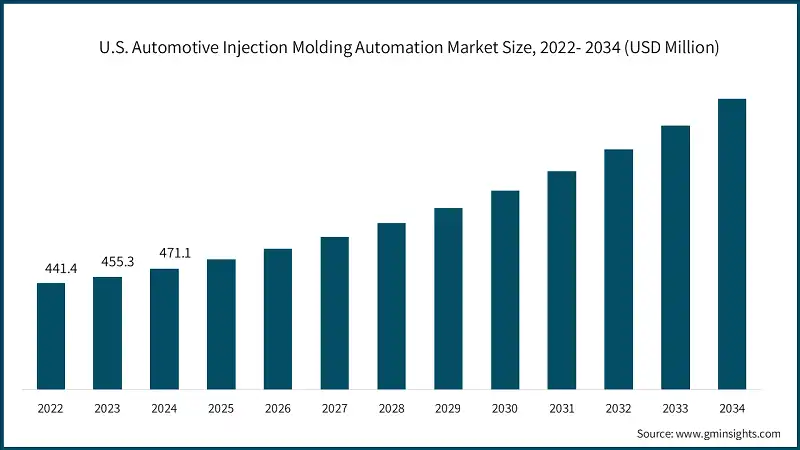
The U.S. automotive injection molding automation market captured over 86.4% revenue share in 2024 and experience significant and promising growth from 2025 to 2034.
- The transition to electric vehicles fuels the use of automation in injection molding for battery housings, connectors and electronic enclosures. Automation provides repeated precision, dimensional accuracy, and repeatability, which supports both OEMs (original equipment manufacturers) and 1st-tier suppliers in meeting stringent quality standards while efficiently producing high-volume parts for EV (electric vehicle) and hybrid vehicle lines.
- The combination of AI, IoT, and predictive maintenance allows for real-time monitoring and autonomous process optimization of injection molding lines. Smart manufacturing reduces downtime, improves energy efficiency, and speeds the quality control process. This allows automotive plants to remain competitive against ever-changing production requirements for high-tech, high-precision components.
- Domestic reshoring efforts are boosting local automotive production, which increases the demand for automated, flexible molding systems that can quickly make many different parts efficiently. Automation helps OEMs and 1st-tier suppliers reduce costs, achieve consistent part quality and scalability, which is important for staying nimble to meet the pressures of demand and supply chain stabilization from the North American automotive market.
North America automotive injection molding automation market was valued at USD 545.2 million in 2024 and is estimated to grow at a CAGR of 4.8% from 2025 to 2034.
- Car manufacturers are incorporating robotics and fully automated injection molding systems to manage high-volume production of interior, exterior, and functional parts. Automation improves throughput, reduces reliance on labor, and offers consistent quality to help OEMs and suppliers efficiently respond to increasing demand for precision automotive components.
- Manufacturers in North America are also installing automated molding systems that are energy efficient and low-waste to help reduce material consumption, energy usage, and carbon emissions. Automated molding supports sustainable production while still achieving high levels of output quality to meet environmental targets and regional regulatory standards in the automotive manufacturing sector.
- The growing use and demand for high-performance polymers, composites, and bio-based plastics supports the growth of automated injection molding capable of processing these various materials. Automated molding provides repeatable quality, better processing accuracy, and consistent output, allowing for the production of lightweight, durable components for next-generation automotive applications such as EVs and connected vehicles.
The Europe automotive injection molding automation market is expected to grow at a CAGR of 5.8% to reach USD 579.9 million by 2034.
- Countries in Europe, particularly France, Italy, and Spain, are forecasted to grow in EV production leading to an increased demand for the automated injection molding of lightweight battery housings, body panels and enclosures for electronics. To attain high status of precision, repeatable and scalable production needs automation to satisfy the demands of EV related markets.
- Interrelated systems of injection molding that incorporate AI, IoT and predictive analytics permit the monitoring of manufacturing processes in real time as well as the optimization of manufacturing processes autonomously. Plants in Europe are delivering on the automation of injection molding towards reducing defects, increasing throughput and a program of quality. As such, automation is critical for European automotive manufacturers to maintain competitiveness in producing components at high levels of precision and high volume.
- European regulatory developments regarding safety, emissions performance, and quality, are feeding into demand for automation technology in the automotive space. Automated systems are also very precise in terms of rigid dimensional compliance, minimizing wastage of material, and repetitive processes. All in all, automation is helping the European manufacturers to comply with the regulations, enhance their productivity and minimise the risk of operations in the automotive manufacturing environment.
The Germany automotive injection molding automation market is expected to hold 32.6% share in 2024 and experience significant growth from 2025 to 2034.
- German car manufacturers are implementing smart factory principles on their molding lines with the use of IoT connection, artificial intelligence, and predictive maintenance. This results in higher preciseness, fewer defects and higher productivity which supports the overall standing of Germany internationally as a pioneer in automated, high-volume manufacturing of quality automotive parts.
- Production of high-end vehicles requires perfect parts for both interior and exterior. The automated injection-molding process, along with robotics and video inspection systems, allows manufacturers to guarantee the surface finish, overall dimensions and repeatability needed to meet vehicle manufacturer expectations for premium brands.
- German OEMs are focused on energy-efficient machines and production processes. The implementation of automation reduces energy use and waste of materials and can reduce overall operational costs all while producing a high-quality product. This approach supports sustainability targets either to mitigate environmental impact, comply with regulations or be globally competitive with low-cost production.
The Asia Pacific automotive injection molding automation market held approximately 41.1% market share in 2024, growing at 3.7% CAGR to reach USD 1 billion by 2034.
- Countries such as India, Thailand, and South Korea are expanding automotive production. Automated injection molding systems allow for efficient production of interior, exterior, and functional parts for each domestic and export market while ensuring quality.
- Growing labor costs and limited numbers of skilled workforce have prompted automotive manufacturers to automate their molding processes. Automation lowers the reliance on manual labor, maintains quality, and cycle time which improves throughput, all of which contributes to a more efficient and competitive automotive components manufacturing environment for those companies.
- The shift in energy sources for vehicles and lightweighting initiatives will drive the need for advanced plastics and composites in automotive component production. Automated injection molding systems can offer precision manufacturing, repeatable quality, and cycle-time benefits with multiple material types, which covers the types of materials and manufacturing processes.
The China automotive injection molding automation market was worth over USD 294.5 million in 2024 and is expected to experience significant and promising growth from 2025 to 2034.
- China's substantial automotive manufacturing capabilities need high-speed, automated injection molding systems. Automation also offers integrated quality, accuracy, and volume in the manufacture of interior, exterior, and functional parts to the local and overseas markets.
- The rapid growth of China's EV market is driving demand for lightweight, precise plastic parts. Automated molding systems enable high-quality, reproducible production of battery housings, connectors, and electronic parts to OEM quality and consumer demand levels.
- Manufacturers throughout China are increasingly incorporating Industry 4.0 compliance into their processes. The automation with IoT sensors, AI-controlled process, and predictive maintenance enhances the efficiency of the overall, minimizes waste resources, and improves the quality of products of not only high-volume ICE but also high-volume EV component production.
The Latin American automotive injection molding automation market is projected to grow at a CAGR of 3.2% to reach USD 124.3 million by 2034.
- Mexico, Brazil and Argentina are ramping up vehicle production thereby driving a new demand for automated injection molding systems. Automation allows for cost efficient production of high-quality interior, exterior and functional components benefiting both domestic consumption and export-based production.
- Manufacturers will utilize semi-automated or modular systems so they can leverage gains in productivity while maintaining reasonable investment costs. Automation supports productivity gains, improves efficiencies, minimizes scrap, and ensures part quality and uniformity while accommodating the varied production capacities of Latin American automotive plants.
- The adoption of EVs is gradually increasing which in turn is increasing demand for exact and quality plastic components (e.g., battery housings, connectors). Automation gives manufacturers repeatability of production and ultimately reduces scrap, as manufacturers work to keep up with evolving sustainability and quality standards.
The MEA automotive injection molding automation market is projected to grow at a CAGR of 2.2% to reach USD 62.9 million by 2034.
- The MEA countries have increased automotive assembly and component manufacturing. Automated injection molding allows consistent and high-quality production of interior, exterior, and functional components, which is benefiting the region's industrialization and development of automotive markets.
- Shortage of skilled labor and the rising cost of running the business, which is causing the adoption of robotics and automated injection molding machines. Automation increases throughput, lowers defects and ensures consistent quality in automotive component manufacturing.
- Government supported industrial zones and smart manufacturing initiatives are in support of connected, AI-enabled injection molding systems. The automation is needed to provide efficiency in operation, quality and conformity to the regional efforts to improve and modernize facilities of manufacturing automotive components.
Automotive Injection Molding Automation Market Share
- The top 7 companies in the automotive injection molding automation industry are ENGEL, ARBURG, FANUC, Haitian, KraussMaffei, KUKA and Wittmann Battenfeld contributing around 23.8% of the market in 2024.
- ENGEL is the market leader in automotive injection molding automation with its range injection molding machines, automation system and process technologies. Its tie-bar-less Victory series and integrated automation technology are popular due to its versatility, precision and seamless integration with automation, and which has further solidified its position as a global manufacturing partner for automotive production.
- KraussMaffei is a leader in large-tonnage injection molding systems and automation technology, for complex automotive products. Its MX series and their integrated automation cells have been widely utilized for producing exterior panels and structural parts due to combining the ability to conduct high clamping force with precision of control as required by automotive manufactures around the world.
- FANUC’s dominance in the automotive injection molding automation segment is driven by its robotics and control technologies. The ROBOSHOT all electric injection molding machines and their extensive robotics line-up provides high precision, energy efficiency and process consistency enabling automotive manufactures around the world to achieve high levels of automation in performance and production reliability.
- Haitian is committed to growing its automotive injection molding automation capabilities through increasingly advanced and cost-competitive technologies. Its emphasis on AI-based process control and integration of automation systems in injection molding has enhanced its capabilities in this regard, especially in Asia, in support of the growth of high-volume automotive component production.
Automotive Injection Molding Automation Market Companies
Major players operating in the automotive injection molding automation industry are:
- ARBURG
- ENGEL
- FANUC
- Haitian
- KraussMaffei
- KUKA
- Nissei Plastic Industrial
- Sumitomo (SHI-Demag)
- Wittmann Battenfeld
- ENGEL is pioneering integrated injection molding and automation solutions for vehicle manufacturing. Integration of its AI-enabled process control systems and collaborative robots represent fundamental technological advancements. Its strong presence in Europe, Asia and the U.S. allows ENGEL to provide local support and full service to all automotive manufacturers worldwide.
- ARBURG remains competitive with its ALLROUNDER series and modular automation systems. Its emphasis on energy-efficient electric drives and Industry 4.0 enabled production is in favor of sustainability for flexible manufacturing. New process monitoring and digitalized automation innovations continue to keep ARBURG competitive in high-precision automotive molding applications.
- KraussMaffei has built its reputation on large tonnage molding systems and sophisticated automation for complex parts in the automotive industry, especially as continually increasing strength and durability are essential for exterior and structural components of autos. Their MX series is designed to deliver high-strength exterior and structural components. Recent partnerships for digital manufacturing, and investments in sustainable processing technologies, align the company's strategic goals of efficiency, precision, and improved environmental aspects of production.
- FANUC combines its expertise in Robotics and its all-electric injection molding technology to provide customers with fully automated automotive manufacturing solutions. Their ROBOSHOT systems and robot offerings provide manufacturers with precision and energy savings. Recent innovations include AI-driven predictive maintenance and human-machine interfaces that you can understand and improve operational uptime and usability in any of their automated, computing and control, industrial manufacturing processes in the automotive industries.
Automotive Injection Molding Automation Market Report Attributes
| Key Takeaway | Details |
|---|---|
| Market Size & Growth | |
| Base Year | 2024 |
| Market Size in 2024 | USD 1.73 Billion |
| Market Size in 2025 | USD 1.79 Billion |
| Forecast Period 2025 – 2034 CAGR | 4.4% |
| Market Size in 2034 | USD 2.64 Billion |
| Key Market Trends | |
| Drivers | Impact |
| Electrification and Lightweighting of Vehicles | The EV shift increases demand for lightweight, precise molded parts. Automation ensures consistent quality and dimensional accuracy, supporting large-scale production of battery housings and electronic components, thus accelerating adoption of automated injection molding systems across the automotive industry. |
| Rising Adoption of Industry 4.0 Technologies | Integration of AI, IoT, and predictive analytics allows real-time optimization of injection molding processes. These smart systems improve productivity, reduce downtime, and enhance quality, driving faster adoption of automation solutions among global automotive OEMs and Tier-1 suppliers. |
| Demand for High-Volume Precision Manufacturing | Automotive components require exacting tolerances and repeatability. Automated molding lines enable faster cycles and minimal errors, meeting OEM standards. This precision need boosts automation investment, particularly in interior, exterior, and electronic component production lines. |
| Labor Shortages and Cost Optimization | Growing labor costs and shortages in skilled technicians are driving automakers toward robotic and fully automated molding cells. Automation mitigates labor dependency, reduces operating costs, and ensures consistent production efficiency. |
| Sustainability and Waste Reduction Goals | Automation supports sustainability by optimizing material usage, reducing scrap, and improving energy efficiency. As global automakers pursue carbon neutrality, automated systems help achieve measurable production sustainability targets while maintaining profitability. |
| Pitfalls & Challenges | Impact |
| High Initial Capital Investment | Setting up automated molding cells requires significant upfront costs in robotics, software, and integration, which can deter small and mid-sized suppliers from adopting automation rapidly. |
| Integration and Technical Complexity | Integrating automation with existing legacy machines demands technical expertise and downtime, slowing adoption among manufacturers with mixed or older equipment setups. |
| Opportunities: | Impact |
| Retrofitting Existing Molding Lines | Upgrading legacy injection molding setups with automation modules provides cost-effective modernization, extending machine life and improving efficiency without full replacement. |
| Expansion in Emerging Automotive Markets | Rapid industrialization and new automotive plants in Asia-Pacific and Latin America present strong growth potential for automated molding systems. |
| AI and Advanced Robotics Development | The evolution of AI-driven robots enables adaptive manufacturing, allowing injection systems to self-correct and maintain precision under variable conditions. |
| Demand for Sustainable and Smart Factories | Global OEMs investing in digital, low-emission smart factories are accelerating demand for connected automated injection molding solutions integrated with energy and material monitoring. |
| Market Leaders (2024) | |
| Market Leaders |
4.6% market share |
| Top Players |
Collective market share in 2024 is 15.5% |
| Competitive Edge |
|
| Regional Insights | |
| Largest Market | Asia Pacific |
| Fastest growing market | North America |
| Emerging countries | India, Brazil, Southeast Asia, South Africa |
| Future outlook |
|
What are the growth opportunities in this market?
Automotive Injection Molding Automation Market News
- In February 2024, Haitian International launched its fifth generation of intelligent injection molding machines that have advanced artificial intelligence capabilities for process control, as well as predictive maintenance capability. The new systems use machine learning algorithms to automatically optimize machine parameters and monitor quality in real-time, designed for high volume automotive applications (Haitian International).
- In January 2024, ENGEL Austria announced it will expand its North American manufacturing facility in Pennsylvania, investing USD 25 million to increase capacity for automotive-focused injection molding automation systems. The expansion will accommodate new assembly lines for large tonnages of machines as well as automation cells for integrated products that capitalize on the growing electric vehicle market.
- In December 2023, ARBURG launched its new allrounder golden electric line with improved automation capabilities and 50% greater energy efficiency over previous generations. The machines come equipped with integrated vision systems and interfaces specifically designed for collaborative robotics for automotive interior component applications.
- In November 2023, KraussMaffei finalized acquiring specialized automation technology from an Italian robotics manufacturer to expand its collection of turnkey automation solutions for automotive injection molding. This acquisition will incorporate vision-guided robotics and AI-supported quality control into KraussMaffei's portfolio.
- In October 2023, FANUC announced the launch of its ROBOSHOT α-SiA series of all-electric injection molding machines with AI-supported process optimization. These systems utilize enhanced servo control technology and predictive maintenance capabilities with a focus on automotive manufacturers adopting Industry 4.0.
The automotive injection molding automation market research report includes in-depth coverage of the industry with estimates & forecasts in terms of revenue $Mn/Bn) and volume (Units) from 2021 to 2034, for the following segments:
- Interior Components
- Exterior Components
- Others
Market, By Automation
- Robotic Automation
- Process Control Automation
- Material Handling Automation
- Quality Inspection Automation
- Packaging & Post-Processing Automation
Market, By Level of automation
- Semi-Automated Systems
- Fully Automated Systems
- Smart/Industry 4.0-Enabled Systems
Market, By End Use
- Component Manufacturing Lines
- Precision Tooling & Mold Engineering
- Secondary Production & Finishing
The above information is provided for the following regions and countries:
- North America
- US
- Canada
- Europe
- Germany
- UK
- France
- Italy
- Spain
- Nordics
- Netherlands
- Russia
- Asia Pacific
- China
- India
- Japan
- Australia
- South Korea
- Southeast Asia
- Latin America
- Brazil
- Mexico
- Argentina
- MEA
- South Africa
- Saudi Arabia
- UAE
Frequently Asked Question(FAQ) :
What is the market size of the automotive injection molding automation in 2024?
The market size was USD 1.73 billion in 2024, with a CAGR of 4.4% expected through 2034 driven by rising labor costs, skilled workforce shortages, and the shift toward electric vehicles requiring lightweight, precise plastic components.
What is the projected value of the automotive injection molding automation market by 2034?
The automotive injection molding automation market is expected to reach USD 2.64 billion by 2034, propelled by Industry 4.0 adoption, AI and IoT integration, and demand for high-volume precision manufacturing in automotive production.
What is the current automotive injection molding automation market size in 2025?
The market size is projected to reach USD 1.79 billion in 2025.
How much revenue did the interior components segment generate in 2024?
Interior components generated USD 1.73 billion in 2024 and are estimated to grow at a CAGR of 5% from 2025 to 2034.
What was the valuation of the robotic automation segment in 2024?
Robotic automation held approximately 32% market share in 2024, supported by pick-and-place operations, insert loading, and improved process efficiency.
Which region leads the automotive injection molding automation market?
The U.S. dominated the North America automotive injection molding automation market with over 86.4% revenue share in 2024, fueled by rapid EV adoption boosting automation use in battery housings, connectors, and electronic enclosures.
What are the upcoming trends in the automotive injection molding automation market?
Key trends include integration of AI, IoT, and predictive analytics for smart factories, adoption of digital twin simulations for precision tooling, AI-enabled vision inspection systems, and sustainable automation reducing material waste and energy consumption.
Who are the key players in the automotive injection molding automation market?
Key players include ARBURG, ENGEL, FANUC, Haitian, KraussMaffei, KUKA, Nissei Plastic Industrial, Sumitomo (SHI-Demag), and Wittmann Battenfeld.
Automotive Injection Molding Automation Market Scope
Related Reports