Summary
Table of Content

Automotive Curtain Airbags Market
Get a free sample of this report
Form submitted successfully!
Error submitting form. Please try again.
Thank you!
Your inquiry has been received. Our team will reach out to you with the required details via email. To ensure that you don't miss their response, kindly remember to check your spam folder as well!
Request Sectional Data
Thank you!
Your inquiry has been received. Our team will reach out to you with the required details via email. To ensure that you don't miss their response, kindly remember to check your spam folder as well!
Form submitted successfully!
Error submitting form. Please try again.
Automotive Curtain Airbags Market Size
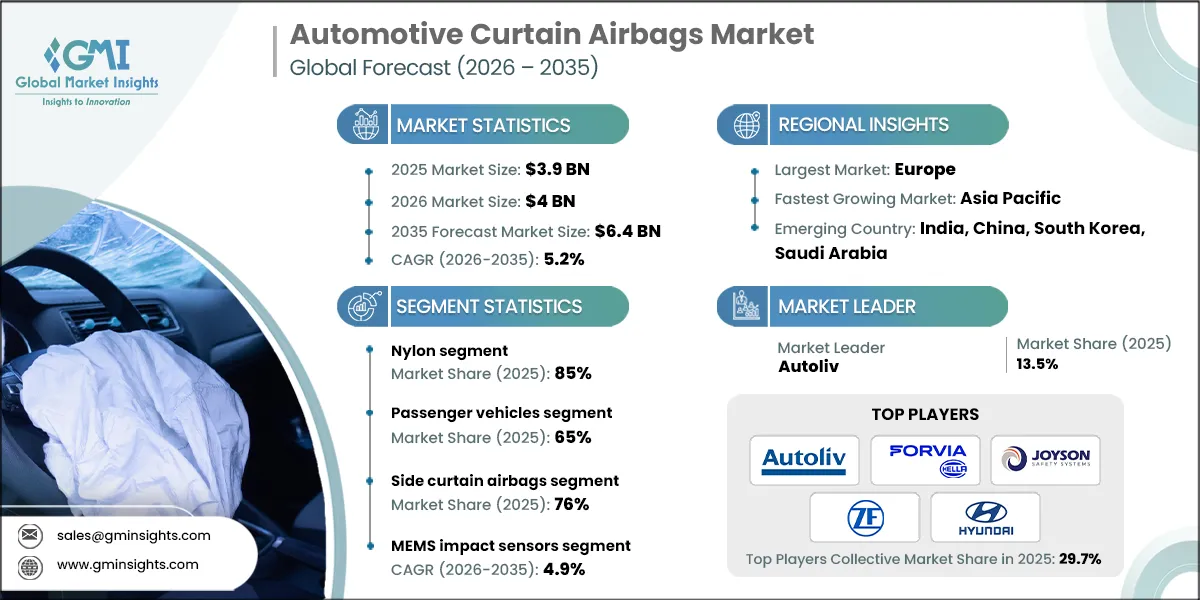
The global automotive curtain airbags market size was estimated at USD 3.9 billion in 2025. The market is expected to grow from USD 4 billion in 2026 to USD 6.4 billion in 2035, at a CAGR of 5.2%, according to latest report published by Global Market Insights Inc.
Automotive Curtain Airbags Market Key Takeaways
Market Size & Growth
- 2025 Market Size: USD 3.9 Billion
- 2026 Market Size: USD 4 Billion
- 2035 Forecast Market Size: USD 6.4 Billion
- CAGR (2026–2035): 5.2%
Regional Dominance
- Largest Market: Europe
- Fastest Growing Region: Asia Pacific
Key Market Drivers
- Growing Emphasis on Occupant Safety Compliance.
- Rising Adoption of SUVs and Crossovers.
- Technological Advancements in Adaptive Airbag Systems.
- Production Expansion in Emerging Automotive Hubs.
- Shift Toward Sustainable Materials.
Challenges
- High System Integration and Component Costs.
- Limited Safety Regulations in Emerging Markets.
Opportunity
- Growth in Autonomous and Semi-Autonomous Vehicles.
- Aftermarket Replacement and Recall-Driven Demand.
- Expansion into Commercial Vehicles and Fleets.
- Sustainability-Driven Procurement Shifts.
Key Players
- Market Leader: Autoliv led with over 13.5% market share in 2025.
- Leading Players: Top 5 players in this market include Autoliv, Forvia Hella, Joyson Safety Systems, ZF Friedrichshafen, Hyundai, which collectively held a market share of 29.7% in 2025.
Get Market Insights & Growth Opportunities
The SUV and crossover market will continue to grow in part due to how higher rooflines and larger cabins provide greater exposure and therefore, a larger need for head protection. Therefore, most manufacturers are starting to adopt curtain airbags as standard equipment on more vehicles globally and at a very reasonable price point.
In July 2024, Hyundai Mobis introduced the world's first airbags tailored for Purpose-Built Vehicles (PBVs). These innovative airbags enhance passenger safety by adapting to flexible seating arrangements, ensuring optimal protection in diverse configurations. The technology aligns with evolving mobility trends, offering solutions for future autonomous and shared vehicle designs.
The use of skateboard architectures (EV Platforms) will result in changes to the way vehicles are packaged and the way sensors are packaged, allowing for a better way to install curtain airbags. As a result of this, suppliers are developing smaller and lighter inflatable curtain airbags and textile materials that will allow for greater levels of protection within tighter cabins all over the world.
Global safety regulations mandate OEMs must provide side impact protection with the use of curtain airbags across their entire range, especially for SUV, family vehicle and other rapidly expanding vehicle lines in emerging markets (such as Latin America and Asia).
Due to an increase in consumer awareness and desire for increased occupant protection, more consumers are looking for vehicles that provide the highest level of safety and, as a result, OEMs are creating differentiation between the products they offer by including advanced passive safety systems, as well as complying with regulations that require increased protection.
Significant advances have been made in crash sensors, electronics and the multi-stage inflatable technologies have enabled greater accuracy of curtain airbag deployment relative to crash types and occupant sizes, which has resulted in superior levels of safety performance and OEMs are now willing to specify curtain airbags on most models.
To get key market trends
Automotive Curtain Airbags Market Trends
Growing advances in occupant detection technology and multi-chamber curtain airbag designs are allowing for adaptive curtain airbag deployment to accommodate variable occupant seating positions, resulting in reduced severity of injury and improved side impact.
Utilization of lightweight materials and smaller inflatable technologies reduces vehicle system weight, increases EV range, and decreases manufacturing footprint. As a result, suppliers are concentrating on providing high-strength woven fabrics and low EPP gas generator products for mass volume production and lower-cost suppliers.
By developing modular curtain airbag platforms that can share use across multiple OEMs/models, suppliers are enabling systems to lower their unit costs and facilitate quicker fitment of curtain airbags in entry-level vehicles that lack complete side-impact protection through standardization of technology and global supplier alliances.
Growing harmonization of regulatory testing (Euro NCAP /IIHS) for side impacts as well as increased tests to achieve the highest possible ratings from consumers has led many manufacturers to standardize their curtain airbag products to meet these consumer expectations and gain the confidence of consumers in terms of how well their products will perform in an accident.
In November 2024 ZF presented their new radar-enhanced curtain airbag designs, which use a 60 GHz radar sensor allowing for real-time occupant tracking. Their curtain airbag technology can inflate based upon the seating arrangement of an autonomous vehicle and incorporates the latest passive safety features with advanced radar technologies to improve the timing of inflation providing greater accuracy at time of deployment.
There has been an increase in the number of aftermarket and updated curtain airbag solutions being sold in developing nations, as the need for economic solutions for older vehicle fleets has risen with the increase in awareness of safety issues coupled with regulatory encouragement from NGOs, insurers and legislative bodies.
Automotive Curtain Airbags Market Analysis
Learn more about the key segments shaping this market
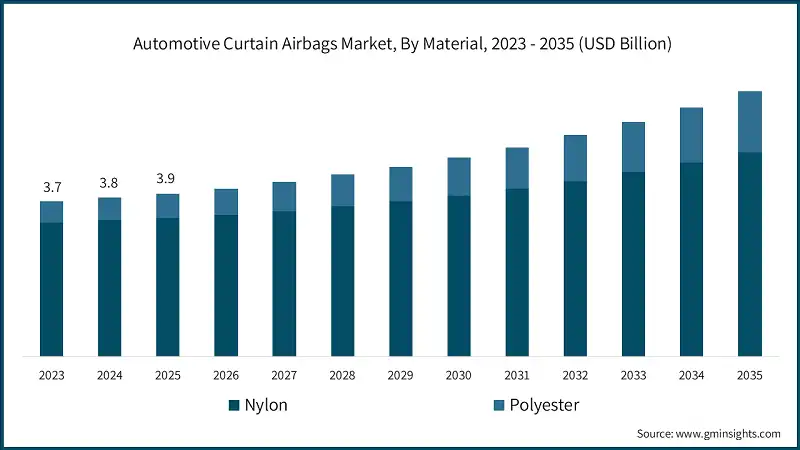
Based on material, the automotive curtain airbags market is segmented into nylon and polyester. The nylon segment dominates the market with 85% share in 2025, and the segment is expected to grow at a CAGR of 4.2% from 2026 to 2035.
- Regulations, customer trust with original equipment manufacturers (OEMs), and continual advances in materials with finer yarns and better weaving results are supporting the growth of nylon. Due to its high melting point and established production infrastructure, nylon is very durable and is therefore expected to be used over a long period and to continue to gain market share.
- Polyester airbags have experienced strong growth as a result of their lower costs, better sustainability benefits than nylon, and new advances in fiber-engineering techniques. Due to improved recyclability, lower emissions, and ability to perform well in low-force applications, polyester is becoming increasingly popular for use in automotive curtain airbag systems.
- Nylon-polyester hybrid fabrics, alternative nylon-based materials, and the development of bio-based polyamides are examples of possible future developments. As a result of changing safety regulations, growing sustainability initiatives, and new innovations in fiber chemistry, the performance gap between nylon and polyester will continue to be reduced by the ongoing use of these materials.
Learn more about the key segments shaping this market
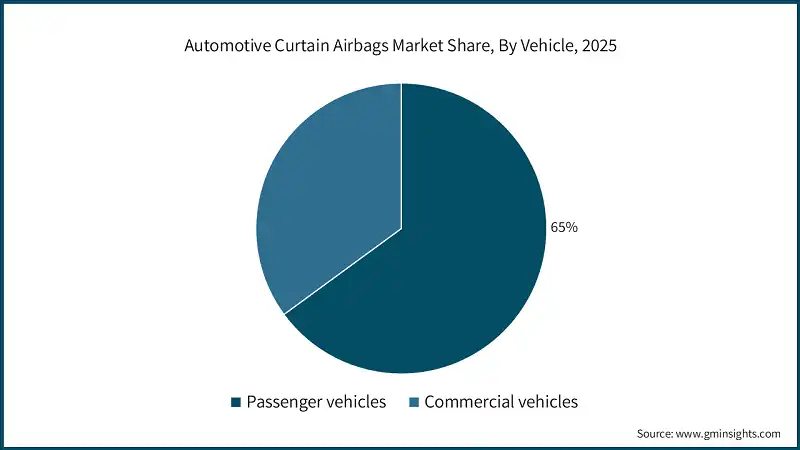
Based on vehicle, the automotive curtain airbags market is segmented into passenger vehicles and commercial vehicles. The passenger vehicles segment dominated the market, accounting for around 65% in 2025 and is expected to grow at a CAGR of 5.5% from 2026 to 2035.
- The approach to the adoption of passenger vehicles depends on the vehicle's class. The luxury class of passenger vehicles has nearly universal adoption of curtain airbag systems. The mid-market class of passenger vehicles has rapidly adopted curtain airbag systems as standard. The entry-level passenger vehicle class is constrained by cost and has low adoption in emerging markets. However, the adoption rate across all vehicle price levels is steadily climbing as regulations evolve.
- The commercial vehicle market is developing slower than the passenger vehicle market due to the relative lack of regulations, fleet operators' sensitivity to costs, and habitually single occupant use patterns. However, as liability concerns increase, so does the expectation for safety and protection from accidents, causing commercial fleets to adopt passenger-vehicle protection standards. Hence, the growth potential of this market segment is increasing globally.
- In the future, the growth potential for commercial vehicles will be supported by harmonized regulations, integration of EV platforms in commercial vehicles, and incentives from insurers to encourage the integration of full safety systems. Moreover, the establishment of new use cases for commercial vehicles (e.g., autonomous, specialized vehicles) requires the development of new designs for curtain airbag systems specific to the capabilities and operational environments of these vehicles.
Based on type, the automotive curtain airbags market is segmented into side curtain airbags, front curtain airbags, and rear curtain airbags. The side curtain airbags segment dominated the market, accounting for around 76% share in 2025 and is expected to grow at a CAGR of 4.3% from 2026 to 2035.
- Airbag system designs often include large volume deployments of airbags, very quick deployment speed, and extended inflation times to help protect against rollover. New technologies such as rollover sensing, multi-stage inflators and far-side protection are also incorporated into these systems to further protect against rollover. Industrialization of these technologies has created a great deal of pressure on manufacturers to implement these technologies into their designs to comply with evolving Euro NCAP test standards, as well as to meet increasing consumer safety expectations.
- Front curtain airbags are increasingly becoming options for the head protection of passengers in frontal impact and offset crashes. Adoption of this technology is highest in premium vehicles and vehicles that are expected to be equipped with autonomous interiors. However, limitations of packaging, cost constraints and visibility issues are inhibiting widespread adoption. Ongoing design advancements combined with regulatory updates should help drive adoption in the near future.
- Rear curtain airbag technology is seeing rapid growth as both regulatory and consumer focus on protecting rear-seat occupants increases, particularly with the advent of premium and autonomous three-row vehicles. Although there are challenges associated with installation and the variability of rear cabin configurations, the increased emphasis on providing occupant protection for all vehicle occupants is leading to wider adoption of the technology in SUVs, luxury vehicles and next-gen mobility platforms.
Based on sensor, the automotive curtain airbags market is segmented into MEMS impact sensors, rollover gyro sensors and unified safety ECUs. MEMS impact sensors is projected to dominate the market and is expected to grow at a CAGR of 4.9% from 2026 to 2035.
- MEMS (Micro-Electromechanical Systems) sensors consist of tiny moving components that can detect different impact types within a vehicle using either capacitive or piezoresistive techniques. Future developments will result in faster processing, enhanced communication capabilities, and better reliability of Electric Vehicles (EVs) which will allow for broader applications of these devices in developing new systems to help prevent crashes through safer driving practices.
- Due to the maturity and regulatory compliance of rollover gyro sensors, their market growth is sluggish at this stage. These sensors measure the rotation of a vehicle during a rollover event and are being enhanced via sensor fusion, predictive algorithms, and earlier deployment timelines. While the growth of rollover gyro sensors will not be significant due to the slow integration of ECU architectures; more advanced technologies are making it easier to incorporate newer features into existing vehicle ECU designs.
- The rapid growth of unified safety ECUs reflects the shift towards a more centralized electronic architecture for automobiles. Unified safety ECUs provides a single platform for all aspects of safety-related sensing and processing, thereby reducing the number of separate devices used for the same function, facilitating improved sensor fusion capabilities, and enhancing the accuracy with which they can be set to deploy. These systems will likely become increasingly appealing for new vehicle models utilizing software-based safety functions in combination with their electronic architecture.
Looking for region specific data?
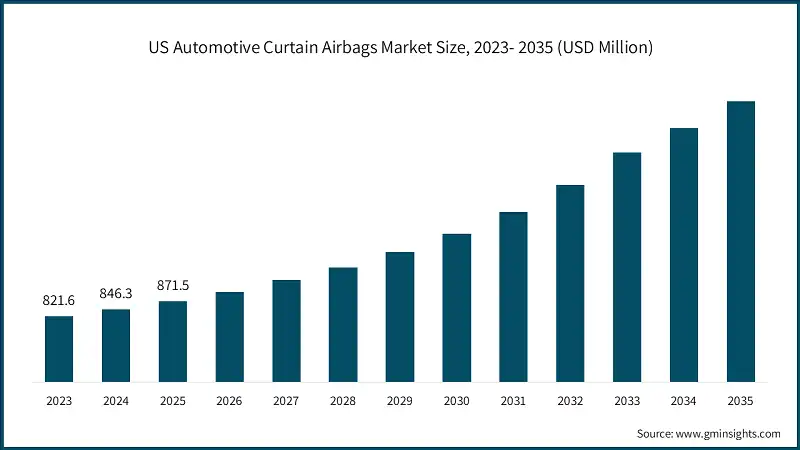
The US automotive curtain airbags market is valued USD 871.5 million in 2025 and is expected to experience significant and promising growth from 2026 to 2035.
- The NHTSA has accepted additional responsibilities to develop its side impact and ejection mitigation tests and to push manufacturers into using new advanced curtain airbags that have an enhanced range of coverage, more efficient rollover performance (compared to existing curtain airbags), and more effective performance (compared to existing curtain airbags) for larger SUV’s and pickup trucks that are similar in size to these vehicles.
- As more SUVs and pickup trucks are sold, there is a need for increased numbers of curtain airbags due to increased exterior space (size), increased exterior space (size), and increased consumer expectations of safety; therefore, OEM's have a need to develop and develop multi-row curtain airbag systems as standard across the range of trims for most SUVs and Pickup trucks.
- US-based OEM are increasingly integrating curtain airbag systems with advanced occupant monitoring technologies, rear seat reminders, and child detection systems, therefore reducing the risk of injury and improving the ability of the airbag to deploy appropriately during a crash, based on the new testing protocols being released over time by NHTSA.
- New NHTSA crash testing protocols and the associated incentives provided by insurance companies allow OEM to enhance the performance of their curtain airbag systems, especially in the far-side impact performance area, as they continue to work toward achieving Top Safety Pick ratings; therefore, strengthening their competitive position in the marketplace.
North America dominated the automotive curtain airbags market with a market share of 26% in 2025.
- The curtain airbag market in North America continues to grow because of the established presence of the automotive market, strong regulations for vehicle safety, and consumer expectations of safe vehicles. The popularity of SUVs and light trucks also contributes to the demand for large amounts of curtain airbags across many vehicle types.
- The United States is the main contributor to the demand for curtain airbags in North America. This is because of the government-imposed safety standards, the competitive nature of the vehicle safety ratings, and the constant number of light vehicle sales. As a result of the need for ejection-mitigation systems and the evolving standards for vehicle crash testing, the automotive manufacturers are working towards creating more extensive and advanced curtain airbags.
- Looking ahead, North America has an opportunity for growth because of the continued development of EV platforms, the sustained popularity of SUVs and pickups, and the emergence of new technology. The growth in Canada will be slow compared to the rest of North America because of the smaller size of the Canadian automotive market, the high percentage of vehicles imported from other countries, and the lack of manufacturing capacity in Canada.
The China is fastest growing country in Asia Pacific automotive curtain airbags market growing with a CAGR of 7.2% from 2026 to 2035.
- China's rising expectations for safety along with upgrades to C-NCAP support broader adoption of curtain airbags on mass-market vehicles, diversifying from luxury cars into smaller sedan types, entry-level SUVs, and many large Chinese automotive brands.
- Increased government safety regulations and consumer protection enforcement initiatives fuel the growth of using multiple row curtain systems as standard equipment on family-oriented vehicles where there is a growing concern about rear seating passenger safety, including children, during a collision.
- Chinese OEM's are making large investments in advanced sensor systems and integrated electronic control units (ECU), which result in improved deployment accuracy, and allow the OEM's to differentiate themselves as competitive in offering economically priced and high-tech vertical side-curtain systems.
- China's New Energy Vehicle (NEV) growth provides the opportunity for greater integration into the existing advanced curtain airbag systems as more platforms emerging now allow much greater flexibility in packaging of these advanced systems; therefore, OEM's will likely place increasing emphasis on enhancing vehicle occupant side-impact protection as they work to build the public's confidence in these rapidly expanding NEV segments.
Asia Pacific region dominated the automotive curtain airbags market, which is anticipated to grow at a CAGR of 6.7% during the analysis timeframe.
- The growing demand for curtain airbags globally can be attributed to the rise of vehicle production, increased safety regulations convergence between countries, and the availability of higher quantities of money to purchase vehicles by consumers in the middle class in Asia Pacific.
- China will continue to dominate the curtain airbag market. The Chinese government is also planning to implement progressive automotive safety regulations and new automotive safety standards (based on UN and Euro NCAP protocols) that will encourage widespread use of curtain airbags in all new automotive products in China.
- Expansion of the vehicle manufacturing sector in India, technology leadership by Japan and South Korea, and the increase in regional automotive regulatory standards throughout ASEAN are dimensions of growth in the overall Asia Pacific region. Global demand for electric vehicles, export-oriented manufacturing of electric vehicles, and higher standards for automotive safety (usually higher than that required under international commercial guidelines) are adding further to the growth in the Asia Pacific automotive market.
Germany dominates the Europe automotive curtain airbags market, showcasing strong growth potential, with a CAGR of 5.6% from 2026 to 2035.
- Germany is ahead of the curve when it comes to adopting new multi-stage (or far-side) curtain airbags or centre-line airbags, made possible by high consumer expectations in the premium vehicle segment, stringent Euro NCAP requirements, and a strong focus by German manufacturers on safety driven by Engineering.
- The shift towards a centralized function (i.e. the use of centralized ECUs) also opens the door to advanced technologies such as sensor fusion, which will allow the timing of airbag deployment to be optimized using data gathered from multiple sensors. It will also allow for over-the-air re-calibration of the system for new safety functions as they become available over time.
- The use of skateboard platforms for battery-electric vehicles allows for some new advantages in optimizing the design of roof rails for a longer curtain airbag while at the same time minimizing the number of wires required to achieve a functioning system in compliance with the latest requirements for protection against side impacts across all regions, especially when it comes to EVs.
- In addition, the increased focus on safety for rear-seat passengers by Euro NCAP has resulted in greater adoption of rear curtain airbags in premium SUVs and executive sedans for the chauffeur-driven market.
Europe automotive curtain airbags market accounted for USD 1.1 billion in 2025 and is anticipated to show growth of 5.1% CAGR over the forecast period.
- The market for curtain airbags in Europe is on a steady increase and is aided by the global leadership in regulatory compliance for safety, high presence of luxury/premium vehicles, and the nearly universal availability of curtain airbags on new models. With Europe’s increased focus on advanced protection systems, the demand for curtain airbags among OEMs (Original Equipment Manufacturers) and across all vehicle segments is continually strong.
- Germany is considered the innovation centre of the region for curtain airbags. A few of the major OEMs are headquartered there, and several of the world’s leading suppliers of crash test dummies and other safety systems also have their headquarters in Germany. Additionally, Germany possesses strong expertise in engineering and the development of advanced materials, as well as being one of the largest exporters of curtain airbags globally. Therefore, the innovation and development of next-generation curtain airbags will be conducted primarily in Germany.
- The entire European market is supported by the multiple manufacturing hubs located in Western and Central Europe (from mass-market to luxury) and has a high degree of regulatory alignment. They are also experiencing growth in expectations from consumers and regulatory agencies regarding the safety of their vehicles and continued growth in multi-country OEM networks, which will lead to an acceleration in the acceptance of curtain airbags across all segments of the automotive industry.
Brazil leads the Latin American automotive curtain airbags market, exhibiting remarkable growth of CAGR 3.5% during the forecast period of 2026 to 2035.
- Latin America's market for curtain airbags has grown consistently; however, it remains limited for the following reasons: cost-conscious buyers, inconsistent enforcement of regulations, and the changing economy (i.e., downturns during vehicle production). All of which hinder the adoption of advanced safety systems in all areas, except for large urban centers.
- Brazil is leading demand in the region because of its strong manufacturing base, progressive Contran regulations, and development of a middle class. In addition, the increase in domestic production and continued development of alignment with United Nations (UN) safety standards are still driving increased use of curtain airbags.
- Moreover, Mexico's focus on producing vehicles for export creates a demand for compliance with the United States (U.S.) safety standard. Additionally, Argentina has started to produce vehicles domestically, and gradually as other small markets continue to regulate, some of these markets will eventually begin to develop higher cost technologies for protection. Due to the wide diversity of economic stability in the region, this presents a barrier to the widespread adoption of these technologies.
UAE to experience substantial growth in the Middle East and Africa automotive curtain airbags market in 2025.
- Africa and the Middle East exhibit minor increase in expansion for curtain airbag availability because manufacturers have limited capacity for production; dependence on imports for airbag systems; and the fact that they are continuing to meet standards set by the regulatory bodies related to safety.
- In the UAE, premium vehicles are preferred by consumers, which is driving demand for airbag systems due to an established importation chain for automobiles and a growing rental fleet that is outfitted with newer safety systems, which contributes to the acceleration in the use of curtain airbags by the high-income customer base; thus, while the manufacturers are limited in their ability to produce these systems domestically, the delay in the regulatory process for the approval of these systems is not as great as everywhere else.
- The rest of the region is growing very slowly, due to South Africa’s manufacturing base, North Africa’s production capabilities, and developing nations being inconsistent in their compliance with safety regulations. There also continues to be an excessive number of imported used vehicles and the lack of developed regulations are major roadblocks to the widespread adoption of curtain airbags.
Automotive Curtain Airbags Market Share
- The top 7 companies in the automotive curtain airbags industry are Autoliv, Joyson Safety Systems, Toyoda Gosei, ZF Friedrichshafen, Hyundai, Continental and Forvia Hella contributed around 35% of the market in 2025.
- Autoliv is leading the automotive industry due to its extensive presence worldwide, large patent portfolio, vertical integration of components, consistent investment in research and development, sustainability initiatives using recycled materials, and strong partnerships with OEMs, while simultaneously addressing price management issues and integration challenges associated with the post-acquisition of Veoneer.
- Forvia Hella capitalizes on their expertise in electronics and sensor integration, strong presence in the premium European automotive market, vision system development capabilities, electrification opportunities, and aftermarket capabilities to provide advanced solutions for curtain airbag systems, while addressing the complex, large scale, and geographic concentration factors.
- Joyson Safety Systems has rebuilt its image following the Takata incident by redesigning their inflators, implementing strict quality standards, having a worldwide manufacturing footprint, offering competitive pricing, and recovering their market share through active recovery methods. However, the company still has to deal with issues regarding their past reputation, difficulties associated with integration, and investment limits.
- ZF Friedrichshafen produces integrated vehicle safety system products that contain both curtain airbags, seatbelts, and both types of safety systems, active and passive. Their strengths are in the commercial vehicle segment and the autonomous vehicle technology segment and they provide a complete system that integrates both types of safety systems, while the company is dealing with complexity related to their operations and constraints regarding capital to conduct business.
- Toyoda Gosei strengthens its position through strong ties with Toyota Group, advanced materials expertise, expanding production in China, and consistent quality performance supporting global OEMs. However, it faces challenges related to limited diversification beyond Toyota programs, intensifying competition from larger global suppliers, and the need for higher investment in next-generation safety technologies.
- Hyundai benefits from captive demand from Hyundai-Kia, broad global manufacturing presence, expanding non-captive business, and active development of advanced occupant monitoring and EV-oriented safety systems. Yet it continues to face hurdles involving heavy reliance on Hyundai-Kia volume, limited brand recognition with Western OEMs, and competitive pricing pressure in its core Asian markets.
- Continental enhances its market position through strong electronics expertise, advanced sensing integration, hybrid inflator innovation, and broad global OEM partnerships supported by deep software and safety domain knowledge. Nonetheless, the company contends with rising cost pressures, portfolio complexity across multiple product lines, and the need to balance investment between passive safety, ADAS, and software-defined vehicle transitions.
Automotive Curtain Airbags Market Companies
Major players operating in the automotive curtain airbags industry are:
- Autoliv
- Continental
- Hella
- Hyundai
- Joyson Safety Systems
- Kolon Industries
- Neaton Auto Products Manufacturing
- Toyoda Gosei
- ZF Friedrichshafen
- Forvia Hella, an innovative company, uses its expertise in electronics, sensing, and lighting to create a new generation of next-generation curtain airbag systems, utilizing a strong presence in Europe while also expanding into Asia through advanced Industry 4.0 manufacturing capabilities and continued technology leadership in EV-compatible occupant monitoring and safety solutions.
- Through innovation and significant investments in research and development, Autoliv is at the forefront of automotive safety in the world via their dedicated and extensive manufacturing capabilities (including their advanced inflator and sensor technology), use of recyclable polyester ('Eco-Friendly') safety cushions, and their close working relationship with OEMs that supports their continuous development of passive safety solutions.
- By integrating its Takata assets into Joyson Safety Systems' businesses, Joyson Safety Systems has significantly strengthened its presence in the global safety market by redesigning inflators, developing advanced quality-control processes for products manufactured at their facilities, and adopting a business strategy that focuses on reputation restoration and operational efficiency while developing a competitive position for their products.
- ZF has demonstrated that an integrated solution of passive and active safety can be achieved by combining its strength in commercial vehicles with the capabilities it gained from acquiring TRW; leveraging its extensive global manufacturing network and investing in the development of software-defined vehicles creates a unified and intelligent system for deploying curtain airbags in a coordinated manner across multiple vehicle platforms.
Automotive Curtain Airbags Market Report Attributes
| Key Takeaway | Details |
|---|---|
| Market Size & Growth | |
| Base Year | 2025 |
| Market Size in 2025 | USD 3.9 Billion |
| Market Size in 2026 | USD 4 Billion |
| Forecast Period 2026 - 2035 CAGR | 5.2% |
| Market Size in 2035 | USD 6.4 Billion |
| Key Market Trends | |
| Drivers | Impact |
| Growing Emphasis on Occupant Safety Compliance | Tightening global crash-safety regulations and NCAP protocols push OEMs to adopt curtain airbags as standard equipment, accelerating baseline installation rates and strengthening supplier demand across mass-market and premium vehicle segments. |
| Rising Adoption of SUVs and Crossovers | Increasing global SUV and crossover sales vehicles with higher rollover risk boost curtain-airbag integration, expand volume demand and encourage OEMs to specify larger multi-row curtain systems for broader cabin coverage. |
| Technological Advancements in Adaptive Airbag Systems | Sensor fusion, occupant-monitoring, and AI-based deployment optimization enhance curtain-airbag performance, prompting OEMs to integrate advanced systems that improve protection accuracy, support autonomous-vehicle scenarios, and increase supplier value-added content. |
| Production Expansion in Emerging Automotive Hubs | Regional manufacturing growth in China, India, Southeast Asia, and Eastern Europe drives localized curtain-airbag sourcing, expanding supplier networks, reducing logistics costs, and supporting high-volume vehicle production with safety-feature standardization. |
| Shift Toward Sustainable Materials | OEM sustainability commitments accelerate adoption of bio-based fabrics, recycled polyester, and low-carbon inflators, increasing supplier differentiation and enabling compliance with lifecycle-impact regulations while maintaining performance parity with traditional materials. |
| Pitfalls & Challenges | Impact |
| High System Integration and Component Costs | Curtain airbags require complex inflators, fabric assemblies, and ECU integration, adding cost pressure in price-sensitive markets where OEMs prioritize affordability, limiting adoption in entry-level segments and developing economies. |
| Limited Safety Regulations in Emerging Markets | Weak or inconsistent safety mandates across parts of Africa, Middle East, and Latin America reduce OEM incentives to standardize curtain airbags, slowing volume penetration and constraining long-term market expansion. |
| Opportunities: | Impact |
| Growth in Autonomous and Semi-Autonomous Vehicles | Non-traditional seating postures in AVs increase need for adaptive curtain-airbag solutions. Enhanced occupancy sensing and customizable protection create new premium safety packages and higher system value for suppliers. |
| Aftermarket Replacement and Recall-Driven Demand | Large legacy inflator recalls and expanding vehicle parc create long-term aftermarket opportunities for compliant replacement modules, enabling suppliers to secure recurring revenue beyond OEM production cycles. |
| Expansion into Commercial Vehicles and Fleets | Rising safety expectations in buses, vans, and logistics fleets generate new adoption avenues for extended-length curtain airbags, supported by government fleet-safety programs and corporate ESG commitments. |
| Sustainability-Driven Procurement Shifts | OEM preference for low-emission materials opens market space for recycled polyester, bio-based fabrics, and energy-efficient manufacturing, enabling suppliers with sustainable portfolios to win future-platform sourcing contracts. |
| Market Leaders (2025) | |
| Market Leaders |
13.5% Market Share |
| Top Players |
|
| Competitive Edge |
|
| Regional Insights | |
| Largest Market | Europe |
| Fastest growing market | Asia Pacific |
| Emerging countries | India, China, South Korea, Saudi Arabia |
| Future outlook |
|
What are the growth opportunities in this market?
Automotive Curtain Airbags Industry News
- Forvia announced the launch of 100-per cent bio-based polyamide airbag suited for curtain applications manufactured with castor oil-derived feedstocks in December 2024. This new product is made of materials similar to those used in commercially available nylon 66 materials while providing approximately 60% less carbon footprint. Production plans are underway, commencing in 2026, for the German luxury vehicle market and scaling up is anticipated as demand grows.
- Joyson's program to install new curtain airbag inflators that are free from ammonium nitrate is complete (as of October 2024). To accomplish this, 3.2 million inflators have been replaced, and the new inflator designs provide improved moisture resistance due to their better sealing capabilities. The successful completion of this program concludes the remediation process started in 2017 due to the Takata airbag defect cases.
- Bosch released a unified safety ECU with artificial intelligence capability that can monitor up to 16 sensors and conform to ASIL-D level safety standards in September 2024. This device reduces the number of false inflations that occur during a motor vehicle collision by approximately 30-40%, and the design is being targeted for use in 2026 vehicle programs.
- Hyundai Mobis and OMNIVISION are working together on developing integrated occupant monitoring systems and curtain airbag control systems to be used in 2026-2027 eventually electric vehicle platforms utilizing RGB-IR cameras for August 2024.
- Continental introduced hybrid-propellant curtain airbag inflator designs in July 2024 that utilize both pyrotechnic gas generation through heat with controlled release of compressed gases through electronic modulation to achieve more accurate inflation and improved occupant protection regardless of crash severity. Production readiness for these designs is scheduled for the 2027-2028 time frame. Toyoda Gosei announced their Tianjin curtain airbag facility in June 2024. The new facility features fully automated processes that include robot sewing, computer-controlled cutting, and vision inspection systems. The new facility will produce up to 3-4 million curtain airbags per year to support the demands of Chinese OEMs for safe passenger vehicles.
- In May 2024, Autoliv released the results of their lifecycle study of using recycled polyester materials to produce curtain airbags. According to the findings, manufacturing curtain airbags from recycled polyester has been shown to reduce greenhouse gas emissions by 50% and energy consumption by 30% compared to using virgin polyester while still allowing compliance with the FMVSS and Euro NCAP crash test standards.
The automotive curtain airbags market research report includes in-depth coverage of the industry with estimates & forecasts in terms of revenue ($Mn) and volume (Units) from 2022 to 2035, for the following segments:
Market, By Type
- Side curtain airbags
- Nylon
- Polyester
- Front curtain airbags
- Nylon
- Polyester
- Rear curtain airbags
- Nylon
- Polyester
Market, By Material
- Nylon
- Polyester
Market, By Sensor
- MEMS Impact Sensors
- Rollover Gyro Sensors
- Unified Safety ECUs
Market, By Vehicle
- Passenger vehicles
- Hatchback
- Sedan
- SUVS
- Commercial vehicles
- Light commercial vehicles (LCVs)
- Medium commercial vehicles (MCVs)
- Heavy commercial vehicles (HCVs)
Market, By Sales Channel
- OEM
- Aftermarket
The above information is provided for the following regions and countries:
- North America
- US
- Canada
- Europe
- Germany
- UK
- France
- Italy
- Spain
- Russia
- Nordics
- Portugal
- Croatia
- Benelux
- Asia Pacific
- China
- India
- Japan
- Australia
- South Korea
- Singapore
- Thailand
- Indonesia
- Vietnam
- Latin America
- Brazil
- Mexico
- Argentina
- MEA
- South Africa
- Saudi Arabia
- UAE
- Turkey
Frequently Asked Question(FAQ) :
What is the market size of the automotive curtain airbags in 2025?
The market size was estimated at USD 3.9 billion in 2025, with a CAGR of 5.2% expected through 2035. The increasing adoption of curtain airbags as standard equipment and the growing SUV and crossover market are driving growth.
What is the projected value of the automotive curtain airbags market by 2035?
The market is poised to reach USD 6.4 billion by 2035, driven by advancements in occupant detection technology, lightweight materials, and modular airbag platforms.
What is the expected size of the automotive curtain airbags industry in 2026?
The market size is projected to reach USD 4 billion in 2026.
How much revenue did the nylon segment generate in 2025?
The nylon segment dominated the market with an 85% share in 2025 and is expected to grow at a CAGR of 4.2% from 2026 to 2035.
What was the valuation of the passenger vehicles segment in 2025?
The passenger vehicles segment accounted for approximately 65% of the market in 2025 and is set to expand at a CAGR of 5.5% till 2035.
What is the growth outlook for the side curtain airbags segment?
The side curtain airbags segment, which held a 76% market share in 2025, is anticipated to observe around 4.3% CAGR up to 2035.
Which region leads the automotive curtain airbags sector?
The United States leads the market, valued at USD 871.5 million in 2025. The NHTSA's focus on advanced curtain airbags with enhanced coverage and performance is driving growth in this region.
What are the upcoming trends in the automotive curtain airbags market?
Key trends include smarter airbags, lighter EV materials, modular systems, standardized tests, radar integration, and rising aftermarket adoption.
Who are the key players in the automotive curtain airbags industry?
Key players include Autoliv, Continental, Hella, Hyundai, Joyson Safety Systems, Kolon Industries, Neaton Auto Products Manufacturing, Toyoda Gosei, and ZF Friedrichshafen.
Automotive Curtain Airbags Market Scope
Related Reports