Summary
Table of Content

Automotive Blockchain Security Module Market
Get a free sample of this report
Form submitted successfully!
Error submitting form. Please try again.
Thank you!
Your inquiry has been received. Our team will reach out to you with the required details via email. To ensure that you don't miss their response, kindly remember to check your spam folder as well!
Request Sectional Data
Thank you!
Your inquiry has been received. Our team will reach out to you with the required details via email. To ensure that you don't miss their response, kindly remember to check your spam folder as well!
Form submitted successfully!
Error submitting form. Please try again.
Automotive Blockchain Security Module Market Size
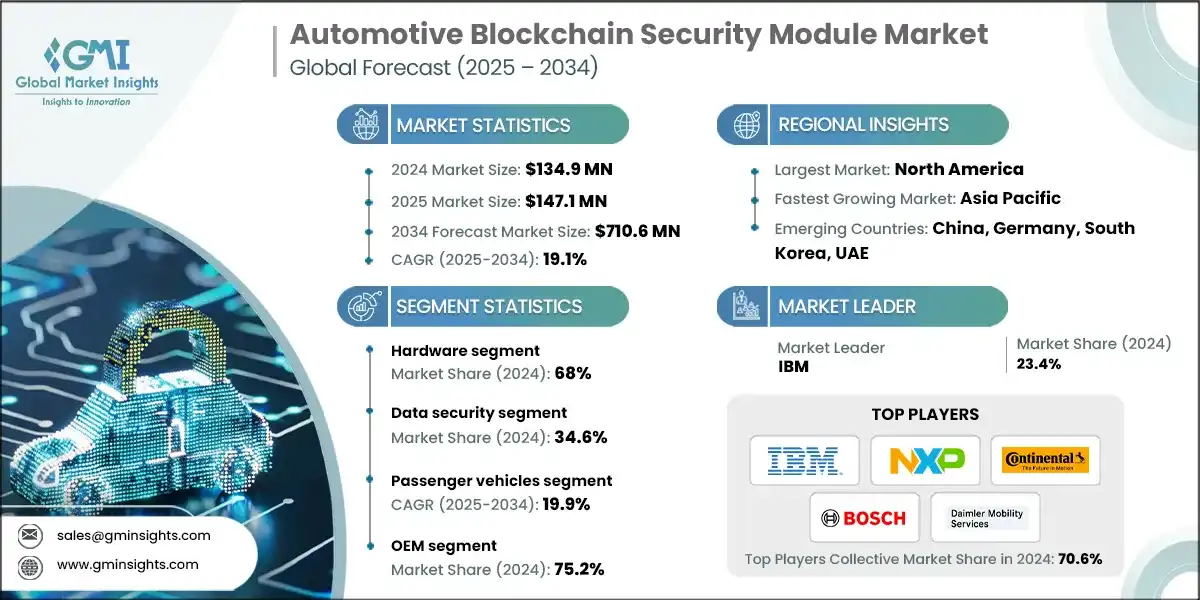
The global automotive blockchain security module market size was estimated at USD 134.9 million in 2024. The market is expected to grow from USD 147.1 million in 2025 to USD 710.6 million in 2034, at a CAGR of 19.1% according to latest report published by Global Market Insights Inc.
Automotive Blockchain Security Module Market Key Takeaways
Market Size & Growth
- 2024 Market Size: USD 134.9 Million
- 2025 Market Size: USD 147.1 Million
- 2034 Forecast Market Size: USD 710.6 Million
- CAGR (2025–2034): 19.1%
Regional Dominance
- Largest Market: North America
- Fastest Growing Region: Asia Pacific
Key Market Drivers
- Rising adoption of connected, electric, and autonomous vehicles.
- Growth of vehicle-to-everything (V2X) and IoT ecosystems.
- Stringent cybersecurity and data privacy regulations.
- Rise of software-defined and AI-driven vehicles.
- Increasing need for supply chain transparency.
Challenges
- High integration complexity and cost.
- Scalability and latency constraints.
Opportunity
- Integration of blockchain in EV and autonomous architectures.
- Expansion of decentralized mobility and fleet management platforms.
- Blockchain-secured over-the-air (OTA) and software updates.
- Emergence of tokenized vehicle data and payments.
Key Players
- Market Leader: IBM led with over 23.4% market share in 2024.
- Leading Players: Top 5 players in this market include IBM, NXP Semiconductors, Continental, Bosch, Daimler Mobility, which collectively held a market share of 70.6% in 2024.
Get Market Insights & Growth Opportunities
The competitive landscape of the automotive blockchain security module market is intensifying, driven by AI integration development, semiconductor progress, and cybersecurity enhancement. Leaders in the market are focusing on the development of low-power, high-performance chips that enable secure communication, decentralized identity management, and blockchain-based transaction processing in connected vehicles.
The automotive blockchain security module market is projected to exceed USD 238.6 million by 2029 and USD 282.3 million by 2030. Key growth drivers include increasing priority on secure semiconductor solutions and the transition to electrification and connected vehicle architecture.
Leading semiconductor players such as STMicroelectronics, NXP Semiconductors, Renesas Electronics, and Infineon Technologies are in the lead of creating blockchain-optimized security modules that reduce wiring complexity, ease power distribution and optimize real-time data protection in automotive networks. The market also continues to see strong traction from supply chain resilience and chip localization initiatives in the post-pandemic era.
The Asia-Pacific dominates the market, supported by robust automotive, EV and electronics hubs in China, Japan, South Korea and India. Carmakers and Tier-1s are investing heavily in smart mobility ecosystems, integrating blockchain modules with vehicle communication systems, digital keys, and data authentication systems to increase connected car security.
Europe is the fastest-growing regional market, propelled by stringent EU data protection and automotive safety regulations, in addition to high demand for connected and autonomous vehicle technologies. Prominent OEMs such as BMW, Volkswagen, and Mercedes-Benz are partnering with semiconductor players to embed secure cryptographic processors and blockchain controllers into vehicle architectures, facilitating transparent supply chain tracking and data integrity.
In North America, classic semiconductor leaders such as NXP Semiconductors, Qualcomm Technologies, and Texas Instruments are strengthening their position by developing AI-driven, blockchain-supported hardware solutions for electric and hybrid vehicles.
To get key market trends
Automotive Blockchain Security Module Market Trends
In early 2024, The market for automotive blockchain security modules is growing significantly as OEMs and Tier-1s incorporate more blockchain-enabled systems within connected vehicle architectures. Such modules are becoming core building blocks in the security of communications among smart inverters, zonal controllers, and power management ICs providing data integrity and traceability across vehicle networks.
With the increasing adoption of vehicle electronics towards multi-domain and zonal architectures, blockchain is being co-designed with next-generation microcontrollers, gateways, and transceivers to create tamper-resistant, verifiable communication systems. Such development is especially crucial in the era of electric and hybrid vehicles, where battery management, powertrain control, and regenerative systems depend on trusted, authenticated data exchange.
Growing demand for electric vehicles (EVs) is also driving demand for blockchain-secured semiconductor platforms optimized for energy management and cybersecurity. These modules enable double optimization handling secure data streams for both energy harvesting and energy storage with blockchain enabling transparent monitoring of all energy transactions within the vehicle ecosystem.
OEM are already designing AI-driven, blockchain-secured architectures that integrate energy efficiency and digital trust. This allows the car's central computing system to dynamically manage resources while maintaining immutable records of energy use, software updates and component authentication. As cars evolve into software-defined, connected assets, blockchain security modules are becoming the underpinning of trusted communication between onboard systems, external infrastructure and the energy grid.
Moreover, future blockchain security modules for next-generation blockchains will facilitate two-way flows of energy and data, enabling vehicles not just to sell authenticated power back to the grid (vehicle-to-grid or V2G) but also to participate securely in decentralized energy markets. OEMs are exploring chipsets with embedded blockchain protocols for grid compliance, digital identity, and over-the-air (OTA) security rendering vehicles smart, self-governed and attestable nodes in the broader smart mobility network.
Automotive Blockchain Security Module Market Analysis
Learn more about the key segments shaping this market
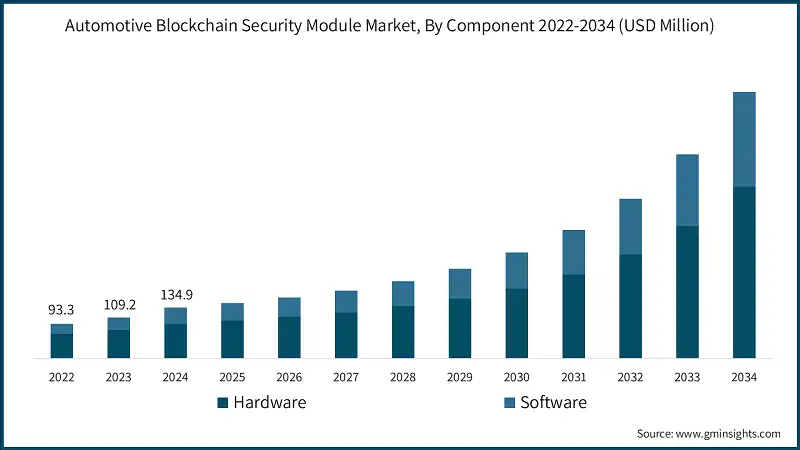
Based on component, automotive blockchain security module market is segmented into hardware and software. The hardware segment dominates the market with 68% share in 2024, and the segment is expected to grow at a CAGR of over 18.3% from 2025 to 2034.
- The hardware market is growing strongly as blockchain-secured processors, crypto accelerators and trusted hardware modules are increasingly being adopted in automotive ECUs. The devices enable tamper-proof data exchange and authentication in vehicle systems, meeting cybersecurity demands in future-connected vehicles.
- As the transition happens to zonal and domain architecture, hardware-based blockchain modules are becoming the need to manage secure communication between in-vehicle nodes, gateways and cloud interfaces.
- Also, manufacturers are investing in energy-efficient, automotive-grade hardware security modules (HSMs) to support real-time blockchain processing and over-the-air (OTA) authentication. These modules support low-latency encryption, tamper-resistant key storage, and cyber-attack immunity.
- The software modules ensure data integrity, verifiable updates, and easy communication in mobility networks. Open blockchain frameworks are also encouraging collaboration between Tier-1 suppliers for interoperable and scalable solutions.
- AI-driven blockchain analytics technological advancements are enabling predictive threat detection, smart contract automation, and decentralized application (dApp) deployment for vehicle identity management.
Learn more about the key segments shaping this market
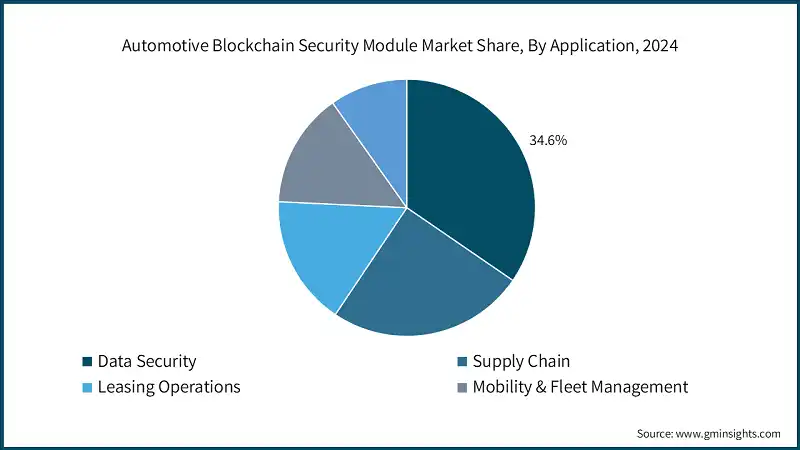
Based on application, automotive blockchain security module market is divided into data security, supply chain, leasing operations, mobility & fleet management, battery & EV lifecycle management. Data security segment dominated the market, accounting for around 34.6% share in 2024 and is expected to grow at a CAGR of 19.7% from 2025 to 2034.
- Data security is the largest application segment for blockchain modules in automobiles. Blockchain offers immutable storage, which defends against unauthorized change of safety-critical information. Vehicle manufacturers are employing blockchain-based encryption and digital identity management to authenticate devices, drivers and services in the connected world.
- Additionally, blockchain also supports increased cyber security against V2X and OTA system threats. Using decentralized key management and secure consensus mechanisms, vehicles can verify transactions and updates in real-time.
- Blockchain is at the forefront of managing the entire value chain of EV batteries, ranging from production all the way to recycling. Distributed ledgers record each transaction and change in ownership, ensuring traceability in sourcing, use, and end-of-life processes. This makes it easier to comply with sustainability regulations and traceability in second-life and recycling uses.
- By combining AI and IoT, blockchain enables predictive maintenance, driver analytics and autonomous billing. Real-time validation of data ensures the trustworthiness of ride-hailing, delivery, and commercial fleets' operations. With increasing interconnected urban mobility, blockchain modules are strengthening cybersecurity, optimizing resource management, and supporting efficient and transparent fleet operations in public and private mobility networks.
Based on vehicle, the market is segmented into passenger vehicles and commercial vehicles. Passenger vehicles segment is projected to dominate the market with a CAGR of 19.9% from 2025 to 2034, owing to acceleration in data privacy, security, and user trust become central to the connected car experience.
- Blockchain adoption in passenger vehicles is gaining momentum as data security, privacy, and consumer trust become highest priorities for the connected vehicle ecosystem. Blockchain modules safeguard OTA updates, digital keys, and in-vehicle data transactions from alteration.
- In 2024, the passenger cars segment dominated the Automotive Blockchain Security Module market, driven by rising adoption of EV, infotainment systems, and green energy features in compact cars, sedans, and SUVs.
- OEMs are employing blockchain to enable individualized services, secure payment for EV charging, parking, and infotainment via identifiable user identities.
- Commercial vehicles are embracing blockchain for better data integrity, logistics transparency, and operational security. Blockchain modules secure communication in fleets using connectivity, enabling secure exchange of data among fleet managers, insurers and regulators.
- Smart contracts facilitate freight documentation, delivery confirmation, and maintenance records to increase operation efficiency and reduce administrative hassles.
Based on Deployment, the automotive blockchain security module market is divided into OEM, and aftermarket. OEM segment dominated the market accounting around 75.2% in 2024 and is expected to grow at a CAGR of 19.3% from 2025 to 2034.
- OEMs are embedding blockchain modules in vehicle ECUs, telematics units and domain controllers to achieve native, hardware-based security. The embedded systems enable real-time authentication, secure OTA software updates and immutable handling of lifecycle data. Blockchain-based digital twins enable OEMs to track every software and hardware change through the life of a vehicle.
- Joint ventures of automakers and blockchain technology firms are driving the development of standardized embedded compliance platforms. Embedded blockchain modules also enable secure data monetization and V2X communication making vehicles trusted digital assets in smart mobility ecosystems.
- Retrofit blockchain modules provide networked and legacy vehicles with sophisticated cybersecurity, tamper-proof service history and predictive repair. Service shops and third-party providers are using blockchain to authenticate parts, monitor repairs and prevent warranty fraud.
- Moreover, decentralized ledgers enable open vehicle ownership transfers, insurance settlements, and performance tracking. As the aftermarket business is digitalized, blockchain ensures data integrity and interoperability between stakeholders facilitating new business models centered on trust, traceability, and customer value.
Looking for region specific data?
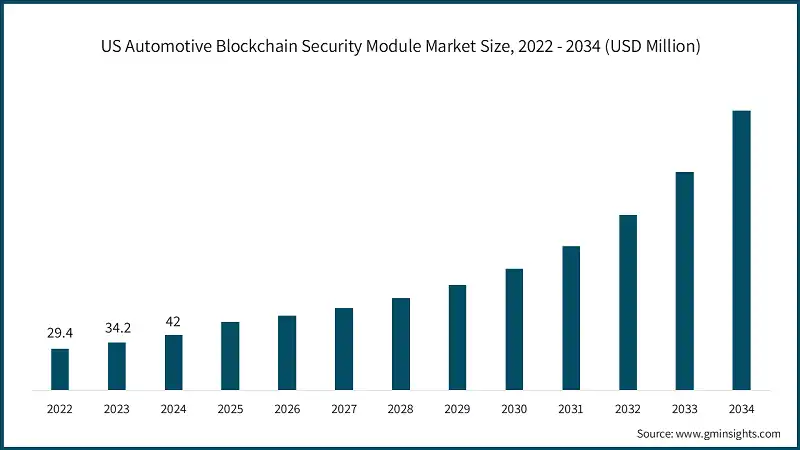
North America region dominated the automotive blockchain security module market with a market share of 36.5% in 2024.
- North America has advanced cybersecurity ecosystem and well-established digital infrastructure, the region is growing significantly owing to the adoption of blockchain automotive security. Automotive Tech companies and automakers are working together to create decentralized networks that guarantee transparent and impenetrable vehicle data management systems.
- Blockchain adoption for EVs and autonomous vehicles is emphasized in the US and Canada. Automotive original equipment manufacturers (OEMs) use blockchain modules to manage vehicle-to-grid (V2G) communications, authenticate software updates and improve traceability across supply chains and connected car networks.
- Blockchain adoption for in-vehicle communication protection is driven by growing compliance pressure with NHTSA and ISO cybersecurity standards. Blockchain module development for intelligent mobility applications is fueled by the region's robust R&D and semiconductor ecosystems.
- Tier-1 suppliers and startups develop scalable blockchain middleware for OTA data encryption, identity management, and secure fleet analytics. North America is the blockchain-secured connected and electric vehicle innovation hub worldwide, setting global regulatory standards.
The US is growing at a high CAGR of 19.3% driven by presence of OEM and increasing government initiatives.
- The US leads the world in blockchain implementation of automotive cybersecurity and EV systems. Automakers use decentralized networks to protect OTA updates, protect driver data, and authenticate in-vehicle communications.
- Blockchain application is also extended to supply chain openness, connected fleet management, and predictive maintenance. Large OEMs partner with technology firms to co-create blockchain chipsets for software-defined vehicles.
- Government regulations on cybersecurity and incentives for the adoption of EVs propel blockchain adoption in transportation networks. Blockchain provides compliance, trust and transparency in fast-growing digital mobility systems.
- Leading semiconductor firms create blockchain-compatible modules that enhance real-time data routing and encryption for connected cars. The U.S. remains the leader in building secure and smart auto data infrastructure.
Europe region accounted for USD 45.6 million in 2024 and is anticipated to show growth of 18.7% CAGR over the forecast period.
- Europe shows rapid blockchain module adoption, driven by digital trust regulations, eco-friendliness targets and connected vehicle needs. The EU data privacy regulations push blockchain usage for open mobility data management and secure cross-border fleet operations.
- Germany, France and the UK lead in investing in blockchain-enabled car cybersecurity. European OEMs use blockchain for supply chain traceability, EV battery condition monitoring and real-time vehicle identity authentication in the digital twin ecosystem.
- Carbon neutrality objectives in the region strengthen the role of blockchain in monitoring renewable energy usage and authenticating carbon emissions across EV lifecycles. Automaker blockchain deployments align with EU Green Deal and cybersecurity laws.
Germany dominates the Europe automotive blockchain security module market, showcasing strong growth potential, with a significant CAGR of 17.9% from 2025 to 2034.
- Germany keeps Europe's blockchain automotive sector together with its engineering capabilities and Industry 4.0 leadership. OEMs integrate blockchain modules for validated software authentication and trusted supply chain management.
- Blockchain enables EV battery and component lifecycle traceability that complements the nation's environmental and circular economy strategies. Automakers are interested in blockchain-based sustainability certification.
- Collaborations between car giants and blockchain companies reinforce Germany's position as a leader in digital mobility innovation. The country significantly invests in blockchain research for autonomous and connected driving systems.
- Germany's emphasis on regulation, security, and innovation results in consistent blockchain uptake on production lines and intelligent factories, shaping Europe's car cybersecurity.
The Asia Pacific automotive blockchain security module market is anticipated to grow at a CAGR of 20.4% during the analysis timeframe.
- Asia-Pacific region is expanding significantly in producing blockchain-secured automotive parts, with China, Japan, and South Korea leading the movement of innovation. Governments enhance blockchain-enabled automotive infrastructure and secure EV ecosystems through specialized digital economy initiatives.
- China applies blockchain to EV life cycle management and battery recycling models. Japanese automakers emphasize blockchain-based proof of data, making autonomous car dependability and energy trading in open decentralized smart grids.
- The region's growing semiconductor and electronics industries are driving co-design of blockchain chipsets with automotive processor integration for increased data encryption and hardware protection. Tier-1 suppliers are scaling up mass production of blockchain-capable telematics and powertrain systems.
- Asia-Pacific's fast-growing electric vehicle markets create the need for decentralized fleet management platforms. Blockchain enhances the efficiency of EV ecosystems through secure over-the-air updates, traceability of fleets, and seamless integration of renewable energy in connected mobility solutions.
The automotive blockchain security module market in China is expected to experience significant and promising growth from 2025 to 2034.
- China is rapidly adopting blockchain technology in automotive to secure connected mobility solutions and enhance EV data integrity. China national plans drive blockchain adoption for energy trading and smart transportation systems.
- Chinese OEMs consolidate their position as innovators in EV digitalization by implementing blockchain technology for real-time battery traceability, autonomous fleet management, and cybersecurity compliance.
- Government-sponsored blockchain infrastructure projects strengthen vehicle-to-grid connectivity, ensuring safe energy transactions and carbon credit verification in smart city settings.
- Partnerships between automakers and tech firms encourage mass-scale rollout of blockchain modules, enhancing system dependability, energy efficiency and vehicle life cycle traceability.
Brazil leads the Latin American automotive blockchain security module market, exhibiting remarkable growth of 14.5% during the forecast period of 2025 to 2034.
- The Brazilian automotive industry uses blockchain to improve transparency of logistics and secure connected fleet management. Automakers leverage blockchain solutions for fraud detection and vehicle tracking.
- Growing EV adoption fuels blockchain adoption to verify charging and lock in energy transactions among fleets and grids.
- Tech startups and auto firms forge strategic partnerships to drive blockchain adoption in leasing, insurance validation, and supply chain management for Brazil's transport infrastructure.
- Investor interest in digital transparency and sustainability fuels investment in blockchain-shielded vehicle ecosystems to drive Brazil's mobility transition agenda.
United Arab Emirates to experience substantial growth in the Middle East and Africa automotive blockchain security module market in 2024.
- The UAE utilizes blockchain across its car industry within the national digital development plan of the country. Blockchain provides data integrity and cybersecurity for EV and autonomous vehicle platforms.
- Blockchain-secured fleet systems in the city projects of Dubai and Abu Dhabi enhance transport efficiency and transparency.
- Collaborations between OEMs and regional tech firms encourage blockchain-supported V2X communication, predictive maintenance and decentralized energy management.
- The UAE's visionary policies position it as a regional leader in blockchain-secured mobility innovation, driving Middle Eastern smart and sustainable transportation.
Automotive Blockchain Security Module Market Share
The top 7 companies in the automotive blockchain security module industry are IBM, NXP, Continental, Bosch, Daimler, Thales and Infineon Technologies contributed around 75.2% of the market share in 2024.
- IBM: IBM is a dominant Player in automotive blockchain security module market with its enterprise-class blockchain platform that offers secure data exchange through vehicle networks. Its focus on scalability, interoperability and cryptographic security further instills confidence in the automotive digital ecosystems.
- NXP Semiconductors: It provides secure hardware and cryptography processors integrated into automotive blockchain platforms which ensure secure data storage and communication that is tamper-proof. Automotive-grade secure elements and edge processing by the company enhance transaction integrity and vehicle identity management.
- Continental: Continental integrates blockchain-backed modules in its connected mobility solutions to lock down vehicle parts and provide data transparency. Its collaboration with OEMs empowers decentralized security frameworks for over-the-air updates, maintenance records, and mobility-as-a-service ecosystems.
- Bosch: Bosch leverages blockchain to boost cybersecurity across its automotive IoT platforms, beginning with secure identity, access management, and decentralized data verification. Its robust R&D in mobility software and cryptographic infrastructure assures trusted vehicle-to-cloud communication.
- Daimler: Daimler makes use of blockchain-based modules to execute secure financial transactions, car tracking and mobility sharing uses. Daimler emphasizes the interoperability of blockchain with existing IT infrastructure to foster transparency and trust between connected fleet management as well as supply chain activities.
- Thales: Thales provides cryptographic hardware and digital identity solutions in the interest of automotive blockchain security. Its blockchain integrations focus on secure management of keys, verification of identity and compliance with automotive cybersecurity regulations leading to robust security against data breaches.
- Infineon Technologies: Infineon provides security modules based on semiconductors, enabling blockchain authentication for vehicles and components. Its Trusted Platform Modules (TPMs) and encryption technologies are essential to the integrity of transactions, secure over-the-air software updates and end-to-end protection of vehicle data.
Automotive Blockchain Security Module Market Companies
Major players operating in the automotive blockchain security module industry are:
- IBM
- NXP Semiconductors
- Continental
- Bosch
- Daimler
- Thales
- Infineon
- Renesas Electronics
- STMicroelectronics
- Microchip Technology
- The automotive blockchain security module market is experiencing rapid evolution, driven by a combination of global automotive OEMs and semiconductor innovators who are transforming the way in which vehicles design, manufacturing, and sell specialized hardware and software. Each participant brings a unique technological focus, reflecting diverse strategies in the areas of electrification, sustainability, and secure integration.
- IBM, NXP, and Continental are actively developing provides a wide range of secure MCUs, with a particular emphasis on securing vehicle communications and data, making it ideal for blockchain-based applications.
- Bosch, Daimler, Thales and Infineon are working on the development of highly integrated platforms that support secure in-vehicle networks and gateways, providing the tamper-proof environment required for trusted blockchain operations.
- Renesas, STMicroelectronics and Microchip are designing to secure in-vehicle networks, authenticate components, and protect data integrity, making them a key enabler for decentralized automotive applications.
Automotive Blockchain Security Module Market Report Attributes
| Key Takeaway | Details |
|---|---|
| Market Size & Growth | |
| Base Year | 2024 |
| Market Size in 2024 | USD 134.9 Million |
| Market Size in 2025 | USD 147.1 Million |
| Forecast Period 2025 - 2034 CAGR | 19.1% |
| Market Size in 2034 | USD 710.6 Million |
| Key Market Trends | |
| Drivers | Impact |
| Rising adoption of connected, electric, and autonomous vehicles | The increasing complexity of connected vehicle networks drives demand for blockchain modules that secure in-vehicle communication, data sharing, and over-the-air (OTA) software updates. |
| Growth of vehicle-to-everything (V2X) and IoT ecosystems | Blockchain enhances trust, transparency, and authentication across V2X networks, ensuring data integrity and protection from cyber threats in multi-vehicle and infrastructure communication. |
| Stringent cybersecurity and data privacy regulations | Government mandates such as UNECE WP.29 and ISO/SAE 21434 are compelling OEMs to integrate blockchain security modules for real-time compliance and secure data logging. |
| Rise of software-defined and AI-driven vehicles | Blockchain enables immutable data tracking and decentralized control across electronic control units (ECUs), enhancing safety and reliability in autonomous and software-centric mobility systems. |
| Increasing need for supply chain transparency | Blockchain secures component provenance and software authenticity, allowing OEMs and suppliers to verify sourcing and prevent counterfeit parts in global automotive ecosystems. |
| Pitfalls & Challenges | Impact |
| High integration complexity and cost | Implementing blockchain modules across multi-domain vehicle architectures increases hardware, software, and validation expenses for OEMs and Tier-1 suppliers. |
| Scalability and latency constraints | Real-time vehicle operations require high-speed consensus mechanisms; traditional blockchain frameworks may face performance limitations in dynamic automotive networks. |
| Opportunities: | Impact |
| Integration of blockchain in EV and autonomous architectures | Enables secure data sharing among vehicles, grids, and cloud platforms, supporting trusted communication in self-driving and energy-exchange systems. |
| Expansion of decentralized mobility and fleet management platforms | Blockchain allows transparent fleet transactions, leasing operations, and predictive maintenance tracking through verifiable digital ledgers. |
| Blockchain-secured over-the-air (OTA) and software updates | Ensures tamper-proof firmware deployment and authentication of connected components, minimizing cyber risks in digital vehicle ecosystems. |
| Emergence of tokenized vehicle data and payments | Enables microtransactions for services such as EV charging, tolling, and insurance using blockchain-based digital identity and payment modules. |
| Market Leaders (2024) | |
| Market Leaders |
23.4% Market Share |
| Top Players |
Collective Market Share is 70.6% |
| Competitive Edge |
|
| Regional Insights | |
| Largest Market | North America |
| Fastest growing market | Asia Pacific |
| Emerging countries | China, Germany, South Korea, UAE |
| Future outlook |
|
What are the growth opportunities in this market?
Automotive Blockchain Security Module Industry News
- In December 2024, Exxe, a technology firm, declared the acquisition of Chain Adoption. This acquisition represents yet another breakthrough for Exxe in its drive to transform industries using blockchain technology. The company intends to provide a Blockchain Solutions Suite on top of its existing SaaS extensions for products and services so that it can improve its Blockchain services.
- In April 2024, VeChain announced a partnership with BMW to implement blockchain technology for tracking carbon emissions in its supply chain. This initiative aimed to enhance transparency and sustainability by providing immutable records of carbon footprint data across BMW's manufacturing processes and supplier network. VeChain's blockchain solutions enabled BMW to achieve better environmental accountability and compliance with regulatory standards, reinforcing its commitment to reducing carbon emissions and promoting sustainable practices in the automotive industry.
- In March 2024, Ford Motor unveiled its collaboration with Microsoft to integrate blockchain technology into its vehicle telematics systems. This partnership aimed to enhance data security, facilitate secure Vehicle-To-Everything (V2X) communications, and enable secure & seamless updates to vehicle software. By leveraging Microsoft's Azure Blockchain platform, Ford aims to improve vehicle connectivity, enhance operational efficiency, and provide customers with enhanced safety & personalized driving experiences through advanced blockchain-enabled technologies.
The automotive blockchain security module market research report includes in-depth coverage of the industry with estimates & forecasts in terms of revenue (USD Mn) and volume (Units) from 2021 to 2034, for the following segments:
Market, By Component
- Hardware
- Trusted Platform Modules (TPMs)
- Hardware Security Modules (HSMs)
- Secure Elements
- Cryptographic Accelerators
- Security Controllers
- Tamper-Resistant Hardware
- Software
- Blockchain Client Software
- Smart Contract Platforms
- Cryptographic Libraries
- Key Management Software
- Consensus Algorithm Implementations
- Blockchain Middleware & APIs
- Digital Wallet Software
- Firmware & Embedded Software
Market, By Application
- Data Security
- Supply Chain
- Leasing Operations
- Mobility & Fleet Management
- Battery & EV Lifecycle Management
Market, By Vehicle
- Passenger cars
- Hatchback
- Sedan
- SUV
- Commercial Vehicles
- Light commercial vehicles (LCV)
- Heavy commercial vehicles (HCV)
- Medium commercial vehicles (MCV)
Market, By Deployment
- OEM Embedded Solutions
- Aftermarket
The above information is provided for the following regions and countries:
- North America
- US
- Canada
- Europe
- Germany
- UK
- France
- Italy
- Spain
- Russia
- Nordics
- Portugal
- Croatia
- Asia Pacific
- China
- India
- Japan
- Australia
- South Korea
- Singapore
- Thailand
- Indonesia
- Latin America
- Brazil
- Mexico
- Argentina
- MEA
- South Africa
- Saudi Arabia
- UAE
- Turkey
Frequently Asked Question(FAQ) :
What is the market size of the automotive blockchain security module in 2024?
The market size was USD 134.9 million in 2024, with a CAGR of 19.1% expected through 2034. Advancements in AI integration, semiconductor technology, and cybersecurity are driving market growth.
What is the projected value of the automotive blockchain security module market by 2034?
The market is poised to reach USD 710.6 million by 2034, driven by the adoption of blockchain-enabled systems in connected vehicles and advancements in secure communication technologies.
What is the expected size of the automotive blockchain security module industry in 2025?
The market size is projected to reach USD 147.1 million in 2025.
How much revenue did the hardware segment generate in 2024?
The hardware segment generated approximately 68% of the market revenue in 2024 and is expected to witness over 18.3% CAGR till 2034.
What was the valuation of the data security segment in 2024?
The data security segment accounted for 34.6% of the market share in 2024 and is set to expand at a CAGR of 19.7% up to 2034.
What is the growth outlook for the OEM segment from 2025 to 2034?
The OEM segment, which dominated the market with a 75.2% share in 2024, is anticipated to showcase around 19.3% CAGR though 2034.
Which region leads the automotive blockchain security module sector?
North America leads the market with a 36.5% share in 2024, led by its advanced cybersecurity ecosystem and well-established digital infrastructure.
What are the upcoming trends in the automotive blockchain security module market?
Trends include AI-driven blockchain architectures, V2G energy flows, and decentralized energy markets.
Who are the key players in the automotive blockchain security module industry?
Key players include IBM, NXP Semiconductors, Continental, Bosch, Daimler, Thales, Infineon, Renesas Electronics, STMicroelectronics, and Microchip Technology.
Automotive Blockchain Security Module Market Scope
Related Reports