Summary
Table of Content

Automotive Airbag Inflator Market
Get a free sample of this report
Form submitted successfully!
Error submitting form. Please try again.
Thank you!
Your inquiry has been received. Our team will reach out to you with the required details via email. To ensure that you don't miss their response, kindly remember to check your spam folder as well!
Request Sectional Data
Thank you!
Your inquiry has been received. Our team will reach out to you with the required details via email. To ensure that you don't miss their response, kindly remember to check your spam folder as well!
Form submitted successfully!
Error submitting form. Please try again.
Automotive Airbag Inflator Market Size
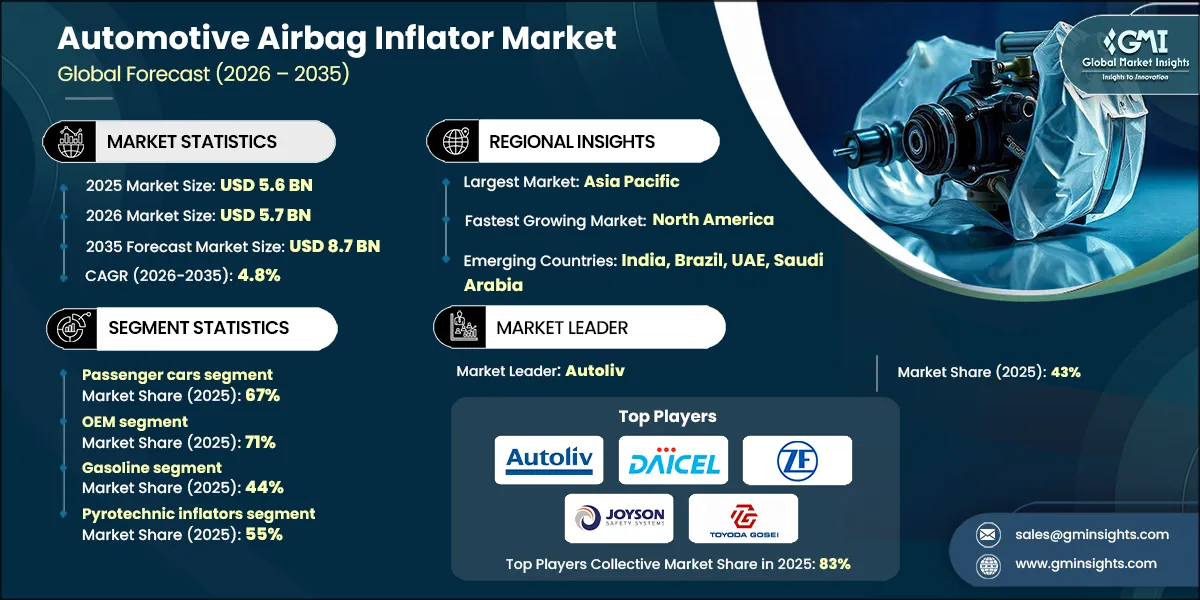
The global automotive airbag inflator market was estimated at USD 5.6 billion in 2025. The market is expected to grow from USD 5.7 billion in 2026 to USD 8.7 billion in 2035, at a CAGR of 4.8 % according to latest report published by Global Market Insights Inc.
Automotive Airbag Inflator Market Key Takeaways
Market Size & Growth
- 2025 Market Size: USD 5.6 Billion
- 2026 Market Size: USD 5.7 Billion
- 2035 Forecast Market Size: USD 8.7 Billion
- CAGR (2026–2035): 4.8%
Regional Dominance
- Largest Market: Asia Pacific
- Fastest Growing Region: North America
Key Market Drivers
- Rising global vehicle production.
- Stringent safety regulations.
- Growth of multi-airbag architectures.
- Inflator technology advancements.
Challenges
- Recall and liability risks.
- Raw material cost volatility.
Opportunity
- EV & autonomous vehicle growth.
- Emerging market safety adoption.
- Aftermarket & recall replacements.
Key Players
- Market Leader: Autoliv led with over 43% market share in 2025.
- Leading Players: Top 5 players in this market include Autoliv, Daicel, ZF, Joyson Safety Systems, Toyoda Gosei, which collectively held a market share of 83% in 2025.
Get Market Insights & Growth Opportunities
Rising global motor vehicle production is a key growth factor for the automotive airbag inflator market. As OEMs increase output to meet recovering and growing demand, every new vehicle produced needs multiple airbag inflators. Higher production volumes boost inflator installation rates, strengthen long-term supplier contracts, improve economies of scale, and speed up the adoption of better inflator technologies across vehicle segments.
According to International Organization of Motor Vehicle Manufacturers, global motor vehicle production witnessed a significant rise from Q3 2024 to Q3 2025, marking an impressive growth of approximately 4%. This surge reflects the industry's recovery and expansion, driven by increasing demand and advancements in manufacturing capabilities.
Customers are increasingly focusing on the crash protection and the advanced passive safety systems while buying of cars. Buyers are encouraged to buy models which have advanced inflator technology because they are aware of the statistics of accidents that are survivable by airbags. OEMs reacts by incorporating high-tech multi-airbag systems within different price ranges. This changed preference of the buyer increases the content of safety equipment per vehicle, increasing the market demand, and the innovation of suppliers.
Smart and connected vehicles use sophisticated safety architectures to offset emerging risk profiles. These systems are based on predictive sensors and smart crash response algorithms that demand high performance, rapid deploying inflators. Occupant protection strategies are augmented with integration with the advanced driver assist systems (ADAS). This interplay of technologies boosts the use of next-generation inflators, accelerating supply to accelerate market expansion and creating opportunities to suppliers.
Maker of automobiles are working to achieve better fuel economy and electrification, which require smaller, lighter elements. High-level inflator models with new propellants and small mechanisms contribute to the minimization of the total weight of the vehicle without compromising performance. These innovations have been used to enable electric and hybrid platforms to improve safety during collisions and maintain range. This two-fold advantage encourages the OEM investments, triggers competitive differentiation, and ignites wider market adoption.
The quick development of North America can be attributed to the active changes in the safety policy, with such aspects as the requirements of the advanced side-impact and pedestrian protection standards being mandatory. The ownership of vehicles, high consumer demand of high-level safety, and faster electrification of the fleet are growing, applying multi-stage, intelligent airbag inflators. Joint industry efforts, test infrastructure, and supplier ecosystems further drive development and deployment to make North America an innovation and growth center.
The high market share of APAC is propelled by the high growth in car manufacturing and the increasing road safety debate in China, India, and in Southeast Asia. The integration of airbags is promoted by large domestic fleets, growing demand among the middle classes, and the gradual introduction of safety rules. High volumes are supported by cost-competitive manufacturing by the regional suppliers which scale rapidly. The strong government incentives and investments in the infrastructure keep the demand strong and cement the dominant position of APAC.
To get key market trends
Automotive Airbag Inflator Market Trends
The world is going through a stage where governments are increasing their occupant safety measures by enforcing airbags in front, side, curtain and knee positions. These standards directly inflate the demand of airbags inflators per vehicle. The constant revision of crash test measures and safety ratings require OEMs to incorporate new high-technology inflators, which would guarantee a stable minimum demand and future developments of inflator vendors.
Increasingly, modern cars have multi-airbag designs to provide greater occupant protection under a variety of crash conditions. Replacement of single frontal airbags by complex airbags that include side, curtain, and center airbags would greatly enhance inflater units per vehicle. This organizational transformation increases the average income per car and supports long-term market growth.
The cars of electric and hybrid type need a redesign of the safety system because of the change in the weight distribution and battery location. These platforms are usually fitted with reliable restraint technologies, which demand small, lightweight and high-performance inflators. The inflator suppliers will enjoy the design wins and the increased value parts as EV design penetration increases at a rapid pace around the globe.
Propellant chemistry, hybrid inflators, and lightweight materials lead to the advancement of deployment precision, reliability, and efficiency of packaging. Multi-stage and adaptive inflators allow the airbags to be deployed to adapt to the severity of the crash. The benefits of these technological advances include improved safety performance of vehicles, promotion of OEM upgrades, and stimulation of replacement of old inflator systems.
Safety features are becoming a leading consideration among consumers in the market as they buy cars due to their safety ratings, accident statistics, and regulatory consciousness. The pressure to have a higher security level stimulates producers to introduce the latest systems with airbags even in mid-range and budget models. This customer-motivated change increases the inflator penetration by segment.
The world is facing a rapid expansion in vehicle production in Asia, Latin America and some parts of Eastern Europe which increases the global reachable market of airbag inflators. With new economies enforcing obligation of airbag laws and increasing the safety standards, suppliers of inflators enjoy the opportunity of high-volume production and multivolume contracts with OEMs.
Automotive Airbag Inflator Market Analysis
Learn more about the key segments shaping this market
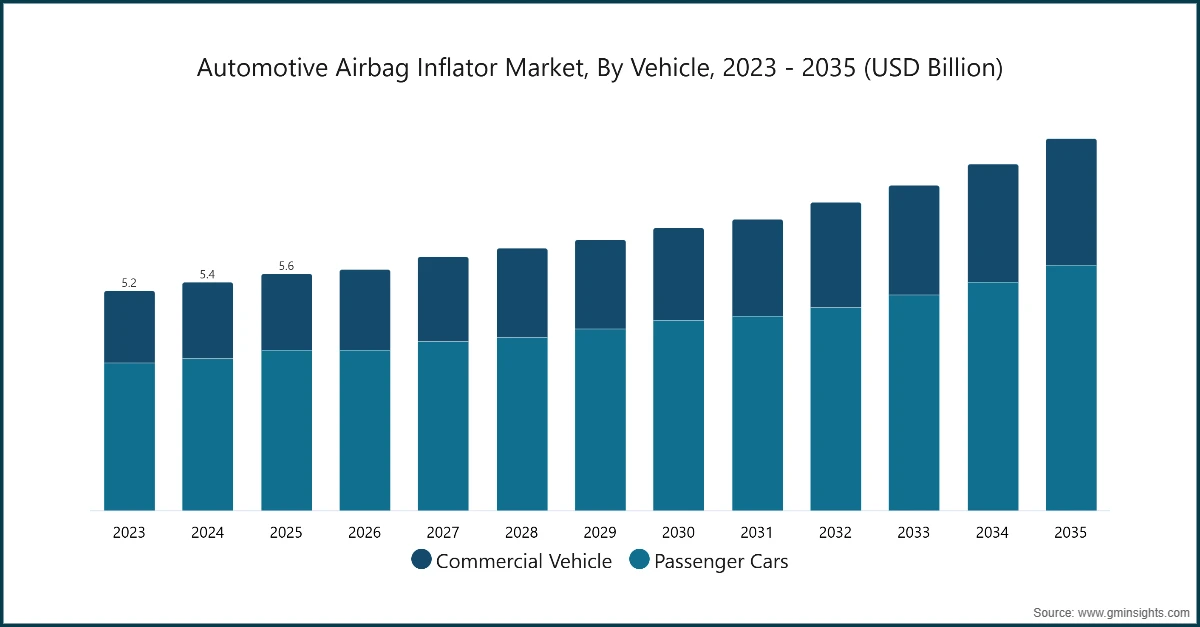
Based on vehicle, the automotive airbag inflator market is divided into passenger cars and commercial vehicles. The passenger cars segment dominated the market accounting for around 67% share in 2025 and is expected to grow at a CAGR of 4.7% from 2026 to 2035.
- Governments have now mandated airbags to be fitted in passenger cars as a standard item including the entry-level cars. Laws which mandate dual frontal, side, and curtain airbags directly raise the inflator demand per car. With the growing compliance deadlines throughout regions, OEMs hasten the incorporation of airbags and can guarantee the consistent, regulation-based growth of the passenger vehicle supplier of airbag inflators.
- Buyers of passenger vehicles are very dependent on passenger vehicle safety ratings like NCAP scores when they make their purchases. The greater the rating, the more sophisticated multi-airbag systems with proven inflater systems. The influx of airbags by automakers to gain competitive safety scores moves more inflators towards compact, mid-size, and premium passenger vehicle segments worldwide.
- Expanding passenger vehicles that fall in the compact and middle size reduce is a major growth in passenger vehicles, especially in the emerging markets that increase airbag inflator demand. These large volume segments are fast coming up with airbags as their standard features. The growing volumes of production, along with the safety penetration, form the high unit demand on inflators in the platforms of the cost-conscious passenger vehicles.
- Electric passenger cars have changed restraint systems because of the position of the batteries and the dynamics of the crash. OEMs incorporate lightweight, small inflators to maximize the packaging and safety effectiveness. With the growing pace of EV adoption in the passenger car sector, the inflator suppliers have an opportunity to supply higher-value, specialized inflator solutions.
- Passenger vehicles also having side, curtain, knee and center airbags to enhance safety of occupants. This change greatly adds to the quantity of inflators fitted to every vehicle. Cabin safety designs boosted by both city traffic density and crash severity issues are pushed upwards in the long-term inflator demand in the passenger car platforms.
- The safety features are moving towards optional upgrades to a standard in passenger cars. Customers are demanding extensive occupant coverage irrespective of the price category. To address this expectation, OEMs are broadening the airbag coverage, adding more inflator material per vehicle and sustaining the growth of the passenger vehicle airbag inflator market.
Learn more about the key segments shaping this market
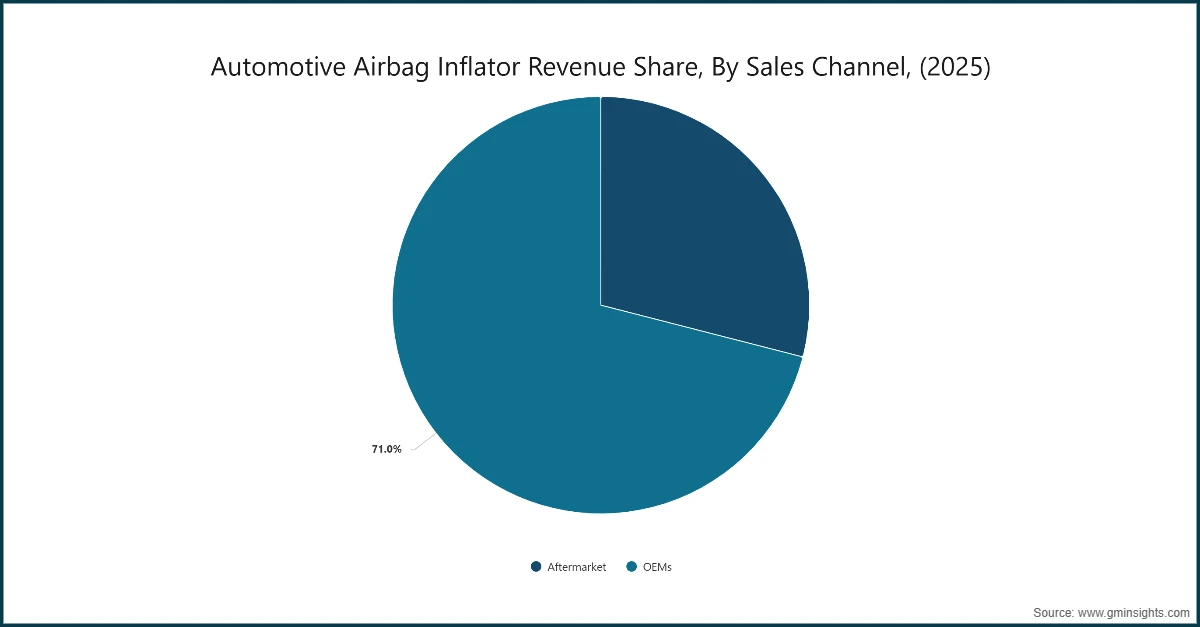
Based on sales channel, the automotive airbag inflator market is segmented into OEM and aftermarket. OEM segment dominated the market with 71% share in 2025 and is expected to grow at a CAGR of 4.5% from 2026 to 2035.
- Strict adherence to the changing safety rules by automotive OEMs ensures that they are punishable, recall and reputational losses are prevented. Firmer, innovative airbag inflators can assist OEMs in achieving cross-platform consistency in global crash requirements. This emphasis is the reason why long-term sourcing contracts with the inflator suppliers are made so that the demand is stable and indeed the consistent upgrading of the technologies is motivating.
- OEMs are progressively standardizing platforms of vehicles across models and across geographical locations as a strategy of cutting down on development expenses. Installation of airbag inflators as uniform safety devices on such platforms boosts the procurement volumes. This plan enhances inflator supplier’s demand transparency and allows OEMs to enter into multi-year contracts (scalable) that can help drive market expansion.
- OEMs spend significant amounts of money on sophisticated passive safety systems to distinguish the products. Multi-stage, adjustable inflators enhance occupant protection and safety ratings. This is an innovation-based strategy propelling the need towards next-generation inflators, fostered co-operation among suppliers in the course of vehicle development, and elevated the value of inflators per vehicle platform.
- OEMs are increasing the manufacturing presence in emerging and high-growth regions. The sourcing of airbag inflators should be regional to produce the localized vehicle production that should achieve cost and logistics goals. This growth opens up new opportunities to the suppliers in the inflator industry, who are able to put up local plants and win OEM collaboration with the increased volumes of production.
- OEM that switch to the electric and hybrid vehicle models encounter new crash dynamics and packaging limitations. This change promotes the use of small, lightweight inflators that could be used to handle battery-dense architectures. High-value platform-specific inflator solutions and OEM needs of tailor-made inflator designs increase supplier innovation and broaden the high-value range of customized inflators.
- To ensure quality, traceability, and accountability, OEMs are increasingly preferring to work with reputable inflator vendors with good quality products and services. Long-term relationships enhance supply-chain risk reduction and guarantee safety performance. This favorability promotes long-term demand of the current inflator suppliers and consolidation and scale benefits in the OEM-oriented inflator market.
Based on propulsion, the market is segmented into Gasoline, Diesel, BEV, PHEV, HEV, FCEV, and CNG/LPG. The gasoline segment dominated the market, accounting for 44% share in 2025.
- Gasoline-powered vehicles still make up most of the global passenger fleet, especially in emerging and budget-conscious markets. High production volumes of these vehicles lead to a significant demand for airbag inflators. This mix of vehicles ensures a steady need for inflators, even as electrification trends increase worldwide.
- Automakers work on improving safe ty features in gasoline internal combustion engine platforms to stay competitive. Adding side, curtain, and knee airbags increases the number of inflators each vehicle needs. These updates, driven by regulations and consumer expectations, keep inflator demand strong in gasoline models.
- Gasoline vehicle platforms usually have longer production lifecycles than newer electric ones. This durability supports stable and predictable inflator demand over time. Suppliers benefit from regular orders, easier manufacturing, and lower redesign costs, helping market growth linked to gasoline vehicle production.
- Emerging markets in Asia, Africa, and Latin America still depend heavily on gasoline vehicles due to their affordability and limited charging options. Growing urbanization and rising incomes lead to more passenger car sales, increasing airbag inflator installations. Government safety regulations also strengthen the need for inflators in gasoline-driven markets.
- Gasoline vehicle segments focus on cost efficiency, prompting inflator suppliers to create reliable and cost-effective inflators for mass production. High-volume manufacturing leads to lower costs and better profits for suppliers. This focus on cost allows for wider airbag adoption, especially in entry-level and mid-range gasoline vehicles.
- The large number of gasoline vehicles on the road creates ongoing demand for airbag inflator replacements due to recalls, old parts, and repairs from accidents. This generates a consistent revenue stream for inflator manufacturers, completing original equipment manufacturer (OEM) demand and supporting long-term market growth.
Based on inflator, the market is divided into pyrotechnic inflators, stored gas inflators, and hybrid inflators. Pyrotechnic inflators dominated the market with 55% share in 2025.
- Pyrotechnic inflators are trusted for their quick gas generation and reliable deployment during severe crashes. Their proven reliability makes them the top choice for frontal and side airbags in different vehicle types. OEMs have confidence in pyrotechnic technology, which keeps adoption rates high and demand steady for airbag inflators worldwide.
- When compared to other inflator technologies, pyrotechnic inflators offer cost-effective manufacturing on a large scale. Their simple design and established supply chains support mass production for high-volume passenger vehicles. This economic advantage ensures their continued use in entry-level and mid-range vehicles, reinforcing their market dominance.
- Pyrotechnic inflators fit well into existing airbag modules and vehicle designs. The minimal redesign needed allows OEMs to use them across various platforms efficiently. This compatibility cuts down development time, reduces integration costs, and encourages ongoing use as automakers update current models instead of completely redesigning safety systems.
- Pyrotechnic inflators comply with global safety and performance standards, making certification easier across regions. Their long history of regulatory compliance lowers risks for OEMs and suppliers. This broad acceptance speeds up approvals, supports international vehicle production, and maintains solid global demand for pyrotechnic inflator systems.
- Improvements in propellant formulations boost stability, control over gas output, and durability of pyrotechnic inflators. These advances tackle past safety concerns and lengthen product lifespan. As a result, they renew OEM confidence, prompt the replacement of older inflators, and support their ongoing use in modern vehicle safety systems.
- Large recalls and inflator replacement programs have increased the need for certified pyrotechnic inflators. The large number of vehicles using this technology creates ongoing aftermarket opportunities. Suppliers gain from consistent replacement cycles, supporting long-term growth alongside OEM demand for new vehicle production.
Looking for region specific data?
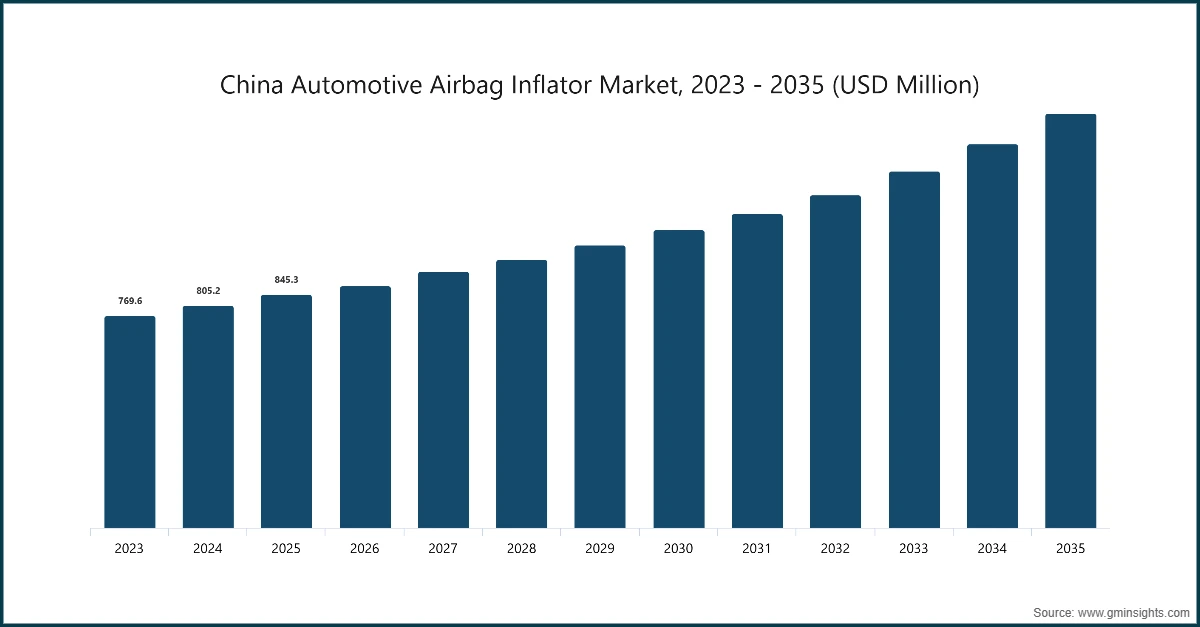
China dominated the automotive airbag inflator market in Asia Pacific with around 40% share and generated USD 845.3 million in revenue in 2025.
- China is the largest automotive manufacturing hub in the world, producing millions of passenger vehicles each year. High production volumes lead to strong demand for airbag inflators in entry-level, mid-range, and premium vehicles. Ongoing capacity expansion by domestic and joint-venture OEMs keeps inflator consumption high and promotes long-term growth for suppliers.
- Chinese authorities are tightening vehicle safety standards to match global crash and occupant protection norms. The mandatory installation of multiple airbags in new passenger vehicles increases the number of inflators per vehicle. Regulatory enforcement in mass-market models significantly boosts demand for airbag inflators across the country.
- The rise of competitive domestic OEMs like BYD, Geely, Chery, and SAIC drives up inflator demand. These manufacturers are ramping up production, launching new models, and improving safety features. Increasing domestic brand presence strengthens sourcing opportunities for inflator suppliers within China's growing automotive market.
- China is at the forefront of global electric vehicle adoption, which requires redesigned safety systems to handle battery-related crash dynamics. EV platforms use advanced and compact inflator technologies, increasing the need for specialized inflators. Government incentives and higher consumer interest in EVs create more opportunities for inflators in China's changing vehicle market.
- Chinese consumers are becoming more safety-conscious due to crash-test ratings and higher expectations for vehicle quality. Demand for vehicles with complete airbag systems is rising across all income levels. This change drives OEMs to improve airbag coverage, increasing the number of inflators per vehicle.
- China's established automotive supply chain supports large-scale, cost-effective inflator production. By sourcing materials, manufacturing, and logistics locally, costs and lead times decrease. These benefits encourage OEMs to add more airbags while allowing inflator suppliers to grow quickly, further supporting China’s strong market expansion.
The US automotive airbag inflator market reached over USD 1.4 billion in 2025, driven by high passenger vehicle ownership, stringent federal vehicle safety regulations, and strong enforcement of advanced crash protection standards.
- Widespread adoption of multi-airbag architectures, rapid integration of smart restraint and sensor-linked safety systems, and continuous vehicle platform upgrades across major domestic and international OEMs support sustained inflator demand across the U.S. automotive ecosystem.
- US has strict vehicle safety standards enforced by NHTSA and FMVSS regulations, which require airbags and better occupant protection. Ongoing updates to crash test requirements push OEMs to add advanced multi-airbag systems. This regulatory setting creates steady demand for reliable airbag inflators in all passenger and light commercial vehicle segments.
- SUVs and pickup trucks make up a large part of US vehicle sales, necessitating larger cabins and better occupant protection. These vehicles usually have multiple front, side, and curtain airbags, which increases the number of inflators needed per unit. The continued popularity of larger vehicles significantly raises per-vehicle inflator demand and contributes to overall market growth.
- US consumers value vehicle safety ratings highly when buying cars. NCAP scores, safety recalls, and insurance factors play a role in their purchasing decisions. To stay competitive, OEMs improve airbag coverage and inflator performance, leading to a greater use of advanced inflator technologies across different vehicle segments.
- US is seeing a rapid increase in electric and hybrid vehicles. These models require new safety systems to fit battery placements and changed crash dynamics. There is a growing need for compact, lightweight, and adaptive inflators as OEMs include next-generation restraint systems in electrified platforms.
- US has one of the largest active vehicle fleets in the world, leading to significant aftermarket demand for airbag inflator replacements. Recalls, aging vehicles, and repair work create ongoing replacement cycles. This large installed base offers long-term revenue stability for inflator manufacturers.
- US has advanced crash testing facilities, safety research organizations, and strong partnerships between OEMs and suppliers. Ongoing innovation in passive safety systems speeds up the adoption of smart and multi-stage inflators. This innovation-focused environment boosts domestic inflator demand and supports long-term market growth.
The market in Germany is projected to grow at a strong CAGR of 3.9% from 2026 to 2035, driven by accelerating EV adoption, strict battery safety compliance under EU regulations, rapid expansion of charging infrastructure, and rising demand for advanced diagnostics.
- Germany is home to premium car makers like BMW, Mercedes-Benz, Audi, and Volkswagen, which prioritize safety engineering. These companies include multiple, high-performance airbag systems as standard features. Higher safety standards in luxury vehicles raise the number of inflators used per vehicle, creating ongoing demand for sophisticated airbag inflators.
- Germany has some of the strictest automotive safety and crash regulations in Europe. Meeting Euro NCAP and national safety standards pushes manufacturers to adopt improved airbag designs. Increasingly strict regulations heighten the need for dependable, high-quality inflators, which supports steady market growth driven by these rules.
- Germany’s strong commitment to automotive research and engineering innovation accelerates the creation of next-generation safety systems. Manufacturers and suppliers work closely together to implement smart, multi-stage inflators. This focus on innovation encourages early use of advanced inflator technologies and enhances Germany’s position as a tech leader.
- Germany is a key center for electric and autonomous vehicle development. New vehicle designs require redesigned restraint systems to handle different crash dynamics. This change boosts demand for compact, lightweight, and adaptable inflators, opening new growth opportunities within Germany’s changing automotive market.
- Vehicles made in Germany usually come with extensive airbag coverage, including side, curtain, knee, and center airbags. The high use of multi-airbag systems significantly increases the number of inflator units per vehicle. This trend keeps inflator demand above average compared to areas with fewer safety features.
- Germany’s well-established Tier-1 automotive supplier network aids in the manufacturing and integration of airbag inflators. The close relationship between manufacturers and suppliers allows for quick innovation, effective quality control, and reliable supply. This system strengthens long-term partnerships and supports steady growth in Germany's airbag inflator market.
The automotive airbag inflator market in Mexico reached significant scale in 2025, driven by rising vehicle safety regulations, growing consumer demand for advanced passive safety systems, increased adoption of multi-stage and side-curtain airbags, and expanding domestic automotive production.
- Mexico's government has raised vehicle safety standards, requiring airbags in new vehicles. Compliance with frontal, side, and curtain airbag requirements pushes manufacturers to use multi-stage inflators, which increases production and adoption. This regulatory effort improves occupant protection and encourages technological upgrades while strengthening the market for automotive airbag inflators in both domestic and international vehicle models.
- Increasing awareness among Mexican consumers about road accident risks has raised demand for vehicles with better airbag systems. Buyers now prioritize safety features, leading automakers to make side, curtain, and knee airbags standard. This change in consumer preference drives higher-quality inflator production and boosts adoption rates, contributing to steady growth in the automotive airbag inflator market.
- Mexico's automotive production is growing thanks to investments from global manufacturers and the country's strategic manufacturing position. Higher vehicle output needs advanced safety parts, including airbag inflators. Local manufacturing hubs allow for large-scale integration of inflators in passenger cars, commercial vehicles, and SUVs, which boosts domestic demand and benefits suppliers and component innovators.
- The integration of connected car technologies and smart safety systems in Mexico has picked up pace. Vehicles now come with crash sensors, predictive algorithms, and coordinated airbag deployment systems, which increases the reliance on high-performance inflators. These technological improvements motivate manufacturers to adopt advanced multi-stage inflators, driving innovation and supporting market growth for automotive airbag systems.
The automotive airbag inflator market in UAE is projected to grow at a CAGR 2.6% from 2026 to 2035, driven by the country’s expanding automotive sector, rising demand for advanced occupant safety systems, increasing integration of multi-stage and side-curtain airbags, and government initiatives promoting vehicle safety standards and fleet modernization across public and private transport segments.
- The UAE government has strict vehicle safety rules that require advanced airbag systems in all new passenger and commercial vehicles. Compliance with standards for frontal, side, and curtain airbags pushes manufacturers to use multi-stage and pyrotechnic inflators. Regulatory enforcement increases occupant protection, drives technological improvements, and boosts demand for sophisticated automotive airbag systems in the UAE market.
- More UAE consumers are becoming aware of road accidents and passenger safety, which is increasing the demand for vehicles equipped with advanced airbags. Buyers are prioritizing models with side, curtain, and knee airbags. This encourages manufacturers to include high-performance inflators. The shift in consumer preference supports the use of advanced airbag systems, promotes innovation, and fosters market growth for automotive airbag inflators.
- The strong demand for luxury and premium vehicles in the UAE speeds up the adoption of advanced safety features, including multi-stage and side-curtain airbags. High-end vehicles are increasingly adding sophisticated inflators to meet consumer expectations for performance and safety. This trend boosts opportunities for airbag inflator manufacturers and supports the use of new technologies in premium passenger vehicles.
- The rise of connected and smart vehicles in the UAE includes advanced crash sensors, predictive airbag deployment algorithms, and ADAS systems. These technologies need reliable and fast-acting inflators to ensure occupant protection. Manufacturers are increasingly using multi-stage and hybrid inflators, which promotes innovation, improves safety performance, and spurs growth in the UAE market.
Automotive Airbag Inflator Market Share
The top 7 companies in the automotive airbag inflator industry are Autoliv, ZF, Joyson Safety Systems, Daicel, Nippon Kayaku, Toyoda Gosei, and ARC Automotive, contributing around 88% of the market in 2025.
Autoliv stays on top by constantly improving airbag and inflator technologies. It integrates safety systems across global vehicle platforms. The company increases its manufacturing presence, strengthens partnerships with OEMs, and invests in research and development for adaptive and lightweight inflators. This ensures it meets changing safety regulations. Autoliv’s broad global reach and varied safety portfolio support its strong position in occupant protection solutions.
ZF uses its deep knowledge of automotive systems to provide integrated safety architectures. These architectures align inflator deployment with ADAS and pre-crash technologies. The company invests in manufacturing and electronic control integration, increasing production in key areas to meet the growing safety needs of electric and autonomous vehicles. Building strategic capacity and innovating adaptive inflators help ZF strengthen its competitive position worldwide.
Joyson Safety Systems prioritizes innovation and quality protocols to rebuild trust and increase market share after the Takata integration. The company creates advanced inflator chemistries and strong quality systems, securing significant contracts with OEMs. Strategic partnerships, a global manufacturing presence, and a diverse range of safety products strengthen its competitive advantage in providing reliable and compliant inflator solutions worldwide.
Daicel draws on its expertise in chemistry and materials to produce a variety of inflator technologies. These include pyrotechnic, hybrid, and environmentally friendly solutions. The company heavily invests in research and development and scales production in important regions like Asia and North America. Its unique formulations and rapid deployment systems attract OEMs looking for high-performance, lightweight safety components, boosting its competitiveness in the market.
Nippon Kayaku relies on its foundational knowledge of explosives and chemicals to create reliable gas generators and inflator parts for driver, passenger, and side airbags. Strong relationships with top OEMs and a focus on developing safety systems enable Nippon Kayaku to compete effectively in specialized airbag inflator segments, especially where performance and precision are crucial.
Toyoda Gosei focuses on cost-effective production, local manufacturing, and working closely with partners like Daicel and Nippon Kayaku on inflator development. Expanding its global production sites meets regional demand, while integrated safety solutions improve its competitiveness. Its commitment to sustainable materials and efficient manufacturing processes helps address OEM needs for both performance and cost effectiveness in airbag inflator solutions.
ARC Automotive strengthens its market position by offering a wide range of inflators for different airbag applications, backed by decades of design experience. Collaborations and joint ventures expand its market access, and a focus on tailored inflator technologies meets specific OEM needs. ARC’s dedication to quality and specialized products supports its growth in North America and beyond.
Automotive Airbag Inflator Market Companies
Major players operating in the automotive airbag inflator market are:
- ARC Automotive
- Ashimori Industry
- Autoliv
- Daicel
- Hyundai Mobis
- ITW Automotive
- Joyson Safety Systems
- Nippon Kayaku
- Toyoda Gosei
- ZF
- The global airbag inflator market is very competitive. It is led by well-known Tier-1 suppliers like Autoliv, ZF, Joyson Safety Systems, and Daicel. These companies compete by constantly improving their multi-stage, pyrotechnic, and hybrid inflator technologies. They ensure they meet strict global safety rules. Partnerships with OEMs, expanding production in different regions, and a focus on lightweight, compact designs help them strengthen their market positions. Companies also invest in research and development to integrate with advanced driver-assistance systems (ADAS) and connected car systems to improve performance, reliability, and safety.
- New players and regional manufacturers are growing their presence in Asia, Latin America, and the Middle East, making competition tougher. Strategic mergers, acquisitions, and joint ventures allow for sharing technology and gaining access to global markets. Cost efficiency, quality certifications, and quick deployment solutions set competitors apart. In addition, sustainability projects and the use of eco-friendly propellants increase their market appeal. Companies are continually refining their supply chains, responding to changing regulations, and focusing on both passenger and commercial vehicle segments to stay competitive and grow worldwide.
Automotive Airbag Inflator Market Report Attributes
| Key Takeaway | Details |
|---|---|
| Market Size & Growth | |
| Base Year | 2025 |
| Market Size in 2025 | USD 5.6 Billion |
| Market Size in 2026 | USD 5.7 Billion |
| Forecast Period 2026-2035 CAGR | 4.8% |
| Market Size in 2035 | USD 8.7 Billion |
| Key Market Trends | |
| Drivers | Impact |
| Rising global vehicle production | Increasing passenger and commercial vehicle output raises demand for airbag inflators as each vehicle integrates multiple airbags, driving higher installation volumes and long-term OEM contracts. |
| Stringent safety regulations | Mandatory airbag norms and enhanced crash safety standards globally ensure consistent inflator demand across all vehicle segments. |
| Growth of multi-airbag architectures | Integration of frontal, side, curtain, knee, and center airbags increases inflator content per vehicle, boosting revenue per unit. |
| Inflator technology advancements | Development of lightweight, compact, and multi-stage inflators improves deployment precision and vehicle safety performance |
| Pitfalls & Challenges | Impact |
| Recall and liability risks | Inflator defects can trigger large-scale recalls, increasing financial and reputational risk for manufacturers. |
| Raw material cost volatility | Fluctuating prices of metals and energetic materials impact manufacturing costs and margins. |
| Opportunities: | Impact |
| EV & autonomous vehicle growth | New vehicle platforms demand advanced, adaptive inflator systems, creating innovation opportunities. |
| Emerging market safety adoption | Phased airbag regulations in India, Southeast Asia, and Latin America unlock new demand. |
| Aftermarket & recall replacements | Replacement inflators and recall-driven demand generate recurring aftermarket revenue. |
| Market Leaders (2025) | |
| Market Leader |
43% Market Share |
| Top Players |
Collective Market Share is 83% |
| Competitive Edge |
|
| Regional Insights | |
| Largest Market | Asia Pacific |
| Fastest Growing Market | North America |
| Emerging Countries | India, Brazil, UAE, Saudi Arabia |
What are the growth opportunities in this market?
Automotive Airbag Inflator Industry News
- In September 2024, ZF Rane Automotive opened a new inflator plant and sled test facility in India. The company invested about USD 12 million to set up the inflator and sled facility. The inflator plant will initially produce driver and passenger versions, with the ability to make around 3 million inflators each year. The sled test facility will improve the company's testing capabilities and help shorten product development time.
- In June 2024, Autoliv introduced airbag cushions made from 100% recycled polyester. This move significantly cuts greenhouse gas emissions by about 50% at the polymer level. Developed with supply chain partners, the recycled material meets the safety performance of traditional airbags. This innovation supports Autoliv's goal of achieving net-zero emissions across its supply chain by 2040. The new airbag cushions are available worldwide, representing a significant step toward sustainability in automotive safety. Autoliv continues to lead the industry by focusing on circularity and reducing environmental impact while keeping high safety standards.
- In January 2024, Toyoda Gosei moved and expanded its existing engineering and sales office to the new Toyoda Gosei Technical Center India. This move allows Toyoda Gosei to better meet the rising demand for safety systems and grow its business in the fast-expanding Indian automotive market.
- In June 2023, Autoliv launched a new passenger airbag module that uses Bernoulli's Principle. This design allows for more efficient inflation of larger airbags while lowering development time and costs. In the Bernoulli Airbag, the inflator receives a crash signal and sends high-pressure gases at supersonic speeds through multiple inlet tubes.
The automotive airbag inflator market research report includes in-depth coverage of the industry with estimates & forecasts in terms of revenue ($ Mn/Bn) and shipment (Units) from 2022 to 2035, for the following segments:
Market, By Vehicle
- Passenger cars
- Hatchback
- Sedan
- SUV
- Others
- Commercial vehicle
- Light commercial vehicle (LCV)
- Medium commercial vehicle (MCV)
- Heavy commercial vehicle (HCV)
Market, By Inflator
- Pyrotechnic inflators
- Stored gas inflators
- Hybrid inflators
Market, By Airbag
- Frontal
- Side
- Curtain
- Knee
- Pedestrian
Market, By Propulsion
- Gasoline
- Diesel
- BEV
- PHEV
- HEV
- FCEV
- CNG/LPG
Market, By Sales Channel
- OEM
- Aftermarket
Market, By Deployment Mode
- Single-stage
- Multi-stage
The above information is provided for the following regions and countries:
- North America
- Europe
- Asia Pacific
- Latin America
- MEA
Frequently Asked Question(FAQ) :
What is the market size of the automotive airbag inflator in 2025?
The market size was USD 5.6 billion in 2025, with a CAGR of 4.8% expected through 2035 driven by rising global vehicle production, stringent safety regulations, growth of multi-airbag architectures, and inflator technology advancements.
What is the projected value of the automotive airbag inflator market by 2035?
The automotive airbag inflator market is expected to reach USD 8.7 billion by 2035, propelled by EV and autonomous vehicle growth, emerging market safety adoption, and aftermarket and recall replacement demand.
What is the current automotive airbag inflator market size in 2026?
The market size is projected to reach USD 5.7 billion in 2026.
How much revenue did the passenger cars segment generate in 2025?
The passenger cars segment dominated the market accounting for around 67% share in 2025 and is expected to grow at a CAGR of 4.7% from 2026 to 2035, driven by mandatory airbag regulations and consumer focus on safety ratings.
What was the market share of the OEM segment in 2025?
The OEM segment dominated the market with 71% share in 2025 and is expected to grow at a CAGR of 4.5% from 2026 to 2035, driven by strict regulatory compliance and platform standardization strategies.
What is the growth outlook for the pyrotechnic inflators segment from 2026 to 2035?
Pyrotechnic inflators dominated the market with 55% share in 2025, driven by their proven reliability for quick gas generation, cost-effective manufacturing, and strong compliance with global safety standards.
Which region leads the automotive airbag inflator market?
China led the Asia Pacific automotive airbag inflator market with around a 40% share, generating USD 845.3 million in revenue in 2025.
What are the upcoming trends in the automotive airbag inflator market?
Key trends include mandated multi-airbag systems, advanced adaptive inflators, compact designs for electric and hybrid vehicles, and rising demand for enhanced safety across all vehicle segments.
Who are the key players in the automotive airbag inflator market?
Key players include Autoliv, Daicel, ZF, Joyson Safety Systems, Toyoda Gosei, ARC Automotive, Ashimori Industry, Hyundai Mobis, ITW Automotive, and Nippon Kayaku.
Automotive Airbag Inflator Market Scope
Related Reports