Summary
Table of Content

Antibacterial Glass Market
Get a free sample of this report
Form submitted successfully!
Error submitting form. Please try again.
Thank you!
Your inquiry has been received. Our team will reach out to you with the required details via email. To ensure that you don't miss their response, kindly remember to check your spam folder as well!
Request Sectional Data
Thank you!
Your inquiry has been received. Our team will reach out to you with the required details via email. To ensure that you don't miss their response, kindly remember to check your spam folder as well!
Form submitted successfully!
Error submitting form. Please try again.
Antibacterial Glass Market Size
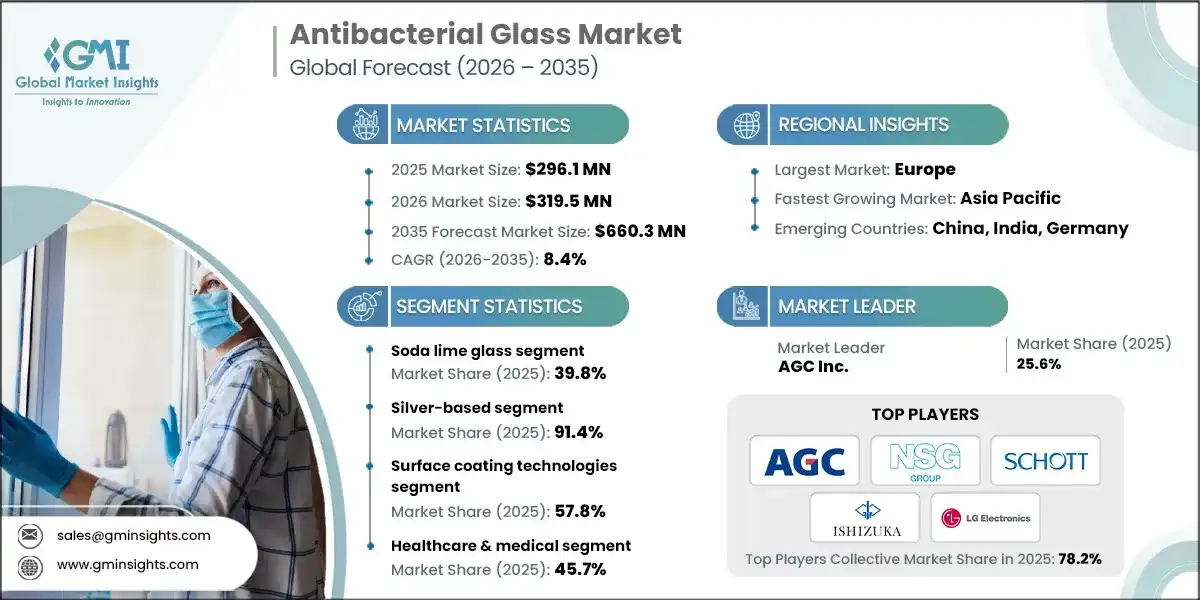
The global antibacterial glass market was valued at USD 296.1 million in 2025. The market is expected to grow from USD 319.5 million in 2026 to USD 660.3 million in 2035, at a CAGR of 8.4%, according to latest report published by Global Market Insights Inc.
Antibacterial Glass Market Key Takeaways
Market Size & Growth
- 2025 Market Size: USD 296.1 Million
- 2026 Market Size: USD 319.5 Million
- 2035 Forecast Market Size: USD 660.3 Million
- CAGR (2026–2035): 8.4%
Regional Dominance
- Largest Market: Europe
- Fastest Growing Region: Asia Pacific
Key Market Drivers
- Rising Healthcare-Associated Infections Driving Demand for Hospital Antimicrobial Solutions.
- Post-Pandemic Hygiene Awareness Accelerating Adoption Across Public Spaces and Consumer Environments.
- Stringent Food Safety Regulations Mandating Antimicrobial Packaging Solutions.
Challenges
- High Production Costs Limiting Widespread Adoption in Price-Sensitive Markets.
- Long-Term Antimicrobial Efficacy Degradation Concerns Under Harsh Environmental Conditions.
Opportunity
- Emerging Smart Cities Infrastructure Creating Massive Demand for Public Transit Applications.
- Consumer Electronics Boom Driving Premium Antimicrobial Touchscreen Glass Requirements.
Key Players
- Market Leader: AGC Inc. led with over 25.6% in 2025.
- Leading Players: Top 5 players in this market include AGC Inc, Nippon Sheet Glass Co Ltd, Schott AG, Ishizuka Glass Co Ltd, LG Electronics, which collectively held a market share of 78.2% in 2025.
Get Market Insights & Growth Opportunities
- The global antibacterial glass market is expanding significantly as more users are seeking hygiene-based solutions for sectors such as healthcare, consumer electronics, and commercial industries. There is competition between companies to build innovative products, leading to an increase in high-end offerings across multiple industries.
- By glass type soda lime glass will be the most dominant with a 39.8% share in 2025 as it provides consumers and businesses with cost-effective, mass-market capability. Borosilicate glass will have a growth trajectory due to its superior thermal and chemical resistance, which is particularly important in laboratories and food-contact uses, and therefore borosilicate is expected to see continued growth throughout the next decade. Aluminosilicate glass will have a projected growth rate of 9.5% CAGR as smartphones and other high-touch devices utilize more scratch-resistant products.
- The antimicrobial section is expected to continue to be dominated by silver-based products due to their high levels of effectiveness across a wide range of germs and their durability, whereas copper, zinc, and titanium-based products are developed as fast acting, eco-friendly, and UV activated products.
- In 2025, the healthcare market holds the largest share 45.7% of the antibacterial glass market. The other sectors that will drive the growth of the market are the food and beverage, consumer electronics, building, transportation, and defense markets.
- The widespread use of antibacterial glass in hospitals and labs in North America is primarily due to increased awareness of hygiene. European Countries, with Germany in the lead, are currently using these products in the construction, transportation and various industrial settings. Due to rapid urbanization and Increased Investments in Healthcare, The Asia Pacific Region has seen a tremendous growth rate with regards to antibacterial glass. Most areas in Latin America and The Middle East are beginning to use antibacterial glass for hospitality and public space usage, along with their homes, but will eventually have new uses for the same technology over time.
To get key market trends
Antibacterial Glass Market Trends
- There’s an increasing level of interest among both consumers and businesses alike in the use of antibacterial smart glass products that come equipped with built-in sensor systems for detecting pathogens in real-time - these high-end solutions are gaining traction across many industries such as health care, consumer electronics and commercial/retail spaces due to their enhanced sanitation and security capabilities. The addition of these types of features has resulted in a shift to premium-priced products and increased competition based on innovation among multiple end-user markets.
- As a result of increased awareness regarding hygiene issues after the COVID-19 Pandemic and adopted regulatory requirements regarding the safety of public places that resulted from COVID-19 Evolution, there’s been an increase in the utilization of large scale coated and/or bulk-integrated solutions creating a high volume of business opportunity for manufacturers to grow their product offering as well create greater opportunity for developing stronger partnerships globally within both the construction and infrastructure industries.
Antibacterial Glass Market Analysis
Learn more about the key segments shaping this market
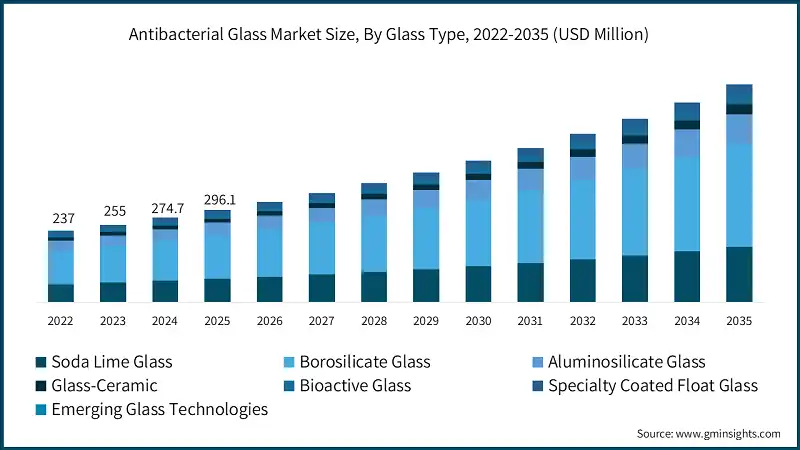
Based on glass type, the market is segmented into soda lime glass, borosilicate glass, aluminosilicate glass, glass-ceramic, bioactive glass, specialty coated float glass, and emerging glass technologies. Soda lime glass dominated the market with an approximate market share of 39.8% in 2025 and is expected to grow with a CAGR of 7% by 2035.
- Soda lime glass is a cost effective, well-established glass type that can be easily obtained and is commonly used for mass market applications including public spaces and households. Due to its increased thermal and chemical resistance capabilities, borosilicate glass has started to penetrate markets historically occupied by soda lime glass and is currently being marketed as a superior product for laboratory, pharmaceutical, food contact applications.
- Aluminosilicate glass is expected to increase its market growth with a 9.5% CAGR, as it will be used due to its inherent strength and scratch-resistant qualities in smartphone, tablet, and other high-touch applications requiring long-lasting antimicrobial protection.
- The glass-ceramic of antibacterial materials is expected to hold 8.6% of the market share by 2025, is an emerging niche category that will continue to grow rapidly due to its ability to provide exceptional heat stability and long-lived antimicrobial performance in industrial and defense-related applications.
- Specialty glasses are expanding in the areas of medical implants, advanced diagnostic devices, and premium architectural applications, the growth of the specialty glass sector is being supported by the introduction of innovations in nanocoating and multi-ion antimicrobial technology.
Learn more about the key segments shaping this market
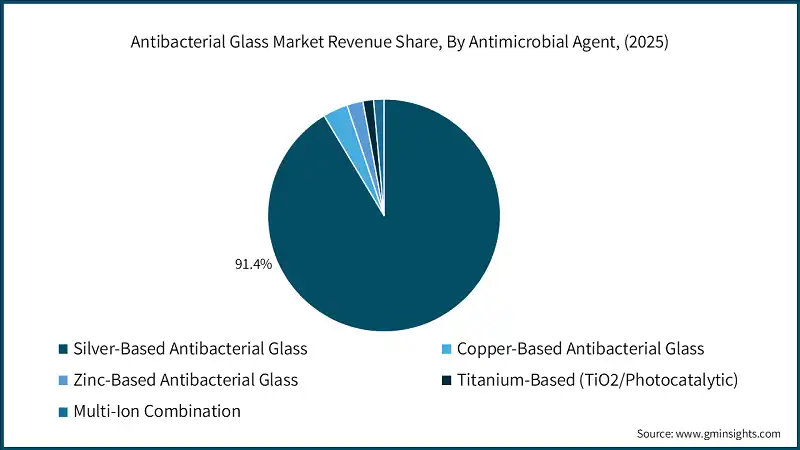
Based on antimicrobial agent, the antibacterial glass market is segmented into silver-based antibacterial glass, copper-based antibacterial glass, zinc-based antibacterial glass, titanium-based (tio2/photocatalytic), and multi-ion combination. Silver-based antibacterial glass held the largest market share of 91.4% in 2025 and is expected to grow at a CAGR of 8.2% during 2025-2034.
- The most commonly used type of antimicrobial agent is based on Silver. These materials are proven to inactivate a wide range of microorganisms for an extended time period and are able to be used with a variety of different types of glass. Silver-based antimicrobial agents are the most commonly used by hospitals, large-scale public facilities, and electronic product manufacturers, as they provide continuous protection from germs and other pathogens.
- Antimicrobial agents based on Copper have been increasingly popular for their ability to quickly inactivate microorganisms and their compatibility with high-frequency areas of contact. The value of Copper as an antimicrobial agent is expected to reach USD 10.2 million in 2025.
- Antimicrobial agents based on Zinc and Titanium are also gaining popularity, but at a slower rate. Manufacturers are increasingly interested in finding more cost-effective and eco-friendly alternatives to conventional antimicrobial agents.
Based on manufacturing technology, the antibacterial glass market is segmented into surface coating technologies, bulk integration technologies, and hybrid/advanced technologies. Surface coating technologies segment dominated the market with an approximate market share of 57.8% in 2025 and is expected to grow with the CAGR of 8% by 2035.
- The coating of finished glass surfaces with antimicrobial agents like silver, copper, and titanium using surface coating technologies is the most common method of applying these agents because it provides many options for customization, is relatively inexpensive to produce, and is quick to create consumer electronics, healthcare products and architectural items.
- Incorporating antimicrobial agents into the glass matrix (bulk integration) during the production of glass results in much longer-lasting, stronger products that can meet the needs of laboratory, pharmaceutical and industrial applications. Projections indicate that bulk integration will comprise approximately 38.9% of the total market share by 2035.
- The hybrid or advanced technology utilizes a combination of surface coating and bulk integration techniques or multiple ion technologies to produce an antimicrobial product that provides enhanced antimicrobial activity, broad-spectrum protection and increased resistance to wear and cleaning. It is projected that hybrid or advanced technology will grow at a CAGR of 7.3%.
Based on application, the antibacterial glass market is segmented into healthcare & medical, food & beverage, consumer electronics, building & construction, transportation & automotive, military & defense, residential/household, laboratory & research, and emerging applications. Healthcare & medical segment dominated the market with an approximate market share of 45.7% in 2025 and is expected to grow with the CAGR of 7.5% by 2035.
- The healthcare and medical sector is by far the largest user of antibacterial glass products. Hospitals, clinics, and diagnostic equipment have a constant need for hygiene protection and, therefore, are expected to be the primary drivers of demand for antibacterial glass products. Food/beverage applications are also major users of antimicrobial glass products and include packaging, storage, and display for the purpose of reducing contamination and extending the shelf life of food/beverages.
- The consumer electronics industry is projected to account for 16.8% of the total antibacterial glass market in 2025, as it continues to incorporate antibacterial coatings into products, including smartphones, tablets, and wearables, to reduce the transfer of pathogens from high-touch surfaces. The building/construction market is using antibacterial glass products to improve hygiene and durability in public areas, building facades, and high-traffic areas of buildings.
- The transportation/automotive market is also expanding, particularly with respect to antibacterial glass products used on surfaces that receive frequent contact, such as handrails, windows/screens, and interiors. Military and defense applications include antibacterial glass products into their offerings for use in challenging and harsh environments. This segment is expected to experience a CAGR of 10.6% over the forecast period.
- Laboratories and research laboratories have an urgent demand for strong chemical-resistant antimicrobial surfaces. Antimicrobial glass product offerings are also expected to expand rapidly based on new inventions of smart coatings and bioactive glasses which offer numerous new growth opportunities across all industries.
Looking for region specific data?
The North America antibacterial glass market is growing rapidly on the global level with a market share of 28.1% in 2025.
- North America is experiencing growth in multiple avenues including the improvement of healthcare infrastructure, the establishment of strict hygiene regulations, and, due to the increasing use of Antimicrobial Technology (AMT) in the medical, consumer electronics, and building industries.
- The use of Antibacterial Glass is becoming more common in hospitals, research laboratories, and other public facilities, in order to reduce the incidence of infection. Additionally, increased awareness of hygiene within the transportation and commercial industry has also contributed to an increase in sales of the products in this market.
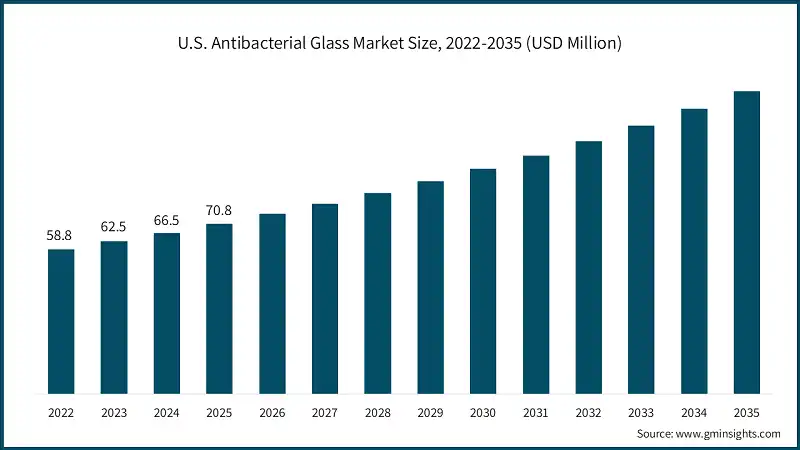
U.S. dominates the North America antibacterial glass market occupying a market of USD 70.8 million in 2025, showcasing strong growth potential.
- The U.S. is experiencing a growing awareness of the need to prevent infections in public spaces and transportation systems, thus driving more demand in the market. Innovations in surface coatings, bulk integration and bioactive glasses are creating additional growth potential in the market. Other sectors (kitchenware, furniture) for residential applications are rapidly emerging.
- Advanced healthcare infrastructures, stringent hygiene regulations, and adoption of antimicrobial technologies in hospitals, laboratories, and consumer electronics has allowed the United States to dominate the market for antibacterial glass.
Europe antibacterial glass market leads the industry with revenue of USD 123.7 million in 2025 and is anticipated to show lucrative growth over the forecast period.
- Increased awareness of public health and safety concerns, and the construction and automotive industries continue to be strong contributors. The main countries within Europe for the antimicrobial glass market are Germany, France, and the United Kingdom where antibacterial glass is used in hospitals and laboratories, as well as many other buildings that have a great deal of human traffic.
- The market is being driven by advances in the coating technology and through developing a more durable product for the public. Food and beverage packaging, as well as emerging applications in smart building designs and eco-friendly solutions, is also driving market growth.
Germany dominates the European antibacterial glass market, showcasing strong growth potential.
- Germany is the largest European market for antibacterial glass due to its strict hygiene regulations, robust healthcare systems, and extensive use in construction, transportation, and industrial sectors. Antimicrobial glass is being increasingly used in hospitals, laboratories, and high-traffic commercial buildings for the control of infections. Technological innovations are driving growth in the market. Residential applications, food packaging, and automotive interiors are also supporting growth.
The Asia Pacific antibacterial glass market is anticipated to grow at a CAGR of 9.3% during the analysis timeframe.
- Asia Pacific is the largest growth area in the antimicrobial glass market. The rapid urbanization of many cities in Asia, increases in investment into Health Care, Other Health Sciences and advancements in consumer electronics and their subsequent markets has caused increased utilization of the Antimicrobial Glass product. Many local governments are also introducing initiatives to augment the installation of public health infrastructure to improve public health in those areas.
China antibacterial glass market is estimated to grow with a significant CAGR in the Asia Pacific region.
- China holds the largest share of the market, primarily because of its high rate of urbanization and increased investment in healthcare and electronics. Antimicrobial glass is being heavily utilized in hospitals, laboratories, public areas, and electronic devices. Initiatives by the government to promote public health combined with the growing awareness of hygiene in densely populated urban areas are also increasing the demand for antibacterial glass from China.
Latin America antibacterial glass accounted for 4% market share in 2025 and is anticipated to show highest growth over the forecast period.
- The Latin American area is moderately growing with Brazil and Mexico being the main contributors. The growth in the area is primarily from the increased usage of antibacterial glass within hospitals and public areas to improve cleanliness. The use of consumer electronics and marketplace buildings is helping the Latin American region continue growing, but their adoption rate lags behind North America and Europe. New applications in food and drink packaging markets, as well as government efforts to create more public health awareness, will lead to gradual growth for the region.
Brazil leads the Latin American antibacterial glass market, exhibiting remarkable growth during the analysis period.
- Brazil is considered the leading market in Latin America, due to hospitals, public infrastructure, and public transport. There has been an increase in awareness regarding hygiene, especially in heavily populated cities, contributing positively towards the increase in demand for Antimicrobial Glass Products within both Commercial and Residential settings.
- Government Initiatives to increase the level of Healthcare Standards and improve Public Health are presently being developed, which would contribute to the continued acceptance of Antimicrobial Glass Technology by the Brazilian population therefore, this presents a considerable opportunity to establish Brazil as another significant Regional Market with steady sales and product acceptance in the future.
Middle East & Africa antibacterial glass accounted for 2.7% market share in 2025 and is anticipated to show lucrative growth over the forecast period.
- The MEA area is expanding steadily, mainly due to investments in new infrastructure by governments, increased investment in the healthcare sector, and increased attention to sanitation by consumers in both residential and commercial settings. Most of the demand for these products comes from hospitals, airports, and large commercial office buildings. There are also opportunities to expand into application areas including defense and high-end consumer electronics. Due to limited local manufacturing capabilities, MEA countries rely heavily on imports; however, new technological innovations in coatings and hybrid treatments are improving the overall level of penetration of these products into the marketplace within MEA.
Saudi Arabia antibacterial glass industry to experience substantial growth in the Middle East and Africa antibacterial glass market in 2025.
- Saudi Arabia is the leading market for antimicrobial glass in the middle east. The rapid growth of the country is primarily attributed to the enormous growth of public infrastructure development, increased healthcare investment, and a growing awareness about hygiene practices. Antimicrobial glass is being used in hospitals, airports, and commercial buildings to meet the safety requirements within those sectors.
- Defense, automotive, and various other sectors are emerging as growing applications for these products. Limited domestic manufacturing capacity has led to heavy reliance on imports, but the development of new coating technologies and hybrid product manufacturing techniques are allowing for increased penetration of antimicrobial glass into the market as time passes.
Antibacterial Glass Market Share
The top 5 companies in antibacterial glass industry include Asahi Glass Co Ltd (AGC)
Nippon Sheet Glass Co., Ltd., Ishizuka Glass Co., Ltd, Schott AG, and L.G Advanced materials. These are prominent companies operating in their respective regions covering approximately 78.2% of the market share in 2025. These companies hold strong positions due to their extensive experience in antibacterial glass industry. Their diverse product portfolios, backed by robust production capabilities and distribution networks, enable them to meet the rising demand across various regions.
- The AGC Group, a worldwide manufacturer of all glass products, has taken its experience in the areas of glass, electronics and material sciences, to develop antimicrobial products for use in health-related areas. The development of antibacterial glass products that are based on silver ions and target hygiene intensive marketplaces such as healthcare, public infrastructure and construction has established AGC as a leader in the antimicrobial glass marketplace with the ability to supply the global market.
- The NSG Group has developed products that integrate glass and coatings for commercial, architectural and institutional markets. The antimicrobial glass solutions that they have developed are designed for durability and long-lasting sanitary performance, making them suitable for high traffic buildings, sanitary conditions and other locations in which the need to maintain a clean and sanitary environment is important.
- Schott AG is one of the largest specialty glass and glass-ceramics manufacturers and is also involved in developing antimicrobial glass products. Schott's performance and decorative glass products for the healthcare, laboratory and food safety markets, have a reputation for providing chemical and thermal resistance. This makes their antimicrobial glass products ideal for use in highly sanitary environments.
- Ishizuka Group manufactures functionalized glass products, particularly antimicrobial glass products. Due to being a smaller company compared to global giants, Ishizuka Group has narrowed its efforts to Hygienic Glass Solutions that manufacture antimicrobial glass products for unique applications, for example in consumer goods where hygiene is essential.
- LG is entering the antimicrobial glass space through the launch of “PuroTec” powder. The powder can be incorporated into substrates such as coatings, plastics or other materials to add antibacterial and antifungal properties to many different types of products including Medical-grade Surfaces, Appliances, Construction Materials and Consumer Products. This development creates a broader spectrum of product possibilities for antimicrobial glass based on traditional building product applications into composite materials and numerous different types of consumer end uses.
Antibacterial Glass Market Companies
Major players operating in the antibacterial glass industry include:
- AGC Inc.
- AGI Glaspac
- Fuyao Glass Industry Group Co., Ltd.
- HMI Glass
- Ishizuka Glass Co., Ltd.
- LC Corporations
- Nippon Sheet Glass Co., Ltd. (NSG Group / Pilkington)
- Saint Gobain
- Schott AG
- Xinyi Glass Holdings Limited
Antibacterial Glass Market Report Attributes
| Key Takeaway | Details |
|---|---|
| Market Size & Growth | |
| Base Year | 2025 |
| Market Size in 2025 | USD 296.1 Million |
| Market Size in 2026 | USD 319.5 Million |
| Forecast Period 2026-2035 CAGR | 8.4% |
| Market Size in 2035 | USD 660.3 Million |
| Key Market Trends | |
| Drivers | Impact |
| Rising Healthcare-Associated Infections Driving Demand for Hospital Antimicrobial Solutions | Hospitals and clinics increasingly adopt antimicrobial glass, boosting market growth and sales across healthcare facilities globally. |
| Post-Pandemic Hygiene Awareness Accelerating Adoption Across Public Spaces and Consumer Environments | Heightened hygiene consciousness drives adoption in transportation, food, electronics, and public infrastructure, increasing overall market penetration. |
| Stringent Food Safety Regulations Mandating Antimicrobial Packaging Solutions | Food and beverage manufacturers increasingly require antimicrobial glass, expanding market demand for safe and compliant packaging solutions. |
| Pitfalls & Challenges | Impact |
| High Production Costs Limiting Widespread Adoption in Price-Sensitive Markets | Elevated manufacturing costs prevent small and mid-size buyers from adopting antimicrobial glass, slowing market expansion potential. |
| Long-Term Antimicrobial Efficacy Degradation Concerns Under Harsh Environmental Conditions | Performance concerns under extreme conditions reduce customer confidence and hinder long-term adoption in critical applications. |
| Opportunities: | Impact |
| Emerging Smart Cities Infrastructure Creating Massive Demand for Public Transit Applications | Smart city projects drive large-scale deployment of antimicrobial glass in public transit, hospitals, and urban infrastructure. |
| Consumer Electronics Boom Driving Premium Antimicrobial Touchscreen Glass Requirements | Rising electronics demand encourages manufacturers to adopt antimicrobial glass in smartphones, tablets, and other high-touch devices. |
| Market Leaders (2025) | |
| Market Leaders |
25.6% |
| Top Players |
|
| Competitive Edge |
|
| Regional Insights | |
| Largest Market | Europe |
| Fastest growing market | Asia Pacific |
| Emerging countries | China, India, Germany |
| Future outlook |
|
What are the growth opportunities in this market?
Antibacterial Glass Industry News
- In 2025, LG Electronics entered the market with the introduction of PuroTec, its advanced materials business, which manufactures antimicrobial glass powder used in plastic, paint, rubber and other materials. Antimicrobial properties may be derived from the use of only small amounts of this powder, effectively creating a protective barrier against bacteria and fungi which otherwise cause odors, contamination and discoloration.
- In 2021, NSG Group introduced a sol-gel coating containing both antibacterial and antiviral properties for use on glass, which contains copper, to produce reactive oxygen species, which deactivate both bacteria and viruses.
This antibacterial glass market research report includes in-depth coverage of the industry, with estimates & forecasts in terms of revenue (USD Million) and volume (Kilo Tons) from 2026 to 2035, for the following segments:
Market, By Glass Type
- Soda Lime Glass
- Borosilicate Glass
- Aluminosilicate Glass
- Glass-Ceramic
- Bioactive Glass
- Specialty Coated Float Glass
Market, By Antimicrobial Agent
- Surface Coating Technologies
- Sol-Gel Coating Method
- Spray/Dip Coating Method
- Physical Vapor Deposition (PVD)/Chemical Plating
- Burn-In/High-Temperature Embedding
- Photocatalytic On-Line Coating
- Bulk Integration Technologies
- Conventional Melting/Additive Incorporation
- Ion-Exchange Method
- Chemical Strengthening with Antimicrobial Integration
- Hybrid/Advanced Technologies
- Glass-Ceramic Formation
- Nanoparticle/Nanotechnology Integration
Market, By Manufacturing Technology
- Silver-Based Antibacterial Glass
- Copper-Based Antibacterial Glass
- Zinc-Based Antibacterial Glass
- Titanium-Based (TiO2/Photocatalytic) Antibacterial Glass
- Multi-Ion Combination Antibacterial Glass
Market, By Application
- Healthcare & Medical
- Food & Beverage
- Consumer Electronics
- Building & Construction
- Transportation & Automotive
- Military & Defense
- Residential/Household
- Laboratory & Research
The above information is provided for the following regions and countries:
- North America
- U.S.
- Canada
- Europe
- Germany
- UK
- France
- Spain
- Italy
- Rest of Europe
- Asia Pacific
- China
- India
- Japan
- Australia
- South Korea
- Rest of Asia Pacific
- Latin America
- Brazil
- Mexico
- Argentina
- Rest of Latin America
- Middle East and Africa
- Saudi Arabia
- South Africa
- UAE
- Rest of Middle East and Africa
Frequently Asked Question(FAQ) :
What is the antibacterial glass market size in 2025?
The market size for antibacterial glass was valued at USD 296.1 million in 2025. Rising hygiene awareness, increased hospital-acquired infection (HAI) risks, and expanded use across healthcare, electronics, and commercial spaces continue to support strong market growth.
What is the market size of the antibacterial glass industry in 2026?
The market size for antibacterial glass reached USD 319.5 million in 2026, reflecting steady expansion driven by healthcare infrastructure upgrades, strict sanitation norms, and broader integration of antimicrobial materials.
What is the projected value of the antibacterial glass market by 2035?
The market size for antibacterial glass is expected to reach USD 660.3 million by 2035, growing at a CAGR of 8.4%. Growth is fueled by increasing demand for antimicrobial coatings, smart-city infrastructure development, and adoption in electronics, transportation, and building applications.
How much revenue did the soda lime glass segment generate in 2025?
Soda lime glass accounted for 39.8% of the market in 2025, making it the largest glass type category. Its dominance is supported by cost-effectiveness, high availability, and suitability for mass-market public and household applications.
What was the valuation of the silver-based antibacterial glass segment in 2025?
Silver-based antibacterial glass held a 91.4% market share in 2025, maintaining strong leadership due to its proven long-lasting germ inactivation, durability, and widespread adoption across hospitals, public facilities, and electronic device manufacturers.
What is the growth outlook for the healthcare & medical segment from 2025 to 2035?
The healthcare & medical segment is projected to grow at a CAGR of 7.5% through 2035. Rising HAI concerns, adoption of antimicrobial surfaces in hospitals, and expansion of diagnostic and laboratory infrastructure are driving sustained market growth.
Which country leads the North America antibacterial glass market?
The U.S. led the North America market in 2025 with USD 70.8 million in revenue. Growth is driven by rising hygiene awareness and increasing adoption of antimicrobial technologies across healthcare and public facilities.
What are the upcoming trends in the antibacterial glass industry?
Key trends include adoption of antimicrobial smart glass, advancements in nanocoating and multi-ion technologies, increased use in consumer electronics, and rising demand driven by post-pandemic hygiene awareness. Smart city development and growth in food safety applications are also shaping the future market landscape.
Who are the key players in the antibacterial glass market?
Key players include AGC Inc., Nippon Sheet Glass (NSG), Schott AG, Ishizuka Glass Co. Ltd., and LG Electronics. These companies are investing in advanced antimicrobial coatings, high-performance glass technologies, and expanded product portfolios to strengthen global market presence.
Antibacterial Glass Market Scope
Related Reports