Summary
Table of Content

Animal Feed Alternative Protein Market
Get a free sample of this report
Form submitted successfully!
Error submitting form. Please try again.
Thank you!
Your inquiry has been received. Our team will reach out to you with the required details via email. To ensure that you don't miss their response, kindly remember to check your spam folder as well!
Request Sectional Data
Thank you!
Your inquiry has been received. Our team will reach out to you with the required details via email. To ensure that you don't miss their response, kindly remember to check your spam folder as well!
Form submitted successfully!
Error submitting form. Please try again.
Animal Feed Alternative Protein Market Size
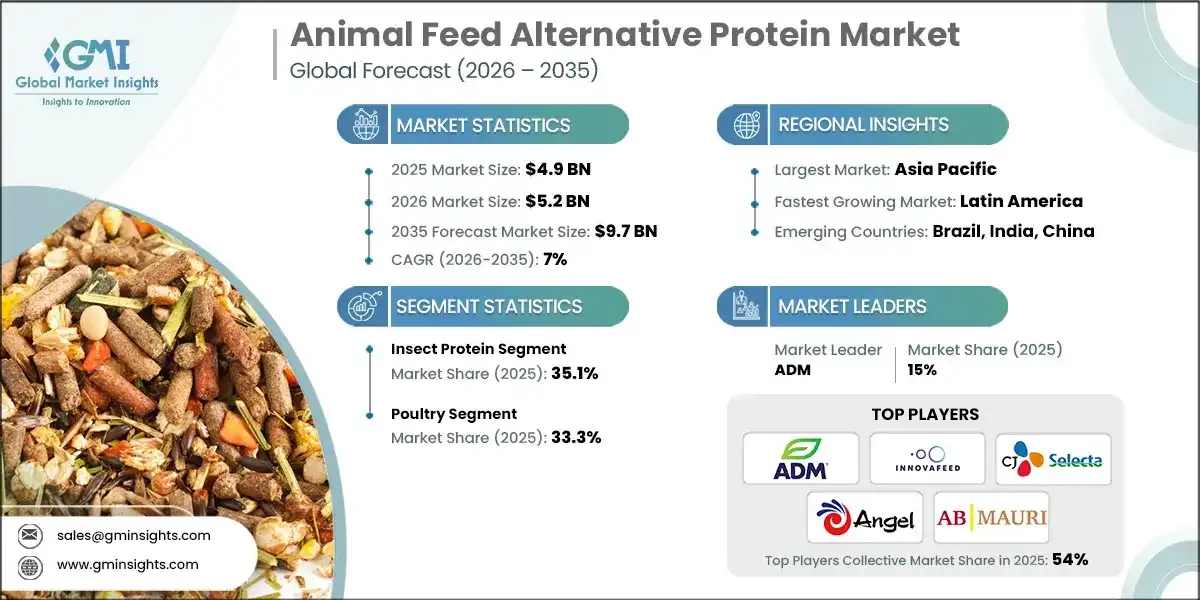
The global animal feed alternative protein market was valued at USD 4.9 billion in 2025. The market is expected to grow from USD 5.2 billion in 2026 to USD 9.7 billion in 2035, at a CAGR of 7%, according to latest report published by Global Market Insights Inc.
To get key market trends
- Sustainability pressure over 2022–2025 diversified the protein input. Emissions and land use from livestock, as captured by the FAO and IPCC, enlisted integrators and retailers to seek lower impact protein options that insect, single, and fermented soy, and. Because they are side-streamed crops and bred to yield a higher protein per hectare, they are lower impact options.
- The adoption of alternative proteins was also informed by food security. from 2021 to 2023, linked to supply and geopolitical tensions, the feed cost increased over 2021 to 2023. the alternative protein stabilized poultry, aquaculture, and swine producers to trial. The tested insect meal, fermented soy, and dried yeast product, while reducing dependence performance was comparable to that of conventional imported protein meals.
- 2021 to 2025 was a time when innovation and regulations transformed across the globe. Countries across the EU began to approve of the use of insect proteins within the animal feed of poultry and swine. Asian countries began to increase investments within insect farming and fermentation. Digestion, gut health, and antibiotic-free production scientific works created confidence that alternative proteins can have a positive impact on the performance and welfare, and even support the branding of premium protein markets.
Animal Feed Alternative Protein Market Report Attributes
| Key Takeaway | Details |
|---|---|
| Market Size & Growth | |
| Base Year | 2025 |
| Market Size in 2025 | USD 4.9 Billion |
| Market Size in 2026 | USD 5.2 Billion |
| Forecast Period 2026-2035 CAGR | 7% |
| Market Size in 2035 | USD 9.7 Billion |
| Key Market Trends | |
| Drivers | Impact |
| Volatile soymeal prices and supply disruptions | Push integrators to diversify into alternative proteins |
| Rising meat and aquaculture demand in Asia | Increases protein requirements, favoring scalable alternatives |
| Sustainability, deforestation and emissions concerns | Encourages lower impact proteins from insects and fermentation |
| Pitfalls & Challenges | Impact |
| Higher cost and limited large scale supply | Constrains inclusion rates in commodity feed rations |
| Regulatory approvals and safety perception issues | Slow broader adoption across regions and species |
| Opportunities: | Impact |
| Upcycling agri‑food side‑streams into feed protein | Cutting waste while creating cost‑competitive new ingredients |
| Premium, antibiotic‑free and functional meat labels | Rewards use of probiotics and gut‑health focused proteins |
| Market Leaders (2025) | |
| Market Leader |
|
| Top Players |
|
| Regional Insights | |
| Largest Market | Asia Pacific |
| Fastest growing market | Latin America |
| Emerging countries | Brazil, India, China |
| Future outlook |
|
What are the growth opportunities in this market?
Animal Feed Alternative Protein Market Trends
- Nutritional and functional upgrading of soy-based proteins: Fermented soy protein, concentrates, and specialty soy fractions are being optimized for digestibility, amino acid balance, and gut health. For example, low anti nutritional fermented soy products are increasingly used in piglet and poultry starter feeds to improve feed conversion and reduce dependence on antibiotic growth promoters.
- Rapid scaling of insect and single-cell protein capacity: Black soldier fly, mealworm, and microbial protein producers are building industrial plants close to food processing side streams. Innova Feed’s large insect facilities in Europe and Asia, and multiple single cell protein projects using natural gas or methanol, indicate a clear shift toward circular, resource efficient protein production.
- Integration with sustainability and deforestation-free commitments: Retailers and integrators are tying feed procurement to deforestation free soy and lowercarbon diets, encouraging partial replacement with insect, yeast, and bacterial proteins. Several European poultry and salmon brands already market “responsibly fed” or “insectfed” lines, using feed composition to differentiate on climate and biodiversity impacts.
Growth of precision feeding and species-specific formulations: Alternative proteins are being tailored to species and life stages, supported by digestibility data and gut microbiome research. In aquaculture, for example, single cell and insect proteins are blended with soy concentrates to reduce fishmeal while maintaining growth, while pet food uses novel proteins to target hypoallergenic and grainfree formulations.
Animal Feed Alternative Protein Market Analysis
Learn more about the key segments shaping this market
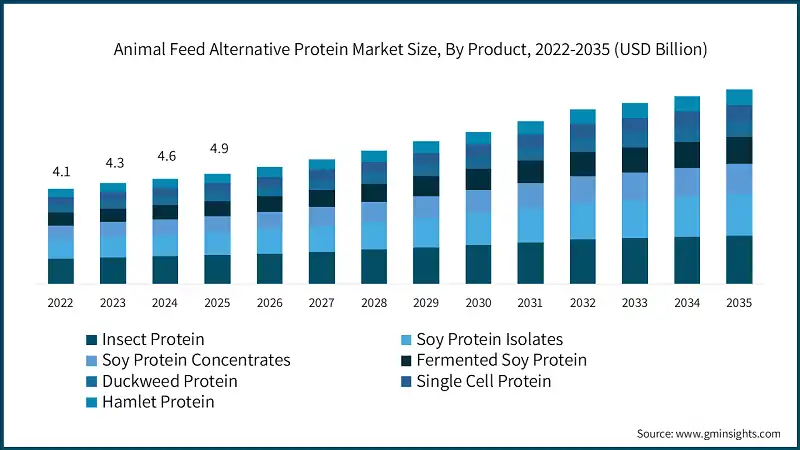
Based on product, the market is segmented into Insect protein, Soy protein isolates, Soy protein concentrates, Fermented soy protein, Duckweed protein, Single cell protein, Hamlet protein. Insect Protein held the largest market share of 35.1% in 2025 and is expected to grow at a CAGR of 6.8% during 2026-2035.
- The types of sources and organisms used for alternative feed protein are transitioning from single-source and on experimental trials to being part of a wider portfolio. Large feed producers do not generally use a single one of these sources. Insects, single-cell, algae, fungi, and yeast protein sources are used in conjunction with soy isolates, concentrates, and fermented soy. This mixture acts to achieve a balance of all factors including cost, sustainability claims beefing, amino acid profiles, and bifunctional benefits like gut health.
The business models focus on securing feedstock and valorization of side-streams. In fermentation, sugars, glycerol or off-gasses are used; in insect farms, agri-food by-products are consumed; in duckweed and grain protein, local crops are used. Branded concepts like Hamlet Protein or tailored yeast/fungal products focus on differentiating based on performance in young animal diets, antibiotic-free production, and lower reliance on soy.
Learn more about the key segments shaping this market
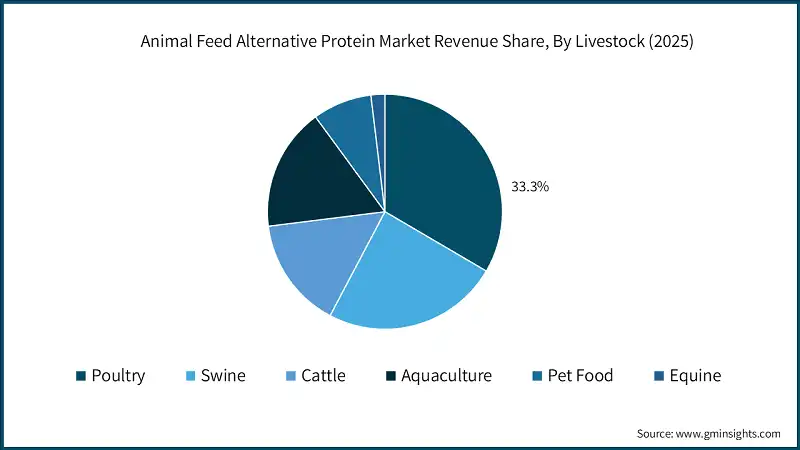
Based on Livestock, the animal feed alternative protein market is segmented into poultry, Swine, Cattle, Aquaculture, Pet food, Equine. Poultry held the largest market share of 33.3% in 2025 and is expected to grow at a CAGR of 6.8% during 2026-2035.
- The applications of alternative feed protein products are implementing phase- and species-specific nutrition. Blends tailored for poultry, swine, cattle, aquaculture, pets, and equine are more frequently produced using a mixture of proteins from insects, fermented soy, single cell, and yeast. Customized formulations are given to broilers, layers, starters, growers, calves, salmon, shrimp, and carp to maximize feed conversion, health, and quality of the carcass while reducing usage of fishmeal and conventional soy.
Industries that prioritize strategy focus on poultry, swine, dairy, and aquaculture, as it is worth investing in more expensive ingredients due to higher profit margins. Producers work in conjunction with other entities to create balanced feeds, using alternative proteins to promote as tools to reduce, improve, and market gut antibiotics integrity with claims of “sustainably fed,” “fishmeal-reduced,” and “novel-protein” pet foods.
Looking for region specific data?
North America contributes a substantial share of the global animal feed alternative protein market, increasing from USD 1.19 billion in 2024 to USD 2.37 billion in 2034, mainly driven by large integrators seeking supply resilience and sustainability. Strong poultry, pet food, and specialty feed sectors accelerate adoption of fermented, yeast, and single-cell proteins.
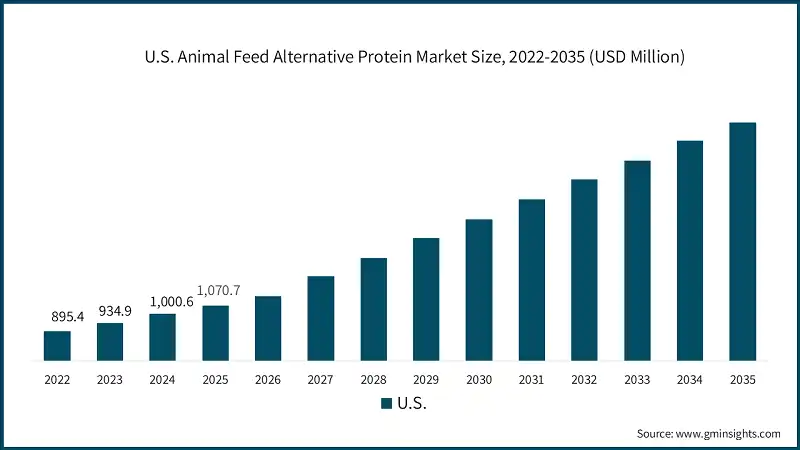
- The U.S. is the primary market for alternative feed proteins in North America. Robust poultry and pet food industries, retailer sustainability commitments, and advanced fermentation capacity underpin growing use of novel proteins to partially replace conventional soymeal while supporting antibioticfree and premium positioning.
Europe holds a significant position in the global animal feed alternative protein market, rising from USD 1.28 billion in 2024 to USD 2.47 billion in 2034, mainly driven by stringent environmental policies and deforestation free sourcing commitments. EU regulatory support for insect and single-cell proteins in feed further encourages diversification beyond traditional soy and fishmeal.
- Germany is a key European adopter of alternative proteins in compound feed. Its highly efficient pork, poultry, and dairy sectors, plus strong feed cooperatives, support trials and scaleup of insect meal, fermented soy, and yeast products that align with animal welfare, climate, and nitrogenreduction objectives.
Asia Pacific represents the largest and fastest growing regional market, expanding from USD 1.47 billion in 2024 to USD 2.94 billion in 2034, mainly driven by rising poultry and aquaculture output and higher meat consumption. The region’s strong CAGR of about 7.2% reflects rapid scaleup of fermentation and insect production facilities serving local integrators.
- China is the principal demand center for alternative feed proteins within Asia Pacific. Its enormous poultry, swine, and aquaculture industries, exposure to soy import volatility, and government interest in food security encourage adoption of singlecell, insect, and upgraded soy proteins to stabilize rations and reduce external dependency.
Latin America shows steady growth in animal feed alternative protein market, moving from USD 364 million in 2024 to USD 689 million in 2034, mainly driven by export oriented poultry and pork industries. Producers explore novel proteins to complement abundant local soy, improve sustainability credentials, and mitigate disease related supply shocks in traditional feed chains.
- Brazil is the leading Latin American market for alternative feed proteins. While still heavily reliant on soy, major integrators and exporters test insect meal, fermented soy, and yeast-based products to differentiate export meat on sustainability, reduce antibiotic use, and better utilize local agroindustrial byproducts.
MEA contributes a smaller but rapidly expanding share, increasing from USD 276 million in 2024 to USD 552 million in 2034, mainly driven by poultry expansion and food security strategies in Gulf and North African countries. Strong CAGR near 7.2% reflects growing investment in local feed production and interest in resource efficient proteins.
Saudi Arabia is an emerging hotspot for alternative feed protein within MEA. Its dependence on imported feedstuffs, large poultry sector, and government backed diversification into Agritech and aquaculture create opportunities for insect, yeast, and singlecell proteins that can be produced closer to demand centers.
Animal Feed Alternative Protein Market Share
Top five companies ADM, Innova Feed, CJ Selecta, Angel Yeast, and AB Mauri together control about 54% of the market. The landscape is led by a global grain and oilseed major complemented by specialist insect and fermentation players. Their combined scale, technology, and integrator partnerships heavily influence pricing, performance benchmarks, and sustainability standards across key regions.
- ADM: ADM is a central force in alternative feed proteins with around 15% share. Leveraging its grain origination, crushing, and fermentation platforms, ADM supplies soy concentrates, isolates, and microbial proteins into poultry, swine, and aquaculture feeds. The company increasingly links sustainability analytics and deforestationfree sourcing with its alternative protein value propositions.
- Innova Feed: InnovaFeed holds roughly 12% share, emerging as a flagship industrial insect protein producer. Focused on black soldier fly meal and oil, it colocates near agrifood sidestreams and partners with major integrators. Its proteins target poultry, swine, and aquaculture, emphasizing circularity, reduced land use, and strong digestibility performance data.
- CJ Selecta: CJ Selecta accounts for about 10% share, specializing in soy protein concentrates and upgraded soy derivatives for feed. With strong presence in Latin America and export markets, it positions its ingredients as consistent, highprotein alternatives to commodity meals, supporting aquaculture and monogastric diets that seek improved digestibility and lower antinutritional factors.
- Angel Yeast: Angel Yeast commands close to 9% share through its broad yeast and yeast derivative portfolio. It supplies functional yeast proteins, hydrolysates, and postbiotics that enhance gut health, palatability, and immune function. Angels are increasingly integrating these solutions into antibioticreduction strategies for poultry, swine, and aqua feeds across Asia and beyond.
- AB Mauri: AB Mauri holds around 8% share, leveraging its expertise in yeast and fermentation from bakery into animal nutrition. The company offers yeast-based proteins and functional ingredients for gut health and feed efficiency, working with integrators and premix firms. Its focus on reliable supply and performance in young-animal and specialty diets underpins steady growth.
Animal Feed Alternative Protein Market Companies
Major players operating in the animal feed alternative protein industry include:
- ADM
- CJ Selecta
- Calysta Inc
- CHS Inc
- Hamlet Protein A/S
- Titan Biotech Ltd
- E.I. Du Pont De Nemours And Company
- Deep Branch Biotechnology
- Agriprotein GmbH
- Innova Feed
- Angel Yeast
- AB Mauri
- Crescent Biotech
Animal Feed Alternative Protein Industry News
- In May 2025, ADM outlined further expansion of its alternative protein and fermentation capabilities, highlighting new capacity aimed at supplying highvalue soy concentrates and microbial proteins for poultry, swine, and aquaculture feeds in North America, Europe, and Asia.
- In October 2024, Innova Feed announced progress on large-scale insect protein plants in North America and Asia, colocated with agrifood processors. The projects aim to supply black soldier fly meal and oil for poultry, pig, and aqua feeds using circular, lowcarbon feedstocks.
- In March 2024, Angel Yeast reported new investments in yeast and yeastderivative production lines dedicated to animal nutrition. The company emphasized functional yeast proteins and postbiotics designed to support gut health, immunity, and antibiotic free production in poultry and swine.
- In July 2023, AB Mauri expanded its animal nutrition portfolio with additional yeast based feed ingredients, focusing on young animal and stress phase diets. The launch targeted premix companies and integrators seeking performance improvements and better resilience under tightening antibiotic use regulations.
This animal feed alternative protein market research report includes in-depth coverage of the industry, with estimates & forecasts in terms of revenue (USD Billion) and volume (Kilo Tons) from 2026 to 2035, for the following segments:
Market By Product
- Insect Protein
- Soy Protein Isolates
- Soy Protein Concentrates
- Fermented Soy Protein
- Duckweed Protein
- Single Cell Protein
- Algae Protein
- Grain Protein
- Fungal Protein
- Yeast Protein
- Hamlet Protein
Market, By Livestock
- Poultry
- Broiler
- Layer
- Turkey
- Others
- Swine
- Starter
- Grower
- Sow
- Cattle
- Dairy
- Calf
- Others
- Aquaculture
- Salmon
- Trout’s
- Shrimps
- Carp
- Others
- Pet Food
- Equine
The above information is provided for the following regions and countries:
- North America
- U.S.
- Canada
- Europe
- Germany
- UK
- France
- Spain
- Italy
- Rest of Europe
- Germany
- Asia Pacific
- China
- India
- Japan
- Australia
- South Korea
- Rest of Asia Pacific
- Latin America
- Brazil
- Mexico
- Argentina
- Rest of Latin America
Middle East and Africa
- Saudi Arabia
- South Africa
- UAE
- Rest of Middle East and Africa
Frequently Asked Question(FAQ) :
Who are the key players in the global animal feed alternative protein market?
Key players include ADM, CJ Selecta, Calysta Inc, CHS Inc, Hamlet Protein A/S, Titan Biotech Ltd, E.I. Du Pont De Nemours And Company, Deep Branch Biotechnology, Agriprotein GmbH, and Innova Feed.
What was the market share of the insect protein segment in 2025?
Insect protein held the largest market share of 35.1% in 2025 and is anticipated to grow at a CAGR of 6.8% during the forecast period of 2026-2035.
What was the market share of the poultry segment in 2025?
The poultry segment accounted for 33.3% of the market share in 2025 and is expected to grow at a CAGR of 6.8% from 2026 to 2035.
What are the key trends in the global animal feed alternative protein industry?
Key trends include the optimization of soy-based proteins for improved digestibility and gut health, and the rapid scaling of insect and single-cell protein production through resource-efficient and circular production methods.
Which region leads the global animal feed alternative protein market?
North America leads the market, contributing USD 1.19 billion in 2024 and projected to reach USD 2.37 billion by 2034. The region's dominance is driven by strong poultry, pet food, and specialty feed sectors, along with a focus on supply resilience and sustainability.
What was the market size of the global animal feed alternative protein market in 2026?
The market size is projected to reach USD 5.2 billion in 2026.
What was the market size of the animal feed alternative protein market in 2025?
The market size was valued at USD 4.9 billion in 2025, with a CAGR of 7% expected through 2035, driven by advancements in protein production technologies and increasing demand for sustainable feed solutions.
What is the projected value of the animal feed alternative protein market by 2035?
The market is expected to reach USD 9.7 billion by 2035, fueled by the adoption of resource-efficient proteins such as insect and single-cell proteins.
Animal Feed Alternative Protein Market Scope
Related Reports