Summary
Table of Content

ADAS Subscription Market
Get a free sample of this report
Form submitted successfully!
Error submitting form. Please try again.
Thank you!
Your inquiry has been received. Our team will reach out to you with the required details via email. To ensure that you don't miss their response, kindly remember to check your spam folder as well!
Request Sectional Data
Thank you!
Your inquiry has been received. Our team will reach out to you with the required details via email. To ensure that you don't miss their response, kindly remember to check your spam folder as well!
Form submitted successfully!
Error submitting form. Please try again.
ADAS Subscription Market Size
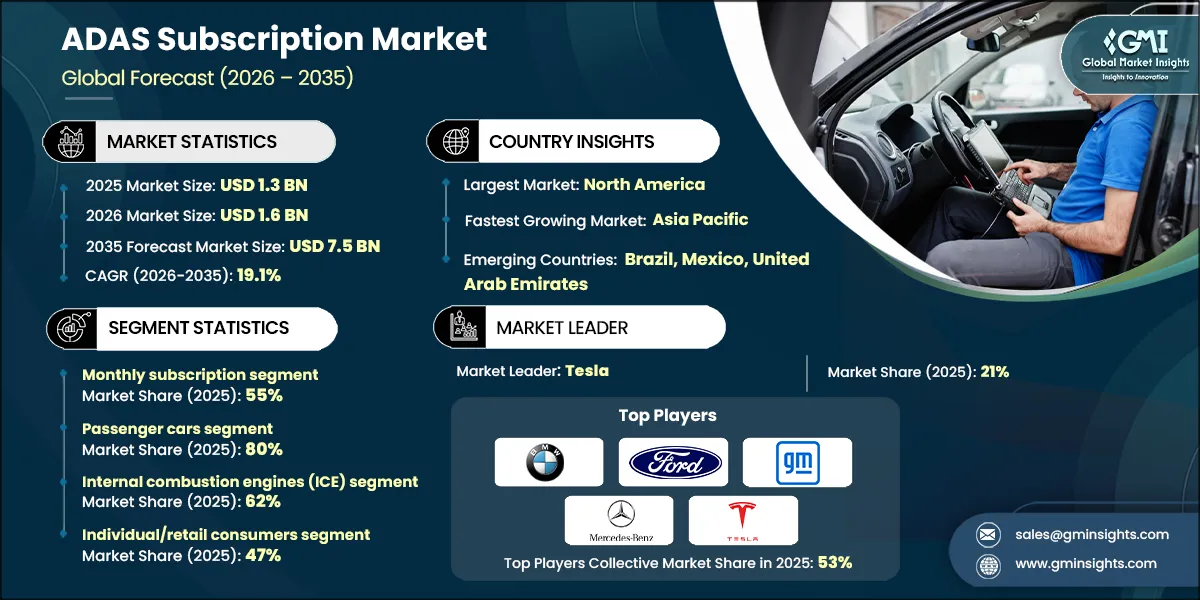
Global ADAS subscription market was estimated at USD 1.3 billion in 2025. The market is expected to grow from USD 1.6 billion in 2026 to USD 7.5 billion in 2035, at a CAGR of 19.1% according to latest report published by Global Market Insights Inc.
To get key market trends
The ADAS subscription model marks a shift from hardware-based sales to software-driven recurring revenue. This aligns with the industry's move toward software-defined vehicles (SDVs), where safety and autonomous features are updated and monetized via over-the-air (OTA) updates and subscriptions.
The ADAS subscription market marks a key shift in the automotive industry's move toward software-driven revenue models. It includes active payments for advanced driver assistance features beyond regulatory requirements, covering monthly subscriptions, annual contracts, and pay-per-use models for passenger and commercial vehicles.
Automakers are swiftly embracing software-defined architectures, pouring significant investments into centralized computing platforms that offer feature-on-demand capabilities. The United Nations Economic Commission for Europe reports that the rollout of UN Regulation 155, focusing on cybersecurity, and UN Regulation 156, centered on software updates, has established uniform frameworks for over-the-air (OTA) updates among member states. This move lays the groundwork for subscription-based Advanced Driver-Assistance Systems (ADAS) features.
Government safety mandates are accelerating the adoption of ADAS features in new vehicles. The NHTSA has proposed mandatory AEB systems for all light vehicles, while the EC's GSR requires advanced emergency braking, lane-keeping assistance, and intelligent speed assistance in all new vehicles starting 2024. These regulations are driving ADAS adoption and enabling subscription-based feature upgrades.
Electric vehicles (EVs) exhibit higher adoption rates of Advanced Driver Assistance Systems (ADAS) subscriptions compared to internal combustion engine vehicles. According to the International Energy Agency (IEA), EVs' centralized electrical architecture and superior computing power enabled software integration. With EVs projected to account for over 30% of global vehicle sales by 2030, the market for premium ADAS subscriptions is poised for significant growth.
For instance, in March 2025, General Motors (GM) expanded its Super Cruise subscription to Cadillac and Chevrolet EV models. Priced at $25 per month, it leverages centralized vehicle computing platforms for OTA feature delivery.
By 2025, North America is projected to account for 35% of the global market value, driven by high vehicle connectivity, robust telematics infrastructure, and consumer adoption of subscription services. Safety initiatives have also accelerated ADAS hardware integration, expanding the subscription-capable vehicle base.
ADAS Subscription Market Report Attributes
| Key Takeaway | Details |
|---|---|
| Market Size & Growth | |
| Base Year | 2025 |
| Market Size in 2025 | USD 1.3 Billion |
| Market Size in 2026 | USD 1.6 Billion |
| Forecast Period 2026-2035 CAGR | 19.1% |
| Market Size in 2035 | USD 7.5 Billion |
| Key Market Trends | |
| Drivers | Impact |
| Rising demand for safety & autonomous features | Increased adoption of ADAS software subscriptions as OEMs and fleet operators seek scalable, upgradable safety solutions. |
| Shift to software-defined vehicles (SDV) | Accelerates the move from one-time ADAS purchases to subscription models for continuous software updates and feature enhancements. |
| OEM revenue diversification & recurring revenue models | Encourages OEMs to offer ADAS via subscription to secure predictable, recurring income streams. |
| Government mandates for advanced safety systems | Regulatory requirements drive adoption of subscription-based ADAS solutions to ensure compliance with evolving safety standards. |
| Declining hardware costs & increased software value | Lowers upfront barriers while emphasizing software subscriptions as the primary revenue driver for ADAS features. |
| Pitfalls & Challenges | Impact |
| High consumer skepticism & perceived money-grab | Limits subscriber adoption as end-users may question recurring fees for features, they expect to own, slowing market growth. |
| Low market awareness | Lack of knowledge about subscription-based ADAS offerings reduces demand, making OEMs’ customer acquisition and conversion more challenging. |
| Opportunities: | Impact |
| Untapped EV market potential (2x higher adoption rates) | Accelerates ADAS subscription adoption as EVs increasingly integrate advanced safety and autonomous software features from launch. |
| Emerging markets with leapfrog technology adoption | Newer markets adopting advanced vehicle technologies rapidly create fresh demand for subscription-based ADAS solutions. |
| Fleet & MaaS provider subscription packages | Fleet operators and mobility-as-a-service providers seek scalable, recurring ADAS subscriptions to enhance safety and reduce operational risk. |
| Aftermarket subscription services | Expands revenue opportunities by offering ADAS feature upgrades and software updates to existing vehicle owners, increasing market penetration. |
| Market Leaders (2025) | |
| Market Leader |
21% Market Share |
| Top Players |
Collective Market Share is 53% |
| Competitive Edge |
|
| Regional Insights | |
| Largest Market | North America |
| Fastest growing market | Asia Pacific |
| Emerging countries | Brazil, Mexico, United Arab Emirates |
| Future outlook |
|
What are the growth opportunities in this market?
ADAS Subscription Market Trends
The ADAS subscription market is undergoing transformation due to five key trends, impacting automotive value chains, revenue models, and consumer interactions with vehicle technology. These trends stem from regulatory mandates, technological advancements, business model innovations, and changing consumer preferences.
The automotive industry is transitioning to centralized, software-defined platforms, enabling over-the-air updates and ADAS subscription models. UNECE's UN Regulation 156 establishes global standards for software updates and vehicle cybersecurity, providing regulatory clarity for OEMs adopting these architectures.
Traditional vehicle architecture used 70-100 distributed ECUs, making feature updates complex and prone to compatibility issues. The software-defined vehicle architecture replaces these with 3-5 high-performance domain controllers, simplifying updates and enabling continuous feature enhancements throughout the vehicle lifecycle.
Centralized computing platforms allow OEMs to pre-install ADAS sensors and process hardware during manufacturing, enabling feature upgrades via software subscriptions. According to Institute of Electrical and Electronics Engineers (IEEE) standards, hardware costs for cameras, radar, and ultrasonic sensors have dropped 35–40% over the past five years, making universal hardware installation feasible even in mid-market vehicles.
Government safety regulations worldwide are establishing comprehensive ADAS feature requirements that mandate hardware installation across all new vehicle segments. These regulations create a universal baseline of ADAS-capable vehicles, providing OEMs with a vast addressable market for subscription-based feature enhancements beyond regulatory minimums.
The global electric vehicle (EV) market shows higher adoption rates of Advanced Driver-Assistance Systems (ADAS) subscriptions compared to internal combustion engine vehicles. This growth is fueled by EV buyer demographics, architectural benefits, and strategic OEM initiatives.
For instance, in January 2025, Tesla rolled out its Full Self-Driving (FSD) subscription across North America, allowing EV owners to access features such as Navigate on Autopilot, automated lane changes, and traffic-aware cruise control for a monthly fee of $199.
ADAS Subscription Market Analysis
 Learn more about the key segments shaping this market
Learn more about the key segments shaping this market
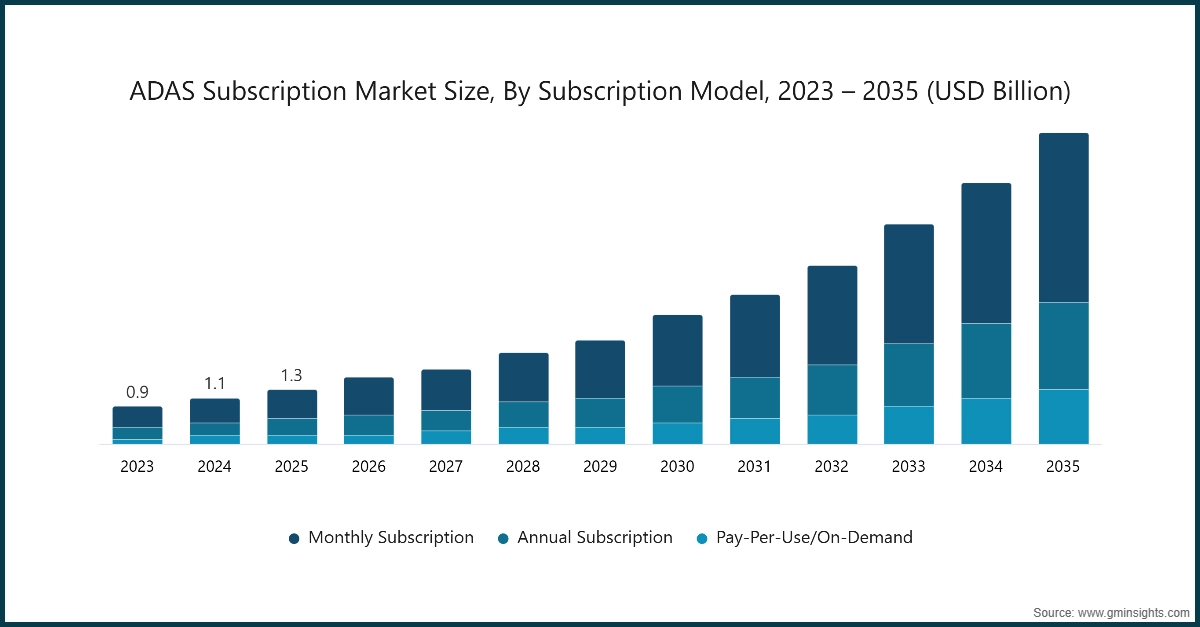
Based on subscription model, ADAS subscription market is segmented into monthly subscription, annual subscription, and pay-per-use/on-demand. These models cater to diverse customer preferences and usage patterns while enhancing OEM revenue across market segments. The monthly subscription segment dominates the market with 55% share in 2025, and the segment is expected to grow at a CAGR of 18.9% from 2026 to 2035.
The Monthly Subscription Model dominates the market, offering flexibility with fees ranging from $10-30 for basic packages to over $200 for premium autonomous driving features.
- The monthly model leads the market, driven by consumer demand for subscription flexibility across industries like streaming, software, and telecommunications.
- Monthly subscriptions provide OEMs with continuous customer engagement and revenue visibility while enabling dynamic feature delivery and pricing optimization.
- The model facilitates A/B testing of features, pricing, and promotional offers, generating valuable customer data that informs product development and marketing strategies Monthly subscription models face retention challenges, with ADAS subscriptions experiencing 15-25% annual churn, necessitating consistent value delivery and engagement.
- For instance, in October 2025, Ford BlueCruise, the hands-free driving system, sets its monthly subscription at $49.99 for vehicles of the 2025 model year. This pricing, updated on October 1, 2024, will persist throughout 2025.
- By 2025, the annual subscription model will represent 29% of the market value, growing at a CAGR of 18.7%, driven by 15-20% discounts over monthly plans and improved OEM cash flow predictability.
- This model attracts price-sensitive consumers comfortable with longer commitment horizons and fleet operators seeking budgeting certainty.
- The annual model reduces customer acquisition costs per retained revenue dollar and improves subscription economics through reduced payment processing and customer service interactions.
- Proactive engagement 30-60 days before subscription expiration is essential to address customer friction during renewal points and maintain retention rates.
- OEMs employ anniversary feature enhancements, loyalty discounts, and usage analytics reports demonstrating subscription value to facilitate renewals.
- By 2025, the pay-per-use/on-demand Model will comprise 16% of the market value, growing at a 20.1% CAGR during the forecast period.
- This model charges consumers only when ADAS features are actively utilized, appealing to infrequent users, rental/car-sharing applications, and consumers testing feature value before committing to recurring subscriptions.
- On-demand models address consumer concerns by eliminating costs during non-use, making them ideal for seasonal vehicle use, occasional highway driving, or infrequent urban parking needs.
Learn more about the key segments shaping this market
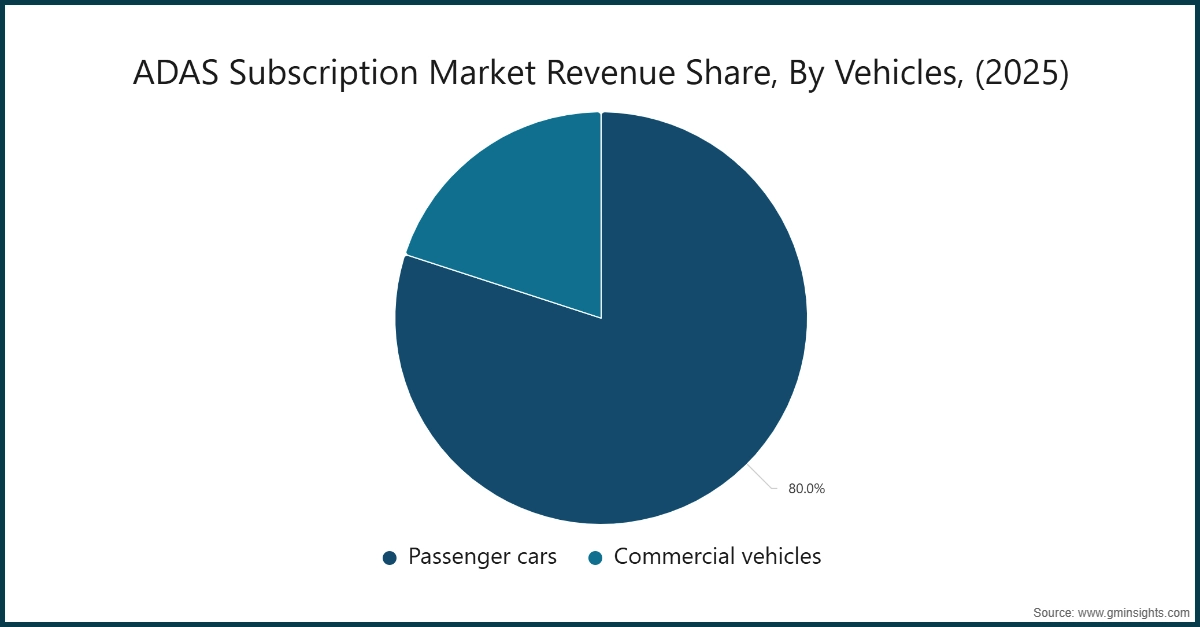
Based on vehicles, ADAS subscription market is divided into passenger cars and commercial vehicles with distinct adoption drivers, use cases, and value propositions characterizing each segment. The passenger cars segment dominates with 80% market share in 2025 and is growing at the rate of 18.8% CAGR.
- Passenger cars segment encompasses all consumer-owned and operated light vehicles including sedans, SUVs, crossovers, and light trucks.
- Consumer safety awareness, perceived convenience, and the desire to signal status through technology adoption are driving the adoption of ADAS subscriptions in passenger cars.
- Within passenger cars, luxury and premium segments demonstrate significantly higher subscription adoption rates (35-40%) compared to mid-market segments (8-12%) and entry-level vehicles (3-5%). This adoption gradient reflects vehicle price positioning, buyer demographics, and hardware capability pre-installation rates.
- Premium vehicles include ADAS sensors suites as standard, easing subscription activation, while mid-market vehicles face price sensitivity despite hardware pre-installation.
- North American consumers, familiar with the automotive subscription market, show a greater willingness to adopt car subscriptions. This trend is largely influenced by their long commute distances and a travel pattern heavily reliant on highways.
- European adoption is driven by stringent safety regulations and a strong premium vehicle market but faces pricing challenges from urban public transportation alternatives.
- Subscription adoption rates for battery electric vehicles (BEVs) in the passenger car segment are 22-25%, significantly higher than the 10-12% for internal combustion engine (ICE) vehicles, driven by buyer demographics, vehicle design, and OEM strategies.
- For instance, in June 2025, Mercedes-Benz announced that approximately 38% of newly delivered S-Class and EQS sedans in Europe opted for the ADAS subscription, coinciding with elevated rates of pre-installed hardware.
- The commercial vehicles segment includes light commercial vehicles (delivery vans, pickup trucks), medium-duty trucks, and heavy-duty commercial vehicles used for freight transport, passenger transport, and specialized commercial applications.
- Commercial vehicle ADAS subscriptions demonstrate fundamentally different value propositions compared to passenger applications.
- Fleet operators aim for measurable ROI by reducing accident-related costs, lowering insurance premiums, cutting driver training expenses, and optimizing vehicle utilization through ADAS-enabled predictive maintenance.
- Commercial vehicle segment growth is particularly pronounced in last-mile delivery applications, where e-commerce growth drives expanding light commercial vehicle fleets.
- Advancements in automated driving are creating significant ADAS subscription opportunities in heavy-duty trucking, especially for Level 3-4 automation in long-haul freight operations.
Based on propulsion, the ADAS subscription market is segmented into internal combustion engines (ICE), electric / battery electric vehicles (BEV), hybrid electric vehicles (HEV), and plug-in hybrid electric vehicles (PHEV). The internal combustion engines (ICE) segment dominates with 62% market share in 2025 with 18.3% CAGR during 2026 to 2035.
Despite the automotive industry's shift toward electrification, ICE vehicles are expected to dominate most of the forecast period due to their large installed base and continued production in developing markets.
- Technical and demographic challenges hinder the adoption of ADAS subscriptions in ICE vehicles due to traditional architectures with limited computing power.
- Retrofitting software-defined architectures into ICE platforms requires substantial engineering investment, creating economic barriers particularly for mid-market vehicle segments.
- ICE vehicle buyers tend to be older demographically and demonstrate lower technology affinity compared to EV buyers, reducing subscription adoption propensity.
- The large ICE vehicle population offers significant market opportunities as premium manufacturers like Mercedes-Benz, BMW, and Audi adopt centralized computing platforms and advanced sensor suites like EVs.
- For instance, in October 2025, Ford continues to offer its BlueCruise automated driver-assist system through flexible subscription plans, showcasing OEM efforts to monetize ADAS on ICE and hybrid platforms amid growing electrification.
- By 2025, battery electric vehicles (BEVs) are expected to account for 21% of the market, driven by a 20.6% CAGR and higher per-vehicle subscription adoption rates, as per internation energy agency projections.
- BEV platforms, with centralized electrical architectures and high-voltage battery systems, enable seamless integration of advanced ADAS features.
- BEV manufacturers such as Tesla, Rivian, Lucid, and Chinese EV startups have incorporated subscription models into vehicle designs from the start, avoiding retrofit challenges.
- BEV buyers, who are 8-12 years younger than ICE vehicle buyers, spend more on technology and prefer software-defined features with continuous enhancements.
- The growing BEV market share, rising from 5% in 2025 to over 25% by 2035, coupled with higher subscription adoption per vehicle, is driving significant market growth.
- By 2025, Hybrid Electric Vehicles (HEVs) are expected to capture 11% of the market value, growing at a 19.4% CAGR, with adoption trends positioned between ICE and BEV platforms.
- The partial electrification provides some architectural advantages for ADAS integration including enhanced electrical power availability and increasingly centralized computing platforms in newer HEV generations.
- HEV buyers tend to be younger than ICE vehicle buyers but older than BEV purchasers, reflecting moderate technology affinity and balanced practical/environmental purchase motivations.
- The HEV segment serves as a transitional technology bridge, with market share projections indicating gradual decline after 2028 as BEV adoption accelerates and ICE market share decreases.
- PHEVs offer dual-mode operation combining electric propulsion for limited range with ICE backup for extended driving, appealing to consumers seeking EV benefits while mitigating range anxiety concerns.
- PHEV subscriptions, with adoption rates of 18-20%, surpass HEV and ICE vehicles but remain behind BEVs, driven by younger, tech-savvy buyers.
- PHEV platforms increasingly incorporate advanced ADAS hardware and software-defined architectures matching or approaching BEV implementation levels, particularly in premium vehicle segments.
- Market projections indicate PHEV segment growth decelerating after 2030 as BEV range capabilities improve and charging infrastructure expands, reducing the value proposition of dual-mode propulsion.
Based on end use, the ADAS subscription market is divided between individual/retail consumers, fleet operators, mobility-as-a-service (MaaS) providers, leasing companies, and others. Individual/retail consumers dominate with 47% market share in 2025, and with a CAGR of 18.3% during forecast period.
- The individual/retail consumers segment, comprising private vehicle owners, is the most price-sensitive category but offers substantial volume potential for ADAS subscriptions.
- Individual consumer subscription decisions demonstrate strong price elasticity, with adoption rates declining sharply at monthly price points exceeding $100.
- The premium pricing of $150-300 monthly for advanced autonomy features targets early technology adopters and high-income groups, comprising about 8-12% of vehicle owners.
- Retention strategies for individual consumers focus on showcasing value through monthly safety reports, gamification, feature updates, and integration with insurance telematics for premium discounts.
- Fleet Operators, commanding a 28% share of the market value in 2025, are set to witness the steepest growth rate, projected at 20.6% CAGR from 2026 to 2035.
- Fleet applications include commercial delivery vehicles, service fleets, rental car companies, and corporate vehicle fleets.
- Fleet operators demonstrate fundamentally different purchase criteria compared to individual consumers, prioritizing quantifiable ROI through accident rate reduction, liability cost savings, and operational efficiency improvements.
- B2B subscription packages for fleet applications command 2-3x pricing compared to consumer offerings, with comprehensive ADAS and fleet management bundles ranging $150-400 monthly per vehicle.
- The fleet segment demonstrates strong growth in last-mile delivery applications, where e-commerce expansion drives rapid light commercial vehicle fleet growth.
- By 2025, mobility-as-a-Service (MaaS) providers are expected to represent 10% of the market value, growing at a CAGR of 19.6% during forecast period.
- MaaS providers prioritize safety features reducing liability exposure and enhancing passenger perception of service quality.
- In 2024, 70-85% of MaaS vehicles adopt basic ADAS subscription packages, compared to only 15-20% in individual consumer markets.
- Pricing models for MaaS applications typically employ variable/usage-based structures, charging per-mile or per-trip fees for ADAS feature utilization rather than fixed monthly subscriptions.
- The "Others" category includes government fleet vehicles with ADAS for public safety, specialized vehicles for specific industries, flexible feature access for shared vehicles, and niche mobility applications with tailored ADAS needs.
- Government fleet adoption of ADAS subscriptions is emerging in developed markets with budget availability for safety technology investment.
Looking for region specific data?
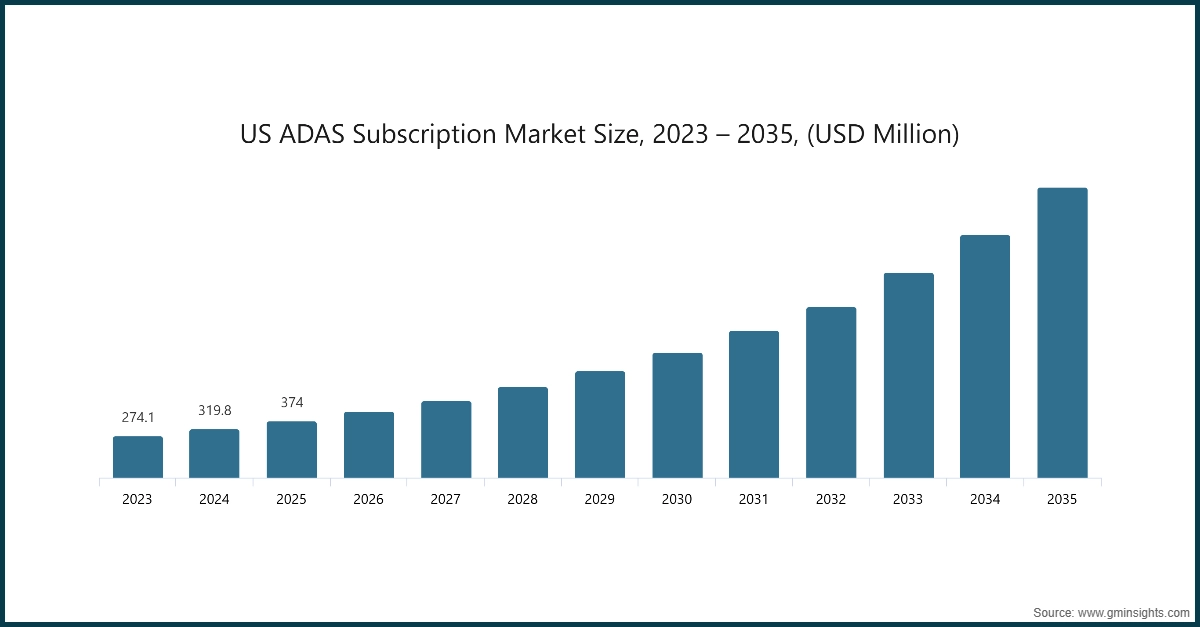
US dominated North America ADAS subscription market generating revenue of USD 374 million in 2025 with CAGR of 18% during the forecasted timeframe from 2026 to 2035.
- The US market leads due to factors like proposed mandatory AEB systems and V2X infrastructure, as highlighted by national highway traffic safety administration (NHTSA) vehicle safety initiatives.
- Vehicles with advanced driver assistance features receive higher safety ratings from the national highway traffic safety administration's new car assessment program (NCAP), motivating OEMs to invest more in sophisticated ADAS capabilities.
- US consumers in suburban markets with long highway commutes are adopting ADAS subscriptions for features like adaptive cruise control and highway pilot systems.
- Geographic analysis indicates highest per-capita subscription adoption in Western states (California, Washington, Oregon) with technology-forward consumer demographics and extensive highway networks.
- Texas and Florida demonstrate strong growth trajectories driven by population expansion, long-distance commuting patterns, and high new vehicle sales volumes.
- The US market benefits from pioneering OEM subscription implementations including Tesla's Full Self-Driving subscription ($199 monthly), GM's Super Cruise ($25 monthly), and Ford's BlueCruise ($75 monthly for 3-year prepaid packages).
- Established offerings have boosted consumer awareness, but research shows subscription adoption drops sharply when monthly fees exceed $100 in the mid-market vehicle segment.
- For instance, in April 2025, Tesla introduced its Full Self-Driving (Supervised) subscription at $99/month across its U.S. lineup, driving higher adoption rates for models like the Model 3 and Model Y.
- The U.S. regulatory framework allows greater flexibility for ADAS feature deployment, with OEMs adhering to baseline safety standards and self-certification processes.
North America dominated the ADAS subscription market accounting for USD 462.6 million in 2025 and is anticipated to show growth of 18.1% CAGR over the forecast period.
- The region's market leadership reflects advanced automotive technology infrastructure, high vehicle connectivity penetration, established consumer familiarity with subscription business models, and early OEM implementation of ADAS subscription offerings.
- North America leads the market, driven by the widespread embrace of connected vehicles, robust OTA software ecosystems, and OEMs' prowess in monetizing driver-assistance features via recurring revenue models.
- The United States dominates the North American ADAS subscription market, driven by regulatory support, early EV adoption, and OEM subscription rollouts, with growth expected during the forecast period.
- Canada's higher growth rates are driven by federal zero-emission vehicle mandates, urbanization in major cities, and regulatory alignment with US standards enabling seamless OEM program deployment.
- Canadian consumer adoption trends align with U.S. patterns, with western provinces showing higher subscription adoption due to tech sector employment and environmental awareness driving EV adoption.
- Quebec shows strong growth in ADAS subscriptions for EVs supported by provincial EV incentives and charging infrastructure investment.
- The bilingual nature of Canadian markets requires French language support for subscription services in Quebec, adding localization complexity for subscription management systems and customer service operations.
- Canada's winter weather challenges ADAS sensor performance, requiring advanced algorithms and sensor fusion to ensure functionality in snow and ice conditions.
- Subscription-based features offering enhanced winter performance, including predictive traction control and automated snow mode activation, demonstrate strong adoption in Canadian markets.
- Transport Canada adopts frameworks to align with global ADAS standards and enable technology transfers from European OEMs.
The ADAS subscription market in China is expected to experience significant and promising growth with a CAGR of 21.2% from 2026 to 2035.
- China, the world's largest automotive market, is driving EV adoption through government policies and advancing domestic OEM capabilities in software-defined vehicle technologies.
- China's national energy policy mandates 40% of new vehicle sales to be electric by 2030, creating a significant market for ADAS subscriptions due to higher adoption rates among EV owners.
- Chinese EV manufacturers including BYD, NIO, XPeng, and Li Auto have integrated subscription-based ADAS features into product strategies from inception, avoiding legacy system transition challenges faced by traditional OEMs.
- These companies offer sophisticated subscription packages combining ADAS features with connectivity services, infotainment, and over-the-air feature enhancements, typically priced 15-25% below comparable Western OEM offerings.
- For instance, in July 2025, XPeng Motors expanded its XNGP (X-Navigation Guided Pilot) subscription to Norway, the Netherlands, and Denmark, priced at €80 per month. The service, offering highway pilot capabilities, has over 200,000 active subscribers in China, with a 35% adoption rate among eligible vehicles.
- Traffic congestion in Chinese megacities like Beijing, Shanghai, Guangzhou, and Shenzhen drives demand for ADAS features such as traffic jam assist and automated parking.
- China's regulatory framework for ADAS and autonomous driving is advancing, with national standards and city-specific pilot programs enabling testing and deployment.
- Data localization requirements mandate that vehicle data collected in China be stored within Chinese territory, affecting subscription service architectures for global OEMs operating in the market.
- These requirements necessitate localized cloud infrastructure and data processing capabilities, increasing subscription service delivery costs for foreign OEMs.
Asia Pacific ADAS subscription market is anticipated to grow at a CAGR of 21.9% during the analysis timeframe.
- The region's growth is driven by rapid EV adoption, large automotive markets, smart mobility initiatives, and tech-savvy urban consumers.
- The region's large-scale infrastructure investments, growing EV adoption, and smart city initiatives are driving connected car technologies and scalable ADAS subscription deployments.
- China's focus on electric vehicles, autonomous driving, and smart city infrastructure, along with high vehicle production, is driving demand for subscription-based ADAS features like adaptive cruise control and traffic jam assist.
- Japan demonstrates sophisticated ADAS adoption supported by domestic OEM technology leadership (Toyota, Honda, Nissan, Subaru) and government policy supporting autonomous driving development.
- Japan's society of automotive engineers establishes industry standards for ADAS features, while the Ministry of land, infrastructure, transport and tourism coordinates autonomous driving regulatory frameworks.
- South Korea's high technology adoption, coupled with Hyundai and Kia's competitive ADAS offerings, drives subscription growth, supported by widespread smartphone and digital payment usage.
- Australia, an advanced market, shares similarities with North America, including long-distance driving, highway-focused transportation, and high vehicle ownership rates.
- India's market is growing rapidly, driven by automotive sector expansion, rising affluence, smart city initiatives, and a tech-savvy young population.
- Southeast Asian markets, including Thailand, Malaysia, Singapore, Indonesia, Vietnam, and the Philippines, are experiencing growth driven by rising vehicle ownership, urbanization, smart mobility investments, and a tech-savvy young population.
Germany dominates the Europe ADAS subscription market, showcasing strong growth potential, with a CAGR of 17.6% from 2026 to 2035.
- Germany dominates the market due to premium OEMs like Mercedes-Benz, BMW, Audi, and Porsche, which lead in ADAS subscriptions and autonomous driving advancements.
- Germany's Federal Motor Transport Authority highlights a rise in new vehicle registrations with advanced ADAS hardware, driving growth in subscription-based feature activations.
- German consumers demonstrate high technology affinity and strong preference for premium automotive features, supporting elevated ADAS subscription adoption rates.
- Germany's extensive Autobahn network enables high-speed ADAS features like adaptive cruise control above standard speed limits and advanced lane-keeping systems for fast highway travel.
- Germany's regulatory environment shaped by European Union directives and national transportation policy creates both opportunities and constraints for ADAS subscriptions.
- German data protection regulations under GDPR enforce strict controls on vehicle data usage, impacting subscription services reliant on driving behavior data.
- Germany's commitment to 1 million public charging points by 2030 and investments in fast-charging networks are driving EV adoption and boosting ADAS subscription rates.
Europe ADAS subscription market accounted for USD 401.8 million in 2025 and is anticipated to show growth of 17.2% CAGR over the forecast period.
- The European market is driven by strict safety regulations, a strong premium vehicle segment, domestic OEM dominance, and advanced connected vehicle infrastructure supporting ADAS subscriptions.
- The mandatory implementation of UNECE R155/R156 regulations in the EU from July 2024 is boosting ADAS subscriptions as OEMs and software providers adopt standardized frameworks for compliance.
- The European Telecommunications Standards Institute (ETSI) is developing CAM and DENM standards to enable subscription-ready ADAS features like automated lane-keeping, adaptive cruise control, and emergency braking notifications.
- Western European markets including France, United Kingdom, Italy, Spain, and Benelux countries demonstrate characteristics like Germany with adjustments for local conditions.
- France shows strong government support for automotive industry digitalization and EV adoption through comprehensive incentive programs.
- The UK market post-Brexit maintains regulatory alignment with EU vehicle safety standards while potentially diverging on data protection and connected vehicle communication standards.
- Italy and Spain show lower per-capita ADAS subscription adoption than Northern Europe due to economic factors and higher urban public transport usage.
- Northern European markets, such as Sweden, Norway, Denmark, and Finland, report high EV adoption rates due to government incentives and environmental awareness.
- Eastern European markets, including Poland, the Czech Republic, and Romania, are emerging as key opportunities for ADAS subscriptions due to rapid automotive growth and stronger integration with Western European value chains.
Brazil leads the Latin American ADAS subscription Market, exhibiting remarkable growth of 20.4% during the forecast period of 2026 to 2035.
- Brazil, the largest economy and automotive market in Latin America, leads ADAS subscription adoption due to strong domestic automotive production, a growing premium vehicle segment, government road safety initiatives, and expanding vehicle connectivity infrastructure.
- The Brazilian market is concentrated in major urban centers like São Paulo and Rio de Janeiro, supported by premium feature adoption among middle and upper-income vehicle owners.
- Economic volatility and currency fluctuations create pricing challenges for subscription services denominated in US dollars or requiring imported technological components.
- Successful subscription implementations employ Brazilian Real pricing with inflation adjustment mechanisms protecting both consumer affordability and OEM revenue realization.
- In Brazil, the state of infrastructure presents unique challenges for the adoption of ADAS. The disparity in road quality, especially between primary highways and secondary routes, directly influences the performance of sensors and the reliability of features.
- Urban traffic congestion in major cities drives adoption of traffic jam assist and automated parking features, while highway safety concerns on long-distance routes support collision avoidance and lane-keeping subscription uptake.
- Brazilian transportation safety authorities report that road accidents claim more than 30,000 lives each year. While there's a growing awareness of the value of safety technologies, their adoption rates remain constrained due to price sensitivity.
UAE to experience substantial growth in the Middle East and Africa ADAS subscription market in 2025.
- The UAE leads regional ADAS subscription adoption due to high per-capita income, advanced infrastructure, smart city initiatives, and a tech-savvy consumer base.
- According to data from the UAE automotive industry, luxury brands account for over 20% of new vehicle sales, highlighting the UAE's premium vehicle market share surpassing global averages.
- Vehicle owners who are tech-savvy and willing to invest in technology are driving higher adoption rates of ADAS subscriptions in this premium market. Yet, the market's size constraints curtail its revenue potential when juxtaposed with broader population markets.
- Climate conditions in UAE create specific ADAS operational considerations. Extreme heat affects sensor performance and requires enhanced thermal management in ADAS computing systems.
- Sand and dust conditions impact camera and radar sensor effectiveness, necessitating robust sensor cleaning systems and algorithms accommodating reduced sensor fidelity.
- Subscription features offering enhanced sensor performance in harsh environmental conditions demonstrate adoption advantages in Gulf markets.
ADAS Subscription Market Share
The top 7 companies in the ADAS subscription industry are Tesla, General Motors, Ford Motor, Mercedes-Benz, BMW, Volkswagen, and Hyundai Motor contributed around 59% of the market in 2025.
- Tesla leads the market with its innovative ADAS subscription models and strong presence in the battery electric vehicle segment, offering premium services like Enhanced Autopilot ($99/month) and Full Self-Driving capability ($199/month) with continuous updates.
- General Motors has rolled out its Super Cruise feature across its Cadillac, GMC, and Chevrolet brands. GM's strategy revolves around a subscription model, offering hands-free driving on designated highways. This is bolstered by comprehensive highway mapping and systems that monitor driver attention.
- Ford Motor offers BlueCruise subscriptions for Ford and Lincoln vehicles, focusing on prepaid annual and multi-year packages to enhance retention, streamline acquisition, and ensure predictable cash flow.
- Mercedes-Benz offers tiered ADAS subscriptions, ranging from basic driver assistance to Drive Pilot Level 3 autonomy in certified markets. Pricing starts at $550 annually for entry-level packages and goes up to $2,500 for advanced autonomous capabilities, reflecting its premium brand positioning.
- BMW, along with its MINI and Rolls-Royce brands, offers flexible subscription tiers with monthly options. Features like parking assistance ($10/month), heated seats ($18/month in select markets), and driving assistance packages ($60-$90/month) can be activated as needed.
- Volkswagen tailors its ADAS strategy across brands. Volkswagen focuses on affordable subscriptions for mainstream markets, Audi offers premium packages aligned with its tech leadership, and Porsche emphasizes performance-oriented features for sports cars.
- Hyundai Motor, comprising Hyundai, Kia, and Genesis brands, focuses on value and feature-rich offerings at accessible prices. Hyundai and Kia integrate ADAS features into trim upgrades, while Genesis offers subscription packages aligned with its luxury positioning.
ADAS Subscription Market Companies
Major players operating in ADAS subscription industry are:
- BMW
- Ford Motor
- General Motors
- Honda Motor
- Hyundai Motor
- Mercedes-Benz
- Mobileye
- Nissan Motor
- Tesla
- Volkswagen
- BMW, Ford Motor, General Motors, Honda Motor, Hyundai Motor, Mercedes-Benz, Mobileye, Nissan Motor, Tesla, and Volkswagen dominate the ADAS subscription market. They offer advanced features like adaptive cruise control and lane-keeping assist via over-the-air updates, ensuring continuous functionality and safety.
- These OEMs enhance the value of ADAS subscriptions by integrating AI-driven driver assistance analytics, software-defined vehicle platforms, and cloud-based feature management. Their solutions improve vehicle safety, customer experience, and feature personalization, supported by strong global manufacturing footprints and technology partnerships.
- The market is expanding rapidly due to the growing adoption of connected and electric vehicles, stricter regulatory mandates for advanced driver assistance systems (ADAS), and rising consumer demand for subscription-based mobility services. Key players are driving ADAS subscription adoption by integrating advanced safety features with flexible payment models and over-the-air upgrades.
ADAS Subscription Market News
- In January 2026, Mercedes-Benz expanded the geographic availability of its Drive Pilot Level 3 autonomous driving subscription to France, Italy, and Spain, following regulatory certifications under ALKS frameworks. This expansion increases the addressable market for the €2,500 annual subscription, with the system achieving 95% operational availability in certified regions.
- In December 2025, General Motors announced the Super Cruise Ultra, set to launch with late 2026 model year vehicles. Priced at $75 monthly or $750 annually, it offers advanced autonomous features, with availability projected across 12 vehicle models by the end of 2027.
- In November 2025, Hyundai Motor Group announced a unified ADAS subscription platform for Hyundai, Kia, and Genesis brands, launching in North America in Q1 2026. The tiered model replaces brand-specific approaches, reducing customer confusion and enabling cross-brand subscription transfers.
- In October 2025, Ford Motor Company expanded its BlueCruise technology to enable hands-free towing for F-150 and Super Duty trucks with the Max Trailer Tow package. Priced at $95 monthly, the feature is geofenced to certified highways and marks the first autonomous towing solution for production vehicles.
The ADAS subscription market research report includes in-depth coverage of the industry with estimates & forecasts in terms of revenue (USD Bn) from 2022 to 2035, for the following segments:
Market, By Subscription Model
- Monthly subscription
- Annual subscription
- Pay-per-use/on-demand
Market, By Vehicles
- Passenger cars
- Hatchbacks
- SUV
- Sedan
- Commercial vehicles
- Light commercial vehicles (LCVs)
- Medium commercial vehicles (MCVs)
- Heavy commercial vehicles (HCVs)
Market, By ADAS Features
- Adaptive cruise control (ACC)
- Lane keeping/departure systems
- Automated parking assist
- Collision avoidance systems
- Traffic jam assistance
- Highway pilot/full self-driving
- Blind spot detection
- Others
Market, By Autonomy Level
- Level 1 (L1)
- Level 2 (L2)
- Level 2+ (L2+)
- Level 3 (L3)
- Level 4 (L4)
Market, By Propulsion
- Internal combustion engine (ICE)
- Electric / battery electric vehicles (BEV)
- Hybrid electric vehicles (HEV)
- Plug-in hybrid electric vehicles (PHEV)
Market, By End Use
- Individual/retail consumers
- Fleet operators
- Mobility-as-a-service (MaaS) providers
- Leasing companies
- Others
The above information is provided for the following regions and countries:
- North America
- US
- Canada
- Europe
- Germany
- UK
- France
- Italy
- Spain
- Russia
- Netherlands
- Sweden
- Denmark
- Poland
- Asia Pacific
- China
- India
- Japan
- Australia
- South Korea
- Singapore
- Thailand
- Indonesia
- Vietnam
- Latin America
- Brazil
- Mexico
- Argentina
- Colombia
- MEA
- South Africa
- Saudi Arabia
- UAE
- Israel
Frequently Asked Question(FAQ) :
What was the market size of the global ADAS subscription market in 2025?
The market size was USD 1.3 billion in 2025, with a CAGR of 19.1% projected through 2035, driven by regulatory mandates, technological advancements, and evolving consumer preferences.
What is the projected value of the ADAS subscription industry by 2035?
The market is expected to reach USD 7.5 billion by 2035, fueled by the adoption of software-defined vehicle architectures and over-the-air update capabilities.
What is the projected size of the ADAS subscription market in 2026?
The market is expected to grow to USD 1.6 billion in 2026.
What was the market share of the monthly subscription segment in 2025?
The monthly subscription segment held the largest share, accounting for 55% of the market in 2025, and is projected to grow at a CAGR of 18.9% from 2026 to 2035.
What was the market share of the passenger cars segment in 2025?
The passenger cars segment dominated the market with an 80% share in 2025, growing at a CAGR of 18.8% through 2035.
What was the market share of the internal combustion engines (ICE) segment in 2025?
The internal combustion engines (ICE) segment held a 62% market share in 2025, with a projected CAGR of 18.3% from 2026 to 2035.
Which region leads the ADAS subscription market?
The United States led the North American market, generating USD 374 million in revenue in 2025. The region is expected to grow at a CAGR of 18% through 2035, driven by advancements in automotive technology and strong consumer adoption.
Who are the key players in the ADAS subscription market?
Major players include BMW, Ford Motor, General Motors, Honda Motor, Hyundai Motor, Mercedes-Benz, Mobileye, and Nissan Motor.
ADAS Subscription Market Scope
Related Reports