Summary
Table of Content

4D Printing Services for Consumer Applications Market
Get a free sample of this report
Form submitted successfully!
Error submitting form. Please try again.
Thank you!
Your inquiry has been received. Our team will reach out to you with the required details via email. To ensure that you don't miss their response, kindly remember to check your spam folder as well!
Request Sectional Data
Thank you!
Your inquiry has been received. Our team will reach out to you with the required details via email. To ensure that you don't miss their response, kindly remember to check your spam folder as well!
Form submitted successfully!
Error submitting form. Please try again.
4D Printing Services for Consumer Applications Market Size
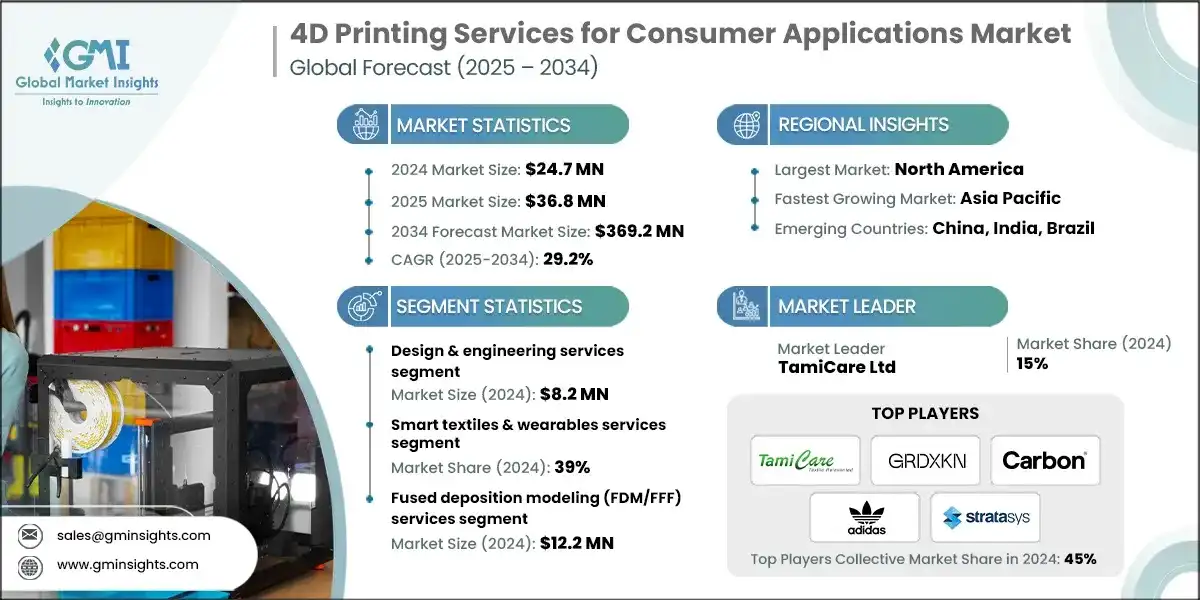
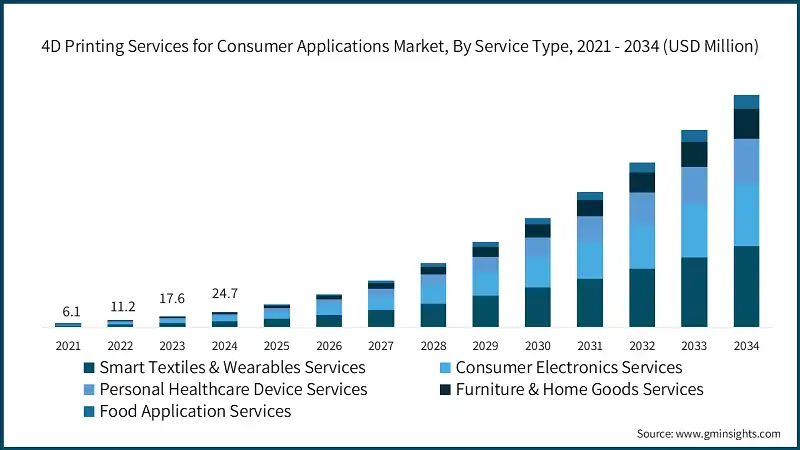
The 4D printing services for consumer applications market was estimated at USD 24.7 million in 2024. The market is expected to grow from USD 36.8 million in 2025 to USD 369.2 million in 2034, at a CAGR of 29.2% according to latest report published by Global Market Insights Inc.
4D Printing Services for Consumer Applications Market Key Takeaways
Market Size & Growth
- 2024 Market Size: USD 24.7 Million
- 2025 Market Size: USD 36.8 Million
- 2034 Forecast Market Size: USD 369.2 Million
- CAGR (2025–2034): 29.2%
Key Market Drivers
- Customization and smart adaptability of consumer products.
- Advancements in smart materials and printing technologies.
- Growing demand for sustainable and functional design.
Challenges
- High production costs and limited scalability.
- Lack of standardization and regulatory frameworks.
Opportunity
- Integration into wearable technology and smart textiles.
- Expansion into home automation and smart furniture.
Key Players
- Market Leader: TamiCare Ltd led with over 15% market share in 2024.
- Leading Players: Top 5 players in this market include TamiCare Ltd, GRDXKN, Carbon Inc., Adidas Innovation Lab, Stratasys Ltd., which collectively held a market share of 45% in 2024.
Get Market Insights & Growth Opportunities
The market for consumer applications in 4D printing services has potential for further development based on demand for adaptive products. 4D printing utilizes adaptive materials and is not 3D printing. 4D printing leverages material items that transform shapes and functions based on environmental triggers such as heat, light, and moisture. 4D printing technology is geared toward creating a range of consumer applications such as adaptive footwear, climate responsive clothing, and auto-assembly furniture.
Research entities, startups and technology companies are currently exploring the application of transforming materials into consumer products aimed at convenience, personalization, and sustainability. Technology is still in development; however, prototypes are appearing in the fashion, home, and wearable heel market. The marketplace is comprised of innovative labs, research institutions, and niche service providers, and interest in the consumer marketplace is being enhanced with participants emerging in key industries.
While we are dependent upon technology to drive product development today for potential industry transformation, we have moved past issues of cost, scaling, and material constraints, and are focused on implementation and enhancement. A consumer interest in dynamic products will allow further development of 4D printing in consumer markets to transform the interfaces to the products. The market will transition to development and refinement of applications in the consumer.
To get key market trends
4D Printing Services for Consumer Applications Market Trends
The market is in constant evolution, and they are mainly driven by new technologies and evolving user needs.
- 4D printing allows clothing and wearable devices to alter their shape, size, or properties dynamically. These garments adapt according to the environment—in reaction to temperature, moisture, or body to provide the user with an increased level of comfort and functionality.
- 4D printing with consumer goods is based on the use of shape-memory polymers and hydrogels as smart materials. It allows a product to react to external stimuli such as heat, light, and water, and provides the ability for products to change or self-assemble properties to create a dynamic product.
- By using 4D printing in sustainable fashion, it reduces fabric waste by producing garments in a flat state instead of being cut in the shape of the garment. Additionally, many of these products possess a self-healing quality, increasing their durability.
- Technology will allow customizable and functional consumer goods, producing items that respond to their user’s needs and preferences over time, allowing for increased usability and responsiveness to the user’s context and requirements.
- The future direction of 4D printing (with consumer goods) will involve integrating Artificial Intelligence (AI) and the Internet of Things (IoT). The introduction of these technologies will create products with a higher level of responsiveness and adaptive capabilities within the consumer environment.
4D Printing Services for Consumer Applications Market Analysis
Learn more about the key segments shaping this market
Based on service type, the market is divided into design & engineering services, contract manufacturing services, material development services, software & digital services, regulatory compliance consulting and maintenance & support services. In 2024, design & engineering services held the major market share, generating a revenue of USD 8.2 million.
- Design and engineering services stem from project engagements, and as such it is important for service providers to continue to develop expertise in the understanding of materials science, mechanics of transformation, and application-specific requirements. The services segment is increasing as organizations explore the capabilities of 4D printing.
- Contract manufacturing services represent a significant potential growth segment, indicating that the market is beginning to mature towards production scale services. This segment offers complete manufacturing services on a scale, as well as quality assurance systems, supply chain systems and logistics for shipping commercially 4D printed products. This segment represents significant investments in printing systems, quality systems, and a skilled manufacturing workforce. Based on trends observed, manufacturing scale services are expected to represent a substantial market segment that shifts competitive landscapes to service providers that can offer manufacturing.
Learn more about the key segments shaping this market
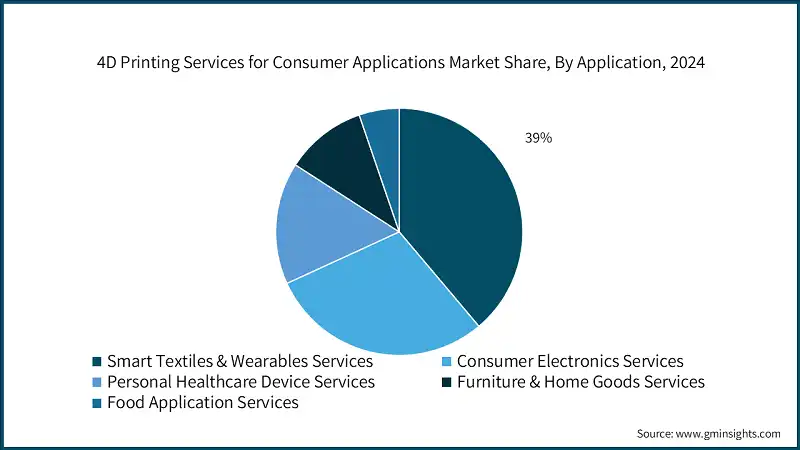
Based on application, the 4D printing services for consumer applications market is segmented into smart textiles & wearables services, consumer electronics services, personal healthcare device services, furniture & home goods services, and food application services. The smart textiles & wearables services segment held the largest share, accounting for 39% of the global market in 2024.
- Smart textiles and wearables comprise a significant portion of consumer applications utilizing 4D printing capabilities to deliver adaptive textiles that respond to environmental conditions as well as to user-specific needs. This category consists of athletic apparel, fashion, medical textiles, and smart clothing with performance indicators embedded. Top-of-the-line sportswear brands have demonstrated commercial feasibility by capitalizing on athletic performance combined with 4D printing.
- The consumer electronics segment offers substantial growth driven by demand for complex, lightweight parts that can be adapted post-manufacturing. This is in applications like phone parts, wearables, home automation, and adaptive user interfaces. This segment focuses on industry trends toward miniaturization and integration of functionalities.
- The market for personal health device services shows good potential for growth as the trend towards personalized medicine matures. The market includes individualized implants, responsive prosthetics/conductive fabrics, drug delivery, and diagnostics that actively respond to physiological conditions. All of which will benefit from increased emphasis in healthcare applications to expand personalized or patient-specific devices.
Based on the technology, the 4D printing services for consumer applications market is segmented into fused deposition modeling (FDM/FFF) services, stereolithography (SLA/DLP) services, direct ink writing (DIW) services, and hybrid multi-technology services. In 2024, fused deposition modeling (FDM/FFF) services held a major market share, generating a revenue of USD 12.2 million.
- With FDM/FFF services dominating the 4D printing space, this category is the most ubiquitous means for innovative applications. Though FDM/FFF offers economical production capabilities, it lays forth a versatile platform for shaping materials and enables supply chains already established to support its use and commercialized application.
- FDM/FFF's ability to work with shape memory polymers and smart materials allows for use across different consumer products that require reliability and repeatability.
- SLA/DLP services also significantly take up the market and present an opportunity for high-precision printing in complex geometries and biomedical applications. SLA/DLP can deliver high resolution printing, suitable for small, detailed components in consumer electronics, medical devices and precision mechanisms.
- SLA/DLP technology does require specialized expertise in the chemistry of photopolymers, optimizing light exposure, and post-processing methods. Service providers tend to keep advanced equipment, as well as knowledge and experience in material handling and quality control, to keep production services to properly photopolymerize the material, therefore making the prices premium.
Looking for region specific data?
North America 4D Printing Services for Consumer Applications Market
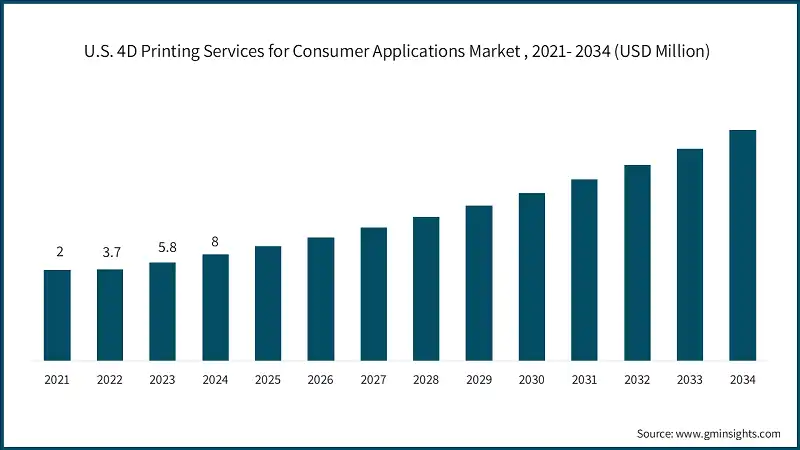
In 2024, the U.S. dominated the North America market, accounting for around 84% and generating around USD 8 million revenue in the same year.
- North America has a substantial share of the global market and is experiencing significant growth because of the population's investment into research and development, universities, and the government's backing.
- The region utilizes NASA's Technology Transfer Program to access SMA technologies that have been validated, while government policy provides support to enhance technology commercialization. The position within the stated market demonstrates the region has advanced capabilities, strong intellectual property protection, and market readiness for new technologies.
- The innovative ecosystem of the region includes collaborations between research institutions, technology companies and regulatory frameworks. Organizations such as Carbon Inc., Stratasys Ltd. and NASA are recognized contributors to technological advancement and partnerships to validate research. The already established infrastructures of venture capital which supports startup growth and technology commercialization are also a contributor to regionally expanded markets.
- The growth of the region is sustained through investment in manufacturing capabilities, government backing of emerging technologies, and consumer marketplaces. The regional market is grounded within a strong technological economy of educated consumers that make advancements in 4D printing a viable application for consumers adopted by trends.
Europe 4D Printing Services for Consumer Applications Market
Europe market, Germany leads the market 27.1% share in 2024 and is expected to grow at 29.4% during the forecast period.
- The European market is thriving, aided by cooperative research programs, technology sharing across borders, and regulatory support for innovation. The region's push towards sustainability and circular economic principles opens further opportunities for sustainability-focused service providers.
- Market development is driven by investments in Industry 4.0 initiatives, sustainable manufacturing, and new research on advanced materials.
Asia Pacific 4D Printing Services for Consumer Applications Market
The Asia Pacific leads the 4D printing services for consumer applications industry. China holds a market share of around 44.1% in 2024 and is anticipated to grow with a CAGR of around 31.1% from 2025 to 2034.
- Market growth has been strong in the Asia Pacific region due to benefits from lower cost manufacturing for producing and adopting newer technology and growing consumer markets for those products. Asia Pacific has leveraged the combination of its manufacturing base, skilled labor and supportive government to harness the benefits of adopting advanced manufacturing technologies.
- India and China will continue to offer the greatest potential for significant market growth with large consumer markets and industrial manufacturing capacity soon.
- The region is experiencing challenges due to high upfront costs that are limiting adoption and limited skilled workforce. However, continued investment in education and training programs shows that the skills gap will largely resolve throughout the forecast period, thereby maintaining the growth forecast.
4D Printing Services for Consumer Applications Market Share
TamiCare Ltd. is leading with 12% market share. TamiCare Ltd., GRDXKN, Carbon Inc., Adidas Innovation Lab, and Stratasys Ltd. collectively hold around 45%, indicating moderately fragmented market concentration. These prominent players are proactively involved in strategic endeavors, such as mergers & acquisitions, facility expansions & collaborations, to expand their product portfolios, extend their reach to a broad customer base, and strengthen their market position.
- TamiCare Ltd. is an industry leader, demonstrating full manufacturing capability within the sector of smart textile applications. The company possesses proprietary unique formulations for the base materials and individual printing technology and has application expertise in the sportswear and medical textile category, with supporting evidence of achieving successful commercial outcomes. Their platform is designed specifically for the combination of multiple leg services for the purpose of charging premium pricing and to enhance the base of the service offering.
- GRDXKN is also focused on advanced material development, along with precision manufacturing of applications needing complex geometry. The company is strong in technical capability, proprietary materials and complexity in the medical devices and consumer electronics markets, supported by research partnership development and patent protection.
- Carbon, Inc. is developing an integrated platform that combines hardware, software and materials. Their integrated platform as a comprehensive 4D printing capability combines design software optimizations with process controls. The company is moving forward with platform development as described both with the design company expertise and to develop manufacturing process automations.
4D Printing Services for Consumer Applications Market Companies
Major players operating in the 4D printing services for consumer applications industry are:
- Stratasys Ltd.
- Carbon, Inc.
- HP Inc.
- Formlabs Inc.
- GRDXKN
- Mitsubishi Chemical Corporation
- Adidas AG - Innovation Lab
- Nervous System Inc.
- Self-Assembly Lab (MIT)
- TamiCare Ltd.
Adidas Innovation Lab designs commercial 4D printing applications and has recently introduced products such as the 4DFWD sneaker. The company arguably demonstrates the advantage of excellence in synchronous dynamics related to athletic performance and brand recognition while they leverage an evolving and advanced technology communicating and transitioning to traditional manufacturing for fulfillment of mass consumption of products.
Stratasys Ltd. has enabled an application of their 3D printing expertise for 4D applications through established relationships with existing customers, while often being engaged with active processes of manufacturing. The company is investing in new 4D technology while keeping a partnering role with material suppliers and technology companies.
4D Printing Services for Consumer Applications Market Report Attributes
| Key Takeaway | Details |
|---|---|
| Market Size & Growth | |
| Base Year | 2024 |
| Market Size in 2024 | USD 24.7 Million |
| Market Size in 2025 | USD 36.8 Million |
| Forecast Period 2025 - 2034 CAGR | 29.2% |
| Market Size in 2034 | USD 369.2 Million |
| Key Market Trends | |
| Drivers | Impact |
| Customization and smart adaptability of consumer products | 4D printing can take objects and change their shape or function in relation to their environment (temperature, moisture, etc.) over a defined period, creating an extremely tailored and adaptive experience for the consumer. |
| Advancements in smart materials and printing technologies | Recent advances in shape-memory polymers, hydrogels, and multi-material 3D printing continue to develop the feasibility and performance of 4D printed consumer products, ranging from wearables to home appliances. |
| Growing demand for sustainable and functional design | 4D printing can support sustainability and a longer product lifecycle with waste reduction, self-repair, and transformation of product functionality or design. The market for consumer products is moving toward eco-friendly and multifunctional products. |
| Pitfalls & Challenges | Impact |
| High production costs and limited scalability | The cost of using smart materials and the difficulty with the 4D printing process will limit large scale mass production in price-sensitive consumer markets. |
| Lack of standardization and regulatory frameworks | The obstacle to wide adoption and consumer acceptance of 4D printing processes is that standards for material, reliability, and performance of 4D printed products has not yet established. |
| Opportunities: | Impact |
| Integration into wearable technology and smart textiles | 4D printing can impact the athletic and leisure lifestyles of consumers by creating clothing or accessories that modify based on bodys temperature, movement, or environmental conditions, to enhance comfort for the wearer and develop a multi-functional outerwear garment. |
| Expansion into home automation and smart furniture | The 4D printing process affords new levels of possibility in furniture or household items that can morph or self-assemble, creating options for multi-functional, responsive living space with living space continuity. |
| Market Leaders (2024) | |
| Market Leaders |
15% market share |
| Top Players |
Collective market share in 2024 is 45% |
| Competitive Edge |
|
| Regional Insights | |
| Largest Market | North America |
| Fastest Growing Market | Asia Pacific |
| Emerging Country | China, India, Brazil |
| Future Outlook |
|
What are the growth opportunities in this market?
4D Printing Services for Consumer Applications Industry News
- In January 2025, 4D Fusion debuted the very first commercial 4D printer, targeted to both consumers and industrial applications, making it one of the first movers into commercial 4D printing technology.
- In July 2024, 4D Medicine raised £3.4 million in Series A financing for its 4Degra® biomaterial platform focused on resorbable medical devices. The financing will help the firm with preclinical testing and, once complete, will pursue FDA clearances for the US medical device market.
- In May 2024, researchers at the Southern University of Science and Technology developed MRC-SMP materials for reconfigurable 4D printing with better mechanical properties. The development improves dynamic-covalent shape memory polymers and opens application opportunities for use in reconfigurable actuators and modular assemblies.
The 4D printing services for consumer applications market research report includes in-depth coverage of the industry with estimates & forecasts in terms of revenue (USD Million) from 2021 to 2034, for the following segments:
Market, By Service Type
- Design & engineering services
- Contract manufacturing services
- Material development services
- Software & digital services
- Regulatory compliance consulting
- Maintenance & support services
Market, By Technology
- Fused deposition modeling (FDM/FFF) services
- Stereolithography (SLA/DLP) services
- Direct ink writing (DIW) services
- Hybrid multi-technology services
Market, By Application
- Smart textiles & wearables services
- Food application services
- Consumer electronics services
- Furniture & home goods services
- Personal healthcare device services
Market, By Service Model
- On-demand services
- Subscription-based services
- Project-based services
- Managed services
The above information is provided for the following regions and countries:
- North America
- U.S.
- Canada
- Europe
- Germany
- UK
- France
- Italy
- Spain
- Asia Pacific
- China
- India
- Japan
- Australia
- South Korea
- Latin America
- Brazil
- Mexico
- Argentina
- Middle East and Africa
- South Africa
- Saudi Arabia
- UAE
Frequently Asked Question(FAQ) :
What is the market size of the global 4D printing services for consumer applications market in 2024?
The market size was USD 24.7 million in 2024, driven by increasing demand for adaptive, smart consumer products and advancements in material science enabling shape-memory and self-transforming functionalities.
What is the projected market value of the global 4D printing services for consumer applications industry by 2034?
The market is expected to reach USD 369.2 million by 2034, growing at a CAGR of 29.2%, fueled by innovation in smart materials, growing investment in R&D, and rising consumer interest in customizable and sustainable product designs.
What is the estimated market size of the global 4D printing services for consumer applications industry in 2025?
The market is projected to reach USD 36.8 million in 2025, supported by expanding commercial adoption of 4D printing in fashion, wearable devices, and smart home products.
Which service type segment dominated the 4D printing services for consumer applications market in 2024?
The design and engineering services segment held the largest share, generating USD 8.2 million in 2024, as companies focus on developing material science expertise and application-specific customization.
Which application segment generated the highest revenue in 2024?
The smart textiles and wearables services segment dominated with a 39% share in 2024, driven by the development of adaptive apparel, self-healing fabrics, and performance-enhancing athletic gear.
Which technology segment held the largest share in the 4D printing services for consumer applications market in 2024?
The fused deposition modeling (FDM/FFF) services segment led the market with USD 12.2 million revenue in 2024, owing to its affordability, versatility, and compatibility with shape-memory polymers and smart materials.
Which region leads the global 4D printing services for consumer applications industry?
North America dominated the market in 2024, accounting for around USD 8 million (84% U.S. share), supported by strong R&D infrastructure, NASA’s technology transfer initiatives, and active participation by companies such as Carbon Inc. and Stratasys Ltd.
Who are the key players in the global 4D printing services for consumer applications market?
Key players include Stratasys Ltd., Carbon Inc., HP Inc., Formlabs Inc., GRDXKN, Mitsubishi Chemical Corporation, Adidas AG (Innovation Lab), Nervous System Inc., Self-Assembly Lab (MIT), and TamiCare Ltd.
4D Printing Services for Consumer Applications Market Scope
Related Reports