
The Global AI Race: How Countries Are Competing in 2025
Published Date: September 19, 2025
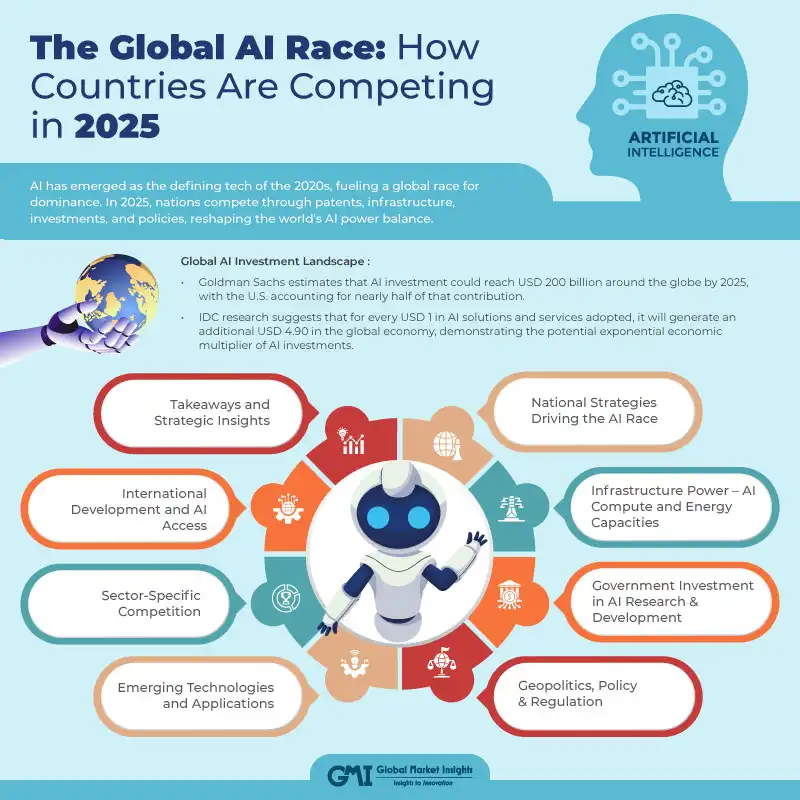
Artificial intelligence has become the defining technology of the 2020s, setting the stage for a global race among countries vying for technological supremacy. From AI patents and infrastructure to strategic investments and geopolitical maneuvers, the landscape in 2025 reflects intense competition across continents. This blog dives into the AI race, spotlighting countries' strategies, technology deployments, policy moves, and how the world's AI power balances are shifting.
1. Global AI Investment Landscape
The Fundraising Surge has been Unstoppable:
•Goldman Sachs estimates that AI investment could reach USD 200 billion around the globe by 2025, with the U.S. accounting for nearly half of that contribution.
•IDC research suggests that for every USD 1 in AI solutions and services adopted, it will generate an additional USD 4.90 in the global economy, demonstrating the potential exponential economic multiplier of AI investments.
Venture Capital Bang:
• Global venture capital invested in generative AI was $49.2 billion during the first half of this year, well over the investment for the entire year of 2024 ($44.2 billion) and more than twice the $21.3 billion experienced in 2023, according to EY Ireland's most recent Generative AI Key Deals and Market Insights report.
• McKinsey analysis estimates the long-term opportunity for AI at $4.4 trillion in potential for added productivity growth, and this explains why countries are competing aggressively to embrace this revolutionary technology.
Global IT Spending Context:
Gartner predicts global IT expenditures of more than $5.7 trillion will be driven by a range of factors, including AI infrastructure, inflation, and the refresh of devices from the COVID era, and AI expenditures are a big chunk of this colossal spending.
Country-Level Figures: Based on the Stanford AI Index, 2025:
|
Country |
Private AI Investment (2013–2024) |
|---|---|
|
United States |
USD 470.9 billion |
|
China |
USD 119.3 billion |
|
United Kingdom |
USD 28.2 billion |
|
Germany |
USD 11.3 billion |
|
India |
USD 11.1 billion |
These massive amounts are being spent across different sectors, with enterprise generative AI solutions being very high on the priority list for Fortune 500 companies looking for a competitive edge by leveraging high-end automation and intelligence features found in generative AI. In July 2025, AWS announced an additional $100 million investment in its Generative AI Innovation Center to help customers pursue the next generation of AI innovation.
2. National Strategies Driving the AI Race
China
• WIPO reported, from a study in 2014-2023, that Chinese inventors produced 38,210 generative AI related inventions--six times the total produced by U.S. inventors, who developed 6,276 inventions.
• In April 2025, the nation announced the establishment of a state-supported fund worth 60 billion yuan (about US$8.2 billion) to finance early-stage investment in artificial intelligence ventures.
•The "New Generation AI Development Plan" contains plans to take the lead by 2030. Under this plan, Beijing has set a lofty goal to establish a core AI industry worth RMB 300 billion (some USD 42.37 billion) in size by 2025 and be the world's leading AI innovation hub by 2030.
OECD statistics reveal R&D expenditure growth decelerating in OECD nations while accelerating in China, signaling China's proactive dedication to technological progress. China's strategy prioritizes AI in manufacturing uses, using its industrial foundation to embed smart systems throughout production lines and supply chains.
United States
• Number of AI patents hit 8,609 in 2024. (WIPO)
• AI infrastructure shield through initiatives such as Stargate LLC—a consortium established by OpenAI, SoftBank, Oracle, and investment company MGX that will see it invest up to US$500 billion in AI infrastructure in the United States by 2029.
• The new ATOM (American Truly Open Models) Project, the AI embedded within wwt.com, provides employees, clients, and partners with insights and assistance. The generative AI digital assistant is designed to improve productivity, optimize internal processes, and facilitate innovation by providing up-to-date, accurate information in real-time.
McKinsey analysis finds that capacity requirements for non-AI and AI workloads may nearly triple by 2030, with AI capacity rising 3.5-fold and accounting for about 70 percent of the total, indicating the enormous infrastructure requirements fueling U.S. investments.
The U.S. dominates AI chipset design and deployment, with NVIDIA, AMD, and Intel pushing hardware advancements that fuel global AI infrastructure. Furthermore, AI as a Service offerings from large cloud vendors are creating American supremacy in AI access.
European Union & UK
European Patent Office's Patent Index 2023 states that over 2,000 European patents exclusively for artificial neural networks exist.
•In February 2025, the EU launched InvestAI, a plan to mobilize €200 billion in AI investment, including the establishment of a new €20 billion European fund focused on AI gigafactories.
•UK government estimates place the country as the world's third-largest AI market after the US and China. With a worth of $92 billion (£72.3 billion) in 2024, the UK AI sector is higher than that of any other European country.
By 2025, 39% of global organizations are expected to be in the experimentation stage of Gartner’s AI adoption curve, while 14% will have reached the expansion stage, with European companies leading in governance frameworks and the development of ethical AI.
Europe is leading in AI governance models and ethical AI development, making it a frontrunner in the responsible deployment of AI, with the UK heavily investing in AI in BFSI implementations to ensure London's dominance in financial services.
Japan
• Remains robust with more than 1500 AI patents in 2024, addressing industrial AI and healthcare domains (WIPO)
• ABC 3.0, Japan's cutting-edge public supercomputer for AI research and development, started full-scale operations in January 2025. Installed at the National Institute of Advanced Industrial Science and Technology (AIST), the project was funded by the government with about 36 billion yen ($232 million). The system is installed with a huge number of GPUs, high-end semiconductors optimized to speed up AI computations.
Japan's approach is on AI in automotive uses, building on its leadership in the automotive sector to create autonomous driving and intelligent mobility solutions. This mirrors worldwide trends as automotive AI use sees quick growth.
Canada & India
Canada:
The Canadian Sovereign AI Compute Strategy
•Budget 2024 committed $2 billion over five years, starting 2024–25, to bring new initiatives to help Canadian researchers and AI firms have access to the tools required to stay competitive in the world.
•The government is investing a maximum of $700 million to enhance the Canadian AI ecosystem by developing domestic AI computing capacity, tapping into the natural strengths of the country in energy, land, and climate.
India:
• India received ?11,943 crore (US$1.4 billion) in private AI investments during 2023, ranking 10th globally, according to a UN report. It is among just two developing nations, besides China, that have been able to secure significant AI funding.
India's strategy focuses on AI in telecommunication and AI in agriculture, tackling top national priorities and establishing technological capabilities for rural development and connectivity growth.
Middle East (UAE, Saudi Arabia, GCC)
•PwC estimates AI would add USD 320 billion to regional economies by 2030
•UAE targeting around 14% of GDP (~USD 100 billion) from AI by 2030, supported by a USD 30 billion AI infrastructure joint venture (BlackRock, Microsoft, Abu Dhabi)
•Saudi Arabia is looking to achieve ~12% of GDP by 2030, driven by NEOM and SDAIA initiatives
The Gulf nations are heavily investing in AI in asset management to diversify their economies beyond oil and set themselves up as global financial and technology centers.
3. Infrastructure Power – AI Compute and Energy Capacities
• The U.S. takes the lead at 39.7M H100 equivalents and 19.8 GW power capacity
• UAE is second for compute power (23.1M), with Saudi Arabia following (7.2M), South Korea (5.1M), France (2.4M), India (1.2M today), and China comes in last at 0.4M due to limited power Other tidbits are:
• Germany's Jupiter supercomputer became the fastest and most energy-efficient exascale machine in Europe in mid-2025
• Finland's LUMI supercomputer, powered purely from hydroelectricity, is now at the forefront of green, high-performance computing
• OpenAI's expansion of the Stargate project to Europe, with a Norwegian AI facility containing 100,000 GPUs fueled by hydropower is a strategic infrastructure initiative
The infrastructure race is fueling the demand for edge AI solutions that execute data processing closer to users, lowering latency and enhancing performance for real-time use cases. Deep learning workloads demand enormous computational resources, and as such, infrastructure capacity becomes a key competitive advantage.
4. Government Investment in AI Research & Development
OECD evaluation of government expenditure shows enormous investments in AI-related research and development projects by 13 big funds worldwide, indicating deliberate government interest in AI research. The OECD's extended monitoring illustrates how countries are cautiously investing in critical AI research.
AI Adoption Timeline: 24% of worldwide organizations will be at the planning phase of AI adoption by 2027 and will have begun implementing 21% of all AI applications, reflecting the speeding up rate of AI adoption by industries and nations.
Economic Effect on Employment: IMF estimates show AI will impact nearly 40 percent of employment globally, substituting some and augmenting others, with developing countries possibly facing varying effects, as 80 percent of the world's workforce is based in these countries.
5. Geopolitics, Policy & Regulation
During the 2025 AI Action Summit in Paris, the EU launched InvestAI, commanding support from private and public sectors—financial commitments alone reached close to €110 billion.
Trade tensions, however, are still red-hot. In changing U.S.–China dynamics, OpenAI's efforts to Europe can also be viewed as a diversification strategy.
Cyber governance and AI ethics—with initiatives such as the UK AI Safety Institute and EU regulatory drive—are becoming strategic means, rather than purely technical ones. Emphasis on multimodal AI capabilities is redefining the way countries approach the development of AI, integrating text, image, and voice processing for deeper applications.
Supply Chain Intelligence: In 2025, 50% of supply chain companies will be investing in applications that enable AI and advanced analytics abilities, as AI-fortified supply chains are more than 67% more efficient, showing how countries are using AI to gain strategic economic benefits.
6. Emerging Technologies and Applications
The race to AI has moved from infrastructure to niche applications. AI Training datasets have emerged as strategic resources with nations investing in high-quality, local data to train models that comprehend local languages, customs, and business practices.
Small language models are picking up steam as countries pursue cost-effective AI solutions that can execute locally without dependency on cloud services in other countries. This shift complements digital sovereignty efforts as it brings down costs.
AIOps Market Growth: The size of the global AIOps market was worth USD 5.3 billion in 2024 and is expected to reach USD 44.1 billion by 2034, with the largest adopters being IT/technology departments. AIOps solutions are becoming increasingly vital to handle the sophisticated AI infrastructure supporting national AI strategies. (Global Market Insights Inc.)
7. Sector-Specific Competition
Specialized AI applications across sectors are being competed for by countries:
•Financial Services: BFSI AI applications are transforming banking and insurance
•Legal Technology: Legal AI platforms are revolutionizing judicial procedures and regulatory compliance
•Professional Services: AI for accounting is automating complex financial procedures
High-Performing Organizations: McKinsey research indicates that AI high performers are over five times more likely to invest over 20 percent of their digital budgets on AI, reflecting how top countries and organizations are placing their bets on AI investments.
8. International Development and AI Access
Global Development Impact: Both the World Bank and international institutions have a growing interest in making sure that AI gains are accrued to developing countries. The World Bank's recent analysis suggests that AI is changing development in developing countries, with tailored personalized education, sophisticated health diagnostics, and demonstrating the global development potential of technology.
Through its Impact AI initiative, the World Bank is demonstrating how global institutions are using it in becoming able to synthesize policy research and support decision-making in development settings, as well as ensuring that the global race to use AI considers substantial inclusion in growth.
9. Takeaways and Strategic Insights
•Hardware follows the footprint soon enough. Compute infrastructure (GPU clusters, data centers, supercomputers) plays a larger role in determining AI leadership.
•U.S. & China remains on top, yet Europe, India, and the Gulf are investing seriously in regional autonomy.
•Open source is the soft power frontier. The ATOM project highlights new strategic interest in open AI models.
•Energy access and sustainability are important. The areas with low-cost renewable power (Nordics, Middle East) are capturing the AI infrastructure advantage.
•Investments are only one aspect. Policy, talent, and ecosystem maturity determine how much infrastructure is converted into capability.
The competition also fuels hyper automation solution innovation, where nations integrate AI with robotic process automation to secure unmatched efficiency benefits in government and industry operations.
Economic Multiplier Effect: IDC analysis of a $4.90 economic return for each $1 of AI investment illustrates why governments are making AI investment a strategic rather than discretionary expenditure.
Conclusion & Key Takeaways
The 2025 global AI race is redesigning national approaches—from China's extended infrastructure and European AI gigafactories to India's compute growth and the Gulf's investment bubble. The winners will be those with the compute power, policy systems, ethics framework, and sustainable ecosystems.
Data-driven transformation: With AI workloads forecasted to represent about 70% of total data center capacity by 2030, countries must strategically plan their infrastructure for both current needs and what is required in the future.
Acceleration of adoption: With 39% of companies entering a phase of AI experimentation, and 14% deploying at scale by 2025, each country will be in competition over how quickly they can move from experimentation to scalable deployment.
Growth opportunity defines the competition beyond computing capacity to include necessary applied expertise, ethical frameworks, and sustainable development goals. Countries that can embed AI fluidly across all sectors in the economy and control their technological direction will be the drivers of the next chapter of global economic growth.
Global impact: The McKinsey insight on the $4.4 trillion growth opportunity on productivity illustrates that this isn't a technology race, but a struggle for global leadership with opportunity to shape the next chapter of human advancement.


