Market Size by Product, Application, End Use & Global Forecast.
Report ID: GMI7515
|
Published Date: April 2026
|
Report Format: PDF
Download Free PDF
Wound Care Market Size
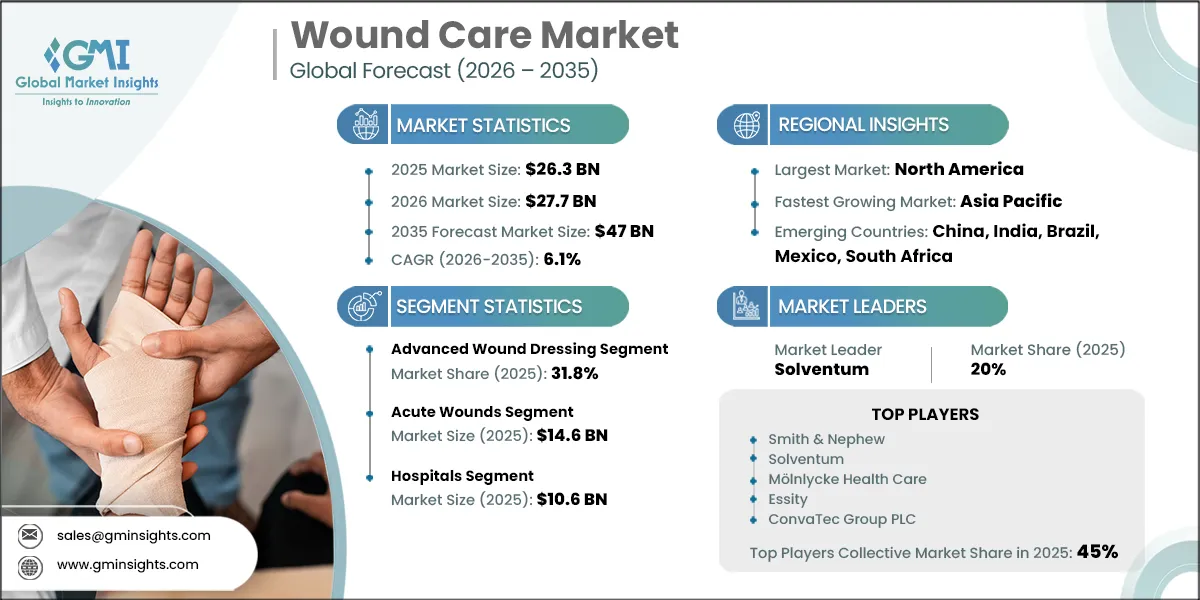
The wound care market size was valued at USD 26.3 billion in 2025 and is expected to reach USD 47 billion in 2035, growing at a CAGR of 6.1% from 2026 to 2035, according to the latest report published by Global Market Insights Inc. This steady growth is stimulated by various factors such as increasing number of surgical procedures, rising demand for wound care products, rising prevalence of diabetes, growing technological advancements in wound care products, and rise in number of trauma cases.
The rising prevalence of diabetes is a crucial factor driving market growth. For instance, according to the International Diabetes Federation Atlas, there will be a substantial increase in the diabetic population, from 463 million in 2019 to 578 million by 2030, and an estimated 700 million by 2045. This underscores the growing demand for effective wound care products, such as advanced wound dressings, foam dressings, and hydrogel dressings, driven by the increasing prevalence of diabetes-related complications.
Furthermore, the rise in trauma cases is a significant driver for the wound care market. Accidents, road traffic injuries, falls, burns, and violence-related incidents are increasing globally due to urbanization, industrialization, and rising vehicular density. Trauma cases often result in acute, complex, and contaminated wounds that require immediate and intensive wound management, including advanced dressings, hemostatic agents, antimicrobial solutions, and surgical wound care products. The growing burden of trauma places sustained demand on emergency departments, trauma centers, and post-acute care facilities, leading to high and repeat consumption of wound care consumables.
Wound care includes dressing products that are used in contact with the wound site to encourage healing and prevent further complications. Various types of wound dressings are used depending on the type of wound.
Wound Care MarketTrends
The increasing demand for wound care solutions across surgical treatments is evident globally. This trend has become a key driver for the growth of wound care products as medical interventions continue to advance and become more accessible. For instance, according to the American Academy of Orthopaedic Surgeons (AAOS), due to the growing demand for surgeries, orthopedic surgeons in the U.S. will need to either double their total joint arthroplasty (TJA) caseload or increase the number of surgeons by 10% every five years to meet the rising demand by 2050.
The rise in emergency surgeries and elective procedures, such as those required for trauma cases, accidents, and acute medical conditions, has created a significant need for immediate surgical interventions, cosmetic surgeries, and other procedures. This demand is contributing substantially to the overall increase in surgical interventions and driving the adoption of advanced wound care products.
Furthermore, the emergence of 3D bioprinting technology has accelerated the adoption of skin grafts and scaffolds to improve the healing process for chronic wounds, burns, and diabetic ulcers. This process, known as the fabrication of functional skin tissues, involves depositing bioinks containing cells, biomaterials, and growth factors in successive layers.
The development of biopolymers such as polycaprolactone, poly(lactic-co-glycolic acid), and hydrogel materials has significantly increased their demand. Additionally, there is a global rise in the use of bioinks made from living cells and biomaterials, including collagen, gelatin, fibrin, chitosan, alginate, and other growth factors.
Wound Care Market Analysis
Based on products, the wound care market is segmented as advanced wound dressing, surgical wound care, traditional wound care, wound therapy devices, and wound care biologics. Further, advanced wound care segment is segmented into foam dressings, hydrocolloid dressings, film dressings, alginate dressings, hydrogel dressings, collagen dressings, and other advanced dressings. The advanced wound dressing segment was valued at USD 8.3 billion in 2025.
Advanced wound dressings maintain an effective moisture balance, promoting faster tissue repair and reducing the risk of scab formation, which can delay the healing process.
These dressings help create an optimal moist wound environment, which has been proven to accelerate healing, promote tissue regeneration, and reduce scab formation. Many advanced dressings, such as foam, hydrocolloid, alginate, hydrogel, antimicrobial, and bioactive dressings, are designed to manage exudate effectively, preventing wound maceration while keeping the wound adequately hydrated.
Additionally, advanced wound dressings support specialized wound management, including diabetic foot ulcers, pressure ulcers, venous leg ulcers, burns, surgical wounds, and traumatic injuries. Their ease of use makes them suitable for hospital, outpatient, and home-care settings, contributing to lower overall treatment costs by reducing hospital stays and preventing wound deterioration.
Based on application, the wound care market is bifurcated into chronic wounds and acute wounds. Further, the acute wounds is segmented into surgical wounds, traumatic wounds, and burns. The acute wounds segment accounted for USD 14.6 billion in 2025.
Wound care products such as foam dressings, hydrogel dressings, and film dressings are extensively used to provide immediate protection to acute wounds and reduce the risk of infection.
Additionally, the adoption of advanced wound dressing products, such as silicone-based or hydrogel dressings, which help reduce pain and irritation during dressing changes, is increasing during the treatment of acute wounds. This trend is further contributing to the growth of the segment.
Advanced wound care solutions also provide effective exudate management, prevent wound maceration, and keep the wound adequately hydrated. This is particularly important for acute wounds that produce high levels of fluid during the inflammatory phase.
Moreover, acute wounds vary in size and type, ranging from small cuts to surgical incisions or minor burns. Wound care products are highly versatile and can be adapted to treat various kinds of acute wounds.
Based on end use, the wound care market is bifurcated into hospitals, specialty clinics, home care settings, and other end users. The hospitals segment accounted for USD 10.6 billion in 2025.
Hospitals play a critical role in wound care by delivering comprehensive, timely, and clinically advanced treatment for both acute and complex cases. A key advantage is their access to multidisciplinary clinical expertise, including surgeons, wound care specialists, nurses, infectious disease experts, and diabetologists, enabling accurate diagnosis, coordinated care, and individualized treatment plans.
Wound care products are easily available and can be stocked in large quantities in hospitals. Additionally, hospitals ensure constant care for patients, even during emergencies or periods of high patient inflow, by maintaining adequate supplies of these essential products.
In emergency cases, where time and speed are crucial, advanced wound care products offer quick and effective solutions for treating wounds.
Furthermore, hospitals extensively use antimicrobial dressings and other infection control products to minimize the risk of wound infections, thereby improving patient safety.
North America Wound Care Market
The North America region accounted for 31.6% of the global wound care market in 2025. The wound care market in North America is experiencing robust expansion, driven by the region’s advanced healthcare infrastructure and technological advancements.
The U.S. market size reached USD 7.5 billion in 2025, growing from USD 7.1 billion in 2024.
In the U.S., chronic wounds affect an estimated 6.5 million people annually, costing between USD 28.1 to 96.8 billion, as reported by the American Academy of Home Care Medicine. This translates to roughly 1 in every 38 adults. Consequently, there is a growing demand for effective wound care products in the U.S.
The U.S. has one of the most advanced healthcare infrastructures globally, featuring a robust network of hospitals, clinics, and specialized care centers.
The aging population and the rising prevalence of diabetes in the U.S. are contributing to an increase in both chronic and acute wounds. For instance, the Centers for Disease Control and Prevention reports that approximately 11.6% of the U.S. population has diabetes. This trend highlights the increasing demand for wound care solutions in the country.
Europe Wound Care Market
Europe, wound care accounted for USD 7.7 billion in 2025 and is anticipated to show lucrative growth over the forecast period.
In Europe, the rising prevalence of diabetes, an aging population, and the increase in chronic diseases have significantly boosted the demand for wound care solutions. The growing number of patients with diabetic foot ulcers, pressure ulcers, venous leg ulcers, and post-surgical wounds has made effective wound care management essential within Europe’s healthcare systems, driving sustained demand for advanced wound dressings and chronic wound care therapies.
Technological advancements have played a crucial role in accelerating the growth of the European wound care market. Innovations such as antimicrobial and bioactive dressings, negative pressure wound therapy (NPWT), smart wound monitoring, and digital wound assessment tools have improved treatment efficiency, enhanced healing outcomes, and reduced hospital stays.
The wound care market in UK is expected to experience significant and promising growth from 2026 to 2035.
In the UK, the increasing incidence of chronic wounds is driving the demand for wound care products. According to Public Policy Projects, 1 in every 50 people in the UK lives with a chronic wound. The UK’s National Health Services (NHS) provides a vast network of healthcare resources, ensuring that all patients have convenient access to essential wound care products. This accessibility drives revenue growth in the UK’s wound care market.
According to Public Policy Projects, wound care represents the third-largest expenditure for the NHS, following cancer and diabetes. Wound care incurred an expense of USD 10-11 billion during 2017 to 2018, which increased to approximately USD 14-15 billion in 2023.
Furthermore, government support through initiatives such as the National Wound Care Strategy Program is developing tools, workstreams, and pathways to promote faster wound healing through the use of advanced wound care products. This is expected to drive revenue growth in the market during the forecast period.
Asia Pacific Wound Care Market
The Asia Pacific wound care is anticipated to grow at the highest CAGR of 6.8% during the analysis timeframe.
The Asia Pacific wound care market is experiencing rapid growth, driven by the rising prevalence of diabetes, increasing cases of chronic and acute wounds, a growing elderly population, and improving health awareness across the region. The increasing burden of diabetic foot ulcers, pressure ulcers, surgical wounds, and trauma-related injuries has significantly boosted the demand for effective wound care solutions. Both advanced and traditional wound care products are essential for patient management in the Asia Pacific region.
The development of new hospitals, trauma centers, and specialty clinics across Asia Pacific is significantly driving the demand for advanced wound care products. Expanding healthcare infrastructure and rising investments in medical facilities are improving access to quality wound management services. This is enabling the wider adoption of advanced wound dressings, infection-control solutions, and chronic wound therapies.
Japan wound care market is anticipated to witness lucrative growth between 2026 – 2035.
Japan has one of the fastest-aging populations. Chronic diseases such as diabetes, ulcers, and age-related skin conditions are becoming more common as the population ages. According to the World Bank Group, in 2023, people aged 65 and above accounted for about 30% of Japan's total population.
Thus, the rise in chronic diseases such as diabetes among the elderly has led to a surge in chronic wounds requiring continuous treatment, which is fueling the demand for wound care supplies.
Latin America Wound Care Market
The growing burden of both acute and chronic wounds is increasing reliance on continuous and extended wound care treatment, particularly for home-based care and the prevention of severe complications such as infections, amputations, and prolonged hospitalizations. This trend is strengthening the demand for advanced wound dressings, infection-control products, and chronic wound therapies across hospitals, clinics, and home-care settings.
Increasing awareness regarding early wound diagnosis, proper wound management, and the prevention of complications in Latin America, supported by public health initiatives, physician training programs, and community-level healthcare outreach, is encouraging the wider adoption of advanced wound care solutions. A greater emphasis on affordable, easy-to-use, and clinically effective wound care products is improving uptake across hospitals, retail pharmacies, and home-healthcare environments throughout the region.
Middle East and Africa Wound Care Market
The wound care market in Saudi Arabia is expected to experience lucrative growth opportunities during the forecast period.
In Saudi Arabia, the demand for wound care products has surged due to an increase in surgical interventions, both critical and non-critical. According to the Ministry of Health of the Saudi Arabian government, approximately 290,000 surgeries were performed in 2022 across different regions in Saudi Arabia.
Additionally, the rising prevalence of chronic diseases, the presence of advanced medical infrastructure, and the growing adoption of wound care technologies are further driving market growth in the country. According to a February 2024 study published by the National Institutes of Health, diabetic foot complications are among the most common chronic health problems in Saudi Arabia, with foot ulcers accounting for about 81% of these cases.
Wound Care Market Share
The top five global players in the wound care market Smith & Nephew, 3M Company, Mölnlycke Health Care AB, Essity, and ConvaTec Group PLC account for approximately 45% of the market share. These companies maintain strong positions through extensive product portfolios that include advanced wound dressings, negative pressure wound therapy (NPWT), antimicrobial solutions, and surgical wound care.
For example, Smith & Nephew continues to strengthen its position in wound care by focusing on clinical education and awareness initiatives. These efforts emphasize advanced wound management and infection prevention. The company actively engages healthcare professionals through training programs, hospital partnerships, and digital platforms to promote early intervention and best practices in chronic and post-surgical wound care. This approach supports greater product adoption and fosters long-term institutional demand.
Additionally, companies like Solventum and Coloplast are gaining traction by focusing on innovation, premium product performance, and caregiver-friendly designs. Advancements such as antimicrobial and silicone-based dressings, skin integrity solutions, and data-enabled wound assessment tools are driving improved healing outcomes and enhancing workflow efficiency. Companies are also increasingly integrating digital tools and remote monitoring capabilities into wound care pathways to ensure continuity of care across hospital, outpatient, and home-care settings.
Competition in the wound care market has intensified due to rising healthcare expenditure, government initiatives aimed at reducing the chronic wound burden, and growing demand for cost-effective yet clinically advanced solutions. This dynamic environment highlights the importance of continuous innovation, strong clinical validation, and geographic expansion strategies for market players seeking to maintain and enhance their competitive positioning in the evolving wound care landscape.
Wound Care Market Companies
Some of the eminent market participants operating in the wound care industry include:
Smith & Nephew has strong product portfolio for wound care, specifically in negative pressure wound therapy segment, which helps in driving the market expansion of the company. The company has expertise in regenerative medicines, where it offers biomaterials for chronic wound healing and collagen-based wound dressings.
3M Company has strong geographical presence, enhancing its market reach. The company primarily offers antimicrobial dressings, hydrogels, surgical tapes, and foam dressings. After the acquisition of KCI in 2019, 3M has become one of the key market player in the negative pressure wound therapy segment.
ConvaTec Group PLC is one of the major player in chronic wound management and offers innovative products used for treating diabetic foot ulcers, pressure ulcers, and venous leg ulcers. The company specifically targets hospitals and home care settings through offering cost effective products.
Wound Care Industry News:
In October 2024, Smith & Nephew announced the launch of RENASYS EDGE NPWT System, a novel system for treating chronic wounds which is designed with patient convenience in mind. The system comes with a canister that is not only discreet and operates in a non-obtrusive manner while the patients carry on with their daily activities.
In July 2024, Mölnlycke Health Care announced to sign a partnership agreement with MediWound Ltd., known for their next generation enzymatic therapeutics targeted towards non-surgical wound debridement. Mölnlycke Health Care invested USD 15 million, which is expected to support Mölnlycke’s Wound Care mission, that aims to helping free patients from debilitating wounds.
The wound care market research report includes an in-depth coverage of the industry with estimates and forecast in terms of revenue in USD Million from 2022 – 2035 for the following segments:
Market, By Product
Advanced wound dressing
Foam dressings
Hydrocolloid dressings
Film dressings
Alginate dressings
Hydrogel dressings
Collagen dressings
Other advanced dressings
Surgical wound care
Sutures and staples
Tissue adhesive and sealants
Anti-infective dressing
Traditional wound care
Medical tapes
Cotton
Bandages
Gauzes
Sponges
Cleansing agents
Wound therapy devices
Negative pressure wound therapy
Oxygen and hyperbaric oxygen equipment
Electric stimulation devices
Pressure relief devices
Other wound therapy devices
Wound care biologics
Skin substitutes
Biological
Allograft
Xenograft
Other biologicals
Synthetic
Topical agents
Market, By Application
Chronic wounds
Diabetic foot ulcers
Pressure ulcers
Venous leg ulcers
Other chronic wounds
Acute wounds
Surgical wounds
Traumatic wounds
Burns
Market, By End Use
Hospitals
Specialty clinics
Home care settings
Other end users
The above information is provided for the following regions and countries:
North America
U.S.
Canada
Europe
Germany
UK
France
Spain
Italy
Netherlands
Asia Pacific
China
Japan
India
Australia
South Korea
Latin America
Brazil
Mexico
Argentina
Middle East and Africa
South Africa
Saudi Arabia
UAE
Authors: Monali Tayade, Jignesh Rawal
Wound Care Market Scope
Wound Care Market Size
Wound Care Market Trends
Wound Care Market Analysis
Wound Care Market Share
Report Content
Chapter 1 Methodology and Scope
1.1 Market scope and definitions
1.2 Research design
1.2.1 Research approach
1.2.2 Data collection methods
1.3 Base estimates and calculations
1.3.1 Base year calculation
1.3.2 Key trends for market estimation
1.4 Forecast model
1.5 Primary research and validation
1.5.1 Primary sources
1.5.2 Data mining sources
Chapter 2 Executive Summary
2.1 Industry 3600 synopsis
Chapter 3 Industry Insights
3.1 Industry ecosystem analysis
3.2 Industry impact forces
3.2.1 Growth drivers
3.2.1.1 Increasing number of surgical procedures
3.2.1.2 Rising demand for wound care products
3.2.1.3 Rising prevalence of diabetes
3.2.1.4 Growing technological advancements in wound care products
3.2.1.5 Rise in number of trauma cases
3.2.2 Industry pitfalls and challenges
3.2.2.1 Availability of alternative therapies
3.2.2.2 Improper wound management due to lack of awareness of advanced wound care products in emerging economies
3.2.2.3 Prolonged diagnosis of chronic wounds in developing countries
3.3 Growth potential analysis
3.4 Regulatory landscape
3.5 Technology landscape
3.6 Patent analysis
3.7 Future market trends
3.8 Gap analysis
3.9 Porter's analysis
3.10 PESTEL analysis
Chapter 4 Competitive Landscape, 2024
4.1 Introduction
4.2 Company market share analysis
4.3 Company matrix analysis
4.4 Competitive analysis of major market players
4.5 Competitive positioning matrix
4.6 Strategy dashboard
Chapter 5 Market Estimates and Forecast, By Products, 2021 – 2034 ($ Mn)
5.1 Key trends
5.2 Advanced wound dressing
5.2.1 Foam dressings
5.2.2 Hydrocolloid dressings
5.2.3 Film dressings
5.2.4 Alginate dressings
5.2.5 Hydrogel dressings
5.2.6 Collagen dressings
5.2.7 Other advanced dressings
5.3 Surgical wound care
5.3.1 Sutures and staples
5.3.2 Tissue adhesive and sealants
5.3.3 Anti-infective dressing
5.4 Traditional wound care
5.4.1 Medical tapes
5.4.2 Cotton
5.4.3 Bandages
5.4.4 Gauzes
5.4.5 Sponges
5.4.6 Cleansing agents
5.5 Wound therapy devices
5.5.1 Negative pressure wound therapy
5.5.2 Oxygen and hyperbaric oxygen equipment
5.5.3 Electric stimulation devices
5.5.4 Pressure relief devices
5.5.5 Other wound therapy devices
5.6 Wound care biologics
5.6.1 Skin substitutes
5.6.1.1 Biological
5.6.1.1.1 Allograft
5.6.1.1.2 Xenograft
5.6.1.1.3 Other biologicals
5.6.1.2 Synthetic
5.6.2 Topical agents
Chapter 6 Market Estimates and Forecast, By Application, 2021 – 2034 ($ Mn)
6.1 Key trends
6.2 Chronic wounds
6.2.1 Diabetic foot ulcers
6.2.2 Pressure ulcers
6.2.3 Venous leg ulcers
6.2.4 Other chronic wounds
6.3 Acute wounds
6.3.1 Surgical wounds
6.3.2 Traumatic wounds
6.3.3 Burns
Chapter 7 Market Estimates and Forecast, By End Use, 2021 – 2034 ($ Mn)
7.1 Key trends
7.2 Hospitals
7.3 Specialty clinics
7.4 Home care settings
7.5 Other end use
Chapter 8 Market Estimates and Forecast, By Region, 2021 – 2034 ($ Mn)
8.1 Key trends
8.2 North America
8.2.1 U.S.
8.2.2 Canada
8.3 Europe
8.3.1 Germany
8.3.2 UK
8.3.3 France
8.3.4 Spain
8.3.5 Italy
8.3.6 Russia
8.3.7 Czech Republic
8.3.8 Netherlands
8.3.9 Denmark
8.3.10 Hungary
8.4 Asia Pacific
8.4.1 China
8.4.2 Japan
8.4.3 India
8.4.4 Australia
8.4.5 South Korea
8.5 Latin America
8.5.1 Brazil
8.5.2 Mexico
8.5.3 Argentina
8.6 Middle East and Africa
8.6.1 South Africa
8.6.2 Saudi Arabia
8.6.3 UAE
Chapter 9 Company Profiles
9.1 3M Company
9.2 Advancis Medical
9.3 B. Braun Melsungen
9.4 Baxter International
9.5 Coloplast
9.6 ConvaTec Group
9.7 Ethicon (Johnson and Johnson)
9.8 Derma Sciences (Integra LifeSciences)
9.9 Medline Industries
9.10 Medtronic
9.11 Mölnlycke Health Care
9.12 Smith and Nephew
9.13 URGO Medical
Don't see your key competitors?
The companies listed in this report are a curated selection - not the full competitive universe.
Our market revenue calculations use a bottom-up methodology that accounts for all players across all regions - including manufacturers, distributors, and specialists not individually profiled. The profiles section spotlights strategically significant players; it does not define the scope of our market sizing.
Your competitive landscape may also include
Regional or domestic-only leaders not in the global top tier
Distributors and channel partners who control market access
Emerging disruptors, startups, or adjacent-industry entrants
Niche players focused on a specific application or end-use
Free customization - up to 20% of report value
Need specific data? Request customization and get the insights tailored to your exact requirements.
Authors: Monali Tayade, Jignesh Rawal
For inquiries regarding discounts, bulk purchases, or customization requests, please contact us at[email protected]
Explore Our Licensing Options:
Starting at: $2,450
Premium Report Details
Base Year: 2024
Companies covered: 13
Tables & Figures: 423
Countries covered: 23
Pages: 275
Download Free PDF
Premium Report Details
Base Year: 2024
Companies covered: 13
Tables & Figures: 423
Countries covered: 23
Pages: 275
Download Free PDF
Share Content
Add Citations
Monali Tayade. 2026, April. Wound Care Market – By Product, Application, End Use & Global Forecast, 2025 – 2034 (Report ID: GMI7515). Global Market Insights Inc. Retrieved May 11, 2026, from https://www.gminsights.com/toc/details/wound-care-market

Wound Care Market
Get a free sample of this report
Get a free sample of this report Wound Care Market
Is your requirement urgent? Please give us your business email for a speedy delivery!
Wound Care Market Size
The wound care market size was valued at USD 26.3 billion in 2025 and is expected to reach USD 47 billion in 2035, growing at a CAGR of 6.1% from 2026 to 2035, according to the latest report published by Global Market Insights Inc. This steady growth is stimulated by various factors such as increasing number of surgical procedures, rising demand for wound care products, rising prevalence of diabetes, growing technological advancements in wound care products, and rise in number of trauma cases.
The rising prevalence of diabetes is a crucial factor driving market growth. For instance, according to the International Diabetes Federation Atlas, there will be a substantial increase in the diabetic population, from 463 million in 2019 to 578 million by 2030, and an estimated 700 million by 2045. This underscores the growing demand for effective wound care products, such as advanced wound dressings, foam dressings, and hydrogel dressings, driven by the increasing prevalence of diabetes-related complications.
Furthermore, the rise in trauma cases is a significant driver for the wound care market. Accidents, road traffic injuries, falls, burns, and violence-related incidents are increasing globally due to urbanization, industrialization, and rising vehicular density. Trauma cases often result in acute, complex, and contaminated wounds that require immediate and intensive wound management, including advanced dressings, hemostatic agents, antimicrobial solutions, and surgical wound care products. The growing burden of trauma places sustained demand on emergency departments, trauma centers, and post-acute care facilities, leading to high and repeat consumption of wound care consumables.
Wound care includes dressing products that are used in contact with the wound site to encourage healing and prevent further complications. Various types of wound dressings are used depending on the type of wound.
Wound Care Market Trends
Wound Care Market Analysis
Based on products, the wound care market is segmented as advanced wound dressing, surgical wound care, traditional wound care, wound therapy devices, and wound care biologics. Further, advanced wound care segment is segmented into foam dressings, hydrocolloid dressings, film dressings, alginate dressings, hydrogel dressings, collagen dressings, and other advanced dressings. The advanced wound dressing segment was valued at USD 8.3 billion in 2025.
Based on application, the wound care market is bifurcated into chronic wounds and acute wounds. Further, the acute wounds is segmented into surgical wounds, traumatic wounds, and burns. The acute wounds segment accounted for USD 14.6 billion in 2025.
Based on end use, the wound care market is bifurcated into hospitals, specialty clinics, home care settings, and other end users. The hospitals segment accounted for USD 10.6 billion in 2025.
The North America region accounted for 31.6% of the global wound care market in 2025. The wound care market in North America is experiencing robust expansion, driven by the region’s advanced healthcare infrastructure and technological advancements.
The U.S. market size reached USD 7.5 billion in 2025, growing from USD 7.1 billion in 2024.
Europe Wound Care Market
Europe, wound care accounted for USD 7.7 billion in 2025 and is anticipated to show lucrative growth over the forecast period.
The wound care market in UK is expected to experience significant and promising growth from 2026 to 2035.
Asia Pacific Wound Care Market
The Asia Pacific wound care is anticipated to grow at the highest CAGR of 6.8% during the analysis timeframe.
Japan wound care market is anticipated to witness lucrative growth between 2026 – 2035.
Latin America Wound Care Market
Middle East and Africa Wound Care Market
The wound care market in Saudi Arabia is expected to experience lucrative growth opportunities during the forecast period.
Wound Care Market Share
Wound Care Market Companies
Some of the eminent market participants operating in the wound care industry include:
Smith & Nephew has strong product portfolio for wound care, specifically in negative pressure wound therapy segment, which helps in driving the market expansion of the company. The company has expertise in regenerative medicines, where it offers biomaterials for chronic wound healing and collagen-based wound dressings.
3M Company has strong geographical presence, enhancing its market reach. The company primarily offers antimicrobial dressings, hydrogels, surgical tapes, and foam dressings. After the acquisition of KCI in 2019, 3M has become one of the key market player in the negative pressure wound therapy segment.
ConvaTec Group PLC is one of the major player in chronic wound management and offers innovative products used for treating diabetic foot ulcers, pressure ulcers, and venous leg ulcers. The company specifically targets hospitals and home care settings through offering cost effective products.
Wound Care Industry News:
The wound care market research report includes an in-depth coverage of the industry with estimates and forecast in terms of revenue in USD Million from 2022 – 2035 for the following segments:
Market, By Product
Market, By Application
Market, By End Use
The above information is provided for the following regions and countries: