U.S. Variable Frequency Drives Market Size & Share 2026-2035
Report ID: GMI3104
|
Published Date: September 2026
|
Report Format: PDF/Excel/Dashboard/Platform
Download Free PDF
Explore our licensing options:
U.S. Variable Frequency Drives Market Size
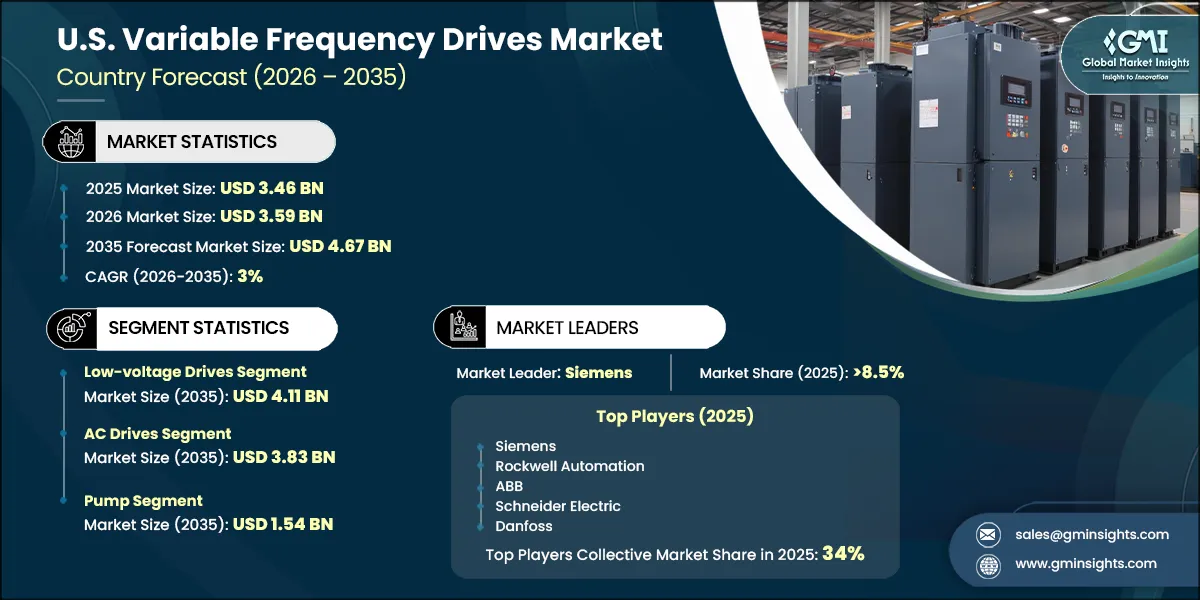
The U.S. variable frequency drives market was valued at USD 3.46 billion in 2025, is projected to reach USD 3.59 billion in 2026, and is expected to advance at a 3.0% CAGR (2026-2035) to USD 4.67 billion by 2035. Variable frequency drives regulate motor speed, torque, and direction by varying the frequency and voltage supplied to the motor, allowing equipment to align power draw with process demand.
The U.S. variable frequency drives market is being shaped by a shift from standalone motor control toward efficiency-led, connected control architectures. Replacement demand remains material in a mature installed base, while modernization projects increasingly pair drives with automation, diagnostics, and energy-management objectives. This combination supports resilient demand across industrial and commercial motor systems even when discretionary capital programs are uneven.
GMI Analyst View
Based on input from industry leaders, the U.S. variable frequency drives market reached an installed demand volume of 2,892.5 thousand units in 2025. We view this as evidence that replacement activity and equipment expansion are both sustaining demand, with energy-cost sensitivity and motor-efficiency upgrade cycles providing a durable foundation through changes in industrial capital-spending conditions.
U.S. Variable Frequency Drives Market Trends, Growth Drivers & GMI Forecast Outlook
The forecast reflects a market in which energy efficiency, domestic infrastructure procurement, and increasingly intelligent drive specifications reinforce demand, while retrofit economics and electrical-integration requirements keep adoption incremental rather than abrupt. The result is a measured expansion path rooted in recurring replacement and modernization decisions.
Key Drivers
Driver
Evidence signal
Market-demand implication
GMI forecast condition
Vast untapped installed base with no load-control technology
74% of U.S. industrial motor-system capacity operates without any load-control technology
Even marginal conversion of this base into VFD-equipped systems generates durable replacement and upgrade demand across pump, fan, compressor, and conveyor circuits
Moderate, sustained revenue growth through the forecast period, anchored in recurring retrofit activity and federal efficiency-compliance timelines that refresh addressable demand regardless of cyclical industrial capital spending
Domestic manufacturing expansion by leading VFD producers
ABB invested approximately USD 100 million in its flagship VFD manufacturing campus in New Berlin, Wisconsin
Expanded domestic production capacity enables faster delivery cycles and BABA-compliant product availability for federally funded infrastructure projects, supporting volume growth in the commercial and industrial pipeline
Incremental market share movement toward domestically certified drive suppliers accelerates as federal procurement requirements tighten through the forecast period
IIoT integration and predictive maintenance capability elevating drive specifications
Modern industrial drive platforms incorporate embedded sensors, Ethernet/fieldbus connectivity, onboard analytics, and safety-rated (SIL 2/3) control logic compliant with IEC 61800 and IEC 62061
Customers shifting from commodity to intelligent drive procurement raise average revenue per unit and reduce competitive pressure on price, expanding total addressable revenue
Growing share of premium intelligent drive platforms sustains average selling price growth alongside measured unit volume expansion through the forecast period
Evidence anchors use cited external data; demand implications and forecast conditions represent GMI analysis.
The conversion opportunity is substantial because many operating motor systems still rely on mechanical control methods that dissipate energy rather than matching motor output to the load. This makes VFD adoption particularly compelling where flow, pressure, ventilation, or conveyance demand varies over time. The commercial rationale is reinforced by the high electricity burden associated with motor systems across U.S. industrial and commercial facilities [1].
Regulation adds timing discipline to this retrofit opportunity. The U.S. Department of Energy's expanded-scope electric-motor rule establishes new efficiency requirements for covered fractional-horsepower motors, creating additional equipment-replacement windows where operators can reconsider the control architecture rather than merely replace like for like [2]. For drive suppliers, these windows are valuable because the purchasing decision can shift from a component transaction to an energy-performance and lifecycle-cost evaluation.
Domestic production is also becoming a competitive variable in publicly funded infrastructure. ABB's New Berlin manufacturing investment indicates that suppliers are positioning capacity around shorter lead times, customer qualification requirements, and domestic-content expectations [3]. Where Buy America, Build America requirements influence procurement, locally certified supply can improve a manufacturer's access to water, transportation, and energy-infrastructure projects [4].
Intelligent-drive adoption changes the basis of competition. Embedded diagnostics, network connectivity, and safety functions allow a drive to contribute operating data and maintenance visibility rather than serving only as a motor-speed controller. This favors suppliers that can integrate the device into a customer's automation environment and support application engineering over the installed life of the equipment.
Key Restraints
Restraint
Evidence signal
Market-demand implication
GMI forecast condition
Deep entrenchment of fixed-speed motor operations
Approximately 85% of industrial pumps and fans in the U.S. rely on fixed-speed motors and mechanical controls
The scale of the unconverted installed base creates both an opportunity and a barrier: capital and engineering requirements for systematic retrofit programs are substantial, and operators in cost-sensitive industries often defer conversion until equipment failure forces replacement
Retrofit adoption remains gradual rather than transformational through the forecast horizon, constraining the demand upside case and keeping the blended market growth rate well below the theoretical pace of full installed-base conversion
Significantly lower VFD penetration in commercial applications
Only 4% of commercial facility motor-system capacity in the U.S. operates on VFDs
The commercial sector - encompassing buildings, HVAC, water, and retail - presents a structural conversion gap, but smaller motor sizes, lower electricity cost exposure per installation, and longer specifier decision cycles slow commercial VFD adoption relative to industrial
Commercial demand stays below industrial growth rates through the forecast period, capping the blended market expansion rate and reinforcing the measured pace of the overall market trajectory
Harmonic distortion and power quality compliance requirements
IEC 61000-3-12 and IEEE 519 harmonic standards require active front-end drives, line reactors, or dedicated harmonic filters in multi-drive or grid-sensitive installations
Additional mitigation hardware raises total installed system cost significantly above drive-only purchase price, creating a screening threshold that limits VFD specification in smaller and less energy-intensive applications
Total system cost acts as a persistent adoption barrier in commercial and light-industrial tiers, moderating volume growth below theoretical penetration potential through the forecast period
Evidence anchors use cited external data; demand implications and forecast conditions represent GMI analysis.
The principal restraint is not a lack of technical applicability, but the difficulty of converting operating equipment before a failure, expansion, or code-compliance event creates an unavoidable intervention point. Pump and fan retrofits can require controls redesign, electrical work, operator training, and shutdown planning. ITT's launch of an embedded motor-drive product illustrates the industry's effort to reduce the installation complexity that has historically limited retrofit uptake [5].
Commercial facilities pose a different adoption challenge. Building owners and facility managers often face smaller savings per installation, fragmented decision-making, and legacy HVAC designs that were not configured around variable-speed operation. Utility incentives and energy codes can improve project economics, but adoption depends on whether the drive can be specified within a broader maintenance or renovation cycle.
Power-quality requirements further widen the gap between the price of a drive and the installed cost of a compliant system. In sensitive or multi-drive environments, buyers must account for filtering, reactors, commissioning, and technical verification. That burden weighs most heavily on smaller projects, where the operational benefit may be clear but insufficient to justify a more complex electrical scope.
GMI Analyst View
We see the market's central tension as a constructive one: strong efficiency and operating-control incentives are present, but implementation remains governed by capital timing, engineering capacity, and site-specific payback. This should preserve a steady modernization cycle rather than create a uniform replacement surge, with higher-value installations benefiting most where energy intensity and process-control requirements are greatest.
U.S. Variable Frequency Drives Market Segment Analysis
By Voltage
Low Voltage
Low-voltage drives accounted for 90.8% of U.S. variable frequency drives market revenue in 2025 and are projected to generate USD 4.11 billion in 2035. Low-voltage products serve the broadest range of pumps, fans, conveyors, HVAC equipment, and general industrial motors. Their scale reflects the depth of the installed base rather than a single end-market dependency. Demand should remain anchored in replacements, building-system upgrades, and automation additions, although more demanding high-power applications increasingly favor medium-voltage platforms.
Medium Voltage
Medium-voltage drives generated USD 310 million in 2025 and are projected to expand at a 5.9% CAGR (2026-2035). This segment is concentrated in applications where high-horsepower motor control can materially affect energy use, process stability, and equipment stress. Oil and gas compression, power-generation auxiliaries, mining, and heavy process industries create a more specialized qualification environment, which supports a higher-value product mix and rewards suppliers with application-engineering capability.
By Drive
AC Drives
AC drives held an 80.0% revenue share in 2025 and are projected to reach USD 3.83 billion in 2035. AC drives form the commercial core of the U.S. variable frequency drives market because AC induction and permanent-magnet motor systems dominate most industrial and commercial installations. Their addressable base spans general-purpose motor control through more advanced vector-control applications, while digital connectivity and diagnostics are expanding the value proposition beyond speed regulation alone.
DC Drives
DC drives generated USD 400 million in 2025 and are projected to grow at a 2.0% CAGR (2026-2035). The segment is sustained primarily by the installed population of legacy DC motor systems in metals, mining, and paper operations. New capital projects generally favor AC-based architectures, but replacement demand persists where existing equipment, process familiarity, and downtime risk make immediate system conversion impractical.
Servo Drives
Servo drives accounted for 8.3% of market revenue in 2025 and are projected to generate USD 340 million in 2035. Servo systems retain an important role in motion-intensive manufacturing, robotics, packaging, and machine-tool applications where positional accuracy and dynamic response are central to throughput or quality. Competition is intensifying as advanced AC platforms add vector-control capabilities, placing greater emphasis on integration, software, and application-specific performance.
By Application
Pump
Pump applications are projected to generate USD 1.54 billion in 2035 and represented 33.7% of market revenue in 2025. Pumps are the largest application pool because variable-speed control directly aligns output with changing flow and pressure requirements. This creates a strong retrofit case in water and wastewater, cooling systems, chemical processing, oil and gas, and power operations. Municipal infrastructure investment and lifecycle energy management should continue to favor drive-equipped pumping systems.
Fan
Fan applications generated USD 730 million in 2025 and are projected to grow at a 2.9% CAGR (2026-2035). Fan demand is supported by industrial ventilation, air-handling systems, commercial HVAC, and cooling-intensive facilities. The application's value proposition rests on matching airflow to actual demand, reducing mechanical stress, and enabling more responsive building or process control. Data-center cooling and energy-management initiatives provide an additional route to adoption.
Conveyor
Conveyor applications are projected to hold a 5.4% revenue share in 2035 and are expected to expand at a 4.1% CAGR (2026-2035). Conveyor demand is increasingly tied to warehouse automation, distribution networks, and material-handling systems rather than traditional manufacturing alone. Drives enable controlled starts, speed matching, and smoother system operation, which matters as fulfillment operations deploy more automated sortation and goods-movement equipment.
Compressor
Compressor applications generated USD 710 million in 2025 and are projected to reach USD 970 million in 2035. The application spans pipeline and production compression as well as compressed-air systems in manufacturing and process industries. VFDs allow compressor output to track demand rather than relying on throttling or constant-speed operation, improving the operating case where load profiles fluctuate. The result is a durable demand base across both energy and industrial facilities.
Extruder
Extruder applications accounted for 7.5% of market revenue in 2025 and are projected to generate USD 360 million in 2035. Extrusion processes require stable torque and speed control to protect product consistency, reduce scrap, and maintain throughput. Plastic and rubber processing, food production, cable manufacturing, and chemical applications therefore favor drive systems that can deliver repeatable control within increasingly automated production lines.
Others
Other applications are projected to account for an 11.7% revenue share in 2035, compared with 12.1% in 2025. This category includes materials handling, hoists, HVAC chillers, drilling rigs, and other industrial machinery. Its modest share movement reflects faster expansion in selected application groups rather than a weakening absolute opportunity. The breadth of this installed base provides useful demand stability across diverse equipment replacement cycles.
By End Use
Oil & Gas
Oil and gas accounted for 16.2% of market revenue in 2025 and is projected to grow at a 2.5% CAGR (2026-2035). This end use relies on drives for pumps, compression, ventilation, and process-control duties across upstream, midstream, and downstream facilities. Replacement requirements in established assets underpin demand, although capital spending patterns and already-developed efficiency practices make expansion more measured than in newer industrial demand pockets.
Power Generation
Power generation is projected to generate USD 960 million in 2035 and expand at a 3.3% CAGR (2026-2035). VFD deployment covers boiler-feed pumps, cooling-water systems, cooling towers, and draft-fan applications, as well as auxiliary equipment associated with renewable and thermal generation assets. Grid modernization, asset refurbishment, and the need to improve auxiliary-system efficiency support demand across multiple generation technologies.
Mining & Metals
Mining and metals generated USD 490 million in 2025 and are projected to reach USD 660 million in 2035. The segment uses drives in conveyors, crushers, mills, pumps, hoists, and rolling-mill operations, where control reliability and torque performance are operationally consequential. Domestic critical-minerals investment can support new drive-intensive projects, while the application profile also favors medium-voltage systems for larger motors.
Pulp & Paper
Pulp and paper held an 8.3% revenue share in 2025 and is projected to grow at a 3.3% CAGR (2026-2035). Continuous-process operations in this industry rely on coordinated control across refiners, pulpers, paper-machine rolls, and vacuum systems. Energy-management programs and investment in specialty, tissue, and packaging grades can sustain modernization activity, particularly where tighter process consistency improves yield and operating economics.
Marine
Marine applications are projected to represent a 4.3% revenue share in 2035 and grow at a 3.7% CAGR (2026-2035). Demand is linked to propulsion-related systems, thrusters, ballast pumps, cargo handling, and onboard HVAC. Electrified and hybrid vessel architectures increase the relevance of power-electronics control, while shipbuilding and offshore activity provide specialized project-driven opportunities for qualified suppliers.
Others
Other end uses are projected to generate USD 1.72 billion in 2035 and accounted for 37.4% of market revenue in 2025. This broad group includes building HVAC, water and wastewater, food and beverage, chemicals, pharmaceuticals, and light manufacturing. Its diversity lowers dependence on any single industrial investment cycle and gives the market a large base of recurring replacement and efficiency-upgrade opportunities.
GMI Analyst View
We find that the segment mix favors suppliers able to serve both broad installed-base replacement needs and narrower high-performance use cases. Pumps, fans, and compressors provide dependable volume, while conveyor, processing, and motion-control applications increasingly reward software integration, responsiveness, and engineering support. The market is therefore shifting toward more capable platform architectures without abandoning its large general-purpose base.
U.S. Variable Frequency Drives Market Analysis
United States
The U.S. variable frequency drives market is projected to reach 3,592.7 thousand units in 2035, compared with 2,979.2 thousand units in 2026.
Demand is distributed across industrial, energy, commercial-building, and infrastructure corridors rather than concentrated in one localized market. Gulf Coast processing and energy assets favor high-power drive systems; the Midwest supports broad manufacturing and distribution demand; and water, wastewater, HVAC, and data-center projects expand the addressable base in other regions. Domestic-content requirements and utility efficiency programs can further influence supplier selection and retrofit timing.
GMI Analyst View
We view geographic diversity as a stabilizing feature of U.S. demand. Energy and process industries remain important, but logistics infrastructure, data-intensive facilities, water systems, and commercial modernization widen the set of demand drivers. This dispersion reduces reliance on a single regional cycle while increasing the importance of local channel coverage, application expertise, and qualified domestic supply.
U.S. Variable Frequency Drives Market Share & Competitive Landscape
The U.S. variable frequency drives market share landscape is moderately concentrated, with the top five companies collectively holding a 34% revenue share in 2025. Competition combines product breadth, voltage-range capability, automation-system compatibility, domestic manufacturing credentials, channel reach, and the ability to support technically demanding installations.
Siemens held an 8.5% revenue share in 2025. Its Sinamics portfolio supports a broad set of building, industrial, and energy applications, while its wider automation ecosystem can create integration advantages for customers using Simatic controls, engineering software, and Industrial Edge tools. The company introduced the Sinamics S220 multi-axis drive system for industrial applications, emphasizing functional safety, high-frequency data capability, and virtual commissioning [6].
Rockwell Automation held an 8.0% revenue share in 2025. Its PowerFlex range benefits from a deep position in U.S. discrete and hybrid manufacturing, where interoperability with ControlLogix, CompactLogix, and Studio 5000 environments can raise switching costs. The company's medium-voltage offerings also extend its reach into large-motor applications in process industries.
ABB held a 7.0% revenue share in 2025. Its broad ACS, ACH, and ACQ portfolios address industrial, HVAC, and water applications, while the New Berlin operation supports domestic supply and application engineering. ABB's U.S. Drives business received NEMA Make It American certification for qualifying VFD products, strengthening its position in federally funded infrastructure procurement.
Schneider Electric is positioned in commercial buildings and industrial HVAC through its Altivar portfolio and its connection to the EcoStruxure energy-management ecosystem. Its opportunity is closely tied to multi-drive commercial facilities and distributed material-handling applications, where energy monitoring and system-level controls are part of the purchasing decision.
Danfoss competes across HVAC, water, marine, and process industries through its iC7 and VLT drive families. Its iC7-Automation update added hazardous-area, redundancy, and higher-power capabilities, reinforcing its relevance in applications where process continuity, communication resilience, and engineering qualification are decisive [7].
Beyond the leading suppliers, WEG, Yaskawa America, Eaton, GE Vernova, Fuji Electric Corp. of America, Hitachi Industrial Equipment & Solutions America, Beckhoff Automation, Bosch Rexroth, KEB Automation, Nidec Motor Corporation, ADVANCED Motion Controls, Applied Motion Products, and Franklin Electric address distinct combinations of industrial automation, precision motion, fluid handling, power conversion, and specialized drive requirements. Their competitive positions depend less on scale alone than on application knowledge, channel relationships, integration capability, and responsiveness in targeted verticals.
Recent Industry Developments
Siemens introduced the Sinamics S220 industrial drive system in June 2026. The product expands the company's multi-axis offering for digitally connected manufacturing and incorporates functional-safety, monitoring, and virtual-commissioning capabilities intended to reduce integration complexity in advanced automation environments.
Danfoss released a hardware and software update for its iC7-Automation VFD in July 2026. The update added hazardous-area motor-control capability, redundant communication support, and expanded high-power configurations for process-critical industrial applications.
Need a specific section of this report?
Purchase regional analysis, country-level analysis, company profiles, or any other segment-level insights separately
based on your research needs.
Authors: Ankit Gupta, Manish Dhiman
U.S. Variable Frequency Drives Market Scope
U.S. Variable Frequency Drives Market Size
U.S. Variable Frequency Drives Market Trends
U.S. Variable Frequency Drives Market Analysis
U.S. Variable Frequency Drives Market Share
Report Content
Chapter 1. Research Methodology
1.1 Research Approach
1.2 Quality Commitment
1.2.1 GMI AI Policy & Data Integrity Commitment
1.2.1.1 Source Consistency Protocol
1.3 Research Trail & Confidence Scoring
1.3.1 Research Trail Components
1.3.2 Scoring Components
1.4 Data Collection
1.4.1 Partial List of Primary Sources
1.5 Data Mining Sources
1.5.1 Paid Sources
1.5.1.1 Sources, by Country
1.6 Base Estimates and Calculations
1.6.1 Base Year Calculation
1.7 Forecast Model
1.7.1 Quantified Market Impact Analysis
1.7.1.1 Mathematical Impact of Growth Parameters on Forecast
1.8 Research Transparency Addendum
1.8.1 Source Attribution Framework
1.8.2 Quality Assurance Metrics
1.8.3 Our Commitment to Trust
Chapter 2. Executive Summary
2.1 Industry 360° Synopsis
2.2 Key Market Trends
2.2.1 Voltage Trends (Chapter 5)
2.2.2 Drive Trends (Chapter 6)
2.2.3 Application Trends (Chapter 7)
2.2.4 End Use Trends (Chapter 8)
2.3 CXO Perspectives: Strategic Imperatives
Chapter 3. Industry Insights
3.1 Industry Ecosystem Analysis
3.1.1 Supplier Landscape
3.1.2 Profit Margin
3.1.3 Cost Structure
3.1.4 Value Addition at Each Stage
3.1.5 Factors Affecting the Value Chain
3.1.6 Disruptions
3.2 Industry Impact Forces
3.2.1 Growth Drivers
3.2.1.1 Vast Untapped Installed Base with No Load-Control Technology
3.2.1.2 Domestic Manufacturing Expansion by Leading VFD Producers
3.2.1.3 IIoT Integration and Predictive Maintenance Capability Elevating Drive Specifications
3.2.2 Industry Pitfalls & Challenges
3.2.2.1 Deep Entrenchment of Fixed-Speed Motor Operations
3.2.2.2 Significantly Lower VFD Penetration in Commercial Applications
3.2.2.3 Harmonic Distortion and Power Quality Compliance Requirements
3.2.3 Market Opportunities
3.3 Growth Potential Analysis
3.4 Pricing Analysis (Driven by Primary Research)
3.4.1 Historical Price Trend Analysis
3.4.2 Pricing Strategy by Player Type (Premium / Value / Cost-plus)
3.5 Regulatory Landscape
3.6 Porter's Analysis
3.7 PESTEL Analysis
3.8 Trade Data Analysis
3.8.1 Import/Export Volume & Value Trends
3.8.2 Key Trade Corridors & Tariff Impact
3.9 Impact of AI & Generative AI on the Market (Driven by Primary Research)
3.9.1 AI-Driven Disruption of Existing Business Models
3.9.2 GenAI Use Cases & Adoption Roadmap by Segment
4.6.1 Tier Classification Criteria & Qualifying Thresholds
4.6.2 Tier Positioning Matrix by Revenue, Geography & Innovation
Chapter 5. Market Estimates and Forecast, By Voltage, 2022-2035 (USD Million, '000 Units)
5.1 Key Trends
5.2 Low
5.3 Medium
Chapter 6. Market Estimates and Forecast, By Drive, 2022-2035 (USD Million, '000 Units)
6.1 Key Trends
6.2 AC
6.3 DC
6.4 Servo
Chapter 7. Market Estimates and Forecast, By Application, 2022-2035 (USD Million, '000 Units)
7.1 Key Trends
7.2 Pump
7.3 Fan
7.4 Conveyor
7.5 Compressor
7.6 Extruder
7.7 Others
Chapter 8. Market Estimates and Forecast, By End Use, 2022-2035 (USD Million, '000 Units)
8.1 Key Trends
8.2 Oil & Gas
8.3 Power Generation
8.4 Mining & Metals
8.5 Pulp & Paper
8.6 Marine
8.7 Others
Chapter 9. Company Profiles
Don't see your key competitors?
The companies listed in this report are a curated selection - not the full competitive universe.
Our market revenue calculations use a bottom-up methodology that accounts for all players across all regions - including manufacturers, distributors, and specialists not individually profiled. The profiles section spotlights strategically significant players; it does not define the scope of our market sizing.
Your competitive landscape may also include
Regional or domestic-only leaders not in the global top tier
Distributors and channel partners who control market access
Emerging disruptors, startups, or adjacent-industry entrants
Niche players focused on a specific application or end-use
Free customization - up to 20% of report value
Need specific data? Request customization and get the insights tailored to your exact requirements.
For inquiries regarding discounts, bulk purchases, or customization requests, please contact us at[email protected]
Over 70% of our clients customize reports to fit their needs. Please tell us how you would like to customize yours below



U.S. Variable Frequency Drives Market Size
The U.S. variable frequency drives market was valued at USD 3.46 billion in 2025, is projected to reach USD 3.59 billion in 2026, and is expected to advance at a 3.0% CAGR (2026-2035) to USD 4.67 billion by 2035. Variable frequency drives regulate motor speed, torque, and direction by varying the frequency and voltage supplied to the motor, allowing equipment to align power draw with process demand.
The U.S. variable frequency drives market is being shaped by a shift from standalone motor control toward efficiency-led, connected control architectures. Replacement demand remains material in a mature installed base, while modernization projects increasingly pair drives with automation, diagnostics, and energy-management objectives. This combination supports resilient demand across industrial and commercial motor systems even when discretionary capital programs are uneven.
GMI Analyst View
Based on input from industry leaders, the U.S. variable frequency drives market reached an installed demand volume of 2,892.5 thousand units in 2025. We view this as evidence that replacement activity and equipment expansion are both sustaining demand, with energy-cost sensitivity and motor-efficiency upgrade cycles providing a durable foundation through changes in industrial capital-spending conditions.
U.S. Variable Frequency Drives Market Trends, Growth Drivers & GMI Forecast Outlook
The forecast reflects a market in which energy efficiency, domestic infrastructure procurement, and increasingly intelligent drive specifications reinforce demand, while retrofit economics and electrical-integration requirements keep adoption incremental rather than abrupt. The result is a measured expansion path rooted in recurring replacement and modernization decisions.
Key Drivers
Evidence anchors use cited external data; demand implications and forecast conditions represent GMI analysis.
The conversion opportunity is substantial because many operating motor systems still rely on mechanical control methods that dissipate energy rather than matching motor output to the load. This makes VFD adoption particularly compelling where flow, pressure, ventilation, or conveyance demand varies over time. The commercial rationale is reinforced by the high electricity burden associated with motor systems across U.S. industrial and commercial facilities [1].
Regulation adds timing discipline to this retrofit opportunity. The U.S. Department of Energy's expanded-scope electric-motor rule establishes new efficiency requirements for covered fractional-horsepower motors, creating additional equipment-replacement windows where operators can reconsider the control architecture rather than merely replace like for like [2]. For drive suppliers, these windows are valuable because the purchasing decision can shift from a component transaction to an energy-performance and lifecycle-cost evaluation.
Domestic production is also becoming a competitive variable in publicly funded infrastructure. ABB's New Berlin manufacturing investment indicates that suppliers are positioning capacity around shorter lead times, customer qualification requirements, and domestic-content expectations [3]. Where Buy America, Build America requirements influence procurement, locally certified supply can improve a manufacturer's access to water, transportation, and energy-infrastructure projects [4].
Intelligent-drive adoption changes the basis of competition. Embedded diagnostics, network connectivity, and safety functions allow a drive to contribute operating data and maintenance visibility rather than serving only as a motor-speed controller. This favors suppliers that can integrate the device into a customer's automation environment and support application engineering over the installed life of the equipment.
Key Restraints
Evidence anchors use cited external data; demand implications and forecast conditions represent GMI analysis.
The principal restraint is not a lack of technical applicability, but the difficulty of converting operating equipment before a failure, expansion, or code-compliance event creates an unavoidable intervention point. Pump and fan retrofits can require controls redesign, electrical work, operator training, and shutdown planning. ITT's launch of an embedded motor-drive product illustrates the industry's effort to reduce the installation complexity that has historically limited retrofit uptake [5].
Commercial facilities pose a different adoption challenge. Building owners and facility managers often face smaller savings per installation, fragmented decision-making, and legacy HVAC designs that were not configured around variable-speed operation. Utility incentives and energy codes can improve project economics, but adoption depends on whether the drive can be specified within a broader maintenance or renovation cycle.
Power-quality requirements further widen the gap between the price of a drive and the installed cost of a compliant system. In sensitive or multi-drive environments, buyers must account for filtering, reactors, commissioning, and technical verification. That burden weighs most heavily on smaller projects, where the operational benefit may be clear but insufficient to justify a more complex electrical scope.
GMI Analyst View
We see the market's central tension as a constructive one: strong efficiency and operating-control incentives are present, but implementation remains governed by capital timing, engineering capacity, and site-specific payback. This should preserve a steady modernization cycle rather than create a uniform replacement surge, with higher-value installations benefiting most where energy intensity and process-control requirements are greatest.
U.S. Variable Frequency Drives Market Segment Analysis
By Voltage
Low Voltage
Low-voltage drives accounted for 90.8% of U.S. variable frequency drives market revenue in 2025 and are projected to generate USD 4.11 billion in 2035. Low-voltage products serve the broadest range of pumps, fans, conveyors, HVAC equipment, and general industrial motors. Their scale reflects the depth of the installed base rather than a single end-market dependency. Demand should remain anchored in replacements, building-system upgrades, and automation additions, although more demanding high-power applications increasingly favor medium-voltage platforms.
Medium Voltage
Medium-voltage drives generated USD 310 million in 2025 and are projected to expand at a 5.9% CAGR (2026-2035). This segment is concentrated in applications where high-horsepower motor control can materially affect energy use, process stability, and equipment stress. Oil and gas compression, power-generation auxiliaries, mining, and heavy process industries create a more specialized qualification environment, which supports a higher-value product mix and rewards suppliers with application-engineering capability.
By Drive
AC Drives
AC drives held an 80.0% revenue share in 2025 and are projected to reach USD 3.83 billion in 2035. AC drives form the commercial core of the U.S. variable frequency drives market because AC induction and permanent-magnet motor systems dominate most industrial and commercial installations. Their addressable base spans general-purpose motor control through more advanced vector-control applications, while digital connectivity and diagnostics are expanding the value proposition beyond speed regulation alone.
DC Drives
DC drives generated USD 400 million in 2025 and are projected to grow at a 2.0% CAGR (2026-2035). The segment is sustained primarily by the installed population of legacy DC motor systems in metals, mining, and paper operations. New capital projects generally favor AC-based architectures, but replacement demand persists where existing equipment, process familiarity, and downtime risk make immediate system conversion impractical.
Servo Drives
Servo drives accounted for 8.3% of market revenue in 2025 and are projected to generate USD 340 million in 2035. Servo systems retain an important role in motion-intensive manufacturing, robotics, packaging, and machine-tool applications where positional accuracy and dynamic response are central to throughput or quality. Competition is intensifying as advanced AC platforms add vector-control capabilities, placing greater emphasis on integration, software, and application-specific performance.
By Application
Pump
Pump applications are projected to generate USD 1.54 billion in 2035 and represented 33.7% of market revenue in 2025. Pumps are the largest application pool because variable-speed control directly aligns output with changing flow and pressure requirements. This creates a strong retrofit case in water and wastewater, cooling systems, chemical processing, oil and gas, and power operations. Municipal infrastructure investment and lifecycle energy management should continue to favor drive-equipped pumping systems.
Fan
Fan applications generated USD 730 million in 2025 and are projected to grow at a 2.9% CAGR (2026-2035). Fan demand is supported by industrial ventilation, air-handling systems, commercial HVAC, and cooling-intensive facilities. The application's value proposition rests on matching airflow to actual demand, reducing mechanical stress, and enabling more responsive building or process control. Data-center cooling and energy-management initiatives provide an additional route to adoption.
Conveyor
Conveyor applications are projected to hold a 5.4% revenue share in 2035 and are expected to expand at a 4.1% CAGR (2026-2035). Conveyor demand is increasingly tied to warehouse automation, distribution networks, and material-handling systems rather than traditional manufacturing alone. Drives enable controlled starts, speed matching, and smoother system operation, which matters as fulfillment operations deploy more automated sortation and goods-movement equipment.
Compressor
Compressor applications generated USD 710 million in 2025 and are projected to reach USD 970 million in 2035. The application spans pipeline and production compression as well as compressed-air systems in manufacturing and process industries. VFDs allow compressor output to track demand rather than relying on throttling or constant-speed operation, improving the operating case where load profiles fluctuate. The result is a durable demand base across both energy and industrial facilities.
Extruder
Extruder applications accounted for 7.5% of market revenue in 2025 and are projected to generate USD 360 million in 2035. Extrusion processes require stable torque and speed control to protect product consistency, reduce scrap, and maintain throughput. Plastic and rubber processing, food production, cable manufacturing, and chemical applications therefore favor drive systems that can deliver repeatable control within increasingly automated production lines.
Others
Other applications are projected to account for an 11.7% revenue share in 2035, compared with 12.1% in 2025. This category includes materials handling, hoists, HVAC chillers, drilling rigs, and other industrial machinery. Its modest share movement reflects faster expansion in selected application groups rather than a weakening absolute opportunity. The breadth of this installed base provides useful demand stability across diverse equipment replacement cycles.
By End Use
Oil & Gas
Oil and gas accounted for 16.2% of market revenue in 2025 and is projected to grow at a 2.5% CAGR (2026-2035). This end use relies on drives for pumps, compression, ventilation, and process-control duties across upstream, midstream, and downstream facilities. Replacement requirements in established assets underpin demand, although capital spending patterns and already-developed efficiency practices make expansion more measured than in newer industrial demand pockets.
Power Generation
Power generation is projected to generate USD 960 million in 2035 and expand at a 3.3% CAGR (2026-2035). VFD deployment covers boiler-feed pumps, cooling-water systems, cooling towers, and draft-fan applications, as well as auxiliary equipment associated with renewable and thermal generation assets. Grid modernization, asset refurbishment, and the need to improve auxiliary-system efficiency support demand across multiple generation technologies.
Mining & Metals
Mining and metals generated USD 490 million in 2025 and are projected to reach USD 660 million in 2035. The segment uses drives in conveyors, crushers, mills, pumps, hoists, and rolling-mill operations, where control reliability and torque performance are operationally consequential. Domestic critical-minerals investment can support new drive-intensive projects, while the application profile also favors medium-voltage systems for larger motors.
Pulp & Paper
Pulp and paper held an 8.3% revenue share in 2025 and is projected to grow at a 3.3% CAGR (2026-2035). Continuous-process operations in this industry rely on coordinated control across refiners, pulpers, paper-machine rolls, and vacuum systems. Energy-management programs and investment in specialty, tissue, and packaging grades can sustain modernization activity, particularly where tighter process consistency improves yield and operating economics.
Marine
Marine applications are projected to represent a 4.3% revenue share in 2035 and grow at a 3.7% CAGR (2026-2035). Demand is linked to propulsion-related systems, thrusters, ballast pumps, cargo handling, and onboard HVAC. Electrified and hybrid vessel architectures increase the relevance of power-electronics control, while shipbuilding and offshore activity provide specialized project-driven opportunities for qualified suppliers.
Others
Other end uses are projected to generate USD 1.72 billion in 2035 and accounted for 37.4% of market revenue in 2025. This broad group includes building HVAC, water and wastewater, food and beverage, chemicals, pharmaceuticals, and light manufacturing. Its diversity lowers dependence on any single industrial investment cycle and gives the market a large base of recurring replacement and efficiency-upgrade opportunities.
GMI Analyst View
We find that the segment mix favors suppliers able to serve both broad installed-base replacement needs and narrower high-performance use cases. Pumps, fans, and compressors provide dependable volume, while conveyor, processing, and motion-control applications increasingly reward software integration, responsiveness, and engineering support. The market is therefore shifting toward more capable platform architectures without abandoning its large general-purpose base.
U.S. Variable Frequency Drives Market Analysis
United States
The U.S. variable frequency drives market is projected to reach 3,592.7 thousand units in 2035, compared with 2,979.2 thousand units in 2026.
Demand is distributed across industrial, energy, commercial-building, and infrastructure corridors rather than concentrated in one localized market. Gulf Coast processing and energy assets favor high-power drive systems; the Midwest supports broad manufacturing and distribution demand; and water, wastewater, HVAC, and data-center projects expand the addressable base in other regions. Domestic-content requirements and utility efficiency programs can further influence supplier selection and retrofit timing.
GMI Analyst View
We view geographic diversity as a stabilizing feature of U.S. demand. Energy and process industries remain important, but logistics infrastructure, data-intensive facilities, water systems, and commercial modernization widen the set of demand drivers. This dispersion reduces reliance on a single regional cycle while increasing the importance of local channel coverage, application expertise, and qualified domestic supply.
U.S. Variable Frequency Drives Market Share & Competitive Landscape
The U.S. variable frequency drives market share landscape is moderately concentrated, with the top five companies collectively holding a 34% revenue share in 2025. Competition combines product breadth, voltage-range capability, automation-system compatibility, domestic manufacturing credentials, channel reach, and the ability to support technically demanding installations.
Siemens held an 8.5% revenue share in 2025. Its Sinamics portfolio supports a broad set of building, industrial, and energy applications, while its wider automation ecosystem can create integration advantages for customers using Simatic controls, engineering software, and Industrial Edge tools. The company introduced the Sinamics S220 multi-axis drive system for industrial applications, emphasizing functional safety, high-frequency data capability, and virtual commissioning [6].
Rockwell Automation held an 8.0% revenue share in 2025. Its PowerFlex range benefits from a deep position in U.S. discrete and hybrid manufacturing, where interoperability with ControlLogix, CompactLogix, and Studio 5000 environments can raise switching costs. The company's medium-voltage offerings also extend its reach into large-motor applications in process industries.
ABB held a 7.0% revenue share in 2025. Its broad ACS, ACH, and ACQ portfolios address industrial, HVAC, and water applications, while the New Berlin operation supports domestic supply and application engineering. ABB's U.S. Drives business received NEMA Make It American certification for qualifying VFD products, strengthening its position in federally funded infrastructure procurement.
Schneider Electric is positioned in commercial buildings and industrial HVAC through its Altivar portfolio and its connection to the EcoStruxure energy-management ecosystem. Its opportunity is closely tied to multi-drive commercial facilities and distributed material-handling applications, where energy monitoring and system-level controls are part of the purchasing decision.
Danfoss competes across HVAC, water, marine, and process industries through its iC7 and VLT drive families. Its iC7-Automation update added hazardous-area, redundancy, and higher-power capabilities, reinforcing its relevance in applications where process continuity, communication resilience, and engineering qualification are decisive [7].
Beyond the leading suppliers, WEG, Yaskawa America, Eaton, GE Vernova, Fuji Electric Corp. of America, Hitachi Industrial Equipment & Solutions America, Beckhoff Automation, Bosch Rexroth, KEB Automation, Nidec Motor Corporation, ADVANCED Motion Controls, Applied Motion Products, and Franklin Electric address distinct combinations of industrial automation, precision motion, fluid handling, power conversion, and specialized drive requirements. Their competitive positions depend less on scale alone than on application knowledge, channel relationships, integration capability, and responsiveness in targeted verticals.
Recent Industry Developments
Siemens introduced the Sinamics S220 industrial drive system in June 2026. The product expands the company's multi-axis offering for digitally connected manufacturing and incorporates functional-safety, monitoring, and virtual-commissioning capabilities intended to reduce integration complexity in advanced automation environments.
Danfoss released a hardware and software update for its iC7-Automation VFD in July 2026. The update added hazardous-area motor-control capability, redundant communication support, and expanded high-power configurations for process-critical industrial applications.
Need a specific section of this report?
Purchase regional analysis, country-level analysis, company profiles, or any other segment-level insights separately
based on your research needs.