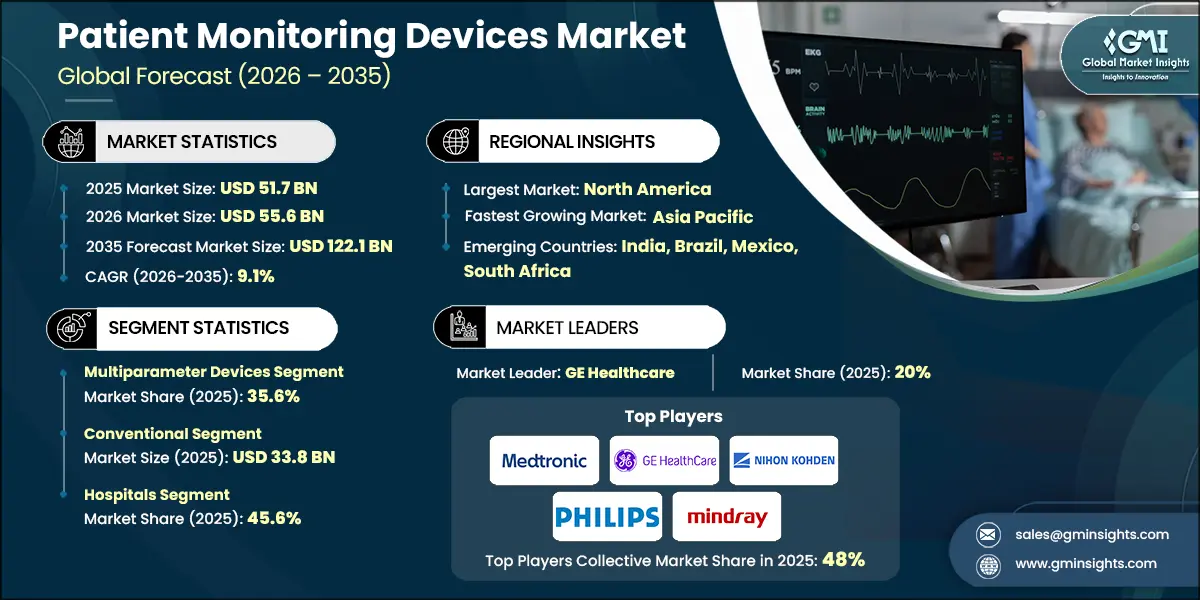
The global patient monitoring devices market was valued at USD 51.7 billion in 2025 and is projected to grow from USD 55.6 billion in 2026 to USD 122.1 billion by 2035, expanding at a CAGR of 9.1%, according to the latest report published by Global Market Insights Inc.
The steady growth of the market is driven by the increasing prevalence of chronic diseases, a growing geriatric population, technological advancements in patient monitoring devices, and rising disposable income and healthcare expenditure in emerging countries. Major companies in the industry include Medtronic, GE Healthcare, Nihon Kohden Corporation, Koninklijke Philips, and Mindray Bio-Medical Electronics.
The rising incidence of chronic diseases, including cardiovascular disorders, cancer, neurovascular disorders, and chronic kidney disease (CKD), is a key driver of growth in the market. For example, according to the World Health Organization (WHO), in 2021, non-communicable diseases accounted for approximately 43 million deaths globally, with cardiovascular diseases responsible for nearly 19 million deaths, followed by cancer at 10 million and chronic respiratory diseases at 4 million. These figures underscore the critical need for advanced patient monitoring solutions that enable early detection, continuous health tracking, and timely interventions for managing chronic conditions such as cardiovascular diseases.
Additionally, the growing geriatric population is a significant driver of the patient monitoring devices market. As global demographics shift toward older age groups, the prevalence of age-related chronic conditions such as cardiovascular disorders, diabetes, and respiratory diseases is increasing, creating substantial demand for advanced monitoring solutions. For instance, according to the World Health Organization (WHO), the global population aged 60 years and above is projected to rise from 1 billion in 2020 to 1.4 billion by 2030 and will double to 2.1 billion by 2050. Moreover, the number of individuals aged 80 years and older is expected to triple by 2050, reaching 426 million. This demographic trend significantly creates the need for continuous health assessment and timely intervention, driving the adoption of patient monitoring devices in both clinical and home care settings.
Patient monitoring devices are medical instruments and systems designed to continuously or periodically track a patient’s vital signs and physiological parameters. These devices help healthcare professionals monitor critical metrics such as heart rate, blood pressure, respiratory rate, oxygen saturation, temperature, and glucose levels, either in hospital settings or remotely through telehealth solutions.
Patient Monitoring Devices Market Trends
Technological advancements in patient monitoring devices are transforming healthcare delivery globally, particularly in emerging markets. The integration of artificial intelligence (AI) in healthcare, which is estimated to reach USD 317.1 billion by 2032, along with innovations in wearable technology, sensor precision, and telehealth connectivity, is driving more efficient and personalized monitoring solutions.
Modern patient monitoring systems increasingly incorporate Internet of Things (IoT) and AI capabilities, enabling real-time data collection, predictive analytics, and automated clinical decision-making. AI-powered algorithms identify potential health risks early, supporting timely interventions and individualized care plans.
For example, GE Healthcare’s CARESCAPE Monitor B850 features advanced networking and interoperability, allowing clinicians to seamlessly access patient data across multiple care points. This connectivity ensures continuous monitoring and supports predictive insights for critical patients.
Recent developments have enhanced device accuracy, portability, and functionality. Innovations such as wireless connectivity, modular design, and cloud-based data management enable faster clinical decisions and improve workflow efficiency in critical care and surgical settings.
Philips IntelliVue MX Series exemplifies these advancements by delivering precise measurements even under challenging conditions such as motion or low perfusion, making it ideal for neonatal and critical care. The MX550 model combines advanced bedside monitoring with a reliable battery backup, ensuring uninterrupted performance during patient transfers or power outages.
Patient Monitoring Devices Market Analysis
Based on product, the market is segmented cardiac monitoring devices, neuromonitoring devices, respiratory monitoring devices, anesthesia monitor, hemodynamic monitoring devices, fetal and neonatal monitoring, multiparameter devices, and other products. The multiparameter devices segment was valued at USD 18.4 billion in 2025 and held a significant market share of 35.6%.
Multiparameter patient monitoring devices are advanced systems designed to track and display several vital signs simultaneously, making them indispensable in critical care units, operating rooms, and emergency settings. These devices consolidate multiple measurements into a single platform, streamlining clinical workflows and reducing the need for separate monitoring equipment.
For example, the Life Scope G9 from Nihon Kohden is a bedside monitor designed to deliver comprehensive patient monitoring with advanced features. It offers multi-waveform and multi-parameter full disclosure, detailed arrhythmia and ST segment analysis, 12-lead ECG capability for neonatal care.
Modern multiparameter monitors feature high-resolution displays, modular configurations, and customizable settings, allowing healthcare providers to adapt monitoring capabilities to specific patient needs. They also include alarm systems, trend analysis, and data storage, which help clinicians detect early signs of deterioration and make timely interventions.
Further, recent innovations have introduced wireless connectivity, portability, and battery backup, making these devices suitable for patient transfers and emergency scenarios. Additionally, AI-driven analytics and predictive algorithms are being incorporated to provide clinical decision support, improving outcomes in high-acuity environments.
Based on type, the patient monitoring devices market is segmented into conventional and wireless. The conventional segment accounted for a revenue of USD 33.8 billion in 2025.
Conventional patient monitoring devices refer to bedside monitors that are widely used in hospitals to track essential physiological parameters. These systems are typically hardwired, stationary units designed for continuous monitoring in intensive care units (ICUs), operating rooms, and general wards.
For example, the Philips SureSigns VS2+ monitor is designed for simplicity and efficiency. It features an easy-to-read display and pleth waveform visualization, making vital signs monitoring straightforward and user-friendly.
Further, these devices primarily focus on basic vital signs monitoring, such as heart rate, blood pressure, oxygen saturation, and temperature, which are displayed on a fixed screen at the patient’s bedside.
Based on end use, the patient monitoring devices market is segmented into hospitals, ambulatory surgical centers, clinics, and other end users. The hospitals segment held a significant market share of 45.6% in 2025.
Hospitals dominate the market as they serve as the primary centers for advanced treatments and critical care. Equipped with specialized infrastructure and high-acuity units such as ICUs and operating rooms, hospitals rely on comprehensive monitoring systems to manage complex cases and surgical procedures.
Patient monitoring devices in hospitals are essential for the continuous observation of vital signs, ensuring timely interventions and improved patient safety. These systems provide real-time data, trend analysis, and alarm management, which are critical for managing high-risk patients during surgeries, post-operative recovery, and emergency care.
The growing prevalence of chronic diseases, increasing surgical volumes, and rising demand for intensive care are driving hospitals to adopt advanced monitoring technologies. Modern hospital setups are transitioning from basic monitors to integrated systems featuring wireless connectivity, centralized monitoring stations, and interoperability with electronic health records (EHR).
Further, these innovations enhance workflow efficiency, reduce response times, and improve clinical decision-making, thereby fueling the growth of patient monitoring devices in hospital settings.
North America Patient Monitoring Devices Market
The North America region accounted for 42.5% of the global market in 2025. The market in North America is experiencing robust expansion, driven by the region’s advanced healthcare infrastructure and technological advancements.
The U.S. market was valued at USD 16.1 billion and USD 17.3 billion in 2022 and 2023, respectively. In 2025 the market size increased to USD 20.2 billion from USD 18.7 billion in 2024.
The growth of the U.S. market is primarily driven by the increasing prevalence of chronic conditions such as cardiovascular diseases, respiratory diseases, and other chronic illnesses. These conditions require continuous monitoring, which is boosting the demand for advanced monitoring solutions in hospitals and homecare settings.
For example, according to the Centers for Disease Control and Prevention (CDC), in 2021, approximately 38.4 million individuals in the U.S. were living with diabetes, accounting for 11.6% of the total population. Additionally, between 2021 and 2023, nearly 47.7% of adults, including older individuals, were diagnosed with hypertension.
The U.S. leads the market due to its advanced healthcare infrastructure, high surgical volumes, and significant investment in digital health. Hospitals are rapidly transitioning from conventional monitors to integrated systems with wireless connectivity, centralized monitoring, and EHR interoperability, which is driving market growth.
Europe Patient Monitoring Devices Market
Europe market accounted for USD 13.4 billion in 2025 and is anticipated to show lucrative growth over the forecast period.
The growth of the market in Europe is primarily attributed to the rising prevalence of chronic diseases and increasing government initiatives aimed at strengthening healthcare infrastructure across the region. Hospitals and healthcare facilities are investing in advanced monitoring systems to improve patient outcomes and reduce treatment delays.
Technological advancements in patient monitoring devices, such as wireless connectivity, modular designs, and integration with electronic health records (EHR), are accelerating adoption in Europe. These innovations enable real-time monitoring and improve workflow efficiency in critical care and surgical settings.
Germany's patient monitoring devices market is projected to experience steady growth between 2026 and 2035.
The growing aging population in Germany is a major driver for the adoption of patient monitoring devices. According to Statista, in 2024, individuals aged 40–59 represent the largest age group at approximately 22.3 million, while those aged sixty-five and older account for around nineteen million. This demographic trend increases the demand for continuous monitoring solutions in hospitals and homecare settings.
Germany is emerging as a significant market for patient monitoring devices, supported by its advanced healthcare infrastructure, strong clinical expertise, and increasing adoption of digital technologies for critical care and chronic disease management.
Public-private initiatives and investments in hospital modernization are accelerating the integration of innovative monitoring systems, including wireless connectivity, centralized monitoring stations, and interoperability with electronic health records (EHR). These advancements enhance workflow efficiency, improve patient safety, and support timely interventions, fueling market growth in Germany.
Asia Pacific Patient Monitoring Devices Market
The Asia Pacific region is projected to show a lucrative growth of about 9.6% during the forecast period.
The market in Asia-Pacific is witnessing rapid growth, driven by the rising prevalence of chronic diseases, growing awareness of early diagnosis, and increasing demand for advanced monitoring solutions in hospitals and homecare settings.
Countries such as China, India, and Japan are adopting next-generation patient monitoring technologies at a fast pace, supported by improvements in healthcare infrastructure and the need for efficient management of high-acuity and long-term conditions.
Additionally, the expansion of hospitals and diagnostic centers, coupled with government initiatives aimed at strengthening healthcare systems and promoting digital health integration, is further accelerating market growth in the region.
China patient monitoring devices market is poised to witness lucrative growth between 2026 - 2035.
China's aging population is driving the adoption of patient monitoring devices.
According to WHO estimates (2019), approximately 254 million people aged 65 and above were living in China, and this number is projected to reach around 402 million individuals over the age of 60 by 2040. This demographic trend significantly increases the need for continuous monitoring solutions in hospitals and homecare settings.
Government initiatives to strengthen healthcare infrastructure, coupled with investments in digital health technologies, are accelerating the integration of innovative monitoring solutions featuring wireless connectivity, centralized monitoring stations, and interoperability with electronic health records (EHR). These advancements enhance clinical efficiency and patient safety, driving substantial market growth in China.
Latin America Patient Monitoring Devices Market
Brazil is experiencing significant growth in the market.
The growth of the market in Brazil is strongly driven by technological advancements and the rising prevalence of chronic and critical conditions requiring continuous monitoring. Hospitals and healthcare facilities are increasingly adopting advanced monitoring systems to improve patient safety and clinical outcomes.
Furthermore, government initiatives and private investments in hospital modernization are accelerating the adoption of innovative technologies, including AI-powered analytics and cloud-enabled platforms. These advancements improve diagnostic accuracy, support timely interventions, and ensure better patient management, driving sustained growth of the market in Brazil.
Middle East and Africa Patient Monitoring Devices Market
Saudi Arabia is steadily increasing investments in healthcare modernization, driven by both government and private sector initiatives. The country is prioritizing advanced patient monitoring systems to strengthen critical care and improve overall healthcare delivery.
As part of its Vision 2030 initiative, the Saudi government has allocated significant resources to upgrade hospital infrastructure and integrate innovative technologies, including multiparameter monitors, centralized monitoring stations, and wireless connectivity solutions. These systems enable real-time data sharing and enhance clinical efficiency.
Patient Monitoring Devices Market Share
The top five players in the market, Medtronic, GE Healthcare, Nihon Kohden Corporation, Koninklijke Philips, and Mindray Bio-Medical Electronics, collectively hold a 48% share of the global market. These companies strengthen their positions through continuous product innovation, compliance with regulatory standards, and strategic collaborations. Leading players are investing heavily in R&D to develop next-generation monitoring solutions, including wireless connectivity, AI-driven analytics, and cloud-based platforms to enhance real-time monitoring and clinical decision-making.
Philips maintains a strong position with its IntelliVue series, offering modular designs and advanced signal processing for critical care environments. The company focuses on integrating smart connectivity and predictive analytics to improve workflow efficiency and patient safety. Similarly, GE Healthcare emphasizes interoperability and centralized monitoring through its CARESCAPE platform, enabling seamless data sharing across hospital networks.
Manufacturers are also adopting cost-effective strategies to penetrate emerging markets, introducing compact, easy-to-use monitors and portable devices for general wards and homecare settings. These innovations aim to increase accessibility and improve patient outcomes, particularly in regions with growing demand for chronic disease management.
Emerging trends in the market include AI-powered predictive algorithms, wireless monitoring systems, integration with electronic health records (EHR), and remote monitoring capabilities for post-discharge care. These advancements are reshaping the market and driving sustained growth globally.
Patient Monitoring Devices Market Companies
Few of the prominent players operating in the patient monitoring devices industry include:
Becton Dickinson and Company
Biotronik
EPSIMED
Fukuda Denshi
GE Healthcare
HILLROM & WELCH ALLYN
Koninklijke Philips
Medion
Medtronic
Natus Medical
Nihon Kohden Corporation
OMRON Corporation
OSI Systems
Shenzhen Mindray Bio-Medical Electronics
Skanray Technologies
Medtronic
Medtronic is a global leader in patient monitoring solutions, offering a comprehensive portfolio for cardiac and remote monitoring. The product range includes implantable cardiac monitors, mobile telemetry systems, and cloud-based platforms designed to enable continuous monitoring and provide predictive insights for chronic disease management.
GE Healthcare
GE Healthcare is a major innovator in patient monitoring technologies, providing advanced multiparameter monitors, wireless connectivity solutions, and AI-driven analytics. Its competitive edge lies in strong integration with hospital IT systems, real-time data sharing, and scalable solutions for critical care and perioperative environments.
Koninklijke Philips
Philips is a provider of connected patient monitoring systems, offering bedside monitors, wearable devices, and telehealth platforms. The company’s strength is in interoperability, cloud-based data management, and AI-powered decision support tools, enabling seamless monitoring across hospital and homecare settings.
Patient Monitoring Devices Industry News
In October 2025, GE HealthCare launched its new Carevance Patient Monitor and Carestation 850 Anesthesiology device. These innovations strengthened the company’s portfolio in critical care and perioperative monitoring by offering advanced connectivity, improved workflow efficiency, and integrated monitoring solutions for hospitals, enhancing its competitive position.
In January 2024, Mindray unveiled its uMEC series patient monitors, including the uMEC 100, 120, and 150 models, marking a significant milestone in its product portfolio. This launch strengthened Mindray’s position in the global market by providing cost-effective, high-performance solutions tailored for diverse clinical settings, thereby expanding its reach in both developed and emerging markets.
The patient monitoring devices market research report includes an in-depth coverage of the industry with estimates and forecast in terms of revenue in USD Million and from 2022 - 2035 for the following segments:
Market, By Product
Cardiac monitoring devices
ECG devices
Implantable loop recorders
Mobile cardiac telemetry monitors
Smart wearable ECG patches
Neuromonitoring devices
EEG devices
Cerebral oximeters
Intracranial pressure monitors
EMG devices
Respiratory monitoring devices
Pulse oximeters
Spirometers
Capnographs
Peak flow meters
Anesthesia monitor
Hemodynamic monitoring devices
Fetal and neonatal monitoring
Multiparameter devices
Other products
Market, By Type
Conventional
Wireless
Market, By End Use
Hospitals
Ambulatory surgical centers
Homecare settings
Other end users
The above information is provided for the following regions and countries:
North America
U.S.
Canada
Europe
Germany
UK
France
Italy
Spain
Netherlands
Asia Pacific
China
India
Japan
Australia
South Korea
Latin America
Brazil
Mexico
Argentina
Middle East and Africa
Saudi Arabia
South Africa
UAE
Authors: Monali Tayade, Sampada Kulkarni
Patient Monitoring Devices Market Scope
Patient Monitoring Devices Market Size
Patient Monitoring Devices Market Trends
Patient Monitoring Devices Market Analysis
Patient Monitoring Devices Market Share
Report Content
Chapter 1 Methodology and Scope
1.1 Research approach
1.2 Quality commitments
1.2.1 GMI AI policy & data integrity commitment
1.2.1.1 Source consistency protocol
1.3 Research trail & confidence scoring
1.3.1 Research trail components
1.3.2 Scoring components
1.4 Data collection
1.4.1 Partial list of primary sources
1.5 Data mining sources
1.5.1 Paid sources
1.5.1.1 Sources, by region
1.6 Base estimates and calculations
1.6.1 Base year calculation for any one approach
1.7 Forecast model
1.7.1 Quantified market impact analysis
1.7.1.1 Mathematical impact of growth parameters on forecast
1.7.2 Research transparency addendum
1.7.3 Source attribution framework
1.7.4 Quality assurance metrics
1.8 Our commitment to trust
Chapter 2 Executive Summary
2.1 Industry 360° synopsis
2.2 Key market trends
2.2.1 Regional trends
2.2.2 Product trends
2.2.3 Type trends
2.2.4 End use trends
2.3 CXO perspectives: Strategic imperatives
Chapter 3 Industry Insights
3.1 Industry ecosystem analysis
3.2 Industry impact forces
3.2.1 Growth drivers
3.2.1.1 Increasing prevalence of chronic diseases
3.2.1.2 Growing disposable income and healthcare expenditure in emerging countries
3.2.1.3 Technological advancement in patient monitoring devices
3.2.1.4 Growing geriatric population base
3.2.2 Industry pitfalls and challenges
3.2.2.1 High cost of devices
3.2.2.2 Stringent regulatory scenario
3.2.3 Market opportunities
3.2.3.1 Increasing adoption for AI-powered predictive monitoring tools
3.3 Growth potential analysis
3.4 Regulatory landscape (Driven by Primary Research)
3.4.1 North America
3.4.2 Europe
3.4.3 Asia Pacific
3.5 Technological advancements
3.5.1 Current technological trends
3.5.2 Emerging technologies
3.6 Future market trends
3.7 Porter's analysis
3.8 PESTEL analysis
Chapter 4 Competitive Landscape, 2025
4.1 Introduction
4.2 Company market share analysis
4.3 Company matrix analysis
4.4 Competitive analysis of major market players
4.5 Competitive positioning matrix
4.6 Key developments
4.6.1 Mergers and acquisitions
4.6.2 Partnerships and collaborations
4.6.3 New product launches
4.6.4 Expansion plans
Chapter 5 Market Estimates and Forecast, By Product, 2022 - 2035 ($ Mn)
5.1 Key trends
5.2 Cardiac monitoring devices
5.2.1 ECG devices
5.2.2 Implantable loop recorders
5.2.3 Mobile cardiac telemetry monitors
5.2.4 Smart wearable ECG patches
5.3 Neuromonitoring devices
5.3.1 EEG devices
5.3.2 Cerebral oximeters
5.3.3 Intracranial pressure monitors
5.3.4 EMG devices
5.4 Respiratory monitoring devices
5.4.1 Pulse oximeters
5.4.2 Spirometers
5.4.3 Capnographs
5.4.4 Peak flow meters
5.5 Anesthesia monitor
5.6 Hemodynamic monitoring devices
5.7 Fetal and neonatal monitoring
5.8 Multiparameter devices
5.9 Other products
Chapter 6 Market Estimates and Forecast, By Type, 2022 - 2035 ($ Mn)
6.1 Key trends
6.2 Conventional
6.3 Wireless
Chapter 7 Market Estimates and Forecast, By End Use, 2022 - 2035 ($ Mn)
7.1 Key trends
7.2 Hospitals
7.3 Ambulatory surgical centers
7.4 Homecare settings
7.5 Other end users
Chapter 8 Market Estimates and Forecast, By Region, 2022 - 2035 ($ Mn)
8.1 Key trends
8.2 North America
8.2.1 U.S.
8.2.2 Canada
8.3 Europe
8.3.1 Germany
8.3.2 UK
8.3.3 France
8.3.4 Spain
8.3.5 Italy
8.3.6 Netherlands
8.4 Asia Pacific
8.4.1 China
8.4.2 India
8.4.3 Japan
8.4.4 Australia
8.4.5 South Korea
8.5 Latin America
8.5.1 Brazil
8.5.2 Mexico
8.5.3 Argentina
8.6 Middle East and Africa
8.6.1 Saudi Arabia
8.6.2 South Africa
8.6.3 UAE
Chapter 9 Company Profiles
Don't see your key competitors?
The companies listed in this report are a curated selection - not the full competitive universe.
Our market revenue calculations use a bottom-up methodology that accounts for all players across all regions - including manufacturers, distributors, and specialists not individually profiled. The profiles section spotlights strategically significant players; it does not define the scope of our market sizing.
Your competitive landscape may also include
Regional or domestic-only leaders not in the global top tier
Distributors and channel partners who control market access
Emerging disruptors, startups, or adjacent-industry entrants
Niche players focused on a specific application or end-use
Free customization - up to 20% of report value
Need specific data? Request customization and get the insights tailored to your exact requirements.
For inquiries regarding discounts, bulk purchases, or customization requests, please contact us at[email protected]



Patient Monitoring Devices Market Size
The global patient monitoring devices market was valued at USD 51.7 billion in 2025 and is projected to grow from USD 55.6 billion in 2026 to USD 122.1 billion by 2035, expanding at a CAGR of 9.1%, according to the latest report published by Global Market Insights Inc.
The steady growth of the market is driven by the increasing prevalence of chronic diseases, a growing geriatric population, technological advancements in patient monitoring devices, and rising disposable income and healthcare expenditure in emerging countries. Major companies in the industry include Medtronic, GE Healthcare, Nihon Kohden Corporation, Koninklijke Philips, and Mindray Bio-Medical Electronics.
The rising incidence of chronic diseases, including cardiovascular disorders, cancer, neurovascular disorders, and chronic kidney disease (CKD), is a key driver of growth in the market. For example, according to the World Health Organization (WHO), in 2021, non-communicable diseases accounted for approximately 43 million deaths globally, with cardiovascular diseases responsible for nearly 19 million deaths, followed by cancer at 10 million and chronic respiratory diseases at 4 million. These figures underscore the critical need for advanced patient monitoring solutions that enable early detection, continuous health tracking, and timely interventions for managing chronic conditions such as cardiovascular diseases.
Additionally, the growing geriatric population is a significant driver of the patient monitoring devices market. As global demographics shift toward older age groups, the prevalence of age-related chronic conditions such as cardiovascular disorders, diabetes, and respiratory diseases is increasing, creating substantial demand for advanced monitoring solutions. For instance, according to the World Health Organization (WHO), the global population aged 60 years and above is projected to rise from 1 billion in 2020 to 1.4 billion by 2030 and will double to 2.1 billion by 2050. Moreover, the number of individuals aged 80 years and older is expected to triple by 2050, reaching 426 million. This demographic trend significantly creates the need for continuous health assessment and timely intervention, driving the adoption of patient monitoring devices in both clinical and home care settings.
Patient monitoring devices are medical instruments and systems designed to continuously or periodically track a patient’s vital signs and physiological parameters. These devices help healthcare professionals monitor critical metrics such as heart rate, blood pressure, respiratory rate, oxygen saturation, temperature, and glucose levels, either in hospital settings or remotely through telehealth solutions.
Patient Monitoring Devices Market Trends
Patient Monitoring Devices Market Analysis
Based on product, the market is segmented cardiac monitoring devices, neuromonitoring devices, respiratory monitoring devices, anesthesia monitor, hemodynamic monitoring devices, fetal and neonatal monitoring, multiparameter devices, and other products. The multiparameter devices segment was valued at USD 18.4 billion in 2025 and held a significant market share of 35.6%.
Based on type, the patient monitoring devices market is segmented into conventional and wireless. The conventional segment accounted for a revenue of USD 33.8 billion in 2025.
Based on end use, the patient monitoring devices market is segmented into hospitals, ambulatory surgical centers, clinics, and other end users. The hospitals segment held a significant market share of 45.6% in 2025.
North America Patient Monitoring Devices Market
The North America region accounted for 42.5% of the global market in 2025. The market in North America is experiencing robust expansion, driven by the region’s advanced healthcare infrastructure and technological advancements.
Europe Patient Monitoring Devices Market
Europe market accounted for USD 13.4 billion in 2025 and is anticipated to show lucrative growth over the forecast period.
Germany's patient monitoring devices market is projected to experience steady growth between 2026 and 2035.
Asia Pacific Patient Monitoring Devices Market
The Asia Pacific region is projected to show a lucrative growth of about 9.6% during the forecast period.
China patient monitoring devices market is poised to witness lucrative growth between 2026 - 2035.
Latin America Patient Monitoring Devices Market
Brazil is experiencing significant growth in the market.
Middle East and Africa Patient Monitoring Devices Market
Patient Monitoring Devices Market Share
Patient Monitoring Devices Market Companies
Few of the prominent players operating in the patient monitoring devices industry include:
Medtronic is a global leader in patient monitoring solutions, offering a comprehensive portfolio for cardiac and remote monitoring. The product range includes implantable cardiac monitors, mobile telemetry systems, and cloud-based platforms designed to enable continuous monitoring and provide predictive insights for chronic disease management.
GE Healthcare is a major innovator in patient monitoring technologies, providing advanced multiparameter monitors, wireless connectivity solutions, and AI-driven analytics. Its competitive edge lies in strong integration with hospital IT systems, real-time data sharing, and scalable solutions for critical care and perioperative environments.
Philips is a provider of connected patient monitoring systems, offering bedside monitors, wearable devices, and telehealth platforms. The company’s strength is in interoperability, cloud-based data management, and AI-powered decision support tools, enabling seamless monitoring across hospital and homecare settings.
Patient Monitoring Devices Industry News
The patient monitoring devices market research report includes an in-depth coverage of the industry with estimates and forecast in terms of revenue in USD Million and from 2022 - 2035 for the following segments:
Market, By Product
Market, By Type
Market, By End Use
The above information is provided for the following regions and countries: