
Marine Engines Market Size & Share 2026-2035
Download Free PDF
Report Content
Chapter 1 Methodology & Scope
1.1 Research design
1.2 Quality commitments
1.2.1 GMI AI policy & data integrity commitment
1.2.1.1 Source consistency protocol
1.3 Research trail & confidence scoring
1.3.1 Research trail components
1.3.2 Scoring components
1.4 Data collection
1.4.1 Partial list of primary sources
1.5 Data mining sources
1.5.1 Paid sources
1.5.1.1 Sources, by region
1.6 Base estimates and calculations
1.6.1 Base year calculation for any one approach
1.7 Market estimates and forecasts parameters
1.8 Forecast model
1.8.1 Quantified market impact analysis
1.8.1.1 Mathematical impact of growth parameters on forecast
1.9 Research transparency addendum
1.9.1 Source attribution framework
1.9.2 Quality assurance metrics
1.9.3 Our commitment to trust
1.10 Market definitions
Chapter 2 Executive Summary
2.1 Industry synopsis, 2022 - 2035
2.1.1 Business trends
2.1.2 Product trends
2.1.3 Power trends
2.1.4 Technology trends
2.1.5 Propulsion trends
2.1.6 Application trends
2.1.7 Regional trends
Chapter 3 Industry Insights
3.1 Industry ecosystem analysis
3.1.1 Raw material availability & sourcing analysis
3.1.2 Manufacturing capacity assessment
3.1.3 Supply chain resilience & risk factors
3.1.4 Distribution network analysis
3.2 Industry impact forces
3.2.1 Growth drivers
3.2.2 Industry pitfalls & challenges
3.3 Regulatory landscape
3.4 Growth potential analysis
3.5 Price trend analysis (USD/Unit)
3.5.1 By region
3.5.2 By power
3.6 Porter's analysis
3.6.1 Bargaining power of suppliers
3.6.2 Bargaining power of buyers
3.6.3 Threat of new entrants
3.6.4 Threat of substitutes
3.7 PESTEL analysis
3.7.1 Political factors
3.7.2 Economic factors
3.7.3 Social factors
3.7.4 Technological factors
3.7.5 Legal factors
3.7.6 Environmental factors
3.8 Cost structure analysis of marine engines
3.9 Emerging opportunities & trends
3.9.1 Digitalization & IoT integration
3.9.2 Growth in untapped markets & applications
3.10 Investment analysis & future prospects
Chapter 4 Competitive Landscape, 2026
4.1 Introduction
4.2 Company market share analysis, by region, 2025
4.2.1 North America
4.2.2 Europe
4.2.3 Asia Pacific
4.2.4 Middle East & Africa
4.2.5 Latin America
4.3 Competitive positioning matrix
4.4 Key developments
4.4.1 Mergers & acquisitions
4.4.2 Partnerships & collaborations
4.4.3 New product launches
4.4.4 Expansion plans & funding
Chapter 5 Market Size and Forecast, By Product, 2022 - 2035 (USD Million & Units)
5.1 Key trends
5.2 MDO
5.3 MGO
5.4 LNG
5.5 Hybrid
5.6 Others
Chapter 6 Market Size and Forecast, By Power, 2022 - 2035 (USD Million & Units)
6.1 Key trends
6.2 < 1,000 HP
6.3 1,000 - 5,000 HP
6.4 5,001 - 10,000 HP
6.5 10,001 - 20,000 HP
6.6 > 20,000 HP
Chapter 7 Market Size and Forecast, By Technology, 2022 - 2035 (USD Million & Units)
7.1 Key trends
7.2 Low speed
7.3 Medium speed
7.4 High speed
Chapter 8 Market Size and Forecast, By Propulsion, 2022 - 2035 (USD Million & Units)
8.1 Key trends
8.2 2 Stroke
8.3 4 Stroke
Chapter 9 Market Size and Forecast, By Application, 2022 - 2035 (USD Million & Units)
9.1 Key trends
9.2 Merchant
9.2.1 Container vessels
9.2.2 Tankers
9.2.3 Bulk carriers
9.2.4 Gas carriers
9.2.5 RO-RO
9.2.6 Others
9.3 Offshore
9.3.1 Drilling rigs & ships
9.3.2 Anchor handling vessels
9.3.3 Offshore support vessels
9.3.4 Floating production units
9.3.5 Platform supply vessels
9.4 Cruise & ferry
9.4.1 Cruise vessels
9.4.2 Passenger ferries
9.4.3 Passenger/cargo vessels
9.4.4 Others
9.5 Navy
9.6 Others
Chapter 10 Market Size and Forecast, By Region, 2022 - 2035 (USD Million & Units)
10.1 Key trends
10.2 North America
10.2.1 U.S.
10.2.2 Canada
10.3 Europe
10.3.1 Germany
10.3.2 UK
10.3.3 Italy
10.3.4 Norway
10.3.5 France
10.3.6 Russia
10.3.7 Denmark
10.4 Asia Pacific
10.4.1 China
10.4.2 Japan
10.4.3 India
10.4.4 South Korea
10.4.5 Australia
10.4.6 Vietnam
10.5 Middle East & Africa
10.5.1 Saudi Arabia
10.5.2 UAE
10.5.3 Iran
10.5.4 Angola
10.5.5 Egypt
10.5.6 South Africa
10.6 Latin America
10.6.1 Brazil
10.6.2 Argentina
10.6.3 Mexico
Chapter 11 Company Profiles
Don't see your key competitors?
The companies listed in this report are a curated selection - not the full competitive universe.
Our market revenue calculations use a bottom-up methodology that accounts for all players across all regions - including manufacturers, distributors, and specialists not individually profiled. The profiles section spotlights strategically significant players; it does not define the scope of our market sizing.
Your competitive landscape may also include
Free customization - up to 20% of report value
Need specific data? Request customization and get the insights tailored to your exact requirements.
For inquiries regarding discounts, bulk purchases, or customization requests, please contact us at [email protected]
Share Content
Add Citations
Ankit Gupta. 2026, March. Marine Engines Market Size - By Product, By Power, By Technology, By Propulsion, By Application, Analysis, Share, Growth Forecast, 2026 - 2035 (Report ID: GMI2572). Global Market Insights Inc. Retrieved September 30, 2026, from https://www.gminsights.com/toc/details/marine-engines-market

Marine Engines Market
Get a free sample of this report
Marine Engines Market Size
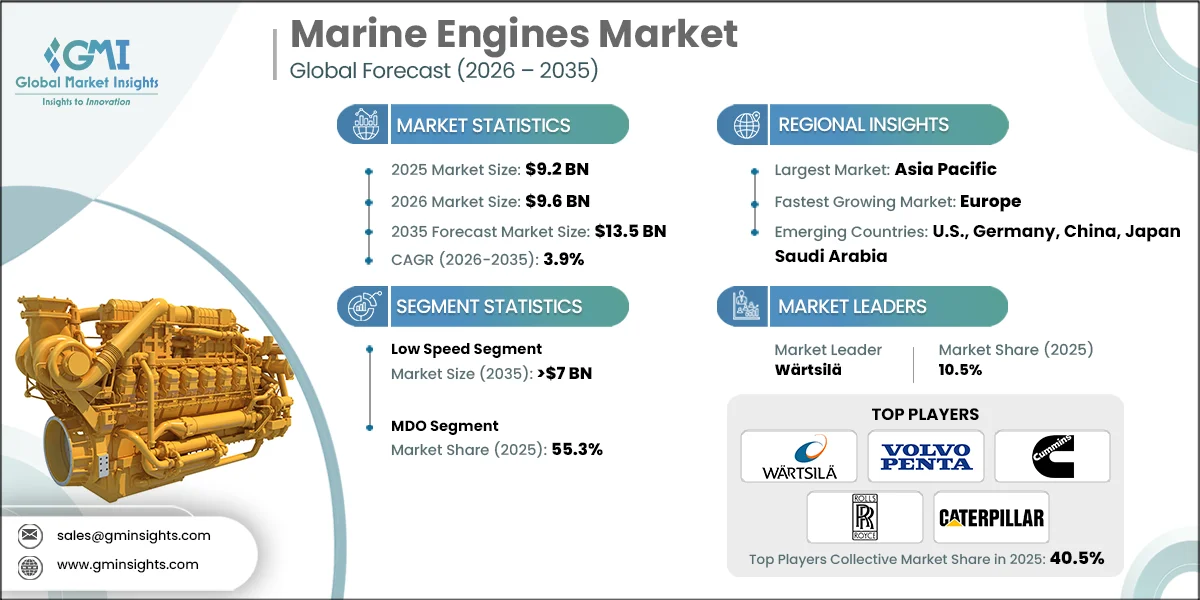
The global marine engines market was estimated at USD 9.2 billion in 2025. The market is expected to grow from USD 9.6 billion in 2026 to USD 13.5 billion by 2035, at a CAGR of 3.9%, according to a recent study by Global Market Insights Inc.
The international maritime trade and transport is being influenced by changing factors such as the cost structure & the structure of logistics, pricing patterns, and supply chain adjustments. These changes are playing a vital role in the determination of the trade competitiveness of countries. The growth of the global economy in conformity with the growth of merchandise trade will energize the industry dynamic.
The engines are crucial in the maritime propulsion system and are meant for providing power & efficiency for different types of boats, ranging from small ones to large cargo vessels. These engines are exposed to adverse weather, saltwater, and vibrations, and hence, durability and resistance to corrosion are of utmost importance. Furthermore, with the constant aim of making the engines more effective, there is a growing need for developing more reliable engines. Also, the outlook for trade by sea, combined with the economic indicators, is expected to boost the demand for the products.
For instance, according to UNCTAD, the global maritime trade sector is anticipated to post an average growth rate of around 2.4% annually until 2029. This is a result of the sustained growth in global merchandise trade and the gradual normalization of supply chains. The sustained growth in the demand for maritime trade is expected to support the growth of the sector despite the challenges it is facing. This is a testament to the significance of the maritime sector in supporting global trade and economic growth.
Marine Engines Market Trends
The industry is further undergoing a period of change with the influence of trends, which includes a move towards environmentally sustainable solutions, improvements in engine technology, and an increased focus on fuel efficiency. Furthermore, an increase in trade, modernization of the fleet, and an increase in demand for high-speed and reliable engines for use in commercial, defense, and leisure boats will positively sway the business potential. Improvements in technology, which include digital monitoring systems and improved propulsion mechanisms will foster the growth trajectory.
Marine Engines Market Analysis
The low speed marine engines market is set to reach over USD 7 billion by 2035. The development of seaports and the increasing demand for tugboats will boost the penetration of the product. The performance and compactness of the engines contribute to the increasing demand for the product. Small vessels, ferries, boats, yachts, and fishing boats are the applications of the engines. Four-stroke engines with fewer cylinders fall under this category. The engines operate at a rated speed range. The compactness of the engines not only facilitates easier installation but also increases the performance of the engines.
The MDO marine engines market holds a market share of 55.3% in 2025. These engines will gain appreciable momentum owing to their high speeds, low noise levels, and suitability for series production. This system is cost-effective as it has fewer working components, offers better fuel efficiency compared to two-stroke engines as fuel is burnt once every four strokes, and also does not require extra fuel or lubricants as well as reduced emissions.
U.S. marine engines market was estimated at USD 890.1 million in 2025. The rising need to ensure operational reliability in ships is set to propel the product deployment phase. Increased focus on boosting diesel engine potential to fuel next-generation advanced tanks is also expected to fuel growth in this industry. Moreover, the factors such as an increase in demand for comfort & luxury, engine performance, growth in the maritime transportation industry, and economic stability are set to accelerate this industry dynamics.
For instance, the Port Infrastructure Development Program, administered by the Maritime Administration of the US, offers competitive grant funding to support improvements to safety, efficiency, and reliability of freight movement related to ports. Additionally, USD 2.25 billion has been allocated to this program under the Bipartisan Infrastructure Law to support 2022-2026, including USD 450 million in FY 2026, as well as potential future appropriations.
The marine engines market in the Asia Pacific will witness an upsurge on account of increasing trade with the help of the rising exploration and production activities. The use of advanced technology and the need for the upcoming environmental regulations are also fueling the use of marine engines. Increasing investments in port infrastructure and the seaborne trade will propel the business scenario.
Marine Engines Market Share
The companies operating in the market are implementing various strategies to improve their market presence and meet the changing needs of the industry. Investments are being made by the companies in research and development to incorporate the latest technologies that will improve the performance of the engines. Partnerships are done with the companies operating in the industry and the shipbuilding sector to expand the market presence and promote innovation. Continuous focus is being given by the companies to the after-sales services provided by the companies to ensure customer retention and industry growth.
Marine Engines Market Companies
Major players operating in the marine engines industry are:
AB Volvo Penta
Anglo Belgian Corporation
Caterpillar
Cummins
DAIHATSU INFINEARTH
DEUTZ
Deere & Company
Everllence
Hyundai Heavy Industries
IHI Corporation
Mercury Marine
Mitsubishi Heavy Industries
Rolls-Royce
Société Internationale des Moteurs Baudouin
Scania
Shanghai Diesel Engine
STX Engines
Wärtsilä
Weichai Holding Group
Yamaha Motor
YANMAR HOLDINGS
Yuchai International
Marine Engines Industry News
In October 2025, Rolls-Royce successfully tested a high-speed marine engine that uses only methanol as fuel. This is a significant step forward in low-carbon propulsion for ships. The innovation comes from a research project called meOHmare, which involved Rolls-Royce and two other companies, WTZ Roßlau and Woodward L’Orange. This achievement is a step in the right direction in our journey to a climate-neutral future at sea. It will allow ship operators to reduce CO2 emissions by a large amount without compromising speed and reliability. This achievement aligns well with its strategy for sustainable growth.
In January 2025, Deere & Company introduced their JD18 & JD14 series of marine engines, with power range from 298 kW (400 HP) to 599 kW (803 HP), for use in commercial fishing, passenger boats, and work boats, offering high performance benefits as well as fuel efficiency. These marine engines were based on Deere's Next Generation Engine technology, which offered features such as a high-pressure common rail fuel system, fluid service intervals, and IMO Tier 2, EPA Tier 3, and EU RCD II certification.
The marine engines market research report includes in-depth coverage of the industry with estimates & forecast in terms of volume (Units) & revenue (USD Million) from 2022 to 2035, for the following segments:
Market, By Product
MDO
MGO
LNG
Hybrid
Others
Market, By Power
< 1,000 HP
1,000 - 5,000 HP
5,001 - 10,000 HP
10,001 - 20,000 HP
> 20,000 HP
Market, By Technology
Low speed
Medium speed
High speed
Market, By Propulsion
2 stroke
4 stroke
Market, By Application
Merchant
Container vessels
Tankers
Bulk carriers
Gas carriers
RO-RO
Others
Offshore
Drilling rigs & ships
Anchor handling vessels
Offshore support vessels
Floating production units
Platform supply vessels
Cruise & ferry
Cruise vessels
Passenger ferries
Passenger/cargo vessels
Others
Navy
Others
The above information has been provided for the following regions and countries:
North America
U.S.
Canada
Europe
Germany
UK
Italy
Norway
France
Russia
Denmark
Asia Pacific
China
Japan
India
South Korea
Australia
Vietnam
Middle East & Africa
Saudi Arabia
UAE
Iran
Angola
Egypt
South Africa
Latin America
Brazil
Argentina
Mexico