
Glutathione Market Size & Share 2026-2035
Download Free PDF
Report Content
Chapter 1. Research Methodology
1.1 Research Approach
1.2 Quality Commitments
1.2.1 GMI AI Policy & Data Integrity Commitment
1.2.1.1 Source Consistency Protocol
1.3 Research Trail & Confidence Scoring
1.3.1 Research Trail Components
1.3.2 Scoring Components
1.4 Data Collection
1.4.1 Partial List of Primary Sources
1.5 Data Mining Sources
1.5.1 Paid Sources
1.5.1.1 Sources, By Region
1.6 Base Estimates & Calculations
1.6.1 Base Year Calculation
1.7 Forecast Model
1.7.1 Quantified Market Impact Analysis
1.7.1.1 Mathematical Impact of Growth Parameters on Forecast
1.8 Research Transparency Addendum
1.8.1 Source Attribution Framework
1.8.2 Quality Assurance Metrics
1.8.3 Our Commitment to Trust
Chapter 2. Executive Summary
2.1 Industry 360° Synopsis
2.2 Key Market Trends
2.2.1 Product Type Trends
2.2.2 Product Form Trends
2.2.3 Application Trends
2.2.4 Regional Trends
2.3 TAM analysis, 2027-2035 (USD Billion)
2.4 CXO Perspectives: Strategic Imperatives
Chapter 3. Industry Insights
3.1 Industry Ecosystem Analysis
3.1.1 Supplier Landscape
3.1.2 Profit Margin
3.1.3 Cost Structure
3.1.4 Value Addition at Each Stage
3.1.5 Factors Affecting the Value Chain
3.1.6 Disruptions
3.2 Industry Impact Forces
3.2.1 Growth Drivers
3.2.2 Industry Pitfalls & Challenges
3.2.3 Market Opportunities
3.3 Growth Potential Analysis
3.4 Pricing Analysis (Driven by Primary Research)
3.4.1 Historical Price Trend Analysis (Driven by Primary Research)
3.4.2 Pricing Strategy by Player Type (Premium / Value / Cost-plus) (Driven by Primary Research)
3.5 Regulatory Landscape
3.5.1 North America
3.5.2 Europe
3.5.3 Asia Pacific
3.5.4 Latin America
3.5.5 Middle East & Africa
3.6 Porter's Analysis
3.7 PESTEL Analysis
3.8 Trade Data Analysis (Based on Paid Database)
3.8.1 Import/Export Volume & Value Trends (Based on Paid Database)
3.8.2 Key Trade Corridors & Tariff Impact (Based on Paid Database)
3.9 Impact of AI & Generative AI on the Market (Driven by Primary Research)
3.9.1 AI-Driven Disruption of Existing Business Models
3.9.2 GenAI Use Cases & Adoption Roadmap by Segment
3.9.3 Risks, Limitations & Regulatory Considerations
3.10 Capacity & Production Landscape (Driven by Primary Research)
3.10.1 Production Capacity by Region & Key Producer (Driven by Primary Research)
3.10.2 Capacity Utilization Rates & Expansion Pipelines (Driven by Primary Research)
3.11 Forecast Assumptions & Scenario Analysis (Driven by Primary Research)
3.11.1 Base Case — Key Macro & Industry Variables Driving CAGR
3.11.2 Optimistic Scenario — Favourable Macro & Industry Tailwinds
3.11.3 Pessimistic Scenario — Macroeconomic Slowdown or Industry Headwinds
Chapter 4. Competitive Landscape, 2025
4.1 Introduction
4.2 Company Market Share Analysis
4.2.1 By Region
4.2.1.1 North America
4.2.1.2 Europe
4.2.1.3 Asia Pacific
4.2.1.4 Latin America
4.2.1.5 Middle East & Africa
4.2.2 Market Concentration Analysis
4.3 Competitive Analysis of Major Market Players
4.4 Competitive Positioning Matrix
4.5 Key Developments
4.5.1 Mergers & Acquisitions
4.5.2 Partnerships & Collaborations
4.5.3 New Product Launches
4.5.4 Expansion Plans & Funding
4.6 Company Tier Benchmarking
4.6.1 Tier Classification Criteria & Qualifying Thresholds
4.6.2 Tier Positioning Matrix by Revenue, Geography & Innovation
Chapter 5. Glutathione Market Estimates & Forecast, By Product Type (USD Million, 2022–2035)
5.1 Key Trends & Opportunities by Product Type
5.2 Reduced Glutathione (GSH)
5.2.1 Pharmaceutical-Grade GSH
5.2.2 Nutraceutical-Grade GSH
5.2.3 Cosmetic-Grade GSH
5.3 Oxidized Glutathione (GSSG)
5.3.1 Pharmaceutical-Grade GSSG
5.3.2 Research & Industrial-Grade GSSG
5.4 Glutathione Precursors & Derivatives
5.4.1 N-Acetylcysteine (NAC)
5.4.2 S-Acetyl Glutathione
5.4.3 Other Precursors & Derivatives
5.5 Others
Chapter 6. Glutathione Market Estimates & Forecast, By Product Form (USD Million, 2022–2035)
6.1 Key Trends & Opportunities by Product Form
6.2 Oral Solid
6.2.1 Capsules
6.2.2 Tablets
6.2.3 Lozenges
6.3 Liquid & Injectable
6.3.1 Intravenous (IV) Glutathione Solutions
6.3.2 Oral Liquid Formulations
6.4 Topical
6.4.1 Creams & Lotions
6.4.2 Serums & Concentrates
6.4.3 Patches
6.5 Inhalation
6.5.1 Nebulized Glutathione
6.5.2 Dry Powder Inhalation
6.6 Others
Chapter 7. Glutathione Market Estimates & Forecast, By Application / End-Use (USD Million, 2022–2035)
7.1 Key Trends & Opportunities by Application
7.2 Pharmaceuticals
7.2.1 Liver Disease & Hepatoprotective Therapy
7.2.2 Chemotherapy Support & Oncology Adjunct
7.2.3 Neurological Disorders (Parkinson's, Alzheimer's)
7.2.4 Immune Dysfunction & Infectious Disease Management
7.2.5 Other Pharmaceutical Applications
7.3 Nutraceuticals & Dietary Supplements
7.3.1 Immune Boosting & General Wellness Supplements
7.3.2 Anti-Aging & Longevity Formulations
7.3.3 Sports Nutrition & Athletic Recovery
7.3.4 Detoxification & Liver Support Supplements
7.4 Cosmetics & Personal Care
7.4.1 Skin-Brightening & Depigmentation Products
7.4.2 Anti-Aging & Wrinkle-Reduction Formulations
7.4.3 IV Aesthetic Therapy (Wellness Clinics & Drip Bars)
7.4.4 Hair Care Applications
7.5 Food & Beverages
7.5.1 Functional Foods with Antioxidant Claims
7.5.2 Food Preservation & Shelf-Life Extension
7.5.3 Functional Beverages & Health Drinks
7.6 Others
7.6.1 Veterinary & Animal Health
7.6.2 Research & Diagnostic Applications
Chapter 8. Glutathione Market Estimates & Forecast, By Region (USD Million, 2022–2035)
8.1 Key Trends
8.2 North America
8.2.1 U.S.
8.2.2 Canada
8.3 Europe
8.3.1 Germany
8.3.2 UK
8.3.3 France
8.3.4 Rest of Europe
8.4 Asia Pacific
8.4.1 China
8.4.2 Japan
8.4.3 South Korea
8.4.4 India
8.4.5 Rest of Asia Pacific
8.5 Latin America
8.5.1 Brazil
8.5.2 Mexico
8.5.3 Rest of Latin America
8.6 Middle East & Africa
8.6.1 South Africa
8.6.2 Saudi Arabia
8.6.3 UAE
8.6.4 Rest of Middle East & Africa
Chapter 9. Company Profiles (Driven by Primary Research)
Don't see your key competitors?
The companies listed in this report are a curated selection - not the full competitive universe.
Our market revenue calculations use a bottom-up methodology that accounts for all players across all regions - including manufacturers, distributors, and specialists not individually profiled. The profiles section spotlights strategically significant players; it does not define the scope of our market sizing.
Your competitive landscape may also include
Free customization - up to 20% of report value
Need specific data? Request customization and get the insights tailored to your exact requirements.
For inquiries regarding discounts, bulk purchases, or customization requests, please contact us at [email protected]
Share Content
Add Citations
Kiran Pulidindi. 2026, September. Glutathione Market Size – By Product, Application Analysis, Share, Growth Forecast, 2025 - 2034 (Report ID: GMI4147). Global Market Insights Inc. Retrieved November 11, 2026, from https://www.gminsights.com/toc/details/glutathione-market

Glutathione Market
Get a free sample of this report
Glutathione Market Size
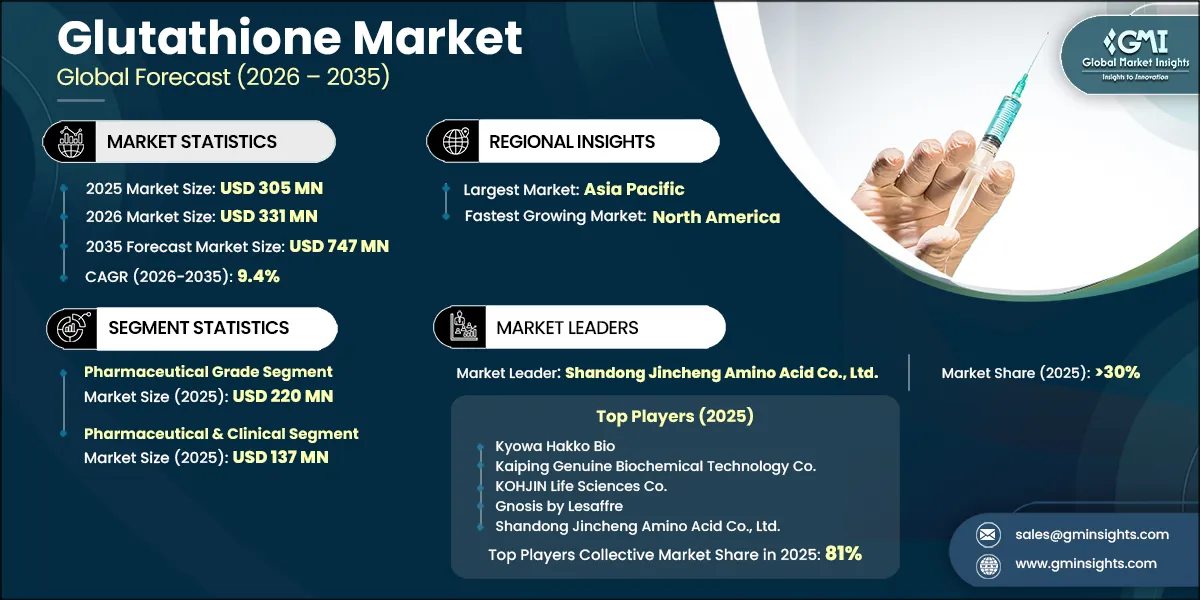
The glutathione market was valued at USD 305 million in 2025, advanced to USD 331 million in 2026, and is projected to grow at a 9.4% CAGR from 2026 to 2035, reaching USD 747 million by 2035.
The glutathione market is being reshaped by demand for higher-purity material and differentiated delivery formats rather than by broad-based volume expansion alone. Pharmaceutical procurement, branded supplement formulations, and clinically positioned wellness channels are increasing the value captured per unit, while fermentation capacity and grade-specific qualification requirements continue to influence supply availability and product mix.
GMI Analyst View
Based on our consultations with glutathione manufacturers and procurement buyers across end-use industries, we expect volume demand to grow at a 6.1% CAGR from 2026 to 2035. The difference between physical demand expansion and market value growth indicates a durable premiumization cycle, with formulators favoring higher-purity grades and differentiated delivery systems that improve positioning, qualification, and realized pricing.
Glutathione Market Trends, Growth Drivers & GMI Forecast Outlook
Demand is widening across premium wellness, clinical, and beauty-oriented uses, yet commercial outcomes will depend on the ability of suppliers and formulators to navigate grade qualification, constrained high-quality supply, and evolving regulatory pathways for differentiated glutathione derivatives.
Key Drivers
Evidence anchors use cited external data; demand implications and forecast conditions represent GMI analysis.
The supplement channel provides an increasingly receptive setting for glutathione products that can establish a clear efficacy, quality, or bioavailability proposition. Established retail, direct-to-consumer, and practitioner-led channels allow branded ingredients and advanced formats to compete on formulation value rather than only on ingredient cost. This favors suppliers able to offer reliable specifications, supporting documentation, and delivery formats suited to premium consumer positioning.
IV therapy broadens the professional demand base for pharmaceutical- and clinical-grade glutathione by connecting raw-material qualification to a service-led wellness setting. The channel's economics favor traceable supply and high-grade material, while its local regulatory exposure makes documentation and appropriate product positioning central to sustained adoption. Its influence is therefore larger than its physical footprint alone would suggest.
A favorable novel-food safety opinion for S-acetyl glutathione creates a potential route for European product differentiation, subject to the relevant authorization process. The opportunity is commercially important because it permits formulators to position a derivative around stability and delivery characteristics rather than relying solely on standard reduced glutathione. That distinction may strengthen the premium supplement proposition in markets where evidence standards and ingredient differentiation influence purchasing decisions.
Key Restraints
Evidence anchors use cited external data; demand implications and forecast conditions represent GMI analysis.
Manufacturing remains concentrated among fermentation producers with the scale, process control, and qualification history required by regulated and premium-use customers. For buyers, supplier concentration raises the importance of procurement continuity, batch consistency, and alternative-source qualification. These requirements can lengthen switching cycles and preserve incumbent advantages even where downstream demand expands.
Pharmaceutical-grade pricing separates clinical demand from lower-specification consumer uses. Formulators serving cost-sensitive markets may favor nutraceutical or cosmetic positioning where appropriate, while clinical suppliers must absorb the cost of higher-purity manufacturing, documentation, and quality systems. This creates a persistent hierarchy in which value growth can outpace broader material accessibility.
Injectable use is subject to a materially different compliance threshold from conventional supplement applications. FDA guidance distinguishes dietary supplement-grade glutathione from material suitable for compounded sterile injectables, reinforcing the need for defined quality credentials in clinical supply chains [5]. For suppliers, the resulting burden is not merely procedural; it shapes capital allocation, customer qualification, and the range of channels that can be served credibly.
GMI Analyst View
We see the market's central tension as the coexistence of widening consumer and professional demand with a supply chain that remains selective at the highest-value grades. Commercial winners will be those that can convert compliance, traceability, and delivery differentiation into durable customer preference rather than simply expanding bulk availability.
Glutathione Market Segment Analysis
By Grade/Type
Pharmaceutical Grade generated USD 220 million in revenue in 2025 and is projected to account for 69.7% of market revenue by 2035. Pharmaceutical Grade remains the value anchor of the glutathione market because injectable, IV, and regulated oral applications require stringent specifications and dependable documentation. Its position is reinforced by the cost and qualification barriers facing new suppliers, even as faster-growing consumer uses gradually broaden the market mix.
Nutraceutical/Food Grade is projected to reach USD 162 million by 2035 and is forecast to expand at a 10.4% CAGR (2026–2035). Nutraceutical/Food Grade benefits from the convergence of consumer interest in antioxidant support, direct-to-consumer brand building, and formulation innovation. Liposomal, reduced, and specialty derivative formats give supplement marketers routes to differentiate products beyond standard commodity positioning, supporting premium ingredient selection across retail and digital channels.
Cosmetic Grade is projected to reach USD 64 million by 2035 and represented 8.2% of market revenue in 2025. Cosmetic Grade demand is shaped by skin-health, brightening, and anti-aging product development, particularly where consumers already recognize glutathione as a premium beauty active. Encapsulation and topical-delivery innovation are important to the segment's commercial logic because they allow formulators to focus on product performance and application-specific differentiation.
By Application
Pharmaceutical & Clinical generated USD 137 million in revenue in 2025 and is projected to hold 41.0% of market revenue by 2035. Pharmaceutical & Clinical use depends on a narrow set of supply partners capable of meeting quality, documentation, and procurement requirements. Clinical and IV-related channels therefore sustain an attractive value pool, although their expansion is influenced by regulatory oversight and the availability of qualified material rather than consumer demand alone.
Dietary Supplements are projected to reach USD 269 million by 2035 and are forecast to expand at a 10.6% CAGR (2026–2035). Dietary Supplements are the market's most responsive application to consumer wellness trends, particularly where branded products can link glutathione to cellular-health, antioxidant, and longevity narratives. The category's growth will favor suppliers that combine credible ingredient differentiation with formats tailored to e-commerce, specialty retail, and practitioner-supported distribution.
Cosmetics & Personal Care represented 15.1% of market revenue in 2025 and is projected to reach USD 120 million by 2035. Cosmetics & Personal Care creates a distinct demand pool because purchasing decisions are influenced by visible product claims, sensory formulation, and premium skincare positioning. Growth is supported by the ability of manufacturers to incorporate glutathione into differentiated beauty systems rather than rely on the ingredient as a stand-alone claim.
Food & Beverages represented 7.0% of market revenue by 2035 and generated USD 24 million in revenue in 2025. Food & Beverages face a more constrained route to scale than supplements because thermal stability, sensory compatibility, and jurisdiction-specific food rules complicate mainstream formulation. Commercial adoption is therefore likely to remain concentrated in specialized functional offerings and adjacent wellness products rather than broad mass-market beverage formats.
GMI Analyst View
We expect segment competition to increasingly center on the boundary between high-value clinical material and premium consumer formulations. Pharmaceutical applications retain their defensible qualification moat, while supplements and beauty products offer the more flexible arena for delivery innovation, branded ingredients, and consumer-facing differentiation.
Glutathione Market Regional Analysis
North America Glutathione Market Analysis
The North America glutathione market generated USD 101 million in revenue in 2025 and is forecast to grow at a 10.0% CAGR (2026–2035). North America combines sophisticated supplement distribution with a developed professional wellness infrastructure, making it an important market for premiumized glutathione products. Demand is especially responsive to branded delivery formats, traceable supply, and formulations positioned around high-value consumer and clinical use cases.
United States
The United States generated USD 91 million in revenue in 2025 and is projected to reach USD 236 million by 2035. The United States remains the region's commercial center because national supplement distribution, consumer familiarity with specialized wellness ingredients, and professional IV channels reinforce one another. Regulatory attention to sterile compounding makes quality credentials particularly meaningful for suppliers serving clinical-adjacent demand.
Canada
Canada generated USD 10 million in revenue in 2025 and is projected to reach USD 26 million by 2035. Canada benefits from established premium wellness retail and e-commerce channels, while its regulated natural-health-product environment provides a defined setting for supplement commercialization. The country's demand profile supports measured adoption of differentiated glutathione formulations rather than a purely price-led market.
Europe Glutathione Market Analysis
The Europe glutathione market is projected to reach USD 94 million by 2035 and represented 12.5% of global market revenue in 2025. Europe's opportunity is closely linked to regulatory acceptance, evidence-led formulation, and the capacity of premium ingredient suppliers to meet market-specific requirements. Novel-food developments may expand the addressable space for differentiated glutathione derivatives, but commercial realization will vary by national pathway and authorization timing.
Germany
Germany generated USD 9.5 million in revenue in 2025 and is projected to reach USD 23.5 million by 2035. Germany's pharmaceutical and evidence-oriented supplement environment supports demand for documented, high-quality glutathione ingredients. The market is positioned to reward suppliers that can provide credible technical substantiation and align product claims with a tightly governed health and nutrition landscape.
United Kingdom
The United Kingdom generated USD 7.6 million in revenue in 2025 and represented 20.0% of European market value in 2025. The United Kingdom offers a commercially attractive mix of consumer interest in longevity, skin health, and wellness supplementation, but suppliers must navigate a national authorization framework distinct from the European Union. This makes regulatory planning and local commercialization capability important competitive differentiators.
France
France represented 15.0% of European market revenue in 2025 and is projected to reach USD 14.1 million by 2035. France's opportunity extends across pharmaceutical and prestige beauty applications, where glutathione can be positioned within quality-led, high-value formulations. Its cosmetics ecosystem gives the market an additional route to demand that is less dependent on conventional supplement growth alone.
Asia Pacific Glutathione Market Analysis
The Asia Pacific glutathione market represented 53.4% of global market revenue in 2025 and is projected to reach USD 385 million by 2035. Asia Pacific is the market's principal manufacturing and consumption center, combining fermentation capability with deep use across pharmaceutical, cosmetic, and nutraceutical applications. Its scale supports broad supplier ecosystems, although local competition and differing quality expectations make commercial positioning highly market-specific.
China
China generated USD 89.7 million in revenue in 2025 and is projected to reach USD 211.8 million by 2035. China's dual role as a major production base and an expanding domestic demand market creates a distinctive competitive position. Suppliers are investing in quality systems and export-facing capabilities while serving local pharmaceutical, beauty, and wellness channels that continue to broaden in sophistication.
Japan
Japan represented 20.0% of Asia Pacific market revenue in 2025 and is projected to reach USD 77 million by 2035. Japan's demand is supported by established pharmaceutical use, mature nutraceutical purchasing behavior, and a long-standing beauty-market role for glutathione. Rigorous quality expectations favor technically differentiated offerings and support premium positioning for products that meet the country's high standards.
South Korea
South Korea generated USD 13 million in revenue in 2025 and is projected to reach USD 30.8 million by 2035. South Korea's skincare culture and influential beauty-product ecosystem provide a strong setting for cosmetic and wellness-oriented glutathione use. The country's ability to translate local beauty trends into internationally visible product concepts further strengthens the strategic importance of its demand base.
India
India generated USD 8.2 million in revenue in 2025 and is projected to reach USD 19.3 million by 2035. India's market is advancing through pharmaceutical demand and an expanding urban supplement consumer base. Quality and safety expectations around injectable use will remain important in determining how quickly clinical and aesthetic channels can expand on a durable basis.
Latin America Glutathione Market Analysis
The Latin America glutathione market generated USD 2 million in revenue in 2025 and is projected to reach USD 4 million by 2035. Latin America offers selective expansion potential through urban supplement consumers and aesthetic-medicine channels, although high-grade material remains difficult to scale where purchasing power and premium-health infrastructure are limited. Market development will depend on local distribution capability and appropriately positioned price points.
Brazil
Brazil generated USD 1.2 million in revenue in 2025 and is projected to reach USD 2.4 million by 2035. Brazil provides the region's most material platform for premium wellness and beauty-oriented glutathione formulations. Its established health and wellness retail ecosystem gives suppliers a practical route to build consumer awareness and premium product adoption.
Mexico
Mexico is supported by pharmaceutical-channel demand and an emerging supplement base. The country's opportunity is tied to the development of credible retail and professional channels for qualified glutathione products. Suppliers that can align grade, price, and local distribution strategy will be better placed to translate emerging interest into sustained sales.
Middle East & Africa Glutathione Market Analysis
The Middle East & Africa glutathione market generated USD 1 million in revenue in 2025 and is projected to reach USD 2 million by 2035. Middle East & Africa demand is concentrated in premium aesthetic, wellness, and better-resourced healthcare settings. The region's smaller size does not eliminate its strategic relevance, as specialty clinic infrastructure and premium beauty demand can create concentrated opportunities for appropriately qualified material.
Saudi Arabia
Saudi Arabia generated USD 0.3 million in revenue in 2025 and is projected to reach USD 0.6 million by 2035. Saudi Arabia's premium wellness and aesthetic-care setting supports demand for specialty formulations, particularly where provider-led channels can communicate quality and product differentiation. The pace of growth will depend on the depth of specialized distribution and clinic adoption.
United Arab Emirates
The United Arab Emirates represented 30.0% of Middle East & Africa market revenue in 2025 and is projected to reach USD 0.6 million by 2035. The United Arab Emirates benefits from a concentration of aesthetic medicine, wellness services, and medical-tourism activity. These attributes make it an important regional reference point for professionally administered and high-value consumer glutathione applications.
South Africa
South Africa contributes to regional pharmaceutical and supplement demand through a developing retail and healthcare base. Its market potential depends on accessible product formats, reliable distribution, and the extent to which premium glutathione propositions can be adapted to local affordability and regulatory conditions.
GMI Analyst View
We view regional performance as increasingly differentiated by channel architecture rather than geography alone. Asia Pacific retains its scale advantage, North America offers the strongest premium-channel responsiveness, and Europe's upside depends on regulatory translation. Smaller regions can develop attractive niches, but only where qualified supply and premium distribution mature together.
Glutathione Market Share & Competitive Landscape
The glutathione market share structure is concentrated at the manufacturer level, with the top five producers collectively holding approximately 81% of global market revenue in 2025. Scale fermentation, pharmaceutical-grade qualification, and the cost of building durable customer approval processes create meaningful barriers to entry and reinforce the influence of established producers.
Shandong Jincheng Amino Acid Co., Ltd. held approximately 30% market share in 2025.
The company's leadership reflects production scale and its ability to supply multiple glutathione grades across domestic and export markets. Its position materially influences buyer sourcing strategies, particularly where customers require reliable, high-volume supply with consistent quality specifications.
Kyowa Hakko Bio Co., Ltd. / Meihua Holdings held 20% market share in 2025.
Kyowa Hakko Bio's amino acid business transfer to Meihua Holdings expanded Chinese ownership of established fermentation capability, while branded ingredient activities retained a distinct commercial role [7]. This separation illustrates how bulk manufacturing scale and branded, application-specific ingredient programs can coexist as different sources of competitive advantage.
Kaiping Genuine Biochemical Technology Co., Ltd. held 16% market share in 2025.
Kaiping Genuine's market position is supported by its participation in pharmaceutical and nutraceutical supply, where dependable capacity and grade flexibility are commercially important. Competitive pressure from such scaled producers is likely to remain strongest in bulk supply, while technical differentiation will be increasingly important in premium formulations.
KOHJIN Life Sciences Co., Ltd. and Mitsubishi Corporation Life Sciences Limited are positioned around technical differentiation, pharmaceutical-grade manufacturing capability, and downstream commercial reach. Their ability to serve regulated and premium customers strengthens their relevance where qualification standards matter as much as price.
Merck KGaA participates through life-science supply capabilities that are aligned with research, pharmaceutical, and regulated-use customers. Its established quality reputation and distribution infrastructure support a differentiated position in applications where procurement risk and documentation requirements are central.
Shenzhen GSH Bio-Technology Co., Ltd. contributes to the China-based fermentation supply base serving pharmaceutical and nutraceutical customers. Gnosis by Lesaffre is differentiated by branded ingredient development, including S-acetyl glutathione positioning for premium supplement applications. Jarrow Formulas, Inc. and NOW Foods influence demand from the downstream side through branded consumer supplement products, helping shape format preferences and ingredient expectations in North American retail channels.
Recent Industry Developments
EFSA issued a positive safety opinion for chemically synthesized S-acetyl glutathione, subject to subsequent European Commission authorization. The development supports a potential regulatory pathway for Gnosis by Lesaffre's Emothion® ingredient in European food-supplement and related applications, creating a basis for premium product differentiation [1].
Kyowa Hakko announced that a finished dietary supplement containing Setria® glutathione received registration approval for sale in Chile through SEREMI de Salud. The development, undertaken with Nutrapharm, extends the branded ingredient's commercial presence in Latin American supplement channels [6].
Need a specific section of this report?
Purchase regional analysis, country-level analysis, company profiles, or any other segment-level insights separately
based on your research needs.