
Forklift Market Size & Share 2026-2035
Download Free PDF
Report Content
Chapter 1. Research Methodology
1.1 Research Approach
1.2 Quality Commitments
1.2.1 GMI AI Policy & Data Integrity Commitment
1.2.1.1 Source Consistency Protocol
1.3 Research Trail & Confidence Scoring
1.3.1 Research Trail Components
1.3.2 Scoring Components
1.4 Data Collection
1.4.1 Partial List of Primary Sources
1.5 Data Mining Sources
1.5.1 Paid Sources
1.5.1.1 Sources, by Region
1.6 Base Estimates and Calculations
1.6.1 Base Year Calculation
1.7 Forecast Model
1.7.1 Quantified Market Impact Analysis
1.7.1.1 Mathematical Impact of Growth Parameters on Forecast
1.8 Research Transparency Addendum
1.8.1 Source Attribution Framework
1.8.2 Quality Assurance Metrics
1.8.3 Our Commitment to Trust
Chapter 2. Executive Summary
2.1 Industry 360° Synopsis
2.2 Key Market Trends
2.2.1 Product Type Trends
2.2.2 Fuel Type Trends
2.2.3 Class Trends
2.2.4 End-Use Trends
2.2.5 Regional Trends
2.3 TAM Analysis, 2027–2035
2.4 CXO Perspectives: Strategic Imperatives
Chapter 3. Industry Insights
3.1 Industry Ecosystem Analysis
3.1.1 Supplier Landscape
3.1.2 Profit Margin
3.1.3 Cost Structure
3.1.4 Value Addition at Each Stage
3.1.5 Factors Affecting the Value Chain
3.1.6 Disruptions
3.2 Industry Impact Forces
3.2.1 Growth Drivers
3.2.1.1 Rapid Expansion of E-Commerce & Warehousing Infrastructure Driving Fleet Demand Globally
3.2.1.2 Rising Labor Costs Accelerating Adoption of Electric & Automated Material Handling Equipment
3.2.1.3 Accelerating Fleet Electrification Supported by Stringent Emission Regulations & Lower Total Cost of Ownership
3.2.2 Industry Pitfalls and Challenges
3.2.2.1 High Upfront Capital Cost of Electric & Hydrogen Forklift Platforms Limiting Adoption Among SMEs
3.2.2.2 Persistent Shortage of Certified Forklift Operators Constraining Operational Capacity Across End-Use Sectors
3.2.2.3 Intensifying Price Competition from Chinese Manufacturers Compressing Margins of Incumbent Global Players
3.2.3 Market Opportunities
3.2.3.1 Hydrogen Fuel Cell Forklifts Gaining Traction in Heavy-Duty Multi-Shift Operations Requiring Rapid Refueling
3.2.3.2 Growth of Rental, Refurbished & Fleet-as-a-Service Models Unlocking Demand Among Cost-Sensitive Buyers
3.2.3.3 Greenfield Logistics Hub Development Across Southeast Asia & Middle East Creating New High-Volume Demand Pockets
3.3 Growth Potential Analysis
3.4 Pricing Analysis (Driven by Primary Research)
3.4.1 Historical Price Trend Analysis
3.4.2 Pricing Strategy by Player Type (Premium / Value / Cost-Plus)
3.5 Regulatory Landscape
3.5.1 North America
3.5.2 Europe
3.5.3 Asia Pacific
3.5.4 Latin America
3.5.5 Middle East & Africa
3.6 Porter’s Analysis
3.7 PESTEL Analysis
3.8 Trade Data Analysis (Based on Paid Database)
3.8.1 Import/Export Volume & Value Trends
3.8.2 Key Trade Corridors & Tariff Impact
3.9 Impact of AI & Generative AI on the Market (Driven by Primary Research)
3.9.1 AI-Driven Disruption of Existing Business Models
3.9.2 GenAI Use Cases & Adoption Roadmap by Segment
3.9.3 Risks, Limitations & Regulatory Considerations
3.10 Patent Landscape (Driven by Primary Research)
3.11 Capacity & Production Landscape (Driven by Primary Research)
3.11.1 Installed Production Capacity by Region & Key Manufacturer
3.11.2 Capacity Utilization Rates & Expansion Pipelines
Chapter 4. Competitive Landscape, 2025
4.1 Introduction
4.2 Company Market Share Analysis
4.2.1 By Region
4.2.1.1 North America
4.2.1.2 Europe
4.2.1.3 Asia Pacific
4.2.1.4 Latin America
4.2.1.5 Middle East & Africa
4.2.2 Market Concentration Analysis
4.3 Competitive Analysis of Major Market Players
4.4 Competitive Positioning Matrix
4.5 Key Developments
4.5.1 Mergers & Acquisitions
4.5.2 Partnerships & Collaborations
4.5.3 New Product Launches
4.5.4 Expansion Plans and Funding
4.6 Company Tier Benchmarking
4.6.1 Tier Classification Criteria & Qualifying Thresholds
4.6.2 Tier Positioning Matrix by Revenue, Geography & Innovation
Chapter 5. Market Estimates and Forecast, By Product Type, 2022–2035 (USD Billion, Thousand Units)
5.1 Key Trends
5.2 Warehouse Forklift
5.2.1 Reach Trucks
5.2.2 Order Pickers
5.2.3 Pallet Stackers
5.2.4 Narrow Aisle Turret Trucks
5.3 Counterbalance Forklift
5.3.1 Sit-Down Counterbalance
5.3.2 Stand-Up Counterbalance
Chapter 6. Market Estimates and Forecast, By Fuel Type, 2022–2035 (USD Billion, Thousand Units)
6.1 Key Trends
6.2 Electric
6.2.1 Lead-Acid Battery
6.2.2 Lithium-Ion Battery
6.2.3 Hydrogen Fuel Cell
6.3 Diesel
6.4 LPG/CNG
6.5 Gasoline
Chapter 7. Market Estimates and Forecast, By Class, 2022–2035 (USD Billion, Thousand Units)
7.1 Key Trends
7.2 Class I (Electric Motor Rider Trucks)
7.3 Class II (Electric Motor Narrow Aisle Trucks)
7.4 Class III (Electric Motor Hand Trucks)
7.5 Class IV (IC Engine Trucks)
7.6 Class V (IC Engine Trucks)
7.7 Others (Class VI Tractors & Class VII Rough Terrain)
Chapter 8. Market Estimates and Forecast, By End Use, 2022–2035 (USD Billion, Thousand Units)
8.1 Key Trends
8.2 Chemical
8.3 Food & Beverages
8.4 Industrial
8.5 Logistics
8.6 Retail & E-Commerce
8.7 Others
Chapter 9. Market Estimates and Forecast, By Region, 2022–2035 (USD Billion, Thousand Units)
9.1 Key Trends
9.2 North America
9.2.1 U.S.
9.2.2 Canada
9.3 Europe
9.3.1 Germany
9.3.2 UK
9.3.3 France
9.3.4 Italy
9.3.5 Spain
9.3.6 Rest of Europe
9.4 Asia Pacific
9.4.1 China
9.4.2 Japan
9.4.3 India
9.4.4 South Korea
9.4.5 Australia
9.4.6 Rest of Asia Pacific
9.5 Latin America
9.5.1 Brazil
9.5.2 Argentina
9.5.3 Mexico
9.5.4 Rest of Latin America
9.6 Middle East & Africa
9.6.1 GCC Countries
9.6.2 South Africa
9.6.3 Rest of Middle East & Africa
Chapter 10. Company Profiles
Don't see your key competitors?
The companies listed in this report are a curated selection - not the full competitive universe.
Our market revenue calculations use a bottom-up methodology that accounts for all players across all regions - including manufacturers, distributors, and specialists not individually profiled. The profiles section spotlights strategically significant players; it does not define the scope of our market sizing.
Your competitive landscape may also include
Free customization - up to 20% of report value
Need specific data? Request customization and get the insights tailored to your exact requirements.
For inquiries regarding discounts, bulk purchases, or customization requests, please contact us at [email protected]
Share Content
Add Citations
Avinash Singh. 2026, September. Forklift Market Size & Share 2026 - 2035 (Report ID: GMI1371). Global Market Insights Inc. Retrieved November 20, 2026, from https://www.gminsights.com/toc/details/forklift-market

Forklift Market
Get a free sample of this report
Forklift Market Size
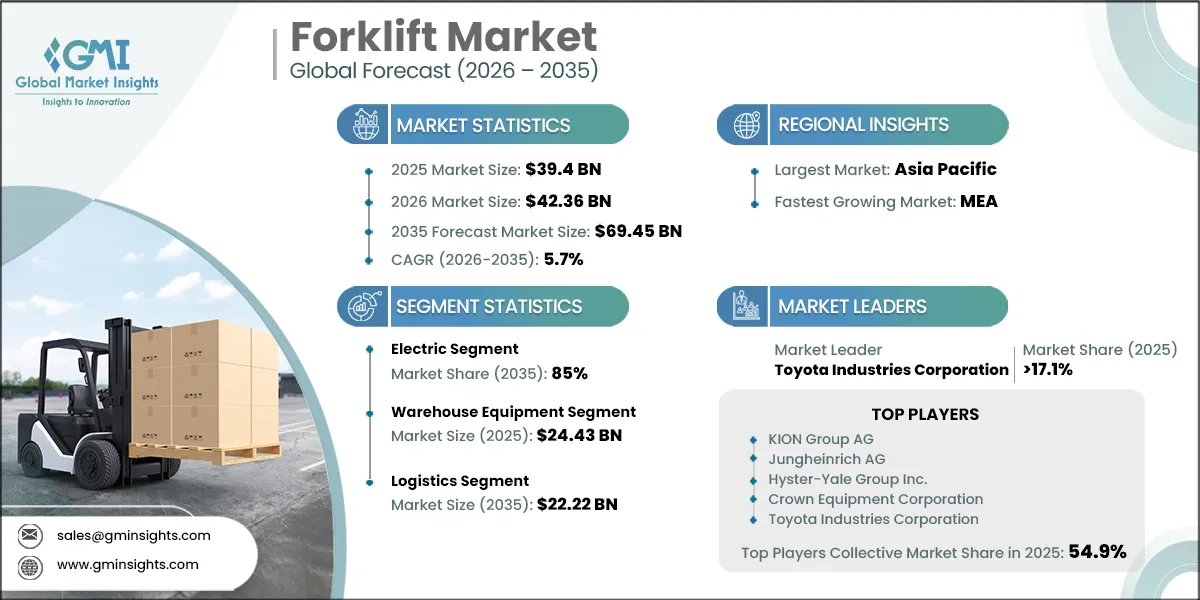
The global forklift market was valued at USD 39.4 billion in 2025, is projected to reach USD 42.36 billion in 2026, and is expected to grow at a 5.7% CAGR (2026–2035) to reach USD 69.45 billion by 2035.
The market covers OEM revenue from new powered industrial trucks used to lift, lower, and move materials across warehouses, distribution centers, manufacturing plants, ports, and construction sites. Growth reflects a transition from post-pandemic order normalization toward fleet renewal, logistics-capacity investment, and new industrial fleet formation, rather than a simple inventory replenishment cycle.
GMI Analyst View
Based on our direct engagement with industry participants, the global forklift market contracted to USD 38.00 billion in 2024 before recovering to the current base-year level. This correction reflected the absorption of elevated post-pandemic OEM backlogs rather than a structural deterioration in end-user demand. The subsequent recovery is supported by fleet renewal and first-time equipment purchasing in emerging industrial markets.
Forklift Market Trends, Growth Drivers & GMI Forecast Outlook
Warehouse investment, emissions-driven fleet replacement, and industrial diversification are expanding the addressable demand base for forklifts. The pace of electrification will depend on whether operators can absorb battery, charging, and facility-upgrade costs, particularly in smaller fleets and grid-constrained industrial locations.
Key Drivers
Evidence anchors use cited external data; demand implications and forecast conditions represent GMI analysis.
Large distribution campuses create an initial fleet requirement before they generate recurring replacement demand. High-throughput facilities typically favor reach trucks, pallet trucks, stackers, and order-picking equipment that can operate within dense storage layouts, making warehouse commissioning a direct source of electric-forklift order intake rather than merely a broad logistics indicator.
Regulation reinforces this demand by changing the replacement decision at the fleet level. As operating restrictions, corporate emissions targets, and financing criteria converge, buyers increasingly assess electric equipment against the cost and compliance burden of retaining internal-combustion fleets. This shifts OEM competition toward battery integration, charging compatibility, uptime support, and application-specific specification.
Manufacturing investment in lower-fleet-density economies adds a different demand mechanism. New electronics, pharmaceutical, automotive, and other industrial facilities require material-handling fleets at commissioning, creating demand that is less dependent on replacement calendars in established logistics markets.
Key Restraints
Evidence anchors use cited external data; demand implications and forecast conditions represent GMI analysis.
Upfront cost remains most consequential where utilization is modest and equipment financing is constrained. Smaller operators may recognize the operating-cost advantages of electric platforms while still extending the life of existing internal-combustion equipment to avoid a concentrated capital commitment. Battery leasing, warranty coverage, and fleet-service structures can reduce that barrier, but their availability and acceptance differ widely by market.
Labour scarcity changes equipment demand through its effect on facility design and operating models. Facilities facing persistent recruitment and retention pressure are more likely to prioritize semi-autonomous workflows, guided vehicles, and automation-ready truck configurations. That does not eliminate forklift demand, but it can alter the mix of conventional and technology-enabled equipment purchased.
Charging readiness is also highly site-specific. New facilities can accommodate electrical infrastructure during design and construction, whereas older warehouses often face upgrade costs, operational disruption, and uncertainty over local grid capacity. These constraints preserve a role for internal-combustion trucks in applications where electrification is commercially attractive but not yet operationally practical.
GMI Analyst View
We view the transition as a segmented adoption curve rather than a uniform fleet conversion. High-utilization distribution, cold-chain, and automation-oriented facilities have the strongest commercial rationale for electric platforms, while lightly utilized fleets and infrastructure-constrained sites will transition more gradually. The decisive variable is the ability to translate lifecycle savings into an executable capital plan.
Forklift Market Segment Analysis
By Fuel Type
The forklift market is increasingly defined by a shift toward electric powertrains, with electric forklifts accounting for 68% of revenue in 2025 and projected to account for 85% by 2035. Electric adoption is being led by warehouse applications where opportunity charging, indoor air-quality requirements, and predictable duty cycles make battery-powered platforms operationally compelling. OEM differentiation increasingly depends on battery management, charger integration, fleet telemetry, and service response rather than solely on truck chassis design. Lithium-ion battery forklifts generated USD 15.76 billion in 2025 and are projected to reach USD 50.00 billion by 2035. Lithium-ion systems are displacing lead-acid batteries where multi-shift operations value faster charging, lower maintenance, and more consistent performance. The technology is also moving into applications historically served by internal-combustion equipment as battery capability and charging architecture improve.
Diesel forklifts represented 18% of revenue in 2025 and are projected to represent 8% by 2035. Diesel remains relevant in heavy-duty, outdoor, uneven-surface, and remote-duty applications where refueling speed and operating conditions still favor internal-combustion equipment. Its competitive position is nonetheless becoming narrower as electric counterbalance trucks extend their operating range and emissions rules raise the cost of diesel fleet retention.
By Product Type
Warehouse equipment generated USD 24.43 billion in 2025 and is projected to account for 67% of the market by 2035. The category benefits directly from fulfillment-center investment and warehouse densification. Reach trucks, pallet movers, stackers, and order pickers address the throughput and space-utilization requirements of higher-rack, narrower-aisle facilities, where fleet productivity carries greater economic weight than simple truck acquisition cost. Class 2 reach trucks and narrow-aisle trucks represented 21% of revenue in 2025 and are projected to grow at a 7.5% CAGR (2026–2035). Their growth reflects warehouse designs that seek more vertical storage and tighter aisle configurations. This operating environment also supports greater adoption of sensing, guidance, load-management, and fleet-control features, increasing the value of software and electronics content within the truck.
Counterbalance IC & Electric forklifts generated USD 14.97 billion in 2025 and are projected to reach USD 22.93 billion by 2035. Counterbalance equipment remains essential for mixed-surface, dockside, manufacturing, and outdoor material-handling work. The category is undergoing a gradual internal rebalancing, with electric offerings expanding in conventional sit-down applications while internal-combustion models retain roles in demanding-duty environments.
By End Use
Logistics generated USD 11.82 billion in 2025 and is projected to reach USD 22.22 billion by 2035. Third-party logistics providers, freight terminals, and cold-chain operators procure at scale and often standardize truck classes, batteries, charging systems, and service arrangements across facility networks. This creates substantial value for OEMs that can combine reliable product availability with dealer coverage, uptime support, and fleet-management capability. Retail & E-Commerce is projected to grow at an 8.1% CAGR (2026–2035) and account for 27% of revenue by 2035. Retail fulfillment demand increasingly favors purpose-specified warehouse equipment over general-purpose trucks. Faster delivery commitments, higher pick density, and smaller order profiles raise the importance of maneuverability, operator ergonomics, charging availability, and compatibility with warehouse automation.
Industrial end use accounted for 20% of revenue in 2025 and is projected to grow at a 4.7% CAGR (2026–2035). Industrial buyers require equipment that can handle heavy loads, variable surfaces, and mixed indoor-outdoor workflows. Nearshoring and domestic manufacturing investment support demand, but the application mix keeps internal-combustion equipment relevant for longer than in enclosed warehouse settings. Food & Beverage generated USD 5.91 billion in 2025 and is projected to reach USD 9.72 billion by 2035. Hygiene controls, refrigerated storage, and continuous distribution requirements favor electric material-handling equipment with dependable performance in temperature-controlled environments. For suppliers, the opportunity is linked to equipment durability, corrosion resistance, battery performance, and maintenance responsiveness in demanding operating conditions.
GMI Analyst View
We see the strongest strategic separation emerging between warehouse-oriented electric platforms and conventional counterbalance equipment. The former is becoming a productivity system shaped by energy management, telematics, and automation compatibility; the latter remains operationally indispensable in selected applications but faces a progressively narrower set of defensible use cases. OEMs that integrate equipment, software, and service will be better positioned to protect value as hardware competition intensifies.
Forklift Market Regional Analysis
North America Forklift Market Analysis
The Market in North America is projected to reach USD 10.27 billion by 2035, while the region accounted for 16% of global revenue in 2025. North American demand is shaped by the interaction of distribution infrastructure, manufacturing investment, and an installed base that is transitioning toward electric equipment. Recovery in equipment ordering depends on fleet replacement discipline as well as greenfield logistics and industrial activity, making dealer inventory management and application-level specification important competitive variables.
U.S.
The U.S. generated USD 4.91 billion in 2025 and is projected to reach USD 8.00 billion by 2035. E-commerce fulfillment, domestic manufacturing investment, and the modernization of warehouse operations support demand across electric warehouse and counterbalance categories. The market also rewards OEMs with deep dealer networks and the ability to support complex fleet deployments across geographically dispersed operations.
Canada
Canada generated USD 760 million in 2025 and is projected to grow at a 5.0% CAGR (2026–2035). Resource-sector activity and colder operating conditions preserve demand for counterbalance equipment, while logistics and retail facilities continue to expand adoption of electric pallet-handling and warehouse platforms. The market's purchasing decisions are shaped by operating resilience and dealer service coverage as much as by initial equipment price.
Europe Forklift Market Analysis
Europe generated USD 10.64 billion in 2025 and is projected to grow at a 4.5% CAGR (2026–2035). Europe combines a mature replacement market with strong regulatory and corporate incentives for electrification. Its competitive environment favors suppliers that can provide battery-powered fleets, charging solutions, automation integration, and lifecycle support across diverse warehouse and manufacturing applications.
Germany
Germany generated USD 2.34 billion in 2025 and is projected to reach USD 3.63 billion by 2035. Germany remains central to European forklift manufacturing and demand. Its large industrial base, advanced intralogistics sector, and concentration of established OEM capability support demand for high-specification equipment, even as cyclical manufacturing conditions influence short-term procurement timing.
UK
The UK accounted for 4% of global revenue in 2025 and is projected to reach USD 2.48 billion by 2035. The country's logistics requirements are reinforced by e-commerce activity, domestic inventory management, and ongoing adaptation of supply chains. These conditions support warehouse equipment demand, particularly where operators seek greater storage density and faster order processing.
Asia Pacific Forklift Market Analysis
The Market in Asia Pacific is projected to reach USD 37.02 billion by 2035, after accounting for 50% of global revenue in 2025. Asia Pacific's scale reflects the breadth of Chinese manufacturing and logistics activity alongside expanding industrial ecosystems elsewhere in the region. Demand spans high-volume, price-competitive warehouse equipment and increasingly sophisticated applications that require electrification, automation compatibility, and local service support.
China
China generated USD 12.20 billion in 2025 and is projected to grow at a 5.4% CAGR (2026–2035). China's large production base and high domestic demand give local manufacturers an important cost and scale advantage, particularly in lithium-ion warehouse equipment. Competitive intensity is also extending beyond the domestic market as Chinese suppliers pursue price-sensitive export opportunities in emerging industrial economies.
Japan
Japan generated USD 2.73 billion in 2025 and is projected to reach USD 3.85 billion by 2035. Japan's market is characterized by technologically advanced manufacturing and warehouse operations, supporting demand for connected fleet systems, automated guidance, and specialized electric equipment. Product reliability and integration with disciplined industrial workflows remain key differentiators.
South Korea
South Korea accounted for 3% of global revenue in 2025 and is projected to reach USD 1.83 billion by 2035. Semiconductor, electronics, and export-manufacturing operations create demand for electric warehouse trucks used in controlled, high-throughput environments. Domestic manufacturing capability also strengthens the region's role in supplying both local and export markets.
India
India generated USD 1.20 billion in 2025 and is projected to grow at a 12.0% CAGR (2026–2035). India's growth is tied to greenfield manufacturing, industrial-park development, and the expanding formalization of logistics networks. The market offers substantial fleet-density expansion potential, although financing access, operating infrastructure, and product affordability will determine the pace of powertrain transition.
Latin America Forklift Market Analysis
Latin America accounted for 5% of global revenue in 2025 and is projected to reach USD 3.70 billion by 2035. The regional opportunity is underpinned by industrialization, export-oriented production, agribusiness logistics, and the formal expansion of retail distribution networks. Procurement remains sensitive to financing conditions and equipment durability, supporting demand for suppliers that can pair product availability with local distribution and service capability.
Brazil
Brazil generated USD 1.18 billion in 2025 and is projected to reach USD 2.22 billion by 2035. Agribusiness, port-adjacent storage, manufacturing, and organized retail support a diverse equipment mix. Demand for counterbalance trucks remains significant in outdoor and heavy-load settings, while urban fulfillment and distribution facilities increase the relevance of electric warehouse platforms.
Middle East & Africa Forklift Market Analysis
Middle East & Africa generated USD 1.18 billion in 2025 and is projected to grow at a 6.8% CAGR (2026–2035). Regional growth is supported by logistics-park development, cold-chain investment, industrial diversification, and the gradual modernization of warehouse operations. Market outcomes will vary by infrastructure readiness, financing conditions, and the ability of distributors to provide dependable after-sales support.
GCC Countries
GCC Countries generated USD 640 million in 2025 and are projected to reach USD 1.26 billion by 2035. Logistics development, free-zone activity, food-import distribution, and industrial diversification programs are expanding the need for both warehouse and counterbalance equipment. The transition toward electric fleets will depend on the pace at which operators incorporate charging infrastructure into new facilities and upgrades to existing sites.
GMI Analyst View
We believe geographic diversification improves the market's resilience because it adds greenfield fleet formation to the traditional replacement base of mature economies. While Europe and North America remain important technology and specification leaders, industrializing regions are becoming increasingly material to incremental demand. The resulting market is less dependent on any single mature-region ordering cycle.
Forklift Market Share & Competitive Landscape
The forklift market share structure is moderately concentrated, with the five largest players collectively holding 54.9% of global revenue in 2025. Competition is increasingly shaped by the ability to combine product breadth, dealer and service coverage, battery-electric capabilities, automation integration, and regional manufacturing flexibility.
Toyota Industries Corporation held a 17.1% global revenue share in 2025. Toyota's leadership is supported by coverage across warehouse, counterbalance, and automated equipment, as well as an extensive dealer presence in North America. Its competitive position is reinforced by the ability to coordinate product, service, and automation offerings across large fleet customers that prioritize uptime and standardized procurement.
KION Group AG held a 12.8% global revenue share in 2025. KION's portfolio spans premium, mid-market, and value-oriented offerings, while its supply-chain solutions capability provides an important link to warehouse automation. This combination gives the group a strategic advantage where customers are evaluating conventional forklifts alongside integrated intralogistics and automated-materials-handling systems.
Jungheinrich AG held an 8.9% global revenue share in 2025. Jungheinrich's electric-forklift orientation, fleet-management capability, and growing automation portfolio support its position in high-specification warehouse environments. The company's ability to address both premium buyers and more price-sensitive segments will be important as electric equipment adoption broadens across regions and customer types.
Hyster-Yale and Crown maintain differentiated positions through their manufacturing, product, and regional strengths. Hyster-Yale's global footprint supports flexibility across major markets, while Crown's vertically integrated operating model supports quality control and a premium service proposition in distribution-focused applications.
Chinese manufacturers, including Anhui Heli, Hangcha, and Noblelift, are intensifying price and product competition through lithium-ion platforms that are increasingly credible outside their domestic market. Their expansion is particularly consequential in value-oriented and emerging-market applications, where purchase cost and product availability can outweigh brand legacy.
Recent Industry Developments
Toyota Material Handling North America - Electric Forklift Manufacturing Facility: Toyota Material Handling North America opened a dedicated electric-forklift manufacturing facility at its Columbus, Indiana, campus in August 2026. The facility produces Toyota and Raymond electric forklifts and reflects the company's commitment to supporting higher electric-equipment demand in North America [6].
Jungheinrich - AntOn by Jungheinrich Brand Launch: Jungheinrich launched its AntOn by Jungheinrich entry-level electric material-handling brand in September 2025. The initial range includes lithium-ion forklifts and a pallet truck, with distribution through e-commerce, dealer, and direct-sales channels as part of a multichannel strategy developed with EP Equipment [7].
Need a specific section of this report?
Purchase regional analysis, country-level analysis, company profiles, or any other segment-level insights separately
based on your research needs.