
Fire Door Market Size & Share 2026-2035
Download Free PDF
Report Content
Chapter 1. Research Methodology
1.1 Research Approach
1.2 Quality Commitments
1.2.1 GMI AI Policy & Data Integrity Commitment
1.2.1.1 Source Consistency Protocol
1.3 Research Trail & Confidence Scoring
1.3.1 Research Trail Components
1.3.2 Scoring Components
1.4 Data Collection
1.4.1 Partial List of Primary Sources
1.5 Data Mining Sources
1.5.1 Paid Sources
1.5.1.1 Sources, By Region
1.6 Base Estimates & Calculations
1.6.1 Base Year Calculation
1.7 Forecast Model
1.7.1 Quantified Market Impact Analysis
1.7.1.1 Mathematical Impact of Growth Parameters on Forecast
1.8 Research Transparency Addendum
1.8.1 Source Attribution Framework
1.8.2 Quality Assurance Metrics
1.8.3 Our Commitment to Trust
Chapter 2. Executive Summary
2.1 Industry 360° Synopsis
2.2 Key Market Trends
2.2.1 Material Trends
2.2.2 Product Type & Mechanism Trends
2.2.3 Fire Rating Trends
2.2.4 Operation Trends
2.2.5 End-Use Trends
2.2.6 Installation Type Trends
2.3 TAM Analysis, 2027–2035
2.4 CXO Perspectives: Strategic Imperatives
Chapter 3. Industry Insights
3.1 Industry Ecosystem Analysis
3.1.1 Supplier Landscape
3.1.2 Profit Margin
3.1.3 Cost Structure
3.1.4 Value Addition at Each Stage
3.1.5 Factors Affecting the Value Chain
3.1.6 Disruptions
3.2 Industry Impact Forces
3.2.1 Growth Drivers
3.2.1.1 Stringent Building Safety Codes & Mandatory Compliance (NFPA 80, EN 1634)
3.2.1.2 Rapid Urbanization & Construction Activity in Emerging Economies
3.2.1.3 Growing Institutional & Critical Infrastructure Investment (Hospitals, Data Centers, Airports)
3.2.1.4 Rising Adoption of Smart Building Technologies Driving Premium Fire Door Demand
3.2.2 Industry Pitfalls & Challenges
3.2.2.1 High Cost of Certified Materials & Complex Multi-Jurisdictional Compliance
3.2.2.2 Proliferation of Counterfeit & Non-Certified Fire Doors in Price-Sensitive Markets
3.2.2.3 Raw Material Price Volatility (Steel, Timber) Compressing Manufacturer Margins
3.2.2.4 Improper Installation Voiding Compliance & Manufacturer Reputational Risk
3.2.3 Market Opportunities
3.2.3.1 Large-Scale Retrofit & Replacement Demand from Aging Building Stock
3.2.3.2 IoT-Enabled Smart Fire Door Systems as a High-Value Premium Segment
3.2.3.3 Green Building Certifications (LEED, BREEAM) Driving Sustainable Material Demand
3.2.3.4 Rapid Infrastructure Development in Middle East, Southeast Asia & Africa
3.3 Growth Potential Analysis
3.3.1 Technology & Innovation Landscape
3.3.1.1 Intumescent Seal & Core Technology Evolution
3.3.1.2 Smart & IoT-Enabled Fire Door Systems
3.3.1.3 Sustainable & Low-Carbon Material Innovations
3.3.1.4 Acoustic-Fire Combination Door Technologies
3.3.2 Patent Landscape (Driven by Primary Research)
3.3.2.1 Patent Filing Trends by Technology Type (Driven by Primary Research)
3.3.2.2 Geographic Patent Concentration & Key Assignees (Driven by Primary Research)
3.3.3 Investment & Funding Analysis
3.3.3.1 M&A Activity & Deal Landscape
3.3.3.2 Private Equity & Venture Capital Interest
3.3.4 Capacity & Production Landscape (Driven by Primary Research)
3.3.4.1 Installed Capacity by Region & Key Producer (Driven by Primary Research)
3.3.4.2 Capacity Utilization Rates & Expansion Pipelines (Driven by Primary Research)
3.4 Pricing Analysis (Driven by Primary Research)
3.4.1 Historical Price Trend Analysis (Driven by Primary Research)
3.4.2 Pricing Strategy by Player Type (Premium / Value / Cost-plus) (Driven by Primary Research)
3.5 Regulatory Landscape
3.5.1 North America (NFPA 80, NFPA 101, UL 10C, IBC)
3.5.2 Europe (EN 1634, EN 13501-2, CE Marking, CPR)
3.5.3 Asia-Pacific (GB 12955, IS 3614, AS 1905)
3.5.4 Latin America
3.5.5 Middle East & Africa (BS 476, Civil Defence Authority Codes)
3.6 Porter's Analysis
3.7 PESTEL Analysis
3.8 Trade Data Analysis (Based on Paid Database)
3.8.1 Import/Export Volume & Value Trends
3.8.2 Key Trade Corridors & Tariff Impact
3.9 Impact of AI & Generative AI on the Market (Driven by Primary Research)
3.9.1 AI-Driven Disruption of Existing Business Models
3.9.2 GenAI Use Cases & Adoption Roadmap by Segment
3.9.3 Risks, Limitations & Regulatory Considerations
Chapter 4. Competitive Landscape, 2025
4.1 Introduction
4.2 Company Market Share Analysis
4.2.1 By Region
4.2.1.1 North America
4.2.1.2 Europe
4.2.1.3 Asia-Pacific
4.2.1.4 Latin America
4.2.1.5 Middle East & Africa
4.2.2 Market Concentration Analysis
4.3 Competitive Analysis of Major Market Players
4.4 Competitive Positioning Matrix
4.5 Key Developments
4.5.1 Mergers & Acquisitions
4.5.2 Partnerships & Collaborations
4.5.3 New Product Launches
4.5.4 Expansion Plans & Funding
4.6 Company Tier Benchmarking
4.6.1 Tier Classification Criteria & Qualifying Thresholds
4.6.2 Tier Positioning Matrix by Revenue, Geography & Innovation
Chapter 5. Fire Door Market Estimates & Forecast, By Material (USD Million, 2022–2035)
5.1 Key Trends, By Material
5.2 Steel/Metal
5.2.1 Galvanized Steel
5.2.2 Stainless Steel
5.3 Timber/Wood
5.3.1 Solid-Core Timber
5.3.2 Engineered Wood (HDF/MDF Core)
5.4 Glass
5.4.1 Ceramic Glass
5.4.2 Tempered/Toughened Glass
5.5 Aluminum
5.6 Composite
5.7 Others
Chapter 6. Fire Door Market Estimates & Forecast, By Product Type & Mechanism (USD Million, 2022–2035)
6.1 Key Trends, By Product Type & Mechanism
6.2 Hinged Fire Door
6.3 Sliding Fire Door
6.4 Double-Action Fire Door
6.5 Fabric Fire Door/Curtain
6.6 Flush-Glazed Fire Door
6.7 Others (Folding, Rolling Steel)
Chapter 7. Fire Door Market Estimates & Forecast, By Fire Rating (USD Million, 2022–2035)
7.1 Key Trends, By Fire Rating
7.2 EI 30 (30-Minute)
7.3 EI 60 (60-Minute)
7.4 EI 90 (90-Minute)
7.5 EI 120+ (120-Minute & Above)
Chapter 8. Fire Door Market Estimates & Forecast, By Operation (USD Million, 2022–2035)
8.1 Key Trends, By Operation
8.2 Manual
8.3 Automatic
8.4 Electric
Chapter 9. Fire Door Market Estimates & Forecast, By End-Use (USD Million, 2022–2035)
9.1 Key Trends, By End-Use
9.2 Commercial
9.2.1 Office Buildings
9.2.2 Hotels & Hospitality
9.2.3 Retail & Shopping Malls
9.3 Residential
9.3.1 Multi-Family/Apartment Buildings
9.3.2 High-Rise Residential
9.4 Industrial
9.4.1 Manufacturing Plants & Warehouses
9.4.2 Oil, Gas & Chemical Facilities
9.5 Institutional
9.5.1 Healthcare
9.5.2 Education
9.5.3 Government & Public Infrastructure
9.5.4 Data Centers & Critical Infrastructure
Chapter 10. Fire Door Market Estimates & Forecast, By Installation Type (USD Million, 2022–2035)
10.1 Key Trends, By Installation Type
10.2 New Installation
10.3 Retrofit & Replacement
Chapter 11. Fire Door Market Estimates & Forecast, By Region (USD Million, 2022–2035)
11.1 Key Trends, By Region
11.2 North America
11.2.1 U.S.
11.2.2 Canada
11.2.3 Mexico
11.3 Europe
11.3.1 Germany
11.3.2 U.K.
11.3.3 France
11.3.4 Italy
11.3.5 Spain
11.3.6 Rest of Europe
11.4 Asia Pacific
11.4.1 China
11.4.2 Japan
11.4.3 India
11.4.4 South Korea
11.4.5 Australia
11.4.6 Rest of Asia Pacific
11.5 Latin America
11.5.1 Brazil
11.5.2 Argentina
11.5.3 Rest of Latin America
11.6 Middle East & Africa
11.6.1 Saudi Arabia
11.6.2 UAE
11.6.3 South Africa
11.6.4 Rest of Middle East & Africa
Chapter 12. Company Profiles
Don't see your key competitors?
The companies listed in this report are a curated selection - not the full competitive universe.
Our market revenue calculations use a bottom-up methodology that accounts for all players across all regions - including manufacturers, distributors, and specialists not individually profiled. The profiles section spotlights strategically significant players; it does not define the scope of our market sizing.
Your competitive landscape may also include
Free customization - up to 20% of report value
Need specific data? Request customization and get the insights tailored to your exact requirements.
For inquiries regarding discounts, bulk purchases, or customization requests, please contact us at [email protected]
Share Content
Add Citations
Avinash Singh. 2026, September. Fire Door Market (Report ID: GMI1715). Global Market Insights Inc. Retrieved November 13, 2026, from https://www.gminsights.com/toc/details/fire-door-market

Fire Door Market
Get a free sample of this report
Fire Door Market Size
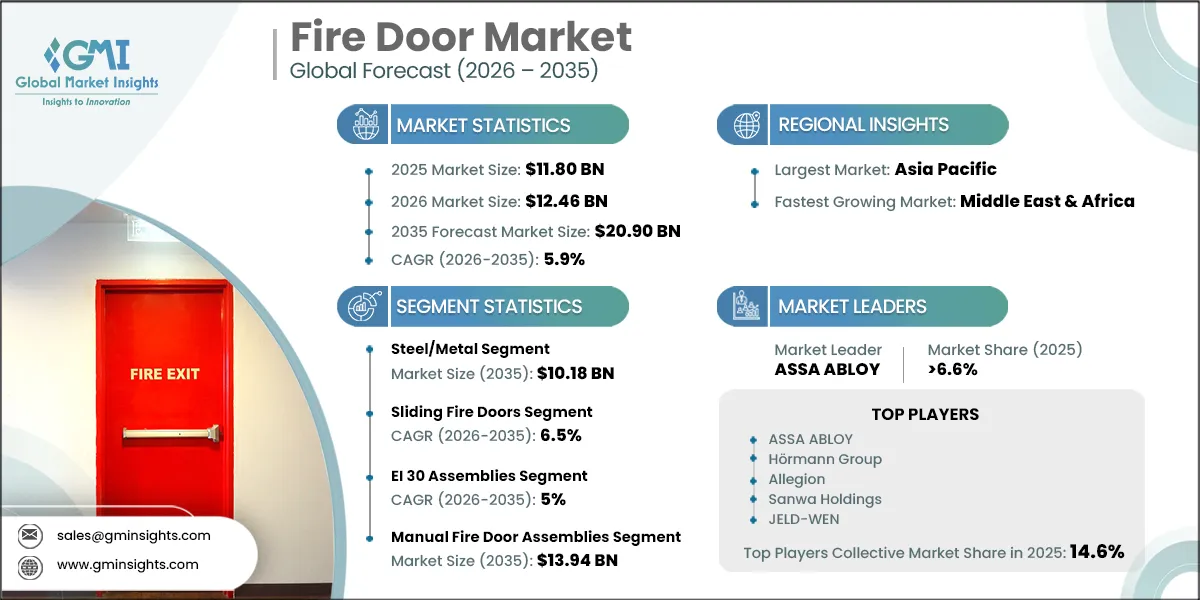
The fire door market was valued at USD 11.80 billion in 2025, is anticipated to reach USD 12.46 billion in 2026, and is projected to expand at a 5.9% CAGR (2026–2035), reaching USD 20.90 billion by 2035. The market comprises certified fire door assemblies, including door leaves, frames, hardware, and smoke- and fire-control seals designed to protect compartment boundaries in commercial, institutional, industrial, and residential buildings.
Market expansion is being shaped by a higher compliance burden in installed building stock and a more demanding specification mix in new construction. Replacement demand is increasingly tied to inspection, labeling, and traceability requirements, while higher-rated, glazed, automated, and electronically integrated assemblies raise revenue per installation in large commercial and institutional projects.
GMI Analyst View
Based on our discussions with industry experts and procurement professionals, the Fire Door Market generated approximately USD 11.20 billion in 2024. This historic performance indicates that compliance-led replacement activity was already becoming a material counterweight to cyclical construction demand before the 2025 base year.
Fire Door Market Trends, Growth Drivers & GMI Forecast Outlook
The outlook reflects a market in which compliance programs increasingly influence procurement timing, while non-residential development expands the physical installation base. Growth depends on the ability of certified manufacturers and installers to serve increasingly complex specifications without allowing testing costs, material volatility, or uneven enforcement to restrict access to compliant products.
Key Drivers
*Evidence anchors use cited external data; demand implications and forecast conditions represent GMI analysis.*
Regulatory intervention is shifting fire doors from a discreet construction component toward a managed life-safety asset. Inspection programs create a direct connection between an installed assembly's condition, its documentation, and a building owner's replacement decision. The UK Building Safety Act 2022 has reinforced this accountability in higher-risk buildings, making product traceability, competent installation, and maintenance capacity increasingly important to suppliers and contractors [3].
New-build demand remains essential because large commercial, healthcare, industrial, and infrastructure projects require a greater density of rated openings than low-rise residential construction. Global construction activity therefore supports broad installation demand, particularly where project owners specify compartmentalization alongside accessibility, security, and smoke-control functionality [1]. In these environments, integration with alarm and building-management systems favors suppliers able to certify the entire assembly rather than supplying an isolated door leaf or hardware component.
Key Restraints
*Evidence anchors use cited external data; demand implications and forecast conditions represent GMI analysis.*
Residential softness creates the clearest near-term constraint where fire doors are procured within multi-family and high-rise development budgets. Door-sector performance has reflected this weaker construction environment, reducing order visibility for suppliers exposed to lower-value and more price-sensitive applications [2]. Recovery in this channel will depend on the return of housing starts and on whether building-safety requirements continue to lift the required performance level of residential assemblies.
Certification expense is a more durable constraint because compliant products require coordinated testing of leaves, frames, glazing, seals, hardware, and installation configurations. The transition toward harmonized performance classifications can favor large suppliers with in-house engineering and testing resources while limiting smaller fabricators' ability to maintain wide product portfolios. The revised European construction-product framework further reinforces the importance of certified, traceable assemblies, although its implementation cadence will influence the timing of replacement demand [4].
GMI Analyst View
We view regulatory enforcement as the principal differentiator between markets that merely specify fire doors and markets that generate recurring replacement demand. The forecast is strongest where inspection, documentation, and liability mechanisms are translated into procurement action; it is more exposed where compliance remains uneven or construction-led demand weakens before retrofit programs mature.
Fire Door Market Segment Analysis
By Material
The fire door market's steel/metal segment generated USD 5.66 billion in 2025 and is projected to reach USD 10.18 billion by 2035. Steel and metal assemblies remain the default choice where buyers prioritize structural durability, broad rating coverage, and compatibility with standardized hardware. Their position is especially resilient in industrial, commercial, and institutional projects where repetitive openings and long service lives reward established fabrication and certification processes.
Timber/wood assemblies accounted for 32.0% of market revenue in 2025 and are projected to represent 29.3% by 2035. Timber retains a meaningful role in hospitality, heritage-sensitive renovation, education, and commercial interiors where finish quality matters alongside fire performance. However, changing test requirements, material-cost exposure, and the rising use of glazed and aluminum systems in premium projects are likely to narrow its relative position.
Fire-rated glass assemblies generated USD 1.06 billion in 2025 and are anticipated to expand at a 7.9% CAGR (2026–2035). Glazed systems benefit from architectural demand for daylight, visibility, and open-plan circulation without compromising compartmentation. Their adoption is strongest in healthcare, transport, education, and high-grade office projects, where transparent boundaries can improve wayfinding and supervision while still meeting rated-assembly requirements.
Aluminum assemblies represented 7.0% of market revenue in 2025 and are projected to reach USD 1.60 billion by 2035. Aluminum's corrosion resistance, lower structural weight, and compatibility with curtain-wall and automated-door designs support its use in commercial façades, corridors, and technology-intensive facilities. It is particularly well positioned where project teams require a coordinated visual language across fire doors, storefronts, and access-control systems.
By Product Type
Hinged single- and double-leaf fire doors generated USD 6.84 billion in 2025 and are projected to reach USD 11.58 billion by 2035. Hinged assemblies remain the most versatile format across corridors, stairwells, service spaces, apartment entrances, and industrial access points. Their installed base, familiarity among contractors, and compatibility with conventional closing and hardware systems make them the core volume platform for the Fire Door Market.
Sliding fire doors represented 14.0% of market revenue in 2025 and are expected to expand at a 6.5% CAGR (2026–2035). Sliding systems address locations where swing clearance is constrained or operational circulation must remain unobstructed. Healthcare, airport, logistics, and transit settings support demand because these applications can combine normal open use with automatic closure when connected to alarm or release mechanisms.
Flush-glazed fire doors generated USD 1.06 billion in 2025 and are projected to grow at an 8.4% CAGR (2026–2035). Flush-glazed products reflect the premiumization of commercial and institutional interiors. Their appeal lies in preserving sightlines and natural light while allowing architects to create rated partitions that read as integrated interior systems rather than purely utilitarian barriers.
Fabric fire curtains represented 7.0% of market revenue in 2025 and are projected to reach USD 1.58 billion by 2035. Fabric curtains serve large openings that would be difficult to protect with conventional swinging or sliding assemblies. Their automatic deployment capability makes them relevant to atria, retail connections, entertainment venues, and other open-volume designs where compartmentation must be largely invisible during normal building operation.
By Fire Rating
EI 30 assemblies represented 22.0% of market revenue in 2025 and are forecast to expand at a 5.0% CAGR (2026–2035). The EI 30 category remains relevant in lower-risk residential and light-commercial uses, but its slower trajectory reflects a gradual shift toward more demanding protection thresholds. Upgrades in code interpretation and building-owner risk management can move procurement toward longer-duration ratings in applications previously served by the minimum compliant tier.
EI 60 assemblies generated USD 4.48 billion in 2025 and are projected to reach USD 7.83 billion by 2035. EI 60 is the core compartmentation rating across many commercial, institutional, and multi-story residential settings. Its role as a commonly specified threshold gives the category a broad demand base spanning both new construction and replacement work in mature building stock.
EI 90 assemblies accounted for 25.0% of market revenue in 2025 and are expected to expand at a 6.2% CAGR (2026–2035). Demand for EI 90 systems is supported by applications where longer containment time is required, including healthcare, high-rise commercial, and public-sector environments. These projects frequently emphasize complete assembly performance, which increases the importance of coordination between door manufacturers, hardware suppliers, and installers.
EI 120+ assemblies generated USD 1.77 billion in 2025 and are anticipated to grow at a 7.2% CAGR (2026–2035). Higher-rated systems are gaining relevance in critical infrastructure, data centers, energy facilities, chemical processing, and other environments where the operational consequences of fire spread are especially severe. Their growth favors suppliers capable of providing tested configurations for complex openings, larger dimensions, glazing, and integrated controls.
By Operation
Manual fire door assemblies generated USD 8.50 billion in 2025 and are projected to reach USD 13.94 billion by 2035. Manual systems remain indispensable because they offer straightforward installation, broad code acceptance, and cost-efficient performance across mass commercial, residential, and lower-complexity industrial applications. Their continuing scale also gives suppliers a large installed base for replacement hardware, maintenance, and compliance services.
Automatic fire doors represented 18.0% of market revenue in 2025 and are expected to expand at a 7.6% CAGR (2026–2035). Automatic hold-open systems meet a practical need in hospitals, schools, public buildings, and high-traffic commercial sites: doors can remain open for circulation and accessibility, then close upon alarm activation. This functional combination supports a shift toward more integrated fire-safety and building-operations specifications.
Electric fire doors accounted for 10.0% of market revenue in 2025 and are projected to reach USD 2.64 billion by 2035. Electric systems are increasingly associated with controlled environments such as data centers, logistics facilities, loading zones, and secure infrastructure. Their value proposition rests on the ability to integrate fire response with access control, monitoring, and automated operational workflows.
By Installation Type
New-installation demand generated USD 7.32 billion in 2025 and is projected to reach USD 12.54 billion by 2035. New construction remains the principal volume channel because rated openings are embedded in the design of commercial, institutional, industrial, and infrastructure projects. Demand is strongest where developers must specify multiple types of tested assemblies across escape routes, plant rooms, service corridors, and compartment boundaries.
Retrofit and replacement demand generated USD 4.48 billion in 2025 and is expected to expand at a 6.5% CAGR (2026–2035). The replacement channel is more closely tied to inspection outcomes and changing compliance obligations than to discretionary capital expenditure. This gives it a stabilizing role when new construction slows, particularly in markets with mature building stock and enforceable maintenance or documentation requirements.
By End-Use
Commercial buildings generated USD 5.31 billion in 2025 and are projected to reach USD 9.27 billion by 2035. Commercial demand is supported by office, retail, hotel, and mixed-use developments that require a broad range of rated openings. These sites increasingly favor systems that balance compartmentation with design quality, access control, visibility, and occupant movement, creating opportunities across conventional and premium product tiers.
Industrial end uses represented 22.0% of market revenue in 2025 and are expected to grow at a 6.5% CAGR (2026–2035). Industrial facilities require durable, high-performing assemblies for production areas, warehouses, energy rooms, loading zones, and storage environments. Data centers are particularly important because their risk-management practices often require carefully specified door assemblies around server spaces, battery areas, and critical electrical infrastructure.
Institutional end uses generated USD 2.36 billion in 2025 and are projected to grow at a 6.0% CAGR (2026–2035). Hospitals, schools, government facilities, and public buildings generate dense demand for fire doors because they combine complex circulation patterns with heightened life-safety obligations. Healthcare is especially significant, as patient movement, infection-control requirements, and compartmentation needs can favor integrated, high-specification assemblies.
Residential end uses represented 13.0% of market revenue in 2025 and are projected to reach USD 2.60 billion by 2035. Residential demand is concentrated in multi-family and high-rise developments, where price discipline is more pronounced than in institutional projects. The segment's opportunity lies in the continued extension of building-safety obligations to apartment entrances and shared circulation areas, although near-term performance remains sensitive to housing construction conditions.
GMI Analyst View
We see the segment mix moving toward value creation through specification complexity rather than simply higher unit volumes. Suppliers with credible testing depth across glazing, automation, higher fire ratings, and integrated hardware are better positioned to capture premium applications, while conventional assemblies remain essential for broad market coverage and replacement demand.
Fire Door Market Regional Analysis
North America Fire Door Market Analysis
The North America fire door market generated USD 3.30 billion in 2025 and is projected to reach USD 5.69 billion by 2035. North American demand rests on a mature compliance environment and a sizable base of commercial, institutional, and multi-family buildings requiring ongoing inspection and replacement. The region's product mix supports both standard hollow-metal assemblies and more integrated systems for healthcare, education, data centers, and public infrastructure. NFPA 80 remains an important framework for installation, inspection, and maintenance practices [5].
U.S.
The U.S. generated USD 2.83 billion in 2025 and is projected to reach USD 4.88 billion by 2035. The U.S. dominates regional demand because it combines a large non-residential construction base with extensive inspection and remediation activity. Demand is reinforced by the presence of specialized inspection firms, established hardware ecosystems, and a broad base of facilities where fire doors must be maintained as active elements of the building's life-safety plan.
Canada
Canada represented 14.3% of North American revenue in 2025 and is expected to expand at a 5.7% CAGR (2026–2035). Canadian demand follows provincial adoption of national building and fire-code principles, with institutional, healthcare, and metropolitan commercial projects providing the most consistent specification base. The market rewards suppliers capable of meeting local procurement, distribution, and code-compliance requirements.
Europe Fire Door Market Analysis
Europe represented 26.0% of market revenue in 2025 and is projected to expand at a 5.4% CAGR (2026–2035). Europe's market is defined by regulatory transition, a large installed commercial and institutional building base, and increasingly rigorous product documentation requirements. Harmonization under the revised Construction Products Regulation is expected to influence certification and product-substitution decisions across member states [4].
Germany
Germany generated USD 708 million in 2025 and is projected to reach USD 1.22 billion by 2035. Germany's industrial, logistics, office, and clean-environment sectors create a durable need for rated assemblies. Demand is particularly attractive for suppliers with established certification credentials and the ability to serve technically demanding applications such as manufacturing facilities, data centers, and high-specification commercial renovations.
UK
The UK represented 23.1% of European revenue in 2025 and is anticipated to expand at a 5.4% CAGR (2026–2035). The UK is a central retrofit market because building-safety obligations have strengthened the importance of inspection, documentation, and replacement in higher-risk residential and public buildings. The transition toward updated classification practices is also increasing the commercial value of tested, traceable products and competent installation services [3].
France
France represented 15.4% of European revenue in 2025 and is projected to generate USD 813 million by 2035. Commercial, hospitality, healthcare, and public-sector renovation work support French demand. Suppliers with the ability to navigate project-led procurement and provide compliant solutions for both modern and legacy building stock are likely to benefit as enforcement and refurbishment activity deepen.
Italy
Italy generated USD 413 million in 2025 and is projected to reach USD 711 million by 2035. Italian demand is shaped by commercial renovation, tourism-related building activity, and industrial-site requirements. Market access depends on balancing performance certification with architectural adaptability, especially in projects involving hospitality, retail, and older urban building stock.
Spain
Spain's market is supported by commercial, tourism, and hotel-sector development, as well as replacement activity within office and hospitality properties. Its specification practices are progressing alongside wider European safety and certification expectations.
Asia Pacific Fire Door Market Analysis
The Asia Pacific Fire Door Market generated USD 4.13 billion in 2025 and is projected to represent 36.6% of total market revenue by 2035. Asia Pacific combines large-scale construction activity with a broad shift toward more formalized fire-safety requirements. Demand is diversified across commercial towers, logistics parks, healthcare facilities, data centers, manufacturing sites, and transport projects. The region's scale creates opportunity for both domestic producers serving high-volume applications and international suppliers focused on certified premium assemblies.
China
China generated USD 2.36 billion in 2025 and is projected to reach USD 4.36 billion by 2035. China is the largest national market because its construction base spans commercial, institutional, logistics, manufacturing, and urban residential developments. Compliance with national standards and the growth of higher-specification infrastructure create a large addressable market, although competitive conditions remain challenging in price-sensitive categories.
India
India represented 17.1% of Asia Pacific revenue in 2025 and is expected to expand at a 6.3% CAGR (2026–2035). India's growth is supported by infrastructure development, healthcare investment, organized retail, and Grade-A office construction. The longer-term opportunity depends on continued improvement in code enforcement and on the replacement of non-certified products with traceable, tested assemblies in major metropolitan markets.
Japan
Japan generated USD 472 million in 2025 and is projected to reach USD 871 million by 2035. Japan's stringent safety culture and mature construction practices support demand for high-quality certified systems. Retrofit needs in aging commercial and institutional buildings complement new construction, while domestic manufacturers retain an advantage through established product quality and distribution relationships.
South Korea
South Korea represented 7.1% of Asia Pacific revenue in 2025 and is projected to generate USD 543 million by 2035. South Korea's dense urban development and expanding semiconductor and data-center infrastructure increase the intensity of fire-door specification. Demand is concentrated in technically sophisticated projects where rated assemblies must align with advanced building systems, security, and operational continuity requirements.
Australia
Australia's market is underpinned by certified-assembly requirements, commercial construction, and healthcare development. The country's standards-oriented procurement environment favors suppliers with credible product documentation and installer support.
Latin America Fire Door Market Analysis
Latin America represented 7.0% of market revenue in 2025 and is expected to expand at a 5.8% CAGR (2026–2035). Latin American demand is driven by urbanization, industrial expansion, commercial development, and gradual strengthening of fire-safety frameworks. Price sensitivity remains more pronounced than in mature markets, making local manufacturing, accessible certification, and enforcement consistency important variables for compliant product adoption.
Brazil
Brazil generated USD 472 million in 2025 and is projected to reach USD 834 million by 2035. Brazil is the region's largest market, supported by commercial construction, healthcare investment, manufacturing activity, and warehouse development. Its standards environment and large urban centers create a meaningful platform for suppliers that can combine local service capacity with certified product performance.
Mexico
Mexico represented 28.6% of Latin American revenue in 2025 and is projected to generate USD 418 million by 2035. Mexico benefits from industrial construction tied to nearshoring, alongside commercial, retail, and hospitality development. Demand for compliant assemblies should rise as facilities serving international manufacturers apply more formal life-safety and risk-management standards.
Argentina
Argentina's market remains constrained by macroeconomic conditions, with demand concentrated in commercial, industrial, and institutional projects in major urban areas. Procurement decisions are likely to remain selective and sensitive to project financing conditions.
Middle East & Africa Fire Door Market Analysis
The Middle East & Africa Fire Door Market generated USD 472 million in 2025 and is anticipated to expand at an 8.0% CAGR (2026–2035). The region's growth is linked to major GCC construction programs, hospitality development, infrastructure investment, and stronger civil-defense enforcement. Demand is project-led and can be uneven, but large developments frequently require higher-rated, architecturally integrated, and internationally certified assemblies.
Saudi Arabia
Saudi Arabia generated USD 177 million in 2025 and is expected to expand at an 8.0% CAGR (2026–2035). Saudi Arabian demand is anchored in large-scale urban, tourism, entertainment, and infrastructure developments. The scale of planned projects creates opportunities for suppliers able to manage specification, local approvals, logistics, installation coordination, and replacement support across complex construction programs.
UAE
The UAE represented 37.5% of Middle East & Africa revenue in 2025 and is projected to generate USD 308 million by 2035. The UAE's high-rise commercial, hospitality, luxury residential, and infrastructure projects create a concentrated market for certified assemblies. The market favors suppliers that can support consultant-led specifications and meet demanding project schedules across both standard and premium product categories.
South Africa
South Africa is the principal sub-Saharan market for certified fire doors, with demand centered on commercial and industrial facilities in major metropolitan areas. Enforcement trends and the strength of private-sector development will determine the pace of adoption of higher-value compliant systems.
GMI Analyst View
We believe Asia Pacific provides the broadest long-term opportunity because construction scale is being reinforced by steadily improving specification quality. Middle East & Africa offers a different opportunity: project concentrations can create high-value demand bursts, rewarding suppliers with strong regional execution, certification capability, and the flexibility to support complex project schedules.
Fire Door Market Share & Competitive Landscape
The Fire Door Market share structure remains fragmented, with the top five suppliers, ASSA ABLOY AB, Hörmann Group, Allegion plc, Sanwa Holdings Corporation, and JELD-WEN Holding Inc. collectively holding approximately 14.6% of global revenue in 2025. Local certification requirements, contractor relationships, freight economics, and the need to coordinate complete tested assemblies all limit the degree to which production can be centralized. Competition therefore operates at both global portfolio scale and local execution depth.
ASSA ABLOY AB
ASSA ABLOY held a 6.6% market share in 2025. The company's leadership reflects its broad portfolio of certified opening solutions, regional distribution footprint, and acquisition-led strategy. Its ability to combine fire-rated doors, frames, hardware, and service capability gives it a strong position in commercial and institutional projects where buyers value coordinated specification and documented compliance.
Hörmann Group
Hörmann held a 2.7% market share in 2025. Hörmann's position is anchored in its European manufacturing base and product breadth across steel, timber, and fire-curtain systems. The company is positioned to benefit from evolving European standards because its offer spans both conventional assemblies and products suited to technically demanding commercial and industrial applications.
Allegion plc
Allegion held a 2.2% market share in 2025. Allegion participates through certified hollow-metal doors and frames as well as fire-rated hardware that forms part of the complete assembly. This combination makes its competitive position particularly relevant in North American commercial and institutional specification channels, where hardware selection, closing performance, and access control are integral to compliance.
Sanwa Holdings Corporation
Sanwa is a leading Japanese supplier of steel and aluminum fire door systems for commercial and institutional applications. Its market position is supported by domestic quality expectations and a regional manufacturing presence. The company is well aligned with Asia Pacific demand for reliable assemblies in high-density urban construction, infrastructure, and technology-intensive facilities.
JELD-WEN Holding Inc.
JELD-WEN participates through its certified commercial door and frame portfolio, including the Ceco Door brand. The company's position in North America is tied to commercial and institutional construction channels where hollow-metal assemblies remain a standard solution. Its ability to support specification and distribution requirements is important in a market where replacement work and new construction often depend on contractor familiarity and regional availability.
Masonite International Corporation
Masonite supplies architectural and performance door products that serve commercial and institutional building applications. The company's role in the market is linked to wood-composite and architectural fire-door offerings, where design compatibility and rated performance must be balanced for offices, healthcare facilities, education buildings, and similar projects.
dormakaba Group
dormakaba combines fire-rated hardware, automatic operators, and systems-integration capability. This positioning is increasingly relevant in high-specification facilities where a fire door must interact with building management, access control, and fire detection systems. The company's integration expertise supports demand for assemblies that address operational convenience alongside life-safety performance.
Regional competitors, including NAFFCO Firesafety & Security Group, Teckentrup GmbH & Co. KG, Chase Industries Inc., Howden Joinery Group Plc, NINZ S.p.A., Rapp Bomek AS, CornellCookson, China Buyang Co. Ltd., and Taotao Group Co. Ltd., compete through local certification, manufacturing responsiveness, and established contractor relationships. Emerging suppliers such as Shakti Hörmann Pvt. Ltd., Metaflex Doors Europe BV, Alufire Sp. z o.o., Yuankai Door Industrial, and Wonly Group Co. Ltd. are building relevance in fast-growing regional and specialist applications.
Recent Industry Developments
September 2026 — Premier Technical Services Group acquires Integrated Doorset Solutions Group: PTSG acquired IDSL Group Holdings, combining fire-door inspection, testing, certification, remediation, maintenance, and manufacturing capabilities. The transaction highlights the growing commercial value of vertically integrated compliance services as UK replacement demand rises under more rigorous building-safety obligations [7].
November 2025 — ASSA ABLOY acquires International Door Products: ASSA ABLOY acquired International Door Products, a Michigan-based manufacturer of standard and custom fire-rated steel door frames. The acquisition strengthens the company's Americas portfolio and adds capacity for custom configurations serving commercial and institutional contractors [6].
Need a specific section of this report?
Purchase regional analysis, country-level analysis, company profiles, or any other segment-level insights separately
based on your research needs.