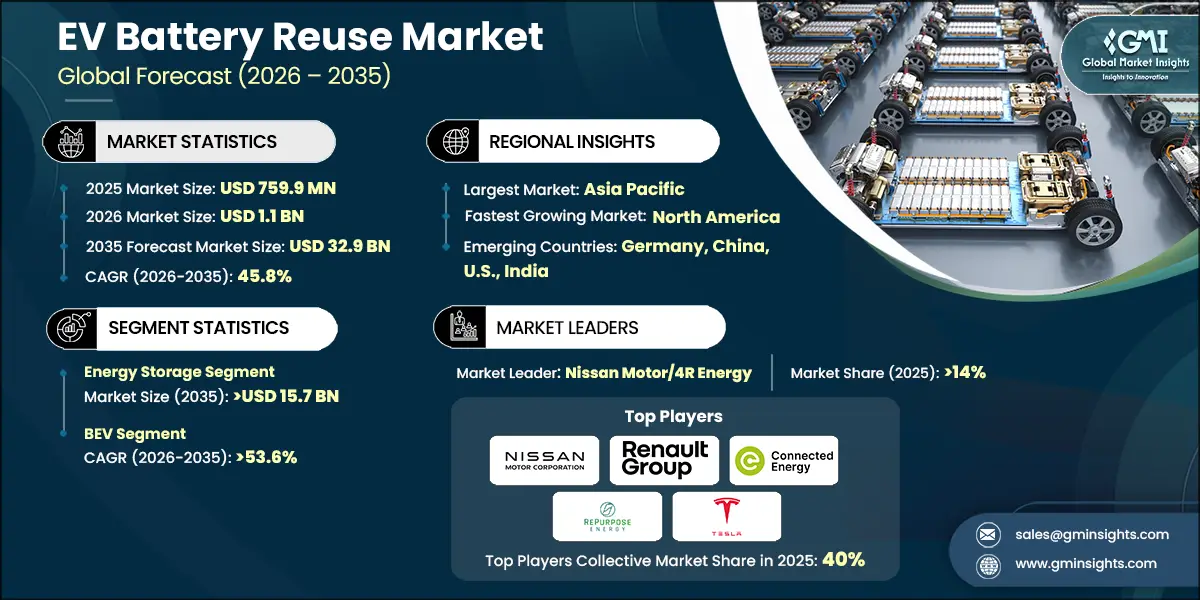
According to a recent study by Global Market Insights Inc., the EV battery reuse market was estimated at USD 759.9 million in 2025. The market is expected to grow from USD 1.1 billion in 2026 to USD 32.9 billion by 2035, at a CAGR of 45.8%. The growth is propelled by growing adoption of electric vehicles and the necessary sustainable management of the battery lifecycle.
With the increased adoption of EVs, there will be an increase in retired batteries, creating a challenge for the secondary use of these batteries. For example, the IEA stated that in 2020 the use of electric vehicles grew to about 4% of total car sales and reached over 25% in 2024. This growth in electric vehicle sales will fuel the need of effective refurbishing and recycling of the used EV batteries, thereby propelling the business landscape.
In addition, other factors that affect market dynamics are policy encouragement for circular economy principles, lowering cost trends for battery refurbishment technologies, and increasing needs for energy storage. Based on a research by Statista, the energy storage capacity grew from 1.6 GW in 2015 to over 90 GW in 2024, representing a significant growth over the years.
There is an increasing focus on reused EV batteries in applications including grid storage, backup power and for main power sources in combination with renewable energy sources, which is positively impacting the market statistics. For reference, B2U Storage Solutions, a prominent player in EV battery reuse market, has developed repurposed battery based backup systems which store solar energy to provide power during power outages.
Moreover, automotive manufacturers and firms dealing with energy storage are perhaps the most prominent investors in second-life battery programs because these programs seem to increase the worth of the batteries and simultaneously lowers the environmental consequences. A case in point is the Moment Energy, a green energy company, which was awarded USD 20.3 million in 2024 from the US DOE to repurpose used electric vehicle batteries into energy storage power systems.
EV Battery Reuse Market Trends
The increase in electric vehicle adoption along with the usage of sustainable energy sources is fueling the EV battery second life market. In Saudi Arabia’s latest technological advancement, it adopted the first 500 MW/2000 MWh BESS fleet in 2024 which utilizes BYD LFP batteries for energy storage from renewable sources.
Moreover, better artificial intelligence powered battery diagnosis and predictive analytics are also aiding in hardware assessment and repurposing optimization. The advancements in the AI powered predictive battery diagnostics and analytics is making it easier to evaluate the health of the batteries and make the processes of repurposing more effective.
Companies across the globe are establishing subsidiaries to cater to the EV battery reuse industry and thus effective repurpose used batteries for second life use. For instance, Nissan partnered with Sumitomo Corporation to form 4R Energy, which will provide repurposed batteries for stationary applications.
However, the absence of uniform testing methodologies, variations in battery composition, and the constraints of the supply chain in battery collection and allocation pose major issues to the market. This industry is still in its growing phase, and the development into its next stage will, however, require significant amounts of R & D funding for the next few years.
Regardless of this, the want for cost effective energy storage will remain which will alter the market for ease-of-use technologies. As the EV market evolves, solutions derived from second life batteries will become essential in improving the positive and reducing the negative impacts of batteries on the environment. These developments ought to enhance the ease with which batteries can be handled at the end of their life cycle.
EV Battery Reuse Market Analysis
The market for EV battery reuse is growing steadily in many application areas including low-speed vehicles, energy storage, base stations, and EV charging. The Electric Vehicle (EV) battery reuse market size was USD 393.6 million, USD 536.6 million and USD 759.9 million in 2023, 2024 and 2025 respectively.
EV battery reuse industry from energy storage systems is expected to reach more than USD 15.7 billion by the end of 2035. The growth of the segment is driven by the increasing energy needs from different industries, which have created a considerable need for additional energy storage systems. As per IEA, the global energy demand rose by 2.2 % in 2023, which complements the energy storage industry growth.
The EV charging application is anticipated to grow at a CAGR of over 60.5% by 2035. In the EV charging market, reused batteries are being used in fast-charging stations to lower dependency on the grid during peak hours. These powers systems help in energy distribution management and operational expenditure reduction for practically all providers of charging infrastructure.
Gradual shift toward electric vehicles is proliferating the investments across the deployment of EV charging stations across the globe. As per Europe ACEA, over USD 290 billion investment is anticipated toward EV charging stations in Europe by 2030 to cope with the soaring adoption of electric vehicles. This will boost the need for charging stations, which will, in turn, drive industry growth.
In base stations, particularly in the telecommunications industry, repurposed batteries are gaining traction for usage in backup power systems instead of using traditional lead-acid batteries owing to their high energy density and longer life. A large number of base stations are located in remote areas which require energy storage systems to aid the high energy demand, therefore complementing the business landscape.
E-bikes, golf carts, and electric forklifts are examples of low-speed vehicles (LSVs) that are starting to use repurposed batteries for reducing the expenditures. Such applications will continue to grow as advancements in battery diagnostics and refurbishment are made, making it easier to support the EV industry's sustainability targets.
Batteries for second life applications are procured from different EV segments which include BEV, HEV, and PHEV. The EV battery reuse market is expected to increase from BEV at a CAGR of over 53.6% by 2035. Ongoing innovations across the EV battery technologies is anticipated to boost the demand for BEVs across the globe, which in turn will drive the EV battery reuse industry outlook.
The BEVs are the largest source of second life batteries owing to their vast battery capacity and high-performance depreciation rates that lead to replacement during prolonged usage. With a rise in BEV adoption globally, there is an increase in the volume of retired batteries from older generation EVs entering the reuse market.
By 2025, HEVs and PHEVs are projected to capture over 52.6% of market share. These vehicles, however, contribute to the reuse market at a lower rate due to their relatively weaker batteries which do not undergo extensive charge and discharge cycling. The improvement in design of hybrid batteries in conjunction with increased lifespan of the vehicles has restricted the number of reusable HEV batteries in the market.
The U.S. EV battery reuse market was estimated at USD 31.4 million, USD 48.2 million and USD 75.1 million in 2023, 2024 and 2025 respectively. Growing EV adoption, stronger sustainability goals, and the need for cost‑effective energy storage are all fueling this market’s momentum. Together, they’re creating a clear path for second‑life batteries to become a mainstream solution in the clean‑energy ecosystem. Government initiatives including tax on waste and the passing of circular economy laws are motivating car manufacturers and energy corporations to formulate programs for the repurposing of batteries.
The Asia Pacific EV battery reuse market is anticipated to grow over USD 22.2 billion by 2035. The industry is led by China, backed by government battery lifecycle management policies and large-scale adoption of EVs. The New Energy Vehicle (NEV) policy of the country requires automakers to collect the used batteries and process them for reuse.
Leading manufacturers of batteries including CATL and BYD are working on second-life energy storage applications across Asia Pacific to commercialize batteries. Additionally, growing urbanization and rising electricity use, combined with the expansion of renewable energy projects, are increasing the need for second‑life batteries.
Europe’s EV battery reuse market is growing, driven by strict environmental rules and an accelerating push toward electrification. Automakers like BMW and Renault are advancing second‑life battery projects for industrial and grid storage, with Germany leading the region due to strong EV adoption and major investments in recycling infrastructure.
EV battery reuse market in the Middle East and Africa market is set to grow as the UAE develops owing to its commitment to sustainability as well as intelligent energy solutions. Government projects like the UAE Vision 2050 focus on circular principles which leads to an increase in battery repurposing for energy storage projects.
There is an increased adoption of second-use solar energy batteries in remote areas where reliance on diesel generators is costly. Added investments into renewable energy and electric vehicles will only solidify the UAE's position as the leader of battery reuse technologies in the region.
EV Battery Reuse Market Share
Top 5 companies operating in EV battery reuse industry include Nissan Motors Corporation, Renault Group, Tesla, Moment Energy and Second Life EV batteries. As a result of their research and development activities, such firms together have a market share of more than 40% in 2025 and are expected to grow their share further in the coming years.
Tesla holds a substantial market presence in the EV battery reuse industry because of its production capabilities in electric vehicles, innovations in batteries, and sustainable practices. Tesla has a considerable stock of decommissioned automotive batteries, thus making it one of the major suppliers of second-use batteries within the EV industry.
Tesla’s automotive batteries are also used in devices like Powerwall and Powerpack that store energy developed on the grid, thus serving as economical sustainable energy sources. Tesla's in-house battery production and management, along with the company's other vertical development strategies, allow for better optimization of batteries, and this puts Tesla ahead of competitors.
EV Battery Reuse Market Companies
Major players operating in the EV battery reuse industry are:
4R Energy Corporation
B2U Storage
BatteryLoop
BeePlanet Factory
Cactos
Connected Energy
EcarACCU
Element Energy
Enel X
Evyon
Higher Wire
Moment Energy
Nissan Motor
OCTAVE
RePurpose Energy
Renault Group
RWE + Audi
Second Life EV Batteries
Spiers New Technologies
Stena Metall
Tesla
During the first half of 2024, Nissan Motor generated USD 19.76 Billion in revenue. The organization has partnered with Ecobat to look into ways to ‘recover, repair, recycle, and repurpose’ EV batteries. This initiative seeks to achieve sustainability in the sector by reusing batteries taken from Nissan electric vehicles.
Renault Group is directing resources towards product innovations and eco-friendly solutions owing to the growing demand for such products. Recently, to manufacture eco-friendly cars, it has opened a company called “The Future is NEUTRAL” jointly owned by Nissan and Suez. It offers collection, recycling, reuse, refurbishing resources, and sustainable waste management options for vehicles and battery systems.
Tesla is recognized all over the world for its EV batteries and cars which are known for their stunning designs, along with the efficiency they offer. In order to maintain its market share and position, it has significantly increased its battery recycling capacity to make the EV sustainable in long term.
In 2023 Spiers technology made an approx. revenue of USD 12 million. The firm specializes in EV battery refurbishment and repurposing. It extends the usable life of battery packs through repair, remanufacturing, and repurposing which helps sustain the EV industry and aid the organisation to hold a notable share in the battery reuse industry.
Connected Energy’s applies an excellent technology which enables commercial energy stored in batteries to be used sustainably. In January 2024, it collaborated with Altilium with the purpose of improving energy storage time of EV batteries at the second life stage. This collaboration helps reduce waste and promotes circular economy by utilizing used batteries for stationary storage, which is a form of secondary life.
EV Battery Reuse Industry News
BatteryLoop in 2024, transformed more than 700 Renault Kangoo ZE batteries into stationary storage batteries under its collaboration with Renault’s Mobilize. Its APC project with Nissan evaluates EV battery life cycles, while a new agreement with Volvo Energy focuses on monitoring battery health for second-life use.
Nissan and Ecobat formed a partnership in April 2024 to give second life to used EV batteries into energy storage solutions, extending their life cycle and supporting sustainability. The initiative cuts environmental impact, supports advanced recycling practices, and aligns with Nissan’s broader electrification goals, strengthening the company’s position in the EV battery reuse market.
BatteryLoop has received an order in January 2023 from Sweden's Stena Fastigheter for the supply of six BESS energy storage systems. The energy storage systems will be installed in Malmö, Gothenburg, and Stockholm and will serve as a backup power source for residential purposes. This order is expected to boost BatteryLoop's revenue in the future.
In September 2023, Tesla announced a battery storage facility construction of USD 1.97 billion in Karnataka, India. The factory will develop battery modules for EVs and energy storage systems, with aim to benefit from demand in the economy and state incentives. This initiative seeks to lower the manufacturing costs, augment Tesla’s supply chain in Asia, and enhance its international footprint.
This EV battery reuse market research report includes an in-depth coverage of the industry with estimates & forecast in terms of volume and revenue in MWh & USD Million from 2022 to 2035, for the following segments:
Market, By Application
Energy storage
EV charging
Base stations
Low speed vehicles
Market, By Source
BEV
HEV &PHEV
The above information has been provided for the following regions and countries:
North America
U.S.
Canada
Europe
UK
Germany
Italy
Spain
Russia
France
Asia Pacific
China
Japan
South Korea
India
Australia
Rest of the World
Authors: Ankit Gupta, Vishal Saini
EV Battery Reuse Market Scope
EV Battery Reuse Market Size
EV Battery Reuse Market Trends
EV Battery Reuse Market Analysis
EV Battery Reuse Market Share
Report Content
Chapter 1 Methodology & Scope
1.1 Research design
1.1.1 Research approach
1.1.2 Data collection methods
1.2 Base estimates and calculations
1.2.1 Base year calculation
1.2.2 Market estimates & forecast parameters
1.3 Forecast
1.3.1 Key trends for market estimates
1.3.2 Quantified market impact analysis
1.3.2.1 Mathematical impact of growth parameters on forecast
1.3.3 Scenario analysis framework
1.4 Primary research and validation
1.4.1 Some of the primary sources (but not limited to)
1.5 Data mining sources
1.5.1 Paid Sources
1.5.2 Sources, by region
1.6 Research trail & scoring components
1.6.1 Research trail components
1.6.2 Scoring components
1.7 Research transparency addendum
1.7.1 Source attribution framework
1.7.2 Quality assurance metrics
1.7.3 Our commitment to trust
1.8 Market definitions
Chapter 2 Executive Summary
2.1 Industry synopsis, 2022 - 2035
2.2 Business trends
2.3 Application trends
2.4 Source trends
2.5 Regional trends
Chapter 3 Industry Insights
3.1 Industry ecosystem analysis
3.2 Regulatory landscape
3.3 Industry impact forces
3.3.1 Growth drivers
3.3.2 Industry pitfalls & challenges
3.4 Growth potential analysis
3.5 Porter's analysis
3.5.1 Bargaining power of suppliers
3.5.2 Bargaining power of buyers
3.5.3 Threat of new entrants
3.5.4 Threat of substitutes
3.6 PESTEL analysis
3.6.1 Political factors
3.6.2 Economic factors
3.6.3 Social factors
3.6.4 Technological factors
3.6.5 Legal factors
3.6.6 Environmental factors
3.7 Price trend analysis, 2022-2035 (USD/MWh)
3.8 Emerging opportunities & trends
3.9 Investment analysis & future prospects
Chapter 4 Competitive landscape, 2025
4.1 Introduction
4.2 Company market share analysis, 2025
4.3 Key developments
4.3.1 Mergers & acquisitions
4.3.2 Partnerships & collaborations
4.3.3 New product launches
4.3.4 Expansion plans and funding
4.4 Competitive benchmarking
4.5 Innovation & sustainability landscape
Chapter 5 Market Size and Forecast, By Application, 2022 – 2035 (MWh & USD Million)
5.1 Key trends
5.2 Energy storage
5.3 EV charging
5.4 Base stations
5.5 Low speed vehicles
Chapter 6 Market Size and Forecast, By Source, 2022 – 2035 (MWh & USD Million)
6.1 Key trends
6.2 BEV
6.3 HEV & PHEV
Chapter 7 Market Size and Forecast, By Region, 2022 – 2035 (MWh & USD Million)
7.1 Key trends
7.2 North America
7.2.1 U.S.
7.2.2 Canada
7.3 Europe
7.3.1 UK
7.3.2 Germany
7.3.3 Italy
7.3.4 Spain
7.3.5 Russia
7.3.6 France
7.4 Asia Pacific
7.4.1 China
7.4.2 Japan
7.4.3 South Korea
7.4.4 India
7.4.5 Australia
7.5 Rest of the world
Chapter 8 Company Profiles
Don't see your key competitors?
The companies listed in this report are a curated selection - not the full competitive universe.
Our market revenue calculations use a bottom-up methodology that accounts for all players across all regions - including manufacturers, distributors, and specialists not individually profiled. The profiles section spotlights strategically significant players; it does not define the scope of our market sizing.
Your competitive landscape may also include
Regional or domestic-only leaders not in the global top tier
Distributors and channel partners who control market access
Emerging disruptors, startups, or adjacent-industry entrants
Niche players focused on a specific application or end-use
Free customization - up to 20% of report value
Need specific data? Request customization and get the insights tailored to your exact requirements.
For inquiries regarding discounts, bulk purchases, or customization requests, please contact us at[email protected]
Share Content
Add Citations
Ankit Gupta. 2026, March. EV Battery Reuse Market Size - By Application, By Source & Forecast, 2026 - 2035 (Report ID: GMI4812). Global Market Insights Inc. Retrieved September 15, 2026, from https://www.gminsights.com/toc/details/ev-battery-reuse-market
EV Battery Reuse Market
Get a free sample of this report
Get a free sample of this report EV Battery Reuse Market
Is your requirement urgent? Please give us your business email for a speedy delivery!



EV Battery Reuse Market Size
According to a recent study by Global Market Insights Inc., the EV battery reuse market was estimated at USD 759.9 million in 2025. The market is expected to grow from USD 1.1 billion in 2026 to USD 32.9 billion by 2035, at a CAGR of 45.8%. The growth is propelled by growing adoption of electric vehicles and the necessary sustainable management of the battery lifecycle.
With the increased adoption of EVs, there will be an increase in retired batteries, creating a challenge for the secondary use of these batteries. For example, the IEA stated that in 2020 the use of electric vehicles grew to about 4% of total car sales and reached over 25% in 2024. This growth in electric vehicle sales will fuel the need of effective refurbishing and recycling of the used EV batteries, thereby propelling the business landscape.
In addition, other factors that affect market dynamics are policy encouragement for circular economy principles, lowering cost trends for battery refurbishment technologies, and increasing needs for energy storage. Based on a research by Statista, the energy storage capacity grew from 1.6 GW in 2015 to over 90 GW in 2024, representing a significant growth over the years.
There is an increasing focus on reused EV batteries in applications including grid storage, backup power and for main power sources in combination with renewable energy sources, which is positively impacting the market statistics. For reference, B2U Storage Solutions, a prominent player in EV battery reuse market, has developed repurposed battery based backup systems which store solar energy to provide power during power outages.
Moreover, automotive manufacturers and firms dealing with energy storage are perhaps the most prominent investors in second-life battery programs because these programs seem to increase the worth of the batteries and simultaneously lowers the environmental consequences. A case in point is the Moment Energy, a green energy company, which was awarded USD 20.3 million in 2024 from the US DOE to repurpose used electric vehicle batteries into energy storage power systems.
EV Battery Reuse Market Trends
EV Battery Reuse Market Analysis
EV Battery Reuse Market Share
Top 5 companies operating in EV battery reuse industry include Nissan Motors Corporation, Renault Group, Tesla, Moment Energy and Second Life EV batteries. As a result of their research and development activities, such firms together have a market share of more than 40% in 2025 and are expected to grow their share further in the coming years.
Tesla holds a substantial market presence in the EV battery reuse industry because of its production capabilities in electric vehicles, innovations in batteries, and sustainable practices. Tesla has a considerable stock of decommissioned automotive batteries, thus making it one of the major suppliers of second-use batteries within the EV industry.
Tesla’s automotive batteries are also used in devices like Powerwall and Powerpack that store energy developed on the grid, thus serving as economical sustainable energy sources. Tesla's in-house battery production and management, along with the company's other vertical development strategies, allow for better optimization of batteries, and this puts Tesla ahead of competitors.
EV Battery Reuse Market Companies
Major players operating in the EV battery reuse industry are:
EV Battery Reuse Industry News
This EV battery reuse market research report includes an in-depth coverage of the industry with estimates & forecast in terms of volume and revenue in MWh & USD Million from 2022 to 2035, for the following segments:
Market, By Application
Market, By Source
The above information has been provided for the following regions and countries: