
Automotive Over-The-Air (OTA) Update Market Size & Share 2026-2035
Download Free PDF
Report Content
Chapter 1 Methodology & Scope
1.1 Market scope and definition
1.2 Research design
1.2.1 Research approach
1.2.2 Data collection methods
1.3 Data mining sources
1.3.1 Global
1.3.2 Regional/Country
1.4 Base estimates and calculations
1.4.1 Base year calculation
1.4.2 Key trends for market estimation
1.5 Primary research and validation
1.5.1 Primary sources
1.6 Forecast
1.7 Research assumptions and limitations
Chapter 2 Executive Summary
2.1 Industry 360° synopsis, 2022 – 2035
2.2 Key market trends
2.2.1 Regional
2.2.2 Component
2.2.3 Vehicle
2.2.4 Connectivity
2.2.5 Technology
2.2.6 Application
2.3 TAM Analysis, 2027–2035
2.4 CXO perspectives: Strategic imperatives
2.4.1 Executive decision points
2.4.2 Critical success factors
2.5 Future outlook and strategic recommendations
Chapter 3 Industry Insights
3.1 Industry ecosystem analysis
3.1.1 Supplier Landscape
3.1.2 Profit Margin
3.1.3 Cost structure
3.1.4 Value addition at each stage
3.1.5 Factor affecting the value chain
3.1.6 Disruptions
3.2 Industry impact forces
3.2.1 Growth drivers
3.2.1.1 Rising Software-Defined Vehicles (SDVs)
3.2.1.2 Growth in Connected & Electric Vehicles
3.2.1.3 Need for Cost Reduction
3.2.1.4 Cybersecurity & Regulatory Compliance
3.2.2 Industry pitfalls and challenges
3.2.2.1 Cybersecurity Risks
3.2.2.2 Complex ECU Integration
3.2.3 Market opportunities
3.2.3.1 5G Expansion
3.2.3.2 Fleet & Commercial Vehicle Digitization
3.2.3.3 AI-Powered Predictive Maintenance Integration
3.2.3.4 Feature-on-Demand & Subscription Services
3.3 Growth potential analysis
3.4 Regulatory landscape
3.4.1 North America
3.4.1.1 U.S.: NHTSA, EPA, CARB Standards
3.4.1.2 Canada: Transport Canada, CMVSS 305
3.4.2 Europe
3.4.2.1 Germany: BMDV, UNECE R155/R156 Compliance
3.4.2.2 France: Ministry of Transport, UNECE Regulations
3.4.2.3 UK: Department for Transport, UNECE Compliance
3.4.2.4 Italy: Ministry of Infrastructure & Transport, Emission & Safety Compliance
3.4.3 Asia Pacific
3.4.3.1 China: MIIT, Cybersecurity & OTA Standards
3.4.3.2 Japan: MLIT, JIS Compliance
3.4.3.3 South Korea: MOLIT, KS OTA Standards
3.4.3.4 India: MoRTH, BS6 & Cybersecurity Guidelines
3.4.4 Latin America
3.4.4.1 Brazil: DENATRAN, CONAMA Standards
3.4.4.2 Mexico: Ministry of Communications & Transport, NOM Emission Regulations
3.4.5 Middle East and Africa
3.4.5.1 UAE: RTA, ESMA OTA Guidelines
3.4.5.2 Saudi Arabia: Ministry of Transport, SASO OTA Regulations
3.5 Porter’s analysis
3.6 PESTEL analysis
3.7 Technology and Innovation Landscape
3.7.1 Current technological trends
3.7.2 Emerging technologies
3.8 Price analysis (Driven by Primary Research)
3.8.1 Historical Price Trend Analysis
3.8.2 Pricing Strategy by Player Type (Premium / Value / Cost-plus)
3.9 Cost breakdown analysis
3.10 Patent analysis (Driven by Primary Research)
3.11 Impact of Artificial Intelligence (AI)
3.11.1 AI-Driven Disruption of Existing Business Models
3.11.2 GenAI Use Cases & Adoption Roadmap by Segment
3.11.3 Risks, Limitations & Regulatory Considerations
3.12 Sustainability and Environmental Aspects
3.12.1 Sustainable practices
3.12.2 Waste reduction strategies
3.12.3 Energy efficiency in production
3.12.4 Eco-friendly initiatives
3.12.5 Carbon footprint considerations
3.13 Use case scenarios
Chapter 4 Competitive Landscape, 2025
4.1 Introduction
4.2 Company market share analysis
4.2.1 North America
4.2.2 Europe
4.2.3 Asia Pacific
4.2.4 Latin America
4.2.5 Middle East & Africa
4.3 Competitive analysis of major market players
4.4 Competitive positioning matrix
4.5 Strategic outlook matrix
4.6 Key developments
4.6.1 Mergers & acquisitions
4.6.2 Partnerships & collaborations
4.6.3 New product launches
4.6.4 Expansion plans and funding
Chapter 5 Market Estimates & Forecast, By Component, 2022 - 2035 ($Bn)
5.1 Key trends
5.2 Software
5.2.1 Update Management Platform
5.2.2 Security Solutions
5.2.3 Data Analytics & Monitoring
5.3 Services
5.3.1 Consulting & Advisory
5.3.2 Implementation & Integration
5.3.3 Testing & Validation
5.3.4 Managed Services
Chapter 6 Market Estimates & Forecast, By Vehicle, 2022 - 2035 ($Bn)
6.1 Key trends
6.2 Passenger vehicles
6.2.1 Hatchbacks
6.2.2 Sedans
6.2.3 SUV
6.3 Commercial vehicles
6.3.1 Light commercial vehicles (LCV)
6.3.2 Medium commercial vehicles (MCV)
6.3.3 Heavy commercial vehicles (HCV)
Chapter 7 Market Estimates & Forecast, By Connectivity, 2022 - 2035 ($Bn)
7.1 Key trends
7.2 Cellular (4G / 5G)
7.3 Wi-Fi
7.4 Satellite
Chapter 8 Market Estimates & Forecast, By Technology, 2022 - 2035 ($Bn)
8.1 Key trends
8.2 SOTA
8.2.1 Infotainment & Navigation Updates
8.2.2 Drive Control & Safety-Critical Updates
8.3 FOTA
8.3.1 ECU Firmware Updates
8.3.2 Bootloader & Low-Level System Updates
Chapter 9 Market Estimates & Forecast, By Application, 2022 - 2035 ($Bn)
9.1 Key trends
9.2 Telematics Control Unit (TCU)
9.3 Electronic Control Unit (ECU)
9.4 Infotainment Systems
9.5 Safety & Security Systems
9.6 Others
Chapter 10 Market Estimates & Forecast, By Region, 2022 - 2035 ($Bn)
10.1 Key trends
10.2 North America
10.2.1 US
10.2.2 Canada
10.3 Europe
10.3.1 UK
10.3.2 Germany
10.3.3 France
10.3.4 Italy
10.3.5 Spain
10.3.6 Belgium
10.3.7 Netherlands
10.3.8 Sweden
10.4 Asia Pacific
10.4.1 China
10.4.2 India
10.4.3 Japan
10.4.4 Australia
10.4.5 Singapore
10.4.6 South Korea
10.4.7 Vietnam
10.4.8 Indonesia
10.5 Latin America
10.5.1 Brazil
10.5.2 Mexico
10.5.3 Argentina
10.6 MEA
10.6.1 UAE
10.6.2 South Africa
10.6.3 Saudi Arabia
Chapter 11 Company Profiles
Don't see your key competitors?
The companies listed in this report are a curated selection - not the full competitive universe.
Our market revenue calculations use a bottom-up methodology that accounts for all players across all regions - including manufacturers, distributors, and specialists not individually profiled. The profiles section spotlights strategically significant players; it does not define the scope of our market sizing.
Your competitive landscape may also include
Free customization - up to 20% of report value
Need specific data? Request customization and get the insights tailored to your exact requirements.
For inquiries regarding discounts, bulk purchases, or customization requests, please contact us at [email protected]
Share Content
Add Citations
Preeti Wadhwani. 2026, March. Automotive Over-The-Air (OTA) Update Market Size & Share - By Component, By Vehicle, By Technology, By Connectivity, By Application, Growth Forecast, 2026 - 2035 (Report ID: GMI2087). Global Market Insights Inc. Retrieved October 24, 2026, from https://www.gminsights.com/toc/details/automotive-over-the-air-ota-updates-market

Automotive Over-The-Air (OTA) Update Market
Get a free sample of this report
Automotive Over-The-Air (OTA) Update Market Size
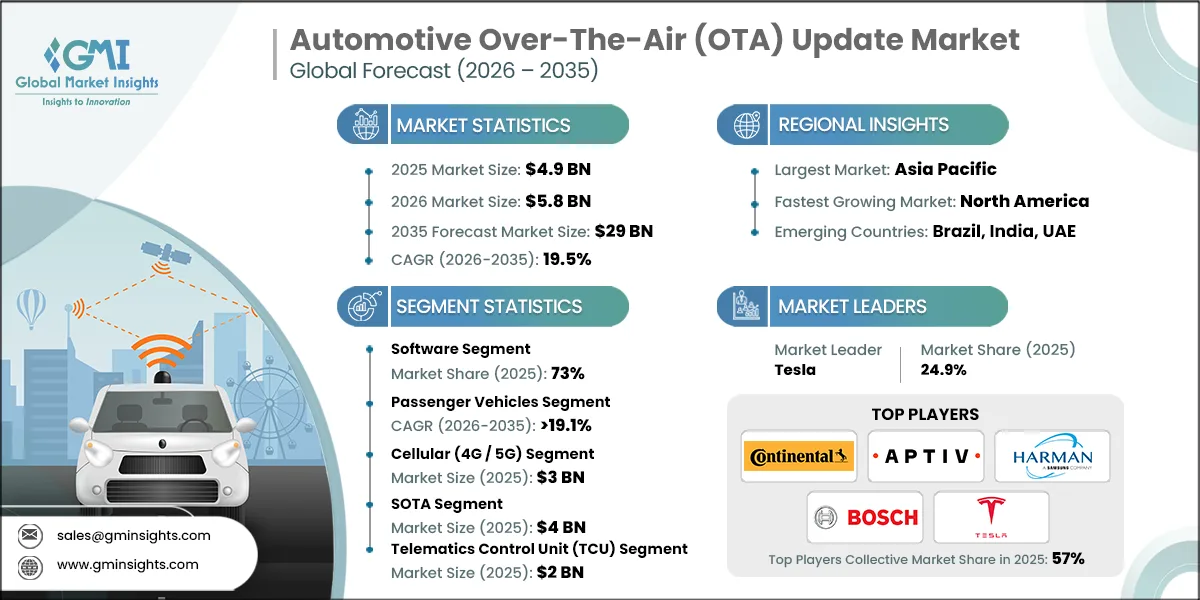
The global automotive over-the-air (OTA) update market was valued at USD 4.9 billion in 2025. The market is expected to grow from USD 5.8 billion in 2026 to USD 29 billion in 2035, at a CAGR of 19.5%, according to latest report published by Global Market Insights Inc.
The market is projected to witness strong and sustained growth in the coming years, driven by the rapid evolution of software-defined vehicles (SDVs), increasing vehicle connectivity, and the growing penetration of electric and connected vehicles worldwide. As automotive architectures become increasingly software-centric, OEMs are prioritizing secure, scalable, and real-time update capabilities to enhance vehicle functionality, safety, and user experience. Regulatory mandates related to cybersecurity management systems, functional safety, and software compliance across North America, Europe, and Asia Pacific are further compelling automakers and technology providers to deploy advanced OTA update frameworks across both passenger and commercial vehicle segments.
Rising pressure on automotive manufacturers to reduce recall costs, improve customer satisfaction, and accelerate feature deployment is fueling demand for robust OTA update platforms covering infotainment systems, telematics control units (TCUs), electronic control units (ECUs), advanced driver assistance systems (ADAS), and battery management systems (BMS). The increasing adoption of electric passenger vehicles, light commercial vehicles (LCVs), medium and heavy commercial vehicles (MCVs/HCVs), and connected fleet platforms is further strengthening the demand for secure firmware-over-the-air (FOTA) and software-over-the-air (SOTA) solutions that enable continuous performance optimization and lifecycle management.
Technological advancements such as cloud-native OTA management platforms, end-to-end encryption protocols, secure boot mechanisms, delta software updates, and edge-computing-enabled deployment models are transforming conventional automotive software maintenance practices. Integration of AI-driven update orchestration, predictive diagnostics, real-time vehicle health monitoring, and digital twin validation is enhancing deployment accuracy and minimizing failed update scenarios. Additionally, the rollout of 5G networks, embedded eSIM technologies, and advanced telematics infrastructure is enabling faster, safer, and more reliable update distribution across diverse geographic and network environments.
In 2025, leading automotive OTA solution providers and Tier-1 suppliers, including Robert Bosch, Continental, DENSO, Aptiv, NXP Semiconductors, Qualcomm Technologies, and HARMAN International, continued expanding their OTA capabilities through investments in cybersecurity, AI-based update management, and scalable multi-OEM platforms. For instance, in early 2025, major Tier-1 suppliers strengthened their UNECE R155 and R156-compliant OTA frameworks, while several OEMs expanded in-house OTA ecosystems to support feature-on-demand monetization models and autonomous driving software enhancements. Strategic collaborations between chipmakers, connectivity providers, and cloud service firms further accelerated the adoption of integrated OTA infrastructures for both passenger and commercial vehicle fleets.
The automotive over-the-air market continues to evolve as digitalization, electrification, and connectivity redefine vehicle lifecycle management and customer engagement models. Industry stakeholders are increasingly prioritizing secure, predictive, and scalable OTA architectures that enhance vehicle performance, enable continuous feature enhancement, reduce recall-related costs, and ensure regulatory compliance. These developments are reshaping the OTA update ecosystem, enabling software-driven innovation, recurring revenue opportunities, and long-term value creation across passenger vehicles, commercial fleets, and emerging autonomous mobility platforms.
Automotive Over-The-Air (OTA) Update Market Trends
The demand for advanced Automotive Over-The-Air (OTA) Update solutions is rapidly increasing, driven by growing collaboration among automotive OEMs, Tier-1 suppliers, telematics providers, sensor technology companies, and regulatory authorities. These partnerships focus on enhancing real-time software updates, cybersecurity patch deployment, ECU firmware management, feature-on-demand delivery, and overall vehicle performance and uptime. Stakeholders are working together to develop integrated, modular, and scalable OTA platforms that support infotainment, safety-critical systems, drive control updates, and fleet software management while ensuring regulatory compliance.
For instance, in 2025, leading companies such as Aptiv PLC, Continental AG, HARMAN International, Robert Bosch, and Tesla strengthened strategic collaborations with OEMs, fleet operators, and cloud service providers to deploy AI-enabled OTA orchestration platforms, telematics-controlled software distribution, secure firmware updates, and predictive diagnostics systems. These initiatives improved update reliability, reduced recall costs, enhanced system integration, and optimized remote feature delivery across passenger and commercial vehicles.
Regional customization of OTA services is emerging as a key trend. Leading providers are developing region-specific software update frameworks, modular deployment kits, localized cybersecurity protocols, and digital support infrastructure across North America, Europe, Asia Pacific, Latin America, and Middle East & Africa. These tailored solutions address OEM-specific vehicle architectures, regional connectivity availability, regulatory standards, environmental conditions, and cost sensitivities, supporting efficient and scalable OTA deployment for global vehicle fleets.
The rise of specialized OTA technology providers, telematics startups, and predictive service platforms is reshaping the competitive landscape. Companies focusing on AI-driven software orchestration, cloud-based update management, ECU health monitoring, and integrated fleet software management enable cost-effective, secure, and efficient OTA deployment. These innovations empower both established players and emerging entrants to improve update reliability, reduce downtime, optimize software lifecycle costs, and enhance end-user satisfaction across passenger and commercial vehicle applications.
The development of standardized, modular, and interoperable OTA platforms is transforming the market. Leading players such as Aptiv PLC, Continental AG, HARMAN International, Robert Bosch, and Tesla are deploying integrated OTA solutions that combine software updates, firmware management, predictive diagnostics, infotainment and drive-control system updates, and cybersecurity patches into compact, scalable frameworks. These platforms enable customizable vehicle integration, high-volume update deployment, regional compliance, and reliability, empowering OEMs, fleet operators, and service providers to deliver efficient, cost-effective, and future-ready OTA solutions across global markets.
Automotive Over-The-Air (OTA) Update Market Analysis
Based on components, the market is divided into software and services. The software dominated the market, accounting for around 73% share in 2025 and is expected to grow at a CAGR of over 19% from 2026 to 2035.
Based on vehicles, the market is divided into passenger vehicles and commercial vehicles. The passenger vehicles segment dominates the market, accounting for around 76% share in 2025, and the segment is expected to grow at a CAGR of over 19.1% from 2026 to 2035.
Based on connectivity, the market is divided into Cellular (4G / 5G), Wi-Fi and Satellite. The Cellular (4G / 5G) segment dominated the market and was valued at USD 3 billion in 2025.
Based on technology, the market is divided into SOTA and FOTA. The SOTA segment dominated the market and was valued at USD 4 billion in 2025.
Based on application, the market is divided into telematics control unit (TCU), electronic control unit (ECU), infotainment systems, safety & security systems and others. The telematics control unit (TCU) segment dominated the market and was valued at USD 2 billion in 2025.
In 2025, China dominated the Asia Pacific automotive over-the-air update market with around 51% market share and generated approximately USD 0.8 billion in revenue.
US holds share of 83% in North America automotive OTA update market in 2025 and it will grow tremendously between 2026 and 2035.
Germany holds share of 21% in Europe automotive over-the-air update market in 2025 and it will grow tremendously between 2026 and 2035.
Automotive over-the-air (OTA) update market in Brazil will experience significant growth between 2026 and 2035.
Automotive Over-The-Air (OTA) update market in UAE will experience significant growth between 2026 and 2035.
Automotive Over-The-Air (OTA) Update Market Share
The top 7 companies in the market are Tesla, Robert Bosch, Continental, HARMAN International, Aptiv, NXP Semiconductors and Qualcomm. These companies hold around 60% of the market share in 2025.
Automotive Over-The-Air (OTA) Update Market Companies
Major players operating in the automotive over-the-air (OTA) update industry include:
Automotive Over-The-Air (OTA) Update Industry News
The automotive over-the-air (OTA) update market research report includes in-depth coverage of the industry with estimates & forecasts in terms of revenue ($ Bn) from 2022 to 2035, for the following segments:
Market, By Component
Market, By Vehicle
Market, By Connectivity
Market, By Technology
Market, By Application
The above information is provided for the following regions and countries: