
Animal Healthcare Market Size & Share 2026-2035
Download Free PDF
Report Content
Chapter 1 Methodology and Scope
1.1 Market scope and definition
1.2 Research approach
1.3 Quality commitments
1.3.1 GMI AI policy and data integrity commitment
1.3.1.1 Source consistency protocol
1.4 Research trail and confidence scoring
1.4.1 Research trail components
1.4.2 Scoring components
1.5 Data collection
1.5.1 Partial list of primary sources
1.6 Data mining sources
1.6.1 Paid sources
1.6.1.1 Sources, by region
1.7 Base estimates and calculations
1.7.1 Revenue share analysis
1.7.2 Base year calculation
1.8 Forecast model
1.9 Research transparency addendum
1.9.1 Source attribution framework
1.9.2 Quality assurance metrics
1.9.3 Our commitment to trust
Chapter 2 Executive Summary
2.1 Industry 360° synopsis
2.2 Key market trends
2.2.1 Regional trends
2.2.2 Product trends
2.2.3 Animal type trends
2.3 CXO perspectives: Strategic imperatives
Chapter 3 Industry Insights
3.1 Industry ecosystem analysis
3.2 Industry impact forces
3.2.1 Growth drivers
3.2.1.1 Increasing population of pet animals
3.2.1.2 Increasing support offered by government and public organizations for animal care
3.2.1.3 Growing demand for online veterinary pharmacies
3.2.1.4 Increase in animal healthcare expenditure
3.2.2 Industry pitfalls and challenges
3.2.2.1 High cost associated with animal health drugs
3.2.2.2 Limited access in rural areas
3.2.3 Market opportunities
3.2.3.1 Expansion of telemedicine and remote veterinary consultation
3.2.3.2 Rising adoption of preventive and wellness-focused animal health solutions
3.3 Growth potential analysis
3.4 Technology landscape (Driven by Primary Research)
3.4.1 Current technological trends
3.4.2 Emerging technologies
3.5 Regulatory landscape (Driven by Primary Research)
3.5.1 North America
3.5.2 Europe
3.5.3 Asia Pacific
3.5.4 Latin America
3.5.5 Middle East and Africa
3.6 Reimbursement scenario (Driven by Primary Research)
3.7 Venture capitalist scenario in animal health industry
3.8 Economic impacts of the animal health industry
3.9 Consumer behaviour trends (Driven by Primary Research)
3.10 Future market trends (Driven by Primary Research)
3.11 Impact of AI and generative AI on the market
3.12 Porter’s analysis
3.13 PESTEL analysis
Chapter 4 Competitive Landscape, 2025
4.1 Introduction
4.2 Company market share analysis
4.3 Company matrix analysis
4.4 Competitive analysis of major market players
4.5 Competitive positioning matrix
4.6 Key developments
4.6.1 Merger and acquisition
4.6.2 Partnership and collaboration
4.6.3 New product launches
4.6.4 Expansion plans
Chapter 5 Market Estimates and Forecast, By Product, 2022 – 2035 ($ Mn)
5.1 Key trends
5.2 Pharmaceuticals
5.2.1 Type
5.2.1.1 Drugs
5.2.1.1.1 Antiparasitic
5.2.1.1.2 Anti-inflammatory
5.2.1.1.3 Anti-infectives
5.2.1.1.4 Corticosteroids
5.2.1.1.5 Tranquilizers
5.2.1.1.6 Cardiovascular drugs
5.2.1.1.7 Gastrointestinal drugs
5.2.1.1.8 Other drugs
5.2.1.2 Vaccines
5.2.1.2.1 Modified live vaccines (MLV)
5.2.1.2.2 Killed inactivated vaccines
5.2.1.2.3 Other vaccines
5.2.1.3 Medicated feed additives
5.2.1.3.1 Antibiotics
5.2.1.3.2 Vitamins
5.2.1.3.3 Amino acids
5.2.1.3.4 Enzymes
5.2.1.3.5 Antioxidants
5.2.1.3.6 Prebiotics and probiotics
5.2.1.3.7 Minerals
5.2.1.3.8 Other medicated feed additives
5.2.2 Indication
5.2.2.1 Dermatology
5.2.2.2 Cardiovascular diseases
5.2.2.3 Gastrointestinal diseases
5.2.2.4 Respiratory diseases
5.2.2.5 Other indications
5.2.3 Distribution channel
5.2.3.1 Veterinary hospital pharmacies
5.2.3.2 E-commerce
5.2.3.3 Retail pharmacies
5.3 Medical devices
5.3.1 Veterinary diagnostic equipment
5.3.2 Anesthesia equipment
5.3.3 Patient monitoring equipment
5.3.4 Veterinary surgical equipment
5.3.5 Veterinary consumables
5.3.6 Other medical devices
5.4 Veterinary services
Chapter 6 Market Estimates and Forecast, By Animal Type, 2022 – 2035 ($ Mn)
6.1 Key trends
6.2 Companion animals
6.2.1 Dogs
6.2.2 Cats
6.2.3 Horses
6.2.4 Other companion animals
6.3 Livestock animals
6.3.1 Poultry
6.3.2 Swine
6.3.3 Cattle
6.3.4 Fish
6.3.5 Other livestock animals
Chapter 7 Market Estimates and Forecast, By Region, 2022 – 2035 ($ Mn)
7.1 Key trends
7.2 North America
7.2.1 U.S.
7.2.2 Canada
7.3 Europe
7.3.1 Germany
7.3.2 UK
7.3.3 France
7.3.4 Spain
7.3.5 Italy
7.3.6 Netherlands
7.4 Asia Pacific
7.4.1 China
7.4.2 India
7.4.3 Japan
7.4.4 Australia
7.4.5 South Korea
7.5 Latin America
7.5.1 Brazil
7.5.2 Mexico
7.5.3 Argentina
7.6 Middle East and Africa
7.6.1 South Africa
7.6.2 GCC Countries
7.6.3 Israel
Chapter 8 Company Profiles
Don't see your key competitors?
The companies listed in this report are a curated selection - not the full competitive universe.
Our market revenue calculations use a bottom-up methodology that accounts for all players across all regions - including manufacturers, distributors, and specialists not individually profiled. The profiles section spotlights strategically significant players; it does not define the scope of our market sizing.
Your competitive landscape may also include
Free customization - up to 20% of report value
Need specific data? Request customization and get the insights tailored to your exact requirements.
For inquiries regarding discounts, bulk purchases, or customization requests, please contact us at [email protected]
Share Content
Add Citations
Monali Tayade. 2026, March. Animal Healthcare Market – By Product, By Animal Type - Global Forecast, 2026-2035 (Report ID: GMI735). Global Market Insights Inc. Retrieved September 19, 2026, from https://www.gminsights.com/toc/details/animal-healthcare-market

Animal Healthcare Market
Get a free sample of this report
Animal Healthcare Market Size
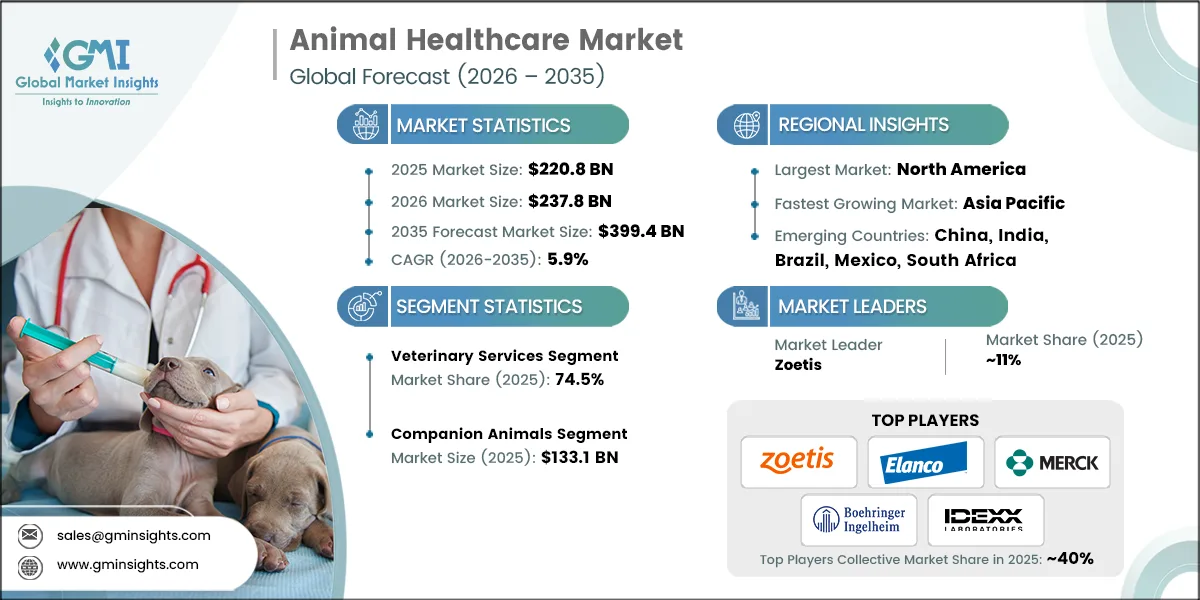
The global animal healthcare market was valued at USD 220.8 billion in 2025. The market is expected to grow from USD 237.8 billion in 2026 to USD 399.4 billion in 2035, at a CAGR of 5.9% during the forecast period, according to the latest report published by Global Market Insights Inc.
This market is primarily driven by rising pet ownership and increasing livestock populations. According to Pet Palace, 45.5% of households own a dog and 32.1% own a cat globally. Additionally, Symrise reports that 23% of households globally own a pet, with approximately 522 million dogs and 445 million cats worldwide. Moreover, expanding demand for protein‑rich animal‑derived food products, greater awareness of animal welfare, and the global emphasis on preventing disease transmission from animals to humans further contribute to market growth.
Further, the increasing burden of animal diseases, including chronic and infectious conditions, has also intensified the need for advanced veterinary intervention. Growing incidence of zoonotic diseases, along with the rising human‑animal interface across farms, homes, and urban environments, continues to shape healthcare priorities globally.
The animal healthcare market refers to the global industry focused on the prevention, diagnosis, and treatment of diseases affecting companion and production animals. It encompasses pharmaceuticals, vaccines, diagnostic tools, medicinal feed additives, equipment and disposables that collectively help maintain animal health, enhance livestock productivity, prevent disease outbreaks, and support public health through the reduction of zoonotic risks.
Key players in the animal healthcare market include Zoetis, Merck Animal Health, Boehringer Ingelheim, Elanco Animal Health, Ceva Sante Animale, Virbac, Vetoquinol, Dechra Pharmaceuticals, Neogen Corporation, Phibro Animal Health Corporation, and Biogenesis Bagó. These companies continue to drive innovation through robust R&D pipelines, expansion of vaccine and biologics portfolios, digital diagnostic advancements, and strategic acquisitions aimed at strengthening global manufacturing and distribution networks. Their combined efforts are instrumental in addressing the long‑term healthcare needs of companion animals and livestock populations worldwide.
Between 2022 and 2024, the animal healthcare market experienced steady and sustained growth, supported by the rising adoption of biologics, increased utilization of advanced diagnostics, and strong demand for preventive veterinary care. During this period, the global market expanded from approximately USD 174.2 billion in 2022 to USD 203.3 billion in 2024. Growth was further reinforced by expanding livestock production, increased investment in veterinary pharmaceuticals and broader access to modern veterinary treatments across both developed and emerging markets.
Animal Healthcare Market Trends
Animal Healthcare Market Analysis
Based on the product, the market is segmented into pharmaceuticals, medical devices, and veterinary services. The veterinary services segment has asserted its dominance in the market by securing a significant revenue share of 74.5% in 2025 and is anticipated to grow at a CAGR of 6% over the forecast years.
Based on animal type, the animal healthcare market is classified as companion animals and livestock animals. The companion animals segment held the highest revenue of USD 133.1 billion in 2025 and is expected to witness a notable growth during the forecast time. The companion animals' segment is sub-segmented into dogs, cats, horses, and other companion animals.
On the other hand, the livestock animals' segment is growing, driven by the rising demand for high‑quality animal protein, increasing prevalence of infectious and production‑limiting diseases, and greater adoption of preventive healthcare practices.
North America Animal Healthcare Market
The North America animal healthcare market dominated the global market with a share of 38.5% in 2025.
The U.S. animal healthcare market was valued at USD 26.2 billion and USD 28 billion in 2022 and 2023, respectively. The market size reached USD 32.7 billion in 2025, growing from USD 30.3 billion in 2024.
Europe Animal Healthcare Market
Europe market accounted for USD 61.5 billion in 2025 and is anticipated to show lucrative growth over the forecast period.
Europe maintains strong momentum due to high pet ownership, established livestock vaccination programs, and widespread availability of veterinary biopharmaceuticals. According to European pet food industry, in Europe, about 90 million households own a pet, stimulating the market demand.
Germany dominates the Europe animal healthcare market, with strong growth potential.
Asia Pacific Animal Healthcare Market
The Asia Pacific market is anticipated to grow at the highest CAGR of 6.3% during the analysis timeframe.
China animal healthcare market is estimated to grow with a significant CAGR, in the Asia Pacific region.
Latin American Animal Healthcare Market
Brazil leads the Latin American animal healthcare industry, exhibiting remarkable growth during the analysis period.
Middle East and Africa Animal Healthcare Market
Saudi Arabia animal healthcare industry is expected to experience substantial growth in the Middle East and Africa.
Animal Healthcare Market Share
The global animal healthcare industry is characterized by a concentrated yet competitive landscape, with a small group of leading companies generating a substantial share of global revenues. Zoetis, Merck Animal Health, Boehringer Ingelheim, Elanco Animal Health, and IDEXX Laboratories collectively account for approximately 40% of the global market, supported by their broad product portfolios, deep research and development capabilities, and extensive international distribution networks. These companies dominate key therapeutic and diagnostic categories across both livestock and companion animal segments, leveraging leadership in vaccines, pharmaceuticals, parasiticides, diagnostics, and digital veterinary solutions.
Strategic expansion through acquisitions, technology partnerships, and manufacturing investments continues to shape the competitive landscape. For instance, Zoetis has recently strengthened its global production footprint through acquisitions of new manufacturing sites, while Merck Animal Health has expanded its portfolio through targeted M&A activities. Leading companies are actively stimulating development pipelines focused on advanced vaccines, biologics, precision diagnostics, and integrated digital health platforms, driven by rising prevalence of zoonotic diseases, growing pet ownership, and increasing demand for protein-rich livestock products.
Animal Healthcare Market Companies
Prominent players operating in the animal healthcare industry are as mentioned below:
B. Braun Vet Care (B Braun Melsungen)
Zoetis holds the leading position in the global animal healthcare market, supported by its extensive portfolio spanning vaccines, pharmaceuticals, diagnostics, and genetics for both livestock and companion animals. The company’s strong market presence is reinforced by consistent revenue growth, making it the largest player in the sector. Its leadership is further strengthened by the strategic global expansion of manufacturing facilities to enhance vaccine development and production capacity demonstrating Zoetis continued investment in innovation and global supply capabilities.
Merck Animal Health maintains a strong competitive standing in the global market, driven by its broad-spectrum portfolio of vaccines, pharmaceuticals, and advanced technology platforms designed for both companion animals and livestock. The company continues to invest in next‑generation vaccines, digital platforms, and sustainability-focused initiatives, while leveraging strategic acquisitions such as expanding into specialized segments of animal health to reinforce its long‑term growth and leadership.
Boehringer Ingelheim plays a pivotal role in the global animal healthcare landscape, supported by its research-driven approach and deep expertise in biotechnology, preventive care, and advanced animal therapeutics. Its strong global distribution network and integrated solutions spanning vaccines, biologics, and digital tools allow Boehringer Ingelheim to address growing demand across both livestock and companion animal segments.
Animal Healthcare Industry News
The animal healthcare market research report includes in-depth coverage of the industry with estimates and forecast in terms of revenue in USD Million from 2022 – 2035 for the following segments:
Market, By Product
Market, By Animal Type
The above information is provided for the following regions and countries: