
Aerogel Insulation Market Size & Share 2026-2035
Download Free PDF
Report Content
Chapter 1. Methodology & Scope
1.1 Research approach
1.2 Quality Commitments
1.2.1 GMI AI policy & data integrity commitment
1.2.1.1 Source consistency protocol
1.3 Research Trail & Confidence Scoring
1.3.1 Research Trail Components
1.3.2 Scoring Components
1.4 Data Collection
1.4.1 Partial list of primary sources
1.5 Data mining sources
1.5.1 Paid sources
1.5.1.1 Sources, by region
1.6 Base estimates and calculations
1.6.1 Base year calculation for any one approach
1.7 Forecast model
1.7.1 Quantified market impact analysis
1.7.1.1 Mathematical impact of growth parameters on forecast
1.8 Research transparency addendum
1.8.1 Source attribution framework
1.8.2 Quality assurance metrics
1.8.3 Our commitment to trust
Chapter 2. Executive Summary
2.1 Industry 360° synopsis
2.2 Key market trends
2.2.1 Regional
2.2.2 Form
2.2.3 Material
2.2.4 Temperature range
2.2.5 End Use
2.3 TAM analysis, 2027-2035
2.4 CXO perspectives: strategic imperatives
Chapter 3. Industry Insights
3.1 Industry ecosystem analysis
3.1.1 Supplier Landscape
3.1.2 Profit Margin
3.1.3 Cost structure
3.1.4 Value addition at each stage
3.1.5 Factor affecting the value chain
3.1.6 Disruptions
3.2 Industry impact forces
3.2.1 Growth drivers
3.2.1.1 Stringent building energy codes & green building standards drivin retrofit demand
3.2.1.2 Rapid ev adoption accelerating demand for battery thermal management & thermal runaway prevention
3.2.1.3 Expanding global oil & gas infrastructure & lng trade volume requiring high-performance pipeline insulation
3.2.2 Industry pitfalls & challenges
3.2.2.1 Lack of standardized testing protocols across geographies creating certification complexity for global expansion
3.2.2.2 Limited installer awareness & skilled labor availability constraining adoption in emerging markets
3.2.3 Market opportunities
3.3 Growth potential analysis
3.4 Pricing Analysis (Driven by Primary Research)
3.4.1 Historical Price Trend Analysis
3.4.2 Pricing Strategy by Player Type (Premium / Value / Cost-plus)
3.5 Regulatory landscape
3.5.1 North America
3.5.2 Europe
3.5.3 Asia-Pacific
3.5.4 Latin America
3.5.5 Middle East and Africa
3.6 Porter’s analysis
3.7 PESTEL analysis
3.8 Trade Data Analysis (Based on Paid Database) (68069000)
3.8.1 Import/Export Volume & Value Trends
3.8.2 Key Trade Corridors & Tariff Impact
3.9 Impact of AI & Generative AI on the Market (Driven by Primary Research)
3.9.1 AI-Driven Disruption of Existing Business Models
3.9.2 GenAI Use Cases & Adoption Roadmap by Segment
3.9.3 Risks, Limitations & Regulatory Considerations
3.10 Capacity & production landscape (driven by primary research)
3.10.1 Installed production capacity by region & key producer (driven by primary research)
3.10.2 Capacity utilization rates & expansion pipelines (driven by primary research)
Chapter 4. Competitive landscape, 2025
4.1 Introduction
4.2 Company market share analysis
4.2.1 By Region
4.2.1.1 North America
4.2.1.2 Europe
4.2.1.3 Asia-Pacific
4.2.1.4 Latin America
4.2.1.5 Middle East and Africa
4.2.2 Market Concentration Analysis
4.3 Competitive analysis of major market players
4.4 Competitive positioning matrix
4.5 Key developments
4.5.1 Mergers & acquisitions
4.5.2 Partnerships & collaborations
4.5.3 New product launches
4.5.4 Expansion plans and funding
4.6 Company tier benchmarking
4.6.1 Tier classification criteria & qualifying thresholds
4.6.2 Tier positioning matrix by revenue, geography & innovation
Chapter 5. Market Estimates & Forecast, By Form, 2022 – 2035, (USD Billion) (Thousand Units)
5.1 Key trends
5.2 Blankets and flexible rolls
5.2.1 Standard non-faced blankets
5.2.2 Faced blankets
5.3 Panels and boards
5.3.1 Rigid aerogel panels
5.3.2 Semi-rigid aerogel panels
5.4 Particles, granules, and powders
5.4.1 Loose-fill granules (for composite boards and renders)
5.4.2 Aerogel-enhanced mortars, renders, and concretes
5.5 Coatings and pastes
5.5.1 Water-based aerogel coatings
5.5.2 Solvent-based aerogel coatings
5.6 Others (monoliths, aerogel foams, and specialty forms)
Chapter 6. Market Estimates & Forecast, By Material , 2022 – 2035, (USD Billion) (Thousand Units)
6.1 Key trends
6.2 Silica Aerogel
6.3 Polymer Aerogel
6.4 Carbon Aerogel
6.5 Other
Chapter 7. Market Estimates & Forecast, By Temperature Range, 2022 – 2035, (USD Billion) (Thousand Units)
7.1 Key trends
7.2 Low-Temperature Insulation (<100 °C)
7.3 Medium-Temperature Insulation (100 °C–500 °C)
7.4 High-Temperature Insulation (>500 °C)
Chapter 8. Market Estimates & Forecast, By End Use, 2022 – 2035, (USD Billion) (Thousand Units)
8.1 Key trends
8.2 Oil and Gas
8.3 Building and Construction
8.4 Automotive and Electric Vehicles
8.5 Aerospace and Defense
8.6 Industrial Processes and Equipment
8.7 Electronics
8.8 Performance Apparel and Footwear
8.9 Others (Marine, Renewable Energy, and Wearable Technology)
Chapter 9. Market Estimates & Forecast, By Region, 2022 – 2035 (USD Billion) (Thousand Units)
9.1 Key trends
9.2 North America
9.2.1 U.S.
9.2.2 Canada
9.3 Europe
9.3.1 Germany
9.3.2 UK
9.3.3 France
9.3.4 Spain
9.3.5 Italy
9.4 Asia Pacific
9.4.1 China
9.4.2 Japan
9.4.3 India
9.4.4 Australia
9.4.5 South Korea
9.5 Latin America
9.5.1 Brazil
9.5.2 Mexico
9.5.3 Argentina
9.6 MEA
9.6.1 South Africa
9.6.2 Saudi Arabia
9.6.3 UAE
Chapter 10. Company Profiles
Don't see your key competitors?
The companies listed in this report are a curated selection - not the full competitive universe.
Our market revenue calculations use a bottom-up methodology that accounts for all players across all regions - including manufacturers, distributors, and specialists not individually profiled. The profiles section spotlights strategically significant players; it does not define the scope of our market sizing.
Your competitive landscape may also include
Free customization - up to 20% of report value
Need specific data? Request customization and get the insights tailored to your exact requirements.
For inquiries regarding discounts, bulk purchases, or customization requests, please contact us at [email protected]
Share Content
Add Citations
Avinash Singh. 2026, September. Aerogel Insulation Market 2026 - 2035 (Report ID: GMI3333). Global Market Insights Inc. Retrieved November 25, 2026, from https://www.gminsights.com/toc/details/aerogel-insulation-market

Aerogel Insulation Market
Get a free sample of this report
Aerogel Insulation Market Size
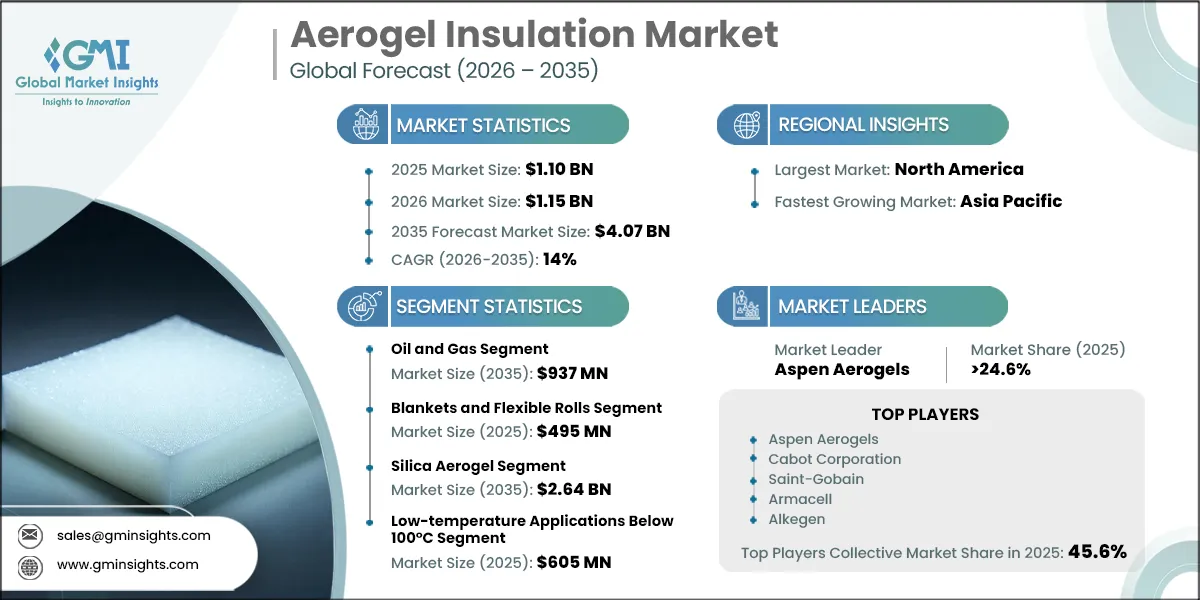
The Aerogel Insulation Market was valued at USD 1.10 billion in 2025, is projected to reach USD 1.15 billion in 2026, is expected to grow at a 14.0% CAGR (2026–2035), and is forecast to reach USD 4.07 billion by 2035.
The market is measured on a demand-side revenue basis at the manufacturer level and covers commercially produced aerogel-based insulation, including flexible blankets, rigid boards, particles, liquid-applied formulations, and specialty configurations. Its near-term recovery reflects a broadening of demand beyond concentrated EV thermal-barrier programs toward code-driven building retrofit, industrial process efficiency, LNG infrastructure, and automotive electrification. That wider application base improves the durability of market demand, although program timing will continue to influence annual revenue realization.
GMI Analyst View
Our discussions with industry participants indicate that the global aerogel insulation market generated revenue of USD 1.35 billion in 2024, which is essential context for interpreting the 2025 base year. The 2025 contraction was driven primarily by reduced EV thermal barrier offtake from key OEM customers following revisions to government incentive programs rather than any structural erosion of demand for aerogel's core performance attributes. The underlying growth thesis — anchored in superior thermal resistance at minimum thickness, fire containment capability, and durability under industrial operating conditions — remains intact, and the 2026 forecast initiates a recovery trajectory that GMI expects to build acceleration from 2027 onward as building and automotive program pipelines mature.
Aerogel Insulation Market Trends, Growth Drivers & GMI Forecast Outlook
Aerogel insulation demand is broadening beyond high-value industrial uses toward EV battery safety, building-code retrofit, and energy infrastructure. The forecast trajectory depends on automotive program conversion, stable policy conditions, and the reduction of installed-cost barriers — with timing variability remaining the principal near-term risk.
Key Drivers
EV adoption creates a specification-led channel for aerogel because battery architectures have limited space to accommodate thermal protection. Cell-level barriers can help contain thermal-runaway propagation while preserving pack geometry and weight targets. The commercial effect is delayed by automotive qualification cycles, but once a material is integrated into a platform, procurement can scale with vehicle production rather than with one-off industrial project schedules.
New dedicated manufacturing capacity also changes the market's commercial proposition. Greater regional supply can reduce lead times, improve formulation availability for local OEMs and contractors, and support applications that previously could not justify premium insulation costs. The strategic issue for producers is whether cost reductions translate into broader specification rather than solely price competition in existing accounts.
The building opportunity is distinguished by aerogel's ability to add thermal resistance where wall thickness, heritage constraints, equipment clearances, or usable floor area limit conventional insulation choices. The EPBD establishes a policy framework for renovation and new construction that increases the value of thin, high-performance materials in technically constrained envelopes. [3]
Key Restraints
*Evidence anchors use cited external data; demand implications and forecast conditions represent GMI analysis.*
The automotive channel exposes suppliers to the production decisions of a limited number of OEM platforms. Policy changes and revised EV output plans can affect material purchasing quickly, especially when recently qualified programs represent a meaningful portion of supplier utilization. Diversification into construction, industrial process, and infrastructure applications is therefore important not only for growth but also for reducing customer-concentration exposure.
Oil and gas remains commercially important, but demand follows project sanctioning, equipment procurement, and construction schedules rather than a smooth replacement cycle. Global LNG trade reached 411.24 million tonnes in 2024 [5], reflecting sustained long-run infrastructure investment, yet delayed permitting, financing changes, or commodity-price volatility can shift project order timing by 12 to 24 months. The result is uneven factory loading for suppliers with high exposure to project work.
Certification fragmentation creates a separate barrier for both new entrants and established manufacturers expanding across borders. Products may require repeated fire, moisture, mechanical, and thermal-performance testing under jurisdiction-specific protocols. The burden is particularly material in markets where third-party testing capacity is limited or where project owners require documentation from internationally recognized laboratories.
GMI Analyst View
We view the market's principal risk as uneven conversion timing rather than an absence of long-term demand. Automotive programs, retrofit mandates, and energy infrastructure all support aerogel adoption, but each advances through different approval, financing, and procurement cycles. Suppliers with certified products, flexible manufacturing, and diversified end-market exposure should be better positioned to absorb this timing variability.
Aerogel Insulation Market Segment Analysis
By End Use
Oil and gas generated USD 330 million in 2025 and is forecast to reach USD 937 million by 2035. Aerogel is specified in subsea systems, LNG assets, process piping, and other critical-service environments where insulation failure can carry substantial operational consequences. Its hydrophobic properties, low thickness, and capability under demanding thermal conditions sustain demand even as the segment's relative position is diluted by faster-growing uses.
Building and construction represented 28.0% of the market in 2025 and is forecast to grow at a 15.9% CAGR (2026–2035). Retrofit projects provide the strongest commercial setting for aerogel where facade depth, protected-building requirements, or internal-space constraints restrict conventional insulation solutions. The segment also benefits from growing architect and contractor familiarity with high-performance envelope systems, although installed cost and applicator expertise remain decisive in wider adoption.
Automotive and EV generated USD 198 million in 2025 and is forecast to reach USD 815 million by 2035. Battery thermal management is reshaping aerogel demand by connecting product performance to vehicle safety architecture. Suppliers must meet demanding requirements for consistency, dust control, fire performance, and high-volume manufacturability, creating a meaningful qualification barrier but also a pathway to recurring program revenue once platforms move into production.
Industrial process applications are forecast to reach USD 448 million by 2035 and are expected to grow at a 15.1% CAGR (2026–2035). Demand is supported by corrosion-under-insulation prevention, heat-loss reduction, and space-constrained equipment design in refineries, petrochemical facilities, and other process operations. Buyers increasingly evaluate aerogel through lifecycle economics, particularly where shutdown avoidance and energy efficiency outweigh the initial material premium.
Aerospace and defense generated USD 77 million in 2025 and is forecast to reach USD 285 million by 2035. Low mass, thin profiles, and thermal protection support use in aircraft, defense platforms, and specialized aerospace systems. The segment's development cycles are lengthy, but those same qualification requirements can provide durable positions for suppliers able to meet performance and documentation standards.
Electronics represented 4.0% of market revenue in 2025 and is forecast to reach USD 163 million by 2035. Component miniaturization, localized heat loads, and the need to isolate sensitive equipment create selective opportunities for thin insulation systems. Commercial adoption depends on integrating aerogel into manufacturable assemblies rather than treating it as a stand-alone thermal material.
Performance apparel generated USD 22 million in 2025 and is expected to account for 1.0% of market revenue by 2035. The segment remains a specialist outlet where extreme-weather performance can justify premium materials. Broader penetration is constrained by durability, washing resistance, garment construction requirements, and the difficulty of maintaining performance through repeated mechanical stress.
By Product Form
Panels and boards represented 25.0% of market revenue in 2025 and are forecast to grow at a 14.5% CAGR (2026–2035). Rigid formats are well suited to wall, roof, and facade assemblies that require dimensional stability and repeatable installation. Their adoption is closely connected to construction-system design, making relationships with specifiers, fabricators, and distribution partners central to growth.
Particles and granules are forecast to reach USD 693 million by 2035 and are projected to grow at a 15.4% CAGR (2026–2035). Granular materials broaden aerogel's addressable use through renders, plasters, mortars, and composite formulations. This format can reduce application complexity and allow thermal performance to be incorporated into established construction materials rather than requiring a specialist insulation installation.
Coatings and pastes generated USD 110 million in 2025 and are expected to account for 13.0% of market revenue by 2035. Liquid-applied systems address complex geometry, pipe supports, structural steel, and retrofit surfaces that are difficult to cover with blankets or boards. Their commercial potential depends on demonstrating consistent field performance and enabling application methods that fit contractor workflows.
By Material Type
Silica aerogel generated USD 792 million in 2025 and is forecast to reach USD 2.64 billion by 2035. Silica retains the broadest established manufacturing base and certification portfolio, supporting its use across industrial, construction, and transportation applications. Its scale and known performance profile make it the reference material for many customers, although suppliers continue to refine handling and integration characteristics.
Polymer aerogel represented 18.0% of market revenue in 2025 and is forecast to grow at a 16.4% CAGR (2026–2035). Improved flexibility and reduced dusting can make polymer-based products attractive for applications that require repeated handling or integration into automotive assemblies. The material's progress will depend on translating these processing advantages into durable customer qualification and competitive total system cost.
Carbon aerogel generated USD 66 million in 2025 and is forecast to reach USD 367 million by 2035. Carbon-based materials are relevant where high-temperature performance and multifunctional thermal or electrical characteristics are valued. Their opportunity is concentrated in demanding industrial and aerospace settings rather than broad, cost-sensitive insulation markets.
By Temperature Range
Low-temperature applications below 100°C generated USD 605 million in 2025 and are expected to account for 52.0% of market revenue by 2035. This range includes building envelopes, EV battery systems, and standard process insulation, placing it at the intersection of the market's largest expansion channels. Demand is driven by thin-profile performance and installation feasibility rather than extreme-temperature requirements alone.
Medium-temperature applications from 100°C to 500°C generated USD 385 million in 2025 and are forecast to grow at a 13.9% CAGR (2026–2035). Process piping, heat exchangers, and industrial equipment provide the core use cases. In these applications, aerogel competes on thermal efficiency, maintenance requirements, and the ability to mitigate corrosion-under-insulation risk in confined operating environments.
High-temperature applications above 500°C are forecast to reach USD 530 million by 2035 and are projected to grow at a 17.0% CAGR (2026–2035). Extreme industrial and aerospace conditions create opportunities where traditional refractory options are too heavy or too thick for the available space. Commercial expansion will remain dependent on validation under demanding operating conditions and on suppliers' ability to meet project-specific engineering requirements.
GMI Analyst View
We see the segment mix shifting toward applications where aerogel changes system design rather than merely replacing another insulation material. Liquid formulations, EV barriers, and constrained-envelope construction use cases are particularly important because they rely on aerogel's thin-profile performance. This favors suppliers that can combine material science with application engineering and customer qualification support.
Aerogel Insulation Market Regional Analysis
North America Aerogel Insulation Market Analysis
The Aerogel Insulation Market in North America represented 37.0% of global revenue in 2025 and is forecast to reach USD 1.14 billion by 2035. The region combines mature oil and gas insulation demand with a significant base of automotive thermal-barrier development and increasingly stringent building-performance requirements. Its near-term trajectory is sensitive to OEM production timing, while its longer-term position is strengthened by established specification practices, engineering capabilities, and high-value industrial applications.
U.S.
The U.S. generated USD 374 million in 2025 and is forecast to reach USD 1.05 billion by 2035. The country is a central market for automotive qualification activity, industrial process insulation, and high-performance building applications. Federal support for domestic supply-chain development has reinforced the strategic relevance of local aerogel manufacturing, including a DOE loan commitment for Aspen Aerogels' Georgia facility. [6]
Europe Aerogel Insulation Market Analysis
Europe generated USD 297 million in 2025 and is forecast to grow at a 13.1% CAGR (2026–2035). Building renovation is the region's defining demand driver because strict efficiency requirements create value for insulation that performs within limited wall and floor depths. Industrial clusters also support demand in chemical, petrochemical, and manufacturing applications, while local production development could improve supply resilience for construction-oriented products.
Germany
Germany represented 24.9% of European market revenue in 2025 and is forecast to reach USD 255 million by 2035. Its demand base combines stringent energy-efficiency expectations with a substantial industrial process sector. This diversified end-use structure supports aerogel specification in both building retrofit and high-value industrial environments.
UK
The UK generated USD 54 million in 2025 and is forecast to grow at a 13.0% CAGR (2026–2035). New-build efficiency requirements and fabric-first retrofit priorities support aerogel use where space-efficient thermal improvement is necessary. Market development will depend on contractor familiarity, product availability, and project economics in the residential and commercial retrofit base.
Asia Pacific Aerogel Insulation Market Analysis
Asia Pacific is forecast to reach USD 1.22 billion by 2035 and is expected to grow at a 17.6% CAGR (2026–2035). The region combines fast-growing EV production, expanding industrial infrastructure, and increasing aerogel manufacturing capacity. Its growth is not reliant on a single demand source: automotive scale, construction activity, electronics manufacturing, and LNG-related investment create several pathways for product adoption.
China
China represented 55.0% of Asia Pacific market revenue in 2025 and is forecast to reach USD 673 million by 2035. The country's EV ecosystem, industrial base, and domestic aerogel supplier network provide a strong foundation for scale. Competition among local producers and international participants is likely to accelerate product adaptation, supply-chain localization, and price accessibility for industrial and automotive users.
India
India generated USD 36 million in 2025 and is forecast to grow at a 17.7% CAGR (2026–2035). Industrial process investment, energy infrastructure, and expanding construction activity offer a developing demand base. The market's pace will depend on the availability of locally supported products, specification awareness, and the ability to address cost sensitivity in major project categories.
Latin America Aerogel Insulation Market Analysis
Latin America represented 4.0% of global market revenue in 2025 and is forecast to reach USD 163 million by 2035. Regional demand is led by oil and gas infrastructure, industrial process insulation, and selected construction projects. Supply-chain access and project economics remain important constraints, making targeted industrial and energy applications more attractive than broad-based building adoption in the near term.
Brazil
Brazil represented 56.8% of Latin American market revenue in 2025 and is forecast to reach USD 91 million by 2035. Offshore energy activity, petrochemical operations, and related infrastructure underpin the country's role in regional demand. Aerogel's value proposition is strongest where reliability, corrosion protection, and thermal performance justify premium material costs.
Middle East & Africa Aerogel Insulation Market Analysis
MEA generated USD 110 million in 2025 and is forecast to reach USD 530 million by 2035. Oil and gas investment, LNG infrastructure, and large-scale process facilities provide the primary market foundation. Demand is supported by technically demanding insulation applications, although regional growth remains dependent on project schedules, procurement practices, and the availability of qualified suppliers.
Saudi Arabia
Saudi Arabia represented 35.5% of MEA market revenue in 2025 and is forecast to reach USD 186 million by 2035. The country's position reflects extensive energy infrastructure investment and demand for insulation in high-temperature, cryogenic, and process-intensive settings. Long-cycle capital programs create a meaningful opportunity for suppliers with relevant engineering support and project credentials.
UAE
The UAE generated USD 33 million in 2025 and is forecast to reach USD 159 million by 2035. Demand spans energy and petrochemical facilities, LNG-related infrastructure, desalination assets, and selected high-performance building projects. The market rewards suppliers able to support complex specifications and provide reliable technical documentation for major developments.
GMI Analyst View
We expect Asia Pacific to become the market's central growth arena because demand and supply are developing together. North America and Europe will remain important for qualification-intensive and retrofit-driven applications, while MEA offers project-led opportunities with high technical requirements. Regional success will depend less on geographic presence alone than on local certification, application support, and channel capability.
Aerogel Insulation Market Share & Competitive Landscape
The Aerogel Insulation Market share structure remains moderately concentrated, with the top five companies collectively accounting for approximately 45.6% of global revenue in 2025. Competition reflects a balance between technically established global suppliers and regional producers seeking to localize supply for automotive, industrial, construction, and specialty applications. Qualification barriers, product certification, manufacturing consistency, and customer application support remain more consequential than price alone, particularly in EV thermal management and critical industrial service.
Aspen Aerogels
Aspen Aerogels held a 24.6% market share in 2025. The company's position reflects its established aerogel portfolio across energy industrial and automotive thermal-barrier applications. Its competitive outlook is linked to the normalization of OEM program schedules, cost discipline, and the ability to convert qualified automotive relationships into sustained production demand.
Cabot Corporation
Cabot Corporation held a 7.0% market share in 2025. Its materials platform, distribution reach, and silica capabilities support participation in construction and industrial markets where product integration and accessible supply are important. The company is positioned to compete where customers seek aerogel-containing composites and scalable building-material solutions.
Saint-Gobain
Saint-Gobain held a 6.0% market share in 2025. Its construction-market channels and broader high-performance materials portfolio create an advantage in applications where aerogel can be incorporated into facade, glazing, and insulation systems. This route to market can reduce the need for customers to source specialist materials separately.
Armacell
Armacell participates through specialty thermal-insulation solutions for industrial process and commercial-building applications. Its established presence in thermal management supports product positioning where conventional elastomeric or mineral-wool solutions do not meet performance requirements within available space.
Alkegen
Alkegen supplies fiber-reinforced aerogel composites for EV enclosures, industrial insulation, and corrosion-under-insulation applications. Its low-dust product approach addresses a practical installation issue that can influence contractor acceptance and maintenance-market adoption.
Regional competitors are increasingly important to the market's supply evolution. LG Chem's South Korean production platform supports its role in EV battery thermal management, while European specialists and Chinese producers are expanding the availability of application-specific aerogel products. Emerging suppliers focused on cost optimization, sustainable feedstocks, or specialty textile and building uses may intensify competition in segments that have historically been underserved by premium aerogel formats.
Recent Industry Developments
LG Chem reached commercial production at its Dangjin aerogel facility in South Korea for Nexula™ TB products targeting EV battery thermal-barrier applications. The development strengthens regional manufacturing capacity for Asian OEM programs and illustrates the movement of aerogel production into larger chemical-industry supply chains. [2]
Keey Aerogel announced a Series A funding round in January 2025 to support European production development using construction-waste feedstock. The initiative highlights growing interest in local, lower-impact supply options for European building-retrofit applications. [7]
Need a specific section of this report?
Purchase regional analysis, country-level analysis, company profiles, or any other segment-level insights separately
based on your research needs.