Market Size – By Product (Advanced Wound Dressing, Surgical Wound Care, Traditional Wound Care, Wound Therapy Devices, Wound Care Biologics), By Application (Chronic Wounds, Acute Wounds), and By End Use (Hospitals, Specialty Clinics, Home Care Settings, Other End Users), Growth Forecast. The market forecasts are provided in terms of revenue (USD Million).
Report ID: GMI7515
|
Published Date: May 2026
|
Report Format: PDF
Download Free PDF
Wound Care Market Size
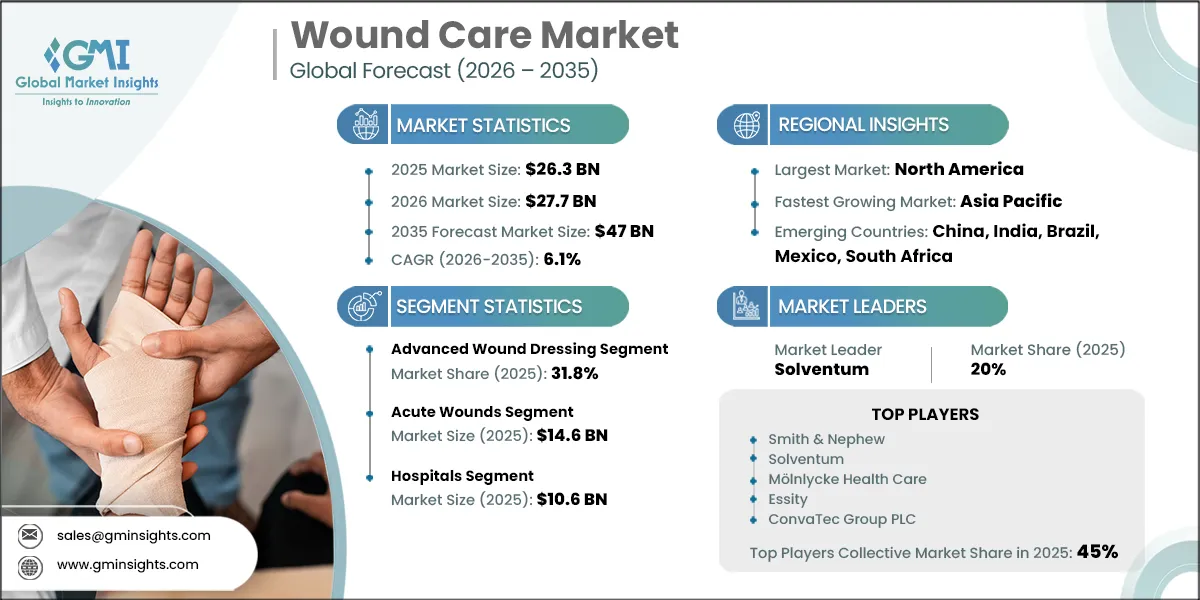
The global wound care market was valued at USD 26.3 billion in 2025. The market is expected to reach from USD 27.7 billion in 2026 to USD 47 billion in 2035, growing at a CAGR of 6.1% during the forecast period, according to the latest report published by Global Market Insights Inc.
This steady growth is stimulated by various factors such as increasing number of surgical procedures, growing demand for wound care products, rising prevalence of diabetes, and surge in number of trauma cases, among other contributing factors.
Wound care refers to the medical management and treatment of acute and chronic wounds to promote healing, prevent infection, and restore tissue integrity. It involves procedures such as wound cleaning, dressing application, infection control, moisture management, and the use of advanced therapies or devices depending on wound severity and type.
The major players in the global internal trauma fixation devices market are Smith & Nephew, Solventum, Mölnlycke Health Care, Essity, and ConvaTec Group. These companies maintain their competitive position through ongoing product innovation, global market presence, and substantial investment in research and development.
The market has increased from USD 22.4 billion in 2022 and reached USD 24.9 billion in 2024, with a historic growth rate of 5.4%. The market growth was driven by increasing incidence of burn injuries and trauma cases, expansion of home healthcare services, growing adoption of antimicrobial and bioactive dressings, rising healthcare expenditure, and improving access to wound management products across emerging economies.
Moreover, the rising prevalence of diabetes is a crucial factor driving market growth. For instance, according to the International Diabetes Federation Atlas, the global diabetic population is projected to increase significantly from 463 million in 2019 to 578 million by 2030 and further reach approximately 700 million by 2045. This trend highlights the growing demand for effective wound care products, including advanced wound dressings, foam dressings, and hydrogel dressings, owing to the increasing incidence of diabetes-related complications such as diabetic foot ulcers and chronic wounds.
Furthermore, the rising number of trauma cases is a significant driver for the wound care market. Accidents, road traffic injuries, falls, burns, and violence-related incidents are increasing globally due to rapid urbanization, industrialization, and growing vehicular density. These trauma cases frequently result in acute, complex, and contaminated wounds that require immediate and intensive wound management using advanced dressings, hemostatic agents, antimicrobial solutions, and surgical wound care products. The increasing trauma burden continues to drive demand across emergency departments, trauma centers, and post-acute care facilities, resulting in high and recurring consumption of wound care products.
Wound Care Market Trends
The increasing demand for wound care solutions in surgical treatments is evident globally and has become a major driver for market growth as medical procedures continue to advance and become more accessible. For instance, according to the American Academy of Orthopaedic Surgeons (AAOS), orthopedic surgeons in the U.S. will need to either double their total joint arthroplasty (TJA) caseload or increase the number of surgeons by 10% every five years to meet the rising demand by 2050.
The growing number of emergency surgeries and elective procedures related to trauma cases, accidents, and acute medical conditions has significantly increased the need for effective wound management solutions. This trend is driving the adoption of advanced wound care products, including surgical dressings, antimicrobial products, and post-operative wound management solutions.
Furthermore, the emergence of 3D bioprinting technology is accelerating the adoption of skin grafts and tissue scaffolds for the treatment of chronic wounds, burns, and diabetic ulcers. This technology enables the fabrication of functional skin tissues through the layer-by-layer deposition of bioinkscontaining cells, biomaterials, and growth factors.
The development of advanced biopolymers, such as polycaprolactone, poly (lactic-co-glycolic acid), and hydrogel-based materials, is further supporting innovation in wound care products. Additionally, the increasing use of bioinks derived from living cells and biomaterials, including collagen, gelatin, fibrin, chitosan, and alginate, is enhancing tissue regeneration and wound healing outcomes.
Wound Care Market Analysis
Based on products, the wound care market is segmented as advanced wound dressing, surgical wound care, traditional wound care, wound therapy devices, and wound care biologics. The advanced wound dressing segment has asserted its dominance in the market by securing a significant market share of 31.8% in 2025 owing to the rising prevalence of chronic wounds and diabetic ulcers, increasing adoption of moisture-balancing and infection-control dressings, growing surgical procedures, and higher demand for faster healing and reduced hospitalization rates. The segment is expected to exceed USD 15.5 billion by 2035, growing at a CAGR of 6.4% during the forecast period.
On the other hand, the surgical wound care segment is expected to grow with a CAGR of 6.2%. This segment's expansion is being fueled by the increasing volume of surgical procedures worldwide, rising incidence of post-operative wound complications, growing demand for infection prevention solutions, and continuous advancements in surgical dressings and wound closure products.
The advanced wound dressing segment continues to dominate the market due to its superior wound healing capabilities and effective moisture management properties. These dressings promote faster tissue repair while minimizing the risk of infection and scab formation that can delay the healing process.
Advanced wound dressings, including foam, hydrocolloid, alginate, hydrogel, antimicrobial, and bioactive dressings, are specifically designed to maintain an optimal moist wound environment and efficiently manage exudate. This helps accelerate healing, support tissue regeneration, and prevent wound maceration while keeping the wound adequately hydrated.
Additionally, these dressings play a critical role in the management of diabetic foot ulcers, pressure ulcers, venous leg ulcers, burns, surgical wounds, and traumatic injuries. Their ease of application and suitability across hospitals, outpatient, and home-care settings contribute to reduced hospitalization rates, lower treatment costs, and improved patient outcomes.
The traditional wound care segment accounted for significant revenue in 2025 and is anticipated to grow at a CAGR of 5.6% over the forecast period. The segment is being driven by its cost-effectiveness, widespread availability, and high usage in the treatment of minor acute wounds, abrasions, and post-surgical injuries across hospitals and primary care settings.
The wound therapy devices segment held a revenue of USD 2.7 billion in 2025, with projections indicating a steady expansion at a CAGR of 5.9% from 2026 to 2035. The segment is expanding due to the increasing adoption of negative pressure wound therapy (NPWT), rising cases of chronic and non-healing wounds, and growing demand for technologically advanced wound monitoring and healing solutions.
The wound care biologics segment accounted for significant revenue in 2025 and is anticipated to grow at a CAGR of 5.3% over the forecast period. The segment is gaining traction owing to the rising focus on regenerative medicine, increasing use of bioengineered skin substitutes and growth factors, and growing demand for advanced therapies for complex and chronic wounds.
Based on application, the wound care market is bifurcated into chronic wounds and acute wounds. Further, the acute wounds segment is divided into surgical wounds, traumatic wounds, and burns. The acute wounds segment dominated the market in 2025, accounting for USD 14.6 billion and is anticipated to grow at a CAGR of 5.9% during the forecast period.
Wound care products such as foam dressings, hydrogel dressings, and film dressings are widely used for the treatment of acute wounds, as they provide immediate protection, maintain a moist healing environment, and reduce the risk of infection.
The increasing adoption of advanced wound dressings, including silicone-based and hydrogel dressings, is further supporting segment growth due to their ability to minimize pain and irritation during dressing changes while improving patient comfort.
Advanced wound care solutions also offer efficient exudate management, helping prevent wound maceration and maintain adequate hydration during the inflammatory phase of wound healing. These benefits contribute to faster recovery and improved healing outcomes.
Moreover, acute wounds range from minor cuts and abrasions to surgical incisions and burns, creating strong demand for versatile wound care products that can be adapted to different wound types and severity levels.
The chronic wounds segment accounted for significant revenue in 2025 and is anticipated to grow at a CAGR of 6.2% over the forecast period. Growth of the segment is driven by the increasing prevalence of obesity and vascular disorders, growing incidence of immobility-related wounds among elderly patients, and rising demand for long-term wound management solutions across home healthcare and long-term care facilities.
Based on end use, the wound care market is bifurcated into hospitals, specialty clinics, home care settings, and other end users. The hospitals segment accounted for USD 10.6 billion in 2025.
Hospitals play a critical role in wound care by providing comprehensive and clinically advanced treatment for acute, chronic, and complex wounds. Their access to multidisciplinary expertise, including surgeons, wound care specialists, nurses, infectious disease experts, and diabetologists, supports accurate diagnosis, coordinated care, and personalized treatment approaches.
Hospitals also maintain large inventories of wound care products, ensuring continuous product availability during emergencies and periods of high patient admissions. This reliable access supports timely wound management and uninterrupted patient care.
In emergency and critical care settings, where rapid treatment is essential, advanced wound care products provide quick and effective solutions for managing surgical wounds, traumatic injuries, and burns.
Furthermore, hospitals extensively utilize antimicrobial dressings and infection-control products to reduce the risk of wound-related infections, improve patient safety, and enhance overall treatment outcomes.
The specialty clinics segment accounted for significant revenue in 2025 and is anticipated to grow at a CAGR of 5.7% over the forecast period. The segment is driven by the growing preference for outpatient wound management services, increasing availability of specialized wound treatment programs, and rising demand for cost-efficient care with shorter patient waiting times.
The home care settings segment held a revenue of USD 5.5 billion in 2025, with projections indicating a steady expansion at a CAGR of 6.4% from 2026 to 2035. The segment is expanding due to the increasing ageing population, growing demand for remote and long-term wound management, and rising preference for convenient, patient-centric care outside traditional hospital environments.
North America Wound Care Market
The North America region accounted for 31.6% of the global wound care market in 2025, driven by the region’s advanced healthcare infrastructure and technological advancements.
The U.S. market was valued at USD 6.5 billion and USD 6.8 billion in 2022 and 2023, respectively. The market size reached USD 7.5 billion in 2025, growing from USD 7.1 billion in 2024, and is anticipated to grow at a CAGR of 5.4% from 2026 to 2035.
North America dominates the wound care market due to the high prevalence of chronic diseases such as diabetes, obesity, and vascular disorders, which significantly increase the incidence of diabetic foot ulcers, pressure ulcers, and non-healing wounds. The growing ageing population further contributes to long-term demand for advanced wound management products across hospitals, long-term care centers, and home healthcare settings.
The region benefits from a highly developed healthcare infrastructure and strong adoption of technologically advanced wound care solutions, including negative pressure wound therapy (NPWT), antimicrobial dressings, and bioengineered skin substitutes. Healthcare providers in the U.S. and Canada increasingly prioritize faster healing outcomes, reduced hospital stays, and infection prevention, supporting premium product adoption.
Europe Wound Care Market
Europe market accounted for USD 7.7 billion in 2025 and is anticipated to show lucrative growth over the forecast period.
Europe represents a significant market for wound care due to the rapidly ageing population and increasing prevalence of chronic wounds associated with diabetes, venous insufficiency, and immobility-related conditions. Countries such as Germany, the U.K., France, and Italy are witnessing rising demand for long-term wound management solutions within hospitals and elderly care facilities.
The region has a strong focus on evidence-based healthcare practices and infection prevention, encouraging the widespread adoption of advanced wound dressings and antimicrobial products. Healthcare systems across Europe emphasize reducing hospital-acquired infections and improving patient recovery outcomes, driving demand for clinically validated wound care solutions.
Asia Pacific Wound Care Market
The Asia Pacific market is anticipated to grow at the highest CAGR of 6.8% during the analysis timeframe.
The Asia Pacific market is experiencing rapid growth due to the growing awareness regarding wound infection management and faster healing solutions is accelerating the adoption of advanced dressings, NPWT devices, and bioactive therapies. Healthcare professionals are increasingly shifting away from traditional wound care methods toward technologically advanced treatment approaches.
The region is also benefiting from the expansion of medical tourism and increasing demand for cosmetic and reconstructive surgeries. This trend is creating additional opportunities for surgical wound care products and post-operative wound management solutions across key healthcare markets in Asia Pacific.
Latin America Wound Care Market
The Latin America market is experiencing robust growth over the analysis timeframe.
The regional market is expanding due to the increasing number of trauma injuries, burns, and surgical procedures is creating strong demand for acute wound care products. Urban population growth and rising road traffic accidents continue to contribute to higher hospitalization rates and increased use of wound care consumables.
Moreover, expansion of private healthcare facilities and specialty wound care clinics is improving access to advanced treatment options. In addition, the growing presence of international wound care manufacturers is enhancing product availability and encouraging technology transfer within the region.
Middle East and Africa Wound Care Market
The Middle East & Africa (MEA) market is experiencing robust growth over the analysis timeframe.
The MEA wound care market is witnessing growth due to the increasing prevalence of diabetes and obesity, particularly in Gulf countries such as Saudi Arabia and the UAE. The growing burden of diabetic foot ulcers and chronic wounds is generating substantial demand for advanced wound management products and therapies.
Rising investments in healthcare infrastructure and hospital modernization projects across the Middle East are supporting the adoption of advanced wound care technologies. Governments are increasingly focusing on improving healthcare quality, infection prevention, and surgical care capabilities within public and private healthcare facilities.
The growing incidence of burn injuries and trauma cases, especially in developing African nations, is contributing to increased demand for emergency wound care products and surgical dressings. Limited access to early treatment in some regions further increases the need for effective wound healing solutions.
Wound Care Market Share
The top five global players in the wound care industry, including Smith & Nephew, Solventum, Mölnlycke Health Care, Essity, and ConvaTec Group, collectively account for approximately 45% of the market share. These companies maintain strong market positions through extensive product portfolios comprising advanced wound dressings, negative pressure wound therapy (NPWT), antimicrobial solutions, and surgical wound care products.
For instance, Smith & Nephew continues to strengthen its market presence by focusing on clinical education and awareness initiatives related to advanced wound management and infection prevention. The company actively engages healthcare professionals through training programs, hospital collaborations, and digital platforms to encourage early intervention and promote best practices in chronic and post-surgical wound care. This strategy supports greater product adoption and strengthens long-term institutional demand.
Additionally, companies such as Solventum and Coloplast are gaining traction by emphasizing product innovation, premium performance, and caregiver-friendly designs. Advancements in antimicrobial and silicone-based dressings, skin integrity solutions, and digital wound assessment tools are improving healing outcomes while enhancing clinical workflow efficiency. Market participants are also increasingly integrating digital technologies and remote monitoring capabilities into wound care pathways to support continuity of care across hospital, outpatient, and home-care settings.
Competition within the wound care market has intensified due to rising healthcare expenditure, increasing government initiatives aimed at reducing the burden of chronic wounds, and growing demand for cost-effective yet clinically advanced treatment solutions. This competitive landscape highlights the importance of continuous product innovation, strong clinical validation, and geographic expansion strategies for companies seeking to strengthen and sustain their market position.
Wound Care Market Companies
Few of the prominent players operating in the wound care industry include:
The company has strong product portfolio for wound care, specifically in negative pressure wound therapy segment, which helps in driving the market expansion of the company. The company has expertise in regenerative medicines, where it offers biomaterials for chronic wound healing and collagen-based wound dressings.
It has strong geographical presence, enhancing its market reach. The company primarily offers antimicrobial dressings, hydrogels, surgical tapes, and foam dressings. After the acquisition of KCI in 2019, 3M has become one of the key market players in the negative pressure wound therapy segment.
ConvaTec Group is one of the major players in chronic wound management and offers innovative products used for treating diabetic foot ulcers, pressure ulcers, and venous leg ulcers. The company specifically targets hospitals and home care settings through offering cost-effective products.
Wound Care Industry News:
In January 2026, Beiersdorf expanded its health care business portfolio by launching Second Skin Protection Spray Plaster and Second Skin Protection Liquid Plaster Concentrate under the Hansaplast, Elastoplast, and CURITAS brands, targeting one of the largest untapped segments in wound care. This development is expected to support market growth by increasing innovation in convenient self-care wound management solutions and expanding consumer adoption of advanced wound protection products.
In October 2024, Smith & Nephew announced the launch of RENASYS EDGE NPWT System, a novel system for treating chronic wounds which is designed with patient convenience in mind. The system comes with a canister that is not only discreet and operates in a non-obtrusive manner while the patients carry on with their daily activities.
In July 2024, Mölnlycke Health Care announced to sign a partnership agreement with MediWound Ltd., known for their next generation enzymatic therapeutics targeted towards non-surgical wound debridement. Mölnlycke Health Care invested USD 15 million, which is expected to support Mölnlycke’s Wound Care mission, that aims to helping free patients from debilitating wounds.
The wound care market research report includes an in-depth coverage of the industry with estimates and forecast in terms of revenue in USD Million from 2022 – 2035 for the following segments:
Market, By Product
Advanced wound dressing
Foam dressings
Hydrocolloid dressings
Film dressings
Alginate dressings
Hydrogel dressings
Collagen dressings
Other advanced wound dressings
Surgical wound care
Sutures and staples
Tissue adhesive and sealants
Anti-infective dressing
Traditional wound care
Medical tapes
Cotton
Bandages
Gauzes
Sponges
Cleansing agents
Wound therapy devices
Negative pressure wound therapy
Oxygen and hyperbaric oxygen equipment
Electric stimulation devices
Pressure relief devices
Other wound therapy devices
Wound care biologics
Skin substitutes
Biological
Allograft
Xenograft
Other biologicals
Synthetic
Topical agents
Market, By Application
Chronic wounds
Diabetic foot ulcers
Pressure ulcers
Venous leg ulcers
Other chronic wounds
Acute wounds
Surgical wounds
Traumatic wounds
Burns
Market, By End Use
Hospitals
Specialty clinics
Home care settings
Other end users
The above information is provided for the following regions and countries:
North America
U.S.
Canada
Europe
Germany
UK
France
Italy
Spain
Netherlands
Asia Pacific
China
India
Japan
Australia
South Korea
Latin America
Brazil
Mexico
Argentina
Middle East and Africa
Saudi Arabia
South Africa
UAE
Authors: Monali Tayade, Shishanka Wangnoo
Wound Care Market Scope
Wound Care Market Size
Wound Care Market Trends
Wound Care Market Analysis
Wound Care Market Share
Report Content
Chapter 1 Methodology and Scope
1.1 Research approach
1.2 Quality commitments
1.2.1 GMI AI policy & data integrity commitment
1.2.1.1 Source consistency protocol
1.3 Research trail & confidence scoring
1.3.1 Research trail components
1.3.2 Scoring components
1.4 Data collection
1.4.1 Partial list of primary sources
1.5 Data mining sources
1.5.1 Paid sources
1.5.1.1 Sources, by region
1.6 Base estimates and calculations
1.6.1 Base year calculation for any one approach
1.7 Forecast model
1.7.1 Quantified market impact analysis
1.7.1.1 Mathematical impact of growth parameters on forecast
1.8 Research transparency addendum
1.8.1 Source attribution framework
1.8.2 Quality assurance metrics
1.8.3 Our commitment to trust
Chapter 2 Executive Summary
2.1 Industry 360° synopsis
2.2 Key market trends
2.2.1 Regional trends
2.2.2 Product trends
2.2.3 Application trends
2.2.4 End use trends
2.3 CXO perspectives: Strategic imperatives
Chapter 3 Industry Insights
3.1 Industry ecosystem analysis
3.2 Industry impact forces
3.2.1 Growth drivers
3.2.1.1 Increasing number of surgical procedures
3.2.1.2 Growing demand for wound care products
3.2.1.3 Rising prevalence of diabetes
3.2.1.4 Growing technological advancements in wound care products
3.2.1.5 Surge in number of trauma cases
3.2.2 Industry pitfalls and challenges
3.2.2.1 Availability of alternative therapies
3.2.2.2 Improper wound management due to lack of awareness of advanced wound care products in emerging economies
3.2.2.3 Prolonged diagnosis of chronic wounds in developing countries
3.2.3 Market opportunities
3.2.3.1 Expansion in emerging markets
3.3 Growth potential analysis
3.4 Regulatory landscape (Driven by Primary Research)
3.4.1 North America
3.4.2 Europe
3.4.3 Asia Pacific
3.4.4 Latin America
3.4.5 MEA
3.5 Technological landscape (Driven by Primary Research)
3.5.1 Current technologies
3.5.1.1 Advanced wound dressings
3.5.1.2 Antimicrobial and infection-control wound care products
3.5.1.3 Negative pressure wound therapy (NPWT) systems
3.5.2 Emerging technologies
3.5.2.1 Electroceutical therapy for wound healing
3.5.2.2 Advanced antimicrobial dressings with multi-layer design
3.6 Pricing analysis, 2025 (Driven by Primary Research)
3.7 Future market trends (Driven by Primary Research)
3.8 Impact of AI and Generative AI on the market (Driven by Primary Research)
3.9 Porter's analysis
3.10 PESTEL analysis
3.11 Customer insights (Driven by primary research)
3.12 Start-up scenarios
3.13 Investment & funding analysis (Driven by primary research)
3.14 Gap analysis
Chapter 4 Competitive Landscape, 2025
4.1 Introduction
4.2 Company market share analysis (Driven by primary research)
4.2.1 Global
4.2.2 North America
4.2.3 Europe
4.2.4 Asia Pacific
4.3 Company matrix analysis
4.4 Competitive analysis of major market players
4.5 Competitive positioning matrix
4.6 Strategic dashboard
4.7 Key developments
4.7.1 Mergers and acquisitions
4.7.2 Partnerships and collaborations
4.7.3 New product launches
4.7.4 Expansion plans
Chapter 5 Market Estimates and Forecast, By Products, 2022 – 2035 ($ Mn)
5.1 Key trends
5.2 Advanced wound dressing
5.2.1 Foam dressings
5.2.2 Hydrocolloid dressings
5.2.3 Film dressings
5.2.4 Alginate dressings
5.2.5 Hydrogel dressings
5.2.6 Collagen dressings
5.2.7 Other advanced wound dressings
5.3 Surgical wound care
5.3.1 Sutures and staples
5.3.2 Tissue adhesive and sealants
5.3.3 Anti-infective dressing
5.4 Traditional wound care
5.4.1 Medical tapes
5.4.2 Cotton
5.4.3 Bandages
5.4.4 Gauzes
5.4.5 Sponges
5.4.6 Cleansing agents
5.5 Wound therapy devices
5.5.1 Negative pressure wound therapy
5.5.2 Oxygen and hyperbaric oxygen equipment
5.5.3 Electric stimulation devices
5.5.4 Pressure relief devices
5.5.5 Other wound therapy devices
5.6 Wound care biologics
5.6.1 Skin substitutes
5.6.1.1 Biological
5.6.1.1.1 Allograft
5.6.1.1.2 Xenograft
5.6.1.1.3 Other biologicals
5.6.1.2 Synthetic
5.6.2 Topical agents
Chapter 6 Market Estimates and Forecast, By Application, 2022 – 2035 ($ Mn)
6.1 Key trends
6.2 Chronic wounds
6.2.1 Diabetic foot ulcers
6.2.2 Pressure ulcers
6.2.3 Venous leg ulcers
6.2.4 Other chronic wounds
6.3 Acute wounds
6.3.1 Surgical wounds
6.3.2 Traumatic wounds
6.3.3 Burns
Chapter 7 Market Estimates and Forecast, By End Use, 2022 – 2035($ Mn)
7.1 Key trends
7.2 Hospitals
7.3 Specialty clinics
7.4 Home care settings
7.5 Other end users
Chapter 8 Market Estimates and Forecast, By Region, 2022 – 2035 ($ Mn)
8.1 Key trends
8.2 North America
8.2.1 U.S.
8.2.2 Canada
8.3 Europe
8.3.1 Germany
8.3.2 UK
8.3.3 France
8.3.4 Spain
8.3.5 Italy
8.3.6 Netherlands
8.4 Asia Pacific
8.4.1 China
8.4.2 Japan
8.4.3 India
8.4.4 Australia
8.4.5 South Korea
8.5 Latin America
8.5.1 Brazil
8.5.2 Mexico
8.5.3 Argentina
8.6 Middle East and Africa
8.6.1 South Africa
8.6.2 Saudi Arabia
8.6.3 UAE
Chapter 9 Company Profiles
9.1 Advancis Medical
9.2 B. Braun
9.3 Baxter International
9.4 Coloplast
9.5 ConvaTec Group
9.6 Essity
9.7 Integra LifeSciences
9.8 Johnson and Johnson
9.9 Medline Industries
9.10 Medtronic
9.11 Mölnlycke Health Care
9.12 PAUL HARTMANN
9.13 Smith & Nephew
9.14 Solventum
9.15 URGO Medical
Don't see your key competitors?
The companies listed in this report are a curated selection - not the full competitive universe.
Our market revenue calculations use a bottom-up methodology that accounts for all players across all regions - including manufacturers, distributors, and specialists not individually profiled. The profiles section spotlights strategically significant players; it does not define the scope of our market sizing.
Your competitive landscape may also include
Regional or domestic-only leaders not in the global top tier
Distributors and channel partners who control market access
Emerging disruptors, startups, or adjacent-industry entrants
Niche players focused on a specific application or end-use
Free customization - up to 20% of report value
Need specific data? Request customization and get the insights tailored to your exact requirements.
Authors: Monali Tayade, Shishanka Wangnoo
For inquiries regarding discounts, bulk purchases, or customization requests, please contact us at[email protected]
Explore our licensing options:
Starting at: $2,450
Premium Report Details
Base Year: 2025
Companies Profiled: 15
Tables and Figures: 142
Countries covered: 19
Pages: 150
Download Free PDF
Premium Report Details
Base Year: 2025
Companies Profiled: 15
Tables and Figures: 142
Countries covered: 19
Pages: 150
Download Free PDF
Share Content
Add Citations
Monali Tayade. 2026, May. Wound Care Market – By Product, Application, End Use & Global Forecast, 2026 – 2035 (Report ID: GMI7515). Global Market Insights Inc. Retrieved June 25, 2026, from https://www.gminsights.com/toc/details/wound-care-market

Wound Care Market
Get a free sample of this report
Get a free sample of this report Wound Care Market
Is your requirement urgent? Please give us your business email for a speedy delivery!
Wound Care Market Size
The global wound care market was valued at USD 26.3 billion in 2025. The market is expected to reach from USD 27.7 billion in 2026 to USD 47 billion in 2035, growing at a CAGR of 6.1% during the forecast period, according to the latest report published by Global Market Insights Inc.
This steady growth is stimulated by various factors such as increasing number of surgical procedures, growing demand for wound care products, rising prevalence of diabetes, and surge in number of trauma cases, among other contributing factors.
Wound care refers to the medical management and treatment of acute and chronic wounds to promote healing, prevent infection, and restore tissue integrity. It involves procedures such as wound cleaning, dressing application, infection control, moisture management, and the use of advanced therapies or devices depending on wound severity and type.
The major players in the global internal trauma fixation devices market are Smith & Nephew, Solventum, Mölnlycke Health Care, Essity, and ConvaTec Group. These companies maintain their competitive position through ongoing product innovation, global market presence, and substantial investment in research and development.
The market has increased from USD 22.4 billion in 2022 and reached USD 24.9 billion in 2024, with a historic growth rate of 5.4%. The market growth was driven by increasing incidence of burn injuries and trauma cases, expansion of home healthcare services, growing adoption of antimicrobial and bioactive dressings, rising healthcare expenditure, and improving access to wound management products across emerging economies.
Moreover, the rising prevalence of diabetes is a crucial factor driving market growth. For instance, according to the International Diabetes Federation Atlas, the global diabetic population is projected to increase significantly from 463 million in 2019 to 578 million by 2030 and further reach approximately 700 million by 2045. This trend highlights the growing demand for effective wound care products, including advanced wound dressings, foam dressings, and hydrogel dressings, owing to the increasing incidence of diabetes-related complications such as diabetic foot ulcers and chronic wounds.
Furthermore, the rising number of trauma cases is a significant driver for the wound care market. Accidents, road traffic injuries, falls, burns, and violence-related incidents are increasing globally due to rapid urbanization, industrialization, and growing vehicular density. These trauma cases frequently result in acute, complex, and contaminated wounds that require immediate and intensive wound management using advanced dressings, hemostatic agents, antimicrobial solutions, and surgical wound care products. The increasing trauma burden continues to drive demand across emergency departments, trauma centers, and post-acute care facilities, resulting in high and recurring consumption of wound care products.
Wound Care Market Trends
Wound Care Market Analysis
Based on products, the wound care market is segmented as advanced wound dressing, surgical wound care, traditional wound care, wound therapy devices, and wound care biologics. The advanced wound dressing segment has asserted its dominance in the market by securing a significant market share of 31.8% in 2025 owing to the rising prevalence of chronic wounds and diabetic ulcers, increasing adoption of moisture-balancing and infection-control dressings, growing surgical procedures, and higher demand for faster healing and reduced hospitalization rates. The segment is expected to exceed USD 15.5 billion by 2035, growing at a CAGR of 6.4% during the forecast period.
On the other hand, the surgical wound care segment is expected to grow with a CAGR of 6.2%. This segment's expansion is being fueled by the increasing volume of surgical procedures worldwide, rising incidence of post-operative wound complications, growing demand for infection prevention solutions, and continuous advancements in surgical dressings and wound closure products.
Based on application, the wound care market is bifurcated into chronic wounds and acute wounds. Further, the acute wounds segment is divided into surgical wounds, traumatic wounds, and burns. The acute wounds segment dominated the market in 2025, accounting for USD 14.6 billion and is anticipated to grow at a CAGR of 5.9% during the forecast period.
Based on end use, the wound care market is bifurcated into hospitals, specialty clinics, home care settings, and other end users. The hospitals segment accounted for USD 10.6 billion in 2025.
North America Wound Care Market
The North America region accounted for 31.6% of the global wound care market in 2025, driven by the region’s advanced healthcare infrastructure and technological advancements.
Europe Wound Care Market
Europe market accounted for USD 7.7 billion in 2025 and is anticipated to show lucrative growth over the forecast period.
Asia Pacific Wound Care Market
The Asia Pacific market is anticipated to grow at the highest CAGR of 6.8% during the analysis timeframe.
Latin America Wound Care Market
The Latin America market is experiencing robust growth over the analysis timeframe.
Middle East and Africa Wound Care Market
The Middle East & Africa (MEA) market is experiencing robust growth over the analysis timeframe.
Wound Care Market Share
Wound Care Market Companies
Few of the prominent players operating in the wound care industry include:
The company has strong product portfolio for wound care, specifically in negative pressure wound therapy segment, which helps in driving the market expansion of the company. The company has expertise in regenerative medicines, where it offers biomaterials for chronic wound healing and collagen-based wound dressings.
It has strong geographical presence, enhancing its market reach. The company primarily offers antimicrobial dressings, hydrogels, surgical tapes, and foam dressings. After the acquisition of KCI in 2019, 3M has become one of the key market players in the negative pressure wound therapy segment.
ConvaTec Group is one of the major players in chronic wound management and offers innovative products used for treating diabetic foot ulcers, pressure ulcers, and venous leg ulcers. The company specifically targets hospitals and home care settings through offering cost-effective products.
Wound Care Industry News:
The wound care market research report includes an in-depth coverage of the industry with estimates and forecast in terms of revenue in USD Million from 2022 – 2035 for the following segments:
Market, By Product
Market, By Application
Market, By End Use
The above information is provided for the following regions and countries: