
Contract Research Organization Market Size & Share 2026-2035
Download Free PDF
Report Content
Chapter 1. Research Methodology
1.1 Research approach
1.2 Quality Commitments
1.2.1 GMI AI policy & data integrity commitment
1.2.1.1 Source consistency protocol
1.3 Research Trail & Confidence Scoring
1.3.1 Research Trail Components
1.3.2 Scoring Components
1.4 Data Collection
1.4.1 Partial list of primary sources
1.5 Data mining sources
1.5.1 Paid sources
1.5.1.1 Sources, by region
1.6 Base estimates and calculations
1.6.1 Base year calculation
1.7 Forecast model
1.7.1 Quantified market impact analysis
1.7.1.1 Mathematical impact of growth parameters on forecast
1.8 Research transparency addendum
1.8.1 Source attribution framework
1.8.2 Quality assurance metrics
1.8.3 Our commitment to trust
Chapter 2. Executive Summary
2.1 Industry 360° synopsis
2.2 Key market trends
2.2.1 Service type trends
2.2.2 Therapeutic area trends
2.2.3 End-use trends
2.2.4 Regional trends
2.3 TAM analysis, 2027–2035
2.4 CXO perspectives: strategic imperatives
Chapter 3. Industry Insights
3.1 Industry ecosystem analysis
3.1.1 Supplier Landscape
3.1.2 Profit Margin
3.1.3 Cost structure
3.1.4 Value addition at each stage
3.1.5 Factors affecting the value chain
3.1.6 Disruptions
3.2 Industry impact forces
3.2.1 Growth drivers
3.2.1.1 Increasing R&D expenditure worldwide
3.2.1.2 Rising number of clinical trials in emerging economies
3.2.1.3 Growing outsourcing of R&D activities by pharmaceutical companies
3.2.1.4 Rising technological advancements in drug development
3.2.2 Industry pitfalls and challenges
3.2.2.1 Intellectual property rights issues
3.2.2.2 Data privacy and confidentiality concerns
3.2.3 Market opportunities
3.3 Growth potential analysis
3.4 Pricing Analysis (Driven by Primary Research)
3.4.1 Historical Price Trend Analysis
3.4.2 Pricing Strategy by Player Type (Premium / Value / Cost-plus)
3.5 Regulatory landscape
3.5.1 North America
3.5.2 Europe
3.5.3 Asia-Pacific
3.5.4 Latin America
3.5.5 Middle East and Africa
3.6 Porter's analysis
3.7 PESTEL analysis
3.8 Trade Data Analysis (Based on Paid Database)
3.8.1 Import/Export Volume & Value Trends
3.8.2 Key Trade Corridors & Tariff Impact
3.9 Impact of AI & Generative AI on the Market (Driven by Primary Research)
3.9.1 AI-Driven Disruption of Existing Business Models
3.9.2 GenAI Use Cases & Adoption Roadmap by Segment
3.9.3 Risks, Limitations & Regulatory Considerations
3.10 Patent / IP Landscape
3.11 Medical Infrastructure Landscape
3.12 Epidemiology / Disease Burden
Chapter 4. Competitive Landscape, 2025
4.1 Introduction
4.2 Company market share analysis
4.2.1 By Region
4.2.1.1 North America
4.2.1.2 Europe
4.2.1.3 Asia-Pacific
4.2.1.4 Latin America
4.2.1.5 Middle East and Africa
4.2.2 Market Concentration Analysis
4.3 Competitive analysis of major market players
4.4 Competitive positioning matrix
4.5 Key developments
4.5.1 Mergers & acquisitions
4.5.2 Partnerships & collaborations
4.5.3 New product launches
4.5.4 Expansion plans and funding
4.6 Company tier benchmarking
4.6.1 Tier classification criteria & qualifying thresholds
4.6.2 Tier positioning matrix by revenue, geography & innovation
Chapter 5. Market Estimates and Forecast, By Service Type, 2022 – 2035 ($ Mn)
5.1 Key trends
5.2 Early phase development services
5.2.1 Discovery phase
5.2.2 Chemistry, manufacturing and control (CMC)
5.2.3 Preclinical services
5.2.3.1 Pharmacokinetic/pharmacodynamic (PK/PD)
5.2.3.2 Toxicology testing services
5.2.3.3 Other preclinical services
5.3 Clinical research services
5.3.1 Phase I
5.3.2 Phase II
5.3.3 Phase III
5.3.4 Phase IV
5.4 Laboratory services
5.4.1 Bioanalytical testing services
5.4.2 Analytical testing services
5.4.2.1 Physical characterization
5.4.2.2 Raw material testing
5.4.2.3 Batch release testing
5.4.2.4 Stability testing
5.4.2.5 Other analytical testing services
5.5 Regulatory consulting services
Chapter 6. Market Estimates and Forecast, By Therapeutic Area, 2022 – 2035 ($ Mn)
6.1 Key trends
6.2 Oncology
6.3 Clinical pharmacology
6.4 Cardiology
6.5 Infectious disease
6.6 Neurology
6.7 Gastroenterology and hepatology
6.8 Ophthalmology
6.9 Other therapeutic areas
Chapter 7. Market Estimates and Forecast, By End Use, 2022 – 2035 ($ Mn)
7.1 Key trends
7.2 Pharmaceutical and biopharmaceutical companies
7.3 Medical device companies
7.4 Academic institutes
Chapter 8. Market Estimates and Forecast, By Region, 2022 – 2035 ($ Mn)
8.1 Key trends
8.2 North America
8.2.1 U.S.
8.2.2 Canada
8.3 Europe
8.3.1 Germany
8.3.2 UK
8.3.3 France
8.3.4 Spain
8.3.5 Italy
8.3.6 Netherlands
8.4 Asia Pacific
8.4.1 China
8.4.2 Japan
8.4.3 India
8.4.4 Australia
8.4.5 South Korea
8.5 Latin America
8.5.1 Brazil
8.5.2 Mexico
8.6 Middle East and Africa
8.6.1 South Africa
8.6.2 Saudi Arabia
8.6.3 UAE
Chapter 9. Company Profiles
Don't see your key competitors?
The companies listed in this report are a curated selection - not the full competitive universe.
Our market revenue calculations use a bottom-up methodology that accounts for all players across all regions - including manufacturers, distributors, and specialists not individually profiled. The profiles section spotlights strategically significant players; it does not define the scope of our market sizing.
Your competitive landscape may also include
Free customization - up to 20% of report value
Need specific data? Request customization and get the insights tailored to your exact requirements.
For inquiries regarding discounts, bulk purchases, or customization requests, please contact us at [email protected]
Share Content
Add Citations
Monali Tayade. 2026, October. Contract Research Organization Market (Report ID: GMI3012). Global Market Insights Inc. Retrieved November 6, 2026, from https://www.gminsights.com/toc/details/contract-research-organization-cro-market

Contract Research Organization Market
Get a free sample of this report
Contract Research Organization (CRO) Market Size
The contract research organization (CRO) market was valued at USD 57.5 billion in 2025, is projected to reach USD 61.2 billion in 2026, and is expected to expand at a 6.5% CAGR from 2026 to 2035, reaching USD 107.6 billion by 2035.
The contract research organization (CRO) market is being reshaped by sponsor efforts to preserve development velocity while limiting fixed clinical operations capacity. Expanding biologics, oncology, cell and gene therapy, and biosimilar pipelines favor outsourced partners that can combine scientific depth, global execution, and data-enabled trial management within a single accountable delivery model.
GMI Analyst View
Based on our discussions with industry experts and demand-side pipeline modeling, the global contract research organization (CRO) market is on track to reach USD 78.80 billion by 2030-a mid-decade inflection point shaped by the concurrent maturation of GLP-1, CAR-T, and biosimilar Phase III programs alongside the accelerating integration of AI-assisted trial management into full-service CRO platforms.
Contract Research Organization (CRO) Market Trends, Growth Drivers & GMI Forecast Outlook
The contract research organization sector enters the forecast decade with expanding oncology and biologics trial mandates raising baseline service demand, while concurrent pressure from data-privacy compliance obligations and trial-cost inflation is compressing margins and shifting sponsor preference toward technology-enabled and full-service partners with demonstrable regulatory track records.
Key Drivers
Evidence anchors use cited external data; demand implications and forecast conditions represent GMI analysis.
R&D budgets matter to CRO demand not merely because they increase spending, but because complex development portfolios strain internal coordination across sites, laboratories, data systems, and regulatory workstreams. Sponsors can transfer that operating burden to partners able to link enrollment operations, medical monitoring, biostatistics, and submission-ready documentation, making execution reliability a central procurement criterion.
The expansion in study starts also increases the premium on therapeutic specialization. Oncology and rare-disease studies frequently require dispersed site networks, biomarker-informed enrollment, and adaptive operating models. CROs that combine established investigator access with validated digital workflows can convert protocol complexity into more durable program relationships rather than isolated transactional assignments.
Key Restraints
Evidence anchors use cited external data; demand implications and forecast conditions represent GMI analysis.
Compliance exposure is becoming a commercial differentiator as trial programs generate increasingly granular patient, biomarker, and real-world datasets. Providers must fund resilient data governance and cybersecurity capabilities while maintaining rapid cross-border data access, creating a cost burden that is more readily absorbed by established platforms with standardized controls.
Recruitment pressure compounds that challenge. Delayed enrollment can disrupt site utilization, alter resource plans, and weaken the economics of fixed-fee engagements. Hybrid and decentralized approaches may expand access, but they do not eliminate the operational difficulty of recruiting narrowly defined populations for complex oncology, rare-disease, and advanced-therapy protocols.
GMI Analyst View
We see outsourcing decisions shifting toward a capability-integrated model in which sponsors prioritize accountability across clinical operations, data, laboratory work, and regulatory execution. This favors providers that can demonstrate therapeutic depth and consistent delivery, while mid-tier CROs face a sharper need to differentiate through specialist expertise, flexibility, or regional execution strength.
Contract Research Organization (CRO) Market Segment Analysis
By Service Type
Clinical research services across Phase I-IV generated USD 27.60 billion in 2025 and are projected to expand at a 6.8% CAGR from 2026 to 2035. Within the contract research organization (CRO) market, this category remains central because sponsors increasingly delegate integrated trial execution rather than fragmenting clinical operations, data management, medical monitoring, and site oversight among multiple vendors.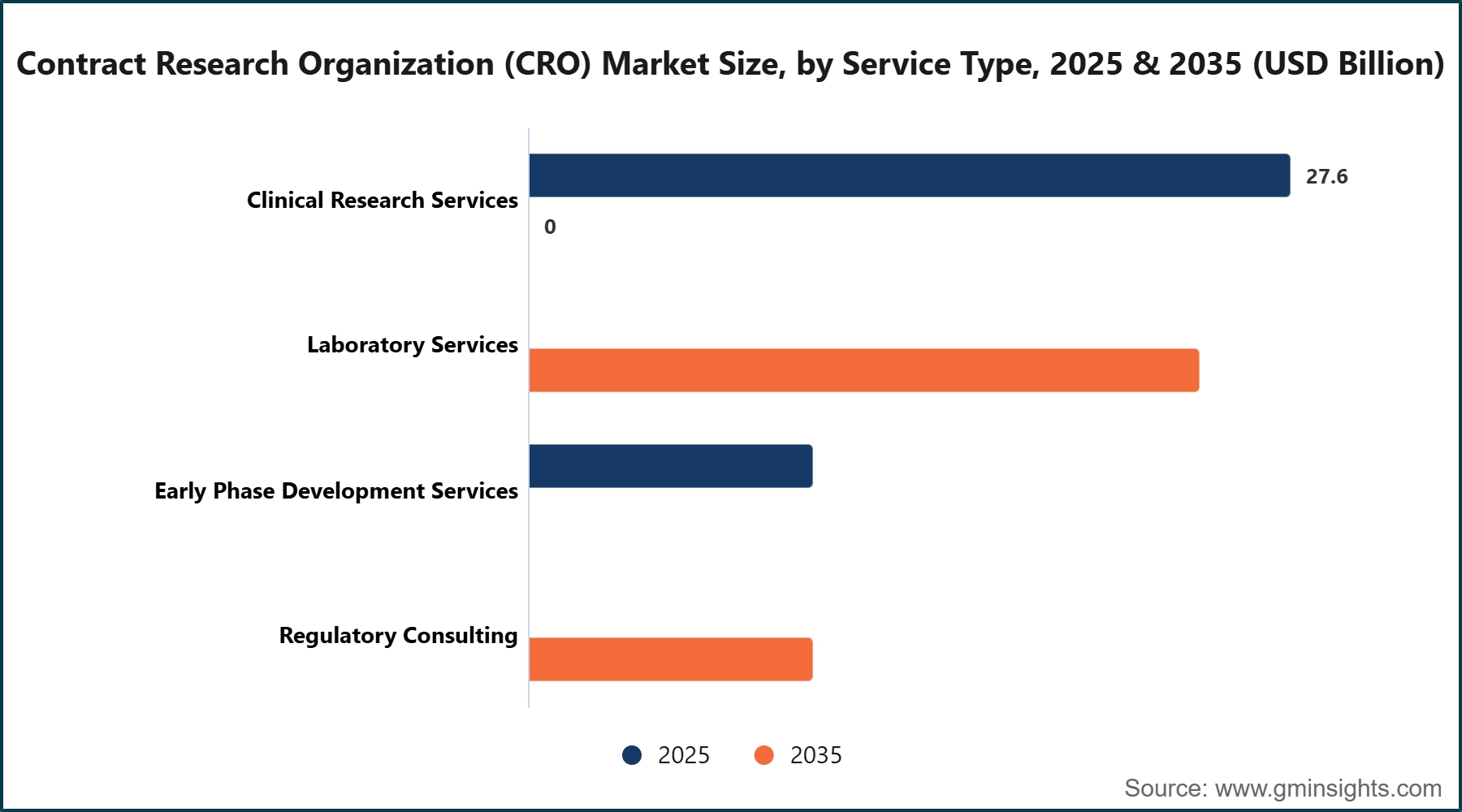
Laboratory services held a 23.0% revenue share in 2025 and are projected to reach USD 24.30 billion by 2035. Demand is strengthened by biomarker-intensive oncology protocols, biologics development, companion diagnostics, and the specialized bioanalytical requirements of cell and gene therapies, all of which elevate the value of accredited central laboratory infrastructure and scientific interpretation capabilities.
Early phase development services generated USD 10.35 billion in 2025 and are expected to grow at a 6.9% CAGR from 2026 to 2035. Emerging biotechnology sponsors frequently lack internal toxicology, pharmacokinetic, and early clinical operations capacity, making integrated discovery-to-IND support attractive where program speed and scientific continuity are important to financing, regulatory submission, and partner-selection milestones.
Regulatory consulting is projected to reach USD 10.30 billion by 2035 and held an 11.0% revenue share in 2025. Although smaller than core clinical operations, the category is strategically important because regulatory advice often shapes development design, agency engagement, and the broader scope of a sponsor's outsourced relationship, particularly for novel modalities and multi-regional filing strategies.
By End Use
Pharma & biopharma companies generated USD 39.10 billion in CRO service revenue in 2025 and are expected to advance at a 6.6% CAGR from 2026 to 2035. Patent pressure, increasingly specialized pipelines, and lean operating structures are reinforcing reliance on external delivery partners, especially among sponsors developing biologics, advanced therapies, and complex oncology assets.
Medical device companies held an 18.0% revenue share in 2025 and are projected to reach USD 19.20 billion by 2035. More demanding clinical evidence expectations for implantables, software-enabled devices, diagnostics, and combination products are increasing the need for partners that can navigate both clinical operations and device-specific regulatory science.
Academic institutes accounted for a 14.0% revenue share in 2025 and are expected to reach USD 15.00 billion by 2035. Investigator-initiated studies increasingly require professional data management, biostatistics, electronic data capture, and regulatory support as institutional review, data-sharing, and protocol-governance requirements become more operationally demanding.
By Therapeutic Area
Oncology generated USD 20.13 billion in 2025 and is projected to grow at a 7.4% CAGR from 2026 to 2035. The category's prominence reflects biomarker-driven designs, complex safety monitoring, specialist-site requirements, and the need to coordinate enrollment across dispersed patient populations, making therapeutic expertise and integrated operational execution decisive differentiators.
Clinical pharmacology held a 15.0% revenue share in 2025 and is expected to reach USD 16.20 billion by 2035. Early human studies for biologics, oligonucleotides, and novel small molecules require specialized investigative sites, bioanalytical capability, and close safety oversight, supporting demand for CROs with dedicated Phase I infrastructure.
Cardiology generated USD 6.90 billion in 2025 and is expected to expand at a 6.2% CAGR from 2026 to 2035. Large cardiovascular outcomes programs can require long follow-up periods, substantial patient cohorts, and endpoint-adjudication coordination, favoring full-service providers with deep site networks and experience managing event-driven studies.
Infectious disease held a 10.0% revenue share in 2025 and is projected to reach USD 10.00 billion by 2035. Demand is normalizing from pandemic-era activity, yet preparedness initiatives, vaccine work, and continuing programs in respiratory and chronic infectious conditions sustain a meaningful need for CROs experienced in adaptive and platform-based trial models.
Neurology generated USD 5.75 billion in 2025 and is projected to grow at a 6.8% CAGR from 2026 to 2035. Complex cognitive assessments, challenging patient identification, and evolving regulatory expectations for disease-modifying therapies create a premium for CROs that can align clinical operations with therapeutic-area-specific endpoint and safety requirements.
Gastro & hepatology held an 8.0% revenue share in 2025 and is projected to reach USD 8.30 billion by 2035. Development activity in inflammatory bowel disease, metabolic dysfunction-associated steatohepatitis, and hepatitis programs supports demand for networks with endoscopy, liver-biopsy, and specialist patient-access capabilities.
Ophthalmology generated USD 2.88 billion in 2025 and is expected to grow at a 6.9% CAGR from 2026 to 2035. The segment rewards providers with retinal imaging, reading-center infrastructure, ocular investigator relationships, and regulatory experience across pharmaceutical and device development, creating meaningful barriers to entry for generalist clinical operations teams.
Other therapeutic areas held a 5.0% revenue share in 2025 and are projected to reach USD 4.90 billion by 2035. These programs provide a stable base of work across mature indications, although their demand profile is less influenced by the high-complexity pipeline expansion evident in oncology, advanced neurology, and specialty metabolic disease.
GMI Analyst View
We view therapeutic specialization as a key dividing line in CRO competition. The most demanding programs increasingly require a combination of scientific credibility, validated operating processes, specialist sites, and technology infrastructure, encouraging sponsors to deepen relationships with partners that can support a development asset across several stages rather than only one discrete service need.
Contract Research Organization (CRO) Market Regional Analysis
North America Contract Research Organization (CRO) Market Analysis
The North America contract research organization (CRO) market generated USD 24.84 billion in 2025 and is projected to grow at a 5.9% CAGR from 2026 to 2035. Its mature outsourcing environment is supported by the concentration of pharmaceutical and biotechnology sponsors, established regulatory pathways, sophisticated academic medical centers, and extensive investigator networks. Growth remains comparatively moderated by the region's high existing outsourcing penetration rather than a loss of strategic importance.
Europe Contract Research Organization (CRO) Market Analysis
Europe is projected to reach USD 30.80 billion by 2035 and held a 29.5% global revenue share in 2025. The region combines established clinical infrastructure with broad patient diversity, while harmonized processes under the EU Clinical Trials Regulation can improve the operational appeal of multi-country programs. Europe remains particularly relevant for sponsors requiring coordinated regulatory, site, and patient-access capabilities across several national markets.
Asia Pacific Contract Research Organization (CRO) Market Analysis
Asia Pacific generated USD 10.35 billion in 2025 and is expected to expand at a 7.2% CAGR from 2026 to 2035. Regulatory alignment with international standards, large and diverse patient populations, and expanding domestic biopharma innovation are increasing the region's role in global registration programs. The opportunity favors CROs able to connect local regulatory expertise and site execution with globally consistent quality and data-management practices.
Latin America Contract Research Organization (CRO) Market Analysis
Latin America is projected to reach USD 5.90 billion by 2035 and represented a 5.5% global revenue share in 2025. The region offers access to diverse patient populations and can strengthen multicontinental enrollment strategies in cardiometabolic disease, oncology, infectious disease, and other high-burden indications. Its commercial relevance depends on CRO capability in local site activation, regulatory coordination, and sustained investigator engagement.
Middle East & Africa Contract Research Organization (CRO) Market Analysis
The Middle East & Africa contract research organization (CRO) market generated USD 2.18 billion in 2025 and is projected to reach USD 4.20 billion by 2035. Expanding clinical research infrastructure, advancing regulatory frameworks, and sponsor interest in representative global datasets are broadening the region's role in international programs. Providers with durable local partnerships and jurisdiction-specific operating knowledge are positioned to benefit as trial activity becomes more geographically diversified.
GMI Analyst View
We believe regional strategy is becoming less about securing lower-cost enrollment capacity and more about creating registration-relevant evidence across diverse populations. Providers that can integrate local execution with global quality standards will be better placed to win programs where geographic coverage is integral to regulatory and commercial strategy.
Contract Research Organization (CRO) Market Share & Competitive Landscape
The contract research organization (CRO) market share landscape is moderately concentrated at the upper tier, with the top three CRO operators collectively holding a 43.6% revenue share in 2025. Scale matters because large global providers can combine broad site access, data platforms, laboratory capabilities, and regulatory support; however, specialty and regional CROs remain relevant where therapeutic focus, client proximity, or jurisdiction-specific expertise carries greater weight than global breadth.
IQVIA Holdings held a 15.5% revenue share in 2025. Its positioning is supported by integrated data assets, technology-enabled trial operations, and the ability to coordinate multinational studies for sponsors that require large-scale enrollment, real-world evidence, and end-to-end clinical development services.
ICON plc held a 14.3% revenue share in 2025. The company competes through therapeutic-area depth, global delivery capacity, and functional-service-provider capabilities that address sponsors seeking a flexible model between fully outsourced development and retained internal operations.
Pharmaceutical Product Development (PPD), the clinical research business of Thermo Fisher Scientific, held a 13.8% revenue share in 2025. Its affiliation with a broader life sciences platform supports an integrated proposition spanning clinical development, bioanalytical work, and supply-chain-adjacent capabilities that can be particularly attractive to biotechnology and specialty-pharma sponsors.
Competitive intensity extends beyond the largest full-service operators. Syneos Health combines clinical development with commercialization capabilities, while Laboratory Corporation of America Holdings leverages laboratory assets for biomarker-intensive programs. Parexel International retains regulatory consulting depth, Medpace Holdings emphasizes integrated in-house scientific functions, and Charles River Laboratories is positioned at the discovery-to-early-development interface. Specialist providers including Caidya, Iris Pharma, Lexitas Pharma Services, and Ora compete through focused therapeutic expertise, while CMIC HOLDINGS, EPS Holdings, and WuXi Clinical provide important regional execution capabilities.
Recent Industry Developments
Novotech announced an agreement to acquire Agilex Biolabs, adding specialist bioanalytical capabilities in Australia to support integrated clinical and laboratory services for biotechnology and pharmaceutical sponsors. The transaction reflects the strategic value of combining regional early-phase capacity with bioanalytical expertise in a market that is increasingly relevant to global development programs [5]Novotech. "Novotech to acquire Agilex Biolabs." novotech-cro.com.
hVIVO announced the acquisition of CRS Clinical Research Services Berlin GmbH, extending its German clinical network with a specialist Phase I/II facility. The development illustrates continuing interest in consolidating targeted early-stage clinical capacity and disease-focused site infrastructure within European CRO operations [6]GlobeNewswire. "hVIVO acquires CRS Berlin, expanding expertise into dermatology and women's health markets." globenewswire.com.
Need a specific section of this report?
Purchase regional analysis, country-level analysis, company profiles, or any other segment-level insights separately
based on your research needs.