
Animal Drugs Market Size & Share 2026-2035
Download Free PDF
Report Content
Chapter 1 Methodology and Scope
1.1 Market scope and definition
1.2 Research approach
1.3 Quality commitments
1.3.1 GMI AI policy and data integrity commitment
1.3.1.1 Source consistency protocol
1.4 Research trail and confidence scoring
1.4.1 Research trail components
1.4.2 Scoring components
1.5 Data collection
1.5.1 Partial list of primary sources
1.6 Data mining sources
1.6.1 Paid sources
1.6.1.1 Sources, by region
1.7 Base estimates and calculations
1.7.1 Revenue share analysis
1.7.2 Base year calculation
1.8 Forecast model
1.9 Research transparency addendum
1.9.1 Source attribution framework
1.9.2 Quality assurance metrics
1.9.3 Our commitment to trust
Chapter 2 Executive Summary
2.1 Industry 360° synopsis
2.2 Key market trends
2.2.1 Regional trends
2.2.2 Product trends
2.2.3 Indication trends
2.2.4 Animal type trends
2.2.5 Route of administration trends
2.2.6 Distribution channel trends
2.3 CXO perspectives: Strategic imperatives
Chapter 3 Industry Insights
3.1 Industry ecosystem analysis
3.2 Industry impact forces
3.2.1 Growth drivers
3.2.1.1 Rising prevalence of animal diseases
3.2.1.2 Growing focus on livestock productivity
3.2.1.3 Surging demand for pet insurance policies
3.2.1.4 Growing government initiatives and support towards animal welfare
3.2.1.5 Intensified R&D activities driving advancements in veterinary medicine
3.2.1.6 Expanding online veterinary pharmacies
3.2.2 Industry pitfalls and challenges
3.2.2.1 Adverse side effects and drug recalls
3.2.2.2 High cost associated with animal drugs development
3.2.3 Market opportunities
3.2.3.1 Expansion of veterinary healthcare infrastructure in emerging markets
3.2.3.2 Increasing adoption of preventive veterinary care
3.3 Growth potential analysis
3.4 Regulatory landscape (Driven by Primary Research)
3.4.1 North America
3.4.1.1 U.S.
3.4.1.2 Canada
3.4.2 Europe
3.4.3 Asia Pacific
3.5 Policy landscape
3.6 Product pipeline analysis (Driven by Primary Research)
3.7 Investor overview
3.8 Consumer behaviour trends (Driven by Primary Research)
3.9 Impact of AI on the market
3.10 Porter's analysis
3.11 PESTEL analysis
Chapter 4 Competitive Landscape, 2025
4.1 Introduction
4.2 Company market share analysis
4.2.1 North America
4.2.2 Europe
4.2.3 Asia Pacific
4.3 Company matrix analysis
4.4 Competitive analysis of major market players
4.5 Competitive positioning matrix
4.6 Key developments
4.6.1 Merger and acquisition
4.6.2 Partnership and collaboration
4.6.3 New product launches
4.6.4 Expansion plans
Chapter 5 Market Estimates and Forecast, By Product, 2022 - 2035 ($ Mn)
5.1 Key trends
5.2 Drugs
5.2.1 Antiparasitic
5.2.2 Anti-inflammatory
5.2.3 Anti-infectives
5.2.4 Corticosteroids
5.2.5 Tranquilizers
5.2.6 Cardiovascular drugs
5.2.7 Gastrointestinal drugs
5.2.8 Other drugs
5.3 Vaccines
5.3.1 Modified live vaccines (MLV)
5.3.2 Killed inactivated vaccines
5.3.3 Recombinant vaccines
5.4 Medicated feed additives
5.4.1 Antibiotics
5.4.2 Vitamins
5.4.3 Amino acids
5.4.4 Enzymes
5.4.5 Antioxidants
5.4.6 Prebiotics and probiotics
5.4.7 Minerals
5.4.8 Other medicated feed additives
Chapter 6 Market Estimates and Forecast, By Animal Type, 2022 - 2035 ($ Mn)
6.1 Key trends
6.2 Companion animals
6.2.1 Dogs
6.2.2 Cats
6.2.3 Horses
6.2.4 Other companion animals
6.3 Livestock animals
6.3.1 Poultry
6.3.2 Swine
6.3.3 Cattle
6.3.4 Fish
6.3.5 Other livestock animals
Chapter 7 Market Estimates and Forecast, By Indication, 2022 - 2035 ($ Mn)
7.1 Key trends
7.2 Dermatology
7.3 Cardiovascular diseases
7.4 Gastrointestinal diseases
7.5 Respiratory diseases
7.6 Other indications
Chapter 8 Market Estimates and Forecast, By Route of Administration, 2022 - 2035 ($ Mn)
8.1 Key trends
8.2 Oral
8.3 Injectable
8.4 Topical
8.5 Other routes of administration
Chapter 9 Market Estimates and Forecast, By Distribution Channel, 2022 - 2035 ($ Mn)
9.1 Key trends
9.2 Veterinary hospital pharmacies
9.3 E-commerce
9.4 Retail pharmacies
Chapter 10 Market Estimates and Forecast, By Region, 2022 - 2035 ($ Mn)
10.1 Key trends
10.2 North America
10.2.1 U.S.
10.2.2 Canada
10.3 Europe
10.3.1 Germany
10.3.2 UK
10.3.3 France
10.3.4 Spain
10.3.5 Italy
10.3.6 Poland
10.3.7 Netherlands
10.4 Asia Pacific
10.4.1 China
10.4.2 Japan
10.4.3 India
10.4.4 Australia
10.4.5 South Korea
10.4.6 Taiwan
10.5 Latin America
10.5.1 Brazil
10.5.2 Mexico
10.5.3 Argentina
10.6 Middle East and Africa
10.6.1 South Africa
10.6.2 GCC Countries
10.6.3 Israel
Chapter 11 Company Profiles
Don't see your key competitors?
The companies listed in this report are a curated selection - not the full competitive universe.
Our market revenue calculations use a bottom-up methodology that accounts for all players across all regions - including manufacturers, distributors, and specialists not individually profiled. The profiles section spotlights strategically significant players; it does not define the scope of our market sizing.
Your competitive landscape may also include
Free customization - up to 20% of report value
Need specific data? Request customization and get the insights tailored to your exact requirements.
For inquiries regarding discounts, bulk purchases, or customization requests, please contact us at [email protected]
Share Content
Add Citations
Monali Tayade. 2026, March. Animal Drugs Market – By Product, By Animal Type, By Indication, By Route of Administration, By Distribution Channel – Global Forecast (2026 - 2035) (Report ID: GMI4445). Global Market Insights Inc. Retrieved September 19, 2026, from https://www.gminsights.com/toc/details/animal-drugs-market

Animal Drugs Market
Get a free sample of this report
Animal Drugs Market Size
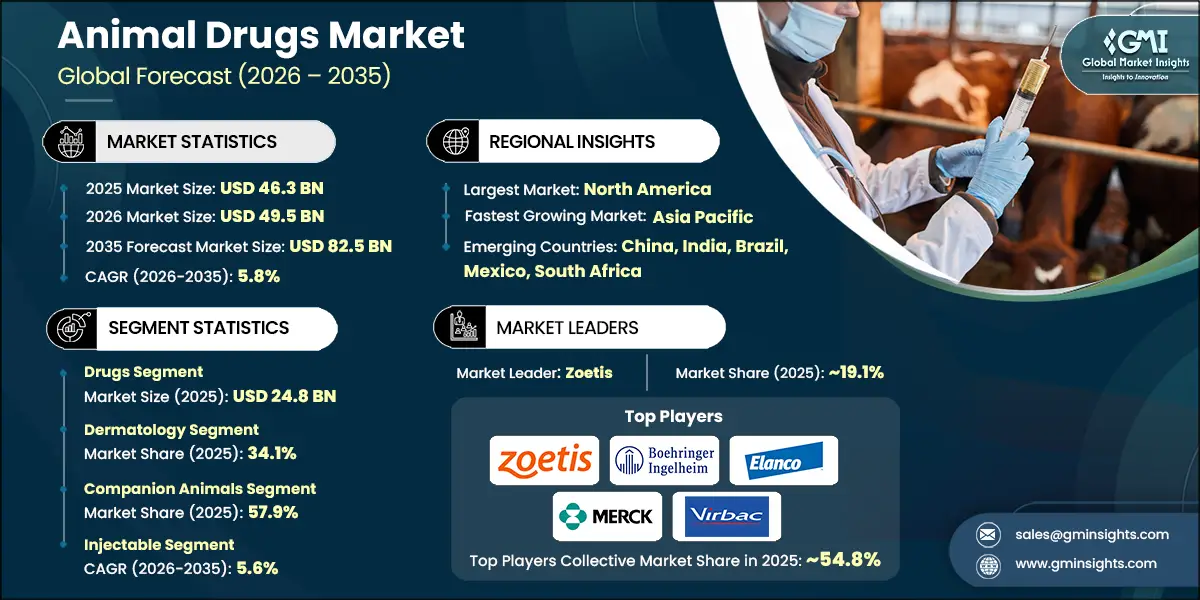
The global animal drugs market was valued at USD 46.3 billion in 2025. The market is expected to grow from USD 49.5 billion in 2026 to USD 82.5 billion in 2035, growing at a CAGR of 5.8% during the forecast period, as per the latest report published by Global Market Insights Inc.
The market is experiencing considerable growth driven by increasing animal population globally, high adoption of pet animals for companionship, rising cases of chronic diseases in animals, and rising expenditure on veterinary care. As per the World Animal Foundation estimates, the companion animal population reached approximately 967 million animals worldwide, of which 522 million were dogs and 445 million were cats. According to FAO, the global ruminant livestock population is roughly 3.6 billion, of which approximately 2 billion represent livestock animals used for meat and dairy production. Similarly, the global poultry population has reached an astounding 26 billion. Such a high volume of animals increases the demand for various animal health products, including pharmaceuticals, vaccines, and feed additives, thereby boosting the market growth.
The animal drugs market witnessed considerable growth, growing from USD 37.7 billion in 2022 to USD 43.3 billion in 2024. This growth can be attributed to the rising prevalence of animal diseases, increasing pet ownership, and growing demand for animal-derived food products. Additionally, expanding livestock production and a greater focus on preventive veterinary care further supported market growth during this period. Furthermore, the availability of advanced medical facilities for pets, cutting-edge therapeutics, an increasing number of veterinary hospitals and clinics, and high adoption of pet insurance are further set to positively impact industry growth.
Also, the rising prevalence of several chronic diseases in animals, such as obesity, osteoarthritis, respiratory diseases, dental problems, diabetes, and cancer, increases the demand for drugs, further enhancing the market growth. As per the North American Veterinary Community (NAVC), diabetes is rising faster in pets than in humans, with more than half a million cats and dogs diagnosed with diabetes each year. Further, several technological advancements in the field of veterinary medicine are set to positively influence the animal health industry. Recent developments such as telemedicine platforms and point-of-care diagnostics, coupled with ongoing research and development activities in veterinary medicine are set to bring rapid expansion in the animal drugs market.
Animal drugs refer to the pharmaceutical and biological products formulated to treat, prevent, or manage diseases in animals. These drugs are categorized into a broad range of products such as drugs, vaccines, and medicated feed additives. These drugs are increasingly used to treat medical conditions and help prevent the spread of infectious diseases among animals. Key market players include Boehringer Ingelheim International, Elanco Animal Health Incorporated, Merck, Zoetis, Virbac, and Ceva Sante Animale. These companies play an essential role in the market by investing in research and development, expanding product portfolios, and introducing innovative veterinary therapeutics and vaccines to address emerging animal health challenges and improve disease management across global livestock and companion animal populations.
Animal Drugs Market Trends
Animal Drugs Market Analysis
Based on the product, the animal drugs market is segmented into drugs, vaccines, and medicated feed additives. In 2025, the drugs segment accounted for the highest market share with a revenue of USD 24.8 billion.
Based on indication, the animal drugs market is segmented into dermatology, cardiovascular diseases, gastrointestinal diseases, respiratory diseases, and other indications. The dermatology segment has asserted its dominance in the market by securing a significant market share of 34.1% in 2025.
Based on the animal type, the animal drugs market is classified into companion animals and livestock animals. The companion animals segment held the highest revenue in 2025 with a market share of 57.9%. The companion animals’ segment is sub-segmented into dogs, cats, horses, and other companion animals.
Based on the route of administration, the animal drugs market is classified into oral, injectable, topical, and other routes of administration. The injectable segment dominated the market in 2025 and is anticipated to witness rapid growth at a CAGR of 5.6% over the forecast years.
Based on the distribution channel, the animal drugs market is bifurcated into veterinary hospital pharmacies, E-commerce, and retail pharmacies. In 2025, the veterinary hospital pharmacies segment dominated the market with a market share of 53.2% and is anticipated to reach USD 42.9 billion by 2035.
North America Animal Drugs Market
North America market held the largest market share of 41.6% in 2025.
The U.S. animal drugs market was valued at USD 14.5 billion and USD 15.6 billion in 2022 and 2023, respectively. The market size reached USD 17.6 billion in 2025, growing from USD 16.6 billion in 2024.
Europe Animal Drugs Market
Europe market accounted for USD 12.9 billion in 2025 and is anticipated to show lucrative growth over the forecast period.
Germany animal drugs market is anticipated to witness significant growth in the coming years.
Asia Pacific Animal Drugs Market
The Asia Pacific animal drugs market demonstrates significant growth potential.
India animal drugs market is poised to witness high growth over the analysis period.
Latin America Animal Drugs Market
Brazil market is anticipated to witness rapid growth over the forecast years.
Middle East & Africa Animal Drugs Market
Saudi Arabia market is set for lucrative growth in the Middle East and Africa market.
Animal Drugs Market Share
The market is highly competitive, with several key companies striving to develop novel formulations in the market. The market is fragmented in nature, with major organizations, local small players, and start-ups joining the industry competition. The top 5 companies in the market, such as Zoetis, Elanco Animal Health, Merck & Co., Inc., Virbac, and Boehringer Ingelheim International, account for approximately 54.8% of the global market share.
Additionally, there are several local and regional players operating in the market that are boosting competition by providing affordable options at lower costs. These players are also involved in several strategies, such as mergers, acquisitions, and novel product launches, to expand their product offerings. For instance, in February 2021, Vetoquinol announced the acquisition of the Canadian rights to the Profender product family from Elanco Animal Health. The Profender range consists of spot-on de-wormer products for cats. Such initiatives by market players enhance the competitive landscape in the market, thereby boosting the market growth.
Animal Drugs Market Companies
Prominent players operating in the animal drugs industry include:
Zoetis is one of the leading global animal health companies with a market share of ~19.1%. The company discovers, develops, manufactures, and commercializes a diverse portfolio of animal health medicines and vaccines and has operations in over 100 countries. The company's dedication to R&D stimulates innovation in animal healthcare, allowing the launch of novel, effective, and safe treatments.
Boehringer Ingelheim has a notable presence in the market. The company offers a wide array of products, including vaccines, anti-infectives, parasiticides, and therapeutic solutions designed to improve animal health. NexGard SPECTRA is a chewable product designed for dogs. This product leverages the rising trend of pet ownership and increasing awareness about pet health and wellness in India. This strategy is expected to add value to the company’s business portfolio.
Animal Drugs Industry News
The animal drugs market research report includes an in-depth coverage of the industry with estimates and forecast in terms of revenue in USD Million from 2022 - 2035 for the following segments:
Market, By Product
Market, By Indication
Market, By Animal Type
Market, By Route of Administration
Market, By Distribution Channel
The above information is provided for the following regions and countries: