Summary
Table of Content

Zinc Oxide Nanoparticles for Electronics Market
Get a free sample of this report
Form submitted successfully!
Error submitting form. Please try again.
Thank you!
Your inquiry has been received. Our team will reach out to you with the required details via email. To ensure that you don't miss their response, kindly remember to check your spam folder as well!
Request Sectional Data
Thank you!
Your inquiry has been received. Our team will reach out to you with the required details via email. To ensure that you don't miss their response, kindly remember to check your spam folder as well!
Form submitted successfully!
Error submitting form. Please try again.
Zinc Oxide Nanoparticles for Electronics Market Size
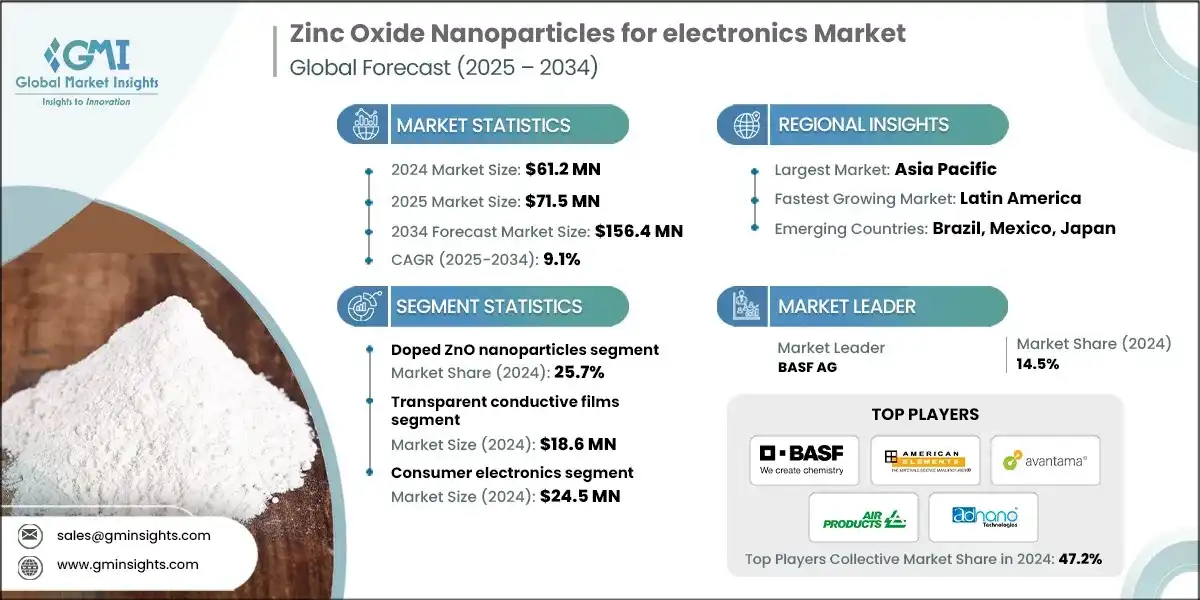
The global zinc oxide nanoparticles for electronics market was estimated at USD 61.2 million in 2024. It is expected to grow from USD 71.5 million in 2025 to USD 156.4 million by 2034, at a CAGR of 9.1%, according to latest report published by Global Market Insights Inc.
To get key market trends
- The expansion of the market has been largely supported by the growing demand for miniaturization and performance of the semiconducting industry. The ZnO nanostructures, with high electron mobility and wide bandgap properties, can pave the way for high-performance electronic devices with small dimensions. The materials' transparent characteristics in the visible light spectrum, along with excellent electrical conductivity, suggest that there is a key to transparent electronics applications.
- The regional market distribution indicates a high-level concentration in Asia Pacific region with a 55.5% market share out of the anticipated global market in 2024. This concentration is attributable to the already developed semiconductor manufacturing ecosystem in the Asia Pacific region, specifically in China, Japan, and South Korea, where prime electronics manufacturers are incorporating ZnO nanostructures in their production processes. North America is the second-best market with a 24.3% market share in 2024 driven by advanced research initiatives and early adoption of innovative electronic technologies.
- The properties wherein nanoparticles of zinc oxide find application in electronics are high surface area, UV-blocking activity, excellent semiconducting behavior, and so on-life sufficiency. Tending to be the most pronounced in applications such as transparent conductive films, sensors, and thin-film transistors Industry reports run on analyzing the region of Asia-Pacific remaining the most important area of production and consumption owing to its well-established electronics manufacturing ecosystem along with the cost advantages.
- Zinc oxide nanostructures have been progressively preferred in specialized form, such as doped nanoparticles and nanorods, in terms of electrical and optical improvements for development of next-generation devices. Such transition by the manufacturers is aided by various lucrative applications in flexible electronics, renewable energy components, and optoelectronic sensors, away from commodity-grade materials increasingly. Support for this transition is the evolution in green synthesis methods and surface-coating technologies for improving product safety and performance under sustainability mandates.
Zinc Oxide Nanoparticles for Electronics Market Report Attributes
| Key Takeaway | Details |
|---|---|
| Market Size & Growth | |
| Base Year | 2024 |
| Market Size in 2024 | USD 61.2 Million |
| Market Size in 2025 | USD 71.5 Million |
| Forecast Period 2025 - 2034 CAGR | 9.1% |
| Market Size in 2034 | USD 156.4 Million |
| Key Market Trends | |
| Drivers | Impact |
| Miniaturization of Electronic Devices | Drives demand for nanoscale materials like ZnO nanoparticles to enable compact, high-performance components. |
| Growing Demand for Transparent Conductive Films | Boosts the use of ZnO-based alternatives to ITO in displays, touch panels, and smart windows |
| Advancement in Flexible Electronics | Encourages development of ZnO nanorods, nanowires, and doped variants for bendable and wearable devices. |
| Pitfalls & Challenges | Impact |
| Regulatory Compliance Complexity | Increase time-to-market and operational costs as companies must meet stringent safety and environmental standards for nanomaterials |
| Manufacturing Scalability Challenges | Limits the ability to transition from lab-scale to mass production while maintaining uniform particle size and quality |
| Opportunities: | Impact |
| Emerging Quantum Dot Applications | Creates new revenue streams as ZnO quantum dots gain traction in QLED displays and optoelectronic devices. |
| Next-Generation Solar Cell Integration | Drives demand for ZnO nanostructures such as electron transport layers and buffer components in perovskite and thin-film solar cells. |
| Market Leaders (2024) | |
| Market Leaders |
Market Share14.5% |
| Top Players |
Collective market share in 2024 is Market Share 47.2% |
| Competitive Edge |
|
| Regional Insights | |
| Largest Market | Asia Pacific |
| Fastest growing market | Latin America |
| Emerging countries | Brazil, Mexico, Japan |
| Future outlook |
|
What are the growth opportunities in this market?
Zinc Oxide Nanoparticles for Electronics Market Trends
- Innovation in the manufacturing process is one of the trends that will make sure ZnO nanostructures are widely accepted in all electronic applications. Several manufacturing techniques that can be fine-tuned for commercial-scale production include sputtering, chemical vapor deposition, sol gel processing, and hydrothermal synthesis.
- Increased demand for ZnO nanostructures is attributed to their flexibility and appreciably high electrical conductivity that could easily accommodate such structures in flexible and wearable electronics. With such properties, bendable displays, smart textiles, and next-generation sensors are fabricated in response to the rapid evolution of consumer electronics and IoT devices.
- This flexible and wearable electronics trend is a new transformative one that opens several application opportunities in ZnO nanostructures. These now cover bendable displays, stretchable sensors, e-textiles, and biomedical devices. ZnO's mechanical flexibility and stable electrical properties allow for electronic devices that comply with curved surfaces and withhold mechanical deformation.
- ZnO UV sensors respond to illumination by providing output at levels of up to 3300 A/W and their response times fit well into real-time monitoring applications. Among the various applications, gas sensing seems to be one of the most promising: ZnO nanostructures can detect variations in carbon monoxide over timescales of 6 to 8 seconds. This self-powered sensitivity is of especially great significance, as ZnO sensors have been shown to exhibit more than 80% stability for operational durations of 25 days.
Zinc Oxide Nanoparticles for Electronics Market Analysis
Learn more about the key segments shaping this market
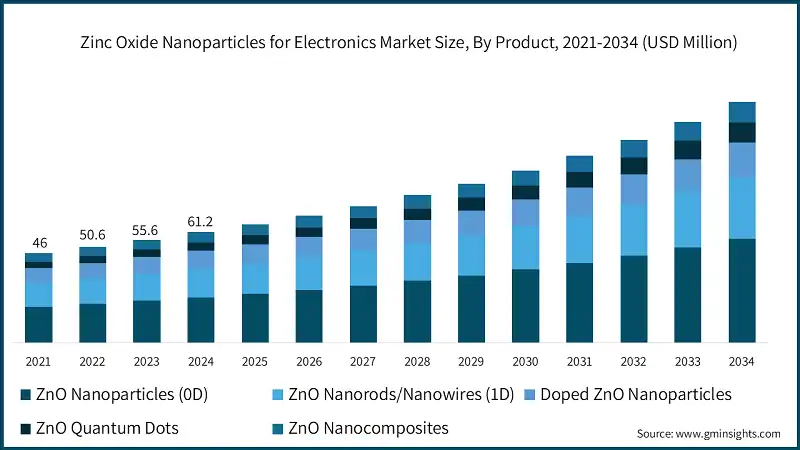
Based on product, the market is segmented into ZnO nanoparticles (0D), ZnO nanorods/nanowires (1D), doped ZnO nanoparticles, ZnO quantum dots, ZnO nanocomposites. ZnO nanoparticles (0D) hold a significant share at a valuation of USD 21 million in 2024.
- Doped ZnO nanoparticles make up the second largest share of the market at 25.7% and 9.4% CAGR from 2025-2034. Their unique electrical and optical properties boost dopant incorporation growth. Both aluminum-doped ZnO (AZO) and gallium-doped ZnO manifest more desirable conductivity levels for transparent conductive applications. Doping represents a legitimate way to achieve specific property tuning for application-required specifications that warrants premium pricing and better profit margins.
- ZnO nanorods and nanowires (1D structures) earn 20.4% market share with the highest CAGR of 9.7% from 2025-2034, mostly growing in demand for anisotropic nanostructures used in advanced electronic devices. Such one-dimensional geometries lend themselves substantially to unique advantages in sensor applications with greater surface area and directional electron transport properties. There is quite a few manufacturing limitations attached to controlled ratio synthesis, which explains the ongoing market penetration, as well as continuing research efforts. The advanced cementitious system involves the ultrasonic activation of the healing agents for effective distribution and release.
Based on application, the zinc oxide nanoparticles for electronics market is segmented into Transparent conductive films, Gas sensors, Photodetectors & UV sensors, thin film transistors (TFTs), Solar cell components, Memory devices. Transparent conductive films segment was valued at USD 18.6 million in 2024.
- Gas sensors occupy 21.6% of the market share in 2024 with a growth potential of 8.4% CAGR through 2034 supported by IoT deployment and environmental monitoring requirements. ZnO proves to be a better candidate for smart sensor networks due to its high sensitivity toward different gases and response times of 6-8 seconds for CO detection. The self-powered character of ZnO sensors eliminates one of the important power consumption hurdles in distributed sensor applications.
- Solar cell components cover 14.5% of the market share in 2024 with 7.9% CAGR through 2034, backed by renewable energy expansion and efficiency improvement initiatives. ZnO electron transport layers allowing efficiencies up to 18.5% exhibit significant advantages for photovoltaic applications.
Learn more about the key segments shaping this market
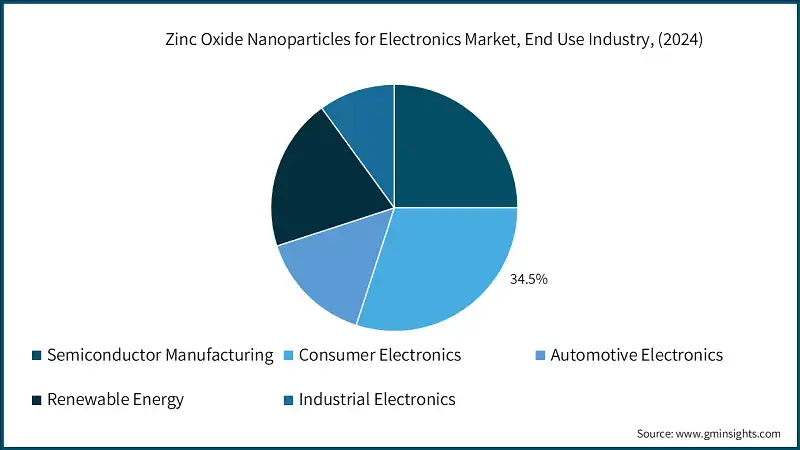
Based on end use industry, the zinc oxide nanoparticles for electronics market is segmented into semiconductor manufacturing, consumer electronics, automotive electronics, renewable energy, and industrial electronics. Consumer electronics are estimated to grasp a value of USD 24.5 million in 2025 and is expected to grow at 8.5% of CAGR during the forecast period.
- The self-healing floor materials are fast making a mark in various end use industries as they provide the cost-effective solutions to maintenance charges besides adding to the life service of its application. The residential houses and official buildings also emerge as significant adoption areas, adding to the importance of the floor since it must be aesthetically pleasing, durable, and cover the wear and tear of daily use. These materials are a great proposition to property owners for high traffic spaces, such as malls and offices, as they limit downtime and repair costs.
- Healthcare and pharmaceutical facilities have stringent hygiene requirements and high footfalls, which make them major consumers. The self-healing floors will restore seamless surfaces and can combine with antimicrobial properties so that health standards remain priority. Intense competition in industrial environments for these materials to have the floor maintain an integrity structure under heavy loads and harsh environments besides the few operational disruptions caused. Other areas such as public infrastructure and education are using these solutions for the long haul of sustainability and cost efficiency.
Looking for region specific data?
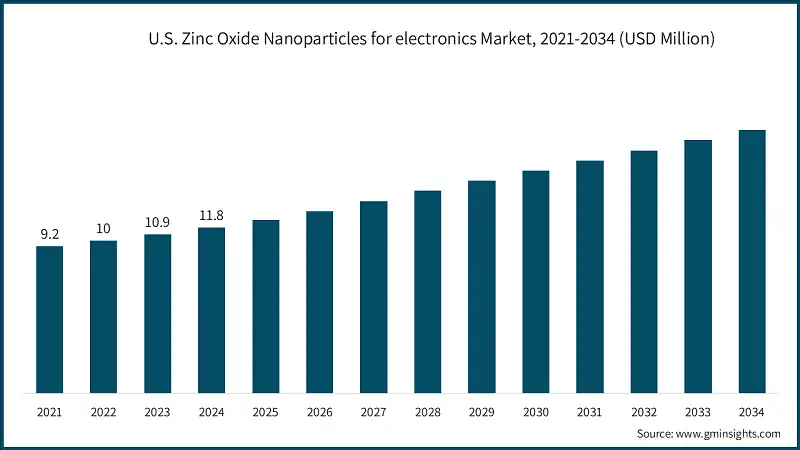
North America zinc oxide nanoparticles for electronics market accounted for USD 14.9 million in 2024 and is anticipated to show lucrative growth over the forecast period.
- The ZnO nanoparticle market has huge potential in North America, being backed up by advanced research institutions and the strong electronics industry. ZnO NPs in transparent conductive films, UV sensors, and piezoelectric devices are leading the market in the U.S. Increasing needs for smart electronics and wearable technologies drive innovation exponential. There are strong government funding and private sector investments in nanotechnology. Strategic partnerships between tech companies and universities would further accelerate the commercialization process.
Europe accounted for USD 8.9 million in 2024 and is anticipated to show lucrative growth over the forecast period.
- The ZnO nanoparticles market over Europe is characterized by its sustainable and innovative approaches to electronics. Germany, France, and the Netherlands are focusing their investments on ZnO NPs in flexible electronics, solar cells, and biosensors. Eco-friendly materials are promoted due to the EU regulations; hence ZnO NPs are a good option for being non-toxic. Research programs like Horizon Europe are supportive of progress in nanotech across member states for research. The region is also studying ZnO NPs for printed electronics and smart packaging applications. While Europe's commercialization is slower than that of Asia, innovation is still strong.
Asia Pacific zinc oxide nanoparticles for electronics market accounted for USD 33.9 million in 2024 and is anticipated to show lucrative growth over the forecast period.
- The Asia Pacific region, home to a colossal ecosystem for electronics manufacturing, is the leader in the global ZnO NPs market. The principal producers of ZnO- based nanomaterials in the Asia-Pacific region are also the major consumers of these materials: namely China, South Korea, Japan, and Taiwan. Advantages like low-cost production, consumer demand, and speed in the embrace of new technologies have favored this region. ZnO NPs find their applications in display panels, sensors, and energy harvesting devices. The nanotechnology sector is highly assisted by various government initiatives and industrial R&D; this will further lead to growth by supporting an exports and domestic consumption-based market industry.
Latin America market accounted for 3.3% market share in 2024 and is anticipated to show steady growth over the forecast period.
- Latin America is the upcoming market for ZnO nanoparticles in electronics, most notably in Brazil and Mexico. Nanotechnology is slowly being adopted in the region for low-cost sensor applications, energy storage, and environmental monitoring. Academic institutions collaborate with partners in international-level research development. Although infrastructure and funding limitations exist, the trend is still in the growth phase in terms of sustainable and inexpensive electronics. Long-term perspectives on the growth of the sector depend on technology transfer and regional innovation policies.
Middle East and Africa market accounted for 2.4% market share in 2024 and is anticipated to show steady growth over the forecast period.
- The region of MEA is contributing the least towards the ZnO NP electronics market, but few niche applications have begun to attract attention. Countries like UAE, Saudi Arabia, and South Africa are now investing in smart city technologies and renewable energy, where various applications for ZnO NP may arise. Research centers are already exploring nanomaterials in solar panels and environmental sensors. Again, market expansion can be constrained with limited manufacturing capabilities and high import dependence. Regional collaborations along with international funding could help to fill this gap. The market is youthful, but its prospects look really well.
Zinc Oxide Nanoparticles for Electronics Market Share
Zinc oxide nanostructures for electronics market in 2024 is moderately fragmented, with BASF AG, American Elements, Avantama AG, Air Products and Chemicals Inc., and AdNano Technologies Pvt Ltd being the top five players sharing a decent chunk of the market share with 47.2% in 2024. Therefore, BASF AG is benefiting from its global manufacturing scale, distribution network, and technical expertise. In contrast, American Elements thrives on manufacturing high-purity customized nanomaterials for advanced electronics. Avantama AG and AdNano Technologies are more inclined toward innovation and customized solutions for niche applications, while Air Products seems to benefit from semiconductor process integration.
The competitions are kept under pressure by factors like optimization of manufacturing costs, consistency of quality, and technical service support. Work such that larger players invest heavily in R&D for improvements in processes and customization for applications, while smaller companies are agile and come up with their specialized synthesis techniques. In the market, keeping in view the stringent requirements related to purity and performance, premium pricing is justified, whereas differentiation takes place on particle size, surface functionalization, and customization basis.
Zinc Oxide Nanoparticles for Electronics Market Companies
Major players operating in the zinc oxide nanoparticles for electronics industry are:
- American Elements
- BASF AG
- Air Products and Chemicals Inc
- SAT NANO
- Techinstro
- MSE Supplies LLC
- Noah Chemicals
- Silox India Pvt Ltd
- Shilpa Enterprises
- Techinstro
- Avantama AG
- Ossila Ltd
- AdNano Technologies Pvt Ltd
BASF SE is one of the world's largest chemical players. The company's strength draws from extensive manufacturing infrastructure, worldwide distribution, and established customer relationships in diversely far-flung industries. The focal point of BASF's nanomaterials business is to develop scalable techniques for production as well as standardization with respect to quality, which will enable high-volume electronics applications.
American Elements is a specialized producer of advanced materials for research institutions and high technology companies requiring customized nanomaterials. Its competitive advantage is in manufacturing high purity ZnO nanostructures built explicitly to specifications for the most demanding applications in electronics. American Elements has a considerable grip of nanomaterial synthesis and characterization enabling speedier development of prototypes or solutions in tailor-made materials.
Avantama AG specializes in developing state-of-the-art nanomaterials for high-performance electronic applications based on inventive synthesis routes and extraordinary properties of the materials. Avantama's competitive edge comes from research and development capabilities and strong intellectual property positions on advanced nanomaterial synthesis. Avantama targets high-end applications that require exceptionally good performance and customization of the materials.
Air Products and Chemicals Inc leverage its industrial gas and specialty chemicals empire to fabricate ZnO nanostructures in concept with advancing circuits for semiconductor industry customers. Process integration capability and extensive application support services towards customer adoption of nanomaterials in complex manufacturing scenarios are strengths of the company. Application-specific solutions development and strict adherence of the quality control standards set for semiconductor manufacture mark the thrust of Air Products.
AdNano Technologies Pvt Ltd is a specialized company working with nanotechnologies, supplying high-quality ZnO nanostructures to both research and commercial customers. The competitive edge enjoyed by the company relates to advanced synthesis technologies and quality control systems capable of producing consistent material properties.
Zinc Oxide Nanoparticles for Electronics Industry News
- In January 2025, BASF AG announced the expansion of its nanomaterials production facility in Ludwigshafen, Germany, specifically aimed at enhanced capacity for aluminum-doped zinc oxide (AZO) nanoparticles used in transparent conductive applications. The facility's expansion will feature cutting-edge synthesis equipment that can produce consistent particle size distributions, as well as quality control systems that meet semiconductor industry standards.
- In January 2024, Allentown LLC-the Aterian Investment Partners' portfolio company-announced the acquisition of ClorDiSys Solutions, Inc. which is based and headquartered in Branchburg, NJ. ClorDiSys provides various solutions for the sterilization of vivariums, laboratory equipment as well as medical devices marking Allentown's second strategic add-on under Aterian's ownership after BetterBuilt which was acquired in May 2023.
The zinc oxide nanoparticles for electronics Market research report includes in-depth coverage of the industry with estimates & forecast in terms of revenue (USD Million) & volume (Kilo Tons) from 2021 to 2034, for the following segments:
Market, By Product Type
- Zno nanoparticles (0d)
- Spherical nanoparticles (1–50 nm)
- Spherical nanoparticles (50–100 nm)
- Spherical nanoparticles (100–200 nm)
- Zno nanorods/nanowires (1d)
- Short nanorods (length <1 μm)
- Long nanowires (length >1 μm)
- Aligned nanorod arrays
- Doped zno nanoparticles
- Aluminum-doped zno (AZO)
- Gallium-doped zno (GZO)
- Indium-doped zno (IZO)
- Other metal-doped variants
- Zno quantum dots
- Ultra-small quantum dots (<5 nm)
- Medium quantum dots (5–10 nm)
- Zno nanocomposites
- Zno-graphene composites
- Zno-metal hybrid structures
- Zno-polymer nanocomposites
Market, By Application
- Transparent conductive films
- Display applications
- Touch panel integration
- Solar cell electrodes
- Smart window technologies
- Gas sensors
- Environmental monitoring sensors
- Industrial process control sensors
- Automotive emission sensors
- Indoor air quality sensors
- Photodetectors & UV sensors
- UV-a detection systems
- UV-b & UV-c detection
- Flame detection applications
- Optical communication components
- Thin Film Transistors (TFTs)
- Display Backplane TFTs
- Flexible Electronics TFTs
- Radio Frequency TFTs
- Solar Cell Components
- Electron Transport Layers
- Photoanode Applications
- Buffer Layer Integration
- Memory Devices
- Resistive Random Access Memory (ReRAM)
- Write-Once Read-Many (WORM) Memory
- Neuromorphic Computing Applications
Market, By End Use Industry
- Semiconductor manufacturing
- Wafer processing applications
- Sputtering target production
- Chemical vapor deposition
- Atomic layer deposition
- Consumer electronics
- Smartphone & tablet integration
- Wearable device applications
- Home appliance electronics
- Gaming & entertainment systems
- Automotive electronics
- Advanced driver assistance systems (adas)
- Electric vehicle components
- Infotainment systems
- Engine control units
- Renewable energy
- Photovoltaic cell manufacturing
- Energy storage systems
- Smart grid technologies
- Wind power electronics
- Industrial electronics
- Process control systems
- Factory automation
- Robotics applications
- Power management systems
The above information is provided for the following regions and countries:
- North America
- U.S.
- Canada
- Europe
- UK
- Germany
- France
- Italy
- Spain
- Rest of Europe
- Asia Pacific
- China
- India
- Japan
- South Korea
- Australia
- Rest of Asia Pacific
- Latin America
- Brazil
- Mexico
- Argentina
- Rest of Latin America
- MEA
- UAE
- Saudi Arabia
- South Africa
- Rest of Middle East and Africa
Frequently Asked Question(FAQ) :
Who are the key players in the zinc oxide nanoparticles for electronics market?
Key players include BASF AG, American Elements, Avantama AG, Air Products and Chemicals Inc., AdNano Technologies Pvt Ltd, SAT NANO, Techinstro, MSE Supplies LLC, Noah Chemicals, Silox India Pvt Ltd, Shilpa Enterprises, and Ossila Ltd.
What is the market size of the U.S. zinc oxide nanoparticles for electronics industry in 2024?
The U.S. market accounted for a major portion of North America’s USD 14.9 million in 2024. This growth is supported by advanced R&D, strong nanotechnology infrastructure, and increasing adoption of smart and wearable electronics.
Which region leads the zinc oxide nanoparticles for electronics market?
Asia Pacific dominated the market with a 55.5% share (USD 33.9 million) in 2024. Growth is driven by the strong semiconductor ecosystem in China, Japan, and South Korea, where ZnO nanostructures are increasingly integrated into advanced electronics manufacturing.
What is the growth outlook for gas sensor applications from 2025 to 2034?
Gas sensors are projected to grow at a CAGR of 8.4% through 2034, driven by IoT expansion and need for energy-efficient environmental monitoring solutions.
What is the current zinc oxide nanoparticles for electronics market size in 2025?
The market size is projected to reach USD 71.5 million in 2025.
What is the projected value of the zinc oxide nanoparticles for electronics market by 2034?
The market is expected to reach USD 156.4 million by 2034, driven by advancements in flexible electronics, transparent conductive films, and quantum dot applications.
How much revenue did the ZnO nanoparticles (0D) segment generate in 2024?
ZnO nanoparticles (0D) segment was valued at USD 21 million in 2024, supported by increasing demand for compact, high-performance materials in semiconductor and display manufacturing.
What was the valuation of the transparent conductive films application segment in 2024?
The transparent conductive films segment generated USD 18.6 million in 2024, fueled by rising use of ZnO-based alternatives to indium tin oxide (ITO) in touch panels, displays, and smart windows.
What is the market size of the zinc oxide nanoparticles for electronics industry in 2024?
The market size was USD 61.2 million in 2024, growing at a CAGR of 9.1% through 2034 driven by miniaturization of electronic devices and demand for high-performance nanoscale materials.
What are the upcoming trends in the zinc oxide nanoparticles for electronics industry?
Key trends include green synthesis of ZnO nanostructures, adoption in flexible and wearable electronics, integration into perovskite solar cells, and development of doped variants for improved optical and electrical performance.
Zinc Oxide Nanoparticles for Electronics Market Scope
Related Reports