Summary
Table of Content

Wireless Display Market
Get a free sample of this report
Form submitted successfully!
Error submitting form. Please try again.
Thank you!
Your inquiry has been received. Our team will reach out to you with the required details via email. To ensure that you don't miss their response, kindly remember to check your spam folder as well!
Request Sectional Data
Thank you!
Your inquiry has been received. Our team will reach out to you with the required details via email. To ensure that you don't miss their response, kindly remember to check your spam folder as well!
Form submitted successfully!
Error submitting form. Please try again.
Wireless Display Market Size
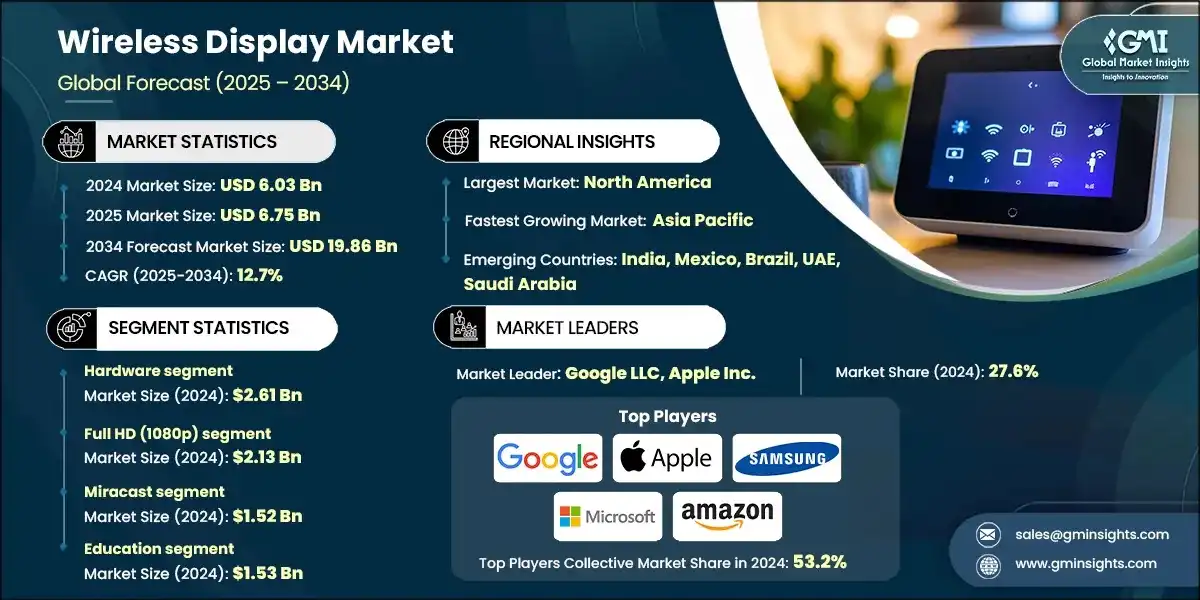
The global wireless display market was valued at USD 6.03 billion and 78.93 million units in 2024. The market is expected to grow from USD 6.75 billion in 2025 to USD 12.11 billion in 2030 and USD 19.86 billion by 2034, at CAGR of 12.7% during the forecasted period of 2025-2034, according to Global Market Insights Inc.
Wireless Display Market Key Takeaways
Market Size & Growth
- 2024 Market Size: USD 6.03 billion
- 2025 Market Size: USD 6.75 billion
- 2034 Forecast Market Size: USD 19.86 billion
- CAGR (2025–2034): 12.7%
Key Market Drivers
- Surge in smart tv and smartphone adoption.
- Rising demand for BYOD and hybrid work models.
- Expansion of online learning and edtech platforms.
- Proliferation of streaming services and gaming platforms.
- Advancements in wi-fi 6/6e and 5g connectivity.
Challenges
- Interoperability and device compatibility issues.
- Latency, signal interference, and bandwidth limitations.
Opportunity
- Integration with unified communication platforms.
- Adoption in smart classrooms and digital learning.
- Expansion in automotive infotainment systems.
- Cloud-based wireless display for remote work.
Key Players
- Market Leader: Google LLC led with over 27.6% market share in 2024.
- Leading Players: Top 5 players in this market include Google LLC, Apple Inc., Samsung Electronics Co., Ltd., Microsoft Corporation, Amazon.com, Inc., which collectively held a market share of 53.2% in 2024.
Get Market Insights & Growth Opportunities
- The growth of wireless display market is attributed to the surge in smart tv and smartphone adoption, rising demand for BYOD and hybrid work models, expansion of online learning and edtech platforms, proliferation of streaming services and gaming platforms, and advancements in wi-fi 6/6e and 5g connectivity.
- The expansion of this market is significantly influenced by the rising penetration of smart TVs and smartphones. Such growth is supported by consumer preferences for effortless cable-free streaming experiences that prioritize convenience, deliver high-definition audiovisual quality, and facilitate seamless interoperability among multiple devices within the connected home ecosystem. According to Statista, the number of smartphone users worldwide reached approximately 6.92 billion in 2023, representing about 86% of the global population.
- The expansion of Bring Your Own Device (BYOD) policies alongside hybrid workplace structures is driving a heightened requirement for wireless collaboration technologies. Corporations are progressively integrating wireless presentation systems into conference rooms and collaborative environments, allowing fluid content sharing from personal laptops, tablets, and smartphones owned by employees.
- The growth of online education and digital learning platforms has intensified the demand for wireless display technology by making flexible, device-agnostic screen-sharing essential in both classrooms and home environments. Consequently, there has been a rapid integration of wireless projectors, interactive smart boards, and screen-casting devices, all of which enrich interactive learning and effectively support hybrid teaching models.
To get key market trends
Wireless Display Market Trends
- The adoption of wireless display technologies in hybrid workspaces is reshaping enterprise collaboration along a trajectory toward flexible, device-agnostic frameworks for content sharing and virtual meetings. This shift first surged in 2020, amid worldwide moves to remote work, and has since sustained strong market demand for uninterrupted screen mirroring across laptops, tablets, and smartphones. Corporations now increasingly deploy meeting-room, huddle-room, and co-working-space ecosystems that incorporate Miracast, Chromecast, and AirPlay, further embedding these protocols in the enterprise landscape.
- Organizations are allocating resources toward platform-agnostic wireless display solutions, strengthen cybersecurity frameworks, and guarantee interoperability with leading unified communication systems such as Zoom and Microsoft Teams. This is anticipated to sustain until 2030, as hybrid work solidifies and companies increasingly focus on cohesive and efficient digital collaboration.
- The expansion of digital learning environments is driving changes in the wireless display sector as educational institutions integrate wireless projection and screen-mirroring technologies to facilitate remote, hybrid, and interactive pedagogies. This is propelled by government funding programmes and educational technology investment in emerging economies. Consequently, adoption of wireless projectors, interactive whiteboards, and screen-casting applications is becoming common, allowing educators to minimize upfront hardware expenditure and to enhance spatial and pedagogical adaptability within learning spaces.
- Educational institutions are prioritizing the implementation of scalable and intuitively operable wireless display platforms that seamlessly interoperate with tablets, laptops, and mobile devices. Market forecasts indicate robust growth through 2032, supported by the ongoing digitization of curricula, the proliferation of e-learning platforms, and an increasing pursuit of personalized, interactive educational experiences.
Wireless Display Market Analysis
Learn more about the key segments shaping this market
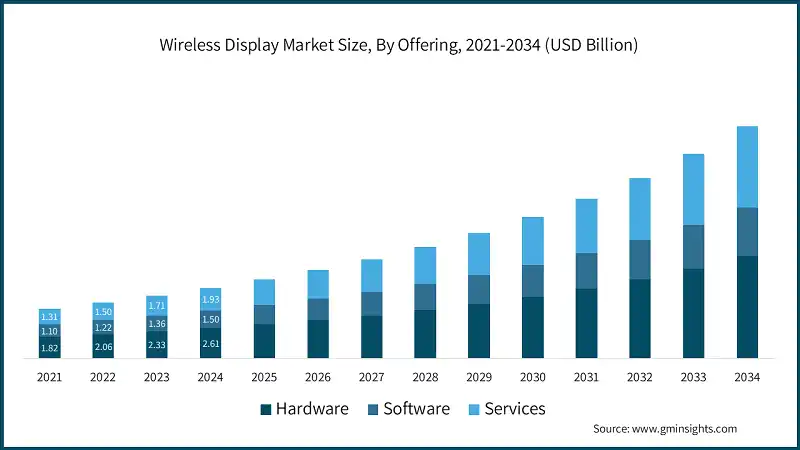
Based on offering, the market is divided into hardware, software, and services.
- The hardware market was the largest market and was valued at USD 2.61 billion in 2024. The is gaining traction because users across consumer, education, and other business sectors insist on high-definition wireless screen casting that operates flexibly across devices and without tethered cables. Using wireless adapters, receivers, dongles, and smart TVs that support Miracast, Chromecast, and AirPlay, hardware solutions deliver plug-and-play screen sharing, facilitating collaborative projects, remote learning, at-home streaming, and on-the-spot presentations.
- The services market is the fastest growing segment and is anticipated to grow with a CAGR of 13.8% during the forecast period. Adoption is accelerating among enterprises, educational institutions, and households needing dependable assistance with wireless display integration, provisioning, and troubleshooting across device landscapes. The fusion of cloud-management utilities, remote diagnostic capabilities, enterprise-grade security protocols, and simultaneous multi-user casting empowers service providers to deploy and maintain wireless display infrastructures effortlessly across workplaces, campuses, and residences.
Learn more about the key segments shaping this market
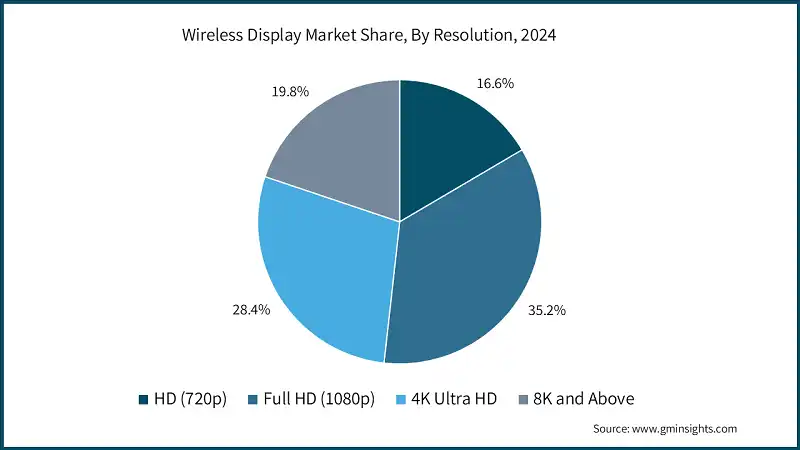
Based on resolution, the wireless display market is divided into HD (720p), full HD (1080p), 4K Ultra HD, and 8K and above.
- The full HD (1080p) was the largest market and was valued at USD 2.13 billion in 2024. Demand is growing among consumers, educators, and professionals for wireless streaming that delivers sharp visuals and minimal lag, while also conserving bandwidth. Full HD (1080p), which is broadly adopted across smart TVs, projectors, laptops, and smartphones, supports seamless content casting for video conferences, online courses, gaming, and home entertainment without the need for extremely fast network. It is used for its large ecosystem, minimal latency, and modest data requirements.
- To meet this demand, developers are designing wireless display solutions by refining efficiency, guaranteeing low-latency links, and enabling dual device interoperability. Partnerships with educational platforms, small and medium sized businesses, and device manufacturers, can help them to deliver dependable, high quality wireless performance that works efficiently.
- The 4K Ultra HD market is the fastest growing segment and is anticipated to grow with a CAGR of 14.4% during the forecast period. It is growing rapidly as media, gaming, and enterprise users seek sharp imagery and immersive quality suitable for large-screen environments. By combining next generation, high-performing Wi-Fi, video encoders, and low latency casting, 4K wireless solutions permit smooth, high fidelity streaming for virtual meetings, digital signage, cinematic playback, and collaborative design work. Premium users and organizations are integrating these to elevate presentations, enrich customer interactions, and boost productivity across diverse industries.
On the basis of technology, the wireless display market is categorized into WiDi (Intel Wireless Display), Miracast, AirPlay, Google Cast (Chromecast), and others.
- The miracast market was the largest and was valued at USD 1.52 billion in 2024. It is gaining acceptance as enterprises, educators, and consumers wants cable-free screen-sharing option that operates seamlessly across a wide variety of Windows and Android devices, without requiring Wi-Fi or additional applications. By leveraging Wi-Fi Direct, Miracast mirrors screens in real time, facilitating lag-free presentations, interactive classroom sessions, and home entertainment, all without an internet connection. Moreover, to satisfy this emerging demand, developers are refining Miracast by minimizing latency, enabling support for higher resolutions and building tighter integration with enterprise collaboration platforms.
- The google cast (Chromecast) market is the fastest growing segment and is anticipated to grow with a CAGR of 14.3% during the forecast period. It is gaining traction as consumers, content creators, and enterprises seek frictionless streaming across devices, rapid deployment, and consistently high-quality playback. By integrating cloud-based casting, multi-device syncing, voice control through Google Assistant, and compatibility with a broad array of applications, Google Cast allows users to wirelessly project video, presentations, and applications from mobile devices or browsers to televisions and display screens. As a result, Chromecast is widely used in smart homes, classrooms, and offices for its ease of use, broad content compatibility, and cross-platform support.
The end use industry segment is divided into consumer electronics, healthcare, education, government & defense, media & entertainment, retail, and others.
- The education market was the largest and fastest growing and was valued at USD 1.53 billion in 2024 and is anticipated to grow with a CAGR of 14.6% during the forecast period. It is gaining traction as schools, universities, and training centers demand interactive, device-agnostic tools that enhance hybrid learning without wired setups. By combining wireless projectors, screen mirroring apps, and casting technologies where educators can deliver real-time content from tablets, laptops, or smartphones to classroom displays, improving engagement and collaborations.
- The consumer electronics market reached a valuation of USD 5.16 billion in 2034. Consumer appetite for wireless display solutions is rising, driven by the desire for effortless, cable-free content sharing among smartphones, tablets, laptops, and televisions for entertainment, gaming, and multitasking. By incorporating established screen-mirroring protocols such as Google Cast, Miracast, and AirPlay, wireless display technology elevates user convenience, enabling real-time media streaming, second-screen interactions, and smart-home control without the need for physical connectors.
Looking for region specific data?
The North America wireless display market held 34.23% market share in 2024 and is growing at a 13% CAGR, driven by high adoption of smart devices, rapid 5G rollout, strong presence of tech giants like Google and Apple, and rising demand for seamless, wireless streaming in education, enterprise, and home entertainment settings.
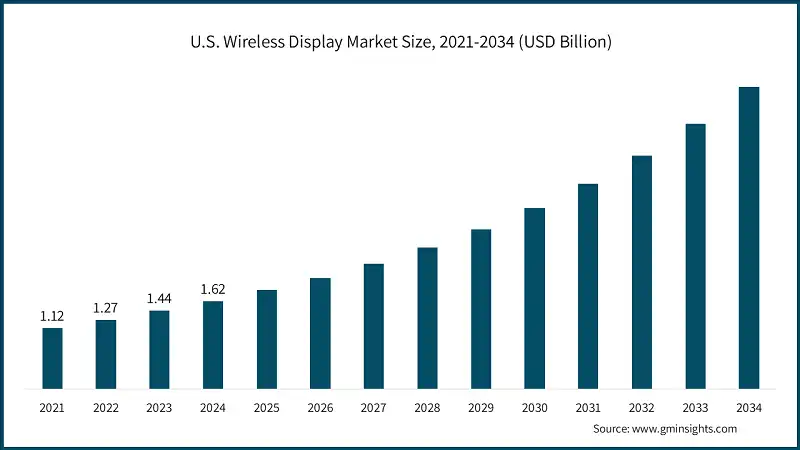
- The wireless display industry in the U.S. has been expanding steadily, achieving a CAGR of 13.2% and reaching a valuation of USD 1.62 billion in 2024. The U.S. market continues to expand as smart device adoption rises, remote work and hybrid learning normalize, and major American tech firms like Google, Apple, and Intel push seamless screen-mirroring innovations. The CTA reports that over 90% of U.S. households own smart TVs or casting enabled devices, while schools and enterprises rely on wireless displays to support collaborative environments. This demand is accelerating the launch of cross-device casting tools and embedded wireless display chipsets in laptops, phones, and tablets.
- The Canada wireless display market is projected to grow significantly with a CAGR of 12.2% during the forecast period. Canada is experiencing robust growth, propelled by adoption of smart devices, an escalated need for collaboration in classrooms and boardrooms, and use of over-the-top (OTT) content. Educational institutions and enterprises across the country are deploying screen-mirroring ecosystems to bolster digital pedagogy and hybrid operating environments, while consumer interest in streaming has concurrently strengthened demand for wireless casting in living rooms.
The Europe wireless display market held 20.7% market share and is growing at a 12.3% CAGR, driven by rising adoption of smart TVs and streaming devices, increasing preference for hybrid work and remote learning environments, and growing demand for high-resolution, wireless content-sharing solutions across enterprise, education, and residential sectors.
- The market in Germany reached a valuation of USD 0.29 Billion in 2024 and is anticipated to grow with a CAGR of 13.2% during the forecast period. The German market is gaining traction due to the adoption of screen mirroring in hybrid-tier workplaces and smart classrooms, and the increasing preference for streamlined home entertainment ecosystems. Anchored by a robust manufacturing ecosystem and an advanced digital backbone, Germany is further supported by EU frameworks such as the Digital Europe Programme, which together promote the use of wireless displays in diverse sectors, including corporate training, automotive design, and media production.
- The UK wireless display market is anticipated to reach USD 0.94 billion in 2034. Robust broadband networks, the expanding BYOD culture, and an innovation-driven education sector are driving the growth of market in the U.K. Media, healthcare, and enterprise clients routinely require effortless screen mirroring, real-time co-authoring, and 4K wireless streaming, particularly as hybrid working and digital-first services become the norm. Ofcom reports that more than 95 per cent of U.K. households are connected to superfast broadband, guaranteeing reliable, high-resolution content streams to residences, classrooms, and workplaces alike.
The Asia-Pacific region is the fastest growing in the wireless display market and is expected to grow at a CAGR of 14.7% during the forecasted period, driven by rapid smartphone adoption, widespread 5G deployment, and rising demand for immersive digital experiences across retail, education, and entertainment sectors.
- The China market is projected to grow significantly, reaching USD 3.24 billion by 2034. There is significant opportunity in China due to high smartphone penetration, new smart-home adoption, and a substantial push from the government for digital infrastructure development. The launch of 5G and Wi-Fi 6 networks across the country is underway which amplifies demand from Chinese consumers for ultra-HD, wireless streaming from device to display—for smartphones and laptop computers, smart TVs, and projectors.
- Japan held a market share of 12.9% in 2024. Japan's wireless display industry is benefitting from advanced digital infrastructure, the rollout of 5G and Wi-Fi 6, and strong demand for high-definition content across consumer electronics, education, and business sectors. As a nation that embraces technology in every aspect of life, Japanese firms such as Sony and Panasonic are including wireless casting features in smart TVs, monitors, and projectors, so that consumers have a good experience as they view content. Adoption of wireless displays in Japan also has strong support from the country’s high penetration of streaming platforms, and newly flexible working arrangements that mix home and office environments.
Latin America held 8.8% market share in 2024 and is growing with a CAGR of 6.3%, driven by growing smartphone and smart TV adoption, rising internet penetration, expanding OTT content consumption, and increased demand for wireless streaming in home entertainment and educational environments.
The Middle East & Africa wireless display market was valued at USD 450 million in 2024. The market growth is driven by increasing digital transformation across education and corporate sectors, rising adoption of smart devices, growing demand for cable-free presentation tools, and expanding OTT media consumption in urban hubs.
- The wireless display industry in UAE reached a valuation of USD 200 million in 2024 and is anticipated to grow with a CAGR of 11.1% during the forecast period. High smartphone adoption rates, growing demand for seamless hybrid work solutions, and UAE's widespread adoption of smart home entertainment ecosystems, are driving the growth of the market. With strong government support for digital transformation, the process of wireless casting and screen mirroring has become the norm in education, hospitality and corporate settings. The increased use of smart TVs and OTT consumption will continue to push the consumer to gain easier access to devices to be able to use their smart devices to consume content which is seamless and free of latency and cables.
- The South Africa wireless display market is anticipated to reach USD 210 million in 2034. This market is increasing due to enhanced internet access, greater adoption of smart devices, and increased demand for flexible learning and remote collaboration solutions. Wireless display screen mirroring and streaming devices that are enabled with Miracast and Chromecast are an important feature of a growing number of homes, schools, and offices with smart TVs and wireless streaming. Their young, connected society is embracing screen-mirroring and cable-free viewing.
Wireless Display Market Share
- The top 5 companies Google LLC, Apple Inc., Samsung Electronics Co., Ltd., Microsoft Corporation, and Amazon.com, Inc. collectively hold around 53.2% of the market. This concentration is due to how tightly they can control an operating systems and cross devices compatibility simultaneously while having massive user bases to accelerate adoption. Their periodic investments into user experience, hardware-combined software optimization, and exclusive beneficial platform functions makes it difficult for smaller competitors to enter this space. They have extensive portfolios of IP and bundled offerings with TVs, tablets, and speakers, and direct the global trends for innovation in wireless display technology.
- Google LLC commands an estimated 14.7% of the wireless display market. Its dominance can be attributed to the worldwide adoption of its Google Cast protocol, native integration in Android devices, and the prevalence of Chromecasts. Its competitive advantages lie in the open and scalable nature of Google Cast, which allows for more efficient multi-device streaming between TVs, mobile devices, laptops and smart speakers.
- Apple Inc. holds roughly 12.9% of the wireless display industry. It is driven by AirPlay's seamless functionality across several different products. Apple's part strength is in the integrity of its closed-loop, tightly controlled base, resulting in highly reliable, low-latency, and overall experience consistency. Apple's strong presence in privacy, encrypted streaming, and the ease of use via native devices, AirPlay is the number one choice for users of Apple products.
- Samsung Electronics co. commands 12.4% of the market share, attributed to its Smart View and SmartThings platforms on Galaxy smartphones, tablets, and smart TVs. Plus, the company ensures a level of compatibility by adopting industry standards while providing an effortless screen mirror option among its own devices. Samsung has fostered partnerships with content providers and brings an open ecosystem across Android and Windows devices, which is key to its dominance in consumer electronics and home entertainment space.
- Microsoft Co. holds roughly 7.9% of the wireless display market, driven by its Miracast-enabled Surface devices, Windows PCs, and Xbox consoles. With interoperability among products because of its adoption of the Wireless Display Adapter technology and native casting in the Windows OS, Microsoft presents a competitive advantage. Microsoft benefits from the enterprise capable ecosystem it sells, the prominence of productivity applications like Teams and PowerPoint that support wireless projection, and its ongoing relationship with standardization around related wireless protocols in both business and educational environments.
- Amazon.com, Inc. currently commands roughly 5.3% of the global market. Through its Fire TV and Fire Stick devices, Amazon.com, Inc. is a significant player in the wireless display market, allowing users to mirror or cast from either mobile or desktop screens. It distinguishes itself however, through strong Alexa integration, integration into a rich content ecosystem, and its increasing uptake in smart homes, establishing itself as a key player in affordable, easy-to-use wireless display platforms.
Wireless Display Market Companies
List of prominent players operating in the wireless display industry include:
- Google LLC
- Apple Inc.
- Intel Corporation
- Microsoft Corporation
- Amazon.com, Inc.
- Samsung Electronics Co., Ltd.
- LG Electronics Inc.
- Airtame ApS
- Barco NV
- Netgear Inc.
- Dell Technologies Inc.
- Sharp Corporation
- BenQ Corporation
- ScreenBeam Inc.
- Google LLC, Apple Inc., Samsung Electronics Co., Ltd., Microsoft Corporation, and Amazon.com, Inc. dominate the wireless display market. These companies control a large portion of the market by incorporating wireless casting and mirroring technologies in widely adopted operating systems and device ecosystems. These companies spend large amounts of money on cross-platform compatibility, low-latency transmission, and an expanding content ecosystem. They can create complete, easy-to-use wireless display experiences because they control device infrastructure and content platforms, developing their strength as demand for time-shifted and cord-free viewing increases in consumer and enterprise environments.
- Intel Corporation, LG Electronics Inc., and Barco NV fall in the challenger category of the wireless display market, and are all making moves to strengthen their positions through more sophisticated hardware and enterprise-level display technologies, as well as integrations. Intel has been an industry leader with their support of the wireless display standards found in WiDi, as well as advances on the embedded chip level, and both LG and Barco are building innovative, high-performance smart displays that include conferencing systems and wireless collaboration that are featured in corporate, health care, and educational environments. All three of these firms are creating a connection to the leaders by creating secure, scaling, and latency-free solutions that will attract enterprise and professional end users around the world.
- BenQ Corporation, Sharp Corporation, and Netgear Inc. are in follower positions in the wireless display market, and they are all focused on providing reliable hardware for home entertainment, business presentations, and education. All of these companies focus on screen casting, smart projectors, and wireless connection capabilities with Miracast, AirPlay, or proprietary protocols. They are generally recognized for their brand heritage and quality hardware but typically focus on the integration of hardware. They have limited presence in the market due to limited innovation on wireless display protocols and have limited investment in an end-to-end ecosystem when compared to the leaders in the market.
- Airtame ApS, ScreenBeam Inc., and Barco NV compete in a niche portion of the wireless display market, catering to essential verticals with specific solutions. Airtame ApS engages with education and business verticals with intuitive wireless presentations that also assist in device control, and support multiple OS platforms. ScreenBeam Inc. targets enterprise and education and uses low-latency, secure Miracast enabled screen mirroring with choices motivated by BYOD and legacy integration. Barco NV operates in the corporate meeting space particularly with the ClickShare development, which has become synonymous with secure wireless content sharing with enterprise-grade encryption and usability. Each of these firms ops in the market not through mass-market share, but through niche expertise, reliability, and institutional relationships.
Wireless Display Market Report Attributes
| Key Takeaway | Details |
|---|---|
| Market Size & Growth | |
| Base Year | 2024 |
| Market Size in 2024 | USD 6.03 billion |
| Market Size in 2025 | USD 6.75 billion |
| Forecast Period 2025 - 2034 CAGR | 12.7% |
| Market Size in 2034 | USD 19.86 billion |
| Key Market Trends | |
| Drivers | Impact |
| Surge in smart tv and smartphone adoption | Drives 40% increase in wireless display connections as consumers seek seamless screen mirroring for content consumption. |
| Rising demand for BYOD and hybrid work models | Fuels 35% growth in enterprise wireless display usage for remote collaboration and digital meetings. |
| Expansion of online learning and edtech platforms | Powers 30% rise in classroom screen-sharing tools and wireless projection systems in smart schools. |
| Proliferation of streaming services and gaming platforms | Spurs 28% jump in wireless display adapters as users seek lag-free casting of OTT and gaming content. |
| Advancements in wi-fi 6/6e and 5g connectivity | Enables 25% uplift in high-resolution, low-latency wireless transmission, unlocking new use cases across home and enterprise environments. |
| Pitfalls & Challenges | Impact |
| Interoperability and device compatibility issues | Limits cross-platform performance, slows adoption in mixed-device environments, and impacts user satisfaction. |
| Latency, signal interference, and bandwidth limitations | Degrades streaming quality, disrupts real-time interactions, and restricts use in demanding applications like gaming and telehealth. |
| Opportunities: | Impact |
| Integration with unified communication platforms | Will boost collaboration, simplify screen sharing, and enhance meeting efficiency. |
| Adoption in smart classrooms and digital learning | Will improve engagement, support hybrid learning, and reduce hardware dependency. |
| Expansion in automotive infotainment systems | Will enhance in-car entertainment and enable seamless multi-device streaming. |
| Cloud-based wireless display for remote work | Will ensure secure access, improve workflows, and reduce reliance on physical setups. |
| Market Leaders (2024) | |
| Market Leaders |
Top 2 companies hold 27.6% market share in 2024 |
| Top Players |
Collective market share in 2024 is 53.2% |
| Competitive Edge |
|
| Regional Insights | |
| Largest Market | North America |
| Fastest Growing Market | Asia Pacific |
| Emerging Country | India, Mexico, Brazil, UAE, Saudi Arabia |
| Future Outlook |
|
What are the growth opportunities in this market?
Wireless Display Industry News
- In May 2025, Samsung and LG introduced advanced wireless TV systems—Samsung’s One Connect Box and LG’s Zero Connect Box—featured in their high-end OLED and Mini-LED models, enabling flexible TV placement and cleaner setups by shifting HDMI and USB ports into an external unit. These innovations reflect growing momentum in the wireless display market, aiming to reduce cable clutter and enhance home aesthetics.
- In January 2025, at CES 2025, EZCast unveiled a suite of groundbreaking wireless display innovations, headlined by the debut of Omni Tetra, a splitter capable of supporting four receivers simultaneously with ultra-low latency and a 300-meter range—ideal for large events. Omni Vision pushed the boundaries further with a 3-kilometer long-range wireless solution designed for professional video production and live streaming.
The wireless display market research report includes an in-depth coverage of the industry with estimates and forecast in terms of revenue (USD billion) and volume (units) from 2021 – 2034 for the following segments:
Market, By Component
- Hardware
- Display devices
- Smart TVs
- Monitors
- Projectors
- Wireless adapters
- Transmission & communication modules
- Antennas
- Receivers
- Repeaters
- Others
- Display devices
- Software
- Consumer-oriented software
- Enterprise / collaboration software
- Content management & media platforms
- Security & device management software
- Others
- Services
- Setup & installation
- Maintenance & support
- Cloud-based streaming
Market, By Resolution
- HD (720p)
- Full HD (1080p)
- 4K Ultra HD
- 8K and Above
Market, By Technology
- WiDi (Intel Wireless Display)
- Miracast
- AirPlay
- Google Cast (Chromecast)
- Others
Market, By End Use Industry
- Consumer electronics
- Home entertainment
- Gaming consoles & PCs
- Smart speakers
- Home automation
- Others
- Healthcare
- Patient monitoring systems
- Medical imaging display
- Surgery & operation theaters
- Training & e-learning
- Others
- Education
- Online learning
- Smart campuses
- Interactive whiteboards & projectors
- Educational content streaming
- Others
- Government & defense
- Command & control centers
- Public sector offices & administration
- Surveillance & monitoring displays
- Military training & simulation
- Others
- Media & entertainment
- Broadcasting
- Post-production & editing suites
- Cinema & theater digital projection
- Event & concert visual displays
- Others
- Retail
- Digital signage & advertising
- Interactive kiosks & in-store displays
- Point of Sale (POS) systems
- Others
- Industrial / enterprise
- Control rooms
- Video conferencing
- Factory floor monitoring
- Training & onboarding displays
- Others
- Others
The above information is provided for the following regions and countries:
- North America
- U.S.
- Canada
- Europe
- Germany
- UK
- France
- Italy
- Spain
- Netherlands
- Rest of Europe
- Asia Pacific
- China
- India
- Japan
- South Korea
- Australia
- Rest of Asia Pacific
- Latin America
- Brazil
- Mexico
- Argentina
- Rest of Latin America
- Middle East and Africa
- Saudi Arabia
- South Africa
- UAE
- Rest of MEA
Frequently Asked Question(FAQ) :
What is the market size of the wireless display industry in 2024?
The market size was USD 6.03 billion in 2024, with a CAGR of 12.7% expected through 2034, driven by rising smart TV and smartphone adoption, BYOD policies, and growth in online learning and streaming platforms
What is the current wireless display market size in 2025?
The market size is projected to reach USD 6.75 billion in 2025
What is the projected value of the wireless display market by 2034?
The market size for wireless display is expected to reach USD 19.86 billion by 2034, fueled by advancements in Wi-Fi 6/6e, 5G connectivity, and demand for seamless cross-device streaming
How much revenue did the hardware component segment generate in 2024?
The hardware segment generated USD 2.61 billion in 2024, leading the market as users across consumer, education, and business sectors demanded high-definition, cable-free screen casting
What was the valuation of the full HD (1080p) resolution segment in 2024?
The full HD (1080p) resolution segment reached USD 2.13 billion in 2024, supported by its widespread adoption across smart TVs, laptops, projectors, and smartphones
What is the growth outlook for 4K Ultra HD resolution from 2025 to 2034?
The 4K Ultra HD resolution segment is projected to grow at a CAGR of 14.4% till 2034, driven by demand from gaming, enterprise, and cinematic applications for immersive, high-fidelity wireless streaming
Which region leads the wireless display market?
The U.S. market was valued at USD 1.62 billion in 2024 and is expanding at a CAGR of 13.2%. Growth is driven by high smart device penetration, remote work adoption, hybrid education demand, and strong innovation from leading tech companies such as Google and Apple
What are the upcoming trends in the wireless display industry?
Key trends include AI- and 5G-powered low-latency streaming, adoption in hybrid workspaces, integration with unified communication platforms, and growing use in automotive infotainment and smart classrooms
Who are the key players in the wireless display market?
Key players include Google LLC, Apple Inc., Samsung Electronics Co., Ltd., Microsoft Corporation, Amazon.com, Inc., Intel Corporation, LG Electronics Inc., Barco NV, Netgear Inc., Dell Technologies Inc., Sharp Corporation, BenQ Corporation, and ScreenBeam Inc.
Wireless Display Market Scope
Related Reports