Summary
Table of Content

Wind Turbine Pitch and Yaw Drive Market
Get a free sample of this report
Form submitted successfully!
Error submitting form. Please try again.
Thank you!
Your inquiry has been received. Our team will reach out to you with the required details via email. To ensure that you don't miss their response, kindly remember to check your spam folder as well!
Request Sectional Data
Thank you!
Your inquiry has been received. Our team will reach out to you with the required details via email. To ensure that you don't miss their response, kindly remember to check your spam folder as well!
Form submitted successfully!
Error submitting form. Please try again.
Wind Turbine Pitch and Yaw Drive Market Size
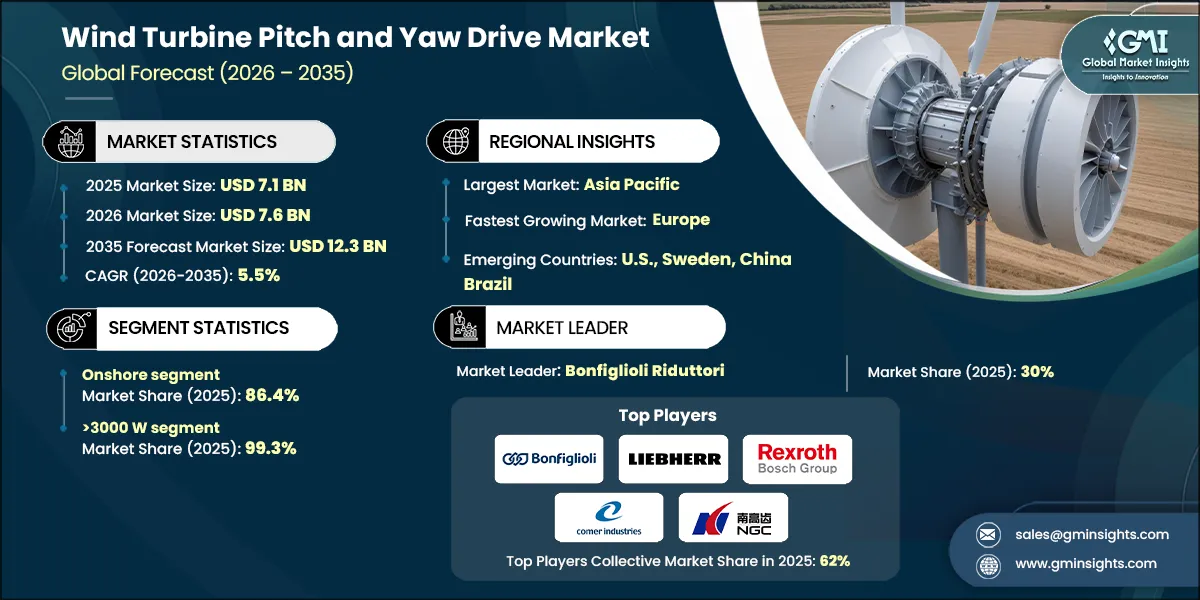
The global wind turbine pitch and yaw drive market size was valued at USD 7.1 Billion in 2025. The market is anticipated to grow from USD 7.6 Billion in 2026 to USD 12.3 billion in 2035, at a CAGR of 5.5%.
Wind Turbine Pitch and Yaw Drive Market Key Takeaways
Market Size & Growth
- 2025 Market Size: USD 7.1 Billion
- 2026 Market Size: USD 7.6 Billion
- 2035 Forecast Market Size: USD 12.3 Billion
- CAGR (2026–2035): 5.5%
Regional Dominance
- Largest Market: Asia Pacific
- Fastest Growing Region: Europe
Key Market Drivers
- Favorable regulatory norms and targets to limit GHG footprints.
- Increasing private & public sector investments in wind power solutions.
- Ongoing advancements in turbine technologies.
Challenges
- High initial investment.
- Local demographics and challenges related to turbine installations.
Opportunity
- Expansion of offshore wind projects.
- Retrofitting and Upgrading Existing Wind Farms.
Key Players
- Market Leader: Bonfiglioli Riduttori led with over 30% market share in 2025.
- Leading Players: Top 5 players in this market include Bonfiglioli Riduttori S.p.A., Liebherr, Bosch Rexroth, Comer Industries, Nanjing High Speed Gear Manufacturing Co., which collectively held a market share of 62% in 2025.
Get Market Insights & Growth Opportunities
- The pitch drive system plays a vital role in regulating the angle of wind turbine blades in response to wind conditions, enabling optimal power generation while safeguarding the turbine against excessive wind loads. It also supports controlled braking and safe shutdown during maintenance activities or emergency situations. In contrast, the yaw drive system ensures that the turbine rotor remains properly aligned with the wind direction, helping to maximize energy output, reduce structural and mechanical stress, and improve overall operational performance.
- The growing emphasis on renewable energy, supported by ambitious climate targets set by governments and organizations to curb emissions and reduce dependence on fossil fuels, is expected to strengthen the industry landscape. As one of the most established and cost-competitive renewable technologies, wind energy plays a central role in this transition, and continued improvements in turbine efficiency and reliability will further reinforce the overall business scenario.
- Ongoing technological improvements in drive systems, along with innovations in control algorithms, materials, and manufacturing techniques, have resulted in more efficient, reliable, and cost-effective solutions, driving greater demand for these products. Such advancements allow wind turbines to perform optimally across varying wind conditions, lower maintenance needs, and extend operational life. Additionally, wind energy developers are increasingly adopting cutting-edge pitch and yaw drive systems to enhance performance and maximize return on investment.
- Offshore wind is experiencing rapid growth, driving demand for pitch and yaw drive systems designed for harsh marine environments. National and international policy frameworks, including the Paris Agreement commitments, are driving aggressive wind deployment targets. Growing technological advancements will create opportunities for market expansion through system upgrades and retrofits.
- Ongoing shift toward individual pitch control strategies, which can reduce structural fatigue but increase pitch travel and wear, may drive demand for more durable pitch actuators and more frequent maintenance or replacement cycles. Turbine scaling trends are driving continuous innovation in pitch and yaw drive systems. Growing investments with falling levelized costs of energy will make wind increasingly competitive and attract both public development finance and private investment.
- For instance, in 2024, the World Bank Group launched the Europe and Central Asia Renewable Energy Scale-up (ECARES) program, committing USD 2 billion over 10 years to add 15 GW of renewable capacity and mobilize approximately USD 6 billion in private capital.
- The growth rate for hydraulic pitch systems reflects their continued use in specific applications despite the industry's overall shift toward electric systems. Key development areas include leak-free hydraulic components biodegradable or low-toxicity hydraulic fluids to reduce environmental impact, integrated condition monitoring to enable predictive maintenance, and compact hydraulic power units that reduce nacelle space requirements and weight, thereby leading to market growth.
- Small blades impose lower aerodynamic loads and moments on pitch systems, allowing for simpler actuator designs and lower torque capacity. Pitch systems for small blades can use lower-cost motors, simpler gearboxes, and standard bearings, reducing system cost and complexity. In addition, for small turbines with limited rotor inertia, fast pitch response is essential to prevent overspeed and protect the drivetrain, requiring pitch actuators with adequate bandwidth despite the lower absolute torque requirements.
- Ongoing deployment of 2-5 MW onshore turbines globally, particularly in emerging markets and repowering projects along with ongoing research on advanced manufacturing emphasizing 3D-printed large composite blade structures, thermal welded/fusion-composite joining, and onsite/modular manufacturing will drive the market outlook.
To get key market trends
Wind Turbine Pitch and Yaw Drive Market Trends
- Governments across multiple regions have implemented supportive policies such as financial incentives, tax benefits, subsidies, and funding programs to promote renewable energy deployment. These measures improve the economic feasibility of investing in advanced wind turbine components, including pitch and yaw drive systems, which in turn supports faster market adoption.
- For instance, Vestas Wind Systems circularity roadmap targets zero-waste turbines by 2040 and increased refurbished component utilization targeting 55% by 2030, thereby indicating potential for refurbished pitch and yaw components to re-enter the market.
- Efficient pitch and yaw drives enhance turbine control, safety, and operational efficiency, strengthening the overall performance, reliability, and long-term cost effectiveness of wind energy projects. Increasing suppliers with diversified manufacturing footprints, localized supply chains, and designs that minimize critical-material content will contribute to the business scenario.
- The wind industry is experiencing a technology transition toward electromechanical pitch and yaw drive systems, moving away from traditional hydraulic actuators. The shift to electric systems aligns with broader industry trends toward reduced maintenance, improved reliability, and lower environmental footprint.
- For instance, in June 2025, UKA commissioned Nordex Group to supply 64 wind turbines for 21 UKA wind projects across eight German federal states. The order includes 56 N175 models and 8 N163 models, bringing UKA's total Nordex-ordered turbines over the past 18 months to 226 units representing over 1.5 GW total capacity.
- Introduction of digitalization and advanced sensing technologies coupled with growing utilization of smart turbines to maximize energy output and reduce unplanned maintenance will drive the business landscape. Advanced control strategies enabled by digitalization are increasing pitch system duty cycles and performance requirements.
- For instance, the National Renewable Energy Laboratory demonstrated LIDAR-assisted feedforward individual pitch control on a 15 MW floating offshore wind turbine, achieving reductions in blade root and tower bending moment standard deviations of up to 20% and damage equivalent load reductions of up to 11%.
Wind Turbine Pitch and Yaw Drive Market Analysis
Learn more about the key segments shaping this market
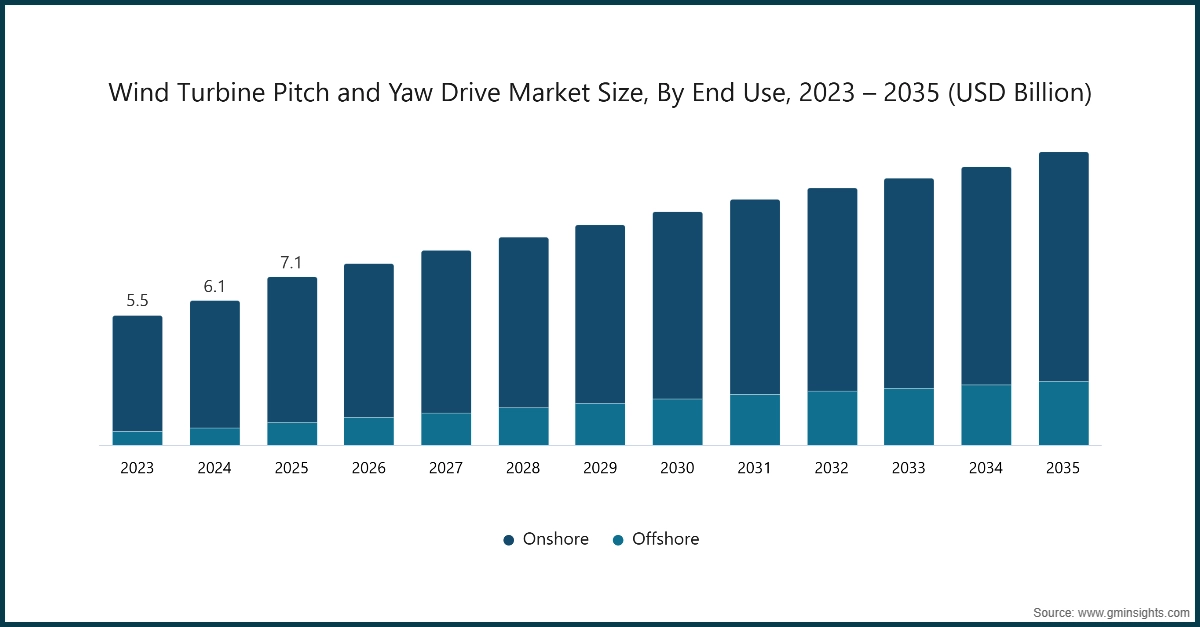
Based on end use, the wind turbine pitch and yaw drive market is segmented into Onshore and Offshore. Onshore accounts for the major share of the market with 86.4% in 2025 and is expected to grow at a CAGR of 4.5% over the forecasted period of 2026-2035 propelled by limited maintenance and installation costs.
- The onshore wind turbine pitch and yaw drive systems benefit from established supply chains, mature manufacturing processes, and cost optimization through volume production. Advancements in wind turbine technology, including larger rotor diameters and taller towers, have greatly enhanced energy capture efficiency. These developments have, in turn, driven demand for advanced pitch and yaw drive systems capable of managing bigger, more powerful turbines, ensuring optimal performance, reliability, and extended operational life, thereby positively shaping the industry landscape.
- For instance, Nordex Group's N175/6.X turbine launched in Canada and Siemens Gamesa's SG 7.0-170 exemplify the upper end of onshore turbine ratings, requiring pitch and yaw systems with correspondingly higher torque capacity and control sophistication.
- Offshore will grow over CAGR 9.5% by 2035 on account of deployment of larger, higher-capacity turbines in harsh marine environments. The drives increasingly incorporate electric actuation, redundant safety mechanisms, sealed housings, and advanced condition-monitoring solutions to minimize maintenance needs and avoid costly offshore interventions. Further, as countries in Europe, North America, and Asia-Pacific scale offshore wind projects to meet decarbonization targets, the demand for robust, digitally enabled pitch and yaw drive solutions will grow, stimulating product penetration.
Learn more about the key segments shaping this market
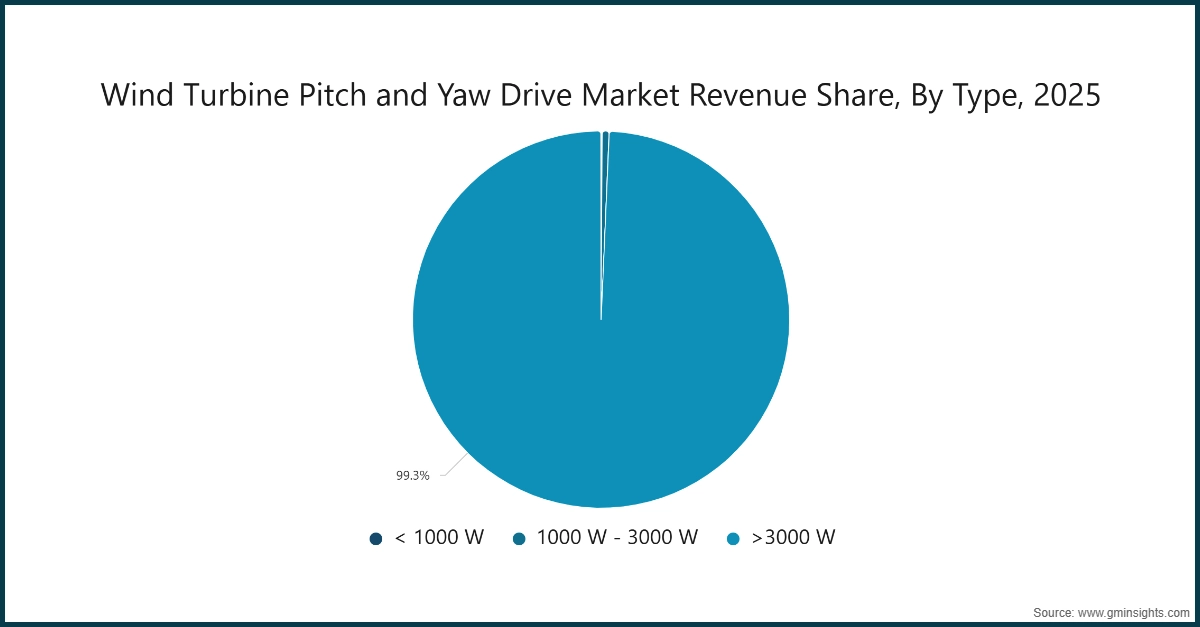
Based on type, the wind turbine pitch and yaw drive market is segmented into < 1000 W, 1000 W – 3000 W and > 3000 W. >3000 W accounts for the major share of the market with 99.3% in 2025 and is expected to grow at a CAGR of 5.4% over the forecasted period of 2026-2035.
- Increasing utilization across the utility scale projects along with their ability to support as a reliable source of renewable energy for off-grid locations and remote communities will continue to drive the business momentum. For instance, in 2025, Vestas Wind Systems completed its first commercial delivery of V236-15.0 MW offshore turbine. Furthermore, growing investments in advanced engineering capabilities, testing facilities, and quality assurance processes along with advantages including economies of scale in manufacturing and supply chain is set to augment the market growth.
- <1000 W wind turbine pitch and yar drive is set to grow owing to increasing adoption of residential wind turbines is supported by advanced pitch and yaw drives which minimize operational noise and blends seamlessly into urban and residential environments. In addition, rising energy costs and environmental consciousness among homeowners will propel the demand for small wind turbines equipped with efficient pitch and yaw drive systems.
- 1000 W – 3000 W will grow over CAGR 9% by 2035 on account of repowering of older sub-1 MW turbines, utilization across markets with limited space, constrained grid capacity, or lower wind resources and increasing deployment in emerging markets in Asia, Latin America, and Africa. Turbines in this capacity range typically employ active pitch and yaw systems with electric or hydraulic actuators. In addition, mature technology and established supply chains, offer cost-effective solutions with proven reliability, thereby leading to enhanced product adoption.
Looking for region specific data?
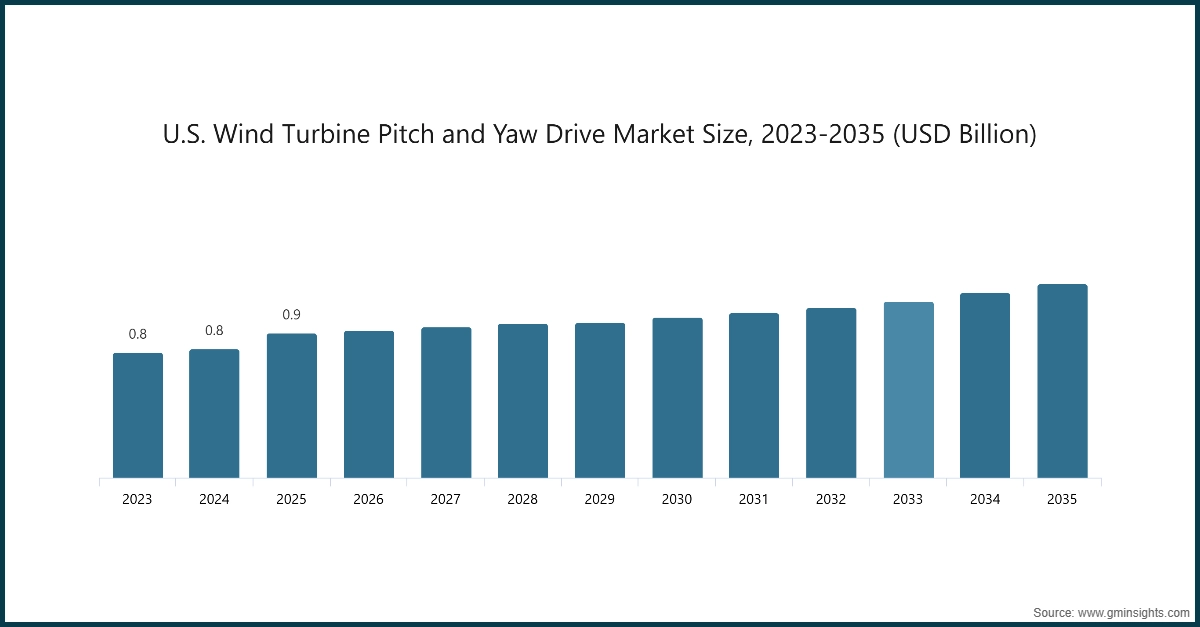
In the U.S., the market was valued at USD 0.9 Billion in 2025 and is projected to grow at a CAGR of 3.1% for the forecast period of 2026-2035.
- North America amounted to 14.8% market share in 2025 owing to ongoing research by the National Renewable Energy Laboratory's on technology advancements. Technology innovations including wake steering, climbing cranes, advanced on-site tower manufacturing, low-specific-power turbines, taller towers, and longer blades are reducing levelized costs of energy and expanding viable locations, thereby strengthening the market landscape.
- Additionally, Canada represents a smaller but growing market within North America. The cold-climate conditions require specialized pitch and yaw systems with anti-icing capabilities. Nordex's Advanced Anti-Icing System for rotor blades to ensure high availability and reduce ice-related downtime, further exemplifies the technical adaptations needed for the market growth.
The wind turbine pitch and yaw drive market in Europe, Germany is anticipated to grow by more than USD 0.73 Billion by 2035.
- Europe is a mature wind market with established onshore capacity and a strong focus on offshore wind development. Strong emphasis on sustainability, circularity, and local content creates opportunities for pitch and yaw system suppliers that can demonstrate environmental credentials and establish European manufacturing footprints. The European Union’s increasingly ambitious renewable energy goals, targeting a minimum of 32% of energy from renewable sources by 2030, coupled with supportive policies and subsidies that encourage the adoption of wind energy technologies, are set to strengthen and accelerate growth in the industry landscape.
- The region’s offshore wind market is the most advanced globally with established projects in the North Sea, Baltic Sea, and Atlantic Ocean. Some major offshore projects include Vestas Wind Systems large offshore orders including Nordseecluster A&B in Germany, and Inch Cape in Scotland among others, driving the industry scenario. Further, repowering projects including GE Vernova's orders for Windplan Groen in the Netherlands and multiple projects in Germany are a significant driver of pitch and yaw system demand.
The wind turbine pitch and yaw drive market in Asia Pacific, China is expected to grow at a CAGR of 4.5% from 2026 to 2035.
- China's domestic wind turbine manufacturing industry is highly developed, with companies like Goldwind Science and Technologies, Ming Yang Smart Energy, and Envision Energy among the global leaders in turbine installations, driving the industry scenario. Ongoing development of developed domestic pitch and yaw drive system supply chains, with companies like Nanjing High Speed Gear Manufacturing Co., Ltd. among the market leaders will contribute to the growth scenario.
- India's renewable energy targets and improving policy frameworks support continued wind deployment, thereby creating demand for pitch and yaw systems tailored to Indian wind conditions and cost structures. For instance, Siemens Gamesa offers the SG 3.4-145 turbine optimized for Indian wind conditions, indicating manufacturer focus on the market growth.
- Other Asia Pacific markets including Japan, South Korea, Taiwan, Australia, and Southeast Asian countries are also expanding wind capacity. These markets offer opportunities for pitch and yaw system suppliers that can meet local content requirements, navigate diverse regulatory frameworks, and provide localized service and support which will augment the business growth.
In the wind turbine pitch and yaw drive market, Middle East & Africa held 2.6% market share in 2025 and is anticipated to grow at a CAGR of 8.5% from 2026 to 2035.
- The region's wind deployment is at an earlier stage than other regions, but improving policy frameworks, declining costs, and energy diversification strategies are driving growth. Increasing investments in renewable energy as part of economic diversification strategies along with ongoing development of utility-scale wind projects in the United Arab Emirates, Saudi Arabia, and other Gulf countries will complement the product adoption.
- The Latin American market is driven by excellent wind resources, competitive auction mechanisms, and improving policy frameworks. The key opportunities include extensive wind deployment in Brazil, renewable energy auctions and policy support for wind development in Argentina and competitive auctions and corporate power purchase agreements in Chile. Additionally, Mexico’s excellent wind resources, particularly in the Isthmus of Tehuantepec region, support high-capacity-factor projects.
Wind Turbine Pitch and Yaw Drive Market Share
- The top five players operating in the wind turbine pitch and yaw drive industry are Vestas Wind Systems, Siemens Gamesa Renewable Energy, General Electric (GE Vernova), Nordex Group, and Goldwind Science and Technologies. These companies compete across multiple dimensions including technology leadership, reliability and service, cost competitiveness, global footprint and localization, and sustainability and circularity.
- Mergers and acquisitions activity in the wind turbine component supply chain reflects consolidation pressures and strategic positioning. While specific M&A transactions in the pitch and yaw drive systems segment are not extensively documented in the available sources, the broader trend toward vertical integration by turbine OEMs and horizontal consolidation among component suppliers is evident. Suppliers that can achieve scale, broaden their technology portfolios, and establish strategic partnerships with major turbine OEMs will be better positioned to compete in the moderately concentrated pitch and yaw drive systems market.
- The suppliers are expanding service offerings, including condition monitoring, predictive maintenance, and component refurbishment, to capture aftermarket revenue and build long-term customer relationships. They are further investing in low-carbon manufacturing, use of recycled or recyclable materials, and design-for-disassembly to meet customer sustainability requirements and differentiate their offerings.
Wind Turbine Pitch and Yaw Drive Market Companies
- Liebherr is a major supplier of pitch and yaw drive systems, leveraging expertise in large gearboxes and slewing bearings developed for construction equipment and heavy machinery. The company’s engineering capabilities and quality reputation make it a preferred supplier for large onshore and offshore turbines.
- Nanjing High Speed Gear Manufacturing is a leading Chinese supplier of wind turbine gearboxes and drive systems, including pitch and yaw drives. The company's strong position in the Chinese market and expertise in high-speed gearboxes support its market leadership in Asia Pacific.
- Nordex Group is a major wind turbine OEM with approximately 57 GW installed in over 40 markets. The company’s focus on onshore turbines in the 4-7+ MW classes and manufacturing network in Germany, Spain, Brazil, India, USA, and Mexico influence pitch and yaw system procurement and specifications.
- Siemens Gamesa Renewable Energy is a major wind turbine OEM with over 117 GW globally installed onshore and 73 GW maintained. The company's diverse turbine portfolio, ranging from 2.6 MW to 7.0 MW onshore and including offshore models, creates substantial demand for pitch and yaw systems across multiple turbine platforms.
- Goldwind Science and Technologies is a leading Chinese turbine manufacturer, represents a major customer for pitch and yaw systems in the Asia Pacific market. The company's strong position in China and expansion into international markets create opportunities for pitch and yaw system suppliers that can meet Goldwind's specifications and cost targets.
- GE Vernova has an installed base of approximately 57,000 turbines and nearly 120 GW of installed capacity worldwide. The company's Workhorse Product Strategy for onshore turbines and development of 15.5 MW offshore prototypes indicate a focus on proven, reliable platforms that require high-quality pitch and yaw systems.
Eminent players operating in the wind turbine pitch and yaw drive industry are:
- ABB
- ABM Greiffenberger
- Bosch Rexroth
- Bonfiglioli
- Comer Industries
- Dana SAC UK
- General Electric
- Goldwind Science and Tcehnologies
- KEBA
- Liebherr
- Mitsubishi Heavy Industries
- Nabtesco Corporation
- Nanjing High Speed Gear Manufacturing
- Nidec Conversion
- Nordex
- SIPCO–MLS
- Siemens Gamesa Renewable Energy
- Schaeffler Group
- Vestas Wind Systems
- ZOLLERN GmbH
Wind Turbine Pitch and Yaw Drive Market Report Attributes
| Key Takeaway | Details |
|---|---|
| Market Size & Growth | |
| Base Year | 2025 |
| Market Size in 2025 | USD 7.1 Billion |
| Market Size in 2026 | USD 7.6 Billion |
| Forecast Period 2026-2035 CAGR | 5.5% |
| Market Size in 2035 | USD 12.3 Billion |
| Key Market Trends | |
| Drivers | Impact |
| Favorable regulatory norms and targets to limit GHG footprints | Favorable regulatory norms and aggressive targets to limit GHG emissions are indirectly but strongly supporting the growth of the wind turbine pitch and yaw drive market, as governments worldwide accelerate wind power deployment to meet decarbonization goals. National and regional policies such as net-zero targets, renewable portfolio standards (RPS), feed-in tariffs, contracts for difference (CfDs), and competitive wind auctions are driving higher annual installations of both onshore and offshore wind turbines. |
| Increasing private & public sector investments in wind power solutions | Increasing private and public sector investments in wind power solutions are significantly boosting the wind turbine pitch and yaw drive market, as capital inflows accelerate both new installations and technology upgrades across onshore and offshore projects. Governments, multilateral banks, and development finance institutions are channeling funds into large-scale wind parks, offshore wind zones, grid modernization, and repowering programs, while private investors including utilities, IPPs, oil & gas majors, infrastructure funds, and pension funds are expanding their wind portfolios to secure long-term, low-carbon returns. |
| Ongoing advancements in turbine technologies | Ongoing advancements in turbine technologies are a key driver for the wind turbine pitch and yaw drive market, as manufacturers strive to improve efficiency, reliability, and energy capture across diverse operating conditions. Innovations such as larger rotor diameters, taller towers, and higher-capacity offshore turbines demand more robust and precise pitch and yaw systems capable of handling increased torque, dynamic loads, and variable wind conditions. Integration of advanced materials, lightweight composites, and improved gearing solutions reduces mechanical stress and enhances the lifespan of drives, while electric and hybrid actuation systems replace traditional hydraulics to improve responsiveness and reduce maintenance requirements. |
| Pitfalls & Challenges | Impact |
| High initial investment | Pitch and yaw drives, particularly those designed for large-scale, multi-megawatt onshore and offshore turbines, involve complex gearing systems, precision motors, sensors, and digital control units, all of which significantly increase upfront capital costs. Additionally, incorporating redundant safety features, corrosion-resistant materials for offshore applications, and IoT-enabled monitoring systems further escalates the initial expenditure. |
| Local demographics and challenges related to turbine installations | Factors such as population density, land availability, topography, and proximity to urban areas can limit suitable sites for turbine installation, especially for large onshore projects. Additionally, community opposition, noise concerns, and environmental restrictions can lead to delays or design modifications, necessitating more precise and adaptable pitch and yaw drive systems to optimize performance in constrained or complex locations. |
| Opportunities: | Impact |
| Expansion of offshore wind projects | The rapid growth of offshore wind energy presents a significant opportunity for the pitch and yaw drive market. Offshore turbines are generally larger, operate in harsher environments, and require more robust, corrosion-resistant, and high-torque drive systems to maintain optimal blade orientation and energy capture. It encourages manufacturers to develop customized solutions, including electrically actuated and digitally monitored drives, which can withstand saltwater corrosion, extreme weather, and high operational loads, creating a lucrative niche within the overall drivetrain market. |
| Retrofitting and Upgrading Existing Wind Farms | Older turbines often have hydraulic or less efficient pitch and yaw systems, and upgrading to modern electric or hybrid drives can improve energy efficiency, reliability, and lifespan without the need for complete turbine replacement. This not only allows operators to meet stricter grid codes and efficiency standards but also reduces maintenance costs over time. As governments and private stakeholders increasingly focus on lifetime extension and performance optimization, retrofitting initiatives are expected to drive steady demand for advanced pitch and yaw drive solutions across mature wind markets |
| Market Leaders (2025) | |
| Market Leader |
30% market share |
| Top Players |
Collective market share is 62% |
| Competitive Edge |
|
| Regional Insights | |
| Largest Market | Asia Pacific |
| Fastest growing market | Europe |
| Emerging countries | U.S., Sweden, China, Brazil |
| Future outlook |
|
What are the growth opportunities in this market?
Wind Turbine Pitch and Yaw Drive Industry News
- In January 2026, Nordex Group reported accounting for approximately 31-32% of newly grid-connected onshore wind turbine installations by MW in Germany in 2025, delivering 285 turbines totaling approximately 1,647 MW. This market leadership position demonstrates strong demand for Nordex turbines and associated pitch and yaw systems in the German market.
- In September 2025, GE Vernova announced onshore wind turbine orders with Prokon and with Enertrag in Germany. Both the orders use GE Vernova's workhorse turbine models manufactured at the Germany facility, demonstrating ongoing repowering activity and demand for proven turbine platforms.
- In March 2025, GE Vernova announced supplying RWE with 109 onshore wind turbines for two Texas projects: new turbines for the Honey Mesquite wind farm and repowering of the Forest Creek Wind Farm. The repowering project replaces 54 Siemens Mark II 2.3 MW turbines originally installed in 2006, demonstrating the growing repowering market and associated demand for new pitch and yaw systems.
- In December 2024, Vestas Wind Systems won a 342 MW order in the USA from Invenergy Wind LLC for the Alle-Catt Wind Energy project, with delivery planned for Q4 2025 and commissioning scheduled for late 2026. The order includes V150-4.5 MW turbines and a 10-year AOM 5000 service agreement.
Wind Turbine Pitch and Yaw Drive Market research report includes an in-depth coverage of the industry with estimates & forecast in terms of volume and revenue in “MW & USD Million” from 2022 to 2035, for the following segments:
Market, By End Use
- Onshore
- Offshore
Market, By Type
- < 1000 W
- 1000 W - 3000 W
- >3000 W
Market, By Pitch System
- Electric
- Mechanical
- Hydraulic
Market, By Blade Length
- Small
- Medium
- Large
The above information has been provided for the following regions and countries:
- North America
- U.S.
- Canada
- Mexico
- Europe
- Germany
- Spain
- UK
- France
- Italy
- Sweden
- Poland
- Denmark
- Portugal
- Netherlands
- Ireland
- Belgium
- Asia Pacific
- China
- India
- Australia
- Japan
- South Korea
- Vietnam
- Thailand
- Philippines
- Taiwan
- Middle East & Africa
- South Africa
- Egypt
- Latin America
- Brazil
- Chile
- Argentina
Frequently Asked Question(FAQ) :
What is the wind turbine pitch and yaw drive market size in 2025?
The market size for wind turbine pitch and yaw drive is valued at USD 7.1 billion in 2025. The market is driven by increasing wind power installations and advancements in turbine technologies.
What is the market size of the wind turbine pitch and yaw drive industry in 2026?
The market size for wind turbine pitch and yaw drives is projected to reach USD 7.6 billion in 2026, reflecting steady growth in the global wind energy sector.
What is the projected value of the wind turbine pitch and yaw drive market by 2035?
The market size for wind turbine pitch and yaw drives is expected to reach USD 12.3 billion by 2035, growing at a CAGR of 5.5%. This growth is fueled by offshore wind expansion, retrofitting initiatives, and technological advancements in turbine systems.
What is the growth outlook for the onshore segment from 2025 to 2035?
The onshore segment accounted for 86.4% of the market in 2025 and is expected to grow at a CAGR of 4.5% during the forecast period of 2026-2035. Its growth is supported by lower installation and maintenance costs compared to offshore projects.
What is the market share of the >3000 W segment in 2025?
The >3000 W segment held a dominant market share of 99.3% in 2025 and is projected to grow at a CAGR of 5.4% over the forecast period of 2026-2035. This is driven by the increasing deployment of high-capacity turbines in both onshore and offshore wind farms.
What is the growth outlook for the U.S. wind turbine pitch and yaw drive market?
The U.S. market was valued at USD 0.9 billion in 2025 and is projected to grow at a CAGR of 3.1% during the forecast period of 2026-2035. Growth is supported by grid modernization, repowering initiatives, and increased investments in wind energy infrastructure.
What are the key trends in the wind turbine pitch and yaw drive market?
Key trends include advancements in turbine technologies such as larger rotor diameters and taller towers, the shift to electric and hybrid actuation systems, and the integration of IoT-enabled monitoring systems.
Who are the key players in the wind turbine pitch and yaw drive market?
Key players include Bonfiglioli Riduttori, Liebherr, Bosch Rexroth, Comer Industries, Nanjing High Speed Gear Manufacturing Co., ABB, ABM Greiffenberger, Dana SAC UK, General Electric, Goldwind Science and Technologies, KEBA, and others.
Wind Turbine Pitch and Yaw Drive Market Scope
Related Reports