Summary
Table of Content

White Oil Market
Get a free sample of this report
Form submitted successfully!
Error submitting form. Please try again.
Thank you!
Your inquiry has been received. Our team will reach out to you with the required details via email. To ensure that you don't miss their response, kindly remember to check your spam folder as well!
Request Sectional Data
Thank you!
Your inquiry has been received. Our team will reach out to you with the required details via email. To ensure that you don't miss their response, kindly remember to check your spam folder as well!
Form submitted successfully!
Error submitting form. Please try again.
White Oil Market Size
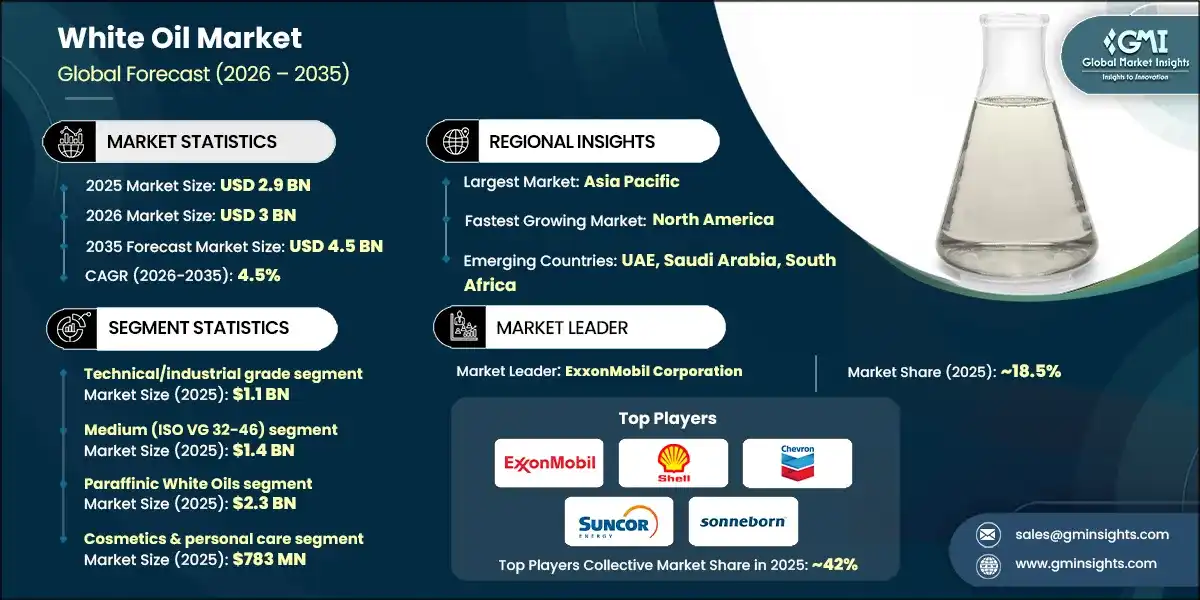
The global white oil market was valued at USD 2.9 billion in 2025. The market is expected to grow from USD 3 billion in 2026 to USD 4.5 billion in 2035, at a CAGR of 4.5%, according to the latest report published by Global Market Insights Inc.
White Oil Market Key Takeaways
Market Size & Growth
- 2025 Market Size: USD 2.9 Billion
- 2026 Market Size: USD 3 Billion
- 2035 Forecast Market Size: USD 4.5 Billion
- CAGR (2026–2035): 4.5%
Regional Dominance
- Largest Market: Asia Pacific
- Fastest Growing Region: North America
Key Market Drivers
- Expanding pharmaceutical and healthcare applications.
- Rising demand in cosmetics and personal care.
- Food industry growth and safety regulations.
Challenges
- Volatility in crude oil prices.
- Competition from synthetic and bio-based alternatives.
Opportunity
- Growth in emerging markets.
- Advanced polymer and plastics applications.
- Specialty applications in electronics and textiles.
Key Players
- Market Leader: ExxonMobil Corporation led with over 18.5% market share in 2025.
- Leading Players: Top 5 players in this market include ExxonMobil Corporation, Royal Dutch Shell plc, Chevron Corporation, Petro-Canada/Suncor Energy, Sonneborn LLC, which collectively held a market share of 42% in 2025.
Get Market Insights & Growth Opportunities
- White oils refer to highly refined mineral oils that are colorless, odorless, and tasteless petroleum-derived products. These oils are characterized by their purity, chemical stability, and non-toxic nature, making them suitable for sensitive applications. White oils are produced through extensive hydrogenation and refining processes that remove aromatic compounds, sulfur, and nitrogen impurities. They are classified based on their purity levels and viscosity grades, with applications spanning pharmaceutical formulations, cosmetics, food processing, and industrial manufacturing where product safety and regulatory compliance are paramount.
- White oils have witnessed significant technological advancements in recent years, driven by improvements in hydrotreatment and catalytic dewaxing processes. Enhanced refining technologies have enabled the production of ultra-pure white oils with superior oxidation stability and longer shelf life, meeting stringent regulatory requirements across different industries. Modern production methods have reduced polycyclic aromatic hydrocarbon (PAH) content to negligible levels, ensuring compliance with FDA, European Pharmacopoeia, and other international standards.
- Innovations in base oil processing and selective hydrogenation have expanded the range of viscosity grades available, allowing manufacturers to tailor products for specific applications. The development of synthetic and bio-based alternatives is also emerging, addressing sustainability concerns while maintaining the performance characteristics required for critical applications. Advanced analytical techniques and quality control measures have further enhanced product consistency and traceability throughout the supply chain.
To get key market trends
White Oil Market Trends
- Growing demand for pharmaceutical-grade white oils is driven by expanding generic drug manufacturing, increasing healthcare access in emerging markets, and rising demand for topical formulations. White oils serve as critical excipients in ointments, creams, laxatives, and controlled-release formulations, with pharmaceutical companies requiring consistent, high-purity products that meet USP and EP specifications.
- Expansion of cosmetics and personal care industries in developing regions is creating substantial growth opportunities. Rising disposable incomes, urbanization, and changing beauty standards are driving consumption of skincare, haircare, and cosmetic products containing white oils as emollients, moisturizers, and texture enhancers. Premium and natural cosmetic formulations increasingly specify high-quality white oils for their safety and performance characteristics.
- Food processing industry modernization and stringent food safety regulations are increasing demand for food-grade white oils. These oils are used as release agents in baking, protective coatings for fruits and vegetables, lubricants for food processing equipment, and components in food packaging materials. Growing consumer awareness of food safety and regulatory enforcement are driving quality upgrades across the supply chain.
- Plastics and polymer industry growth continues to be a significant demand driver, with white oils used as processing aids, plasticizers, and release agents in polypropylene, polyethylene, and other polymer production. The expansion of packaging, automotive, and construction sectors in emerging markets supports sustained demand for technical-grade white oils.
- Technological innovations in refining processes are enabling production of ultra-low PAH white oils and specialty grades for demanding applications. Advanced hydrotreatment technologies and improved quality control systems allow manufacturers to meet evolving regulatory requirements while expanding into new application areas such as electronics, advanced textiles, and specialty chemicals.
White Oil Market Analysis
Learn more about the key segments shaping this market
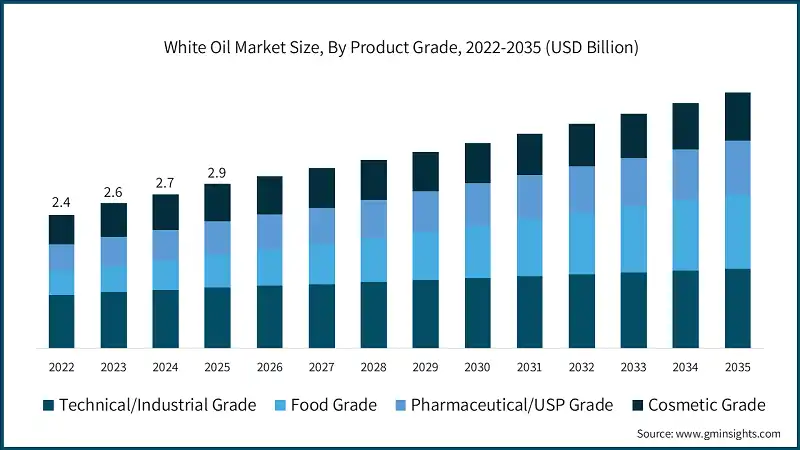
The market by product grade is segmented into technical/industrial grade, food grade, pharmaceutical/USP grade, and cosmetic grade. Technical/industrial grade holds the largest market value of USD 1.1 billion in 2025.
- Technical/industrial grade is showing consistency in demand due to its versatility, cost-effectiveness, and ability to be applied in plastics processing, polymer production, adhesives, and industrial manufacturing. This is attributed to industries such as the plastics and polymers sector that require reliable processing aids and release agents for improved production efficiency and product quality while maintaining competitive costs. Furthermore, ongoing improvements in refining processes and the expansion of manufacturing activities in emerging markets have sustained applications across both existing and new industrial segments.
- Growing segments include food grade and pharmaceutical/USP grade white oils as industries are leaning more towards purity, safety compliance, and regulatory certification for materials used in sensitive applications. Food grade white oils find applications in food processing equipment lubrication, fruit and vegetable coatings, as well as bakery release agents because of more stringent food safety regulations and consumer health awareness. This segment demonstrates the highest growth at 10% CAGR, driven by expanding processed food industries and modernization of food manufacturing in developing regions. Pharmaceutical/USP grade white oils, while maintaining steady 5% growth, continue to be essential in ointments, laxatives, and medical device manufacturing due to their proven safety profile and regulatory acceptance. Meanwhile, cosmetic grade white oils are experiencing market contraction as the personal care industry increasingly shifts toward plant-based oils, synthetic esters, and alternative emollients in response to consumer preferences for natural and sustainable ingredients.
The white oil market by viscosity is segmented into Light (ISO VG 7-15), Medium (ISO VG 32-46), and Heavy (ISO VG 68-100+). Medium (ISO VG 32-46) holds the largest market value of USD 1.4 billion in 2025.
- Medium viscosity (ISO VG 32-46) is showing consistency in demand due to its versatility, balanced performance characteristics, and ability to be applied across diverse end-use industries including plastics processing, industrial manufacturing, and general-purpose applications. This is attributed to industries such as the polymer and plastics sector that require optimal flow properties and processing efficiency while maintaining adequate lubrication and release characteristics. Furthermore, the broad applicability of medium viscosity grades across both technical and consumer applications has sustained their dominant market position, accounting for approximately 48% of total white oil consumption throughout the forecast period.
- Light viscosity (ISO VG 7-15) is experiencing the strongest growth at 4.6% CAGR as industries are leaning more towards low-viscosity, high-purity materials for pharmaceutical formulations, cosmetic applications, and specialty chemical processing. Light viscosity white oils find increasing applications in injectable drug formulations, topical pharmaceutical preparations, premium personal care products, and precision manufacturing processes because of their superior spreadability, enhanced absorption properties, and ability to meet stringent purity requirements. The shift toward lighter grades is particularly pronounced in pharmaceutical and cosmetic sectors where product performance and regulatory compliance demand the highest quality specifications. Conversely, Heavy viscosity grades (ISO VG 68-100+) are showing slower growth at 1.8% CAGR, with declining market share as industries increasingly favor lighter, more refined products that offer better performance in modern applications. Heavy grades remain important in specific industrial applications such as metalworking, heavy-duty lubrication, and certain polymer processing operations, but face competitive pressure from synthetic alternatives and lighter mineral oil grades.
The white oil market by base oil type is segmented into Paraffinic White Oils and Naphthenic White Oils. Paraffinic White Oils hold the largest market value of USD 2.3 billion in 2025.
- Paraffinic White Oils dominate the market with approximately 80% market share due to their superior oxidation stability, excellent thermal properties, and broad regulatory acceptance across pharmaceutical, food, and cosmetic applications. This is attributed to their molecular structure, which provides better resistance to degradation, longer shelf life, and enhanced performance in high-temperature applications. Paraffinic white oils are the preferred choice for pharmaceutical formulations, food-grade applications, and premium cosmetic products because of their compliance with stringent regulatory standards including USP, EP, and FDA requirements. Furthermore, their widespread availability from major petroleum refiners and established manufacturing infrastructure have solidified their dominant position across both developed and emerging markets.
- Naphthenic White Oils, while representing a smaller market share at approximately 20%, maintain steady growth at 4.2% CAGR due to their unique properties including superior low-temperature fluidity, excellent solvency characteristics, and natural compatibility with elastomers and certain polymer systems. Naphthenic white oils find specialized applications in rubber processing, adhesives formulation, metalworking fluids, and specific industrial applications where their aromatic-free composition and cold-weather performance provide distinct advantages. These oils are particularly valued in applications requiring enhanced solvency power and low pour points, such as cold-climate operations and specialty chemical processing. The parallel growth rates of both paraffinic and naphthenic segments at 4.5% CAGR indicate balanced demand dynamics, with each base oil type serving distinct application requirements and maintaining their respective market positions throughout the forecast period.
Learn more about the key segments shaping this market
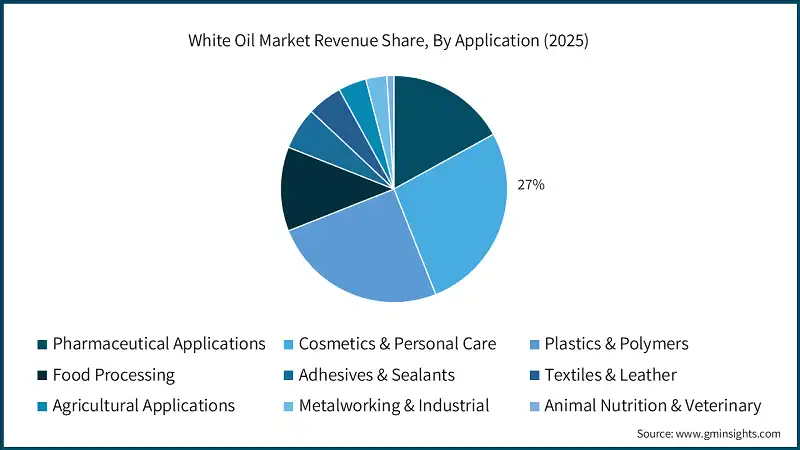
The white oil market by application is segmented into pharmaceutical applications, cosmetics & personal care, plastics & polymers, food processing, adhesives & sealants, textiles & leather, agricultural applications, metalworking & industrial, and animal nutrition & veterinary. Cosmetics & personal care holds the largest market value of USD 783 million in 2025.
- Cosmetics & personal care demonstrates robust growth at 4.6% CAGR, driven by increasing consumer spending on skincare, haircare, and beauty products globally. White oils serve as essential ingredients in moisturizers, lotions, creams, makeup products, and hair care formulations due to their emollient properties, skin compatibility, and ability to enhance product texture and stability. This segment benefits from rising disposable incomes in emerging markets, growing awareness of personal grooming, and expansion of premium beauty product categories. The Asia Pacific region, particularly China, India, and Southeast Asian countries, is experiencing rapid growth in cosmetics consumption, while developed markets continue to demand high-purity white oils for premium formulations. Plastics & Polymers applications maintain steady growth at 4.5% CAGR, with white oils used as processing aids, internal lubricants, and release agents in polypropylene, polyethylene, and other polymer production, supporting packaging, automotive, and consumer goods manufacturing.
- Food processing emerges as the fastest-growing application segment at 4.7% CAGR, reflecting stringent food safety regulations, modernization of food manufacturing infrastructure, and expanding processed food consumption in developing regions. White oils find critical applications as release agents in bakery operations, protective coatings for fruits and vegetables, lubricants for food processing equipment, and components in food-contact packaging materials. Growing regulatory enforcement, particularly in Asia Pacific and Latin America, is driving quality upgrades and increased adoption of food-grade white oils. Meanwhile, Pharmaceutical Applications show declining growth at -5.6% CAGR as the market matures in developed regions and faces competition from synthetic alternatives and specialized pharmaceutical excipients. However, pharmaceutical white oils remain essential in topical ointments, laxative formulations, and medical device manufacturing. Other applications including Adhesives & Sealants, Textiles & Leather, Agricultural Applications, Metalworking & Industrial, and Animal Nutrition & Veterinary maintain steady growth at 4.5% CAGR, serving specialized industrial and agricultural needs with consistent demand patterns across diverse end-use sectors.
Looking for region specific data?
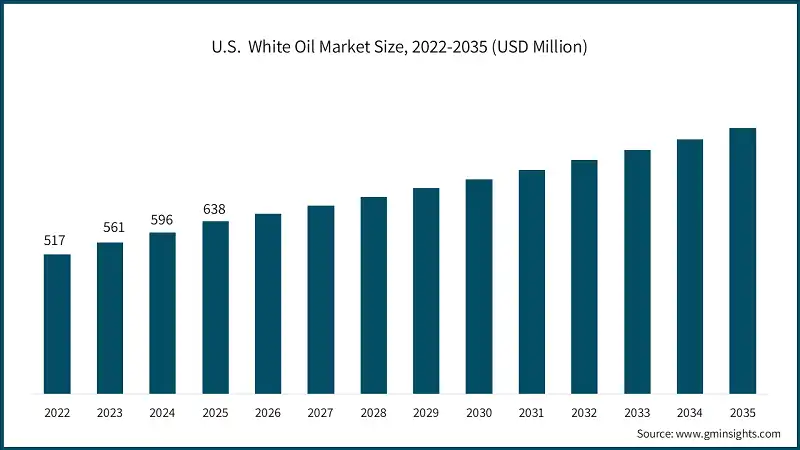
The U.S. white oil market accounted for USD 638 million in 2025.
- The strong support for white oil in North America comes primarily from the United States, wherein consistent demand is driven by well-established pharmaceutical manufacturing, advanced cosmetics production, and stringent food safety regulations. Constant emphasis on high-purity materials for pharmaceutical formulations, personal care products, and food-grade applications, along with robust industrial polymer processing, consistently elevates the country's market position. The presence of major pharmaceutical companies, leading cosmetics brands, and sophisticated food processing infrastructure ensures sustained demand for USP-grade and food-grade white oils that meet FDA and regulatory specifications.
The Germany white oil market is expected to experience significant and promising growth from 2026 to 2035.
- White oil growth in Europe is an integral component of the market due to strong pharmaceutical engineering and well-established sectors of cosmetics and chemical manufacturing. In Germany, pharmaceutical and cosmetics manufacturers are utilizing high-purity white oils that meet stringent European Pharmacopoeia and REACH compliance standards, which can improve product safety and quality while meeting stricter regulatory requirements, driving the advancement of specialty-grade white oil technology into premium formulations and advanced industrial applications.
The white oil market in China is expected to experience significant and promising growth from 2026 to 2035.
- APAC is the steady-growing region in the market and includes China, India, and Japan. China remains the most essential growth driver of the Asia-Pacific white oil industry, which is increasingly driven by the expansion of domestic cosmetics manufacturing, rapid industrialization, and growing pharmaceutical production capacity. The country is increasing the production capacity of both established refiners and new market entrants, thus becoming a competitive supplier in the global arena. The regional momentum is further fueled by strong demand from personal care, food processing, plastics manufacturing, and pharmaceutical industries, with rising middle-class consumption patterns accelerating market expansion.
Saudi Arabia white oil market is expected to experience significant and promising growth from 2026 to 2035.
- The market keeps steadily growing in the Middle East and Africa catered by rising investments in pharmaceutical manufacturing, petrochemical integration, and expanding consumer goods production. The development of pharmaceutical and cosmetics industries, growing food processing activity, and strategic positioning as regional manufacturing hubs are the drivers for such high-purity white oil requirements in countries like Saudi Arabia and the UAE in the Middle East. In Africa, countries such as South Africa are experiencing increased adoption in pharmaceutical manufacturing, cosmetics production, and food processing industries all requiring high-quality, regulatory-compliant white oils for sensitive applications.
Brazil white oil market is expected to experience significant and promising growth from 2026 to 2035.
- Brazil is contributing to the market in Latin America owing to its increasing emphasis on pharmaceutical manufacturing, cosmetics production, and food processing modernization. With the growth in Brazil's personal care sector, gaining momentum for food safety regulations, and thus demand for high-purity and food-grade white oils is steady. Industries are maintaining the trend with increasing regional adoption of white oils for applications in pharmaceutical formulations, cosmetic products, food processing equipment, and polymer manufacturing across diverse end-use sectors.
White Oil Market Share
The market is moderately consolidated with players like ExxonMobil Corporation, Royal Dutch Shell plc, Chevron Corporation, Petro-Canada/Suncor Energy, and Sonneborn LLC holding 42% market share and ExxonMobil Corporation being the market leader holding the market share of 18.5% in 2025.
- White oil manufacturers are constantly involved in research and development to improve refining processes, develop ultra-low PAH formulations, and enhance production efficiency. Innovations in hydrotreatment technologies, specialty viscosity grades, and pharmaceutical-grade purity standards help companies meet evolving customer needs and remain relevant in high-performance sectors such as pharmaceuticals, food processing, and premium cosmetics. Advanced analytical capabilities and quality control systems enable producers to consistently deliver products that exceed stringent regulatory requirements across multiple jurisdictions.
- By establishing collaborations with pharmaceutical companies, cosmetics manufacturers, food processors, and regulatory bodies, companies are increasing the strength of their market presence. These collaborations facilitate co-development of customized white oil solutions for specific formulations and applications such as advanced drug delivery systems or specialty food coatings and sharing best practices which lead to improved product specifications and regulatory compliance. Strategic partnerships with end-users enable manufacturers to anticipate market trends and develop next-generation products aligned with industry requirements.
- Eco-friendly practices, such as development of bio-based white oil alternatives, optimization of energy utilization in refining processes, and reduction of chemical waste and emissions at production facilities, are becoming the trend. Beyond being environmentally friendly, these practices are often demanded by consumers and brand owners looking for sustainable solutions, maximizing the reputation of the brand and making it competitive in the market. Companies investing in green refining technologies and circular economy initiatives are positioning themselves favorably as sustainability becomes a key purchasing criterion across pharmaceutical, cosmetics, and food industries.
- Companies are maintaining their position in the white oil market by engaging with customers and providing comprehensive technical support for specific applications. Regulatory compliance assistance, formulation consulting, analytical testing services, and application development support are given to customers to optimize the use of white oils in their products. This builds very strong, long-term relationships but allows manufacturers to react quickly to changing regulatory requirements and emerging trends in the market, thus firming their status as trusted partners in the global white oil industry. Dedicated technical service teams help customers navigate complex certification processes and ensure product performance across diverse end-use applications.
White Oil Market Companies
Major players operating in the white oil industry are:
- ExxonMobil Corporation
- Royal Dutch Shell plc
- Chevron Corporation
- Petro-Canada/Suncor Energy
- Sonneborn LLC
- H&R Group (Hansen & Rosenthal KG)
- FUCHS Petrolub SE
- APAR Industries Limited
- Savita Oil Technologies Ltd.
- Panama Petrochem Ltd.
- Raj Petro Specialities Pvt. Ltd.
- Lodha Petro
- SEOJIN Chemical Co., Ltd.
- JX Nippon Oil & Energy Corporation
ExxonMobil Corporation is a global energy and petrochemical leader with extensive capabilities in producing high-purity white oils across pharmaceutical, food, cosmetic, and technical grades. It manufactures white oils for pharmaceutical formulations, food processing applications, personal care products, and industrial polymer processing. With innovation, regulatory excellence, and quality assurance, it continues to develop ultra-low PAH white oils with improved oxidation stability and purity levels for demanding applications across healthcare, food safety, and specialty chemical sectors.
Royal Dutch Shell plc manufactures a comprehensive portfolio of petroleum products including specialty white oils for diverse industrial and consumer applications. It focuses on high-purity, regulatory-compliant white oils supplied for pharmaceutical manufacturing, cosmetics formulation, food processing, and plastics production. With advanced refining technology and stringent quality control, Shell delivers white oils in line with international regulatory standards including USP, EP, and FDA specifications, ensuring its strong presence in both developed and emerging markets.
Chevron Corporation is a major integrated energy company and producer of specialty white oils and other refined petroleum products. It supports various sectors including pharmaceuticals, personal care, food processing, and industrial manufacturing by offering white oils with exceptional purity, chemical stability, and consistent quality. Currently, Chevron maintains its market position through continuous investment in refining technology, regulatory compliance capabilities, and customer technical support to meet the evolving demands of high-value white oil applications.
Petro-Canada/Suncor Energy is a Canadian energy company specializing in pharmaceutical-grade white oils, food-grade white oils, and technical specialty products. The applications found in pharmaceutical formulations, food processing equipment, cosmetic products, and polymer manufacturing where its white oils are prized for purity, safety profile, and regulatory acceptance. Petro-Canada invests in advanced hydrotreatment processes and quality assurance systems that enhance product performance and strengthen its market presence across North America and international markets.
Sonneborn LLC is leveraging its expertise in specialty hydrocarbon processing and white oil refining to manufacture a comprehensive range of products including pharmaceutical oils, cosmetic oils, food-grade oils, and technical white oils. Sonneborn's target sectors include healthcare, personal care, food processing, plastics manufacturing, and specialty chemical industries. Committed to innovation and customer partnership, this company produces high-performance white oils to address specific application requirements and regulatory standards while maintaining a global presence through its production facilities, technical centers, and distribution network serving customers in over 100 countries.
White Oil Market Report Attributes
| Key Takeaway | Details |
|---|---|
| Market Size & Growth | |
| Base Year | 2025 |
| Market Size in 2025 | USD 2.9 Billion |
| Market Size in 2026 | USD 3 Billion |
| Forecast Period 2026 - 2035 CAGR | 4.5% |
| Market Size in 2035 | USD 4.5 Billion |
| Key Market Trends | |
| Drivers | Impact |
| Expanding pharmaceutical and healthcare applications | White oils are essential excipients in pharmaceutical formulations, ointments, and medical devices, with growing demand driven by aging populations and healthcare expansion. |
| Rising demand in cosmetics and personal care | Increasing consumer spending on skincare, haircare, and beauty products drives demand for high-purity white oils as emollients and carriers. |
| Food industry growth and safety regulations | Stringent food safety standards and growing processed food consumption increase demand for food-grade white oils in processing equipment and packaging. |
| Pitfalls & Challenges | Impact |
| Volatility in crude oil prices | White oil production costs are directly linked to petroleum prices, creating margin pressure and price instability. |
| Competition from synthetic and bio-based alternatives | Emerging sustainable alternatives challenge traditional mineral oil-based white oils, particularly in consumer-facing applications. |
| Opportunities: | Impact |
| Growth in emerging markets | Rapid industrialization, rising healthcare access, and expanding middle-class populations in Asia Pacific and Latin America create new demand. |
| Advanced polymer and plastics applications | Increasing use as processing aids, release agents, and additives in high-performance polymer manufacturing. |
| Specialty applications in electronics and textiles | Growing demand for ultra-pure white oils in semiconductor manufacturing and technical textile production. |
| Market Leaders (2025) | |
| Market Leaders |
~18.5% market share |
| Top Players |
|
| Competitive Edge |
|
| Regional Insights | |
| Largest Market | Asia Pacific |
| Fastest growing market | North America |
| Emerging country | UAE, Saudi Arabia, South Africa |
| Future outlook |
|
What are the growth opportunities in this market?
White Oil Industry News
- In January 2025, ExxonMobil progressed its Singapore Resid Upgrade Project, which is set for completion in 2025. The upgrade will add about 20,000 barrels per day of lubricant base stocks, including a new extra-heavy Group II product, EHC 340 MAX. This high-viscosity base stock will expand the company’s EHC slate and support growing Asia-Pacific demand for high-performance lubricants.
- In January 2024, Shell Deutschland GmbH took a final investment decision (FID) to convert the hydrocracker of the Wesseling site at the Energy and Chemicals Park Rheinland into a production unit for Group III base oils, used in making high-quality lubricants such as engine and transmission oils. Crude oil processing will end at the Wesseling site by 2025 but will continue at the Godorf site.
The white oil market research report includes an in-depth coverage of the industry with estimates and forecast in terms of revenue in USD Billion and volume in terms of kilo tons from 2022–2035 for the following segments:
Market, By Product Grade
- Technical/industrial grade
- Food grade
- Pharmaceutical/USP grade
- Cosmetic grade
Market, By Viscosity
- Light (ISO VG 7-15)
- Medium (ISO VG 32-46)
- Heavy (ISO VG 68-100+)
Market, By Base Oil Type
- Paraffinic white oils
- Naphthenic white oils
Market, By Application
- Pharmaceutical applications
- Cosmetics & personal care
- Plastics & polymers
- Food processing
- Adhesives & sealants
- Textiles & leather
- Agricultural applications
- Metalworking & industrial
- Animal nutrition & veterinary
The above information is provided for the following regions and countries:
- North America
- U.S.
- Canada
- Europe
- Germany
- UK
- France
- Spain
- Italy
- Rest of Europe
- Asia Pacific
- China
- India
- Japan
- Australia
- South Korea
- Rest of Asia Pacific
- Latin America
- Brazil
- Mexico
- Argentina
- Rest of Latin America
- Middle East and Africa
- Saudi Arabia
- South Africa
- UAE
- Rest of Middle East & Africa
Frequently Asked Question(FAQ) :
What is the market size of the white oil industry in 2025?
The market size for white oil was valued at USD 2.9 billion in 2025 and is growing at a CAGR of 4.5%. Rising consumption in pharmaceuticals, personal care products, food processing, plastics, and industrial formulations continues to support strong market expansion.
What is the current white oil market size in 2026?
The market size is projected to reach USD 3 billion in 2026 as white oil adoption continues to expand in regulated and high-purity end-use industries.
What is the projected value of the white oil market by 2035?
The white oil market is expected to reach USD 4.5 billion by 2035, driven by growth in pharmaceutical formulations, personal care products, food-grade lubricants, and polymer processing.
How much revenue did the cosmetics and personal care segment generate in 2025?
The cosmetics and personal care segment generated USD 783 million in 2025, making it the largest application area for high-purity white oils.
What was the valuation of the technical or industrial-grade segment in 2025?
Technical and industrial-grade white oils generated USD 1.1 billion in 2025, reflecting sustained use in plastics processing, adhesives, and general industrial manufacturing.
What is the growth outlook for food-grade white oil from 2026 to 2035?
Food-grade white oils are projected to grow at a 10% CAGR through 2035 due to rising food safety regulations and modernization of food processing infrastructure.
Which region leads the white oil industry?
The United States accounted for USD 638 million in 2025 within the North American market. Growth is driven by advanced pharmaceutical manufacturing, strong cosmetics production, and stringent FDA-regulated food processing requirements.
What are the upcoming trends in the white oil market?
Key trends include rising demand for pharmaceutical-grade and food-grade white oils, expansion of polymer processing applications, and rapid adoption of ultra-low PAH formulations enabled by advanced refining technologies.
Who are the key players in the white oil market?
Key players include ExxonMobil Corporation, Royal Dutch Shell plc, Chevron Corporation, Petro-Canada/Suncor Energy, Sonneborn LLC, H&R Group, FUCHS Petrolub SE, APAR Industries Limited, Savita Oil Technologies Ltd., Panama Petrochem Ltd., Raj Petro Specialities Pvt. Ltd., Lodha Petro, SEOJIN Chemical Co., Ltd., and JX Nippon Oil & Energy Corporation.
White Oil Market Scope
Related Reports